What Is the Difference Between Cellphone vs Mobile Phone?
Cellphone and mobile phone refer to the same device and are often used interchangeably. The main difference is regional usage. Cellphone is more common in American English, while mobile phone is preferred in British English and many other countries.
Examples:
- I forgot my cellphone at home. (American English)
- She bought a new mobile phone yesterday. (British English)
The confusion gets even bigger when people search for cellphone meaning, mobile phone meaning, cellphone vs mobile phone difference, or which term is correct. And here’s the kicker: while both refer to the same device, one expression is far more common in certain countries than the other.
In this guide, you’ll learn Cellphone vs Mobile Phone in simple terms, discover cellphone definition and mobile phone definition, explore cellphone pronunciation, see cellphone vs mobile phone examples, and find out when to use cellphone or when to use mobile phone in everyday conversation and writing.
Quick Answer: Cellphone vs Mobile Phone
A cellphone and a mobile phone usually mean the same thing: a portable wireless device that connects to a cellular network for communication.
The difference is mainly based on location:
| Term | Commonly Used In | Meaning |
| Cellphone | United States, Canada | A portable phone that uses cellular networks |
| Mobile phone | UK, Europe, Australia, Asia, Africa, many other regions | A portable wireless communication device |
| Smartphone | Worldwide | A mobile phone with advanced features like apps and internet access |
In simple terms:
Cellphone = Mobile phone
The word choice depends on where you live and who you are speaking with.
What Is a Cellphone?
Cellphone Definition and Meaning
A cellphone is a portable electronic device that allows users to communicate through a cellular network. It connects to nearby cell towers that transmit voice calls, text messages, and internet data.
The word “cell” refers to the way wireless networks are organized. Instead of one giant transmitter covering an entire country, cellular networks divide regions into smaller areas called cells.
Each cell usually has:
- A cell tower or base station
- Radio equipment
- A specific coverage area
- Connections to the larger mobile network
When you move while using your phone, your device automatically switches between different cells. This process allows you to stay connected while traveling.
For example, if you are driving from one city to another, your cellphone may connect to dozens or hundreds of different towers without you noticing.
Why Is It Called a Cellphone?
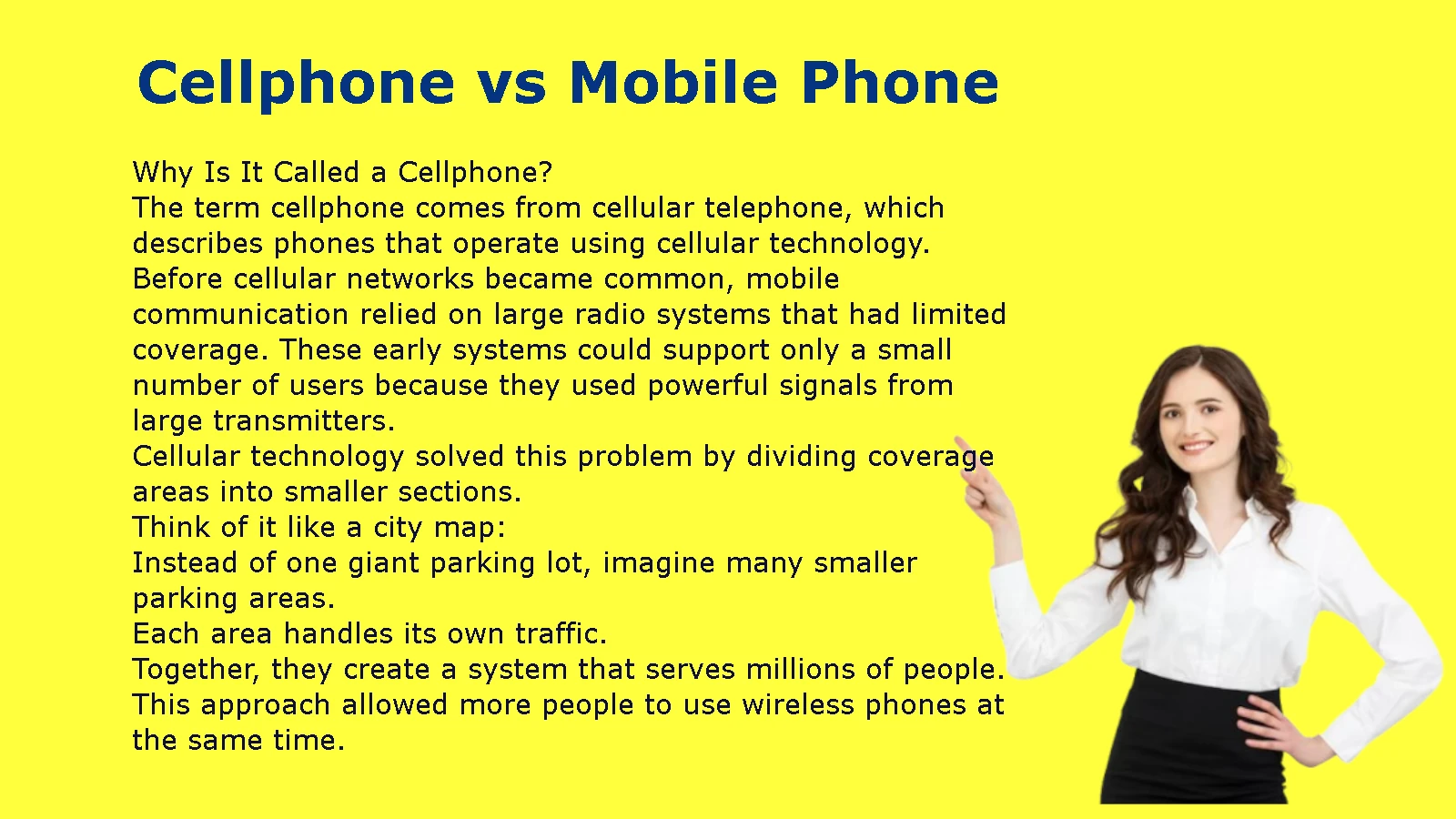
The term cellphone comes from cellular telephone, which describes phones that operate using cellular technology.
Before cellular networks became common, mobile communication relied on large radio systems that had limited coverage. These early systems could support only a small number of users because they used powerful signals from large transmitters.
Cellular technology solved this problem by dividing coverage areas into smaller sections.
Think of it like a city map:
- Instead of one giant parking lot, imagine many smaller parking areas.
- Each area handles its own traffic.
- Together, they create a system that serves millions of people.
This approach allowed more people to use wireless phones at the same time.
History of the Term Cellphone
The idea of cellular communication developed during the 20th century, but handheld cellphones became practical in the 1970s.
One major milestone happened on April 3, 1973, when Motorola engineer Martin Cooper made the first public handheld cellular phone call using a prototype device.
That early cellphone was very different from today’s smartphones.
The first handheld cellphone:
- Weighed about 2.5 pounds (around 1.1 kilograms)
- Offered only about 30 minutes of talk time
- Required about 10 hours to recharge
- Was much larger than modern phones
Over the following decades, cellphones became:
- Smaller
- Cheaper
- More powerful
- More widely available
By the 2000s, cellphones had become common consumer devices.
What Is a Mobile Phone?
Mobile Phone Definition and Meaning
A mobile phone is a portable device that allows wireless communication through a mobile network.
The term highlights the phone’s ability to move with the user. Unlike traditional landline phones, mobile phones are not connected to a fixed location.
A mobile phone can perform many tasks, including:
- Making voice calls
- Sending text messages
- Accessing the internet
- Taking photos and videos
- Running applications
- Using GPS navigation
- Connecting to social media platforms
Today, most mobile phones are smartphones, but the term “mobile phone” can also include older basic phones.
Why Is the Term Mobile Phone Used Worldwide?
The phrase mobile phone became popular because it clearly describes the device’s biggest advantage: mobility.
A landline phone stays in one place.
A mobile phone travels with you.
This simple distinction made the term easy to understand across many countries.
Countries that commonly use “mobile phone” include:
- United Kingdom
- Australia
- New Zealand
- India
- South Africa
- Many European countries
For example:
“Please call me on my mobile phone.”
This sentence sounds natural in many parts of the world.
However, an American English speaker would usually say:
“Please call me on my cellphone.”
Both versions are correct.
Cellphone vs Mobile Phone: Main Differences
Although the two terms refer to similar devices, there are some differences in usage and history.
| Feature | Cellphone | Mobile Phone |
| Basic meaning | A portable phone using cellular networks | A portable wireless communication device |
| Origin | Derived from cellular network technology | Derived from portability |
| Main usage | United States and Canada | Used globally |
| Formality | Common everyday American term | Internationally recognized term |
| Refers to smartphones | Yes | Yes |
| Refers to older phones | Yes | Yes |
The technology behind both terms is the same. The difference exists mostly in language.
Are Cellphones and Mobile Phones the Same Thing?
Why Both Terms Describe the Same Device
In modern conversations, cellphone and mobile phone are interchangeable.
If someone says:
“My cellphone battery died.”
or:
“My mobile phone battery died.”
They mean the same thing.
Modern phones use cellular networks regardless of which term people prefer.
A modern device like an iPhone or Samsung Galaxy is:
- A cellphone
- A mobile phone
- A smartphone
All three descriptions can be accurate.
When Do the Terms Sound Different?
The difference appears when considering regional language.
United States
People commonly say:
- Cellphone
- Cell phone
- Smartphone
Example:
“I need to charge my cellphone.”
United Kingdom
People commonly say:
- Mobile phone
- Mobile
Example:
“I left my mobile in the car.”
Technology Industry
Companies often use terms like:
- Smartphone
- Mobile device
- Mobile technology
because these terms apply to a wider range of connected devices.
Cellphone vs Mobile Phone: Which Term Should You Use?
Use Cellphone for American Audiences
If your audience is mainly from the United States, cellphone sounds natural.
Examples:
- “How many hours do you spend on your cellphone each day?”
- “The cellphone industry continues to grow.”
American websites, advertisements, and conversations commonly use this term.
Use Mobile Phone for International Audiences
If you are writing for a global audience, mobile phone is usually the safer choice.
It is widely understood across countries and appears frequently in international communication.
For example, a technology guide targeting readers worldwide would usually use:
- Mobile phone features
- Mobile phone security
- Mobile phone history
Use Smartphone When Talking About Modern Devices
The word smartphone describes a specific type of mobile phone with advanced computing features.
A smartphone can:
- Run apps
- Browse websites
- Take high-quality photos
- Use artificial intelligence features
- Connect to smart devices
Examples include:
- iPhone models
- Samsung Galaxy phones
- Google Pixel phones
The relationship looks like this:
Mobile Phone
|
└── Smartphone
Every smartphone is a mobile phone, but not every mobile phone is a smartphone.
Early Mobile Communication Systems
Before modern cellphones and mobile phones became common, wireless communication was mostly limited to specialized systems used by governments, emergency services, and businesses.
During the 1940s and 1950s, companies experimented with mobile radio phones. These early systems allowed people to communicate while traveling, but they had major limitations.
They were:
- Large and heavy
- Expensive to operate
- Limited to a small number of users
- Available mostly in vehicles
For example, early mobile telephone systems used in cars required powerful equipment installed inside the vehicle. A person could not simply carry the phone in a pocket or bag.
The biggest challenge was network capacity. A single communication tower could only handle a limited number of conversations at the same time.
The development of cellular technology changed everything.
The Rise of Cellular Phones
The introduction of cellular networks transformed mobile communication.
Instead of using one large coverage area, cellular networks divided regions into smaller sections called cells. Each cell had its own tower, which allowed networks to reuse frequencies and serve many more users.
This breakthrough created the foundation for modern cellphones.
Key developments included:
| Year | Development |
| 1940s–1950s | Early mobile radio telephone systems appeared |
| 1973 | First handheld cellphone call was made by Martin Cooper |
| 1980s | First commercial cellular networks launched |
| 1990s | Digital mobile networks expanded worldwide |
| 2000s | Feature phones became common |
| 2007 onward | Smartphones changed mobile technology |
The shift from analog networks to digital networks improved:
- Call quality
- Battery efficiency
- Security
- Network capacity
The First Commercial Cellphones
The first commercial handheld cellphone was the Motorola DynaTAC 8000X, which became available in 1983.
It represented a major technological achievement, but it was far from the lightweight smartphones people use today.
The Motorola DynaTAC 8000X:
- Cost about $3,995 when launched
- Weighed around 2.5 pounds
- Offered about 30 minutes of talk time
- Required about 10 hours to recharge
At that time, owning a cellphone was considered a luxury.
Business executives, wealthy consumers, and professionals were among the first users.
Over time, competition and improved manufacturing lowered prices, making mobile phones available to everyday consumers.
The Smartphone Era and Changing Meaning of Mobile Phones
How Smartphones Changed Cellphones
For many years, a cellphone was mainly used for:
- Voice calls
- Text messages
- Simple games
- Basic tools like calculators and calendars
The arrival of smartphones changed the role of mobile phones completely.
A smartphone became more than a communication device. It became a pocket sized computer.
Modern smartphones allow people to:
- Work remotely
- Attend video meetings
- Manage finances
- Take professional quality photos
- Stream entertainment
- Navigate cities
- Control smart home devices
A device that once only connected people through calls now handles many parts of daily life.
The Introduction of Modern Smartphones
One of the biggest turning points came in 2007, when Apple introduced the first iPhone.
The iPhone popularized several features that became standard in modern smartphones:
- Touchscreen interfaces
- Mobile applications
- Internet focused experiences
- Advanced multimedia features
After that, companies around the world expanded smartphone technology.
Today, major smartphone platforms include:
| Platform | Company | Main Devices |
| iOS | Apple | iPhone |
| Android | Google and device manufacturers | Samsung Galaxy, Google Pixel, OnePlus, and others |
The smartphone market continues to evolve with features such as:
- Artificial intelligence tools
- Foldable screens
- Satellite communication
- Advanced camera systems
- Faster mobile networks
Why Do Americans Say Cellphone While Others Say Mobile Phone?
Regional Language Differences
Language changes depending on where people live. Different countries often develop different words for the same object.
The difference between cellphone and mobile phone is similar to other English variations.
Examples:
| United States | United Kingdom |
| Cellphone | Mobile phone |
| Elevator | Lift |
| Apartment | Flat |
| Truck | Lorry |
| Vacation | Holiday |
Neither version is wrong. They simply reflect different English traditions.
How Culture Shapes Technology Words
Technology terms often spread through local companies, advertisements, and everyday conversations.
In the United States, the phrase cellphone became popular because American wireless companies focused on the concept of cellular networks.
The word matched the technology behind the service.
In many other countries, mobile phone became more common because it emphasized freedom of movement.
The device was something people could carry anywhere.
Influence of Media and Advertising
Advertising plays a major role in shaping everyday language.
For example:
- American advertisements often use “cellphone plans.”
- International technology websites often use “mobile phone plans.”
- Global companies frequently use “mobile devices” to reach wider audiences.
Large technology brands may adjust their wording depending on their target market.
A company selling phones in the United States may say:
“Get a new cellphone today.”
The same company may advertise internationally with:
“Discover the latest mobile phone technology.”
Cellphone, Mobile Phone, and Smartphone: What’s the Difference?
Many people use these words interchangeably, but they describe slightly different things.
| Term | Definition | Example |
| Cellphone | A phone that connects through cellular networks | “I called you on my cellphone.” |
| Mobile phone | Any portable wireless phone | “My mobile phone needs charging.” |
| Smartphone | A mobile phone with advanced computer features | “My smartphone has dozens of apps.” |
Understanding Feature Phones vs Smartphones
Before smartphones became common, many people used feature phones.
Feature phones could:
- Make calls
- Send text messages
- Play simple games
- Take basic photos
However, they had limited internet access and fewer capabilities.
Examples included classic phones from:
- Nokia
- Motorola
- BlackBerry
Smartphones introduced a new level of functionality.
They combined:
- A phone
- A camera
- A music player
- A web browser
- A navigation system
- A personal assistant
into one device.
Real World Example: How Terminology Changes by Location
Imagine a traveler from the United States visiting London.
They might say:
“I need to check my cellphone.”
A local person might respond:
“You mean your mobile phone?”
They are not correcting the technology. They are simply using a different regional word.
The device remains the same.
This happens often in international communication. Understanding these small language differences helps prevent confusion.
Cellphone vs Mobile Phone for SEO, Writing, and Communication
Which Keyword Should Writers Use?
The best term depends on the target audience.
For US Readers
Use:
- Cellphone
- Cell phone
- Smartphone
Examples:
- Best cellphone plans
- How to protect your cellphone
- Cellphone accessories
For Global Readers
Use:
- Mobile phone
- Mobile device
- Smartphone
Examples:
- Best mobile phones in 2026
- Mobile phone security tips
- Mobile phone features
Why Search Intent Matters
People search differently depending on location.
Someone in the United States may search:
“Best cellphone deals”
Someone in another country may search:
“Best mobile phone deals”
The information they want is similar, but the wording changes.
Good content considers both language and audience.
Common Questions About Cellphones and Mobile Phones
Is a Cellphone the Same as a Mobile Phone?
Yes. In everyday use, a cellphone and a mobile phone usually refer to the same device.
The difference is mainly regional vocabulary.
A person in the US may say cellphone, while someone in India or the UK may say mobile phone.
Is Mobile Phone More Correct Than Cellphone?
No.
Both terms are correct.
The better choice depends on your audience.
Use:
- Cellphone for American English
- Mobile phone for international English
Neither term is technically superior.
Do People Outside America Understand the Word Cellphone?
Yes, many people understand the word cellphone because American media and technology companies have spread the term globally.
However, “mobile phone” remains more common in many countries.
For international communication, mobile phone may sound more natural.
Is an iPhone a Cellphone or a Mobile Phone?
An iPhone is both.
It is:
- A cellphone because it connects to cellular networks.
- A mobile phone because it is portable.
- A smartphone because it runs advanced software and apps.
The terms describe different aspects of the same device.
Cellphone vs Mobile Phone: Which One Is Used More?
The popularity of each term depends heavily on location.
There is no single worldwide winner because language follows culture and geography.
In the United States, cellphone remains the everyday choice. People commonly talk about:
- Cellphone plans
- Cellphone service
- Cellphone bills
- Cellphone accessories
In many other countries, mobile phone is more natural.
People often say:
- Mobile phone network
- Mobile phone provider
- Mobile phone number
- Mobile phone technology
The difference is similar to other regional language variations. People are describing the same thing using words that developed in their own communities.
Global Usage Comparison
| Region | Common Term | Example Sentence |
| United States | Cellphone | “I need to charge my cellphone.” |
| Canada | Cellphone | “My cellphone has a cracked screen.” |
| United Kingdom | Mobile phone | “I bought a new mobile phone.” |
| Australia | Mobile phone | “My mobile phone battery is low.” |
| India | Mobile phone | “I use my mobile phone for online payments.” |
| Europe | Mobile phone | “This mobile phone has a great camera.” |
The important point is that both words communicate the same idea.
Why Do Some People Say “Mobile” Instead of “Mobile Phone”?
In some countries, especially the United Kingdom, people shorten mobile phone to simply mobile.
For example:
“I forgot my mobile at home.”
A person from the United States might find this unusual at first, but the meaning is clear from context.
This shortened version works because the word “mobile” became strongly associated with phones in those regions.
The same thing happens with many everyday words.
Examples:
- “Application” becomes “app.”
- “Advertisement” becomes “ad.”
- “Telephone” becomes “phone.”
Language naturally becomes shorter as people use it more often.
The Difference Between a Cellphone and a Landline Phone
Understanding the history of phones helps explain why terms like cellphone became popular.
A traditional landline phone:
- Uses physical cables
- Connects to a fixed location
- Usually stays in one place
A cellphone or mobile phone:
- Uses wireless signals
- Connects through cellular towers
- Travels with the user
| Feature | Cellphone/Mobile Phone | Landline Phone |
| Connection | Wireless cellular network | Physical cable network |
| Portability | Can move anywhere with coverage | Fixed location |
| Internet access | Usually available | Limited or requires extra service |
| Modern features | Apps, cameras, GPS | Mostly calling |
The biggest advantage of mobile phones has always been freedom of movement.
How Cellular Networks Make Cellphones Work
Many people use cellphones every day without thinking about the technology behind them.
A cellphone works through a combination of:
- Radio waves
- Cell towers
- Network equipment
- Switching systems
- Data connections
Here is a simple breakdown:
Your Cellphone
↓
Nearby Cell Tower
↓
Mobile Network
↓
Another Phone or Internet Service
When you make a call, your phone sends signals to a nearby tower. The network then directs that information to the correct destination.
The same system handles:
- Voice calls
- Text messages
- Mobile internet
- Video calls
How Mobile Phones Changed Daily Life
The impact of mobile phones goes far beyond communication.
A device that once existed mainly for calling has become a tool for work, education, entertainment, and personal organization.
Communication
Mobile phones allow instant communication through:
- Calls
- Text messages
- Video chats
- Social media
- Messaging apps
People can connect across countries in seconds.
Business and Work
Mobile phones changed how businesses operate.
Professionals now use phones to:
- Attend meetings
- Answer emails
- Manage projects
- Process payments
- Communicate with customers
A salesperson can meet a client, send a contract, and complete a payment without returning to an office.
Education
Mobile phones have also transformed learning.
Students use them for:
- Online classes
- Research
- Educational apps
- Digital textbooks
- Language learning
In many areas, mobile phones provide internet access where traditional computers are less available.
Entertainment
Modern smartphones provide access to:
- Streaming videos
- Music platforms
- Games
- Podcasts
- Social networks
The average smartphone now has more entertainment power than many early personal computers.
Common Misunderstandings About Cellphones and Mobile Phones
“Cellphone” and “Mobile Phone” Are Different Devices
This is the biggest misconception.
They are not separate types of technology.
The words simply come from different language traditions.
A Samsung Galaxy phone, Google Pixel, or iPhone can correctly be called:
- A cellphone
- A mobile phone
- A smartphone
A Mobile Phone Always Means a Smartphone
This is also incorrect.
A mobile phone can refer to both:
- Basic phones
- Smartphones
A simple device used only for calling and texting is still a mobile phone.
A smartphone is a more advanced category.
Cellphones Only Work in the United States
The term cellphone is mostly associated with North America, but cellular technology exists worldwide.
Countries around the world use cellular networks.
The name changes, but the technology remains similar.
Cellphone vs Mobile Phone: Which Term Should Businesses Use?
Businesses should choose words based on their audience.
Marketing to Americans
Use phrases like:
- Cellphone plans
- Cellphone accessories
- Cellphone repair
- Cellphone protection
These terms sound natural to US consumers.
Marketing Globally
Use phrases like:
- Mobile phone services
- Mobile phone technology
- Mobile phone accessories
- Mobile device solutions
These terms reach a wider audience.
Technology Writing
For technical articles, smartphone or mobile device often works best because it describes modern products more precisely.
For example:
Less specific:
“Cellphone technology is improving.”
More specific:
“Smartphone technology is improving with faster processors and artificial intelligence features.”
Cellphone vs Mobile Phone: Frequently Asked Questions
What is the difference between a cellphone and a mobile phone?
A cellphone and a mobile phone are usually the same thing. The main difference is regional usage. Americans commonly say cellphone, while many other countries use mobile phone.
Why do Americans call it a cellphone?
Americans use the term cellphone because it comes from cellular network technology. Cellular networks divide areas into smaller sections called cells.
Which word is more common worldwide: cellphone or mobile phone?
Mobile phone is generally more common worldwide because many countries outside North America use that term.
Is a smartphone a cellphone?
Yes. A smartphone is a type of cellphone because it connects through cellular networks.
Is a tablet a mobile phone?
No. A tablet is a mobile device, but it is not usually considered a mobile phone because it may not support traditional phone calls.
Did people always call phones cellphones?
No. Before cellular technology became popular, people used terms like:
- Mobile telephone
- Car phone
- Wireless phone
The term cellphone became popular after cellular networks expanded.
Cellphone vs Mobile Phone: Key Takeaways
The difference between cellphone and mobile phone is mostly about language, not technology.
Here are the main points:
- Cellphone is the preferred term in the United States and Canada.
- Mobile phone is the preferred term in many countries worldwide.
- Both describe portable phones that connect through wireless networks.
- A smartphone is an advanced type of mobile phone.
- Neither term is more correct than the other.
- Your choice should depend on your audience and location.
Final Verdict: Cellphone vs Mobile Phone
When comparing cellphone vs mobile phone, there is no major technological difference. Both words describe portable communication devices that connect people through cellular networks.
The real difference comes from geography and language habits.
If you are speaking with an American audience, cellphone will sound more natural. If you are writing for an international audience, mobile phone is often the better choice.
However, the most widely understood modern term may be smartphone when discussing today’s advanced devices.
A phone is no longer just a phone. It is a camera, computer, map, entertainment system, and communication tool all packed into one small device. Whether you call it a cellphone or a mobile phone, it has become one of the most important technologies in modern life.