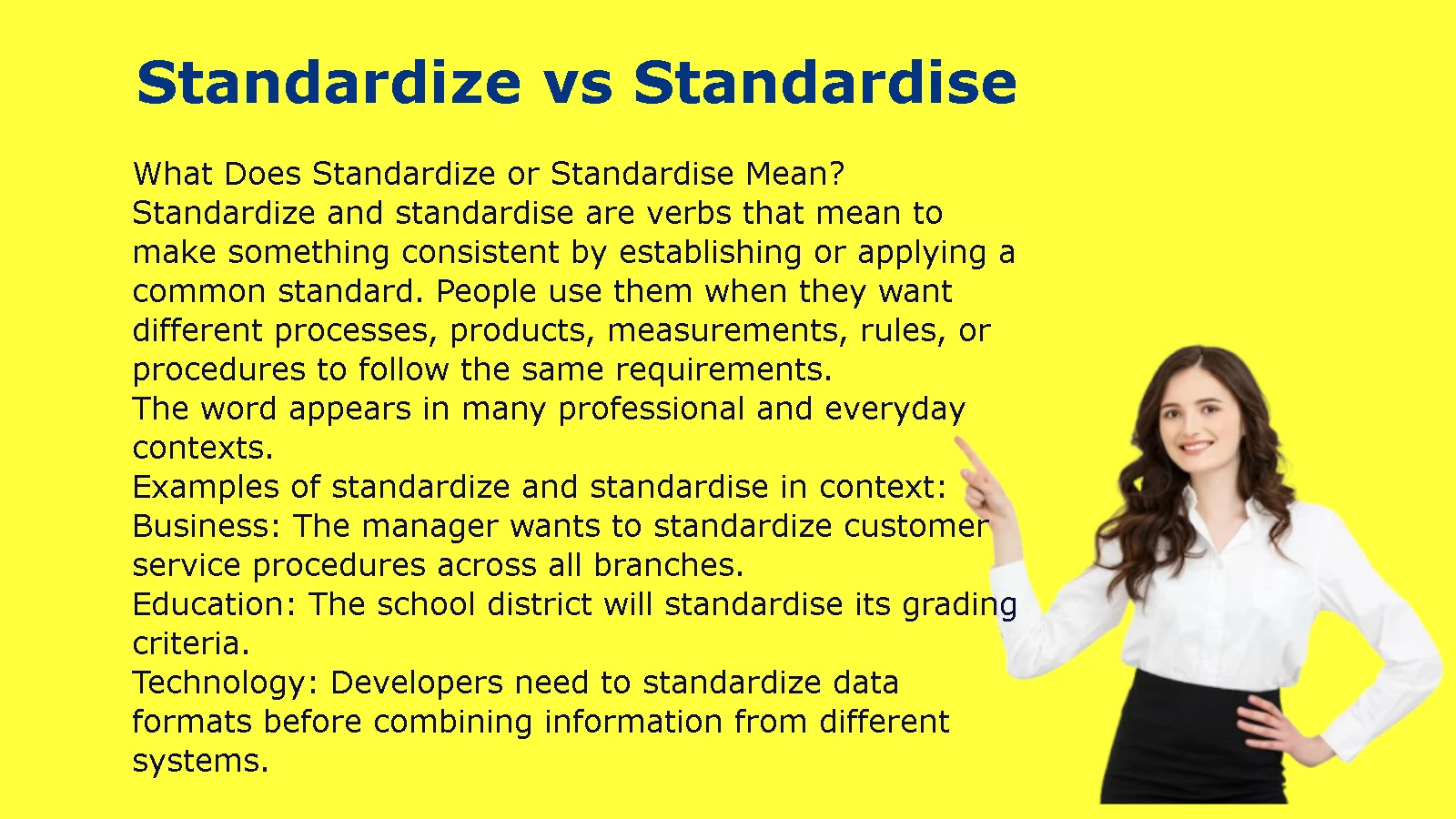
Standardize vs Standardise is a spelling difference between English writing conventions, not a difference in meaning. Standardize is the usual spelling in American English, while standardise is common in British, Australian, and New Zealand English styles that prefer the -ise ending. Both words mean to bring something into conformity with an established standard.
The distinction also applies to related words, including standardization vs. standardisation, standardized vs. standardised, and standardizing vs. standardising. However, British English has an important exception: Oxford spelling uses -ize in many words, including standardize. That means the letter Z is not automatically incorrect in British writing.
Whether you are editing a business report, writing technical documentation, preparing academic work, or publishing content for an international audience, the right choice depends on your readers and the style guide you follow.
Standardize vs Standardise: The Quick Answer
Standardize is the preferred spelling in American English. Standardise is common in British, Australian, New Zealand, and other English varieties that follow the -ise convention. Both spellings have the same meaning, pronunciation, and grammatical function. Choose the form that matches your audience or organization’s style guide, then use it consistently throughout your writing.
Here is the simplest way to remember the difference:
- Standardize: Common in the United States and in styles that use the -ize ending.
- Standardise: Common in British English styles that use the -ise ending and in many Australian and New Zealand publications.
- Standardization: The corresponding noun with a Z.
- Standardisation: The corresponding noun with an S.
For example:
- American English: The company plans to standardize its employee training process.
- British English: The company plans to standardise its employee training process.
Both sentences communicate exactly the same idea. The spelling changes to suit the chosen English convention, but the underlying meaning stays the same.
What Does Standardize or Standardise Mean?
Standardize and standardise are verbs that mean to make something consistent by establishing or applying a common standard. People use them when they want different processes, products, measurements, rules, or procedures to follow the same requirements.
The word appears in many professional and everyday contexts.
Examples of standardize and standardise in context:
- Business: The manager wants to standardize customer service procedures across all branches.
- Education: The school district will standardise its grading criteria.
- Technology: Developers need to standardize data formats before combining information from different systems.
- Manufacturing: The factory standardized its quality-control checks to reduce variation.
- Healthcare administration: The organization plans to standardise patient registration forms.
Standardizing something does not necessarily mean making every detail identical. It means defining the requirements that must remain consistent. For example, a restaurant chain might standardize food-safety procedures while allowing individual locations to adapt their menus to local tastes.
The word can also describe formal agreements. When organizations standardize a measurement, interface, or technical process, they establish common specifications that help different people or systems work together.
Are Standardize and Standardise Pronounced Differently?
No. Standardize and standardise generally have the same pronunciation. The spelling difference does not change the word’s syllables, stress pattern, or meaning.
Both forms are commonly pronounced with the stress on the first syllable: STAN-dard-ize or STAN-dard-ise.
The ending changes in writing, but it does not create a different spoken word. This differs from some English spelling pairs in which a spelling change also signals a difference in pronunciation or meaning.
If you are speaking rather than writing, you usually do not need to worry about whether your audience expects the Z or S spelling. The distinction matters primarily in written communication, especially when you need to follow a regional spelling convention.
Standardize vs Standardise in American and British English
The difference between standardize and standardise reflects a broader pattern in English spelling. American English generally favors -ize in this word, while many British and Commonwealth English styles favor -ise. These preferences are conventions rather than universal rules that apply identically to every publication.
Understanding the regional pattern helps you choose the right form without assuming that one spelling is inherently more correct than the other.
American English: Standardize
Standardize is the normal spelling in American English. American dictionaries, educational materials, business documents, and most US-focused publications use the Z form.
The same convention applies to the noun and other related forms.
Examples include:
- We need to standardize the format of our monthly reports.
- The company introduced a new standardization policy.
- The team is standardizing its software development process.
- The organization has standardized its customer records.
American writers generally use the same spelling convention for related words such as organize, organization, recognize, and recognition, although English spelling has individual exceptions that writers must learn separately.
In professional settings, the Z spelling helps maintain consistency with other American English conventions. A US company that publishes employee handbooks, product instructions, and training materials will usually choose standardize throughout those documents.
Practical tip: If your readers are primarily in the United States, use standardize, standardization, standardized, and standardizing unless a client or publication explicitly requires another style.
British English: Standardise
Standardise is common in British English, particularly in publications that follow the -ise convention. Many British writers use S spellings for verbs ending in -ise, including organise, realise, and recognise.
Examples include:
- The department plans to standardise its reporting procedures.
- The policy encourages greater standardisation across regional offices.
- The team is standardising the company’s internal documentation.
- The organization has standardised its assessment criteria.
British spelling conventions can differ from American ones in several ways. For example, British English commonly uses colour instead of color and centre instead of center. The -ise ending is another familiar distinction, although it does not operate as an absolute rule across every British publication.
One important detail is that standardise is not the only acceptable British spelling. Some British dictionaries, publishers, and style guides accept or prefer the Z form. Oxford spelling is a prominent example.
Consequently, writers should not treat the presence of a Z as proof that a British text contains an American spelling error. The publication’s style guide provides the more useful answer.
Canadian English: Standardize or Standardise?
Canadian English combines several spelling traditions, but standardize is common in Canadian writing. The country often follows American conventions for words such as organize and standardize, while retaining British-style spellings in other cases.
For example:
- The company will standardize its inventory records.
- The committee recommended further standardization of the reporting system.
- The software update will standardize data collection across departments.
Canadian English does not simply copy American or British spelling in every situation. Its conventions vary by word, publication, and institutional style guide.
For this reason, Canadian writers should check the requirements of their employer, university, publisher, or client. A Canadian government document may follow a specific house style that differs from the conventions used by a private company.
If no style guide exists, standardize is a reasonable default for many Canadian business and technical contexts. Consistency matters more than trying to combine different regional systems within the same document.
Australian, New Zealand, and South African English
Standardise is common in Australian and New Zealand English, as well as in many South African publications that follow British-style spelling conventions.
Examples include:
- Australia: The agency will standardise product-labeling requirements.
- New Zealand: The school plans to standardise its assessment procedures.
- South Africa: The organization aims to standardise quality-control practices across its facilities.
The corresponding nouns commonly appear as standardisation in these styles.
However, regional preferences do not mean every publication must follow the same spelling rule. International companies, scientific publishers, software developers, and professional associations may adopt a house style that uses -ize instead.
For example, an Australian employee writing a report for a US-based parent company may need to use standardize to match the organization’s documentation. Conversely, a multinational company producing Australian consumer materials may choose standardise to suit its local audience.
The practical rule: Start with the English variety your readers expect, then check whether the organization has a specific spelling policy.
Standardize vs Standardise: Regional Spelling Comparison
The table below summarizes the common spelling preferences and shows how the difference extends to related forms.
| Region or style | Common verb spelling | Corresponding noun | Example |
| United States | Standardize | Standardization | We standardize the reporting process. |
| United Kingdom using -ise style | Standardise | Standardisation | We standardise the reporting process. |
| Canada | Standardize is common | Standardization is common | The team will standardize its procedures. |
| Australia | Standardise is common | Standardisation is common | The company will standardise its procedures. |
| New Zealand | Standardise is common | Standardisation is common | The agency plans to standardise its forms. |
| Oxford spelling | Standardize | Standardization | The publisher follows the -ize convention. |
These are general tendencies, not rigid rules for every writer in every country. A British publisher may prefer standardize, while a multinational organization may use the same form across all its English-language materials.
The table also highlights a useful principle: the verb and its related forms should normally follow the same spelling convention. If your document uses standardise, it will generally use standardisation and standardised as well.
Why Does British English Sometimes Use Standardize With a Z?
The apparent contradiction comes from the fact that British English does not have a single spelling convention for every word. Although -ise is common in British writing, Oxford spelling deliberately favors -ize in many words, including standardize.
This convention is established in British publishing. It is not simply an American spelling inserted into an otherwise British document.
Understanding the Oxford -ize Convention
Oxford spelling is a style associated with Oxford University Press and its editorial tradition. It favors -ize in many verbs where the ending derives from a Greek element, rather than automatically using -ise because the text follows British English.
Under this convention, writers use forms such as:
- Standardize, not standardise
- Standardization, not standardisation
- Organize, not organise
- Recognize, not recognise
The convention can coexist with other British spellings. A text following Oxford spelling may use standardize and organize while retaining colour, centre, and other forms associated with British English.
This distinction matters because English spelling is not governed by one universal rule that changes every S ending to Z in American English or every Z ending to S in British English.
Instead, writers follow conventions that vary by word and style guide. The Oxford approach is one recognized system among several.
It is also worth remembering that not every word ending in -ise changes to -ize under Oxford spelling. Some words have different histories or spelling rules. For instance, advertise, advise, and surprise retain their S spellings.
What this means for writers: Seeing standardize in a British publication does not automatically indicate an error. The spelling may reflect a deliberate editorial choice.
Is Standardize Correct in the United Kingdom?
Yes. Standardize is an acceptable spelling in British English, particularly in publications that follow Oxford spelling. Standardise is also correct and common in British styles that prefer the S ending.
Consider these examples:
- A British newspaper following an -ise house style might write: “The council plans to standardise its application process.”
- A British publisher following Oxford spelling might write: “The council plans to standardize its application process.”
Both sentences are grammatically correct. The difference reflects the spelling policy used by the writer or publisher.
The same principle applies to standardization and standardisation. Neither noun is universally correct for every British document. The appropriate form depends on the style guide.
Writers sometimes assume that a British audience will always expect an S spelling. That assumption can lead to unnecessary corrections when editing material produced by an organization that intentionally uses Oxford spelling.
A better editing process is to identify the publication’s established convention before changing the text.
Should You Use Oxford Spelling for International Content?
Oxford spelling can be a practical choice for international content when an organization wants one consistent English-language style that uses -ize. However, there is no single spelling convention that every international organization must follow.
The best choice depends on the purpose of the document, its audience, and any applicable editorial or contractual requirements.
Consider three situations:
A multinational software company: The company maintains one English-language technical manual for employees and clients in several countries. It may choose an -ize style to simplify centralized editing and maintain consistency across the manual.
An Australian retail website: The company targets Australian consumers and follows an Australian English house style. It may use standardise to match the spelling readers expect across the site.
A British academic publisher: The publisher requires Oxford spelling. Authors must use standardize even when the intended readers are primarily British.
Each approach can be appropriate within its own context.
For international content, use this checklist:
- Identify the main audience.
- Check the organization’s spelling policy.
- Follow any client, publisher, regulatory, or contractual requirements.
- Apply the selected spelling consistently to headings, body text, tables, captions, and metadata.
- Avoid switching conventions simply because a spelling checker suggests an alternative.
The goal is not to find a universally superior spelling. It is to make the document consistent and appropriate for its intended readers.
Standardization vs. Standardisation: What Changes With the Noun?
The spelling difference continues when standardize or standardise becomes a noun. Standardization follows the -ize convention, while standardisation follows the -ise convention. Both nouns describe the process or result of establishing common standards.
This distinction is especially important in technical writing because the noun appears frequently in discussions of procedures, specifications, quality control, and organizational policy.
Standardization vs. Standardisation
Standardization and standardisation are nouns formed from the corresponding verbs. They describe the act of establishing common requirements or making processes more consistent.
Examples:
- American English: The standardization of data formats improved compatibility between systems.
- British English: The standardisation of data formats improved compatibility between systems.
- Oxford spelling: The project focuses on the standardization of technical terminology.
The noun can describe a broad process or a specific initiative.
For example, a manufacturer might introduce standardization to ensure that components produced at different facilities meet the same specifications. A university might standardise its marking criteria so that students receive consistent assessments across different classes.
In both cases, the term refers to a process of applying shared requirements. The spelling does not alter the concept.
A related distinction is worth noting: standardization does not always mean complete uniformity. Organizations can standardize essential procedures while allowing flexibility where local conditions or professional judgment require it.
For example, a hospital network may standardize patient identification and recordkeeping while allowing individual departments to tailor other workflows to their needs.
Standardizing vs. Standardising
Standardizing and standardising are the present participle and gerund forms of the verb. They can describe an ongoing action or refer to the activity itself.
Examples:
- American English: The team is standardizing the software deployment process.
- British English: The team is standardising the software deployment process.
- American English: Standardizing the forms will reduce duplicate data entry.
- British English: Standardising the forms will reduce duplicate data entry.
The word’s grammatical role depends on how you use it in a sentence.
In “The company is standardizing its reports,” the word forms part of the verb phrase and describes an ongoing action.
In “Standardizing the reports will save time,” it functions as a gerund, naming the activity that will produce a result.
The spelling convention remains the same in both cases. American and -ize styles generally use standardizing, while -ise styles generally use standardising.
Standardized vs. Standardised
Standardized and standardised are the past tense and past participle forms of the verb. Both describe an action completed in the past or a state resulting from that action.
Examples:
- American English: The company standardized its onboarding procedure last year.
- British English: The company standardised its onboarding procedure last year.
- American English: All branches now use a standardized reporting template.
- British English: All branches now use a standardised reporting template.
The past tense describes an action that occurred. The past participle can appear in perfect tenses or passive constructions, and it can also function as an adjective.
For example, “The team has standardized its records” uses the past participle in the present perfect tense. In “The team uses a standardized template,” the same form describes the template.
Writers should check related forms together when editing a document. Correcting standardise to standardize without updating standardisation elsewhere can leave the text inconsistent.
Standardization and Standardisation: Related Word Forms at a Glance
Use this table to check the main forms at a glance.
| American or -ize style | British or -ise style | Grammatical form |
| Standardize | Standardise | Base verb |
| Standardizes | Standardises | Third-person singular |
| Standardized | Standardised | Past tense and past participle |
| Standardizing | Standardising | Present participle and gerund |
| Standardization | Standardisation | Noun |
For example, an American report might say:
“The department standardizes its procedures, is standardizing its records, and has already standardized its forms. This standardization makes the process easier to manage.”
A British report using the -ise convention could express the same idea with standardises, standardising, standardised, and standardisation.
The sentence structure and meaning remain unchanged. Only the spelling convention differs.
How to Choose Between Standardize and Standardise
Choosing between the two spellings becomes easy when you consider the audience, the style guide, and the purpose of the document. Use standardize for American English and other styles that follow -ize; use standardise when the selected style guide calls for -ise.
You do not need to memorize every country’s spelling preferences before writing. A simple editorial process can prevent most mistakes.
Choose Standardize When Writing for an American Audience
Use standardize when writing for a primarily American audience unless your organization requires a different convention.
This choice is appropriate for many types of content:
- US business proposals and internal reports
- American product documentation
- Training manuals for US employees
- Educational resources aimed at American students
- Website content written in American English
- Software instructions intended for US customers
For example:
“The operations team will standardize its inventory process to ensure that every branch records stock in the same way.”
The noun and related forms should follow the same convention:
“The standardization project will create a shared inventory template. The company is standardizing its procedures, and it has already standardized the reporting schedule.”
Keeping the spelling consistent makes the text easier to edit and helps preserve the chosen regional style.
Choose Standardise When Following an -ise Style Guide
Use standardise when writing for an audience or publication that follows the -ise convention.
This approach is common in British, Australian, and New Zealand English content, although individual organizations can choose other styles.
For example:
“The operations team will standardise its inventory process so that every branch records stock in the same way.”
The related forms would normally be standardisation, standardising, and standardised.
This convention works well for regional websites, locally targeted business materials, educational content, and documents that follow a specific British or Commonwealth house style.
However, do not change every S or Z ending mechanically. English contains words that follow different rules, and some words ending in -ise retain that spelling even in American English.
Instead, apply the relevant rule to the word in question and check the organization’s style guide when necessary.
What Should You Use in Global Business and Technical Documents?
For global business and technical writing, consistency and compliance with the chosen style guide matter more than selecting one spelling as universally correct.
A multinational company may maintain a central style guide to prevent regional variations from spreading across product manuals, policies, contracts, and internal knowledge bases.
Suppose a software company operates in the United States, the United Kingdom, Australia, and Canada. Its documentation team needs to decide whether to maintain separate regional versions or use one shared English-language convention.
There are two practical approaches.
Approach one: Use a shared convention.
The company selects an -ize or -ise style for its central documentation. Writers and editors follow that choice across all relevant materials.
This can reduce editing time and simplify quality checks, especially when the same documents serve multiple markets.
Approach two: Localize the spelling by market.
The company uses American spelling for US materials and an -ise style for British or Australian materials when that matches its localization policy.
This approach can make region-specific content feel more natural to local readers. However, it requires clear version control and editorial checks.
Neither approach is automatically correct for every organization.
If a client contract, regulator, technical standard, or publisher specifies a particular spelling, follow that requirement. Do not assume that a preference for international consistency overrides a formal requirement.
A Simple Decision Rule for Editors and Content Writers
Use this four-step process whenever you are unsure which form to choose.
Step one: Identify your audience.
Determine whether the document targets American, British, Australian, New Zealand, Canadian, or international readers.
Step two: Check the style guide.
Look for an explicit spelling policy. The guide may specify American English, British English, Oxford spelling, or a custom company convention.
Step three: Apply the rule to related forms.
If you choose standardize, check for standardization, standardizing, and standardized. If you choose standardise, check for the corresponding S forms.
Step four: Review the complete document.
Search the text for both variants. Check the main content, headings, tables, captions, image descriptions, and other published text.
A simple editorial checklist can help:
- The target audience is clearly identified.
- The required style guide has been checked.
- The base verb follows the selected convention.
- The noun and other related forms match.
- No unintended spelling inconsistencies remain.
This method works for a short email as well as a lengthy technical manual.
A Practical Example: Standardize vs Standardise in a Business Document
Consider a company that operates offices in Chicago and London. Both offices need a shared procedure for reviewing customer applications.
The US team writes:
“We will standardize the application review process across all offices. The standardization project will introduce a common checklist, and the team is standardizing its reporting templates.”
The UK team writes:
“We will standardise the application review process across all offices. The standardisation project will introduce a common checklist, and the team is standardising its reporting templates.”
Both versions are correct under their respective spelling conventions.
The challenge arises when the two paragraphs appear in one document that is supposed to follow a single style. A document that uses standardize in the first section and standardisation in the next may look poorly edited, even though both forms are individually valid.
The company has three options:
| Editorial decision | What it means | When it works |
| Use American spelling throughout | Use standardize and standardization consistently | US-led documentation or a shared -ize house style |
| Use an -ise convention throughout | Use standardise and standardisation consistently | British-style or regional documentation |
| Maintain localized versions | Use different spellings in separate regional editions | Content that needs to follow distinct market conventions |
The key lesson is that a spelling decision should be made at the document or style-guide level, not one word at a time.
That approach prevents inconsistencies and gives writers a repeatable method for handling similar pairs.
Frequently Asked Questions
Is Standardise a Real Word?
Yes. Standardise is a correct English spelling used in British English and other varieties that follow the -ise convention. It has the same meaning as standardize: to bring something into conformity with an established standard.
For example, “The company will standardise its reporting procedures” means the same thing as “The company will standardize its reporting procedures.”
The appropriate form depends on the spelling convention used in the document.
Is It Standardize or Standardise in UK English?
Both standardize and standardise are acceptable in British English. Many British publications prefer standardise, while Oxford spelling uses standardize.
If you are writing for a British publisher, employer, university, or client, check its style guide. That will tell you which spelling to use.
Does Standardize Mean the Same Thing as Standardise?
Yes. Standardize and standardise have the same meaning. Both verbs describe the process of making something conform to an established standard or set of requirements.
The difference is regional spelling, not meaning, grammar, or ordinary pronunciation.
For example, a company can standardize or standardise its employee training process. Either sentence describes an effort to make training consistent.
Is Standardization or Standardisation Correct?
Both standardization and standardisation are correct.
Standardization is common in American English and in styles that follow the -ize convention. Standardisation is common in British and Commonwealth styles that prefer -ise.
Choose the form that matches the spelling policy of your document, and apply the same convention to related words.
How Does ISO Spell Standardization?
The organization’s official name is the International Organization for Standardization, which uses the Z spelling in Organization and Standardization.
This is a useful example of why writers should check an organization’s official name instead of automatically changing its spelling to match their preferred regional convention.
When referring to a named organization, preserve its official name as written.
Which Spelling Should I Use for International Business Writing?
Follow the organization’s or client’s style guide whenever one exists. If no policy applies, choose a consistent spelling convention that suits your audience and the document’s purpose.
An organization may select an -ize style for shared documentation or maintain separate localized versions for different markets. Neither approach makes the other spelling inherently wrong.
For technical or regulated material, check any applicable terminology requirements before making editorial changes.
Final Verdict: Standardize or Standardise?
The difference between Standardize vs Standardise comes down to spelling convention. Standardize is the usual American English form and is also used in Oxford spelling. Standardise is common in British, Australian, New Zealand, and other styles that prefer the -ise ending.
Both spellings have the same meaning. The distinction carries through related forms: standardization and standardisation, standardized and standardised, and standardizing and standardising.
Use these simple rules to make your decision:
- Writing for an American audience? Choose standardize.
- Following a British or Australian style guide that uses -ise? Choose standardise.
- Working with Oxford spelling? Use standardize.
- Preparing international business or technical documents? Follow the organization’s established style guide and any applicable requirements.













