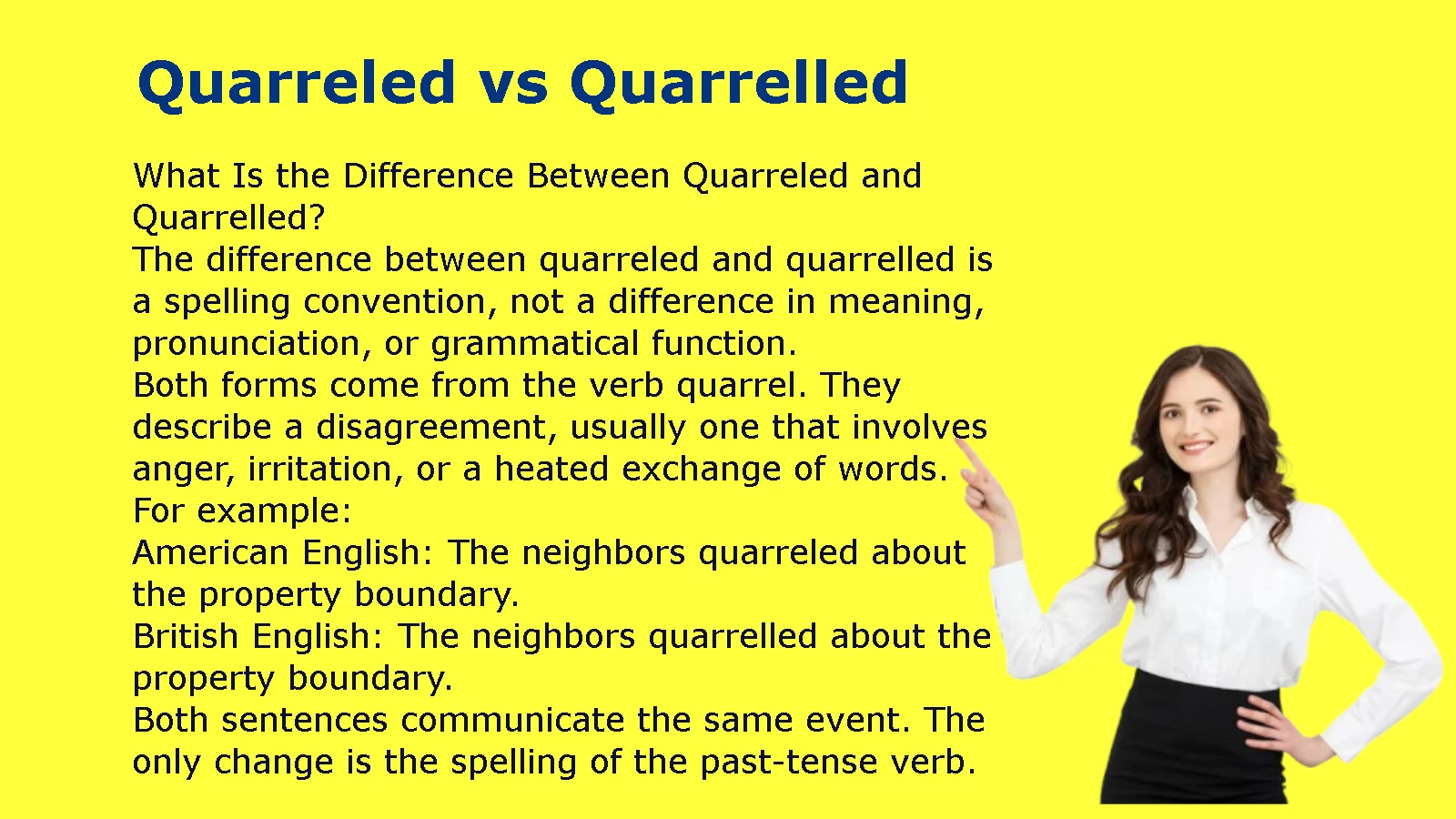
Quarreled vs Quarrelled comes down to regional spelling preferences: American English uses quarreled with one “L,” while British English generally uses quarrelled with two. Both spellings are correct, and both describe a past argument or disagreement. The same difference appears in quarreling vs. quarrelling, as well as related words such as traveled/travelled and canceled/cancelled.
Understanding the difference between these spellings helps you write naturally for American, British, Canadian, and Australian audiences. It also makes proofreading easier because you can recognize the regional rules behind each form rather than treating one spelling as a mistake.
This guide explains when to use each version, how the double-L spelling rule works, how to spell related verb forms, and how to maintain consistency in academic, professional, and everyday writing.
Quick Answer: Quarreled or Quarrelled?
Quarreled is the standard American English spelling, while quarrelled is the standard British English spelling. Canadian and Australian English commonly use quarrelled as well. Both words are the past tense and past participle of quarrel, meaning to argue or disagree angrily. The spelling changes by region, but the meaning stays the same.
Here is the difference at a glance:
| Spelling | Preferred usage | Example |
| Quarreled | American English | The brothers quarreled over the inheritance. |
| Quarrelled | British English | The brothers quarrelled over the inheritance. |
| Quarreling | American English | They were quarreling about the decision. |
| Quarrelling | British English | They were quarrelling about the decision. |
The base word, quarrel, has the same spelling in both varieties of English. The difference appears when you add endings such as -ed and -ing.
Choose the spelling that matches your intended audience. If you are writing for an American newspaper, website, or school assignment, use quarreled. For a British publication, quarrelled is generally the better choice.
What Is the Difference Between Quarreled and Quarrelled?
The difference between quarreled and quarrelled is a spelling convention, not a difference in meaning, pronunciation, or grammatical function.
Both forms come from the verb quarrel. They describe a disagreement, usually one that involves anger, irritation, or a heated exchange of words.
For example:
- American English: The neighbors quarreled about the property boundary.
- British English: The neighbors quarrelled about the property boundary.
Both sentences communicate the same event. The only change is the spelling of the past-tense verb.
Quarreled: The American English Spelling
Quarreled is the preferred spelling in American English. American writers generally use one “L” when adding -ed to quarrel, producing quarreled rather than quarrelled.
This spelling follows a broader American convention that favors a single final “L” in many words when adding suffixes. You can see the same pattern in traveled, canceled, and labeled.
American English uses quarreled in newspapers, novels, business documents, school assignments, and everyday communication.
Consider these examples:
- The two employees quarreled over who should lead the project.
- My grandparents quarreled about the best route to take.
- The candidates quarreled during the televised debate.
- The siblings quarreled over a toy, then apologized to each other.
- Historians disagree about why the two leaders quarreled before the treaty was signed.
Each sentence uses the American spelling naturally. The word can describe a minor disagreement between family members or a serious dispute between public figures.
When should you use quarreled?
Use this form when writing for an American audience or following an American English style guide. It is also the appropriate choice when a publication, employer, school, or client specifically requests US spelling.
Quarrelled: The British English Spelling
Quarrelled is the standard British English spelling. British English commonly doubles the final “L” in words such as quarrel, travel, and cancel when adding certain suffixes.
The result is quarrelled, with two “L”s at the end of the verb before the -ed ending.
British writers use this spelling in fiction, newspapers, formal reports, educational materials, and everyday communication. The form is also common in other English varieties that follow British spelling conventions.
Here are some examples:
- The neighbors quarrelled over a fence that stood between their gardens.
- The politicians quarrelled about the proposed changes to the law.
- The couple quarrelled frequently during their first year together.
- The two historians quarrelled over the interpretation of an ancient document.
- The children quarrelled over whose turn it was to choose a game.
These examples show that quarrelled works in the same contexts as quarreled. It can describe a domestic disagreement, a professional dispute, or a conflict involving public figures.
When should you use quarrelled?
Use this spelling when writing for a British audience or following a British English editorial standard. It is also a suitable choice for publications in countries where double-L spellings are commonly preferred.
Is It Quarreled or Quarrelled in Canada?
Quarrelled is commonly preferred in Canadian English, although spelling preferences can vary by publication and editorial style.
Canadian English combines features of British and American spelling. For example, Canadian writers commonly use colour rather than color, but they often use organize rather than organise. This mixture means you should not assume that every Canadian spelling follows British conventions.
The word quarrelled generally fits Canadian spelling practice, particularly in formal and edited writing.
Examples include:
- The committee quarrelled over the proposed budget.
- The two companies quarrelled about the terms of their agreement.
- The students quarrelled during the discussion but later reached a compromise.
For Canadian writing, check the preferred dictionary or house style of the organization you are writing for. A national spelling tendency is useful, but a specific publication’s rules take priority.
Do Quarreled and Quarrelled Sound Different?
No. Quarreled and quarrelled are pronounced the same way in ordinary English usage. The additional “L” in the British spelling does not introduce another syllable or change the word’s sound.
Both forms usually have two syllables, with the main stress on the first syllable.
The difference is visible in writing rather than audible in speech. This is why spellcheckers and proofreading tools may identify a regional spelling preference even when a reader would hear no difference.
Why Do Quarreled and Quarrelled Have Different Spellings?
The difference reflects established spelling conventions in American and British English. Over time, the two varieties developed different preferences for handling final consonants when adding suffixes.
American English often uses one final “L” in words such as quarreled and traveling. British English generally doubles the “L” in corresponding forms such as quarrelled and travelling.
These patterns are conventions rather than universal rules. English spelling contains exceptions, so it helps to learn common word families instead of relying on a single formula.
The American English Rule for Doubling L
American English commonly retains a single final “L” in words such as quarrel, travel, cancel, and label when adding endings such as -ed or -ing.
This produces the following forms:
- Quarrel → quarreled → quarreling
- Travel → traveled → traveling
- Cancel → canceled → canceling
- Label → labeled → labeling
- Fuel → fueled → fueling
British English generally doubles the “L” in the corresponding forms.
The American pattern is sometimes explained through stress-based spelling rules. In English, a final consonant often doubles when a word ends in a stressed consonant-vowel-consonant syllable before a vowel-initial suffix. For example, admit becomes admitted because the final syllable receives the stress.
However, that rule does not explain every word in the quarreled family. In American English, the single-L forms are also part of a broader regional spelling convention.
Compare these examples:
| Base word | American form | Why it matters |
| Quarrel | Quarreled | American English uses one final “L.” |
| Travel | Traveled | The same regional preference applies. |
| Cancel | Canceled | The single-L form is standard in the US. |
| Admit | Admitted | The final consonant doubles under a different spelling pattern. |
| Repel | Repelled | The final consonant doubles in the standard past tense. |
The important lesson is that English spelling depends on both general suffix rules and established word-specific conventions.
Do not assume that every verb ending in “L” follows the same pattern. When you are unsure, check the standard spelling for your intended variety of English.
The British English Rule for Doubling L
British English commonly doubles the final “L” when adding -ed and -ing to words such as quarrel, travel, cancel, and label.
The resulting forms include:
- Quarrel → quarrelled → quarrelling
- Travel → travelled → travelling
- Cancel → cancelled → cancelling
- Label → labelled → labelling
- Fuel → fuelled → fuelling
This convention differs from the American preference for one “L” in the same word families.
For example, a British writer might write:
“The manager cancelled the meeting after the two department heads quarrelled over the schedule.”
An American writer would typically write:
“The manager canceled the meeting after the two department heads quarreled over the schedule.”
Both sentences follow their respective spelling conventions. Neither version changes the meaning of the events described.
British English spelling also varies across individual words. The double-L pattern applies to many common verbs, but it does not mean that every word containing a final “L” must double that letter whenever a suffix appears.
Practical tip: Learn the common regional pairs together. Remembering quarreled/quarrelled alongside quarreling/quarrelling makes it easier to maintain consistency.
How the Rules Apply to Quarreling and Quarrelling
The same regional difference appears in the present participle of quarrel.
- Quarreling is the standard American English spelling.
- Quarrelling is the standard British English spelling and is commonly used in Canadian English.
The present participle often describes an action in progress. It can also function as an adjective or appear in a gerund phrase.
Examples:
- American English: The neighbors are quarreling again.
- British English: The neighbors are quarrelling again.
- American English: Their constant quarreling made the meeting difficult.
- British English: Their constant quarrelling made the meeting difficult.
Both forms can appear after a form of be, as in “They were quarreling,” or as a noun-like expression, as in “Quarreling rarely solves the problem.”
The spelling distinction remains the same across these grammatical uses.
Here is a quick guide:
| Grammatical form | American English | British English |
| Base verb | Quarrel | Quarrel |
| Third-person singular | Quarrels | Quarrels |
| Present participle | Quarreling | Quarrelling |
| Simple past | Quarreled | Quarrelled |
| Past participle | Quarreled | Quarrelled |
Notice that the base verb quarrel and the third-person singular form quarrels do not change between the two varieties. The difference appears when the spelling convention affects a suffix-bearing form.
Quarreled vs Quarrelled: Spelling Comparison Table
A side-by-side table can help you select the correct form without memorizing every explanation.
| Word form | American English | British English | Common Canadian usage |
| Base form | Quarrel | Quarrel | Quarrel |
| Third-person singular | Quarrels | Quarrels | Quarrels |
| Simple past | Quarreled | Quarrelled | Quarrelled |
| Past participle | Quarreled | Quarrelled | Quarrelled |
| Present participle | Quarreling | Quarrelling | Quarrelling |
The regional labels describe common preferences, not a guarantee that every individual writer or publication uses the same spelling. When a style guide specifies a form, follow that requirement.
Example Sentences With Quarreled
Use quarreled when writing in American English. The following examples show how the word fits different contexts.
Everyday conversation
- The children quarreled over who would sit in the front seat.
- My cousins quarreled about the rules of their favorite board game.
- We quarreled briefly, but we resolved the disagreement before dinner.
Work and professional situations
- The managers quarreled over how to divide the project’s budget.
- The partners quarreled about the direction of the business.
- Two members of the committee quarreled during the planning meeting.
News and historical writing
- The political leaders quarreled over the proposed treaty.
- The generals quarreled about the timing of the military operation.
- The historical records suggest that the advisers quarreled over the king’s decision.
Each example uses quarreled as a past-tense verb. It describes an argument that occurred before the time of writing.
The word can suggest a range of disagreements, from a brief exchange to a prolonged conflict. The surrounding sentence provides the context that tells readers how serious the argument was.
Example Sentences With Quarrelled
Use quarrelled when following British English spelling conventions.
Everyday conversation
- The children quarrelled over who had taken the last biscuit.
- The neighbors quarrelled about the noise coming from the garden.
- We quarrelled over the holiday plans but soon made peace.
Work and professional situations
- The directors quarrelled over the proposed changes to company policy.
- The colleagues quarrelled about the best way to meet the deadline.
- The committee quarrelled over the allocation of public funds.
News and historical writing
- The ministers quarrelled during negotiations.
- The two historians quarrelled over the meaning of the inscription.
- The royal advisers quarrelled about the succession.
These examples use the same grammar and meaning as the American versions. The spelling simply reflects a different regional convention.
How to Use Quarreled and Quarrelled in Different Tenses
Although the main spelling difference concerns the past tense and present participle, understanding the verb’s forms helps prevent other grammatical errors.
| Tense or construction | American English example | British English example |
| Present simple | They quarrel about money. | They quarrel about money. |
| Past simple | They quarreled yesterday. | They quarrelled yesterday. |
| Present continuous | They are quarreling now. | They are quarrelling now. |
| Past continuous | They were quarreling earlier. | They were quarrelling earlier. |
| Present perfect | They have quarreled before. | They have quarrelled before. |
| Past perfect | They had quarreled before the meeting. | They had quarrelled before the meeting. |
The base form remains quarrel in both varieties. The regional distinction appears in the forms that use the past-tense or participle endings.
For example, “They have quarrelled before” is grammatically correct in British English. In American English, the corresponding sentence uses “They have quarreled before.”
Other American and British Words With Single-L and Double-L Spellings
The difference between quarreled and quarrelled is part of a wider pattern. Many English verbs have American forms with one “L” and British forms with two.
Learning these pairs helps you spot spelling inconsistencies in longer articles, school assignments, and professional documents.
Traveled vs. Travelled
Traveled is the standard American English spelling, while travelled is the standard British English spelling.
The same difference appears in the present participle:
- American English: traveling
- British English: travelling
Examples:
- American: We traveled across the country during the summer.
- British: We travelled across the country during the summer.
- American: She is traveling to London next week.
- British: She is travelling to London next week.
The meaning does not change. Both versions describe movement from one place to another.
Canceled vs. Cancelled
Canceled is standard in American English, while cancelled is standard in British English.
Their present participles also differ:
- American English: canceling
- British English: cancelling
Examples:
- American: The airline canceled the flight because of severe weather.
- British: The airline cancelled the flight because of severe weather.
- American: The organizers are canceling the event.
- British: The organizers are cancelling the event.
The single-L form is common in American publications, while the double-L form is typical of British editorial standards.
Fueled vs. Fuelled
Fueled is the usual American spelling, and fuelled is the usual British spelling.
The difference also appears in the present participle:
- American English: fueling
- British English: fuelling
Examples:
- American: Public criticism fueled the debate.
- British: Public criticism fuelled the debate.
- American: The discussion is fueling further concern.
- British: The discussion is fuelling further concern.
In these sentences, fuel is used figuratively. It means to intensify or encourage something, rather than simply to supply a machine with fuel.
Labeled vs. Labelled
Labeled is standard in American English, while labelled is standard in British English.
The present participle forms follow the same pattern:
- American English: labeling
- British English: labelling
Examples:
- American: The technician labeled each sample.
- British: The technician labelled each sample.
- American: She is labeling the storage boxes.
- British: She is labelling the storage boxes.
The verb means to attach a label or identify something with a name or description.
Quick Reference Table for L-Doubling Differences
Use this table as a proofreading reference when editing for a specific English variety.
| American English | British English |
| Quarreled | Quarrelled |
| Quarreling | Quarrelling |
| Traveled | Travelled |
| Traveling | Travelling |
| Canceled | Cancelled |
| Canceling | Cancelling |
| Fueled | Fuelled |
| Fueling | Fuelling |
| Labeled | Labelled |
| Labeling | Labelling |
These pairs illustrate common patterns, but they do not establish a rule for every English word. When a word falls outside a familiar pattern, check its accepted spelling rather than applying the rule automatically.
Which Spelling Should Writers and Content Creators Use?
The right spelling depends on your readers, the publication’s editorial rules, and the variety of English you want to maintain.
Using quarreled in an American article and quarrelled in a British article helps your writing feel consistent and familiar to the intended audience. Neither form is inherently more correct in every context.
Follow Your Target Audience’s English Variety
Start by identifying who will read your content.
For an American audience: Use quarreled, quarreling, traveled, and canceled.
For a Canadian audience: Quarrelled and quarrelling are commonly used. Check the relevant Canadian spelling reference or editorial guide for the publication’s preferred forms.
For an Australian audience: Quarrelled and quarrelling are standard choices in line with common Australian English practice.
Consider a website that publishes articles for readers in several countries. An American version might say, “The travelers quarreled after the tour was canceled.” A British version might say, “The travellers quarrelled after the tour was cancelled.”
Both sentences work. However, mixing the two spelling systems without a reason can make an article look poorly edited.
Check Your Style Guide and Dictionary
A style guide provides rules for spelling, punctuation, capitalization, and other editorial decisions. It helps writers maintain a consistent voice across articles, books, reports, and websites.
Before choosing a spelling, identify the editorial standard you need to follow.
- American publications: Use the publication’s American English dictionary and house style.
- British publications: Follow the publication’s British English spelling conventions.
- Canadian publications: Check the organization’s Canadian English reference.
- International publications: Choose a defined English variety or follow the publisher’s instructions.
Do not assume that every style guide follows exactly the same rule. Some publishers use a general regional standard, while others maintain specific word lists and editorial preferences.
For example, an American publisher may prefer quarreled, while a British publisher may require quarrelled. A global company might use different localized versions of its website to match the spelling conventions of each market.
The practical rule is simple: follow the style guide required by your client, employer, school, or publication. If no guide exists, choose the spelling that best matches your intended audience and use it consistently.
Keep Spelling Consistent Throughout Your Article
Consistency matters because readers notice spelling patterns even when they do not consciously analyze them.
Imagine an article that begins with “The brothers quarreled over money” and later says “They were quarrelling again.” Both forms are valid in their respective regional systems, but switching between them without a reason makes the article look inconsistent.
Use this simple editing process:
Choose the English variety. Decide whether the article will follow American, British, Canadian, or Australian spelling.
Set your spellchecker. Select the appropriate regional language setting in your word processor or editing tool.
Search for common variants. Look for pairs such as quarreled/quarrelled, quarreling/quarrelling, and canceled/cancelled.
Review the entire document. Check headings, captions, quotations, tables, and image descriptions as well as the main body.
Preserve quotations when necessary. If you reproduce a source’s exact wording, retain its original spelling when quotation accuracy matters.
A spellchecker can catch many inconsistencies, but it may not identify every regional mismatch. Both quarreled and quarrelled are valid spellings, so the software may accept either one depending on its language settings.
A Practical Editing Example
Suppose you are editing an article for a US travel website. Your draft includes these sentences:
- The family travelled across the state.
- They quarreled over the itinerary.
- The hotel cancelled their reservation.
The article mixes British and American forms. For a consistent American version, revise it as follows:
- The family traveled across the state.
- They quarreled over the itinerary.
- The hotel canceled their reservation.
For a British version, the original spellings would be consistent:
- The family travelled across the state.
- They quarrelled over the itinerary.
- The hotel cancelled their reservation.
This example demonstrates why it helps to check related spelling pairs together. Correcting only the main keyword may leave other regional differences in the same article.
Frequently Asked Questions About Quarreled vs Quarrelled
Is Quarreled a Spelling Mistake in British English?
Quarreled is the standard American English spelling, while quarrelled is the standard British English form. British-oriented spellcheckers and editors may flag quarreled because it does not match their preferred regional convention. However, the American form is not universally incorrect; it is appropriate for American English.
How Do You Spell Quarreling in Canada?
Quarrelling is commonly preferred in Canadian English. Canadian spelling combines British and American conventions, so not every word follows the British pattern. For formal writing, check the spelling reference or editorial guide used by your school, employer, or publication.
Do Quarreled and Quarrelled Have Different Meanings?
No. Quarreled and quarrelled have the same meaning. Both are past-tense and past-participle forms of quarrel, a verb meaning to argue or disagree angrily. The difference concerns regional spelling preferences, not definition, pronunciation, or grammatical function.
Is Quarrelled Correct in American English?
Quarrelled is recognizable, but quarreled is the standard American English spelling. If you are writing for an American publication, use quarreled unless the publisher specifies a different convention. The double-L version is generally associated with British English spelling.
Why Does British English Double the L in Quarrelled?
British English commonly doubles the final “L” in words such as quarrel, travel, and cancel when adding endings such as -ed or -ing. This convention produces quarrelled, travelled, and cancelled. American English generally uses one “L” in the corresponding forms.
Is It Quarreling or Quarrelling?
Quarreling is the standard American English spelling, while quarrelling is the standard British English spelling and is common in Canadian English. Both forms describe an ongoing argument or the act of arguing. Choose the version that matches your audience and maintain that spelling throughout your writing.
Conclusion: Choose Quarreled or Quarrelled Based on Your Audience
The difference between Quarreled vs Quarrelled is straightforward once you understand the regional spelling convention. American English uses quarreled with one “L,” while British English generally uses quarrelled with two. The same distinction appears in quarreling and quarrelling.
Neither spelling changes the meaning of the word. Both forms describe an argument or disagreement, and both work grammatically in the past tense and past participle.
For clear, consistent writing, follow these guidelines:
- Use quarreled and quarreling for American English.
- Use quarrelled and quarrelling for British English.
- Check the preferred spelling conventions when writing for Canadian or Australian audiences.
- Follow any required style guide and keep related spellings consistent.