Modernize vs Modernise both mean to make something more modern, current, or suitable for present-day use. The difference is spelling: modernize is the preferred form in American English, while modernise is commonly used in British English.
| Question | Answer |
| What does modernize mean? | To make something more modern or up to date. |
| What does modernise mean? | The British English spelling of modernize. |
| Is it modernize or modernise? | Both are correct, depending on whether you use American or British English. |
| Which spelling is used in the US? | Modernize is the standard American English spelling. |
Modernize vs Modernise at a Glance
The easiest way to understand the difference is to put the two spellings side by side.
| Feature | Modernize | Modernise |
| Part of speech | Verb | Verb |
| Meaning | To make something modern | To make something modern |
| Main association | American English | British English |
| Pronunciation | Generally the same | Generally the same |
| Present tense | modernize | modernise |
| Third person | modernizes | modernises |
| Past tense | modernized | modernised |
| Present participle | modernizing | modernising |
| Noun | modernization | modernisation |
| Meaning difference | None | None |
The important point is that modernize and modernise aren’t two different words with two different meanings. They are spelling variants of the same verb.
Think of them like color and colour. The spelling changes depending on the variety of English, but the underlying word and meaning remain the same.
What Does Modernize Mean?
Modernize means to make something more modern, current, efficient, or appropriate for present needs.
You can modernize a physical object, such as a house or factory. You can also modernize something less tangible, such as a business process, education system, policy, or way of working.
Merriam Webster lists modernize as both a transitive and intransitive verb. In its transitive use, it means to make something modern. In its intransitive use, it can mean to adopt modern ways.
For example:
- The company plans to modernize its factories.
- They want to modernize the old kitchen.
- The school needs to modernize its computer systems.
- The government intends to modernize the transportation network.
- Older businesses must modernize to keep up with changing technology.
Oxford gives a similar definition and uses modernize for updating systems, methods, and other things so they become more suitable for present use.
Modernize Can Mean More Than “Make New”
One subtle point matters here: modernize doesn’t simply mean replace something old with something new.
A modernization project may preserve parts of an existing system while improving how they work.
For example, a company might modernize its customer service operation by:
- Introducing online support
- Automating routine requests
- Updating its software
- Improving employee training
- Adding self service tools
- Connecting customer records across departments
The goal isn’t necessarily to throw everything away. Instead, the goal is to bring something up to date.
That distinction makes modernize especially useful in discussions about technology, infrastructure, organizations, and public services.
What Does Modernise Mean?
Modernise has the same meaning as modernize.
It means to make something more modern or to adopt modern methods, ideas, equipment, or practices.
The only visible difference is the spelling of the final syllable:
- modernize
- modernise
Oxford Learner’s Dictionaries specifically lists modernise as a British English form of modernize.
For example:
- The company plans to modernise its factories.
- The government wants to modernise the healthcare system.
- They decided to modernise the old building.
- The school needs to modernise its technology.
- The organization is trying to modernise its working practices.
Nothing about the meaning changes when the z becomes an s.
Modernize vs Modernise: The Main Difference
The central difference between modernize and modernise is spelling convention.
American English generally uses -ize in words such as:
- modernize
- organize
- realize
- recognize
- specialize
British English uses both -ize and -ise in practice. The -ise spelling is very common, while the -ize spelling is also used by some British publishers and style systems.
This means the simple rule “American English uses -ize and British English uses -ise” is useful as a shortcut, but it isn’t completely accurate.
Oxford’s dictionary entry illustrates this clearly: it gives modernize as the main form and explicitly identifies modernise as a British English alternative.
Why Does the Spelling Change?
The -ize/-ise distinction appears in many English words. It reflects different spelling traditions rather than a difference in meaning.
The result is a family of regional spelling pairs:
| American English | British English |
| organize | organise |
| realize | realise |
| recognize | recognise |
| specialize | specialise |
| modernize | modernise |
| modernization | modernisation |
However, British English does not simply reject every -ize spelling. Some British publications and dictionaries use -ize for certain words. That’s why treating -ize as exclusively American can lead to an oversimplified explanation.
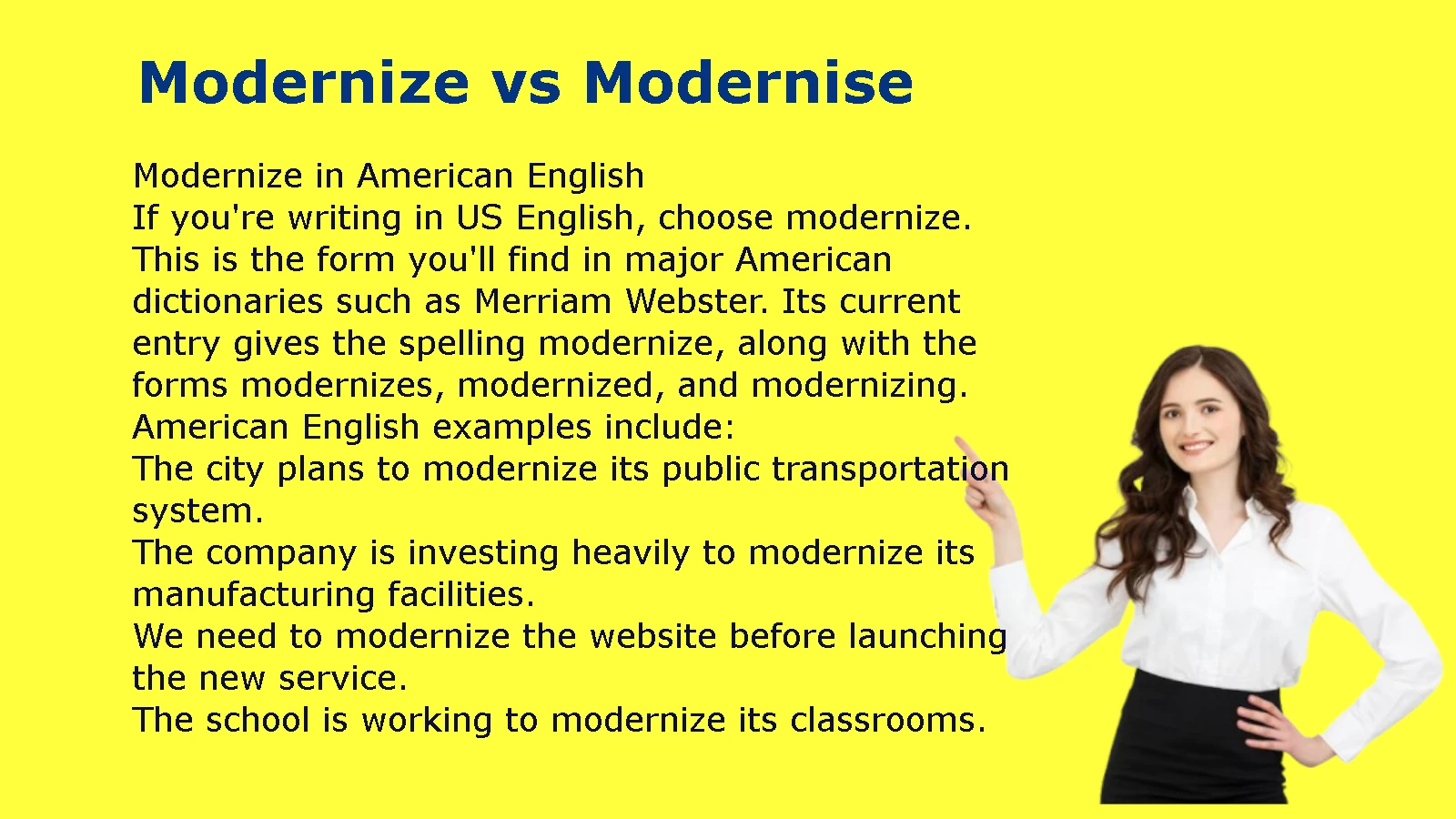
Modernize in American English
If you’re writing in US English, choose modernize.
This is the form you’ll find in major American dictionaries such as Merriam Webster. Its current entry gives the spelling modernize, along with the forms modernizes, modernized, and modernizing.
American English examples include:
The city plans to modernize its public transportation system.
The company is investing heavily to modernize its manufacturing facilities.
We need to modernize the website before launching the new service.
The school is working to modernize its classrooms.
The spelling also follows naturally into related forms:
- modernize
- modernizes
- modernized
- modernizing
- modernization
If an American English article uses modernise in one paragraph and modernize in another, readers will understand both. Still, the inconsistent spelling can make the article look poorly edited.
Consistency matters.
Modernise in British English
If you’re following a British English spelling convention that prefers -ise, use modernise.
Examples include:
The government plans to modernise the railway network.
The company is working to modernise its outdated systems.
The museum will modernise its facilities while preserving the historic building.
Schools need to modernise their approach to technology.
The related forms normally follow the same spelling pattern:
- modernise
- modernises
- modernised
- modernising
- modernisation
This pattern is common in British writing, although British English also permits or uses -ize spellings in some contexts.
Is Modernize or Modernise Correct?
Both spellings are correct.
The better choice depends on the English variety and style guide you’re following.
Use this practical rule:
- Writing for a US audience? → modernize
- Writing in a British style that uses -ise? → modernise
- Following a company’s or publication’s style guide? → Follow its preferred spelling
- Writing for an international audience? → Pick one convention and use it consistently
There is no need to “correct” modernise to modernize simply because one appears in an American dictionary. Likewise, there is no reason to change modernize to modernise merely because the reader is British.
The context determines the appropriate spelling.
Modernize vs Modernise Examples
Seeing the two forms in identical sentences makes the distinction easier to remember.
Examples With Modernize
- The company plans to modernize its accounting system.
- The city needs to modernize its public transportation.
- They want to modernize the kitchen.
- The school will modernize its computer network.
- The factory needs to modernize its equipment.
- The organization is trying to modernize its hiring process.
- Congress approved funding to modernize the infrastructure.
- The retailer hopes to modernize its online store.
The Same Examples With Modernise
- The company plans to modernise its accounting system.
- The city needs to modernise its public transportation.
- They want to modernise the kitchen.
- The school will modernise its computer network.
- The factory needs to modernise its equipment.
- The organization is trying to modernise its hiring process.
- Congress approved funding to modernise the infrastructure.
- The retailer hopes to modernise its online store.
Notice what’s changed. Only the spelling has changed.
The meaning, sentence structure, and grammatical role remain the same.
Modernize and Modernise as Verbs
Both forms function as verbs.
They can be used transitively when they take an object:
The company will modernize the factory.
Here, factory is the object of the verb.
They can also be used intransitively:
The company needs to modernize.
In this sentence, no object follows the verb. The meaning is that the company needs to adopt more modern methods, technology, or practices.
Oxford specifically recognizes both transitive and intransitive uses of modernize.
Modernize and Modernise Verb Forms
The spelling difference continues through the main verb forms.
| Grammar | American English | British -ise spelling |
| Base form | modernize | modernise |
| Third person singular | modernizes | modernises |
| Past tense | modernized | modernised |
| Past participle | modernized | modernised |
| Present participle | modernizing | modernising |
For example:
American English
- We modernize the system every few years.
- She modernizes old buildings.
- They modernized the factory last year.
- The team is modernizing the website.
British English
- We modernise the system every few years.
- She modernises old buildings.
- They modernised the factory last year.
- The team is modernising the website.
Oxford’s American English entry confirms the forms modernize, modernizes, modernized, and modernizing.
Modernize vs Modernise Related Words
The spelling difference doesn’t stop with the verb.
The noun form also changes:
- modernization in American English
- modernisation in British English using the -ise convention
Oxford lists modernization as a noun meaning the process of making a system or method more modern and suitable for present use. It also gives modernisation as a British English form.
Modernization vs Modernisation
Consider these examples:
The company announced a major modernization program.
The company announced a major modernisation program.
Both sentences communicate the same idea.
The same principle applies to the participles:
The company has modernized its facilities.
The company has modernised its facilities.
And:
The government is modernizing the railway.
The government is modernising the railway.
When you choose a spelling convention, it’s best to carry that choice through the related forms.
Modernize vs Modernise Pronunciation
Despite the spelling difference, modernize and modernise are generally pronounced the same way.
The final syllable has the sound represented by /aɪz/ in the standard pronunciation of the word. Merriam Webster gives the pronunciation of modernize as /ˈmä-dər-ˌnīz/, while Oxford provides British and American pronunciation information for modernize.
In other words, changing z to s in the spelling doesn’t normally create a different spoken word.
This is another reason the distinction can be confusing. You hear one word, but you may see two spellings.
Does Modernize Mean the Same as Update?
Usually, but not always exactly.
Update is a close synonym, and Oxford explicitly identifies it as a synonym in its definition of modernize.
However, the words can carry slightly different shades of meaning.
Update often means bringing something current:
We need to update the software.
Modernize can suggest a broader transformation:
The company wants to modernize its entire technology infrastructure.
Other related words include:
- update
- upgrade
- renovate
- revamp
- redesign
- refurbish
- streamline
- renew
- rework
The best choice depends on what actually changes.
For example, replacing an old refrigerator with a newer model could update a kitchen. Reworking the layout, appliances, lighting, plumbing, and technology could be described as modernizing the kitchen.
Modernize vs Modernise in Formal Writing
When you’re writing a formal document, the biggest issue isn’t choosing the “better” spelling. It’s choosing the spelling that matches your audience and style.
Academic Writing
Academic writers should follow the spelling convention required by their institution, publisher, or style guide.
If the paper follows American English, use modernize.
If it follows a British English convention that uses -ise, use modernise.
Don’t switch between the two halfway through a paper.
Business Writing
Business communication benefits from consistency too.
Suppose a US based company writes:
We are modernizing our operations to improve efficiency.
Using modernise elsewhere in the same report would create an unnecessary spelling inconsistency.
The same principle applies to British business writing:
The company is modernising its operations.
The spelling should match the organization’s established editorial style.
Website Content
Websites often serve readers from multiple countries. That can make spelling decisions tricky.
The best approach is usually to identify the site’s primary audience and choose a consistent variety of English.
For a US focused website:
modernize, organize, recognize, specialize
For a British focused website using -ise:
modernise, organise, recognise, specialise
The important thing isn’t to mix them randomly.
A Practical Case Study: Choosing the Right Spelling
Imagine two companies publish nearly identical reports about upgrading old technology.
Company A: US Audience
Its report says:
The company will modernize its software infrastructure over the next three years. The project includes modernizing legacy systems and improving cybersecurity.
The spelling fits American English.
Company B: British Audience
Its report says:
The company will modernise its software infrastructure over the next three years. The project includes modernising legacy systems and improving cybersecurity.
The spelling fits a British -ise convention.
Neither company has chosen a different meaning. They have simply matched the spelling to their editorial convention.
That’s the real lesson: regional spelling should support consistency rather than become a contest over which form is universally correct.
Common Mistakes With Modernize vs Modernise
Several mistakes appear repeatedly when people encounter these two spellings.
Mistake: Assuming Modernise Is Wrong
It’s not.
Modernise is a legitimate spelling used in British English. Oxford explicitly lists it as a British English form of modernize.
Mistake: Assuming Modernize Is Only American
That’s also too simple.
British English can use modernize, particularly under spelling conventions that retain -ize. Oxford’s main dictionary entry itself uses modernize and identifies modernise as the British form.
Mistake: Thinking the Words Have Different Meanings
They don’t.
Both mean to make something more modern.
Mistake: Mixing Related Forms
A writer might use:
The company plans to modernize its systems and begin modernising its offices.
That combination can look inconsistent if it isn’t intentional.
If you’re using the American convention, write:
The company plans to modernize its systems and begin modernizing its offices.
If you’re using the British -ise convention, write:
The company plans to modernise its systems and begin modernising its offices.
Mistake: Treating British English as One Fixed System
British spelling isn’t simply a list where every American z automatically becomes British s.
Different British style guides and publishers have different preferences. Some retain -ize spellings in words where that convention is appropriate.
So the better explanation is “modernise is a common British spelling”, not “modernize is incorrect in British English.”
Modernize vs Modernise in Different English Varieties
English has developed into many regional varieties, so spelling preferences can vary outside the US and UK as well.
American English
Modernize is the normal choice.
British English
Modernise is widely used, while modernize also appears under certain British spelling conventions.
Canadian English
Canadian English contains influences from both American and British English. Spelling choices can therefore vary by word, institution, and editorial style.
Australian and New Zealand English
These varieties generally follow British influenced spelling traditions, so modernise is commonly encountered.
The safest approach isn’t to memorize a rigid country by country list. Instead, follow the spelling system required by your audience, employer, school, publisher, or style guide.
Modernize vs Modernise: Facts to Remember
Here are the most useful facts in one place:
- Modernize and modernise have the same meaning.
- Both words function as verbs.
- Modernize is the standard US spelling.
- Modernise is a common British spelling.
- British English can also use modernize under certain spelling conventions.
- The two forms are generally pronounced the same.
- The spelling difference does not change the grammatical function.
- Related forms change in the same way.
- American English uses modernization.
- British -ise spelling uses modernisation.
- Consistency matters more than trying to declare one spelling universally correct.
Modernize vs Modernise Comparison Table
| Question | Modernize | Modernise |
| Is it a real English word? | Yes | Yes |
| What does it mean? | Make more modern | Make more modern |
| Is it a verb? | Yes | Yes |
| Standard US spelling? | Yes | No |
| Common British spelling? | Yes, under some conventions | Yes |
| Same basic pronunciation? | Yes | Yes |
| Past tense | modernized | modernised |
| Present participle | modernizing | modernising |
| Noun | modernization | modernisation |
| Should you use both in one document? | Usually no | Usually no |
When Should You Use Modernize?
Choose modernize when:
- You’re writing in American English.
- Your audience primarily uses US English.
- Your company follows American spelling.
- Your publication uses an -ize style.
- You’re writing an American English academic or professional document.
- Your related words already use -ize spellings.
For example:
The city plans to modernize its aging infrastructure.
The company is modernizing its customer service platform.
The project is part of a larger modernization effort.
When Should You Use Modernise?
Choose modernise when:
- You’re following a British English spelling convention that uses -ise.
- Your publication prefers -ise forms.
- Your organization has established British spelling standards.
- Your audience expects British English.
- Related words in the document already use -ise.
For example:
The city plans to modernise its aging infrastructure.
The company is modernising its customer service platform.
The project is part of a larger modernisation effort.
How to Remember Modernize vs Modernise
A simple memory trick can help.
If you’re writing for an American audience, remember:
American English → modernize
The same z pattern appears in:
- organize
- realize
- recognize
- specialize
- modernize
For British -ise spelling, remember:
British English → modernise
Alongside:
- organise
- realise
- recognise
- specialise
- modernise
This isn’t a perfect rule for every English word, especially because British spelling systems can use -ize too. Still, it works well as a practical guide for this particular word.
Modernize vs Modernise: Which One Should You Use?
The answer depends on your English variety.
If the article, report, email, assignment, or website uses American English, write modernize.
If it follows a British -ise spelling convention, write modernise.
Most importantly, don’t treat the difference as a difference in meaning. Both forms describe the process of making something more modern.
For US English, the preferred forms are:
modernize → modernized → modernizing → modernization
For a British -ise convention, use:
modernise → modernised → modernising → modernisation
The choice is primarily about spelling style and regional convention.
Frequently Asked Questions About Modernize vs Modernise
Is modernize or modernise correct?
Both are correct. Modernize is the standard American English spelling, while modernise is a common British English spelling. British English can also use modernize under spelling conventions that favor -ize.
Is modernize American or British English?
Modernize is standard in American English. It is also used in British English, particularly by writers and publications that follow an -ize convention.
Is modernise British English?
Yes. Modernise is a common British English spelling of modernize. Oxford Learner’s Dictionaries explicitly lists it as a British English form.
Do modernize and modernise mean the same thing?
Yes. Both mean to make something more modern or suitable for present needs.
Is modernise acceptable in American English?
It can be understood easily, but modernize is the standard spelling in American English. For US English writing, modernize is the better choice.
Is modernize acceptable in British English?
Yes. British English has spelling conventions that use -ize for some words. Therefore, modernize isn’t inherently incorrect in British English.
What is the past tense of modernize?
The past tense is modernized.
The company modernized its offices last year.
What is the past tense of modernise?
The past tense is modernised.
The company modernised its offices last year.
What is the noun form of modernize?
The noun is modernization.
The modernization of the factory took two years.
British English also uses modernisation.
The modernisation of the factory took two years.
Oxford lists modernization as the noun and identifies modernisation as a British English form.
Do modernize and modernise sound the same?
Generally, yes. The spelling difference doesn’t normally produce a different pronunciation. Major dictionaries give the same basic spoken form for the word.
Is modernize a verb?
Yes. Modernize is a verb.
The company wants to modernize its software.
Is modernise a verb?
Yes. Modernise is also a verb.
The company wants to modernise its software.
Final Verdict: Modernize or Modernise?
When deciding between modernize vs modernise, don’t overthink the meaning. They mean the same thing.
The real question is which spelling convention you’re following.
Use modernize for standard US English.
Use modernise when following a British English convention that prefers -ise.
And remember that British English isn’t completely limited to -ise spellings. Some British dictionaries and style systems accept or prefer -ize forms too. Oxford’s treatment of modernize demonstrates that point clearly.
The best writing choice is therefore the one that matches your audience, publication style, and overall spelling system.
Quick Rule
American English: modernize
British English using -ise: modernise
Meaning: exactly the same
Once that rule clicks, modernize vs modernise becomes much easier. The spelling changes. The meaning doesn’t.