Have you ever wondered whether “Freedom vs Liberty” means the same thing or if these two words represent different ideas in the English language? Many people use freedom and liberty interchangeably, but they can carry different meanings depending on the context, history, politics, philosophy, and everyday communication. Understanding the difference between Freedom and Liberty helps improve vocabulary, writing accuracy, and the ability to express ideas about personal rights, choices, and social values clearly.
In simple terms, freedom usually refers to the ability to act, speak, think, or make choices without unnecessary restrictions. It focuses on personal independence and the absence of limits that prevent someone from doing what they want. For example, a person may enjoy freedom of speech, freedom of choice, or the freedom to follow their own beliefs. The word is often connected with individual experiences, emotions, personal decisions, and the feeling of being unrestricted.
On the other hand, liberty often refers to the rights, protections, and legal permissions that allow people to enjoy freedom within a society. The term is commonly used in discussions about government, law, citizenship, and human rights. For example, the concept of civil liberty describes the rights people have under a legal system, while political liberty relates to participation and representation in public life. Although both words describe the ability to live without unfair control, liberty often carries a stronger connection to social structures and protected rights.
This confusion appears frequently in searches such as freedom meaning, liberty meaning, difference between freedom and liberty, and commonly confused English words. These terms also appear in important discussions about democracy, individual rights, personal responsibility, and social justice. Learning their differences helps writers, students, and English learners choose the right word based on meaning and context.
In this guide, you will learn the clear difference between Freedom and Liberty, their definitions, origins, real-life examples, grammar usage, and simple memory tricks to understand when to use each word correctly.
Freedom vs Liberty at a Glance
Before diving deeper, here’s a quick comparison.
| Aspect | Freedom | Liberty |
| Meaning | Ability to act, think, or choose without unnecessary restraint | Rights and freedoms protected by law |
| Primary Focus | Personal choice | Legal protection of individual rights |
| Foundation | Human ability and autonomy | Constitutional or legal guarantees |
| Government’s Role | May expand or restrict freedom | Exists through legal recognition and protection |
| Examples | Choosing a career, speaking your mind | Freedom of speech protected by law |
| Can It Exist Without Law? | Yes, in theory | Rarely, because liberty usually depends on legal protection |
| Main Goal | Personal independence | Protection of rights within society |
Although these definitions provide a useful starting point, the relationship between freedom and liberty becomes much more nuanced when viewed through history, philosophy, and law.
What Is Freedom?
Definition of Freedom
Freedom is the ability to make choices without unnecessary coercion, force, or control. It reflects a person’s capacity to decide how to live, what to believe, where to go, and what goals to pursue.
Freedom doesn’t necessarily mean the complete absence of rules. Every organized society places limits on behavior to protect others. Instead, freedom means enjoying the broadest possible range of choices while respecting the rights of other people.
Think about driving a car. You’re free to travel wherever you want. Yet speed limits, traffic lights, and safety laws exist because unlimited freedom on the road would quickly become dangerous for everyone.
That simple example highlights an important principle: freedom works best when balanced with responsibility.
Key Characteristics of Freedom
Freedom includes several defining qualities.
Personal Choice
At its heart, freedom empowers people to make decisions according to their own values and preferences. Whether choosing a profession, selecting a religion, or deciding where to live, personal choice remains central.
Independence
Freedom allows individuals to act without constant control from governments, institutions, or other individuals.
Self-Expression
People can express opinions, create art, publish ideas, and participate in discussions without fear of unjust punishment.
Opportunity
Freedom creates room for innovation, entrepreneurship, education, and personal growth.
Responsibility
Every freedom comes with corresponding responsibilities. Exercising one person’s freedom should not unfairly infringe upon another person’s rights.
Types of Freedom
Freedom appears in many different forms. Each plays a unique role in modern society.
Personal Freedom
Personal freedom involves everyday decisions.
Examples include:
- Choosing your clothing
- Selecting your career
- Deciding where to live
- Forming personal relationships
- Managing your lifestyle
These choices define individual identity and personal fulfillment.
Political Freedom
Political freedom allows citizens to participate in government.
It often includes:
- Voting in elections
- Running for office
- Joining political parties
- Peaceful protest
- Public debate
Healthy democracies rely heavily on political freedom because governments become more accountable when citizens actively participate.
Economic Freedom
Economic freedom refers to the ability to work, invest, own property, and operate businesses with limited unnecessary interference.
Many economists measure economic freedom using factors such as:
- Property rights
- Business regulations
- Tax policies
- Trade openness
- Investment opportunities
Countries with higher economic freedom often encourage entrepreneurship, although debates continue over the ideal balance between regulation and free markets.
Religious Freedom
Religious freedom allows individuals to:
- Practice a religion
- Change religions
- Decline religious participation
- Worship privately or publicly
Many democratic constitutions explicitly protect religious freedom because belief is considered a deeply personal matter.
Freedom of Speech
Perhaps no freedom receives more attention than free speech.
Freedom of speech generally includes:
- Expressing opinions
- Publishing ideas
- Criticizing governments
- Participating in public discussions
However, most countries also recognize limits involving threats, fraud, defamation, or direct incitement to violence.
Freedom of Movement
Freedom of movement allows people to travel, relocate, and choose where they live within legal boundaries.
This freedom supports:
- Employment opportunities
- Family life
- Education
- Tourism
- Cultural exchange
Intellectual Freedom
Intellectual freedom protects the pursuit of knowledge.
It encourages people to:
- Research ideas
- Read diverse viewpoints
- Conduct scientific inquiry
- Challenge accepted beliefs
- Engage in open academic discussion
Many universities view intellectual freedom as essential for innovation and discovery.
What Is Liberty?
Definition of Liberty
While freedom emphasizes the ability to choose, liberty focuses on rights protected by law.
Liberty exists when governments recognize certain freedoms and agree not to interfere without lawful justification. It transforms abstract freedoms into enforceable rights.
For example, you may believe everyone should speak freely. Liberty exists when courts and legal systems actively protect that right against unlawful government action.
This legal dimension distinguishes liberty from freedom in many philosophical and constitutional discussions.
Key Characteristics of Liberty
Several principles define liberty.
Legal Protection
Liberty isn’t simply an idea. It is usually backed by constitutions, statutes, or judicial decisions.
Equality Before the Law
True liberty applies equally to all citizens rather than favoring certain groups.
Protection Against Arbitrary Power
Liberty limits the ability of governments to imprison, censor, or punish individuals without due process.
Civil Rights
Liberty includes protections involving:
- Fair trials
- Equal treatment
- Privacy
- Religious practice
- Peaceful assembly
Rule of Law
Rather than depending on the goodwill of leaders, liberty depends upon laws that apply consistently.
Types of Liberty
Liberty appears in several important forms.
Civil Liberty
Civil liberties protect individuals from excessive government interference.
Examples include:
- Freedom of speech
- Freedom of religion
- Freedom of assembly
- Freedom of the press
- Privacy protections
Political Liberty
Political liberty allows citizens to influence government decisions through democratic participation.
Key examples include:
- Voting rights
- Running for public office
- Campaign participation
- Political association
Individual Liberty
Individual liberty recognizes each person’s right to make personal decisions without unnecessary state control.
Examples include:
- Family choices
- Personal beliefs
- Lifestyle decisions
- Medical choices within legal frameworks
Religious Liberty
Religious liberty extends beyond private belief by protecting public worship, religious organizations, and equal treatment regardless of faith.
Economic Liberty
Economic liberty protects property ownership, voluntary exchange, and business activity under established legal systems.
Natural Liberty
Philosophers often describe natural liberty as the freedom people possess simply because they are human, even before governments establish formal laws.
This concept became especially influential during the Enlightenment and continues to shape modern human rights discussions.
Freedom vs. Liberty: The Core Differences
Although closely related, these concepts are not identical.
Meaning
Freedom emphasizes what people are able to do.
Liberty emphasizes what society legally protects people from losing.
Source
Freedom often arises from human nature and personal autonomy.
Liberty generally comes from constitutions, legal systems, and recognized rights.
Government’s Role
Freedom can exist even without organized government, at least in theory.
Liberty usually requires laws, courts, and institutions capable of protecting individual rights.
Legal Protection
Someone may possess the desire or ability to speak freely.
They truly enjoy liberty when legal systems protect that speech from unjust punishment.
Individual Choice
Freedom centers on personal decision-making.
Liberty ensures governments cannot remove those choices without lawful justification.
Rights and Responsibilities
Both freedom and liberty involve responsibility.
A society cannot function if everyone exercises unlimited freedom regardless of how it affects others.
For example:
| Freedom | Responsibility |
| Speaking openly | Avoiding defamation or threats |
| Driving a vehicle | Following traffic laws |
| Owning property | Respecting zoning and environmental laws |
| Running a business | Following labor and consumer protection laws |
This balance allows societies to protect both individual independence and public safety.
Freedom vs. Liberty: Side-by-Side Comparison
| Feature | Freedom | Liberty |
| Core idea | Ability to act | Rights protected by law |
| Primary emphasis | Personal independence | Legal safeguards |
| Foundation | Human autonomy | Constitution and legal systems |
| Government involvement | May increase or restrict | Protects recognized rights |
| Scope | Broad concept | More specific legal concept |
| Practical example | Choosing your beliefs | Constitutional protection of those beliefs |
| Relationship to law | Can exist outside formal law | Usually depends on law |
| Goal | Personal choice | Protection against arbitrary power |
Why People Confuse Freedom and Liberty
It’s easy to see why the terms freedom and liberty often get mixed up. In everyday conversations, both words describe the ability to live without unnecessary restrictions. Dictionaries even list them as synonyms in many contexts.
However, history, philosophy, and constitutional law reveal subtle but meaningful differences.
They Share a Common Goal
Both concepts seek to protect individuals from unnecessary control. Whether someone talks about freedom of speech or civil liberty, the underlying goal is similar: allowing people to think, speak, and live without unjust interference.
Because they frequently appear together, many people assume they’re interchangeable.
History Blurred the Lines
Throughout history, influential documents have used both terms.
For example, revolutionary leaders often fought for freedom, while constitutions promised liberty. Over time, public speeches, literature, and political debates blended the language, making the distinction less obvious.
Everyday Language Simplifies Complex Ideas
Most people aren’t discussing constitutional theory during everyday conversations.
If someone says, “I want more freedom,” listeners understand the general idea. Few stop to ask whether the speaker actually means legal liberty, personal autonomy, or political rights.
Politics Uses Both Words Strategically
Political leaders frequently choose whichever word resonates most with their audience.
A campaign focused on reducing government regulation may emphasize freedom. Another focused on protecting constitutional rights may highlight liberty. Both messages appeal to similar values even though they stress different aspects.
Freedom vs Liberty in Philosophy
Philosophers have debated the meaning of freedom and liberty for thousands of years. Although they approached the topic from different perspectives, most agreed that these ideas define what it means to live a meaningful human life.
Ancient Greek Thought
Ancient Greek philosophers viewed freedom through the lens of civic participation.
For many Greeks, a free person wasn’t simply someone who acted without restraint. Freedom also meant participating in public life, contributing to society, and helping govern the community.
Citizenship carried both rights and responsibilities.
Roman Ideas About Liberty
The Romans developed the idea of libertas, which emphasized protection from arbitrary rule.
Rather than focusing solely on personal independence, Roman thinkers believed liberty required laws that limited the power of rulers.
This legal tradition influenced many modern constitutional systems.
Natural Rights Theory
During the seventeenth century, philosophers argued that every human possesses certain rights simply by being human.
According to natural rights theory:
- Rights exist before governments.
- Governments should protect those rights rather than create them.
- If governments violate fundamental rights, citizens may challenge unjust authority.
These ideas profoundly influenced democratic revolutions and constitutional governments.
Positive and Negative Liberty
One of the most influential distinctions in political philosophy separates liberty into negative and positive forms.
Negative Liberty
Negative liberty means freedom from interference.
Examples include:
- Freedom from censorship
- Freedom from unlawful imprisonment
- Freedom from government coercion
The fewer unjust obstacles you face, the greater your negative liberty.
Positive Liberty
Positive liberty focuses on the ability to achieve your potential.
This may include access to:
- Education
- Healthcare
- Equal opportunities
- Economic participation
Supporters argue that removing barriers alone isn’t enough if people lack the resources to exercise meaningful choice.
Modern democracies often attempt to balance both approaches.
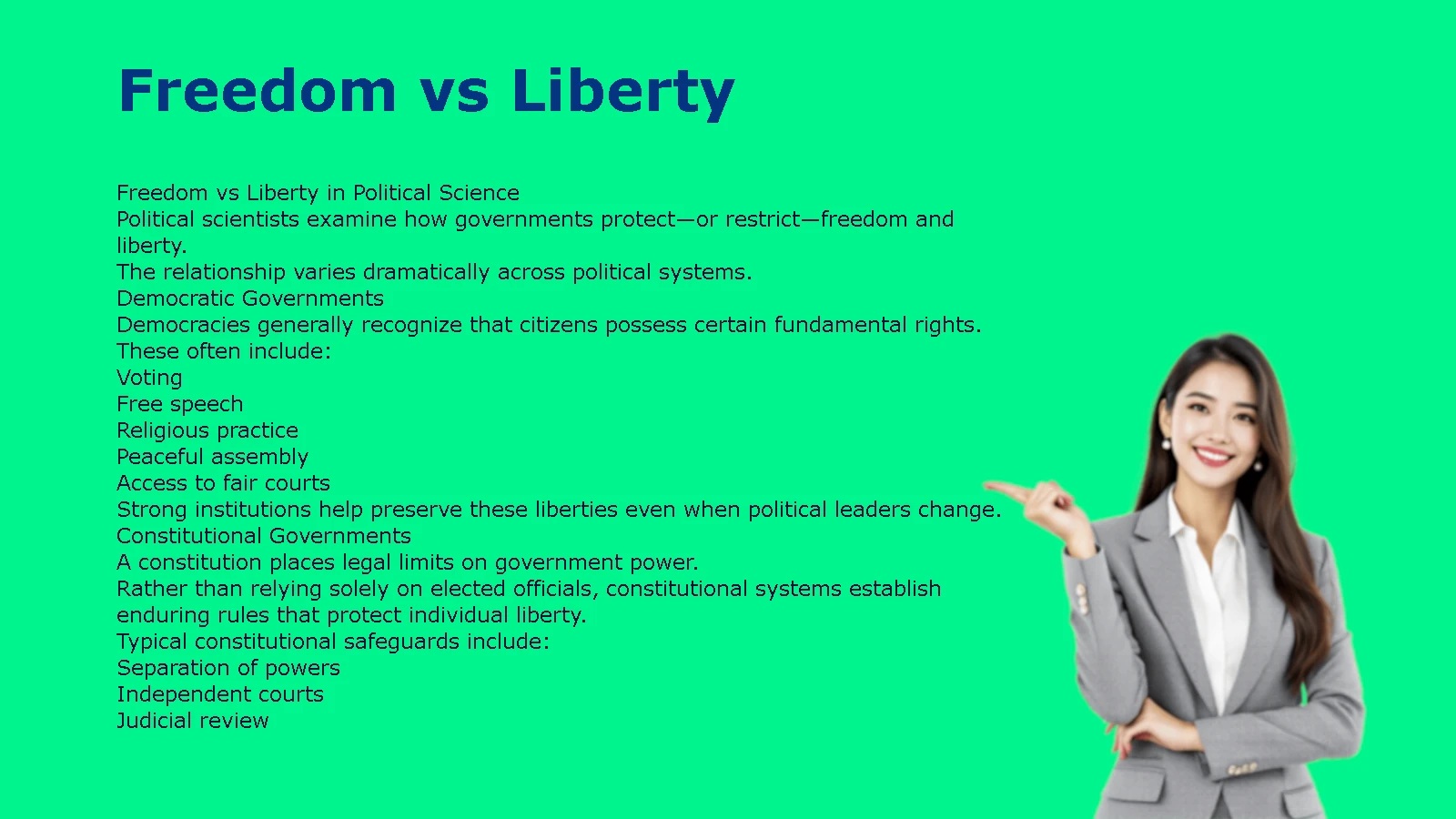
Freedom vs Liberty in Political Science
Political scientists examine how governments protect—or restrict—freedom and liberty.
The relationship varies dramatically across political systems.
Democratic Governments
Democracies generally recognize that citizens possess certain fundamental rights.
These often include:
- Voting
- Free speech
- Religious practice
- Peaceful assembly
- Access to fair courts
Strong institutions help preserve these liberties even when political leaders change.
Constitutional Governments
A constitution places legal limits on government power.
Rather than relying solely on elected officials, constitutional systems establish enduring rules that protect individual liberty.
Typical constitutional safeguards include:
- Separation of powers
- Independent courts
- Judicial review
- Due process
- Equal protection
These mechanisms reduce the risk of arbitrary government action.
Authoritarian Governments
Authoritarian systems often limit both freedom and liberty.
Common restrictions include:
- Media censorship
- Political repression
- Limited elections
- Surveillance
- Restrictions on public protest
Citizens may enjoy certain personal freedoms in private life while lacking meaningful political liberty.
Individual Rights vs. Collective Interests
Every society balances individual rights with community welfare.
Governments routinely regulate activities involving:
- Public health
- National security
- Environmental protection
- Consumer safety
- Criminal justice
The ongoing challenge lies in determining where legitimate regulation ends and unnecessary interference begins.
Freedom vs. Liberty in Law
Law transforms abstract ideals into enforceable rights.
Without legal protection, freedom can become vulnerable to changing political circumstances.
Constitutional Protection
Many constitutions explicitly protect liberties involving:
- Speech
- Religion
- Property
- Privacy
- Assembly
- Voting
These protections help ensure governments cannot easily remove fundamental rights.
Civil Rights
Civil rights guarantee equal treatment under the law.
Examples include protection against discrimination based on characteristics such as race, sex, religion, or disability, depending on a country’s legal framework.
Civil rights promote equal access to education, employment, housing, and public services.
Human Rights
Human rights extend beyond national borders.
International agreements recognize rights including:
- Life
- Liberty
- Security
- Education
- Freedom of thought
- Freedom of conscience
- Freedom of religion
Although enforcement varies, these principles influence laws around the world.
Due Process
Due process prevents governments from depriving individuals of liberty without fair legal procedures.
Important safeguards include:
- Fair hearings
- Legal representation
- Impartial judges
- Opportunity to present evidence
- Appeals
These protections strengthen public confidence in the legal system.
Freedom vs. Liberty in Everyday Life
The distinction isn’t limited to courtrooms or philosophy classrooms.
You encounter freedom and liberty almost every day.
Education
Students generally have the freedom to explore ideas, ask questions, and pursue different fields of study.
Academic institutions also establish rules that maintain respectful learning environments.
Freedom flourishes alongside reasonable standards.
Workplace
Employees enjoy many workplace freedoms, including career choices and professional development.
At the same time, employers establish policies involving:
- Safety
- Conduct
- Confidentiality
- Anti-discrimination
- Performance expectations
These rules protect both workers and organizations.
Family Life
Families make countless decisions independently.
Parents often decide:
- Educational preferences
- Religious upbringing
- Household routines
- Cultural traditions
Governments usually intervene only when necessary to protect children’s welfare or public safety.
Social Media
Social media illustrates the modern tension between freedom and responsibility.
Users enjoy remarkable opportunities to share opinions instantly with global audiences.
However, platforms also enforce policies against:
- Harassment
- Fraud
- Hate speech
- Spam
- Violent threats
Private companies create their own community standards, which differ from constitutional free speech protections.
Religion
Individuals generally enjoy the freedom to practice—or reject—a religion.
Religious liberty also protects houses of worship, charitable organizations, and faith communities from unnecessary government interference while requiring compliance with generally applicable laws.
Travel
Freedom of movement allows people to relocate, work, vacation, and visit family.
Governments may impose temporary restrictions involving:
- Border security
- Public emergencies
- Criminal investigations
- Immigration laws
These limitations illustrate how freedom often exists within carefully defined legal boundaries.
Business
Entrepreneurs benefit from economic freedom when they can innovate and compete.
Still, businesses operate within regulations designed to protect:
- Consumers
- Employees
- Investors
- Public health
- Competition
Healthy markets require both flexibility and accountability.
Healthcare
Healthcare presents one of the clearest examples of balancing freedom with broader societal interests.
Individuals generally make personal medical decisions in consultation with healthcare professionals.
Meanwhile, governments regulate:
- Drug safety
- Medical licensing
- Hospital standards
- Public health responses
Balancing individual autonomy with community well-being remains one of the most debated policy questions.
Real-World Examples of Freedom vs. Liberty
Abstract definitions become much easier to understand through practical examples.
Case Study: Freedom of Speech vs. Legal Protection
Imagine a journalist investigating government corruption.
The journalist possesses the freedom to express opinions and report facts.
That freedom becomes liberty when laws prevent officials from punishing truthful reporting simply because they dislike criticism.
Without legal protection, freedom may exist only in theory.
Case Study: Religious Practice
Consider someone who chooses to attend religious services every week.
Personal belief reflects freedom.
Constitutional safeguards protecting the right to worship without government discrimination represent liberty.
The distinction may appear subtle, yet it becomes critically important whenever governments attempt to restrict religious expression.
Case Study: Starting a Business
An entrepreneur wants to open a neighborhood bakery.
Freedom allows pursuing that dream.
Liberty protects property ownership, contract rights, and equal treatment under commercial laws.
Business regulations still apply because food safety, labor standards, and consumer protection benefit everyone.
Case Study: Privacy in the Digital Age
Modern technology raises important questions about both freedom and liberty.
People enjoy the freedom to communicate online, store personal information digitally, and participate in virtual communities.
Legal liberty enters the picture when laws regulate:
- Government surveillance
- Data collection
- Consumer privacy
- Unauthorized access
- Personal information sharing
As technology evolves, courts continue interpreting how traditional liberties apply in digital environments.
Case Study: Public Safety and Individual Rights
Public emergencies often require balancing competing interests.
For example, governments may temporarily limit certain activities during natural disasters or serious public health emergencies.
Supporters argue such measures protect society.
Critics emphasize protecting individual liberty and ensuring restrictions remain lawful, proportionate, and temporary.
These debates demonstrate that freedom and liberty rarely exist in absolute forms. Instead, societies constantly negotiate the balance between individual rights and the common good.
Common Misconceptions About Freedom vs. Liberty
Misunderstandings surrounding these concepts often lead to confusion in public discussions.
Myth: Freedom Means No Rules
Reality tells a different story.
Every organized society depends on rules that protect people from harm.
Traffic laws, criminal laws, and consumer protections all place limits on individual behavior while expanding overall freedom by creating safer communities.
Myth: Liberty Means Unlimited Rights
Liberty protects important rights, but those rights are not limitless.
Courts frequently balance competing interests, including public safety, national security, and the rights of others.
Legal systems rarely recognize any right as completely unrestricted.
Myth: Freedom and Liberty Always Mean Exactly the Same Thing
Although the words overlap, they emphasize different ideas.
- Freedom highlights the ability to choose.
- Liberty emphasizes legal protection for those choices.
Recognizing this distinction makes constitutional debates, historical documents, and political discussions much easier to understand.
Myth: One Is More Important Than the Other
Rather than competing concepts, freedom and liberty strengthen each other.
Freedom without legal protection can disappear quickly.
Liberty without meaningful opportunities to exercise personal choice becomes little more than words on paper.
A healthy society depends on both.
Can You Have Freedom Without Liberty?
At first glance, the answer seems like yes. A person living in a remote area with little government involvement may enjoy considerable freedom in daily life. They can make personal choices, move around, and manage their affairs independently.
However, that freedom may lack legal protection. If someone stronger or more powerful interferes with those choices, there may be no legal system to defend them. In that sense, freedom exists, but liberty does not.
History provides many examples.
Frontier Communities
Early frontier settlements often gave people significant personal freedom because governments had limited reach. Yet property disputes, violence, and unequal treatment were common because strong legal institutions had not fully developed.
People could act freely in many situations. Protecting those freedoms proved much harder.
Weak or Failed States
In countries where governments have collapsed or legal systems barely function, people sometimes experience fewer official restrictions.
That doesn’t necessarily mean they enjoy liberty.
Without functioning courts, police, and constitutional safeguards, citizens may face intimidation from armed groups, corruption, or organized crime. Their choices depend more on power than on law.
Why Freedom Alone Isn’t Enough
Freedom becomes fragile without institutions that defend it.
Legal systems help protect individuals from:
- Arbitrary arrest
- Property confiscation
- Political persecution
- Discrimination
- Abuse of power
That’s why stable democracies focus on preserving liberty alongside freedom.
Can You Have Liberty Without Freedom?
The opposite situation can also occur.
A constitution may guarantee numerous liberties while people struggle to exercise them in practice.
For example, a country may legally protect freedom of speech. Yet if citizens fear social retaliation, widespread intimidation, or severe economic consequences, they may hesitate to express their opinions openly.
Their liberty exists on paper, but practical freedom remains limited.
Another example involves education.
Suppose the law guarantees every child access to public education. That liberty exists legally. However, if schools are unavailable or inaccessible in certain areas, many children cannot fully benefit from that right.
This illustrates an important lesson:
Liberty establishes legal protection. Freedom reflects how fully people can actually use those protections in everyday life.
Historical Evolution of Freedom and Liberty
The meaning of freedom and liberty has changed over thousands of years.
Each generation has expanded, refined, and debated these concepts.
Ancient Civilizations
Early civilizations often limited freedom to small groups of citizens.
Women, enslaved people, and foreigners frequently lacked many rights recognized today.
Although democratic ideas emerged in some city-states, equality remained limited.
Magna Carta
Signed in 1215, the Magna Carta became one of history’s most influential legal documents.
It established that even rulers must obey certain laws.
Important principles included:
- Due process
- Fair justice
- Limits on arbitrary authority
- Protection of certain legal rights
Many constitutional traditions later built upon these ideas.
The Enlightenment
Between the seventeenth and eighteenth centuries, philosophers emphasized reason, natural rights, and limited government.
Their ideas inspired political reform across Europe and the Americas.
Major themes included:
- Individual liberty
- Equality before the law
- Religious tolerance
- Representative government
- Freedom of expression
These principles continue influencing democratic societies today.
The American Revolution
The American Revolution centered on ideas of self-government and individual rights.
Foundational documents argued that governments derive their authority from the consent of the governed and exist to protect fundamental rights.
Those ideas significantly shaped constitutional government.
The French Revolution
The French Revolution popularized the ideals of:
- Liberty
- Equality
- Fraternity
Its legacy transformed political thought throughout Europe and beyond, although the revolution itself experienced periods of both democratic reform and political violence.
Modern Constitutional Democracies
Today’s democratic constitutions generally protect numerous liberties, including:
- Free speech
- Religious freedom
- Voting rights
- Equal protection
- Due process
- Freedom of association
International human rights agreements have reinforced many of these protections across national borders.
How Different Countries Interpret Freedom and Liberty
Although many democracies share similar values, each country balances freedom and liberty differently.
United States
The United States places strong emphasis on constitutional protections for individual liberties.
Courts regularly interpret constitutional provisions involving speech, religion, privacy, and due process.
Judicial review plays an important role in resolving disputes over constitutional rights.
United Kingdom
The United Kingdom relies on a combination of statutes, judicial decisions, and long-standing constitutional traditions rather than one single written constitutional document.
Individual rights continue evolving through legislation and court decisions.
Canada
Canada protects fundamental freedoms through its constitutional framework while allowing courts to balance individual rights with broader public interests under specific legal standards.
This approach seeks both flexibility and constitutional protection.
European Democracies
Many European democracies emphasize both individual liberty and broader social protections.
Constitutions commonly recognize:
- Human dignity
- Privacy
- Freedom of religion
- Political participation
- Equality before the law
Regional human rights institutions also influence legal protections.
International Perspective
Global human rights agreements recognize numerous freedoms and liberties shared across nations.
Although implementation differs, common principles include:
- Freedom of thought
- Freedom of religion
- Freedom of expression
- Freedom from discrimination
- Equal legal protection
These shared values promote cooperation while respecting national legal systems.
Quotes That Explain Freedom and Liberty
Throughout history, influential thinkers have captured these ideas in memorable ways.
“The only freedom which deserves the name is that of pursuing our own good in our own way.” — John Stuart Mill
Mill argued that individuals should remain free to pursue their own goals provided they do not harm others.
“Where law ends, tyranny begins.” — John Locke
This statement highlights why liberty depends upon lawful limits on government power.
“Those who deny freedom to others deserve it not for themselves.” — Abraham Lincoln
Lincoln connected freedom with equality and universal human dignity.
“For to be free is not merely to cast off one’s chains, but to live in a way that respects and enhances the freedom of others.” — Nelson Mandela
Mandela emphasized that genuine freedom includes responsibility toward other people.
Freedom vs. Liberty: Which Matters More?
The debate often asks which concept deserves greater importance.
The better answer is both.
Freedom encourages creativity, innovation, personal growth, and independent thought.
Liberty protects those freedoms from arbitrary interference.
Without freedom, society becomes rigid and oppressive.
Without liberty, personal freedoms remain vulnerable whenever political power changes.
Healthy democracies depend on both principles working together.
You might think of them this way:
- Freedom is the ability to choose.
- Liberty is the legal shield protecting those choices.
Remove either one, and individual rights become weaker.
Frequently Asked Questions About Freedom vs. Liberty
Is freedom the same as liberty?
Not exactly.
Freedom generally refers to the ability to act, choose, or think without unnecessary restrictions. Liberty usually describes freedoms that receive legal recognition and protection.
Which comes first, freedom or liberty?
Many philosophers argue that freedom exists naturally because people possess the ability to make choices.
Liberty develops when societies establish laws protecting those choices.
Is liberty protected by law?
Yes.
Liberty normally depends on constitutions, legislation, judicial decisions, and legal institutions that safeguard individual rights.
Can freedom exist without government?
In theory, yes.
People may experience personal freedom without formal government. However, protecting that freedom becomes much more difficult without legal institutions.
What is the difference between civil liberty and civil rights?
Civil liberties protect individuals from excessive government interference.
Civil rights focus on equal treatment and protection against unlawful discrimination.
Both play essential roles in democratic societies.
What are positive and negative liberty?
Negative liberty means freedom from interference.
Positive liberty refers to having the ability or opportunity to achieve meaningful goals.
Political philosophers continue debating how best to balance both concepts.
Why do constitutions emphasize liberty?
Constitutions establish lasting legal protections that governments cannot easily remove.
These safeguards preserve fundamental rights even during political change.
Which term appears more often in legal documents?
Many constitutions, court decisions, and legal systems favor the word liberty because it emphasizes enforceable rights rather than broad philosophical ideas.
Key Takeaways
Understanding freedom vs. liberty becomes much easier once their different roles are clear.
- Freedom refers to your ability to think, choose, speak, and act without unnecessary restrictions.
- Liberty refers to those freedoms when they are recognized and protected by law.
- Freedom emphasizes personal autonomy.
- Liberty emphasizes constitutional safeguards and the rule of law.
- Healthy democratic societies rely on both principles rather than treating them as competing ideas.
- Rights become stronger when freedom and liberty work together.
- Courts, constitutions, and legal institutions help transform abstract freedoms into lasting liberties.
- History shows that societies flourish when governments protect individual rights while maintaining justice, equality, and public order.
Final Thoughts
Although people often use freedom and liberty as interchangeable terms, the distinction matters. Freedom reflects the human capacity to make choices and pursue personal goals. Liberty ensures those choices receive legal protection against arbitrary power.
Together, these principles form the foundation of modern constitutional democracies. They influence laws, shape public policy, guide judicial decisions, and define the relationship between individuals and government. Whether you’re studying history, political science, philosophy, or current events, understanding the difference between freedom and liberty provides valuable insight into how democratic societies protect both individual autonomy and the rule of law.