Have you ever confused Peace vs Piece because these two words sound exactly the same? Although peace and piece are pronounced alike, they have completely different meanings, spellings, and uses. Knowing the difference can help you avoid common mistakes in writing and everyday English.
Peace is a noun that means calm, freedom from conflict, or a state without war or fighting. Piece, on the other hand, usually means a part or portion of something. It can also refer to an individual item that forms part of a larger whole.
Examples:
- The two countries finally agreed to live in peace.
- Can I have a piece of cake?
The confusion is understandable. People often search for peace vs piece, difference between peace and piece, peace or piece, or peace and piece meaning because these words are homophones. They sound the same but have different meanings and spellings. And here’s the kicker: choosing the wrong word can completely change the meaning of your sentence.
In this guide, you’ll learn the complete difference between peace and piece, their definitions, pronunciations, parts of speech, and correct usage. You’ll also discover peace vs piece examples, common phrases, memory tricks, and simple ways to remember when to use peace and when to use piece.
Peace vs Piece: Quick Difference
The fastest way to understand peace vs piece is to look at what each word describes.
| Word | Meaning | Part of Speech | Example |
| Peace | Calm, harmony, or freedom from conflict | Noun | The countries signed a peace agreement. |
| Piece | A part, portion, or individual item | Noun | She ate a piece of cake. |
| Peaceful | Characterized by peace or calm | Adjective | The village was peaceful. |
| Pieces | More than one part or item | Plural noun | The puzzle has 500 pieces. |
Here’s an even simpler distinction:
Peace = calm, harmony, or no conflict.
Piece = a part of something.
Think about the two sentences:
- I need some peace.
- I need a piece.
The first person wants calm or quiet. The second person wants a portion of something.
That’s the entire difference in a nutshell.
What Does “Peace” Mean?
Peace is a noun that describes a condition of calm, harmony, or freedom from war and violence. It can apply to relationships between countries, groups, families, or individuals.
Cambridge Dictionary gives two major senses of peace: freedom from war or violence and a state of calm or freedom from worry and disturbance.
Peace as Freedom From Conflict
One of the most common meanings of peace involves the absence of war, violence, or serious conflict.
For example:
- The two nations signed a treaty to establish peace.
- The region enjoyed several years of peace.
- Leaders met to discuss a possible peace agreement.
- The organization works to promote peace around the world.
In this sense, peace is the opposite of war or violent conflict.
You might also see it in phrases such as:
- peace treaty
- peace agreement
- peace talks
- peace process
- peace negotiations
- world peace
- peace initiative
These expressions all deal with reducing or ending conflict.
Peace as Calm and Quiet
Peace doesn’t always involve countries or wars. It can also describe a personal feeling of calm.
For example:
After a long day at school, she wanted some peace and quiet.
Here, peace means freedom from noise, interruptions, stress, or disturbance.
You can also say:
- I finally found some peace.
- The garden gives me a sense of peace.
- He enjoys the peace of the countryside.
- She felt completely at peace.
This meaning is especially common when talking about emotions, environments, or everyday life.
Peace as Inner Calm
The word can describe a calm state of mind as well.
For example:
- Meditation helps him find peace.
- She was finally at peace with her decision.
- The quiet room gave her a feeling of peace.
In these examples, nobody is necessarily fighting. Instead, peace describes emotional or mental calm.
That’s an important distinction because peace can exist even when there isn’t a formal conflict to resolve.
Common Expressions With “Peace”
The word peace appears in several common English expressions.
Peace and Quiet
Peace and quiet means a calm environment without noise, interruptions, or disturbance.
- I need some peace and quiet to finish my homework.
- The library provides a little peace and quiet.
- After the guests left, the house was finally filled with peace and quiet.
This is one of the expressions most often confused with piece and quiet.
The correct phrase is always peace and quiet when you mean calm and silence.
Peace of Mind
Peace of mind means a feeling of calm or reassurance because you aren’t worried about something.
- Backing up your files gives you peace of mind.
- The safety check gave the parents peace of mind.
- Knowing the work was finished gave her peace of mind.
The correct spelling is peace of mind, not piece of mind, when you mean reassurance.
Keep the Peace
Keep the peace means to prevent or reduce conflict.
- The teacher stepped in to keep the peace.
- Someone had to keep the peace during the disagreement.
The expression can describe maintaining harmony in a family, workplace, community, or larger society.
Make Peace
Make peace means to end a disagreement or become friendly again after a conflict.
- The two friends apologized and made peace.
- The neighbors eventually made peace after their argument.
You can also say make peace with something when someone accepts a difficult fact or situation.
At Peace
At peace describes a state of calm or acceptance.
- She felt at peace after making her decision.
- The quiet surroundings helped him feel at peace.
This expression often focuses on emotional calm rather than the end of a physical conflict.
What Does “Piece” Mean?
While peace deals with calm and harmony, piece usually refers to a part, portion, or individual item.
Unlike peace, piece is often countable. You can have one piece, two pieces, or several pieces.
For example:
- I want one piece of cake.
- The vase broke into several pieces.
- She found a piece of paper on the floor.
Piece as a Portion or Part
The most basic meaning of piece is a portion of something larger.
Imagine a pizza. The entire pizza is one object, while each slice can be called a piece.
The same idea applies to countless things:
- a piece of cake
- a piece of bread
- a piece of chocolate
- a piece of paper
- a piece of wood
- a piece of glass
- a piece of fabric
For example:
He cut a small piece of bread for the child.
The bread is the larger whole. The piece is the portion taken from it.
Piece as an Individual Item
Piece can also refer to an individual item within a larger collection or category.
For example:
- The store displayed several beautiful pieces of jewelry.
- Each piece of furniture was carefully selected.
- The museum acquired an important piece of historical equipment.
Here, piece doesn’t necessarily mean a fragment that was physically cut from something. It can simply mean one individual item.
That’s a broader use of the word.
Piece as a Work of Art or Music
You can also use piece for an individual work of art, writing, or music.
For example:
- She performed a difficult piece of music.
- The museum displayed a famous piece of artwork.
- He wrote a short piece for the school newspaper.
In these sentences, piece means an individual creative work.
A song, article, painting, or composition can therefore be described as a piece.
Peace vs Piece: Key Differences Explained
The easiest way to understand peace vs piece is to compare their meanings directly.
Meaning
Peace refers to:
- calm
- tranquility
- harmony
- freedom from conflict
- freedom from war or violence
- emotional calm
Piece refers to:
- a portion
- a part
- an individual item
- a work of art or music
- a section of something larger
Consider this contrast:
The country wanted peace, while the baker offered each visitor a piece of bread.
The first word describes a condition of harmony. The second describes a portion of bread.
Spelling
The words differ by only a couple of letters:
peace
piece
The pronunciation won’t help you because the two words sound the same. Their spelling and context do the heavy lifting.
A useful visual clue is the spelling of piece. It contains pie:
PIE + CE → PIECE
That connection can help you remember that a pie can be divided into pieces.
For peace, connect it to:
peace → peaceful → calm
That gives you a simple mental shortcut.
Grammar
Both peace and piece are nouns, but they behave differently.
Peace is normally uncountable when referring to the general condition of calm or freedom from conflict:
- We all want peace.
- The country has enjoyed peace for years.
- She needs some peace and quiet.
You generally don’t say “three peaces” when talking about the general condition.
Piece, on the other hand, can be countable:
- one piece
- two pieces
- several pieces
For example:
I found three pieces of the broken vase.
This grammatical difference provides another useful clue.
Peace vs Piece Examples
Seeing the words in context makes the distinction much easier.
Examples With “Peace”
- The leaders met to discuss peace.
- Everyone deserves to live in peace.
- The village is known for its peace and quiet.
- She finally found peace after resolving the problem.
- The treaty brought a period of peace.
- He wanted some peace after a busy week.
- They worked together to maintain peace.
- The quiet landscape gave her a sense of peace.
Examples With “Piece”
- Can I have a piece of cake?
- He tore off a piece of paper.
- The machine needs a new piece of equipment.
- She found a missing piece of the puzzle.
- I bought a beautiful piece of furniture.
- The artist displayed a new piece at the gallery.
- One piece of the puzzle was missing.
- He divided the chocolate into small pieces.
Peace and Piece in the Same Sentence
Putting both words together can make the difference crystal clear.
After they made peace, they shared a piece of cake.
Here, peace means harmony after a disagreement. Piece means a portion of cake.
Another example:
The family wanted some peace and decided to share one piece of chocolate.
The meanings remain completely separate even though the words sound identical.
Peace or Piece? How to Choose the Right Word
When you’re unsure which spelling to use, don’t focus on pronunciation. Ask yourself what the word means.
Ask: “Am I Talking About Calm or Conflict?”
If the answer is yes, choose peace.
- The countries negotiated for peace.
- I need some peace and quiet.
- She wants peace of mind.
Ask: “Am I Talking About a Part or Portion?”
If you’re describing one part of something, choose piece.
- I ate a piece of fruit.
- A piece of the puzzle is missing.
- She bought a new piece of furniture.
Use This Simple Test
| If you mean… | Use… |
| Calm | peace |
| Harmony | peace |
| No war | peace |
| Freedom from conflict | peace |
| A portion | piece |
| A part | piece |
| An individual item | piece |
| A work of art or music | piece |
When in doubt, replace the word with calm or part.
If calm works, you probably need peace.
If part works, you probably need piece.
Why Are Peace and Piece Confused?
The main reason is simple: peace and piece are homophones.
A homophone is a word that has the same pronunciation as another word while having a different meaning or spelling. Cambridge Dictionary gives examples such as see and sea to illustrate the concept.
Because peace and piece sound alike, you can’t identify the correct spelling from speech alone.
Imagine someone says:
“I need a piece.”
Without any context, you don’t know whether they mean a portion of something or whether they’ve used the word in a particular expression involving peace.
Once you hear the surrounding sentence, however, the meaning becomes obvious.
That’s why homophones can be especially tricky in writing. Speaking gives you sound. Writing requires you to choose the correct spelling.
Peace vs Piece Pronunciation
Both words are pronounced /piːs/ in standard American English.
The pronunciation can be broken down roughly as:
- p — the initial consonant
- ee — the long vowel sound
- s — the final consonant
So:
peace → /piːs/
piece → /piːs/
Cambridge’s pronunciation entry lists the US pronunciation of peace as /piːs/.
This identical pronunciation explains why the spelling distinction matters so much in writing.
You can’t simply “sound out” the word and know whether to write peace or piece. Context has to guide you.
Easy Memory Tricks for Peace vs Piece
A good memory trick can save you from repeatedly making the same spelling mistake.
Remember “Peace” With “Peaceful”
Think:
peace → peaceful → calm
If you’re talking about something calm, quiet, harmonious, or free from conflict, peace is probably the word you need.
For example:
- peaceful village
- peaceful afternoon
- peaceful relationship
The shared spelling makes this connection easy to remember.
Remember “Piece” With “Pie”
Think:
piece → pie → a portion
A pie can be divided into pieces.
You can visualize a whole pie being cut into several pieces:
🥧 → pieces
This isn’t an etymological rule. It’s simply a practical spelling trick.
Remember “Piece of Cake”
The phrase piece of cake provides another strong memory hook.
When you see:
piece of cake
remember that a piece is a portion of the cake.
Meanwhile:
peace of mind
means calm or reassurance.
These two expressions form a particularly useful pair:
| Correct Expression | Meaning |
| piece of cake | Something easy or a portion of cake |
| peace of mind | A feeling of calm or reassurance |
If you remember those two phrases, you’ll have a reliable way to separate the spellings.
Common Mistakes With Peace and Piece
Most mistakes involving these words come from using the correct pronunciation with the wrong spelling.
Mistake: “Piece of Mind”
Incorrect when you mean reassurance:
- ❌ The insurance gives me piece of mind.
- ✅ The insurance gives me peace of mind.
Peace of mind refers to freedom from worry.
Mistake: “Piece and Quiet”
Incorrect when you mean calm and silence:
- ❌ I need some piece and quiet.
- ✅ I need some peace and quiet.
The expression uses peace because it describes calm.
Mistake: Using “Piece” for Harmony
- ❌ The two sides finally reached piece.
- ✅ The two sides finally reached peace.
They’re not talking about a portion of anything. They’re talking about an end to conflict.
Mistake: Using “Peace” for a Portion
- ❌ Can I have another peace of cake?
- ✅ Can I have another piece of cake?
Cake can be divided into portions. Therefore, piece is correct.
Peace of Mind vs Piece of Mind
This pair deserves special attention because it’s one of the most common mistakes involving peace vs piece.
Correct Phrase: Peace of Mind
Peace of mind means a state of calm or reassurance.
For example:
Knowing that my files are backed up gives me peace of mind.
The person isn’t asking for a physical part of their mind. They’re describing a sense of reassurance.
Other examples include:
- The security system gives us peace of mind.
- Her careful planning gave her peace of mind.
- A clear schedule can give you peace of mind.
Why “Piece of Mind” Usually Doesn’t Work
Piece of mind isn’t the standard expression when you mean calm or reassurance.
The confusion happens because piece is a familiar word meaning “part.” However, the established idiom is peace of mind.
The easiest way to remember it is:
Peace of mind = a calm mind.
If you can replace the expression with calmness or reassurance, use peace.
Peace and Quiet vs Piece and Quiet
Another common error is writing piece and quiet.
The standard phrase is:
peace and quiet
It means an environment with little noise, disturbance, or interruption.
Examples:
- I just want some peace and quiet.
- The library offers peace and quiet for studying.
- After the visitors left, we finally had some peace and quiet.
The word peace makes sense because the expression describes a calm condition.
Piece and quiet doesn’t express that meaning.
Related Words and Forms
Knowing related vocabulary can strengthen your understanding of each word.
Words Related to “Peace”
Common words and expressions include:
- peaceful — calm or free from conflict
- peacefully — in a peaceful manner
- peacemaker — a person who helps resolve conflict
- peacemaking — efforts to establish peace
- peaceful coexistence — living together without conflict
- peace treaty — a formal agreement intended to end conflict
- peace talks — discussions aimed at resolving conflict
For example:
The mediator acted as a peacemaker during the dispute.
The spelling connection between peace, peaceful, and peacemaker can help reinforce the correct form.
Words Related to “Piece”
Common forms and compounds include:
- pieces — plural of piece
- piecemeal — done gradually, one part at a time
- piecework — work paid for according to the amount completed
- masterpiece — an exceptionally successful work of art or craftsmanship
- centerpiece — a central decorative item
For example:
The artist’s latest masterpiece attracted a large audience.
These words all contain piece, which helps reinforce its spelling.
Peace vs Piece: A Closer Look at “Piece”
The word piece has more uses than simply “a portion of food.”
A Piece of an Object
- A piece of the chair broke.
- The machine is missing a piece.
- He found a piece of glass.
Here, the piece is physically part of something larger.
A Piece of Food
- a piece of cake
- a piece of fruit
- a piece of bread
- a piece of chocolate
The word refers to a portion.
A Piece of Work
Piece can also identify a creative work.
- a piece of music
- a piece of writing
- a piece of art
For example:
The composer performed a new piece of music.
Here, piece doesn’t mean a physical fragment. It means an individual creative work.
A Piece of Information
English also uses piece with abstract things.
For example:
- a piece of information
- a piece of advice
- a piece of evidence
This use is important because it shows that piece doesn’t always describe something you can physically break apart.
You can think of it as identifying one individual unit within a larger amount of information or material.
Peace vs Piece: A Practical Comparison
The following examples show how context determines the spelling.
| Sentence | Correct Word | Why |
| The nations wanted ___ after years of conflict. | peace | It means freedom from conflict. |
| She ate a ___ of cake. | piece | It means a portion. |
| I need some ___ and quiet. | peace | It means calm. |
| One ___ of the puzzle is missing. | piece | It means a part. |
| The agreement helped establish ___. | peace | It refers to harmony between sides. |
| He gave me a ___ of advice. | piece | It means one unit of advice. |
| The new security system gave her ___ of mind. | peace | The phrase means reassurance. |
| The artist displayed a new ___ of artwork. | piece | It means an individual work. |
The pattern is remarkably consistent: peace describes a condition, while piece identifies a part, portion, or individual unit.
Case Study: How Context Solves the Confusion
Consider this short situation:
A student writes:
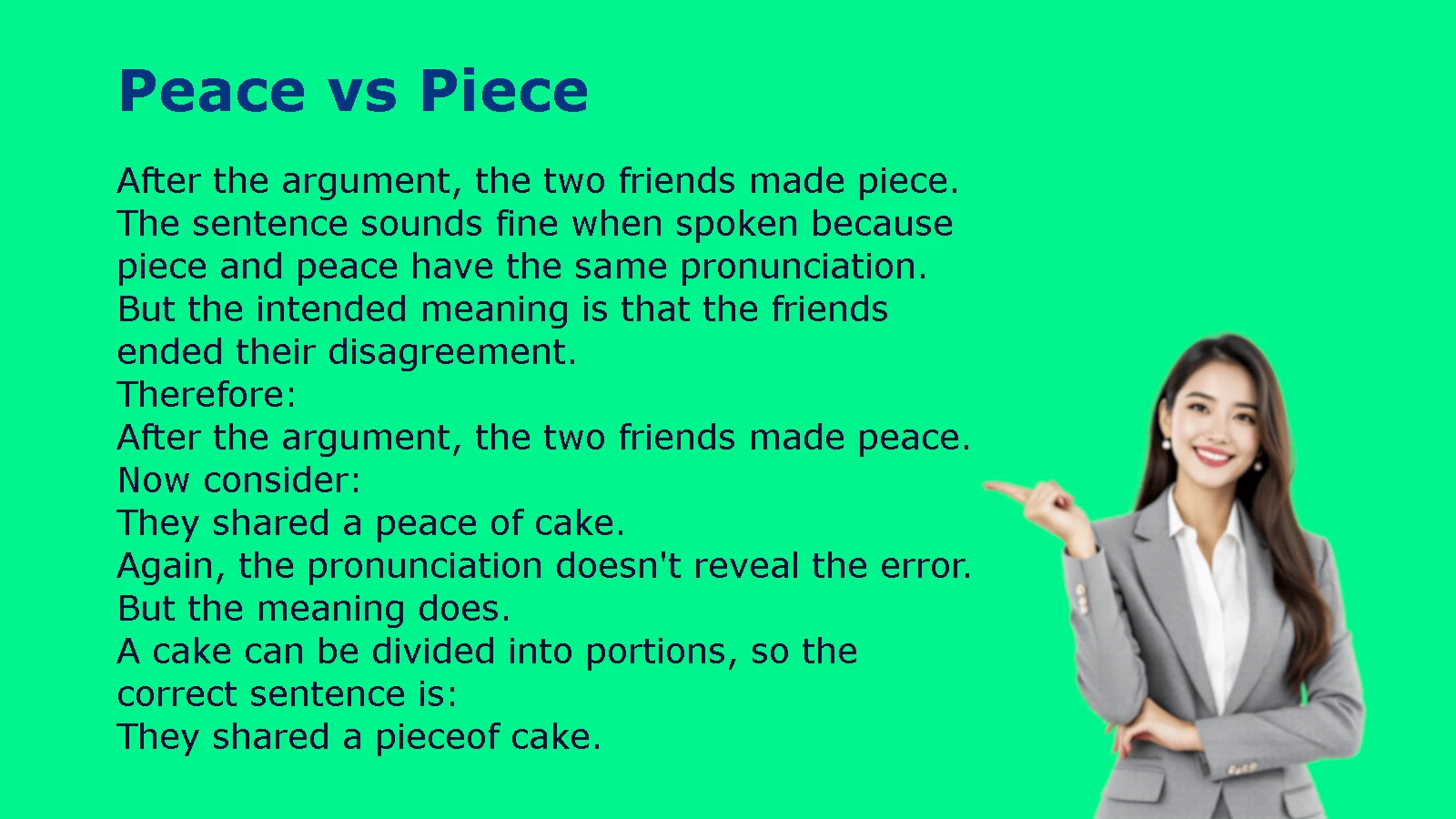
After the argument, the two friends made piece.
The sentence sounds fine when spoken because piece and peace have the same pronunciation.
But the intended meaning is that the friends ended their disagreement.
Therefore:
After the argument, the two friends made peace.
Now consider:
They shared a peace of cake.
Again, the pronunciation doesn’t reveal the error. But the meaning does.
A cake can be divided into portions, so the correct sentence is:
They shared a piece of cake.
This illustrates the central lesson of peace vs piece: meaning determines spelling.
Common Phrases: Peace vs Piece
Here’s a quick reference to some phrases worth memorizing.
Expressions With Peace
- peace and quiet
- peace of mind
- make peace
- keep the peace
- at peace
- rest in peace
- world peace
- peace agreement
- peace treaty
- peace talks
Expressions With Piece
- piece of cake
- piece by piece
- piece of advice
- piece of information
- piece of evidence
- piece of furniture
- piece of artwork
- missing piece
- centerpiece
- masterpiece
Learning these phrases as complete units can make the correct spelling much easier to recall.
Peace vs Piece: Mini Quiz
Choose peace or piece for each blank.
- The two countries finally reached ___.
- Could I have another ___ of cake?
- I need some ___ and quiet.
- One ___ of the puzzle is missing.
- The new lock gave her ___ of mind.
- He wrote a beautiful ___ of music.
- The mediator helped the groups make ___.
- She found a small ___ of paper on the desk.
- Everyone deserves to live in ___.
- The museum displayed an important ___ of artwork.
Answer Key
- peace — The sentence refers to an end to conflict.
- piece — A piece is a portion of cake.
- peace — The expression means calm and quiet.
- piece — A puzzle has individual pieces.
- peace — Peace of mind means reassurance.
- piece — A musical composition can be called a piece.
- peace — Make peace means resolve a conflict.
- piece — The paper is a portion or individual piece of material.
- peace — The sentence refers to living without conflict.
- piece — An individual work of art can be called a piece.
If you got all ten right, you’ve got the basic distinction down.
Frequently Asked Questions About Peace vs Piece
Is “peace” and “piece” the same word?
No. Peace and piece are two different words with different meanings. They happen to sound the same, which makes them homophones.
What is the difference between peace and piece?
Peace means calm, harmony, or freedom from conflict. Piece usually means a part, portion, or individual item.
For example:
- The countries worked toward peace.
- She ate a piece of cake.
Are peace and piece homophones?
Yes. In standard American English, peace and piece have the same pronunciation, /piːs/. Homophones share a pronunciation while differing in meaning or spelling.
Is it “peace of mind” or “piece of mind”?
The standard expression is peace of mind when you mean a feeling of calm or reassurance.
Example:
The backup system gives me peace of mind.
Is it “peace and quiet” or “piece and quiet”?
The correct expression is peace and quiet.
It means calmness and freedom from noise or interruption. Cambridge Dictionary specifically lists peace and quiet as an established expression.
Is “piece of cake” correct?
Yes. Piece of cake is the standard spelling.
It can literally mean a portion of cake. In the familiar idiom a piece of cake, it means something that is very easy.
Can “piece” refer to something abstract?
Yes. Piece can refer to an individual unit of something that isn’t necessarily physical, such as a piece of advice, a piece of information, or a piece of evidence.
Is “peace” countable?
In its common meanings of calm, harmony, or freedom from conflict, peace is generally treated as an uncountable noun.
For example:
- We all want peace.
- The country has enjoyed peace.
Is “piece” countable?
Yes. Piece is commonly countable.
You can say:
- one piece
- two pieces
- several pieces
- many pieces
For example:
The box contains twelve pieces.
The Easiest Way to Remember Peace vs Piece
If you remember only two connections, make them these:
Peace → peaceful → calm
Piece → pie → portion
Then remember the two common expressions:
peace of mind = reassurance
piece of cake = a portion of cake or something easy
The pronunciation won’t help because both words sound like /pees/. Instead, look at the meaning.
If the sentence involves calm, harmony, quiet, or conflict, choose peace.
If it involves a part, portion, object, food, artwork, or individual item, choose piece.
Final Takeaway: Peace vs Piece
The difference between peace vs piece is straightforward once you connect each spelling with its meaning.
Peace means a state of calm, harmony, or freedom from conflict. You use it in expressions such as peace and quiet, peace of mind, make peace, and keep the peace.
Piece means a part, portion, or individual item. You use it in phrases such as piece of cake, piece of advice, piece of information, and piece of furniture.
The tricky part is pronunciation. Both words sound the same, so you can’t rely on what you hear. When writing, stop and ask what you mean.
Peace = calm. Piece = part.
Once that distinction becomes automatic, phrases such as peace of mind and piece of cake become much easier to spell correctly.