Panicking vs Panicing can be confusing because both spellings look similar, but only one is correct in standard English. The word panicking is the correct spelling of the present participle and gerund form of panic, while panicing is a common misspelling. If you’ve wondered whether to write panicking or panicing, the difference comes down to how the final c changes when the word takes the -ing ending.
The panicking vs panicing distinction is based on the spelling rule used when forming words from verbs ending in -c. The correct form is panicking, with a double k, because the final c in panic changes to ck before adding -ing. Words such as panic, panicked, panicking, nervous, anxious, frightened, and overwhelmed are closely related to the meaning and usage of this word.
In this guide, you’ll learn whether “panicking” or “panicing” is correct, why “panicking” is spelled with a double “k,” how to use it in sentences, and what spelling rule explains the change from “panic” to “panicking.” You’ll also see clear examples and related forms to help you remember the correct spelling.
By the end, you’ll know exactly which spelling is correct—panicking or panicing—and how to use “panicking” naturally and correctly in your writing.
Why Is Panicking Spelled With a K?
The easiest way to understand panicking is to look at how English handles verbs ending in -c when they take the -ing suffix.
The base verb is:
panic
The spelling of the -ing form is:
panic → panicking
The important detail is that English adds k before -ing:
panic + k + ing = panicking
This preserves the hard /k/ sound of the final consonant.
Without the k, the form would be written panicing, which is not the standard spelling.
Oxford lists the -ing form specifically as panicking, and Cambridge likewise gives panicking as the present participle.
Why Doesn’t English Simply Write Panicing?
English spelling does not always represent a sound with the same letter in every grammatical form.
The base word panic ends in the letter c, but English commonly uses ck to represent the /k/ sound in this position when another suffix follows.
Compare these forms:
| Base verb | Correct -ing form |
| panic | panicking |
| picnic | picnicking |
| mimic | mimicking |
| traffic | trafficking |
| frolic | frolicking |
The spelling pattern helps preserve the pronunciation of the final consonant.
So panicking is not an arbitrary exception. It belongs to a recognizable spelling pattern.
Why Is Panicing Incorrect?
Panicing is incorrect because it does not follow the standard spelling of the -ing form of panic.
A common mistake is to take the base verb and attach -ing mechanically:
panic + ing = panicing
That looks plausible at first glance, especially because many English verbs can take -ing simply by adding the suffix.
For example:
- walk → walking
- read → reading
- help → helping
- jump → jumping
However, panic belongs to a group of verbs in which the spelling requires an additional k before -ing.
Therefore:
- ❌ panicing
- ✅ panicking
The same issue appears with other verbs ending in -ic.
For example:
- ❌ picnicing
- ✅ picnicking
- ❌ mimicing
- ✅ mimicking
- ❌ frolicing
- ✅ frolicking
The pattern becomes easier to remember once you recognize these related forms.
Panicking vs Panicing Examples
The difference between the two spellings is straightforward: panicking is correct, while panicing is not.
Here are examples showing the correct form in ordinary sentences:
| Correct sentence | Incorrect version |
| She is panicking about the test. | She is panicing about the test. |
| He started panicking when the alarm sounded. | He started panicing when the alarm sounded. |
| They were panicking after losing their way. | They were panicing after losing their way. |
| Stop panicking and read the instructions. | Stop panicing and read the instructions. |
| I could tell that she was panicking. | I could tell that she was panicing. |
| The passengers began panicking. | The passengers began panicing. |
The incorrect examples can look understandable because the pronunciation does not change in a way that clearly signals the missing letter.
That is one reason panicing can appear in informal writing even though it is not the accepted spelling.
Correct Examples With Different Sentence Structures
Present continuous:
She is panicking because she cannot find her passport.
After a verb such as start:
He started panicking when he realized he had missed the train.
After stop:
Try to stop panicking and focus on the problem.
After keep:
She kept panicking instead of following the emergency instructions.
As the subject of a sentence:
Panicking will not solve the problem.
After a preposition:
He was close to panicking when the computer crashed.
These examples demonstrate that panicking works naturally in several grammatical constructions.
Panicking in a Sentence
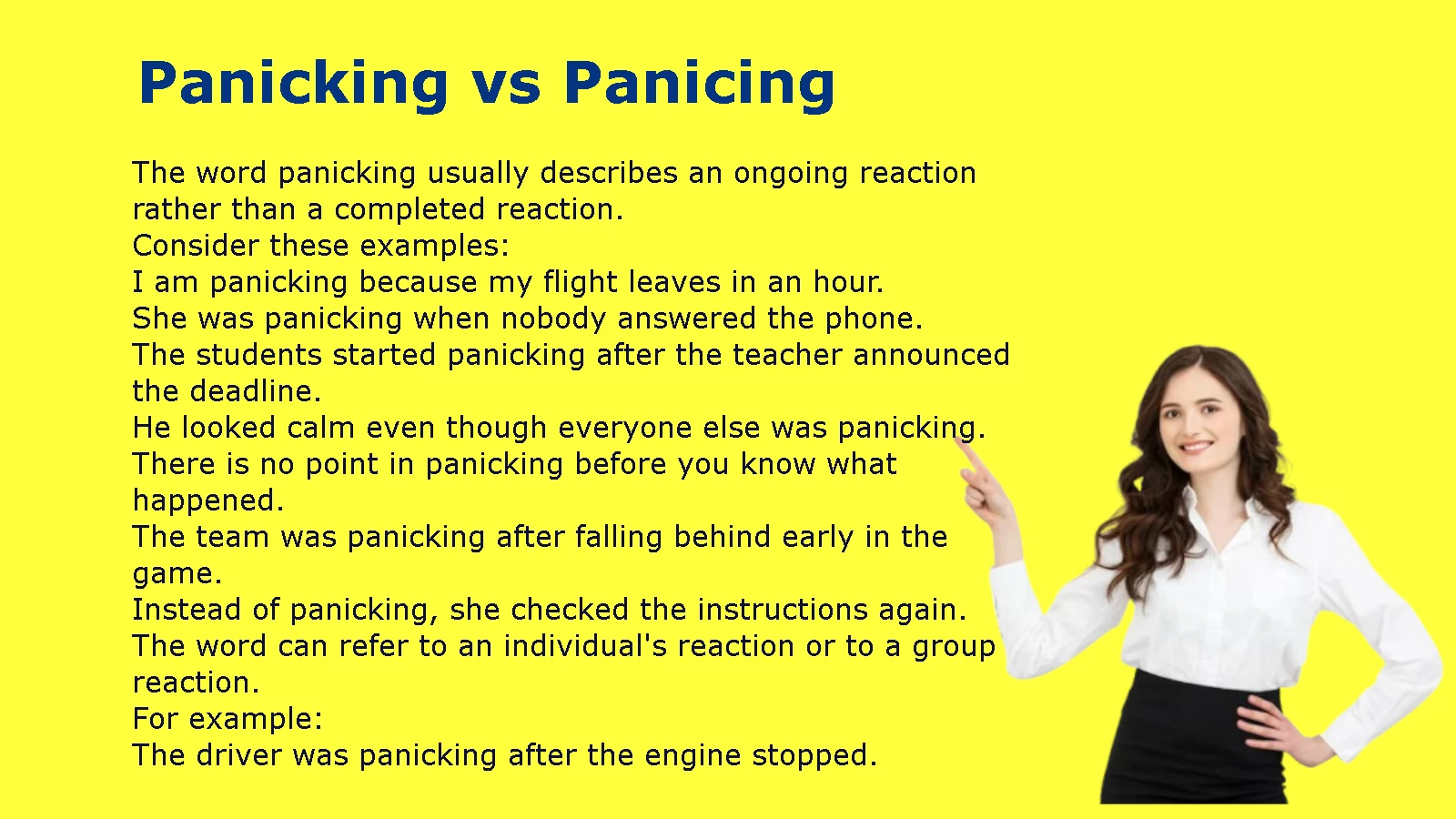
The word panicking usually describes an ongoing reaction rather than a completed reaction.
Consider these examples:
- I am panicking because my flight leaves in an hour.
- She was panicking when nobody answered the phone.
- The students started panicking after the teacher announced the deadline.
- He looked calm even though everyone else was panicking.
- There is no point in panicking before you know what happened.
- The team was panicking after falling behind early in the game.
- Instead of panicking, she checked the instructions again.
The word can refer to an individual’s reaction or to a group reaction.
For example:
The driver was panicking after the engine stopped.
This describes one person.
By contrast:
The passengers were panicking after the announcement.
Here, the same verb form describes the reaction of several people.
Cambridge gives examples of panicking in contexts involving worry, uncertainty, and stressful circumstances, confirming its normal use as the present participle of panic.
Panicking Meaning and Usage
Panicking means becoming or being extremely worried, frightened, or alarmed to the point that calm or reasonable thinking becomes difficult.
The exact intensity depends on context.
Someone can say:
I’m panicking about tomorrow’s presentation.
without necessarily describing an extreme or dangerous situation. In everyday conversation, panicking can be used somewhat loosely to describe intense worry.
The word can also describe a more serious reaction:
The passengers began panicking when smoke filled the cabin.
In that context, the reaction involves an immediate threat.
Oxford distinguishes panic from related words such as fear, terror, alarm, and fright. Panic specifically involves a sudden and difficult-to-control reaction that can interfere with clear thinking.
Common Expressions With Panicking
You will often see panicking followed by about or over when the sentence identifies the cause of the worry.
Examples include:
- panicking about the exam
- panicking about the deadline
- panicking about money
- panicking about the situation
- panicking over a mistake
- panicking over the delay
Cambridge also records the related verb patterns panic about and panic over.
Other common constructions include:
- start panicking
- begin panicking
- stop panicking
- keep panicking
- avoid panicking
- be panicking
- feel like panicking
These combinations are useful because they show how panicking functions naturally in real sentences.
Panicking Spelling Rule: How to Add -ing to Panic
A useful way to remember the spelling is to treat panic as a verb ending in -ic.
When forming its -ing form, the final c is followed by k before the suffix:
panic → panicking
This creates the spelling -cking at the end:
pani + c + k + ing
The same pattern occurs in several other English verbs.
| Base verb | -ing form |
| panic | panicking |
| picnic | picnicking |
| mimic | mimicking |
| frolic | frolicking |
| traffic | trafficking |
This is particularly useful because learning one spelling pattern can help you avoid several mistakes.
A Simple Memory Trick
Remember:
If panic is taking -ing, keep the C sound by adding K: panic → panicking.
Another quick method is to memorize the ending:
-icking
So you get:
- panicking
- mimicking
- picnicking
- frolicking
You should not write -icing in these forms.
Panicking Pronunciation
Panicking is pronounced with three syllables:
/ˈpænɪkɪŋ/
Oxford gives the pronunciation of panicking as /ˈpænɪkɪŋ/.
The pronunciation is important because the spelling mistake panicing can be difficult to notice when you hear the word.
The added k is part of the spelling needed to represent the consonant sound at the end of the first part of the word.
The word has stress on the first syllable.
Compare the forms:
- panic
- panicking
- panicked
Oxford lists panic with the pronunciation /ˈpænɪk/ and gives panicked and panicking as its past and -ing forms.
Common Mistakes With Panicking
Several mistakes can cause confusion between panicking and panicing.
Writing Panicing
This is the main spelling error.
❌ I am panicing.
Correct it to:
✅ I am panicking.
Adding -ing Without Checking the Base Word
Some writers learn a general rule that says, “Add -ing to the verb,” and apply it mechanically.
That works for many verbs but not every spelling pattern.
With panic, you need the additional k.
Confusing Spelling With Pronunciation
The pronunciation may not immediately reveal the spelling.
Someone who hears panicking may reasonably wonder whether the word should be written panicing because the c already appears in panic.
English spelling often requires you to remember a written form rather than simply reproduce every sound letter by letter.
Confusing Panicking With Panicked
These are different forms of the same verb.
| Form | Function | Example |
| panic | base verb | Don’t panic. |
| panics | third-person singular present | She panics easily. |
| panicked | past tense/past participle | He panicked yesterday. |
| panicking | -ing form | She is panicking now. |
Oxford and Cambridge both list panicked and panicking among the standard forms of panic.
Other Words Spelled Like Panicking
Learning related words can make the spelling pattern easier to remember.
Panic → Panicking
panic → panicking
Picnic → Picnicking
picnic → picnicking
For example:
We were picnicking near the lake.
Mimic → Mimicking
mimic → mimicking
For example:
The child was mimicking his father’s gestures.
Frolic → Frolicking
frolic → frolicking
For example:
The puppies were frolicking in the yard.
Traffic → Trafficking
traffic → trafficking
For example:
The organization works to prevent human trafficking.
These words demonstrate why panicking should not be treated as an isolated spelling oddity.
Panicking Synonyms
The best synonym for panicking depends on the context.
| Synonym or related expression | Typical meaning |
| freaking out | Informal expression for becoming extremely upset or alarmed |
| becoming alarmed | Developing concern about danger or a problem |
| becoming frightened | Developing fear |
| becoming anxious | Developing strong worry or unease |
| losing composure | Becoming unable to remain calm or controlled |
| becoming distressed | Becoming seriously upset or troubled |
These words are not perfect substitutes in every sentence.
For example, freaking out is strongly informal, while becoming alarmed can work in more neutral writing.
Oxford groups panic with *fear, terror, alarm, and fright, but also explains that these words differ in meaning and usage.
Panicking specifically emphasizes the process or behavior of becoming overwhelmed by fear or worry.
Panicking vs Panic
Panic and panicking come from the same verb, but they serve different grammatical roles.
Panic is the base form:
Don’t panic.
Panicking is the -ing form:
She is panicking.
The difference becomes clearer in continuous constructions.
He panics whenever he has to speak publicly.
He is panicking because he forgot his notes.
The first sentence describes a repeated or habitual reaction. The second describes an ongoing reaction.
Cambridge identifies panic as both an intransitive and transitive verb and gives panicking as its present participle.
Panicking vs Panicked
Panicked generally refers to a completed or past reaction, while panicking describes an ongoing action or state.
| Form | Example | Meaning |
| panic | Don’t panic. | Base form |
| panics | She panics under pressure. | Present, third-person singular |
| panicked | He panicked when he saw the smoke. | Past reaction |
| panicking | He is panicking now. | Ongoing reaction |
Compare:
She panicked when she heard the alarm.
The reaction occurred in the past.
She is panicking because the alarm is still sounding.
The reaction is happening now.
This distinction matters when choosing the correct verb form, especially in formal writing.
A Practical Case Study: Checking the Spelling in a Sentence
Imagine you are proofreading this sentence:
The passengers started panicing when the plane was delayed.
At first glance, the sentence seems fine. The meaning is clear, and the pronunciation would not necessarily alert you to the spelling problem.
Now identify the base verb:
panic
Next, identify the required form:
panic + -ing
The standard spelling is:
panicking
Therefore, the corrected sentence is:
The passengers started panicking when the plane was delayed.
This simple proofreading process is useful whenever you are unsure about the spelling.
The Three-Step Check
When you encounter panicing, ask:
- What is the base verb?
→ panic - What form do I need?
→ -ing form - What is the standard dictionary form?
→ panicking
This method is more reliable than trying to decide from pronunciation alone.
Panicking in Formal and Informal Writing
Panicking is appropriate in both everyday and formal writing when the meaning calls for it.
In casual writing:
I’m panicking about this deadline.
In a workplace context:
The team began panicking after the system went offline.
In academic or analytical writing:
The sudden announcement triggered a period of uncertainty, with some investors reportedly panicking over the potential consequences.
The word itself is not inherently informal.
What changes is often the surrounding vocabulary and tone.
For example, freaking out is much more conversational:
I’m freaking out about the deadline.
A more neutral version is:
I’m panicking about the deadline.
A more formal construction might be:
The announcement caused considerable alarm among investors.
Choosing among these forms depends on the audience and context.
Is Panicing Ever Correct?
In standard modern English, panicing is not the accepted spelling of the -ing form of panic.
The correct form is panicking.
If you encounter panicing online, in a message, or in an informal document, it is generally a spelling error rather than an alternative standard spelling.
Dictionary evidence is clear: Oxford lists the -ing form as panicking, and Cambridge does the same.
That makes the answer simple:
Use panicking, not panicing.
Panicking vs Panicing: Quick Comparison
| Feature | Panicking | Panicing |
| Standard English | Yes | No |
| Dictionary-listed -ing form | Yes | No |
| Base word | panic | panic |
| Correct suffix formation | panic + k + ing | Incorrect formation |
| Meaning | Becoming or being in a state of panic | Intended to mean the same thing, but misspelled |
| Suitable for formal writing | Yes | No |
| Example | She is panicking. | She is panicing. |
The key difference is only one letter, but that letter determines whether the spelling is correct.
Frequently Asked Questions About Panicking vs Panicing
Is panicking a word?
Yes. Panicking is the standard -ing form and present participle of panic. Both Oxford and Cambridge list it as the correct form.
Is panicing correct?
No. Panicing is a misspelling. The correct form is panicking.
Why does panicking have a K?
The k preserves the spelling of the final /k/ sound when the verb panic takes the -ing suffix. The standard form is panic → panicking, not panic → panicing.
How do you spell panicking?
Spell it:
P-A-N-I-C-K-I-N-G
The correct word contains ck before ing.
What is the meaning of panicking?
Panicking means becoming or being extremely worried, frightened, or alarmed, often to the point that calm or reasonable thinking becomes difficult. Cambridge and Oxford both describe panic in terms of a sudden and intense fear or worry that can interfere with calm thinking.
How do you pronounce panicking?
Oxford gives panicking as /ˈpænɪkɪŋ/. The word has three syllables and stress on the first syllable.
What is the past tense of panic?
The past tense is panicked.
She panicked when she could not find her keys.
Oxford and Cambridge both list panicked as the past form of panic.
What is the noun form of panic?
Panic itself can be a noun.
For example:
A sudden wave of panic swept through the crowd.
Oxford defines panic as a noun referring to a sudden, difficult-to-control feeling of fear, as well as a situation in which people become highly anxious and may act quickly without careful thought.
What are synonyms for panicking?
Depending on context, related expressions include becoming frightened, becoming alarmed, becoming anxious, becoming distressed, and the informal freaking out.
They are not interchangeable in every sentence because they differ in intensity, register, and meaning.
Is panicking the same as having a panic attack?
No. Panicking is a general verb form describing an ongoing reaction of intense fear or worry. A panic attack is a specific term for an episode of intense panic or anxiety. Oxford lists panic attack as a distinct expression under panic.
Can panicking be used as a noun?
Yes. The -ing form can function as a gerund in some sentences.
For example:
Panicking will not help you solve the problem.
Here, panicking functions as the subject of the sentence.
It can also appear after a preposition:
There is no benefit in panicking.
What is the difference between panicking and panicked?
Panicking generally describes an ongoing reaction, while panicked normally describes a completed or past reaction.
She is panicking right now.
She panicked when she heard the news.
Final Answer: Panicking or Panicing?
The correct spelling is panicking.
Panicing is incorrect.
The base verb is panic, and its standard -ing form is panicking. The extra k is essential to the correct spelling:
panic → panicking
Remember the pattern with similar verbs such as picnic → picnicking, mimic → mimicking, and frolic → frolicking.
If you are writing an email, essay, article, school assignment, or professional document, use panicking rather than panicing. Dictionary evidence from Oxford and Cambridge confirms panicking as the standard form.
Quick Fact to Remember
Correct: panicking
Incorrect: panicing
Once you remember panic → panicking, this particular spelling question becomes much easier to get right.