Censure or censor can be confusing because the two words look and sound similar, but they have completely different meanings and uses. If you’ve come across “censure” and “censor” and wondered which word is correct, the difference is mainly about strong criticism, official disapproval, restricting content, removing material, and controlling what can be published or shown.
The censure vs censor distinction refers to two different actions. Censure means to strongly criticize or formally express disapproval of someone or something, while censor means to examine and restrict, remove, or suppress material considered unacceptable, offensive, sensitive, or prohibited. Although both words can involve authority or judgment, they are not interchangeable.
In this guide, you’ll learn the difference between “censure” and “censor,” what each word means, how to use them in sentences, and why these commonly confused words have different meanings. You’ll also see clear examples and related forms such as censured, censored, censure, censor, censorship, and censoring.
By the end, you’ll know exactly when to use censure or censor and how to avoid confusing these two similar-looking words in your writing.
Censure or Censor: Quick Answer
Here is the simplest way to remember the difference:
Censor = restrict content. Censure = criticize or condemn.
| Word | Part of Speech | Meaning | Typical Use | Example |
| Censor | Verb, noun | Suppress or restrict content | Books, films, speech, information | The broadcaster censored the offensive language. |
| Censure | Verb, noun | Express strong or formal disapproval | People, conduct, decisions, actions | The committee censured the official. |
| Censur | — | Not the standard English spelling for these meanings | Usually a spelling error | Use censor or censure, depending on meaning. |
The distinction is supported by standard dictionary definitions. Cambridge defines censor as a verb meaning to prevent some or all of a book, film, document, artwork, or other communication from being publicly available. It defines censure as strong criticism or disapproval and, as a verb, to express that criticism or disapproval.
A one-second test
Ask yourself:
Am I restricting something?
Use censor.
Am I formally criticizing someone or something?
Use censure.
For example:
- The network censored the scene.
- The committee censured the director.
That single distinction solves most censure vs. censor questions.
What Does Censor Mean?
Censor means to examine and restrict, remove, conceal, or prevent material from being made available because it is considered objectionable, harmful, sensitive, or otherwise unsuitable.
Cambridge lists censor as both a noun and a verb. As a verb, it refers to preventing part or all of communication or other material from being seen or made available. As a noun, it can refer to a person responsible for examining such material or to a tool that performs a similar function.
The important idea is control over content.
A person, organization, government, broadcaster, publisher, website, or automated system may censor material. The material itself can include writing, speech, images, films, documents, or online posts.
Censor as a Verb
As a verb, censor describes the act of suppressing or restricting something.
Common patterns include:
- censor a book
- censor a film
- censor a report
- censor an image
- censor a speech
- censor a post
- censor information
- censor language
For example:
The editor decided to censor several passages before publication.
The editor isn’t necessarily criticizing the writer. The action is about removing or restricting material.
Another example:
The broadcaster censored the offensive language.
Again, the focus is on the language being restricted, not on formally condemning the person who used it.
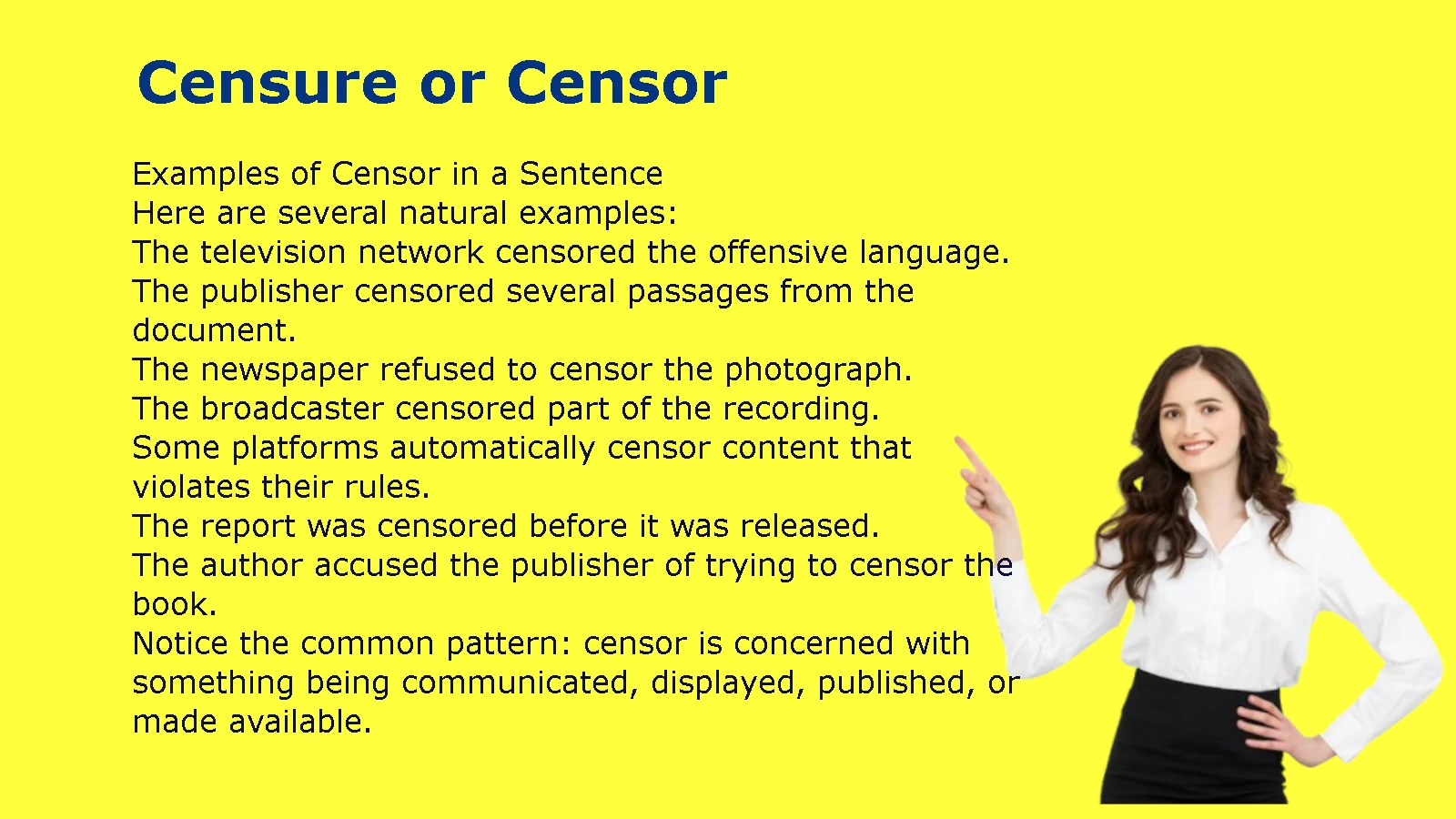
Examples of Censor in a Sentence
Here are several natural examples:
- The television network censored the offensive language.
- The publisher censored several passages from the document.
- The newspaper refused to censor the photograph.
- The broadcaster censored part of the recording.
- Some platforms automatically censor content that violates their rules.
- The report was censored before it was released.
- The author accused the publisher of trying to censor the book.
Notice the common pattern: censor is concerned with something being communicated, displayed, published, or made available.
Censor as a Noun
Censor can also be a noun.
A censor is a person or authority responsible for examining material and deciding whether some or all of it should be restricted. Cambridge also recognizes the use of censor for a computer tool that hides or blocks parts of text, images, recordings, or communications.
For example:
The government appointed a censor to review the material.
Or:
Automatic censors can identify and block certain words.
The noun and verb are closely related:
- Noun: The censor reviewed the film.
- Verb: The official decided to censor the film.
Censor and Censorship
Don’t confuse censor with censorship.
Censor can be a verb or noun.
Censorship is the practice or system of restricting communication or material.
For example:
The government censored the publication.
But:
Critics accused the government of censorship.
The distinction is similar to other word families:
| Word | Function |
| censor | Verb or noun |
| censored | Past tense/past participle |
| censoring | Present participle |
| censorship | Noun describing the practice |
Cambridge defines censorship as preventing part or all of books, films, artworks, documents, or other communication from being publicly available, as well as a system in which an authority limits what people can express or access.
What Does Censure Mean?
Censure means strong criticism or disapproval. As a verb, it means to express strong criticism or disapproval, often in a formal or official context.
The central idea is judgment or condemnation, not suppression.
You can censure a person, an organization, a decision, an action, or conduct.
For example:
The committee censured the official for violating its rules.
The committee isn’t necessarily preventing the official from speaking. Instead, it is formally expressing disapproval of the official’s behavior.
Censure as a Verb
As a verb, censure means to criticize or condemn strongly, often through an official decision or statement.
Common constructions include:
- censure someone
- censure someone for something
- be censured for misconduct
- formally censure someone
- vote to censure someone
For example:
The board censured the member for violating the organization’s code.
Or:
The official was censured for inappropriate conduct.
The construction “censured for” is particularly useful because it clearly identifies the behavior that prompted the criticism.
Examples of Censure in a Sentence
- The committee censured the official for misconduct.
- The board voted to censure the member.
- The organization censured the employee for violating its rules.
- The politician faced censure after the investigation.
- The legislature issued a formal censure.
- The judge’s conduct attracted widespread censure.
- The decision came under severe censure from critics.
Cambridge gives examples of censure being used for official criticism by bodies such as commissions, parliaments, and councils.
Censure as a Noun
Censure is also a noun meaning strong criticism or disapproval.
For example:
The official faced censure from the committee.
Here, censure refers to the criticism itself.
Compare:
The committee censured the official.
In this sentence, censured is a verb describing what the committee did.
So:
- The committee censured him. → verb
- He faced censure. → noun
Is Censure Always Official?
Not necessarily.
Censure often appears in formal or official contexts, but its meaning is broader than a specific institutional procedure. Cambridge describes it as strong criticism or disapproval and notes that it is often used for an official judgment.
For example:
His dishonest behavior came under severe censure.
That doesn’t necessarily require a formal vote or legal proceeding.
However, censure is noticeably more formal and stronger than ordinary words such as dislike or complain.
Censure vs Censor: The Key Difference
The easiest way to understand censure vs. censor is to focus on what receives the action.
Censor Means to Restrict or Suppress
When you censor something, you restrict its availability or remove part of it.
For example:
The publisher censored several passages.
The object is passages. The action affects the content.
You could also say:
The broadcaster censored the recording.
The recording is being restricted or altered.
Censure Means to Criticize or Condemn
When you censure someone or something, you express strong disapproval.
For example:
The board censured the director.
The director is the subject of formal criticism.
You could also say:
The committee censured the decision.
Here, the decision is being strongly criticized.
Side-by-Side Comparison
| Feature | Censor | Censure |
| Main meaning | Suppress or restrict | Strongly criticize or condemn |
| Common role | Verb and noun | Verb and noun |
| Typical object | Content or communication | Person, conduct, action, decision |
| Related noun | Censorship | Censure |
| Common context | Media, publishing, information | Organizations, politics, discipline, criticism |
| Example | They censored the article. | They censured the official. |
| Core idea | Control content | Express disapproval |
A useful rule is:
Censor something; censure someone.
That’s not an absolute grammatical rule, because both words can be used in somewhat broader ways. But as a memory aid, it works extremely well.
Censor and Censure in a Sentence
One of the best ways to understand the distinction is to see both words in the same context.
Consider this sentence:
The network censored the politician’s remarks, while the committee censured the politician for making them.
The two words perform completely different jobs.
The network censored the remarks because the content was restricted.
The committee censured the politician because it disapproved of the politician’s conduct.
This gives you the conceptual difference:
Censor → the content is restricted.
Censure → the conduct is criticized.
More Paired Examples
Example one:
The editor censored the controversial passage, but the publisher later censured the editor for altering the text.
The passage was restricted. The editor was criticized.
Example two:
The broadcaster censored the offensive language, while viewers censured the broadcaster for doing so.
The language was restricted. The broadcaster was criticized.
Example three:
The organization censored the report before publication and later censured the employee responsible for leaking it.
The report was restricted. The employee was formally criticized.
These examples show why replacing one word with the other can produce a completely different meaning.
Censure vs Censor Pronunciation
The pronunciation of these words is another reason they are frequently confused.
How to Pronounce Censor
Censor is commonly pronounced approximately:
SEN-ser
Cambridge gives the US pronunciation as /ˈsen.sɚ/ and the UK pronunciation as /ˈsen.sə/.
How to Pronounce Censure
Censure is commonly pronounced approximately:
SEN-shur
Cambridge gives the US pronunciation as /ˈsen.ʃɚ/ and the UK pronunciation as /ˈsen.ʃə/.
Pronunciation Comparison
| Word | US pronunciation | Simple guide |
| censor | /ˈsen.sɚ/ | SEN-ser |
| censure | /ˈsen.ʃɚ/ | SEN-shur |
The first syllable is similar, but the ending is different.
This is one reason listening alone may not immediately resolve a censure or censor question. Context is important.
Why Are Censure and Censor Confused?
There are several straightforward reasons.
They Look Similar
Both words begin with cens-:
- censor
- censure
Only a few letters separate them.
They Sound Similar
Both begin with a sound similar to “SEN.”
The difference becomes clearer at the end:
- censor → “ser”
- censure → “shur”
Their Meanings Can Appear in Similar Discussions
Both words can occur when people discuss controversial material, public behavior, institutions, or criticism.
For example, a newspaper article could mention both censorship and criticism. But that doesn’t make censor and censure synonyms.
Their meanings remain distinct:
Censor = restrict what is communicated.
Censure = express disapproval about conduct or an action.
Common Mistakes With Censure and Censor
Because the words are so similar, certain mistakes appear repeatedly.
Mistake: Using Censure for Removing Content
Incorrect:
The television station censured the offensive scene.
If the station removed, blocked, or edited the scene, censored is the appropriate word.
Correct:
The television station censored the offensive scene.
The scene is the content being restricted.
Mistake: Using Censor for Formal Criticism
Incorrect:
The committee censored the official for misconduct.
If the committee formally expressed disapproval of the official’s behavior, use censured.
Correct:
The committee censured the official for misconduct.
Mistake: Treating Censure as a Synonym for Censorship
Censure does not mean censorship.
Compare:
The film was subject to censorship.
This means its content was restricted.
But:
The film received censure from critics.
This means critics strongly disapproved of it.
The difference is significant.
Mistake: Assuming Censor Always Means Government Control
Government censorship is one well-known use, but censor is not limited to governments.
A publisher, broadcaster, organization, website, automated system, or individual can censor material depending on the context. Cambridge’s definition covers books, films, artworks, documents, and other forms of communication, as well as computer tools that hide or block content.
Mistake: Assuming Censure Always Means a Legal Punishment
Censure can have serious consequences in institutional contexts, but the word itself means strong criticism or disapproval. It does not automatically mean a fine, criminal conviction, or other legal penalty.
For example:
The committee issued a censure.
That tells you that strong disapproval was expressed. You need additional information to know whether anything else happened.
Censor vs Censure: Easy Memory Trick
A good memory trick is to connect each word with a related concept.
Censor = Content
Think:
Censor → Content
If the issue is content, such as a book, image, statement, recording, or publication, censor may be the correct word.
Censure = Condemn
Think:
Censure → Condemn
If the meaning is condemn, criticize, or express strong disapproval, choose censure.
The Shortest Rule
Censor content. Censure conduct.
It’s an easy way to separate the two when you’re writing quickly.
Censor, Censure, and Related Words
Understanding the related words makes the distinction even clearer.
Censor vs Censorship
Censor can be a verb:
They censored the report.
Censor can also be a noun:
The censor reviewed the report.
Censorship is the broader practice:
The report became subject to censorship.
Cambridge defines censorship as the action or system of preventing some or all of communication from being publicly available.
Censure vs Criticism
Criticism is a broad term for expressing disapproval or evaluating something negatively.
Censure is stronger and more formal.
For example:
The reviewer offered some criticism of the proposal.
This could be ordinary evaluation.
But:
The organization issued a censure of the proposal.
This suggests strong, formal disapproval.
Cambridge’s thesaurus groups censure with words such as criticize, condemn, denounce, chastise, castigate, and decry, while noting differences in tone and formality among them.
Censure vs Condemn
Condemn is broader than censure.
You can condemn a policy, action, behavior, statement, or person.
Censure particularly emphasizes strong disapproval or formal criticism.
For example:
The organization condemned the decision.
The organization censured the official responsible for the decision.
Both express disapproval, but the second emphasizes formal criticism of the official.
Is “Censur” a Correct English Word?
If you’re searching for “censure or censur,” the spelling needs clarification.
For the English meanings discussed in this article, censur is not the standard spelling.
The two standard English words are:
- censor
- censure
So the correct choice depends on your intended meaning.
Censur vs Censure
If you mean formal criticism or strong disapproval, the correct spelling is:
censure
Example:
The official faced censure for misconduct.
If you mean to restrict or suppress content, the correct spelling is:
censor
Example:
The publisher decided to censor the material.
Censur vs Censor vs Censure
| Spelling | Standard English word for this meaning? | Meaning |
| Censor | Yes | Suppress or restrict content |
| Censure | Yes | Strongly criticize or formally express disapproval |
| Censur | No | Not the standard English spelling for either meaning |
Therefore, if you typed “censur” while trying to choose between these words, you probably need either censor or censure.
Censure or Censor: Which Word Should You Use?
Use this decision guide whenever you’re unsure.
Use Censor When You Mean:
- Restrict content
- Remove part of a text
- Block information
- Hide an image
- Suppress a scene
- Remove offensive language
- Prevent material from being publicly available
Examples:
The editor censored the passage.
The broadcaster censored the language.
The platform censored the post.
Use Censure When You Mean:
- Strongly criticize
- Formally condemn
- Express disapproval
- Reprimand someone
- Officially criticize conduct
- Disapprove of an action
Examples:
The committee censured the official.
The board censured the employee for misconduct.
The decision attracted widespread censure.
A Simple Decision Tree
Are you talking about content being blocked, removed, hidden, or restricted?
→ Use censor.
Are you talking about criticism or formal disapproval?
→ Use censure.
Are you trying to spell “censur”?
→ Check whether you mean censor or censure.
Censure or Censor: Real-World Usage
The distinction becomes easier when you look at the kinds of situations in which each word naturally appears.
Publishing
A publisher might censor a passage by removing it from a publication.
A professional organization might censure an author for violating its standards.
The first concerns content. The second concerns conduct.
Broadcasting
A broadcaster may censor language or images before transmission.
Viewers might censure the broadcaster for its decision.
Again, the actions are different.
Organizations
A committee might censure a member for breaking its rules.
It could also censor a document before releasing it.
The same organization can therefore censor a document and censure a member, but the two actions have different purposes.
Public Officials
A governing body can censure an official when it formally expresses disapproval of the official’s behavior.
The word is particularly common in formal institutional and political contexts. Cambridge gives examples involving legislatures, commissions, councils, and officials.
A Practical Case Study: One Situation, Two Different Words
Imagine that an organization discovers inappropriate material in a report.
The organization decides to remove several passages before publishing the report.
That action is censorship:
The organization censored the report.
Later, investigators determine that an employee deliberately violated the organization’s rules.
The organization formally expresses its disapproval of the employee’s conduct.
That action is censure:
The organization censured the employee.
What changed?
| Action | Correct word | Reason |
| Removing passages | Censor | Content was restricted |
| Formally criticizing the employee | Censure | Conduct was condemned |
| The practice of restricting the report | Censorship | Refers to the system/action |
| The formal criticism | Censure | Refers to strong disapproval |
This is the distinction in its clearest form.
Examples: Choose Censure or Censor
Test yourself with these sentences.
Example One
The editor decided to ______ several sections of the report before publication.
Answer: censor
The sections are being restricted or removed.
Example Two
The committee voted to ______ the official for misconduct.
Answer: censure
The committee is formally expressing disapproval.
Example Three
The broadcaster ______ the offensive language.
Answer: censored
The language was restricted.
Example Four
The official faced public ______ after the investigation.
Answer: censure
The official faced strong criticism or disapproval.
Example Five
The newspaper was accused of ______ important information.
Answer: censoring
The newspaper was accused of suppressing information.
Example Six
The board issued a formal ______ of the employee’s conduct.
Answer: censure
Here censure is a noun meaning strong or formal disapproval.
Quick Reference: Censure vs Censor Examples
| Meaning | Correct sentence |
| Restrict content | The publisher censored the article. |
| Restrict language | The broadcaster censored the profanity. |
| Restrict an image | The editor censored the image. |
| Criticize an official | The committee censured the official. |
| Criticize misconduct | The board censured the employee. |
| Express formal disapproval | The organization issued a censure. |
| Practice of restricting content | The report became subject to censorship. |
Frequently Asked Questions About Censure or Censor
Is it censure or censor?
Both are correct English words, but they have different meanings. Censor means to suppress or restrict content, while censure means to express strong criticism or disapproval.
What is the difference between censure and censor?
Censor involves restricting information or communication. Censure involves strongly criticizing or formally expressing disapproval of someone, something, or an action.
A simple rule is:
Censor content; censure conduct.
Is censure a synonym for censor?
No. They are not synonyms.
Censure means strong criticism or disapproval.
Censor means to suppress or restrict material.
Their similar spelling and pronunciation are what make them easy to confuse.
Is “censur” a word?
Censur is not the standard English spelling for the meanings discussed here. If you mean to restrict content, use censor. If you mean strong or formal criticism, use censure.
How do you use censure in a sentence?
You can use censure as either a noun or a verb.
Verb:
The committee censured the official for misconduct.
Noun:
The official faced censure from the committee.
How do you use censor in a sentence?
You can also use censor as a noun or verb.
Verb:
The publisher censored several passages.
Noun:
A government censor reviewed the material.
Are censure and censor pronounced the same?
No. They are similar but not identical. Censor is commonly pronounced approximately “SEN-ser,” while censure is approximately “SEN-shur.” Cambridge provides distinct pronunciations for the two words.
What is the noun form of censor?
Censor itself can be a noun referring to a person or tool that examines or blocks material. Censorship is the noun referring to the practice or system of restricting material.
Is censure always formal?
Censure is generally a formal word, and it is especially common when strong criticism is expressed officially. However, the word can also describe strong disapproval more generally.
Can you censor a person?
Usually, censor refers to restricting what someone says, writes, publishes, or communicates rather than criticizing the person. You can say someone was censored in the sense that their speech or communication was restricted, but if you mean that the person was formally criticized, censure is the better word.
Can you censure an action?
Yes. Censure can refer to strong disapproval of an action, decision, conduct, or behavior as well as criticism directed at a person.
For example:
The board censured the decision as a serious violation of its policy.
Censure or Censor: Final Comparison
The difference between censure and censor becomes straightforward once you focus on their core actions.
Censor is about restriction. It is used when content, communication, information, or material is blocked, removed, hidden, or otherwise prevented from being available.
Censure is about disapproval. It is used when someone strongly criticizes or formally condemns a person, action, decision, or conduct.
The related noun censorship refers to the practice of restricting communication or other material. Censure, meanwhile, can itself be a noun meaning strong criticism or disapproval.
The easiest rule to remember
Censor = suppress content.
Censure = express disapproval.
| If you mean… | Use |
| Remove part of a book | censor |
| Block offensive language | censor |
| Restrict information | censor |
| Restrict an image or scene | censor |
| Formally criticize an official | censure |
| Condemn someone’s conduct | censure |
| Express strong disapproval | censure |
| Formal criticism by an organization | censure |
| The practice of restricting content | censorship |
| The spelling “censur” | Use censor or censure, depending on meaning |
So, if you’re choosing between censure or censor, don’t base your choice on how the words look. Focus on the action.
If something is being restricted or suppressed, use censor.
If someone or something is being strongly criticized or formally condemned, use censure.
That simple distinction will help you use both words accurately in formal writing, academic work, journalism, and everyday English.
Censure or Censor: What’s the Difference?
If you’re wondering whether the correct word is censure or censor, the answer depends on what you mean. Censor means to suppress, remove, or restrict content, while censure means to express strong or formal disapproval of someone or something. They look and sound similar, but they are not interchangeable.
This distinction is especially useful in formal writing because using the wrong word can completely change the meaning of a sentence. You might censor a movie, but you would censure an official for misconduct.
The spelling “censur” can also cause confusion. In standard English, the relevant words are censor and censure. If you are trying to express formal criticism, the spelling is censure.
Censure or Censor: Quick Answer
Here is the simplest way to remember the difference:
Censor = restrict content. Censure = criticize or condemn.
| Word | Part of Speech | Meaning | Typical Use | Example |
| Censor | Verb, noun | Suppress or restrict content | Books, films, speech, information | The broadcaster censored the offensive language. |
| Censure | Verb, noun | Express strong or formal disapproval | People, conduct, decisions, actions | The committee censured the official. |
| Censur | — | Not the standard English spelling for these meanings | Usually a spelling error | Use censor or censure, depending on meaning. |
The distinction is supported by standard dictionary definitions. Cambridge defines censor as a verb meaning to prevent some or all of a book, film, document, artwork, or other communication from being publicly available. It defines censure as strong criticism or disapproval and, as a verb, to express that criticism or disapproval.
A one-second test
Ask yourself:
Am I restricting something?
Use censor.
Am I formally criticizing someone or something?
Use censure.
For example:
- The network censored the scene.
- The committee censured the director.
That single distinction solves most censure vs. censor questions.
What Does Censor Mean?
Censor means to examine and restrict, remove, conceal, or prevent material from being made available because it is considered objectionable, harmful, sensitive, or otherwise unsuitable.
Cambridge lists censor as both a noun and a verb. As a verb, it refers to preventing part or all of communication or other material from being seen or made available. As a noun, it can refer to a person responsible for examining such material or to a tool that performs a similar function.
The important idea is control over content.
A person, organization, government, broadcaster, publisher, website, or automated system may censor material. The material itself can include writing, speech, images, films, documents, or online posts.
Censor as a Verb
As a verb, censor describes the act of suppressing or restricting something.
Common patterns include:
- censor a book
- censor a film
- censor a report
- censor an image
- censor a speech
- censor a post
- censor information
- censor language
For example:
The editor decided to censor several passages before publication.
The editor isn’t necessarily criticizing the writer. The action is about removing or restricting material.
Another example:
The broadcaster censored the offensive language.
Again, the focus is on the language being restricted, not on formally condemning the person who used it.
Examples of Censor in a Sentence
Here are several natural examples:
- The television network censored the offensive language.
- The publisher censored several passages from the document.
- The newspaper refused to censor the photograph.
- The broadcaster censored part of the recording.
- Some platforms automatically censor content that violates their rules.
- The report was censored before it was released.
- The author accused the publisher of trying to censor the book.
Notice the common pattern: censor is concerned with something being communicated, displayed, published, or made available.
Censor as a Noun
Censor can also be a noun.
A censor is a person or authority responsible for examining material and deciding whether some or all of it should be restricted. Cambridge also recognizes the use of censor for a computer tool that hides or blocks parts of text, images, recordings, or communications.
For example:
The government appointed a censor to review the material.
Or:
Automatic censors can identify and block certain words.
The noun and verb are closely related:
- Noun: The censor reviewed the film.
- Verb: The official decided to censor the film.
Censor and Censorship
Don’t confuse censor with censorship.
Censor can be a verb or noun.
Censorship is the practice or system of restricting communication or material.
For example:
The government censored the publication.
But:
Critics accused the government of censorship.
The distinction is similar to other word families:
| Word | Function |
| censor | Verb or noun |
| censored | Past tense/past participle |
| censoring | Present participle |
| censorship | Noun describing the practice |
Cambridge defines censorship as preventing part or all of books, films, artworks, documents, or other communication from being publicly available, as well as a system in which an authority limits what people can express or access.
What Does Censure Mean?
Censure means strong criticism or disapproval. As a verb, it means to express strong criticism or disapproval, often in a formal or official context.
The central idea is judgment or condemnation, not suppression.
You can censure a person, an organization, a decision, an action, or conduct.
For example:
The committee censured the official for violating its rules.
The committee isn’t necessarily preventing the official from speaking. Instead, it is formally expressing disapproval of the official’s behavior.
Censure as a Verb
As a verb, censure means to criticize or condemn strongly, often through an official decision or statement.
Common constructions include:
- censure someone
- censure someone for something
- be censured for misconduct
- formally censure someone
- vote to censure someone
For example:
The board censured the member for violating the organization’s code.
Or:
The official was censured for inappropriate conduct.
The construction “censured for” is particularly useful because it clearly identifies the behavior that prompted the criticism.
Examples of Censure in a Sentence
- The committee censured the official for misconduct.
- The board voted to censure the member.
- The organization censured the employee for violating its rules.
- The politician faced censure after the investigation.
- The legislature issued a formal censure.
- The judge’s conduct attracted widespread censure.
- The decision came under severe censure from critics.
Cambridge gives examples of censure being used for official criticism by bodies such as commissions, parliaments, and councils.
Censure as a Noun
Censure is also a noun meaning strong criticism or disapproval.
For example:
The official faced censure from the committee.
Here, censure refers to the criticism itself.
Compare:
The committee censured the official.
In this sentence, censured is a verb describing what the committee did.
So:
- The committee censured him. → verb
- He faced censure. → noun
Is Censure Always Official?
Not necessarily.
Censure often appears in formal or official contexts, but its meaning is broader than a specific institutional procedure. Cambridge describes it as strong criticism or disapproval and notes that it is often used for an official judgment.
For example:
His dishonest behavior came under severe censure.
That doesn’t necessarily require a formal vote or legal proceeding.
However, censure is noticeably more formal and stronger than ordinary words such as dislike or complain.
Censure vs Censor: The Key Difference
The easiest way to understand censure vs. censor is to focus on what receives the action.
Censor Means to Restrict or Suppress
When you censor something, you restrict its availability or remove part of it.
For example:
The publisher censored several passages.
The object is passages. The action affects the content.
You could also say:
The broadcaster censored the recording.
The recording is being restricted or altered.
Censure Means to Criticize or Condemn
When you censure someone or something, you express strong disapproval.
For example:
The board censured the director.
The director is the subject of formal criticism.
You could also say:
The committee censured the decision.
Here, the decision is being strongly criticized.
Side-by-Side Comparison
| Feature | Censor | Censure |
| Main meaning | Suppress or restrict | Strongly criticize or condemn |
| Common role | Verb and noun | Verb and noun |
| Typical object | Content or communication | Person, conduct, action, decision |
| Related noun | Censorship | Censure |
| Common context | Media, publishing, information | Organizations, politics, discipline, criticism |
| Example | They censored the article. | They censured the official. |
| Core idea | Control content | Express disapproval |
A useful rule is:
Censor something; censure someone.
That’s not an absolute grammatical rule, because both words can be used in somewhat broader ways. But as a memory aid, it works extremely well.
Censor and Censure in a Sentence
One of the best ways to understand the distinction is to see both words in the same context.
Consider this sentence:
The network censored the politician’s remarks, while the committee censured the politician for making them.
The two words perform completely different jobs.
The network censored the remarks because the content was restricted.
The committee censured the politician because it disapproved of the politician’s conduct.
This gives you the conceptual difference:
Censor → the content is restricted.
Censure → the conduct is criticized.
More Paired Examples
Example one:
The editor censored the controversial passage, but the publisher later censured the editor for altering the text.
The passage was restricted. The editor was criticized.
Example two:
The broadcaster censored the offensive language, while viewers censured the broadcaster for doing so.
The language was restricted. The broadcaster was criticized.
Example three:
The organization censored the report before publication and later censured the employee responsible for leaking it.
The report was restricted. The employee was formally criticized.
These examples show why replacing one word with the other can produce a completely different meaning.
Censure vs Censor Pronunciation
The pronunciation of these words is another reason they are frequently confused.
How to Pronounce Censor
Censor is commonly pronounced approximately:
SEN-ser
Cambridge gives the US pronunciation as /ˈsen.sɚ/ and the UK pronunciation as /ˈsen.sə/.
How to Pronounce Censure
Censure is commonly pronounced approximately:
SEN-shur
Cambridge gives the US pronunciation as /ˈsen.ʃɚ/ and the UK pronunciation as /ˈsen.ʃə/.
Pronunciation Comparison
| Word | US pronunciation | Simple guide |
| censor | /ˈsen.sɚ/ | SEN-ser |
| censure | /ˈsen.ʃɚ/ | SEN-shur |
The first syllable is similar, but the ending is different.
This is one reason listening alone may not immediately resolve a censure or censor question. Context is important.
Why Are Censure and Censor Confused?
There are several straightforward reasons.
They Look Similar
Both words begin with cens-:
- censor
- censure
Only a few letters separate them.
They Sound Similar
Both begin with a sound similar to “SEN.”
The difference becomes clearer at the end:
- censor → “ser”
- censure → “shur”
Their Meanings Can Appear in Similar Discussions
Both words can occur when people discuss controversial material, public behavior, institutions, or criticism.
For example, a newspaper article could mention both censorship and criticism. But that doesn’t make censor and censure synonyms.
Their meanings remain distinct:
Censor = restrict what is communicated.
Censure = express disapproval about conduct or an action.
Common Mistakes With Censure and Censor
Because the words are so similar, certain mistakes appear repeatedly.
Mistake: Using Censure for Removing Content
Incorrect:
The television station censured the offensive scene.
If the station removed, blocked, or edited the scene, censored is the appropriate word.
Correct:
The television station censored the offensive scene.
The scene is the content being restricted.
Mistake: Using Censor for Formal Criticism
Incorrect:
The committee censored the official for misconduct.
If the committee formally expressed disapproval of the official’s behavior, use censured.
Correct:
The committee censured the official for misconduct.
Mistake: Treating Censure as a Synonym for Censorship
Censure does not mean censorship.
Compare:
The film was subject to censorship.
This means its content was restricted.
But:
The film received censure from critics.
This means critics strongly disapproved of it.
The difference is significant.
Mistake: Assuming Censor Always Means Government Control
Government censorship is one well-known use, but censor is not limited to governments.
A publisher, broadcaster, organization, website, automated system, or individual can censor material depending on the context. Cambridge’s definition covers books, films, artworks, documents, and other forms of communication, as well as computer tools that hide or block content.
Mistake: Assuming Censure Always Means a Legal Punishment
Censure can have serious consequences in institutional contexts, but the word itself means strong criticism or disapproval. It does not automatically mean a fine, criminal conviction, or other legal penalty.
For example:
The committee issued a censure.
That tells you that strong disapproval was expressed. You need additional information to know whether anything else happened.
Censor vs Censure: Easy Memory Trick
A good memory trick is to connect each word with a related concept.
Censor = Content
Think:
Censor → Content
If the issue is content, such as a book, image, statement, recording, or publication, censor may be the correct word.
Censure = Condemn
Think:
Censure → Condemn
If the meaning is condemn, criticize, or express strong disapproval, choose censure.
The Shortest Rule
Censor content. Censure conduct.
It’s an easy way to separate the two when you’re writing quickly.
Censor, Censure, and Related Words
Understanding the related words makes the distinction even clearer.
Censor vs Censorship
Censor can be a verb:
They censored the report.
Censor can also be a noun:
The censor reviewed the report.
Censorship is the broader practice:
The report became subject to censorship.
Cambridge defines censorship as the action or system of preventing some or all of communication from being publicly available.
Censure vs Criticism
Criticism is a broad term for expressing disapproval or evaluating something negatively.
Censure is stronger and more formal.
For example:
The reviewer offered some criticism of the proposal.
This could be ordinary evaluation.
But:
The organization issued a censure of the proposal.
This suggests strong, formal disapproval.
Cambridge’s thesaurus groups censure with words such as criticize, condemn, denounce, chastise, castigate, and decry, while noting differences in tone and formality among them.
Censure vs Condemn
Condemn is broader than censure.
You can condemn a policy, action, behavior, statement, or person.
Censure particularly emphasizes strong disapproval or formal criticism.
For example:
The organization condemned the decision.
The organization censured the official responsible for the decision.
Both express disapproval, but the second emphasizes formal criticism of the official.
Is “Censur” a Correct English Word?
If you’re searching for “censure or censur,” the spelling needs clarification.
For the English meanings discussed in this article, censur is not the standard spelling.
The two standard English words are:
- censor
- censure
So the correct choice depends on your intended meaning.
Censur vs Censure
If you mean formal criticism or strong disapproval, the correct spelling is:
censure
Example:
The official faced censure for misconduct.
If you mean to restrict or suppress content, the correct spelling is:
censor
Example:
The publisher decided to censor the material.
Censur vs Censor vs Censure
| Spelling | Standard English word for this meaning? | Meaning |
| Censor | Yes | Suppress or restrict content |
| Censure | Yes | Strongly criticize or formally express disapproval |
| Censur | No | Not the standard English spelling for either meaning |
Therefore, if you typed “censur” while trying to choose between these words, you probably need either censor or censure.
Censure or Censor: Which Word Should You Use?
Use this decision guide whenever you’re unsure.
Use Censor When You Mean:
- Restrict content
- Remove part of a text
- Block information
- Hide an image
- Suppress a scene
- Remove offensive language
- Prevent material from being publicly available
Examples:
The editor censored the passage.
The broadcaster censored the language.
The platform censored the post.
Use Censure When You Mean:
- Strongly criticize
- Formally condemn
- Express disapproval
- Reprimand someone
- Officially criticize conduct
- Disapprove of an action
Examples:
The committee censured the official.
The board censured the employee for misconduct.
The decision attracted widespread censure.
A Simple Decision Tree
Are you talking about content being blocked, removed, hidden, or restricted?
→ Use censor.
Are you talking about criticism or formal disapproval?
→ Use censure.
Are you trying to spell “censur”?
→ Check whether you mean censor or censure.
Censure or Censor: Real-World Usage
The distinction becomes easier when you look at the kinds of situations in which each word naturally appears.
Publishing
A publisher might censor a passage by removing it from a publication.
A professional organization might censure an author for violating its standards.
The first concerns content. The second concerns conduct.
Broadcasting
A broadcaster may censor language or images before transmission.
Viewers might censure the broadcaster for its decision.
Again, the actions are different.
Organizations
A committee might censure a member for breaking its rules.
It could also censor a document before releasing it.
The same organization can therefore censor a document and censure a member, but the two actions have different purposes.
Public Officials
A governing body can censure an official when it formally expresses disapproval of the official’s behavior.
The word is particularly common in formal institutional and political contexts. Cambridge gives examples involving legislatures, commissions, councils, and officials.
A Practical Case Study: One Situation, Two Different Words
Imagine that an organization discovers inappropriate material in a report.
The organization decides to remove several passages before publishing the report.
That action is censorship:
The organization censored the report.
Later, investigators determine that an employee deliberately violated the organization’s rules.
The organization formally expresses its disapproval of the employee’s conduct.
That action is censure:
The organization censured the employee.
What changed?
| Action | Correct word | Reason |
| Removing passages | Censor | Content was restricted |
| Formally criticizing the employee | Censure | Conduct was condemned |
| The practice of restricting the report | Censorship | Refers to the system/action |
| The formal criticism | Censure | Refers to strong disapproval |
This is the distinction in its clearest form.
Examples: Choose Censure or Censor
Test yourself with these sentences.
Example One
The editor decided to ______ several sections of the report before publication.
Answer: censor
The sections are being restricted or removed.
Example Two
The committee voted to ______ the official for misconduct.
Answer: censure
The committee is formally expressing disapproval.
Example Three
The broadcaster ______ the offensive language.
Answer: censored
The language was restricted.
Example Four
The official faced public ______ after the investigation.
Answer: censure
The official faced strong criticism or disapproval.
Example Five
The newspaper was accused of ______ important information.
Answer: censoring
The newspaper was accused of suppressing information.
Example Six
The board issued a formal ______ of the employee’s conduct.
Answer: censure
Here censure is a noun meaning strong or formal disapproval.
Quick Reference: Censure vs Censor Examples
| Meaning | Correct sentence |
| Restrict content | The publisher censored the article. |
| Restrict language | The broadcaster censored the profanity. |
| Restrict an image | The editor censored the image. |
| Criticize an official | The committee censured the official. |
| Criticize misconduct | The board censured the employee. |
| Express formal disapproval | The organization issued a censure. |
| Practice of restricting content | The report became subject to censorship. |
Frequently Asked Questions About Censure or Censor
Is it censure or censor?
Both are correct English words, but they have different meanings. Censor means to suppress or restrict content, while censure means to express strong criticism or disapproval.
What is the difference between censure and censor?
Censor involves restricting information or communication. Censure involves strongly criticizing or formally expressing disapproval of someone, something, or an action.
A simple rule is:
Censor content; censure conduct.
Is censure a synonym for censor?
No. They are not synonyms.
Censure means strong criticism or disapproval.
Censor means to suppress or restrict material.
Their similar spelling and pronunciation are what make them easy to confuse.
Is “censur” a word?
Censur is not the standard English spelling for the meanings discussed here. If you mean to restrict content, use censor. If you mean strong or formal criticism, use censure.
How do you use censure in a sentence?
You can use censure as either a noun or a verb.
Verb:
The committee censured the official for misconduct.
Noun:
The official faced censure from the committee.
How do you use censor in a sentence?
You can also use censor as a noun or verb.
Verb:
The publisher censored several passages.
Noun:
A government censor reviewed the material.
Are censure and censor pronounced the same?
No. They are similar but not identical. Censor is commonly pronounced approximately “SEN-ser,” while censure is approximately “SEN-shur.” Cambridge provides distinct pronunciations for the two words.
What is the noun form of censor?
Censor itself can be a noun referring to a person or tool that examines or blocks material. Censorship is the noun referring to the practice or system of restricting material.
Is censure always formal?
Censure is generally a formal word, and it is especially common when strong criticism is expressed officially. However, the word can also describe strong disapproval more generally.
Can you censor a person?
Usually, censor refers to restricting what someone says, writes, publishes, or communicates rather than criticizing the person. You can say someone was censored in the sense that their speech or communication was restricted, but if you mean that the person was formally criticized, censure is the better word.
Can you censure an action?
Yes. Censure can refer to strong disapproval of an action, decision, conduct, or behavior as well as criticism directed at a person.
For example:
The board censured the decision as a serious violation of its policy.
Censure or Censor: Final Comparison
The difference between censure and censor becomes straightforward once you focus on their core actions.
Censor is about restriction. It is used when content, communication, information, or material is blocked, removed, hidden, or otherwise prevented from being available.
Censure is about disapproval. It is used when someone strongly criticizes or formally condemns a person, action, decision, or conduct.
The related noun censorship refers to the practice of restricting communication or other material. Censure, meanwhile, can itself be a noun meaning strong criticism or disapproval.
The easiest rule to remember
Censor = suppress content.
Censure = express disapproval.
| If you mean… | Use |
| Remove part of a book | censor |
| Block offensive language | censor |
| Restrict information | censor |
| Restrict an image or scene | censor |
| Formally criticize an official | censure |
| Condemn someone’s conduct | censure |
| Express strong disapproval | censure |
| Formal criticism by an organization | censure |
| The practice of restricting content | censorship |
| The spelling “censur” | Use censor or censure, depending on meaning |
So, if you’re choosing between censure or censor, don’t base your choice on how the words look. Focus on the action.
If something is being restricted or suppressed, use censor.
If someone or something is being strongly criticized or formally condemned, use censure.
That simple distinction will help you use both words accurately in formal writing, academic work, journalism, and everyday English.