Have you ever written “maneuver” and wondered whether “manoeuvre” is the correct spelling? While Maneuver vs Manoeuvre may look like two different words, they have the same meaning and pronunciation. The main difference is where each spelling is used.
Maneuver is the standard American English spelling, while manoeuvre is the standard British English spelling. Both words can refer to a skillful movement, a carefully planned action, or a strategy used to achieve a particular result.
Examples:
- The driver made a quick maneuver to avoid the obstacle.
- The pilot performed a difficult manoeuvre during the flight.
The confusion is understandable. People often search for maneuver vs manoeuvre, maneuver or manoeuvre, maneuver meaning, or how to spell maneuver because the extra “o” can make the two spellings look like completely different words. And here’s the kicker: neither spelling is wrong. You simply need to use the one that matches your form of English.
In this guide, you’ll learn the complete difference between Maneuver and Manoeuvre, including their meaning, definition, pronunciation, spelling, correct usage, and examples in sentences. You’ll also discover when to use maneuver in American English, when to use manoeuvre in British English, and other spelling differences between American and British English.
Maneuver vs Manoeuvre: The Quick Answer
| Word | Standard variety | Meaning | Example |
| maneuver | American English | A skillful movement or strategic action | He made a quick maneuver. |
| manoeuvre | British English | A skillful movement or strategic action | He made a quick manoeuvre. |
So, which one should you use?
Use “maneuver” when writing American English. Use “manoeuvre” when writing British English.
Major dictionaries make the same distinction. Cambridge identifies maneuver as the US spelling of manoeuvre, while its British English entry identifies manoeuvre as the UK spelling of maneuver.
Merriam-Webster likewise lists manoeuvre as a chiefly British spelling of maneuver.
In other words, neither spelling is universally “more correct.” The right choice depends on the variety of English you’re using.
What Does Maneuver Mean?
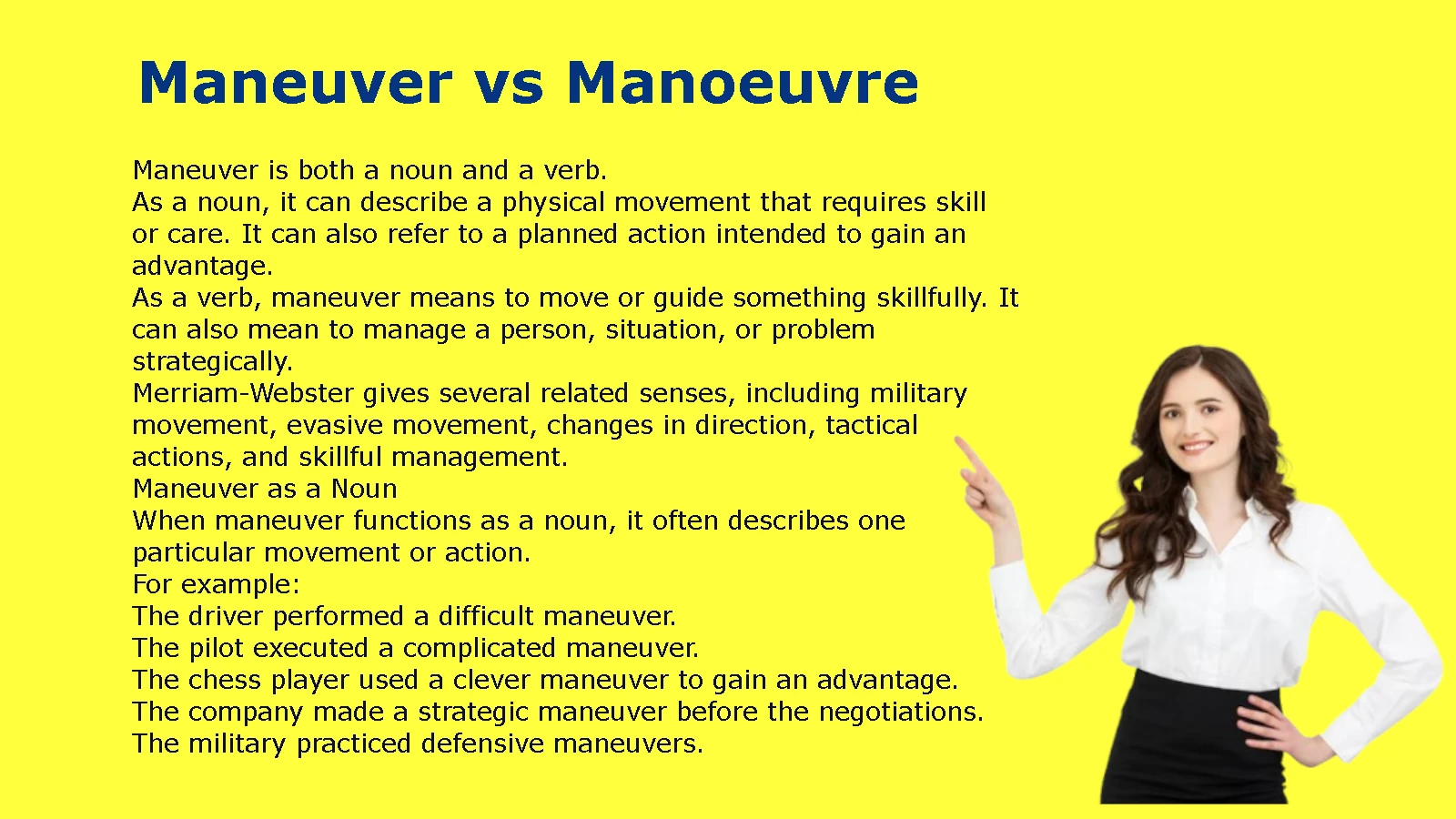
Maneuver is both a noun and a verb.
As a noun, it can describe a physical movement that requires skill or care. It can also refer to a planned action intended to gain an advantage.
As a verb, maneuver means to move or guide something skillfully. It can also mean to manage a person, situation, or problem strategically.
Merriam-Webster gives several related senses, including military movement, evasive movement, changes in direction, tactical actions, and skillful management.
Maneuver as a Noun
When maneuver functions as a noun, it often describes one particular movement or action.
For example:
- The driver performed a difficult maneuver.
- The pilot executed a complicated maneuver.
- The chess player used a clever maneuver to gain an advantage.
- The company made a strategic maneuver before the negotiations.
- The military practiced defensive maneuvers.
The word doesn’t always imply deception or competition. A maneuver can simply be a controlled movement that requires skill.
For instance, backing a large vehicle into a narrow parking space is a maneuver. No secret strategy is involved. It simply takes care and control.
The word can also become more strategic when the context calls for it.
A company might make a financial maneuver to protect its position. A politician might make a political maneuver to gain support. A chess player might make a tactical maneuver to put an opponent under pressure.
Maneuver as a Verb
As a verb, maneuver describes the act of moving, positioning, handling, or strategically managing something.
Consider these examples:
- She maneuvered the car into the garage.
- The pilot maneuvered the aircraft around the storm.
- The crew maneuvered the boat into the harbor.
- He maneuvered through the crowded room.
- The manager maneuvered the proposal into the final stage.
The verb can also describe influencing a person or situation.
For example:
The executives maneuvered the company into a stronger negotiating position.
Here, nobody is physically moving an object. The verb describes strategic management.
Cambridge similarly defines the American spelling as a verb meaning to handle and move something carefully or to cause someone to act in a particular way.
What Does Manoeuvre Mean?
Manoeuvre has the same basic meanings as maneuver. The key difference is spelling.
It is the standard form in British English.
As a noun, manoeuvre can describe a skillful movement, a military operation, or a clever action intended to gain an advantage.
As a verb, it can mean moving something carefully or trying to influence a person or situation.
Cambridge gives examples involving driving, military operations, business strategy, and influencing another person.
Manoeuvre as a Noun
Here are some natural British English examples:
- The driver performed a difficult manoeuvre.
- The pilot carried out several complex manoeuvres.
- The army conducted military manoeuvres.
- The chairman’s latest manoeuvre secured the contract.
- It was a clever political manoeuvre.
Oxford also defines manoeuvre as a movement performed with care and skill and as a clever plan, action, or movement intended to provide an advantage.
Manoeuvre as a Verb
As a verb, manoeuvre describes careful movement or strategic handling.
For example:
- She manoeuvred the car into the garage.
- The pilot manoeuvred around the obstacle.
- The boat manoeuvred into position.
- He manoeuvred carefully through the narrow passage.
- The company manoeuvred its proposal into the final agreement.
Oxford lists forms such as manoeuvres, manoeuvred, and manoeuvring for British English.
Maneuver vs Manoeuvre: The Spelling Difference
The most obvious difference is the spelling:
maneuver
manoeuvre
American English uses the shorter maneuver, while British English retains manoeuvre.
This isn’t a difference in pronunciation or meaning. It’s a regional spelling difference.
The two forms ultimately trace back to French manœuvre. Merriam-Webster gives the word’s etymology as French manœuvre, from Old French maneuvre, with roots connected to the idea of work done by hand.
That history helps explain why the spelling looks unusual to modern English speakers. English borrowed the word from French, and different English spelling traditions eventually settled on different written forms.
Why Does American English Spell It “Maneuver”?
American English generally uses maneuver.
The spelling removes the o found in the British form and presents the word in a form that fits American spelling conventions.
This isn’t unique to this word. American and British English developed several different spelling preferences over time.
For example:
| American English | British English |
| maneuver | manoeuvre |
| color | colour |
| center | centre |
| behavior | behaviour |
| honor | honour |
| labor | labour |
These pairs aren’t identical in their historical development, but they illustrate a broader point: English does not have one universal spelling system.
Why Does British English Spell It “Manoeuvre”?
British English uses the traditional manoeuvre spelling.
The sequence oeu makes the word look more closely related to the French form manœuvre, although modern British spelling is not simply a copy of French.
The important practical point is much simpler:
If the document follows British English conventions, write “manoeuvre.”
If it follows American English conventions, write “maneuver.”
Maneuver vs Manoeuvre: Pronunciation
Despite their different spellings, maneuver and manoeuvre are pronounced very similarly.
Cambridge gives the US pronunciation as approximately /məˈnuː.vɚ/ and the UK pronunciation as approximately /məˈnuː.və/.
The final sound can vary slightly because American and British English have different pronunciation patterns. However, the spelling difference itself does not create a completely different pronunciation.
The main stress falls on the second syllable.
So if you’ve learned one form but encounter the other in writing, don’t assume you’re looking at a different word.
You aren’t.
You’re seeing the same word through a different spelling system.
Maneuver vs Manoeuvre in American English
When writing for an American audience, maneuver is the natural choice.
You’ll find it in contexts involving:
- Driving
- Aviation
- Military operations
- Sports
- Politics
- Business
- Medicine
- Everyday problem solving
For example:
The driver made a three point maneuver to get out of the narrow street.
The pilot performed a difficult maneuver during the training exercise.
The company used a strategic maneuver to strengthen its position.
The doctor performed a maneuver as part of the examination.
That last example is important because maneuver isn’t limited to physical movement or military strategy. Medical terminology also uses the word for specific physical procedures or movements.
Merriam-Webster’s medical definition includes a movement, procedure, or method performed to achieve a desired result.
Maneuver vs Manoeuvre in British English
British English uses manoeuvre in the same kinds of situations.
For example:
The driver performed a difficult manoeuvre.
The pilot carried out a series of complex manoeuvres.
The government made a political manoeuvre.
The machine is easy to manoeuvre.
The boat manoeuvred carefully between the rocks.
The meaning doesn’t change simply because the spelling changes.
Cambridge’s British English entry uses manoeuvre for movement, military operations, clever actions, and strategic influence.
Maneuver vs Manoeuvre in Different Contexts
The easiest way to understand the word is to see how its meaning shifts with context.
Driving
In driving, a maneuver/manoeuvre is usually a controlled movement of a vehicle.
Examples include:
- Turning into a narrow street
- Reversing into a parking space
- Parallel parking
- Turning around in a confined area
- Positioning a vehicle beside a curb
American English:
Parallel parking is one of the most difficult maneuvers for new drivers.
British English:
Parallel parking is one of the most difficult manoeuvres for new drivers.
The meaning stays exactly the same.
Military Operations
Military writing uses maneuver/manoeuvre for planned movements of troops, ships, aircraft, or other forces.
Merriam-Webster includes military or naval movement and armed forces training exercises among the noun’s meanings.
Examples:
The army conducted several large scale maneuvers.
The army conducted several large scale manoeuvres.
The plural forms also show the spelling difference clearly:
- US: maneuvers
- UK: manoeuvres
Aviation
Pilots perform maneuvers that change an aircraft’s direction, position, or flight path.
Examples include turns, loops, climbs, descents, and other controlled changes in flight.
In American English:
The pilot performed several complex maneuvers.
In British English:
The pilot performed several complex manoeuvres.
Merriam-Webster specifically includes controlled variations from a straight and level flight path among the meanings of maneuver.
Sports
In sports, a maneuver can be a skillful movement designed to gain an advantage.
For example:
The midfielder used a clever maneuver to get past the defender.
The British form would be:
The midfielder used a clever manoeuvre to get past the defender.
Here, the word is closer to move, play, or tactic than to a simple physical repositioning.
Business
Business writing often uses maneuver/manoeuvre in a figurative sense.
For example:
The company made a strategic maneuver before entering the new market.
Or:
The company made a strategic manoeuvre before entering the new market.
The word suggests that someone made a deliberate move to improve their position.
Cambridge’s Business English material specifically uses manoeuvre for a planned action intended to gain an advantage and also recognizes the expression room for manoeuvre.
Politics
Political writing frequently uses the word to describe strategic actions.
For example:
The senator’s latest maneuver surprised several members of the party.
In British English:
The senator’s latest manoeuvre surprised several members of the party.
The word can carry a neutral or slightly negative tone depending on the context. Calling something a political maneuver can suggest careful strategy. In some contexts, it can also hint at manipulation or behind the scenes tactics.
Everyday Situations
You don’t need a battlefield or boardroom to use the word.
Consider this sentence:
She maneuvered the sofa through the narrow doorway.
Here, maneuvered simply means that she carefully moved the sofa into the desired position.
The word can therefore describe ordinary physical tasks as well as complicated strategic decisions.
Maneuver vs Manoeuvre: Noun and Verb Forms
The spelling difference continues when you change the word’s grammatical form.
| Form | American English | British English |
| Noun | maneuver | manoeuvre |
| Plural noun | maneuvers | manoeuvres |
| Verb | maneuver | manoeuvre |
| Third person | maneuvers | manoeuvres |
| Past tense | maneuvered | manoeuvred |
| Past participle | maneuvered | manoeuvred |
| Present participle | maneuvering | manoeuvring |
| Related adjective | maneuverable | manoeuvrable |
This is where writers sometimes make mistakes.
Someone may correctly write manoeuvre and then accidentally switch to the American form maneuvered later in the same paragraph.
That creates an inconsistent spelling system.
If you’re writing British English, keep the British forms together:
The driver manoeuvred the car into the space and continued manoeuvring until it was properly positioned.
For American English:
The driver maneuvered the car into the space and continued maneuvering until it was properly positioned.
Oxford confirms the British forms manoeuvred and manoeuvring, while its American English entry gives maneuvered and maneuvering.
Maneuver vs Manoeuvre Examples
A side by side comparison makes the difference easy to spot.
| American English | British English |
| The driver made a quick maneuver. | The driver made a quick manoeuvre. |
| She maneuvered the car into the garage. | She manoeuvred the car into the garage. |
| The pilot performed several maneuvers. | The pilot performed several manoeuvres. |
| The army conducted military maneuvers. | The army conducted military manoeuvres. |
| He made a clever political maneuver. | He made a clever political manoeuvre. |
| The boat maneuvered around the rocks. | The boat manoeuvred around the rocks. |
| The machine is easy to maneuver. | The machine is easy to manoeuvre. |
| The company made a strategic maneuver. | The company made a strategic manoeuvre. |
Notice something important: the sentence structure and meaning don’t need to change. Only the regional spelling changes.
Maneuver vs Manoeuvre: A Practical Case Study
Imagine an American company preparing a report for customers in the United States.
The writer uses:
The aircraft performed several complex maneuvers during the test.
That spelling fits American English.
Now imagine the same report gets adapted for a British publication.
The sentence becomes:
The aircraft performed several complex manoeuvres during the test.
The underlying information remains unchanged. There is no need to rewrite the sentence simply because the spelling changes.
Now consider a longer example.
American English
The driver carefully maneuvered the vehicle through the narrow entrance. After several small maneuvers, she managed to position it directly beside the loading area.
British English
The driver carefully manoeuvred the vehicle through the narrow entrance. After several small manoeuvres, she managed to position it directly beside the loading area.
This is why spelling consistency matters. Once the intended variety of English has been selected, related forms should follow the same system.
Common Mistakes With Maneuver and Manoeuvre
The biggest mistake is treating maneuver and manoeuvre as two words with different meanings.
They aren’t.
They are regional spellings of the same word.
Other common mistakes include the following.
Mixing the Two Spelling Systems
A sentence might begin with:
The pilot performed several manoeuvres…
and later use:
The aircraft maneuvered toward the runway.
That combination may be inappropriate if the document is supposed to follow one consistent spelling standard.
It is better to choose a regional style and stick with it.
Assuming “Manoeuvre” Is More Formal
The longer British spelling can look more formal because it contains more letters. That doesn’t make it more sophisticated or more correct.
Likewise, maneuver isn’t an informal American version.
Both forms work in formal and informal writing.
Inventing Spellings Such as “Manouver”
A common spelling error is dropping letters:
- ❌ manouver
- ❌ maneouver
- ❌ manuever
The correct forms are:
- ✅ maneuver
- ✅ manoeuvre
If you’re writing American English, remember maneuver.
If you’re writing British English, remember manoeuvre.
Forgetting the Verb Forms
The difference isn’t limited to the noun.
Don’t write:
The British report used manoeuvre but later said the pilot maneuvered.
If the document consistently follows British English, use:
The British report used manoeuvre but later said the pilot manoeuvred.
The same principle applies to maneuvering/manoeuvring.
Maneuver vs Manoeuvre and Other US vs. UK Spellings
The pair belongs to a much larger family of spelling differences between American and British English.
Some familiar examples include:
| American English | British English |
| maneuver | manoeuvre |
| color | colour |
| center | centre |
| behavior | behaviour |
| favor | favour |
| honor | honour |
| labor | labour |
| theater | theatre |
| catalog | catalogue |
However, don’t assume that every US and UK spelling difference follows exactly the same historical pattern.
For maneuver/manoeuvre, the connection to French manœuvre is particularly relevant. Merriam-Webster traces the English word through French and Old French forms associated with manual work.
The useful takeaway is practical rather than historical:
English spelling varies by region, and maneuver/manoeuvre is one clear example of that variation.
Is Maneuver or Manoeuvre More Correct?
Both are correct.
The correct spelling depends on the variety of English you’re using.
Use maneuver for American English.
Use manoeuvre for British English.
Dictionaries support this distinction directly. Cambridge labels maneuver as the US spelling and manoeuvre as the UK spelling.
Merriam-Webster also identifies manoeuvre as a chiefly British spelling of maneuver.
So the question isn’t really:
Which spelling is correct?
A better question is:
Which spelling matches the English variety I’m writing in?
That small change in thinking makes the choice much easier.
Which Spelling Should You Use?
Use “maneuver” when writing American English
Choose maneuver if you’re writing:
- For a US audience
- In American English
- For an American publication
- According to a US style guide
- For a document that consistently uses American spellings
For example:
The driver performed a difficult maneuver.
Use “manoeuvre” when writing British English
Choose manoeuvre if you’re writing:
- In British English
- For a UK audience
- For a British publication
- According to a British style guide
- In a document that consistently uses British spellings
For example:
The driver performed a difficult manoeuvre.
The key is consistency.
If the rest of your article uses color, center, and behavior, then maneuver fits naturally.
If it uses colour, centre, and behaviour, then manoeuvre is the better choice.
Maneuver vs Manoeuvre: A Simple Memory Trick
Here’s the easiest rule to remember:
Maneuver = American English
Manoeuvre = British English
Think of the longer spelling as the British form.
You can also remember the spelling visually:
US: maneuver
UK: manoeuvre
When writing American English, don’t add the extra o.
When writing British English, keep the oeu sequence.
It’s a small spelling choice, but it prevents an easy-to-spot consistency error.
Frequently Asked Questions About Maneuver vs Manoeuvre
Is “maneuver” American or British?
Maneuver is the standard American English spelling. British English generally uses manoeuvre. Cambridge explicitly identifies maneuver as the US spelling of manoeuvre.
Is “manoeuvre” American or British?
Manoeuvre is the standard British English spelling. American English normally uses maneuver.
Are maneuver and manoeuvre the same word?
Yes. They are regional spellings of the same word and generally have the same meanings and pronunciation.
Do maneuver and manoeuvre have different meanings?
No. The spelling difference does not normally create a difference in meaning. Both can refer to a skillful movement, strategic action, military operation, or carefully managed action.
How do you spell maneuver in British English?
In British English, the usual spelling is manoeuvre.
How do you spell manoeuvre in American English?
In American English, the usual spelling is maneuver.
Do maneuver and manoeuvre sound the same?
They are pronounced very similarly. American and British accents can produce slight differences, particularly in the final vowel sound, but the spelling difference itself does not represent a separate pronunciation.
Is “maneuvered” or “manoeuvred” correct?
Both are correct in their respective spelling systems:
- American English: maneuvered
- British English: manoeuvred
Is “maneuvering” or “manoeuvring” correct?
Again, both are correct:
- American English: maneuvering
- British English: manoeuvring
Which spelling should I use in academic writing?
Use the spelling required by your institution, publication, or style guide. If you’re writing American English, use maneuver. If you’re writing British English, use manoeuvre.
The important thing is to remain consistent throughout the paper.
Which spelling should I use in the US?
Use maneuver.
Which spelling should I use in the UK?
Use manoeuvre.
Maneuver vs Manoeuvre: Final Verdict
The difference between maneuver and manoeuvre is straightforward once you know the regional spelling rule.
Maneuver is the standard American English spelling.
Manoeuvre is the standard British English spelling.
Both words can function as nouns and verbs. Both can describe physical movements, military operations, strategic actions, or skillful ways of handling a situation. The core meaning doesn’t change simply because the spelling does.
| If you’re writing… | Use… |
| American English | maneuver |
| British English | manoeuvre |
| US noun plural | maneuvers |
| UK noun plural | manoeuvres |
| US past tense | maneuvered |
| UK past tense | manoeuvred |
| US -ing form | maneuvering |
| UK -ing form | manoeuvring |
So, when in doubt, don’t ask which spelling is “better.” Ask which English variety your reader expects.
American English → maneuver. British English → manoeuvre.
That’s the whole distinction, and once you lock in the regional spelling, the rest of the word’s forms fall neatly into place.