Have you ever wondered whether Licorice and Liquorice mean the same thing or if there is actually a difference between them? While Licorice vs Liquorice may look like two different words, both spellings refer to the same plant, flavor, and sweet treat.
Licorice is the standard spelling in American English, while Liquorice is the standard spelling in British English and is also commonly used in other varieties of English. The difference is mainly a matter of regional spelling, not meaning.
Examples:
- Licorice is a popular candy flavor in the United States.
- Liquorice is commonly used in British English.
The confusion is understandable. People often search for licorice vs liquorice, licorice or liquorice, is licorice and liquorice the same, or which spelling is correct because the extra u makes the words look different. And here’s the kicker: neither spelling is wrong. Your choice usually depends on which variety of English you’re using.
In this guide, you’ll learn the complete difference between Licorice and Liquorice, including their meaning, definition, pronunciation, spelling, origin, and correct usage. You’ll also discover which spelling to use in American English vs British English, with clear examples to help you choose the right form.
Licorice vs. Liquorice: What’s the Difference?
The simplest way to understand licorice vs. liquorice is to think about regional spelling rather than vocabulary.
| Spelling | Main regional use | Meaning |
| licorice | American and Canadian English | The licorice plant, root, extract, or candy |
| liquorice | British English | The same plant, root, extract, or candy |
Cambridge labels licorice as the US form and liquorice as the UK form. Collins likewise identifies licorice as the usual US and Canadian spelling and liquorice as the British form. Merriam Webster describes liquorice as a chiefly British spelling of licorice.
In other words, the extra u doesn’t change what the word means.
What Does “Licorice” Mean?
Licorice is a noun with several closely related meanings.
It can refer to:
- The plant Glycyrrhiza glabra
- The dried root of that plant
- An extract made from the root
- A flavor derived from licorice
- Candy flavored with licorice or a similar flavor
Cambridge defines the word in relation to the dried root and its use in flavoring food, particularly candy. Collins gives the plant, dried root or extract, and candy as separate senses. Merriam Webster also recognizes the plant, root preparation, and flavored candy.
So the meaning depends slightly on context.
For example:
The herbal tea contains licorice root.
Here, licorice refers to the plant material.
In:
She bought a bag of black licorice.
the word refers to candy.
And in:
The sauce has a subtle licorice flavor.
it describes a flavor characteristic.
What Does “Liquorice” Mean?
Liquorice has the same meanings as licorice. The difference lies in spelling and regional convention.
British English commonly uses liquorice:
I bought some liquorice sweets.
American English normally uses licorice:
I bought some licorice candy.
The underlying meaning remains the same. Cambridge explicitly defines liquorice as the UK form of licorice.
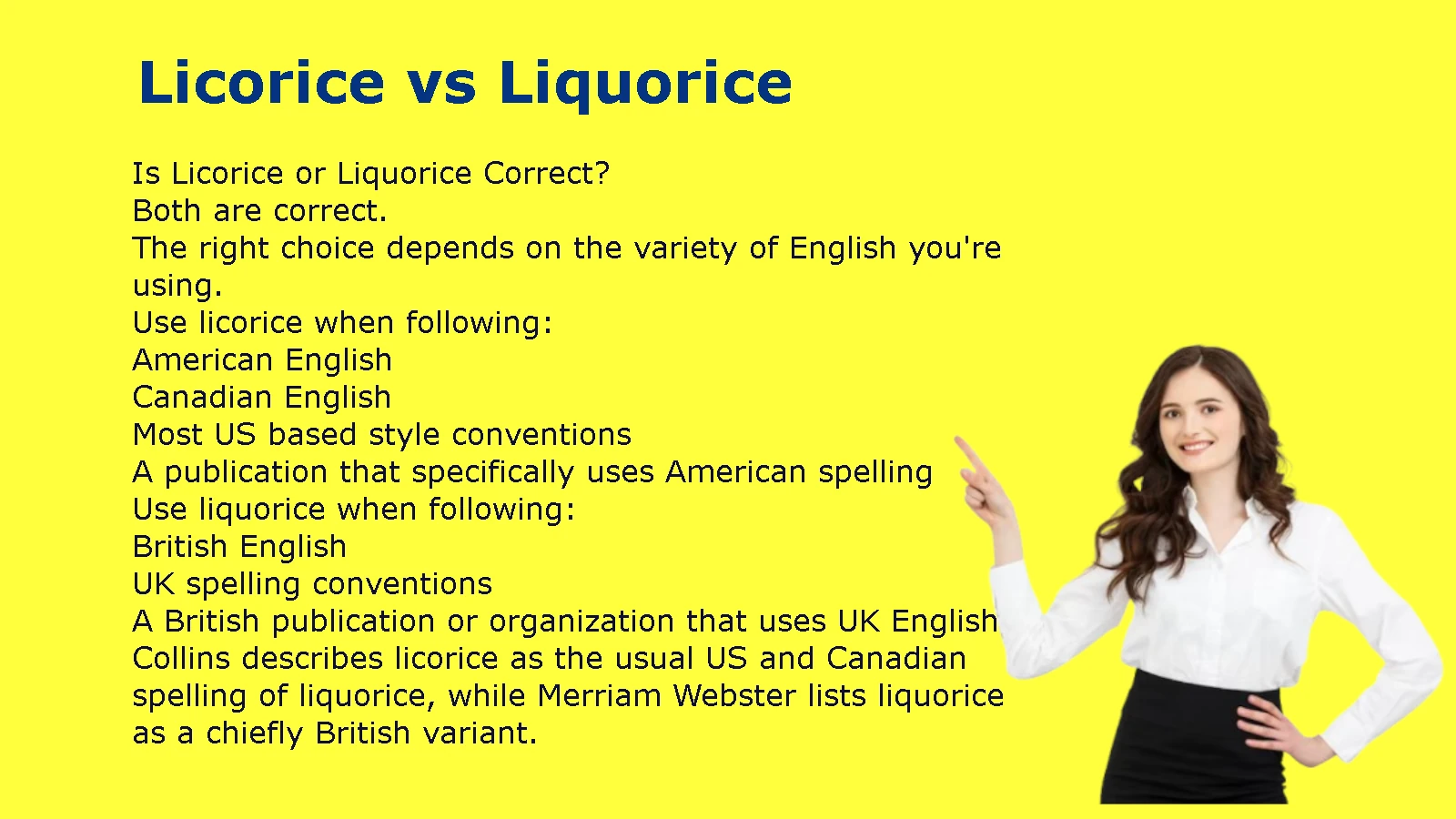
Is Licorice or Liquorice Correct?
Both are correct.
The right choice depends on the variety of English you’re using.
Use licorice when following:
- American English
- Canadian English
- Most US based style conventions
- A publication that specifically uses American spelling
Use liquorice when following:
- British English
- UK spelling conventions
- A British publication or organization that uses UK English
Collins describes licorice as the usual US and Canadian spelling of liquorice, while Merriam Webster lists liquorice as a chiefly British variant.
Neither form is inherently more correct.
That’s an important point because spelling comparisons often tempt people into thinking one version must be a mistake. English doesn’t work that way. Many established words have different spellings across English speaking regions.
Is “Liquorice” Wrong in American English?
No.
An American reader can understand liquorice without difficulty. However, licorice is the conventional American spelling, so it’s usually the better choice when writing specifically in American English.
For example, an American newspaper would normally write:
The store sells black licorice.
rather than:
The store sells black liquorice.
The second version isn’t meaningless or incomprehensible. It simply uses a spelling associated more strongly with British English.
Is “Licorice” Wrong in British English?
No.
British dictionaries recognize licorice as a spelling variant, although liquorice is the normal British form. Collins specifically lists licorice as the usual US and Canadian spelling of British liquorice.
If you’re writing for a British audience, though, consistency matters. If the rest of the article follows British spelling, liquorice will normally fit better.
Licorice vs. Liquorice in American and British English
The regional distinction becomes clearer when you place the two forms side by side.
| English variety | Preferred spelling | Example |
| American English | licorice | I don’t like black licorice. |
| Canadian English | licorice | The recipe uses licorice root. |
| British English | liquorice | I don’t like black liquorice. |
| General international English | Depends on the chosen style | Follow the publication’s regional convention. |
Cambridge identifies licorice as US and liquorice as UK. Collins goes further by identifying licorice as the usual US and Canadian spelling.
This pattern is similar to other regional spelling pairs such as color/colour and flavor/flavour. The difference doesn’t necessarily signal a difference in meaning. It often reflects the spelling system used by a particular variety of English.
Why Does American English Use “Licorice”?
The short answer is that licorice is the established North American form.
It isn’t simply a modern American invention. The spelling has a long history in English. Merriam Webster traces licorice through Middle English and Anglo French to Late Latin and Greek.
So the American spelling isn’t the result of someone recently removing the u from liquorice.
Both forms have historical roots, and the modern regional distinction developed over time.
What Is Licorice?
Licorice is a perennial leguminous plant scientifically known as Glycyrrhiza glabra. Its root has a naturally sweet taste and has been used historically in food, flavoring, and medicinal preparations.
The word can therefore refer to the plant itself or something made from its root.
Licorice as a Plant
The plant belongs to the legume family. Collins describes Glycyrrhiza glabra as a perennial plant with spikes of blue or pale blue flowers and flat pods.
The root is the part that matters most for the word’s everyday uses.
Its characteristic sweetness comes from compounds in the root, especially glycyrrhizin. That gives genuine licorice its distinctive sweet flavor.
Licorice as a Root
Dried licorice root has traditionally been used for flavoring and in various preparations.
When a product label says licorice root, the phrase refers to material derived from the plant rather than to candy.
This distinction matters because “licorice” can describe both a botanical ingredient and a finished food.
Licorice as Candy
In everyday American English, licorice often brings candy to mind.
Black licorice traditionally gets its characteristic flavor from licorice extract. However, not every candy sold as licorice relies exclusively on actual licorice root for its flavor.
Some products use other flavoring ingredients to create a licorice like taste.
That means licorice can describe the flavor profile or the candy category even when the finished product doesn’t consist simply of dried licorice root.
What Is Liquorice?
Liquorice is the British spelling of the same word.
It can describe:
- The Glycyrrhiza glabra plant
- Its dried root
- Extract made from the root
- The characteristic flavor
- Candy made with or flavored like licorice
Collins gives these same basic senses for British liquorice, including the plant, dried root, and sweets with a liquorice flavor.
So if you see liquorice sweets in a British publication, don’t assume the writer is referring to a different ingredient. The writer is simply using the British spelling.
Why Are Licorice and Liquorice Spelled Differently?
The history of licorice vs. liquorice is much older than the American and British distinction.
The word can be traced through several languages before arriving at its modern English forms.
A simplified path looks like this:
Greek glykyrrhiza → Latin glycyrrhiza → Late Latin liquiritia → Old French and Anglo French forms → Middle English → modern English
The exact historical development involves several changes, but the central idea is clear: the word didn’t begin as either modern licorice or liquorice.
The Greek Origin of Licorice
The ancient Greek word glykyrrhiza is especially revealing.
It combines elements meaning:
- glykys = sweet
- rhiza = root
The resulting sense is essentially “sweet root.”
That description fits the plant remarkably well. The root is the part that gives licorice its famous sweetness.
The word’s history therefore connects the modern English term directly to one of the plant’s defining characteristics.
How the Word Entered English
English did not borrow the word directly from modern Greek.
The term passed through Latin and French forms before appearing in Middle English. Etymonline traces the English word to forms such as Middle English licorice and Anglo French licoris, ultimately connected to Late Latin liquiritia and Greek glykyrrhiza.
Merriam Webster similarly traces licorice from Middle English through Anglo French and Late Latin back to Greek.
This explains why the modern spelling doesn’t look much like glykyrrhiza.
Words often change dramatically as they move between languages. Pronunciation, spelling, borrowing patterns, and associations can all reshape them.
Where Did the “U” in Liquorice Come From?
Here’s where the story gets particularly interesting.
The liquor portion of liquorice isn’t evidence that the plant is related to alcoholic liquor in meaning.
Historical sources describe the form as having been influenced by association with Latin liquere, meaning “become fluid,” and later by association with liquor. Etymonline specifically notes the connection between the spelling and the process of extracting the sweet substance from the root.
Collins likewise describes the historical form as being altered by association with liquor.
That distinction is worth remembering:
Liquorice does not mean “liquor + ice.”
The modern spelling developed through a complicated historical chain. It isn’t a literal combination of the English words liquor and ice.
Licorice vs. Liquorice Pronunciation
The spelling changes across regions, and pronunciation can vary too.
Cambridge lists both US and UK pronunciations for licorice. The US forms include pronunciations ending in an sh sound as well as an s sound, while the UK forms similarly include more than one listed ending.
For liquorice, Cambridge likewise gives UK and US pronunciation information.
The important lesson is that spelling and pronunciation aren’t perfectly locked together.
A British speaker may pronounce the word differently from an American speaker even when both are referring to exactly the same thing.
Does the “u” Change the Pronunciation?
Not in a simple one letter equals one sound way.
The difference between licorice and liquorice is primarily orthographic. Regional pronunciation patterns matter more than the presence of the u.
For learners of English, this is useful because you shouldn’t assume that adding or removing the u automatically creates a different pronunciation.
Licorice vs. Liquorice in a Sentence
Seeing the words in context makes the difference much easier to remember.
| American English | British English |
| I bought some licorice candy. | I bought some liquorice sweets. |
| She likes black licorice. | She likes black liquorice. |
| The recipe calls for licorice root. | The recipe calls for liquorice root. |
| The tea has a mild licorice flavor. | The tea has a mild liquorice flavor. |
| The store sells licorice extract. | The store sells liquorice extract. |
Notice something important: the spelling changes, but the underlying concept doesn’t.
The surrounding vocabulary may change too. For example, British English commonly uses sweets, while American English commonly uses candy. That is a separate regional difference.
American English Examples of Licorice
If the target audience uses American English, licorice is the natural spelling.
Here are several examples:
- Black licorice has a strong, distinctive flavor.
- The recipe uses a small amount of licorice root.
- She bought licorice candy at the grocery store.
- The tea contains licorice extract.
- Some people love the taste of licorice, while others can’t stand it.
- The candy has a licorice like flavor.
The spelling remains licorice whether the word describes the plant, ingredient, extract, flavor, or candy.
British English Examples of Liquorice
For British English, replace licorice with liquorice.
Examples include:
- Black liquorice has a strong, distinctive flavor.
- The recipe uses liquorice root.
- She bought liquorice sweets from the shop.
- The tea contains liquorice extract.
- Some people love the taste of liquorice.
- The sweet has a liquorice flavor.
The change is straightforward. You don’t need to alter the meaning.
Licorice vs. Liquorice: Practical Usage Scenarios
The easiest way to choose the right spelling is to consider who will read the text and which style guide you’re following.
Scenario: An American Blog
Suppose an American food website publishes an article about candy.
The natural choice is:
5 Things to Know About Black Licorice
Using liquorice would introduce a British spelling into otherwise American English.
It wouldn’t make the article incorrect, but it could make the style inconsistent.
Scenario: A British Magazine
Now imagine a UK magazine discussing traditional sweets.
The natural heading would be:
Why Do People Love Liquorice?
Here, liquorice matches the publication’s British spelling convention.
Scenario: A Dictionary Comparison
If an article specifically explains the difference between the two forms, both should appear:
Licorice vs. Liquorice: Which Spelling Should You Use?
This is one situation where using both forms is not only acceptable but necessary.
Scenario: An Academic Paper
For academic writing, consistency matters more than personal preference.
If the paper follows American English, use licorice throughout. If it follows British English, use liquorice throughout.
Don’t switch between them randomly.
A paper that uses licorice in one section and liquorice in another without explaining the difference can look poorly edited.
Common Mistakes With Licorice and Liquorice
A few misunderstandings appear repeatedly when people compare these spellings.
Mistake: Thinking They Have Different Meanings
They don’t.
Licorice and liquorice are spelling variants of the same word. Cambridge explicitly identifies liquorice as the UK spelling of licorice.
Mistake: Thinking Liquorice Contains Alcohol
The spelling can create that impression because it resembles liquor.
However, the word’s etymological history does not make liquorice an alcohol related term. Its deeper origin reaches back to Greek glykyrrhiza, meaning “sweet root.”
Mistake: Assuming One Spelling Is a Typo
Seeing liquorice in a British article doesn’t mean someone accidentally inserted a u.
Likewise, seeing licorice in an American publication isn’t an error.
Both forms have legitimate dictionary status.
Mistake: Mixing Regional Styles Without a Reason
Using licorice in one paragraph and liquorice in the next can make a piece look inconsistent.
Choose a regional variety and stick with it.
Does Licorice Mean the Same Thing as Liquorice?
Yes.
This is the central answer to the entire licorice vs. liquorice comparison.
Both can refer to the plant, root, extract, flavor, or candy associated with licorice. The major distinction is the spelling convention associated with different varieties of English.
| Question | Answer |
| Are licorice and liquorice the same word? | Yes, in meaning. |
| Is licorice American English? | Yes, it is the usual US spelling. |
| Is liquorice British English? | Yes, it is the standard British spelling. |
| Is liquorice an American spelling? | It exists, but it is chiefly associated with British usage. |
| Is licorice accepted in British English? | Yes, as a spelling variant, though liquorice is usual. |
| Does the spelling change the meaning? | No. |
| Do both refer to the plant and root? | Yes. |
| Can both refer to candy? | Yes. |
Licorice vs. Liquorice: Which One Should You Use?
The answer depends on your audience.
Use “Licorice” for American English
Choose licorice if you’re writing:
- For a US audience
- For an American website
- In an American English school assignment
- For an American publication
- Under a style guide that requires US spelling
For example:
Black Licorice: A Guide to Its Distinctive Flavor
That’s the natural American English form.
Use “Liquorice” for British English
Choose liquorice if you’re writing:
- For a UK audience
- For a British publication
- In British English
- Under a style guide that requires UK spelling
For example:
Black Liquorice: A Guide to Its Distinctive Flavor
The subject remains exactly the same.
A Quick Memory Trick for Licorice vs. Liquorice
If you frequently forget which spelling belongs to which variety of English, keep the rule simple:
US and Canada: licorice
UK: liquorice
Think of the extra u as part of the broader British spelling pattern you see in words such as colour, favour, and flavour.
This isn’t an etymological rule. It’s simply a practical memory aid.
Why Dictionary Sources Matter for This Spelling Difference
Dictionary labels are especially useful here because casual usage can make regional spelling patterns look more confusing than they really are.
Cambridge directly labels licorice as US and liquorice as UK.
Collins identifies licorice as the usual US and Canadian spelling and lists liquorice as the British form.
Merriam Webster lists liquorice as a chiefly British spelling of licorice and provides the word’s historical development from Middle English through Anglo French and Latin to Greek.
These sources agree on the central point: the two forms are regional spelling variants rather than separate words with separate meanings.
What the Word’s History Tells Us
The history of licorice is a good reminder that English spelling isn’t always logical at first glance.
The modern word has traveled across languages and centuries. Its earliest deep root comes from Greek glykyrrhiza, meaning “sweet root.”
From there, historical forms passed through Latin and French before entering English. Along the way, spelling and pronunciation changed.
The later association with words such as liquor helped shape the form liquorice, while licorice preserved another established spelling path.
So the difference isn’t a modern battle between two invented spellings. It’s the result of a much older linguistic history.
Frequently Asked Questions About Licorice vs. Liquorice
Is licorice the American spelling of liquorice?
Yes. Licorice is the usual American spelling, while liquorice is the standard British spelling. Canadian English also commonly uses licorice.
Is liquorice the British spelling of licorice?
Yes. Cambridge explicitly identifies liquorice as the UK spelling of licorice.
Are licorice and liquorice pronounced differently?
They can be pronounced differently depending on the speaker’s regional accent. Cambridge lists multiple US and UK pronunciations for the word.
Does licorice contain liquor?
No. The spelling liquorice resembles liquor, but the word’s deeper etymology goes back to Greek glykyrrhiza, meaning “sweet root.”
Which spelling should Americans use?
Licorice is the standard choice in American English.
Which spelling should British writers use?
Liquorice is the standard British choice.
Is licorice a plant?
Yes. Licorice can refer to Glycyrrhiza glabra, a perennial leguminous plant. It can also refer to its dried root, extract, flavor, or candy.
Is licorice the same as black licorice?
Not exactly. Licorice can refer to the plant and its root as well as products flavored with it. Black licorice specifically refers to a type of candy associated with that characteristic flavor.
Why does British English add a “u” to liquorice?
The spelling has a long historical development and was influenced by association with liquor. It wasn’t simply created by adding a u to an American spelling.
Can I use liquorice in an American article?
You can, and readers will generally understand it. However, licorice is the conventional American spelling, so it is usually the better choice for consistent US English.
Can I use licorice in a British article?
Yes, but liquorice is the normal British spelling. If the article follows British English throughout, use liquorice for consistency.
Licorice vs. Liquorice: Final Verdict
The licorice vs. liquorice debate has a simple answer: both spellings are correct, and both refer to the same thing.
The difference is mainly regional.
- Licorice is the usual American and Canadian spelling.
- Liquorice is the usual British spelling.
- Both can refer to the plant, dried root, extract, flavor, or candy.
- The two spellings don’t represent different substances.
- The word ultimately traces back to Greek glykyrrhiza, meaning “sweet root.”
- Liquorice has a historical association with liquor, but that doesn’t mean the word refers to alcohol.
The easiest rule is the one worth remembering:
Writing in American English? Use “licorice.” Writing in British English? Use “liquorice.”
Once that regional distinction is clear, there’s really no mystery left. The extra u changes the spelling, not the meaning.