Witch vs Which is one of the most commonly confused word pairs in English, and even confident writers often mix them up. Have you ever second-guessed yourself while typing a sentence, wondering whether you should use “witch” or “which”? You’re not alone—because these two words sound identical but mean completely different things.
This guide is here to clear up that confusion once and for all. It promises a simple, practical explanation that helps you instantly tell the difference and use each word correctly in real writing.
Agree: Many learners struggle with homophones like these because pronunciation gives no clues.
Promise: But don’t worry—this article makes it easy to remember the difference without memorizing complex grammar rules.
Preview: You’ll learn the meaning of each word, see clear examples, and discover quick tricks to avoid common mistakes.
And here’s the best part: once you understand the difference, your writing becomes instantly clearer and more professional. And it gets better…
By the end of this guide, you’ll confidently use witch for magical characters and which for choosing between options—without hesitation or errors.
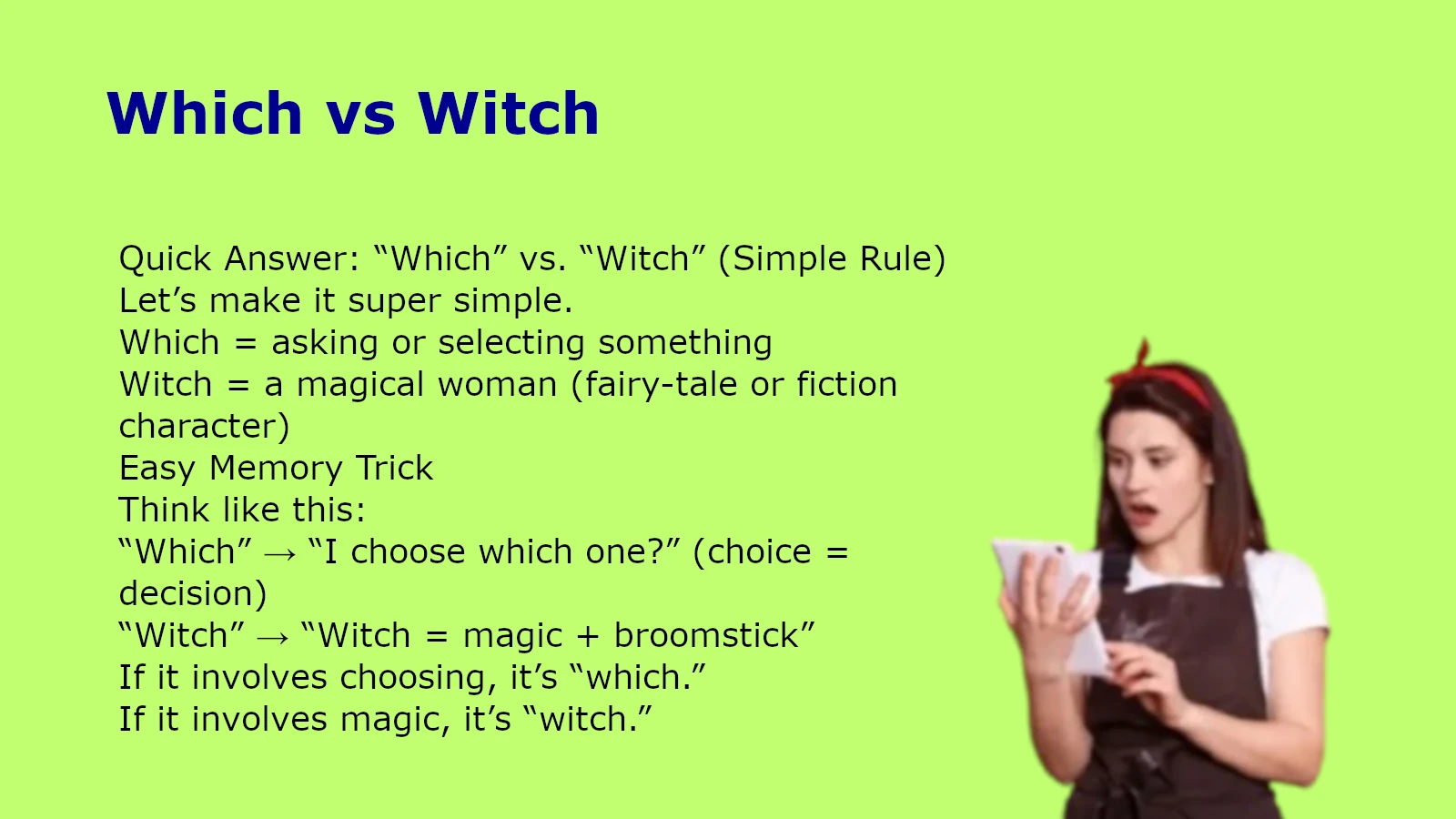
Quick Answer: “Which” vs. “Witch” (Simple Rule)
Let’s make it super simple.
Which = asking or selecting something
Witch = a magical woman (fairy-tale or fiction character)
Easy Memory Trick
Think like this:
- “Which” → “I choose which one?” (choice = decision)
- “Witch” → “Witch = magic + broomstick”
If it involves choosing, it’s “which.”
If it involves magic, it’s “witch.”
Why “Which” and “Witch” Are So Confusing
Here’s the tricky part—they are homophones, meaning they sound identical but are spelled differently.
In Spoken English
You cannot tell the difference by listening alone.
In Writing
Spelling decides everything.
Why People Mix Them Up
- Fast typing on phones
- Autocorrect mistakes
- Weak spelling habits
- Same pronunciation
The result? Totally different meanings from just one letter.
“Which” Explained Clearly (With Real Use Cases)
At its core, “which” is used for choices, questions, or specifying options.
Standard Uses
- Asking questions
- Giving options
- Adding extra information
Real Examples
- “Which shirt do you like?”
- “I don’t know which movie to watch.”
- “Tell me which option is better.”
Key Insight
If you can replace it with “what one” or “what option”, then it’s always which.
“Witch” Explained Clearly (With Real Use Cases)
Now let’s talk about the magical one.
A witch is a fictional or mythological character often associated with magic, spells, and fantasy.
Standard Meaning
A woman believed to have magical powers.
Real Examples
- “The witch cast a spell on the village.”
- “Halloween costumes often include witches.”
- “The story has a wicked witch.”
Key Insight
If there is magic, spells, broomsticks, or fantasy, it’s witch.
Side-by-Side Comparison Table
Here’s a quick visual guide:
| Word | Meaning | Category | Example Sentence |
|---|---|---|---|
| Which | Choice / selection | Grammar word | Which color do you prefer? |
| Witch | Magical woman / sorceress | Noun (fantasy) | The witch flew on a broom. |
Real-Life Examples of “Which”
Let’s make it practical.
Everyday Situations
- “Which route should we take?”
- “Which phone is cheaper?”
- “Do you know which answer is correct?”
Mini Scenario
You’re at a restaurant:
“Which dish do you recommend?”
No confusion here—it’s all about choice.
Real-Life Examples of “Witch”
Now compare.
Common Uses
- “The witch lived in the forest.”
- “Kids dressed as witches on Halloween.”
- “The movie shows a powerful witch.”
Mini Scenario
You’re watching a fantasy film:
“The witch used magic to control the storm.”
Here, it’s clearly fiction + magic.
The Biggest Mistake People Make
Here’s where things go wrong.
People focus on sound instead of meaning.
What Goes Wrong
- “Which” becomes “witch” in typing errors
- “Witch” gets mistaken as a question word
- Context is ignored
Real Example
“I don’t know witch one to pick.”
This completely changes the meaning—and looks incorrect.
Lesson
Always think:
👉 Choice = which
👉 Magic = witch
Why This Confusion Matters
You might think it’s a small spelling issue—but it can change meaning completely.
Example Impact
- “Which one is correct?” → normal question
- “Witch one is correct?” → sounds like fantasy or incorrect grammar
Even a single letter can affect clarity and credibility.
How to Never Confuse “Which” and “Witch” Again
Here are simple strategies:
1. Break the Meaning First
Ask yourself:
- Am I choosing something? → which
- Am I talking about magic? → witch
2. Use Replacement Trick
- Which → “what one”
- Witch → no replacement (it stays magical character)
3. Slow Down While Writing
Most mistakes happen due to speed, not knowledge.
4. Proofread Key Messages
Especially emails, assignments, or posts.
Clear Alternatives to Avoid Mistakes
If you’re unsure, rephrase the sentence:
Instead of:
“Which one is better?”
You can say:
“Can you help me choose the better option?”
This avoids confusion completely.
Quick Decision Guide (Use Instantly)
When stuck, follow this:
- Choice involved → Which
- Magic or fantasy → Witch
- Still unsure → Think meaning, not sound
Simple. Reliable. Done.
FAQ: “Which” vs. “Witch”
Why do “which” and “witch” sound the same?
Because they are homophones in English pronunciation.
Can “witch” ever be used in questions?
No. It is only a noun related to magic or fantasy.
What is the easiest way to remember?
Which = choice
Witch = magic
Is this a common mistake?
Yes, especially in texting and social media writing.
Final Takeaway: The One Rule That Never Fails
Here’s the truth.
English spelling can be tricky, especially with words that sound identical. But confusion disappears when you focus on meaning instead of sound.
So remember:
👉 If you are choosing something, it’s which
👉 If it involves magic, it’s witch
And when in doubt—pause and think about the context. Because in the case of “which” vs. “witch,” one letter changes everything.