Have you ever wondered whether the plural of cactus is cacti or cactuses? Both forms are correct, but the choice can depend on usage, style, and context. If you’ve ever hesitated before writing “two cacti” or “two cactuses,” you’re not alone.
Cacti and cactuses are both plural forms of cactus, a plant known for its thick, fleshy stems and ability to survive in dry environments. Cacti comes from the Latin plural form, while cactuses follows the regular English pattern of adding -es to form the plural.
Examples:
- The desert is home to many cacti.
- She grows several cactuses in her garden.
The confusion is understandable. People often search for cacti or cactuses, is cacti or cactuses correct, cactus plural, or plural of cactus because both forms appear in English. And here’s the kicker: choosing between them isn’t always as complicated as it looks.
In this guide, you’ll learn the difference between cacti and cactuses, their meaning, plural forms, pronunciation, and correct usage. You’ll also see cacti and cactuses in sentences, learn which form is more common, and discover when to use each one.
Cacti or Cactuses: What’s the Correct Plural of Cactus?
The short answer is simple:
Cactus → cacti or cactuses
Both cacti and cactuses are standard plural forms.
Cambridge’s American Dictionary gives cacti and cactuses as plurals of cactus. Oxford’s American English dictionary likewise lists “cactuses or cacti.”
Here’s the basic grammar:
| Form | Number | Example |
| cactus | Singular | I bought one cactus. |
| cacti | Plural | I bought three cacti. |
| cactuses | Plural | I bought three cactuses. |
There is no difference in the number of plants described. Both plural forms refer to two or more cactus plants.
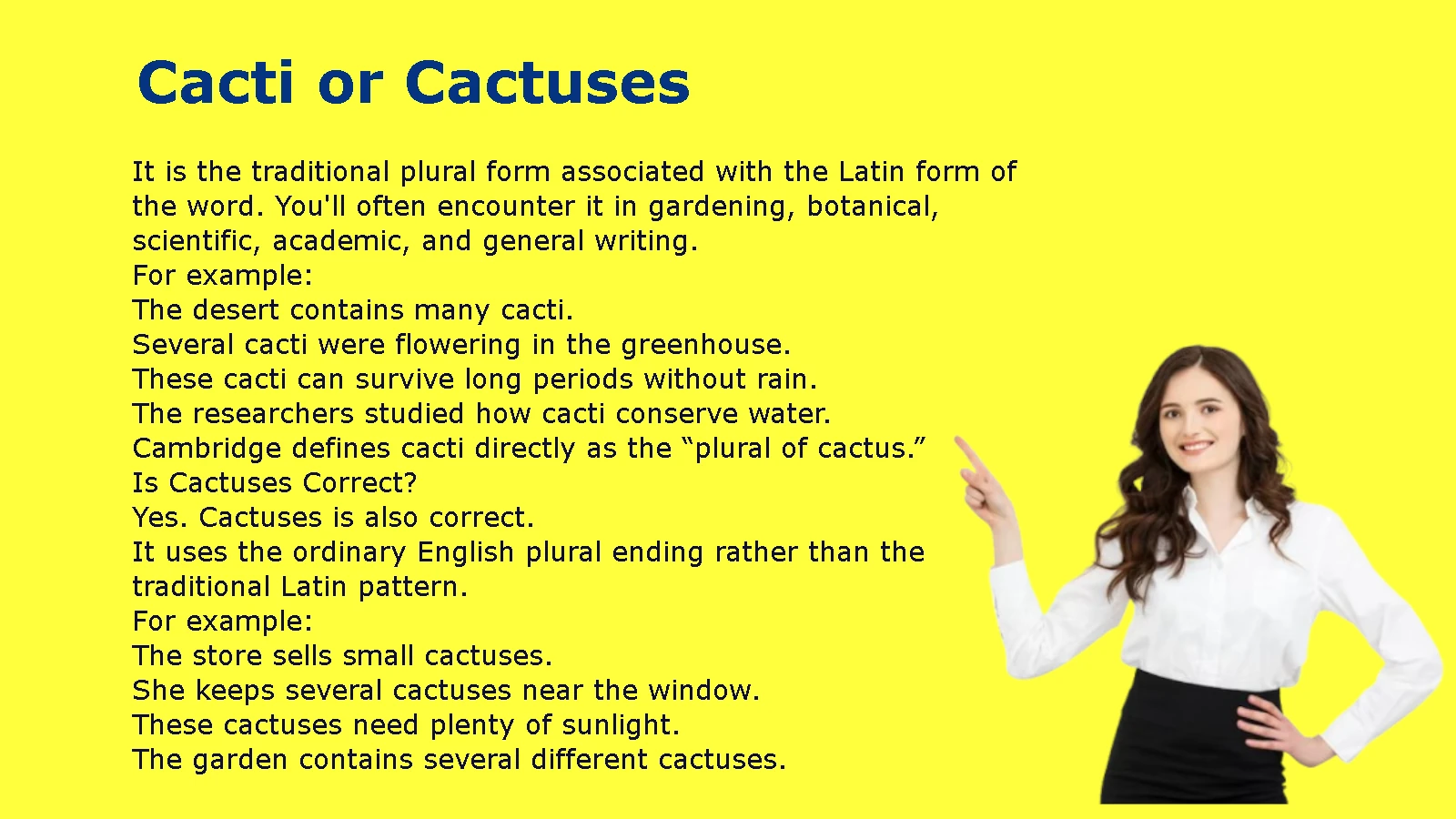
Is Cacti Correct?
Yes. Cacti is completely correct.
It is the traditional plural form associated with the Latin form of the word. You’ll often encounter it in gardening, botanical, scientific, academic, and general writing.
For example:
- The desert contains many cacti.
- Several cacti were flowering in the greenhouse.
- These cacti can survive long periods without rain.
- The researchers studied how cacti conserve water.
Cambridge defines cacti directly as the “plural of cactus.”
Is Cactuses Correct?
Yes. Cactuses is also correct.
It uses the ordinary English plural ending rather than the traditional Latin pattern.
For example:
- The store sells small cactuses.
- She keeps several cactuses near the window.
- These cactuses need plenty of sunlight.
- The garden contains several different cactuses.
Oxford specifically lists cactuses alongside cacti, and its American English entry gives both forms as standard plurals.
So there’s no grammatical reason to treat cactuses as a mistake.
Cacti vs. Cactuses: What’s the Difference?
The biggest difference is form, not meaning.
Cacti comes from the traditional Latin plural pattern. Cactuses follows a regular English plural pattern. Both have become established in modern English.
| Feature | Cacti | Cactuses |
| Singular | cactus | cactus |
| Plural | cacti | cactuses |
| Meaning | More than one cactus | More than one cactus |
| Formation | Traditional Latin based form | English plural form |
| Pronunciation | KAK-tie | KAK-tuh-siz |
| Correct? | Yes | Yes |
| Common contexts | General, botanical, scientific, formal | General, conversational, everyday |
| Can you use it in American English? | Yes | Yes |
The important point is that one form isn’t the “correct” version while the other is a mistake.
Think of it as two roads leading to the same destination. They developed through different grammatical routes, but they now serve the same function in English.
Why Are There Two Plurals of Cactus?
The answer goes back to the history of the word.
Oxford traces cactus to the early 17th century, from Latin, which borrowed it from the Greek word kaktos. Oxford gives the Greek word’s meaning as a type of cardoon, a tall plant with edible leaves and roots.
When English borrows words from other languages, it sometimes keeps an older plural pattern. That’s how forms such as cactus → cacti can develop.
English also has another habit: it takes borrowed words and gradually makes them behave more like ordinary English words.
That’s what happened with cactuses.
Instead of changing -us to -i, English speakers can simply add the plural ending:
cactus → cactuses
This isn’t unusual. English contains many words with competing plural forms because words travel between languages and then adapt to English grammar.
Cacti Follows a Traditional Latin Pattern
The form cacti reflects a traditional Latin pluralization pattern.
You can see similar Latin influenced forms in words such as:
- fungus → fungi
- alumnus → alumni
- radius → radii
- stimulus → stimuli
However, it’s important not to assume that every English word ending in -us should become -i.
English doesn’t operate like a simple Latin grammar worksheet. Some words retain traditional forms, some use regular English plurals, and some accept more than one form.
That’s why cactuses isn’t somehow “less English” or grammatically broken.
Cactuses Follows English Grammar
English commonly forms plurals by adding -s or -es.
Examples include:
- plant → plants
- flower → flowers
- bush → bushes
- cactus → cactuses
The regular English form makes the word easy to understand immediately. It also fits naturally into ordinary conversation.
That’s one reason you may hear or read cactuses even though cacti has been established for a long time.
What Does Cacti Mean?
Cacti is the plural of cactus.
A cactus is a type of plant known for adaptations that help it survive in dry environments. Cambridge describes a cactus as a desert plant with a thick stem for storing water and usually sharp spines.
When you use cacti, you’re talking about more than one of these plants.
Examples of Cacti in Sentences
- Several cacti grow along the rocky hillside.
- The nursery has dozens of cacti for sale.
- Some cacti produce brightly colored flowers.
- These cacti need less water than most houseplants.
- The researchers examined how cacti respond to drought.
- We saw tall cacti throughout the desert landscape.
Notice the verb agreement:
These cacti are healthy.
Not:
These cacti is healthy.
Because cacti is plural, it takes plural verbs such as are, were, and have.
What Does Cactuses Mean?
Cactuses also means more than one cactus.
It has exactly the same basic grammatical job as cacti.
For example:
- Several cactuses grow in the garden.
- Those cactuses need more sunlight.
- The shop sells small cactuses in ceramic pots.
- We moved the cactuses away from the cold window.
The meaning doesn’t change when you replace cactuses with cacti.
Compare these sentences:
The greenhouse contains several cacti.
The greenhouse contains several cactuses.
Both sentences tell the reader that the greenhouse contains multiple cactus plants.
Cacti or Cactuses in American English
If you’re writing in American English, you can use either form.
Oxford’s American English dictionary lists cactuses or cacti as the plural forms. Cambridge’s American Dictionary also lists both.
That means you don’t need to change cactuses to cacti simply because you’re writing for an American audience.
However, cacti may feel more familiar in certain types of writing, especially when the subject is botanical or scientific.
In Everyday American English
Both forms can work:
- “I bought two cacti.”
- “I bought two cactuses.”
Neither sentence contains a plural error.
In Scientific or Botanical Writing
Cacti often fits naturally:
- “The study examined drought tolerance in several species of cacti.”
- “Many cacti have specialized structures that help limit water loss.”
That doesn’t make cactuses ungrammatical. It simply means that cacti can sound more conventional in technical contexts.
Cacti or Cactuses: Which One Is More Common?
Usage evidence generally points toward cacti being the more familiar or more frequently preferred form, although cactuses remains well established.
Scribbr’s current grammar reference describes both as widely accepted and notes that cacti tends to be used more often.
Frequency, however, shouldn’t be confused with correctness.
A word can be less common and still be completely standard.
For example, if you prefer the straightforward English plural cactuses, you aren’t making a grammar mistake. Major dictionaries recognize it.
Why Cacti May Feel More Familiar
The word cacti has a distinctive form. Readers often recognize it immediately as the plural of cactus.
It’s also common in:
- Plant writing
- Gardening content
- Botanical discussions
- Academic material
- Nature writing
- General descriptions of desert plants
Why Cactuses Sounds Natural to Some Readers
Cactuses follows a familiar English pattern.
If you’ve learned that English usually forms plurals with -s or -es, the form feels intuitive:
cactus → cactuses
There’s nothing unusual about choosing it in ordinary writing.
When Should You Use Cacti?
Use cacti when it sounds natural for your audience and context.
It can be especially useful in formal, academic, botanical, or scientific writing.
Examples
Botanical context:
Researchers documented several species of cacti in the region.
Gardening context:
Most cacti prefer well drained soil and bright light.
General writing:
Tall cacti stood against the desert sky.
Academic context:
The researchers compared water use among several cacti species.
In each case, cacti works smoothly because the context already has a somewhat formal or technical tone.
When Should You Use Cactuses?
Use cactuses when you prefer the regular English plural or when it sounds more natural in your sentence.
There’s no need to avoid it.
Examples
Conversation:
“I have three little cactuses on my desk.”
General writing:
The garden center sells several kinds of cactuses.
Personal writing:
My windowsill is crowded with tiny cactuses.
Simple educational writing:
Some cactuses can survive with very little water.
These sentences are grammatically sound.
How Do You Pronounce Cacti?
In US English, cacti is pronounced approximately:
KAK-tie
Cambridge gives the US pronunciation as /ˈkæk.taɪ/.
You can break it down like this:
cacti → KAK + tie
The first part sounds like the beginning of cactus. The second syllable sounds like tie.
Cactus vs. Cacti Pronunciation
| Word | US pronunciation |
| cactus | KAK-tuhs |
| cacti | KAK-tie |
| cactuses | KAK-tuh-siz |
The difference is easy to hear once you know what to expect.
Cactus has two syllables.
Cacti also has two syllables, but its second syllable sounds like “tie.”
How Do You Pronounce Cactuses?
Cactuses is pronounced approximately:
KAK-tuh-siz
The ending sounds similar to the final sound in words such as houses.
You can break it down as:
cactuses → KAK + tuh + siz
Oxford gives the pronunciation of both cactuses and cacti in its dictionary entries.
Is Cacti Singular or Plural?
Cacti is plural.
The singular form is cactus.
Here’s the pattern:
- One cactus
- Two cacti
- Several cacti
- Many cacti
You shouldn’t write:
I bought a cacti.
Write:
I bought a cactus.
Likewise, use plural verbs with cacti:
The cacti are growing quickly.
Not:
The cacti is growing quickly.
Cacti Examples
Singular:
This cactus is flowering.
Plural:
These cacti are flowering.
Singular:
That cactus needs more light.
Plural:
Those cacti need more light.
The same singular versus plural distinction applies whether you choose cacti or cactuses.
Is Cactuses Singular or Plural?
Cactuses is also plural.
The singular remains cactus.
| Singular | Plural |
| one cactus | two cactuses |
| a cactus | several cactuses |
| this cactus | these cactuses |
| that cactus | those cactuses |
For example:
This cactus is healthy.
But:
These cactuses are healthy.
The word ending changes, but the grammatical relationship stays the same.
Cacti or Cactuses in a Sentence
Seeing both forms side by side makes the choice much easier.
With Cacti
The gardener planted several cacti near the stone wall.
These cacti require little water.
We saw enormous cacti during the trip.
With Cactuses
The gardener planted several cactuses near the stone wall.
These cactuses require little water.
We saw enormous cactuses during the trip.
The core meaning remains unchanged.
This is an important distinction: the two forms don’t describe different kinds of plants. They are simply two accepted plural forms of the same noun.
Cacti vs. Cactuses: Real Usage Cases
Looking at realistic writing situations can make the choice clearer.
Usage Case: A Gardening Article
Suppose you’re writing:
“Place the cacti near a bright window and allow the soil to dry between waterings.”
Cacti works naturally here because gardening content frequently uses the traditional plural.
But this version is also grammatical:
“Place the cactuses near a bright window and allow the soil to dry between waterings.”
The second version doesn’t become incorrect simply because the first sounds more familiar.
Usage Case: Everyday Conversation
Imagine someone says:
“I bought three cactuses for my apartment.”
There’s no grammatical problem with that sentence.
You could also say:
“I bought three cacti for my apartment.”
Both communicate the same thing.
In casual conversation, the choice often comes down to personal preference.
Usage Case: Academic Writing
Consider:
“The researchers observed several species of cacti under controlled conditions.”
Here, cacti fits the formal tone nicely.
A sentence using cactuses would still be grammatically acceptable:
“The researchers observed several species of cactuses under controlled conditions.”
However, depending on the publication’s style guide or the writer’s preference, cacti may sound more conventional.
The lesson is simple: context can influence preference without changing grammatical correctness.
Common Mistakes With Cacti and Cactuses
Most mistakes involving these words come from confusing singular and plural forms rather than choosing the “wrong” plural.
Mistake: Using Cacti as a Singular
Incorrect:
I bought a cacti.
Correct:
I bought a cactus.
Cacti refers to multiple plants.
Mistake: Assuming Cactuses Is Wrong
Incorrect assumption:
“Cactuses isn’t a real word.”
That’s false.
Cambridge and Oxford both recognize cactuses as a plural form of cactus.
Correct:
The garden contains several cactuses.
Mistake: Using the Wrong Verb
Incorrect:
The cacti is healthy.
Correct:
The cacti are healthy.
Because cacti is plural, it takes a plural verb.
The same applies to cactuses:
The cactuses are healthy.
Mistake: Mixing Singular and Plural Demonstratives
Incorrect:
This cacti are flowering.
Correct:
These cacti are flowering.
Or:
This cactus is flowering.
The demonstrative must agree with the noun.
| Singular | Plural |
| this cactus | these cacti |
| that cactus | those cacti |
| this cactus | these cactuses |
| that cactus | those cactuses |
Mistake: Treating Cacti and Cactuses as Different Plants
They aren’t.
Cacti and cactuses are simply plural forms of cactus.
The choice doesn’t identify a different species, genus, or variety.
Should You Use Cacti or Cactuses Consistently?
Yes.
Although both forms are correct, consistency makes writing cleaner.
If a paragraph begins with cacti, there’s usually no reason to switch to cactuses halfway through unless there’s a deliberate stylistic reason.
For example, this feels unnecessarily inconsistent:
Many cacti grow in dry climates. These cactuses have adaptations that help them survive drought.
A cleaner version would be:
Many cacti grow in dry climates. These cacti have adaptations that help them survive drought.
Or:
Many cactuses grow in dry climates. These cactuses have adaptations that help them survive drought.
Consistency isn’t a grammatical requirement. It’s simply good editing.
Is Cactus Ever Used as a Plural?
This question can get surprisingly tricky because cactus sometimes appears in contexts where it seems to refer to cactus plants generally.
In ordinary countable English, however, cactus is singular.
For example:
A cactus can survive in very dry conditions.
That’s one plant as a countable noun.
For multiple plants, use:
Cacti can survive in very dry conditions.
Or:
Cactuses can survive in very dry conditions.
The word can also appear before another noun in compounds and descriptive phrases:
- cactus plant
- cactus flower
- cactus species
- cactus garden
- cactus fruit
In these constructions, cactus isn’t necessarily functioning as a plural noun. It’s often acting as a modifier that tells you what kind of plant, flower, garden, or fruit you’re talking about.
Cacti or Cactuses: Which One Should You Use?
If you want the simplest practical rule, use this:
Use either cacti or cactuses. Both are correct.
If you want a more specific style guide, consider the context.
| Situation | Recommended choice |
| General English | Cacti or cactuses |
| Everyday conversation | Cacti or cactuses |
| Gardening writing | Cacti often feels natural |
| Botanical writing | Cacti often fits naturally |
| Scientific writing | Cacti often fits the formal tone |
| Personal writing | Cacti or cactuses |
| Formal writing | Cacti may be preferred stylistically |
| Simple English | Cactuses is straightforward |
| Following a publication style guide | Follow the required style |
The word recommended matters here.
A recommendation about style is not the same thing as a rule about correctness.
You can choose cactuses in a formal sentence and still write grammatically correct English.
Cacti or Cactuses: A Quick Grammar Guide
Here’s the entire issue in one table:
| Question | Answer |
| What is the singular of cacti? | Cactus |
| What is the plural of cactus? | Cacti or cactuses |
| Is cacti correct? | Yes |
| Is cactuses correct? | Yes |
| Is cacti singular? | No, it’s plural |
| Is cactuses singular? | No, it’s plural |
| How is cacti pronounced? | KAK-tie |
| How is cactuses pronounced? | KAK-tuh-siz |
| Which is more traditional? | Cacti |
| Which follows regular English pluralization? | Cactuses |
| Can both be used in American English? | Yes |
Cacti vs. Cactuses vs. Cactus: Examples
Sometimes the fastest way to settle a grammar question is to see the forms working in real sentences.
Cactus: Singular
The cactus is growing beside the window.
I bought a small cactus.
That cactus has bright flowers.
Cacti: Plural
The cacti are growing beside the window.
I bought several cacti.
Those cacti have bright flowers.
Cactuses: Plural
The cactuses are growing beside the window.
I bought several cactuses.
Those cactuses have bright flowers.
The grammatical structure is straightforward:
cactus = one
cacti = more than one
cactuses = more than one
Why English Has So Many Competing Plurals
The cactus question illustrates a larger feature of English: borrowed words don’t always behave consistently.
English has borrowed vocabulary from Latin, Greek, French, German, Norse, Italian, Spanish, and many other languages. Over time, speakers have often adapted those words to English grammar.
That’s why English contains multiple kinds of plurals.
Consider:
| Singular | Plural |
| cactus | cacti / cactuses |
| criterion | criteria |
| phenomenon | phenomena |
| analysis | analyses |
| child | children |
| mouse | mice |
| book | books |
| house | houses |
Some plurals preserve older forms. Others use regular English endings. A few words accept multiple forms.
Cactus belongs to that last group.
The coexistence of cacti and cactuses isn’t a sign that English grammar has failed. It’s a sign that English has absorbed a word and allowed more than one plural pattern to develop.
Where Does the Word Cactus Come From?
The history of cactus is older than the modern English plural forms.
Oxford gives the word’s origin as early 17th century, tracing it from Latin to Greek kaktos. Oxford identifies the Greek term as a word for cardoon, a tall plant related to the artichoke.
Dictionary.com likewise traces cactus through Latin to Greek káktos.
This history helps explain why cacti exists. The word entered English with a classical linguistic background, and English preserved a traditional plural form.
At the same time, English speakers naturally applied familiar English plural rules and produced cactuses.
Both forms survived.
That’s the key historical point.
Do Cacti and Cactuses Have Different Meanings?
No.
The two forms don’t carry different dictionary meanings.
If someone says:
“The desert contains thousands of cacti.”
and someone else says:
“The desert contains thousands of cactuses.”
Both speakers mean multiple cactus plants.
Cambridge’s entry for cactus lists both plural forms, while Oxford likewise lists cactuses and cacti.
The distinction is therefore about word form, style, and usage preference, not about what kind of plant the noun describes.
Can You Use Cacti and Cactuses Interchangeably?
In most ordinary contexts, yes.
You can replace one with the other without changing the basic meaning:
The nursery sells several cacti.
becomes:
The nursery sells several cactuses.
Likewise:
These cactuses need more sunlight.
becomes:
These cacti need more sunlight.
The grammar remains correct.
The only practical consideration is style. If you’re writing for a publication, school, scientific journal, or organization with a house style, follow its preferred usage.
Otherwise, choose the form that sounds natural to you.
Frequently Asked Questions About Cacti or Cactuses
Is cacti the correct plural of cactus?
Yes. Cacti is a correct and widely established plural of cactus. Cambridge defines cacti as the plural of cactus.
Is cactuses grammatically correct?
Yes. Cactuses is also correct. Oxford and Cambridge both list it as a plural form of cactus.
Which is better, cacti or cactuses?
Neither is universally “better.” Cacti is the traditional Latin based form and often feels more natural in botanical or formal writing. Cactuses follows regular English pluralization and works perfectly well in everyday English.
What is the plural of cactus?
The two standard plural forms are cacti and cactuses.
Is cacti singular or plural?
Cacti is plural. The singular form is cactus.
Is cactuses singular or plural?
Cactuses is plural. The singular form is cactus.
How do you pronounce cacti?
In US English, cacti is pronounced approximately KAK-tie, represented by Cambridge as /ˈkæk.taɪ/.
How do you pronounce cactuses?
Cactuses is pronounced approximately KAK-tuh-siz.
Can you use cactuses in formal writing?
Yes. Cactuses is an accepted plural form. Whether you prefer it in formal writing depends on your style guide and the tone you want.
Is cactus the plural of cactus?
In standard countable usage, cactus is the singular form. For more than one, use cacti or cactuses.
Is cacti more correct than cactuses?
No. Cacti is not more grammatically correct than cactuses. It is simply the traditional plural form and may be preferred in certain contexts.
Why does cactus become cacti?
Cacti reflects the traditional Latin plural form associated with cactus. English also developed the regular plural cactuses, which is now accepted alongside it.
Which plural should I use in American English?
Either cacti or cactuses is correct in American English. Oxford’s American English dictionary explicitly lists both.
Cacti or Cactuses: The Final Answer
When you’re stuck between cacti or cactuses, you can stop second guessing yourself.
Both are correct.
- Cactus = singular
- Cacti = plural
- Cactuses = plural
- Cacti follows the traditional Latin plural pattern.
- Cactuses follows a regular English plural pattern.
- Cacti is often preferred in botanical, scientific, and formal contexts.
- Cactuses is completely acceptable in everyday and formal English.
- Both forms refer to more than one cactus.
- In US English, both forms are recognized by major dictionaries.
So if you write “The garden contains several cacti,” you’re right.
If you write “The garden contains several cactuses,” you’re right, too.
The cactus doesn’t care which plural you choose. English doesn’t either.