Have you ever looked at a bottle labeled Bourbon and wondered how it differs from Whiskey? While Bourbon vs Whiskey may seem like a simple comparison, the two terms aren’t interchangeable. Bourbon is a type of whiskey, but whiskey includes many styles made in different places and under different rules.
Whiskey is a distilled alcoholic spirit made from a fermented grain mash, while Bourbon is a specific type of American whiskey that must meet certain requirements. For example, bourbon must be made from a grain mixture containing at least 51% corn and aged in new, charred oak containers.
Examples:
- Bourbon: Kentucky bourbon made primarily from corn and aged in new charred oak barrels.
- Whiskey: Scotch, Irish whiskey, Canadian whisky, and American whiskey are all different styles of whiskey.
The confusion is understandable. People often search for Bourbon vs Whiskey, what is the difference between bourbon and whiskey, is bourbon whiskey, or bourbon vs whiskey taste because the terms overlap. And here’s the kicker: every bourbon is whiskey, but not every whiskey is bourbon.
In this guide, you’ll learn the key differences between Bourbon and Whiskey, including their ingredients, production rules, aging requirements, flavor, origin, and alcohol content. You’ll also discover how bourbon compares with other types of whiskey and how to tell the difference when choosing a bottle.
Bourbon vs Whiskey at a Glance
| Feature | Bourbon | Whiskey |
| What is it? | A specific type of whiskey | A broad category of distilled spirits |
| Where is it made? | United States | Many countries, depending on the style |
| Main grain requirement | At least 51% corn | Depends on the whiskey style |
| Distillation limit for bourbon | 160 proof maximum | Varies by category and regulations |
| Barrel requirement | New charred oak containers | Depends on the style |
| Barrel entry proof for bourbon | 125 proof maximum | Depends on the style |
| Minimum aging | No general minimum for bourbon | Depends on the category |
| Straight designation | At least 2 years | Varies by style |
| Typical bourbon flavors | Vanilla, caramel, oak, baking spice | Can range from sweet and fruity to spicy, malty, smoky, or earthy |
| Examples | Bourbon, straight bourbon | Bourbon, rye, Scotch, Irish whiskey, Canadian whisky, and others |
The key point is simple: “whiskey” describes a broad family, while “bourbon” describes a legally defined American whiskey style.
Is Bourbon Whiskey?
Yes. Bourbon is whiskey.
U.S. federal standards place bourbon within the whiskey category. Federal regulations define bourbon whiskey through requirements that include a fermented grain mash containing at least 51% corn, distillation at no more than 160 proof, and storage at no more than 125 proof in charred new oak containers.
That relationship looks like this:
Whiskey → American whiskey → Bourbon
But whiskey has many branches. Depending on the country and production method, you can also find:
- Rye whiskey
- Wheat whiskey
- Malt whiskey
- Scotch whisky
- Irish whiskey
- Canadian whisky
- Japanese whisky
- Tennessee whiskey
- Corn whiskey
So saying “bourbon or whiskey” is a little like asking whether someone prefers “a Labrador or a dog.” A Labrador is a dog. Bourbon is whiskey.
Why the Confusion Exists
The confusion usually comes from the way people use the word “whiskey.”
In everyday conversation, someone might say, “I like whiskey,” when they actually mean bourbon. Another person might use “whiskey” to mean Scotch or rye.
The word describes a category, not one universal flavor.
That matters because whiskey doesn’t have one single taste profile. A smoky Scotch can taste dramatically different from a sweet, oak forward bourbon. A spicy rye can seem like an entirely different drink again.
What Makes Bourbon Bourbon?
Bourbon isn’t simply whiskey made in Kentucky. It has a defined set of production requirements.
The most important rules involve where it is produced, what grains go into the mash, how it is distilled, and what kind of oak container holds the spirit.
Bourbon Must Be Made in the United States
Bourbon must be produced in the United States.
That includes states outside Kentucky. Kentucky has an enormous historical and cultural connection to bourbon, but Kentucky is not a legal requirement for bourbon.
Bourbon can be produced in other U.S. states as long as it meets the applicable federal requirements.
This distinction is important because “Kentucky bourbon” and “bourbon” aren’t interchangeable terms. Kentucky bourbon identifies the geographic origin more specifically.
Bourbon Must Contain at Least 51% Corn
This is one of the defining characteristics of bourbon.
The fermented mash must contain at least 51% corn. The remaining grains can vary, which gives distillers plenty of room to create different flavor profiles.
Common supporting grains include:
- Rye
- Wheat
- Malted barley
The grain recipe is called the mash bill.
For example, two bourbons can both meet the 51% corn requirement while using different amounts of rye or wheat. Those differences can noticeably affect the final spirit.
H3: Rye Bourbon vs. Wheated Bourbon
A bourbon that uses a larger proportion of rye often develops a more noticeable spicy or peppery character.
A wheated bourbon, on the other hand, replaces much or all of the rye component with wheat. Wheated bourbons are often associated with softer, rounder flavor profiles.
The important point is that neither style stops being bourbon.
Both can satisfy the same basic legal definition while tasting quite different.
Bourbon Must Be Distilled at No More Than 160 Proof
Bourbon must be distilled at 160 proof or lower, equivalent to 80% alcohol by volume.
Why does this matter?
Distillation affects how much of the original grain and fermentation character remains in the spirit. A higher degree of rectification can create a lighter, more neutral spirit. Bourbon’s production rules place a ceiling on distillation strength.
The goal isn’t simply to make the spirit stronger. Distillation is about shaping what carries forward into the barrel.
Bourbon Must Enter New Charred Oak at 125 Proof or Lower
After distillation, bourbon must enter its oak container at 125 proof or lower, or 62.5% ABV. It must also use charred new oak containers.
This requirement plays a huge role in bourbon’s identity.
Freshly charred oak contains compounds that interact with the spirit during maturation. Over time, the whiskey extracts and transforms compounds from the wood.
That’s one reason bourbon commonly develops flavors such as:
- Vanilla
- Caramel
- Toasted oak
- Baking spice
- Brown sugar
- Dried fruit
- Coconut
- Char
The barrel isn’t just a storage container. It’s one of the major ingredients in the flavor story.
Bourbon Must Be Bottled at at Least 80 Proof
Bourbon must be bottled at a minimum of 80 proof, or 40% ABV.
Many bourbons are bottled considerably higher than that.
For example, a bottle labeled 100 proof contains 50% alcohol by volume. That’s because U.S. proof is twice the ABV.
So:
80 proof = 40% ABV
100 proof = 50% ABV
120 proof = 60% ABV
This becomes especially useful when comparing standard bourbon with barrel proof or cask strength releases.
What Is Whiskey?
Whiskey is a distilled spirit made from fermented grain mash. In the broadest sense, it is the family name for a wide range of grain based spirits.
U.S. regulations describe whisky as an alcoholic distillate made from fermented grain mash and bottled at no less than 80 proof, with specific standards applying to different types.
The important word is grain.
Different whiskey styles emphasize different grains, production traditions, locations, and aging practices.
That creates a huge range of flavors.
Major Types of Whiskey
| Type | Defining characteristic | Common flavor direction |
| Bourbon | At least 51% corn and new charred oak | Sweet, rich, vanilla, caramel |
| Rye whiskey | At least 51% rye under U.S. standards | Spicy, peppery, herbal |
| Wheat whiskey | At least 51% wheat under U.S. standards | Soft, sweet, grain forward |
| Scotch whisky | Scottish whisky category with its own regulations | Malt, fruit, smoke, peat depending on style |
| Irish whiskey | Whiskey produced under Irish standards | Often fruity, light, smooth, or rich |
| Canadian whisky | Canadian whiskey tradition and regulations | Often lighter, spicy, or blended |
| Japanese whisky | Japanese whisky tradition influenced by Scotch | Often refined, balanced, and layered |
These are broad descriptions rather than hard flavor rules. A particular bottle can surprise you.
Bourbon vs Whiskey: The Main Differences
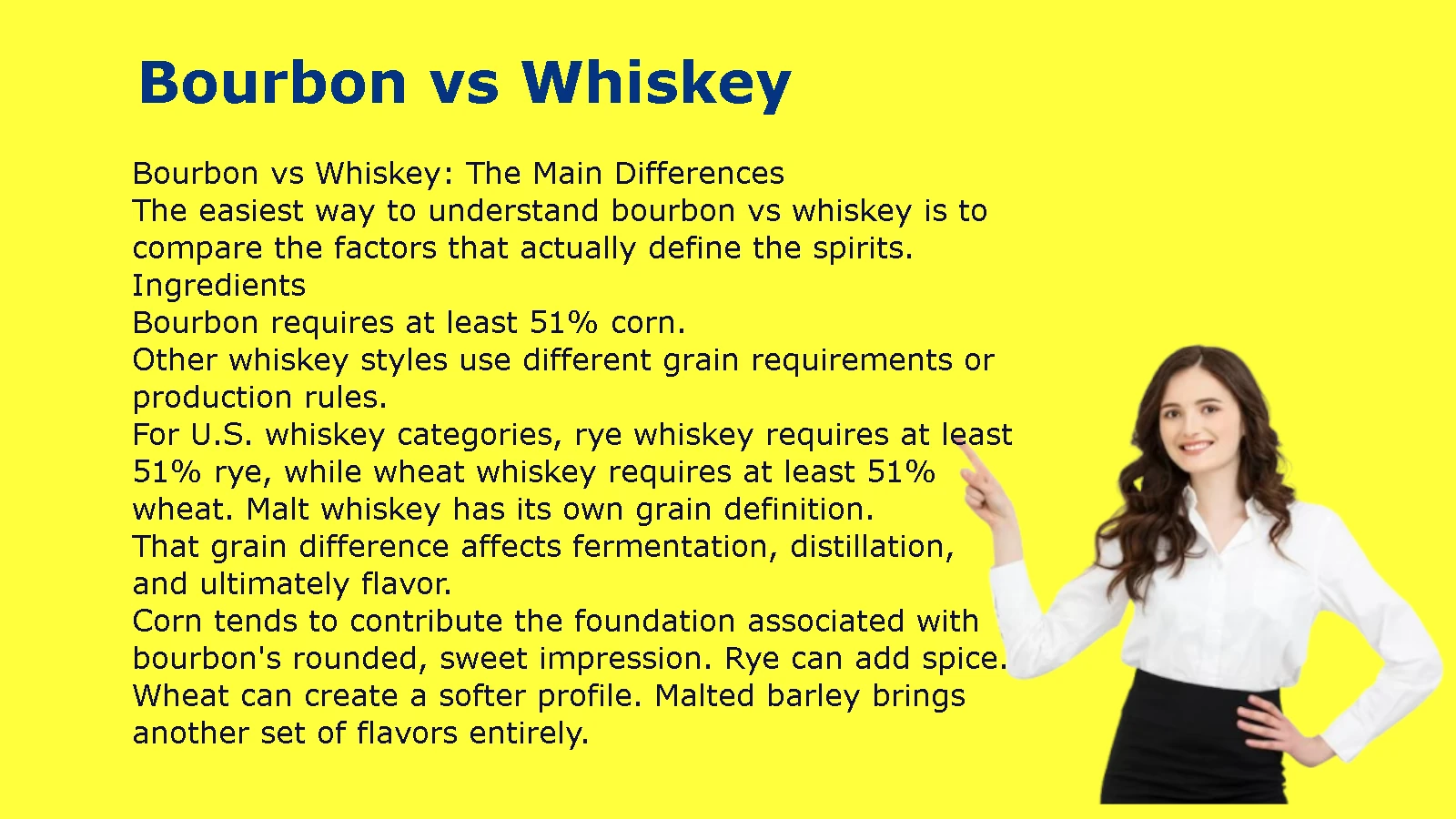
The easiest way to understand bourbon vs whiskey is to compare the factors that actually define the spirits.
Ingredients
Bourbon requires at least 51% corn.
Other whiskey styles use different grain requirements or production rules.
For U.S. whiskey categories, rye whiskey requires at least 51% rye, while wheat whiskey requires at least 51% wheat. Malt whiskey has its own grain definition.
That grain difference affects fermentation, distillation, and ultimately flavor.
Corn tends to contribute the foundation associated with bourbon’s rounded, sweet impression. Rye can add spice. Wheat can create a softer profile. Malted barley brings another set of flavors entirely.
Geography
Bourbon must be produced in the United States.
Whiskey as a broad category has no single geographic home.
You can have whiskey from:
- The United States
- Scotland
- Ireland
- Canada
- Japan
- Other countries with their own whiskey traditions
Geography matters because whiskey production evolved differently in different regions.
Barrels
Bourbon must use new charred oak containers.
That requirement has enormous consequences for flavor. New oak contributes compounds that can produce vanilla, caramelized, toasted, woody, and spicy notes as the spirit matures.
Other whiskey traditions can use different barrel strategies.
Scotch, for example, is strongly associated with maturation in previously used casks. Those casks can previously have held bourbon, sherry, wine, or other spirits.
So the barrel isn’t just a technical detail. It helps define the personality of the whiskey.
Aging
One of the most misunderstood points in the bourbon vs whiskey debate involves age.
Bourbon does not have a universal two year minimum aging requirement.
However, bourbon that carries the straight bourbon designation must meet a minimum two year aging requirement. Federal rules define age as the time the distilled spirit spends stored in oak barrels between distillation and bottling.
This creates an important distinction:
Bourbon ≠ automatically two years old
Straight bourbon = at least two years old
That difference prevents one of the most common bourbon myths.
Does Bourbon Have to Be Made in Kentucky?
No.
Bourbon must be produced in the United States, but federal law does not require it to come from Kentucky.
Kentucky’s importance comes from history, production expertise, climate, infrastructure, and a long established bourbon culture.
Kentucky remains deeply associated with bourbon, but the legal definition is broader.
That means a bourbon produced in another U.S. state can still be bourbon if it meets the applicable standards.
Why Kentucky Became So Important to Bourbon
Kentucky has several natural and historical advantages for bourbon production.
Its limestone rich water has long been part of the bourbon story. The state also developed a large network of distilleries, cooperages, warehouses, transportation routes, and experienced workers.
Over generations, bourbon became deeply connected to Kentucky’s identity.
But cultural association isn’t the same thing as a legal requirement.
What Does Bourbon Taste Like?
Bourbon often has a recognizable flavor family, although no two bottles taste exactly alike.
Common bourbon tasting notes include:
- Vanilla
- Caramel
- Toffee
- Brown sugar
- Toasted oak
- Baking spices
- Cherry
- Dried fruit
- Chocolate
- Nuts
- Char
The exact profile depends on the mash bill, yeast, distillation process, barrel selection, maturation conditions, age, proof, and blending decisions.
Where Does Bourbon’s Sweet Flavor Come From?
This question deserves a little nuance.
Bourbon can taste sweet without being a sugary drink.
Corn provides the dominant grain component, while new charred oak contributes compounds that can create vanilla, caramel, toasted, and sweet spice impressions.
That combination can make bourbon seem sweeter than many other whiskeys.
A spicy rye whiskey may feel drier and more peppery. A heavily peated Scotch may taste smoky and earthy. Bourbon often sits on the richer, warmer side of the whiskey spectrum.
What Does Whiskey Taste Like?
There isn’t one answer.
Asking what whiskey tastes like is a bit like asking what fruit tastes like. The category is simply too broad.
Consider these general profiles:
Bourbon
Often:
- Sweet
- Rich
- Oaky
- Vanilla forward
- Caramel driven
- Warm and full bodied
Rye Whiskey
Often:
- Spicy
- Peppery
- Herbal
- Drier
- Grain forward
Scotch Whisky
Can be:
- Malty
- Fruity
- Nutty
- Floral
- Smoky
- Peaty
- Maritime
Scotch is particularly difficult to reduce to one flavor because styles vary widely across Scotland.
Irish Whiskey
Often features:
- Fruit
- Grain
- Honey
- Vanilla
- Light spice
- Smooth textures
Again, these are general tendencies rather than guarantees.
Bourbon vs Rye Whiskey
Bourbon and rye are two of the most useful styles to compare because both have deep roots in American whiskey.
The biggest difference is the dominant grain requirement.
Bourbon: at least 51% corn.
Rye whiskey: at least 51% rye under U.S. standards.
That difference can produce a noticeable contrast.
| Bourbon | Rye whiskey |
| Corn based | Rye based |
| Often sweeter | Often spicier |
| Vanilla and caramel | Pepper and baking spice |
| Rich and round | Brisk and lively |
| Excellent in Old Fashioneds | Excellent in Manhattans and other whiskey cocktails |
If you like vanilla, caramel, and oak, bourbon may be the better starting point.
If you want peppery spice and a sharper grain character, rye is worth exploring.
Bourbon vs Scotch Whisky
The bourbon vs Scotch comparison reveals just how broad the whiskey family really is.
Bourbon is an American whiskey defined partly by its 51% corn mash bill and new charred oak requirement. Scotch whisky follows Scottish production and maturation rules that create a very different style.
One major flavor distinction is smoke.
Some Scotch whiskies use peat during malt production, which can create smoky, earthy, medicinal, or campfire like aromas.
But don’t assume all Scotch is smoky.
Many Scotch whiskies are light, fruity, floral, malty, or honeyed.
Bourbon vs Scotch at a Glance
| Bourbon | Scotch |
| Made in the United States | Made in Scotland |
| At least 51% corn | Scotch has different grain and category rules |
| New charred oak | Often matured in used casks |
| Often vanilla and caramel | Can range from fruity to heavily smoky |
| Usually spelled “whiskey” | Usually spelled “whisky” |
The spelling difference is useful, but it isn’t the main distinction.
Production rules and tradition matter far more than the letter “e.”
Bourbon vs Irish Whiskey
Irish whiskey follows its own geographical and production standards.
Compared with bourbon, many Irish whiskeys can come across as lighter, fruitier, or more delicate, although the category includes plenty of rich and robust examples.
Bourbon’s new charred oak requirement often gives it a more pronounced vanilla and caramel character.
Irish whiskey can offer a different combination of fruit, grain, spice, oak, and sweetness.
Neither style is automatically smoother or better.
The better choice depends on what you enjoy.
Bourbon vs Tennessee Whiskey
One commonly discussed difference is the Lincoln County Process, in which spirit is filtered through sugar maple charcoal before maturation. The exact legal and labeling treatment of Tennessee whiskey can be more nuanced than simply saying “Tennessee whiskey is bourbon.”
The practical takeaway is this:
Don’t assume bourbon and Tennessee whiskey are completely unrelated categories.
They occupy closely connected territory within American whiskey.
What Does “Straight Bourbon” Mean?
Straight bourbon is not simply a fancy way to say “good bourbon.”
It is a specific designation with additional requirements.
Straight bourbon must be aged for at least two years in new charred oak. Federal standards establish this minimum aging requirement.
That gives us a useful hierarchy:
Whiskey → Bourbon → Straight Bourbon
Each step adds more specific requirements.
Why the Word “Straight” Matters
Suppose two bottles are both bourbon.
One could be a younger bourbon that doesn’t qualify for the straight designation. Another could meet the requirements for straight bourbon after at least two years of aging.
The word “straight” therefore tells you something about the production and aging standard. It doesn’t automatically tell you whether you’ll personally like the whiskey.
Taste remains subjective.
What Does “Bottled in Bond” Mean?
Bottled in Bond is another regulated designation that appears on some American whiskey bottles.
The designation traces back to the Bottled in Bond Act of 1897.
A bottled in bond whiskey must meet specific requirements, including being the product of one distillery and one distilling season, being aged for at least four years, and being bottled at 100 proof.
That gives bottled in bond a useful set of benchmarks:
- 100 proof
- At least four years old
- One distillery
- One distilling season
- Stored under the required bonded warehouse conditions
It’s a meaningful label designation because it provides more production information than vague terms such as “premium” or “handcrafted.”
Bourbon Label Terms You Should Know
Walking through a whiskey aisle gets easier once you know the vocabulary.
Mash Bill
The mash bill is the grain recipe used to make the whiskey.
For bourbon, corn must make up at least 51% of the mash.
The other grains can help shape the spirit’s character.
Small Batch
“Small batch” sounds precise, but it doesn’t have one universal federal definition that tells you exactly how many barrels a producer may use.
Don’t automatically assume small batch means better.
Single Barrel
A single barrel expression comes from one barrel rather than being a blend of multiple barrels.
Because individual barrels can vary, two single barrel releases from the same producer can taste noticeably different.
Barrel Proof
Barrel proof generally indicates whiskey bottled at or near its natural barrel strength rather than being heavily diluted to a standard proof.
These bottles can pack considerably more alcohol than a typical 80 proof release.
Age Statement
An age statement tells you the age of the whiskey according to applicable labeling rules.
Federal regulations also require specific age labeling for certain whiskies under four years old.
Finish
A whiskey can receive additional maturation in another type of cask after its primary aging period.
For example, a producer might use a secondary wine or fortified wine cask to introduce additional flavors.
The Virginia Department of Alcoholic Beverage Control notes that bourbon can receive additional maturation in secondary oak containers and that “finish” can also describe the flavor that remains after drinking.
Does Bourbon Have to Be Aged for Two Years?
No.
This is one of the most common misconceptions about bourbon.
The two year requirement applies to straight bourbon, not bourbon as a whole.
That’s an important distinction because the word “bourbon” doesn’t tell you a specific minimum age.
If the label says straight bourbon, however, the spirit has to satisfy the additional aging requirement.
For whiskies under four years old, federal labeling rules also require an age statement unless an applicable exception applies, such as bottled in bond.
Common Bourbon vs Whiskey Myths
Myth: Bourbon and whiskey are completely different drinks.
Fact: Bourbon is a type of whiskey.
Myth: All bourbon comes from Kentucky.
Fact: Bourbon must be produced in the United States. It doesn’t have to come from Kentucky.
Myth: Every bourbon must be two years old.
Fact: Two years is the minimum aging period for the straight bourbon designation.
Myth: Older bourbon is always better.
Fact: Age can affect flavor and texture, but older doesn’t automatically mean better.
An older bourbon may have intense oak character that some drinkers love and others don’t.
Myth: Darker bourbon is always older.
Fact: Color can be influenced by maturation, but color alone isn’t a reliable way to determine age.
Myth: Whiskey always tastes smoky.
Fact: Some whiskey is smoky, particularly certain Scotch styles. Plenty of whiskey isn’t smoky at all.
Myth: “Small batch” guarantees superior quality.
Fact: The term sounds impressive, but it doesn’t provide one universal measure of quality. Some labeling terms have no precise legal definition.
A Practical Bourbon vs Whiskey Case Study
Imagine three bottles sitting next to each other.
Bottle A: Bourbon
Bottle B: Rye whiskey
Bottle C: Scotch whisky
All three are whiskey.
Yet they can taste completely different.
Nothing about that comparison contradicts the statement that all three are whiskey.
Instead, it demonstrates why “whiskey” is a category rather than one flavor profile.
The grain, location, production rules, fermentation, distillation, barrels, maturation, and blending decisions all shape the final drink.
Which Should You Choose: Bourbon or Whiskey?
The answer depends on your palate.
Choose Bourbon If You Like:
- Vanilla
- Caramel
- Brown sugar
- Toasted oak
- Rich textures
- Warm baking spices
- Fuller, sweeter tasting spirits
Bourbon is often an approachable entry point because its flavor profile can feel familiar.
Try Rye Whiskey If You Like:
- Pepper
- Spice
- Cinnamon
- Herbal notes
- Drier flavors
- More pronounced grain character
Rye can feel livelier and more assertive than a soft, sweet bourbon.
Try Scotch If You Like:
- Malt
- Smoke
- Peat
- Dried fruit
- Earthy flavors
- Complex aromas
If you’re unsure about smoky whiskey, start with a nonpeated Scotch rather than jumping straight into the smokiest bottle you can find.
Try Irish Whiskey If You Like:
- Light fruit
- Honey
- Vanilla
- Smooth textures
- Gentle spice
Irish whiskey offers a broad range of styles, so there’s plenty of room to explore.
How to Taste Bourbon and Whiskey
You don’t need a fancy tasting room or a shelf full of expensive glassware.
Start with a small pour.
Taste It Neat
Pour a modest amount into a glass and smell it first.
Don’t immediately take a large sip.
Notice the aroma.
Then take a small sip and let the whiskey move across your palate.
Look for:
- Sweetness
- Spice
- Oak
- Fruit
- Grain
- Smoke
- Heat
- Texture
Add a Few Drops of Water
A small amount of water can change the aroma and mouthfeel.
This is particularly interesting with higher proof whiskey.
Don’t treat it like a strict rule. If you prefer your whiskey neat, drink it neat.
Try It Over Ice
Ice lowers the temperature and gradually dilutes the whiskey.
That can soften alcohol heat and make a high proof bourbon easier to drink.
It can also mute some aromas.
Again, personal preference wins.
Bourbon vs Whiskey for Cocktails
Bourbon and other whiskeys can behave very differently in cocktails.
Old Fashioned
Bourbon works beautifully in an Old Fashioned when you want a richer, sweeter drink with vanilla and oak character.
Rye works equally well if you want more spice and snap.
Manhattan
Rye is a classic choice for a Manhattan because its spicy character can stand up to sweet vermouth.
Bourbon creates a softer, rounder version.
Whiskey Sour
Bourbon’s sweetness and oak character work naturally with citrus.
The result can be balanced rather than overly sharp.
The broader lesson is useful: the best whiskey for a cocktail depends on the flavor you want the spirit to contribute.
Why New Charred Oak Matters So Much
Bourbon’s barrel requirement deserves special attention because it separates bourbon from many other whiskey traditions.
The spirit begins relatively raw and clear.
Then it enters new charred oak.
During maturation, the interaction between spirit and wood changes the whiskey’s aroma, color, flavor, and texture.
The barrel can contribute compounds associated with:
- Vanilla
- Caramel
- Toast
- Oak
- Spice
- Coconut
- Dried fruit
- Char
Warehouse conditions matter, too.
Temperature changes cause the liquid and wood to interact differently over time. That’s part of why maturation isn’t simply a stopwatch where “older” automatically equals “better.”
A whiskey’s final character reflects time plus environment plus wood plus the original spirit.
Bourbon vs Whiskey: The Most Important Takeaways
If you remember only a handful of points, make them these:
- Bourbon is a type of whiskey.
- Whiskey is the broader category.
- Bourbon must be produced in the United States.
- Bourbon must contain at least 51% corn in its fermented mash.
- Bourbon must be distilled at no more than 160 proof.
- It must enter new charred oak containers at no more than 125 proof.
- Bourbon must be bottled at no less than 80 proof.
- Bourbon doesn’t have a universal two year minimum aging requirement.
- Straight bourbon must be aged for at least two years.
- Bourbon doesn’t have to come from Kentucky.
- Rye, Scotch, Irish whiskey, and other styles are also members of the broader whiskey family.
- Flavor depends on much more than age. Grain, barrels, proof, fermentation, distillation, maturation, and blending all matter.
Frequently Asked Questions About Bourbon vs Whiskey
Is bourbon whiskey?
Yes. Bourbon is a type of American whiskey. It follows specific production requirements that distinguish it from other whiskey styles.
Is bourbon stronger than whiskey?
Not necessarily.
Alcohol strength depends on the individual bottle. Bourbon and other whiskeys can be bottled at many different proofs.
A standard bourbon may be 80 proof, while another bourbon could be 100 proof or considerably higher.
Is bourbon sweeter than whiskey?
Bourbon often tastes sweeter because of its corn based mash and new charred oak maturation.
However, whiskey is a broad category. Some whiskeys can also taste sweet, while others taste spicy, smoky, malty, earthy, or fruity.
Does bourbon have to come from Kentucky?
No. Bourbon must be produced in the United States, but Kentucky is not a legal requirement.
What is the difference between bourbon and straight bourbon?
Straight bourbon meets additional requirements, including a minimum two year aging period.
What is the difference between bourbon and rye whiskey?
The primary difference is the grain.
Bourbon requires at least 51% corn, while U.S. rye whiskey requires at least 51% rye.
That grain difference often leads to bourbon tasting sweeter and rounder while rye tends to taste spicier.
Why is bourbon brown?
Bourbon gains much of its color from maturation in new charred oak. The spirit interacts with the wood over time, extracting and transforming compounds that contribute both color and flavor.
Does older bourbon always taste better?
No.
Age can add complexity, but too much oak can overwhelm the other flavors.
The ideal age depends on the bourbon, the barrel, the maturation environment, and your own palate.
What does bottled in bond mean?
Bottled in bond is a regulated designation with requirements that include at least four years of aging and bottling at 100 proof. It also involves requirements concerning the distillery, distilling season, and bonded storage.
Final Verdict: Bourbon vs Whiskey
The bourbon vs whiskey debate becomes much simpler once you understand the hierarchy.
Whiskey is the category. Bourbon is one type within that category.
Bourbon stands apart because of its specific American production standards. It must use at least 51% corn, be produced in the United States, and mature in new charred oak containers under defined proof limits.
From there, the differences become a matter of style.
Want vanilla, caramel, oak, and a rich profile? Try bourbon.
Prefer pepper and spice? Explore rye.
Want malt, fruit, or smoke? Look at Scotch.
Prefer a lighter, often fruit driven profile? Explore Irish whiskey.
There isn’t one universally “best” whiskey. The fun comes from discovering which combination of grain, oak, proof, age, and production style fits your palate.
And once you know that bourbon is whiskey, but whiskey isn’t necessarily bourbon, the entire category starts to make a lot more sense.