Have you ever wondered whether anxiety or depression is behind the way you or someone else has been feeling? Although Anxiety or Depression are often mentioned together, they are not the same condition. They can have different symptoms, causes, and effects on your daily life. They can also occur at the same time, which can make the difference harder to understand.
Anxiety usually involves excessive worry, fear, nervousness, or a sense of danger. Depression, on the other hand, often involves persistent sadness, hopelessness, low energy, or a loss of interest in things you once enjoyed.
Examples:
- Anxiety: You may constantly worry about what could go wrong, even when there is no immediate danger.
- Depression: You may feel persistently sad or empty and lose interest in activities you normally enjoy.
The confusion is understandable. People often search for anxiety or depression, anxiety vs depression, how to tell the difference between anxiety and depression, or can you have anxiety and depression at the same time because the two can share symptoms such as trouble sleeping, difficulty concentrating, fatigue, and changes in mood. And here’s the kicker: having some symptoms of one does not necessarily mean you have that condition.
In this guide, you’ll learn the key differences between anxiety or depression, including their symptoms, causes, effects, and common signs. You’ll also discover how anxiety and depression can overlap, how they may affect everyday life, and when it may be helpful to talk with a qualified mental health professional.
Anxiety or Depression: What’s the Difference?
The simplest distinction is this:
Anxiety is usually driven by excessive fear or worry. Depression is usually marked by persistent low mood or loss of interest and pleasure.
That doesn’t mean everyone with anxiety feels frightened every minute or everyone with depression feels sad all day. Mental health conditions don’t follow a neat script.
Anxiety may feel like your mind is constantly scanning the horizon for trouble. You might replay conversations, imagine worst case scenarios, worry about your health, avoid situations that make you uncomfortable, or feel physically tense even when there is no immediate danger.
Depression can feel different. Instead of constantly anticipating a threat, you may feel emotionally drained, empty, hopeless, disconnected, or unable to enjoy things that once mattered to you.
The World Health Organization describes anxiety disorders as involving excessive fear and worry along with related behavioral disturbances. Depression, meanwhile, is characterized by low mood or loss of interest and pleasure over a sustained period.
Anxiety vs. Depression at a Glance
| Feature | Anxiety | Depression |
| Core experience | Fear, worry, dread, or apprehension | Low mood, emptiness, hopelessness, or loss of pleasure |
| Common thought pattern | “What if something goes wrong?” | “Things won’t get better.” |
| Typical energy pattern | Restlessness or feeling constantly on edge | Fatigue, low motivation, or feeling slowed down |
| Sleep | Often difficulty falling or staying asleep | Insomnia or sleeping more than usual can occur |
| Concentration | Distracted by worry or racing thoughts | Difficulty focusing or making decisions |
| Behavior | Avoiding feared situations | Withdrawing or losing interest in activities |
| Physical symptoms | Tension, sweating, trembling, palpitations, stomach problems | Fatigue, appetite changes, sleep changes, aches and pains |
| Future outlook | Fear that something bad may happen | Hopelessness or a reduced sense of future possibility |
| Can both occur together? | Yes | Yes |
This table shows common patterns, not strict rules. Real experiences can be much messier.
What Is Anxiety?
Everyone experiences anxiety from time to time. Feeling nervous before an exam, worrying before an important interview, or becoming tense when facing uncertainty can be a normal response to stress.
An anxiety disorder is different.
Anxiety becomes a clinical concern when fear or worry becomes excessive, persistent, difficult to control, or disruptive enough to cause significant distress or interfere with everyday functioning. WHO notes that anxiety disorders can involve symptoms lasting for extended periods, often months, depending on the disorder.
Common Anxiety Symptoms
Anxiety can affect your thoughts, emotions, behavior, and body.
You may experience:
- Excessive or persistent worry
- Feeling nervous, tense, or restless
- A sense of impending danger or doom
- Difficulty relaxing
- Irritability
- Trouble concentrating
- Difficulty making decisions
- Trouble sleeping
- Muscle tension
- Sweating
- Trembling or shaking
- Heart palpitations
- Nausea or abdominal discomfort
- Panic attacks
- Avoidance of situations that trigger anxiety
WHO specifically lists symptoms such as difficulty concentrating, irritability, tension, restlessness, nausea or abdominal distress, heart palpitations, sweating, trembling, sleep problems, and a sense of impending danger among possible features of anxiety disorders.
The physical side of anxiety can be especially confusing. Someone may think, “Why is my heart racing when nothing is happening?” The body can respond to perceived threat even when there isn’t an immediate physical danger.
What Anxiety Can Feel Like
Imagine that your brain has an alarm system.
A useful alarm warns you when there’s genuine danger. An anxiety disorder can make that alarm overly sensitive. The alarm may keep going off when the threat is uncertain, distant, unlikely, or even absent.
That can lead to a cycle:
Worry → physical tension → more worrying → avoidance → short term relief → more anxiety later
Avoidance can feel helpful in the moment. If you skip the presentation that scares you, for example, your anxiety may drop temporarily. However, repeatedly avoiding feared situations can reinforce the belief that you couldn’t handle them.
That is one reason exposure based approaches are used in the treatment of several anxiety disorders. WHO identifies cognitive behavioral approaches, including exposure therapy, among psychological interventions with evidence for treating a range of anxiety disorders.
What Is Depression?
Depression is more than having a bad day.
A difficult event can leave you sad, disappointed, angry, or exhausted. Those emotions can be part of normal life. Depression involves a more persistent and significant pattern that can affect mood, interest, motivation, thinking, physical health, and everyday functioning.
WHO describes depressive disorder as a common mental health condition characterized by low mood or loss of interest or pleasure in activities for prolonged periods.
Common Depression Symptoms
Possible symptoms include:
- Persistent sadness
- Feeling empty or hopeless
- Loss of interest in activities
- Loss of pleasure
- Feelings of guilt or worthlessness
- Low energy
- Fatigue
- Difficulty concentrating
- Difficulty making decisions
- Changes in sleep
- Changes in appetite
- Changes in weight
- Physical aches or pains
- Social withdrawal
- Thoughts of death or suicide
Depression doesn’t always look like obvious sadness. Some people become irritable. Others feel emotionally numb. Someone might continue going to work, attending classes, or taking care of responsibilities while privately struggling with severe symptoms.
That is why functioning on the outside doesn’t automatically mean everything is fine.
How Long Does Depression Last?
Duration matters.
A depressive episode generally involves symptoms occurring for most of the day, nearly every day, for at least two weeks. Diagnosis also considers the overall symptom pattern and how significantly those symptoms affect a person’s life.
Two weeks isn’t a magic line that determines whether someone deserves help. If symptoms are severe, rapidly worsening, or interfering with life, waiting for a particular number of days isn’t necessary before talking with a healthcare professional.
Anxiety Symptoms vs. Depression Symptoms
The overlap between anxiety and depression explains why people often search for “anxiety or depression symptoms” rather than looking for one condition alone.
Both can affect your sleep, concentration, energy, appetite, and ability to function.
The difference often becomes clearer when you look at the emotional driver behind those symptoms.
Emotional Symptoms
With anxiety, the emotional center is often fear or apprehension.
You might worry about:
- Your health
- Money
- Relationships
- Work or school
- Social situations
- Future events
- Making mistakes
- Things that might go wrong
With depression, the emotional center may be sadness, emptiness, hopelessness, or loss of pleasure.
You might think:
- “Nothing feels enjoyable anymore.”
- “I don’t see the point.”
- “I’m exhausted all the time.”
- “Things won’t improve.”
- “I’m a burden.”
These examples illustrate common thought patterns. They aren’t diagnostic statements.
Physical Symptoms
The body can make the distinction even harder.
| Physical or behavioral change | Anxiety | Depression |
| Sleep problems | Common | Common |
| Fatigue | Can occur | Very common |
| Appetite changes | Can occur | Can occur |
| Concentration problems | Common | Common |
| Digestive symptoms | Common in anxiety | Can occur |
| Muscle tension | Common | Less central |
| Restlessness | Common | May occur |
| Loss of pleasure | Not a defining feature | Common |
| Persistent hopelessness | May occur | Common |
This overlap is one reason a symptom checklist alone can’t reliably tell you which condition you have.
Can You Have Anxiety and Depression at the Same Time?
Yes.
Anxiety and depression can occur together. In fact, WHO notes that anxiety disorders increase the risk of depression, while NIMH research and clinical resources recognize the overlap between anxiety disorders and depression.
When both are present, the experience can feel like being stuck between two gears.
Your mind may race with worries while your body feels exhausted. You might spend hours thinking about what could go wrong, then feel too drained to do anything about it. You may avoid people because you’re anxious, then feel lonely because you’ve withdrawn.
A Simple Example
Consider someone who has started worrying constantly about work.
At first, the worry keeps them awake. After several weeks of poor sleep, they become exhausted. They stop exercising and begin declining invitations from friends.
Eventually, they aren’t only worried. They also feel disconnected, lose interest in hobbies, and struggle to imagine things improving.
That person may be experiencing symptoms associated with both anxiety and depression. However, only a professional evaluation can determine whether those symptoms meet the criteria for one or more specific disorders.
The important point: anxiety and depression aren’t mutually exclusive boxes.
How Anxiety and Depression Are Similar
The two conditions share several features.
Both Can Affect Sleep
An anxious mind may stay busy with worries when you’re trying to fall asleep.
Depression can also disrupt sleep. Some people struggle to sleep, while others sleep much more than usual.
Either way, poor sleep can make concentration, mood, and energy worse. That can create another frustrating loop.
Both Can Affect Concentration
Anxiety may pull your attention toward worries.
Depression may make it difficult to concentrate because of low energy, reduced motivation, negative thinking, or other symptoms.
You might read the same paragraph three times without absorbing it. That’s not necessarily laziness. Concentration can genuinely become harder when mental health symptoms are interfering.
Both Can Cause Fatigue
Anxiety can be exhausting because your body and mind may remain in a heightened state of alertness.
Depression can produce profound tiredness and reduced motivation.
The result can look similar from the outside even when the underlying emotional experience differs.
Both Can Interfere With Daily Life
Anxiety and depression can affect:
- Work
- School
- Relationships
- Household responsibilities
- Exercise
- Sleep
- Social activities
- Personal routines
NIMH notes that anxiety disorders can interfere with areas such as work, school, and relationships.
How Anxiety and Depression Are Different
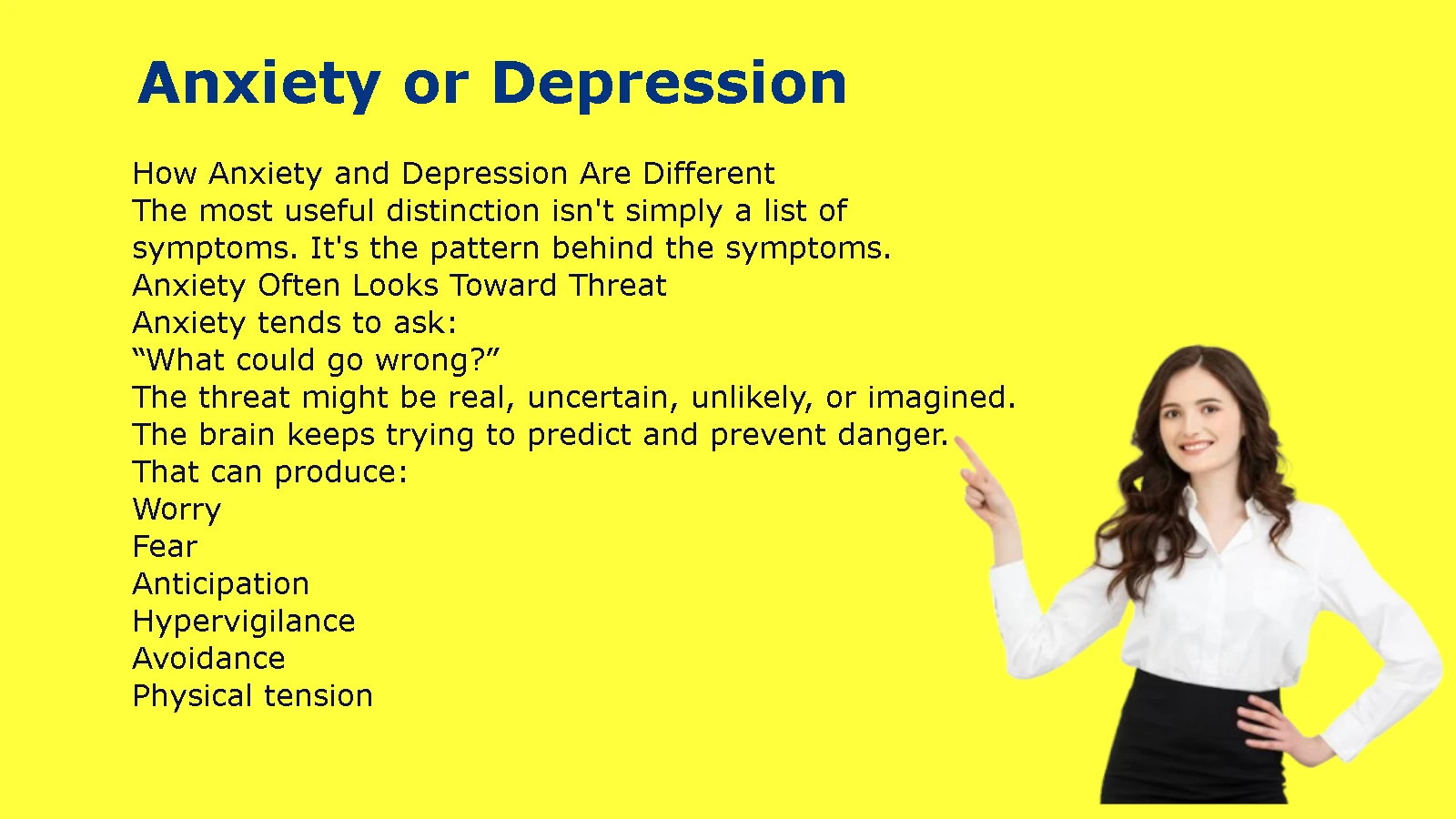
The most useful distinction isn’t simply a list of symptoms. It’s the pattern behind the symptoms.
Anxiety Often Looks Toward Threat
Anxiety tends to ask:
“What could go wrong?”
The threat might be real, uncertain, unlikely, or imagined. The brain keeps trying to predict and prevent danger.
That can produce:
- Worry
- Fear
- Anticipation
- Hypervigilance
- Avoidance
- Physical tension
Depression Often Reduces Interest and Hope
Depression tends to ask a different question:
“Why does anything matter?”
The person may not necessarily fear the future. Instead, the future may feel empty or pointless.
That can produce:
- Low mood
- Hopelessness
- Loss of pleasure
- Low motivation
- Worthlessness
- Withdrawal
- Fatigue
Again, these aren’t rigid categories. A person with depression can feel anxious, and someone with an anxiety disorder can feel depressed.
Is It Anxiety, Depression, Stress, or Something Else?
Not every period of worry or sadness means you have a mental disorder.
Stress, anxiety, and mental health disorders overlap, but they aren’t identical.
NIMH explains that stress is generally a response to an external cause, such as an argument or major deadline. Anxiety can continue even when there is no immediate threat and may interfere with daily life.
Stress
Stress often has an identifiable trigger.
For example:
- A major exam
- Financial pressure
- A difficult work deadline
- A relationship conflict
- Moving to a new home
When the situation changes or resolves, the stress response may decrease.
Anxiety Disorder
An anxiety disorder can persist beyond the immediate situation and may involve excessive fear or worry that is difficult to control.
Depression
Depression involves a broader pattern of low mood, loss of interest or pleasure, and other emotional, cognitive, physical, or behavioral symptoms.
Physical Health Conditions
Some physical health conditions and medications can produce symptoms that resemble depression or anxiety.
That’s another reason professional evaluation matters. A complete assessment looks beyond mental health symptoms alone.
What Causes Anxiety or Depression?
There isn’t one universal cause.
Mental health conditions can develop through a complex interaction of biological, psychological, social, and environmental factors. WHO emphasizes that no single factor reliably predicts whether someone will develop a mental health condition.
Possible contributing factors include:
- Family history and genetics
- Chronic stress
- Trauma
- Abuse
- Major losses
- Difficult life circumstances
- Social isolation
- Physical health problems
- Environmental stressors
- Substance use
- Other mental health conditions
Having one of these factors doesn’t mean you will develop anxiety or depression.
Likewise, someone can develop symptoms without being able to identify one obvious cause.
Mental health isn’t a simple equation where one event automatically produces one condition.
How Are Anxiety and Depression Diagnosed?
Diagnosis involves more than checking boxes on a symptom list.
A healthcare professional may ask about:
- What symptoms you’re experiencing
- When they began
- How frequently they occur
- How long they’ve lasted
- How severe they are
- Your sleep
- Your appetite
- Your energy
- Your concentration
- Your mood
- Your worries or fears
- Your medical history
- Medications or substances
- How symptoms affect work, school, relationships, and daily activities
- Any thoughts of self harm or suicide
The goal is to understand the whole pattern.
For example, trouble sleeping by itself doesn’t tell you whether you’re experiencing anxiety, depression, stress, a sleep disorder, or another problem.
Likewise, feeling sad after a difficult event doesn’t automatically mean clinical depression.
A professional can also consider whether physical health problems or medications could be contributing to symptoms.
When Should You Talk to a Professional?
You don’t have to wait until you’re completely overwhelmed.
Consider talking with a healthcare or mental health professional if:
- Symptoms persist.
- Symptoms keep getting worse.
- Worry feels difficult to control.
- You’re losing interest in things you normally enjoy.
- Sleep or appetite has changed significantly.
- You struggle to concentrate.
- Your work or school performance is suffering.
- You’re withdrawing from friends or family.
- Symptoms interfere with everyday responsibilities.
- You feel hopeless or unable to cope.
A simple rule can help:
If your thoughts, emotions, body, or behavior have changed enough to interfere with your life, it’s reasonable to ask for help.
Seeking support isn’t an admission of failure. It’s a practical response to a problem that deserves attention.
How Are Anxiety and Depression Treated?
Both anxiety disorders and depression are treatable.
The right treatment depends on the condition, severity, symptoms, medical history, preferences, and individual circumstances.
Psychotherapy
Psychotherapy, often called talk therapy, is an important treatment for both anxiety and depression.
Cognitive behavioral therapy (CBT) is one widely used approach. It helps people examine patterns involving thoughts, emotions, and behavior.
For anxiety, psychological treatments may also include exposure based approaches that help people gradually face feared situations rather than continually avoiding them. WHO identifies CBT based approaches and exposure therapy among evidence supported psychological interventions for anxiety disorders.
For depression, psychotherapy can help address negative thinking patterns, behavior changes, relationships, and other factors contributing to symptoms.
Medication
Medication can also play a role.
Antidepressants are commonly used to treat depression. Some antidepressants, including SSRIs and SNRIs, are also used for certain anxiety disorders. NIMH notes that these medications may take several weeks to begin working and can have side effects.
Medication decisions should be made with a qualified healthcare professional.
There isn’t one medication that works identically for everyone. Treatment may involve adjusting the medication, dosage, duration, or overall treatment approach based on the person’s response.
A Combination of Treatments
Some people benefit from psychotherapy and medication together.
NIMH states that depression treatment typically involves psychotherapy, medication, or both.
Treatment also isn’t always a straight line. Finding the right approach can take time, particularly when symptoms are severe, longstanding, or involve more than one condition.
What Can Help Manage Anxiety or Depression Symptoms?
Self care isn’t a replacement for professional treatment when treatment is needed. Still, everyday habits can support mental health and complement appropriate care.
Useful habits include:
- Exercise regularly. Even a short walk can be a practical starting point.
- Keep a regular sleep schedule. Consistency can make sleep easier to manage.
- Eat regularly. Skipping meals can make it harder to maintain energy and routine.
- Practice relaxation techniques. Slow breathing and progressive muscle relaxation can help manage tension.
- Try mindfulness. Even a few minutes can give you a structured break from constant mental activity.
- Stay connected. Isolation can make difficult emotions feel even heavier.
- Limit alcohol. Alcohol can worsen anxiety and interfere with sleep.
- Avoid illicit drugs. Substance use can complicate symptoms and treatment.
WHO specifically recommends regular exercise, healthy eating and sleeping habits, relaxation techniques, and mindfulness as supportive measures for managing anxiety symptoms.
The goal isn’t to build a perfect wellness routine overnight.
If you’re struggling, start small.
A ten minute walk is still a walk. Calling one trusted person is still connection. Going to bed at a consistent time is still progress.
What If You Think You Have Both Anxiety and Depression?
Start by observing the pattern rather than trying to force yourself into one category.
You can write down:
- What you’re feeling
- What you’re thinking
- When symptoms appear
- How often they occur
- What makes them better or worse
- How you’re sleeping
- How your appetite has changed
- Whether you’re avoiding activities
- Whether you’ve lost interest in things you normally enjoy
- How symptoms affect your everyday responsibilities
This information can make a professional appointment more productive.
For example, saying “I feel bad” gives a clinician little detail.
Saying “For the last several weeks, I’ve been worrying most days, sleeping poorly, avoiding social situations, and losing interest in activities I normally enjoy” gives a much clearer picture.
Anxiety or Depression: Questions to Ask Yourself
These questions aren’t a diagnostic test. They’re simply a way to organize what you’re noticing.
Questions That May Point Toward Anxiety
- Do I spend a lot of time worrying about possible problems?
- Is my worry difficult to control?
- Do I frequently expect something bad to happen?
- Do I avoid situations because they make me afraid?
- Do I often feel tense, restless, or on edge?
- Do physical symptoms such as a racing heart or stomach discomfort accompany my worry?
Questions That May Point Toward Depression
- Have I been persistently sad, empty, hopeless, or unusually irritable?
- Have I lost interest in activities I normally enjoy?
- Do things feel less pleasurable than they used to?
- Do I feel unusually tired or unmotivated?
- Have my sleep or appetite changed?
- Do I struggle with feelings of guilt or worthlessness?
- Have I become more socially withdrawn?
Suggest Both
- Do I experience persistent worry and low mood?
- Do I feel anxious but also exhausted and disconnected?
- Am I avoiding activities because of fear while also losing interest in them?
- Are sleep problems, concentration problems, or fatigue affecting several areas of my life?
If several of these questions resonate, that doesn’t automatically establish a diagnosis. It does, however, give you useful information to discuss with a healthcare professional.
A Practical Example: When Anxiety and Depression Overlap
Consider a college student who becomes increasingly worried about academic performance.
At first, the problem looks like anxiety. They constantly worry about grades, replay mistakes, and fear disappointing their family.
The worry affects sleep.
After several months, they become exhausted. They stop meeting friends, abandon hobbies, and begin feeling that nothing they do will make a difference.
Now the picture has changed.
The original anxiety symptoms haven’t necessarily disappeared. They may have been joined by symptoms associated with depression.
This example illustrates why mental health assessment needs to look at the entire pattern rather than one symptom at a time.
When Anxiety or Depression Is an Emergency
Some symptoms require immediate attention.
If you or someone else is experiencing:
- Thoughts of suicide
- Thoughts of self harm
- A plan to seriously hurt yourself
- An inability to stay safe
- An immediate mental health crisis
seek emergency help immediately or contact an appropriate crisis service in your country.
For people in the United States, the 988 Suicide & Crisis Lifeline provides crisis support by calling or texting 988. NIMH also advises people in immediate danger to seek emergency assistance.
If you’re outside the United States, use the emergency or crisis service available where you live.
You don’t need to solve a crisis alone.
Frequently Asked Questions About Anxiety or Depression
Is anxiety or depression worse?
Neither is automatically “worse.”
Severity depends on the person’s symptoms, how long they have lasted, how much they interfere with daily life, and whether there are safety concerns.
A mild anxiety disorder can be deeply disruptive, while severe depression can become life threatening. Comparing the two as though one is always worse misses the point.
Can anxiety turn into depression?
Anxiety doesn’t inevitably turn into depression. However, anxiety disorders are associated with an increased risk of depression.
That’s one reason persistent anxiety deserves attention rather than being dismissed as something you simply have to live with.
Can you have anxiety and depression at the same time?
Yes.
The two conditions can coexist, and some symptoms overlap. A person may experience excessive worry alongside low mood, loss of interest, fatigue, sleep problems, or hopelessness.
A professional evaluation can help determine the most appropriate diagnosis and treatment approach.
How can you tell if you have anxiety or depression?
Look at the overall pattern rather than one symptom.
Anxiety is commonly centered around excessive fear, worry, dread, and threat. Depression is commonly centered around persistent low mood, hopelessness, or loss of interest and pleasure.
However, symptoms can overlap, so self assessment cannot replace professional diagnosis.
Can anxiety cause physical symptoms?
Yes.
Anxiety disorders can involve physical symptoms such as sweating, trembling, heart palpitations, nausea, abdominal discomfort, muscle tension, and sleep problems.
Can depression cause physical symptoms?
Yes.
Depression can affect sleep, appetite, energy, concentration, and physical well being. Some people also experience unexplained aches and pains.
Does anxiety make you tired?
It can.
Persistent worry and physical tension can be exhausting. Anxiety can also interfere with sleep, which can make fatigue worse.
Can depression cause anxiety?
Depression and anxiety can occur together. Someone experiencing depression may also have significant anxious symptoms, but that doesn’t automatically mean they have a separate anxiety disorder.
How long does anxiety last?
Normal anxiety may disappear when a stressful situation ends.
An anxiety disorder can persist much longer and may interfere with everyday life. The duration depends on the specific anxiety disorder and the individual.
How long does depression last?
A depressive episode generally involves symptoms occurring most of the day, nearly every day, for at least two weeks. Depression can also follow recurrent or persistent patterns.
Should I see a doctor for anxiety or depression?
Consider seeking professional help if symptoms persist, become difficult to manage, or interfere with sleep, work, school, relationships, or everyday responsibilities.
You don’t have to wait until symptoms become unbearable.
Both can cause fatigue, sleep problems, concentration difficulties, appetite changes, physical symptoms, and withdrawal. Both can interfere with work, school, relationships, and everyday responsibilities. And yes, you can experience both anxiety and depression at the same time.
The most useful next step isn’t trying to force every symptom into a label. Instead, pay attention to the pattern, duration, severity, and impact on your life.
If something has changed and you aren’t functioning the way you normally do, it’s worth talking with a qualified healthcare or mental health professional.
Most importantly, anxiety and depression are treatable health conditions. Effective psychological treatments exist, medications can help many people, and support can make a meaningful difference. WHO notes that effective treatments for anxiety disorders exist, although access to care remains a major global challenge.
Understanding what’s happening is a useful first step. Getting appropriate support can be the next one.