Species vs species is a common grammar question because the word species can refer to one group of organisms or several groups without changing its spelling. Unlike many English nouns, it does not take a different form in the plural. You can write one species, two species, or many species and remain grammatically correct.
Understanding species singular and plural, species pronunciation, species examples, and species singular possessive will help you use the word correctly in school assignments, scientific writing, and everyday conversations. The key is to look at the context, especially the articles, demonstratives, and verbs surrounding the noun.
Species vs Species: What’s the Difference?
Species has the same spelling in both singular and plural forms. The word refers to one group when used as a singular noun and to multiple groups when used as a plural noun. You determine its number from the meaning of the sentence and the words that accompany it.
For example, these sentences are both correct:
- Singular: This species is native to Australia.
- Plural: These species are native to Australia.
The noun stays the same, but the demonstrative and verb change to match the intended meaning.
Is Species Singular or Plural?
The word species can be singular or plural. It does not need an additional ending when you refer to more than one species.
Consider these examples:
- A species lives in a particular habitat.
- Several species live in the same habitat.
- This species is difficult to identify.
- These species are difficult to identify.
In the first and third examples, species is singular. In the second and fourth examples, it is plural.
The surrounding words provide useful clues. Singular expressions often include a, one, or this. Plural expressions often include several, many, these, or different.
However, you should not rely on one word alone. The full sentence determines whether species refers to one group or multiple groups.
Why Does Species Stay the Same in Both Forms?
Species is an unchanged plural noun, meaning its singular and plural forms are identical. English has several nouns that follow this pattern, including sheep, deer, and series.
| Noun | Singular example | Plural example |
| Species | This species is rare. | These species are rare. |
| Sheep | One sheep is grazing. | Three sheep are grazing. |
| Deer | A deer crossed the road. | Several deer crossed the road. |
| Series | This series is popular. | These series are popular. |
The word species comes from Latin, where it already had a form that English retained. Its unchanged spelling makes it different from regular nouns such as cat/cats, plant/plants, and animal/animals.
You should therefore avoid adding an unnecessary ending. In standard English, specieses is generally incorrect when you want to express the ordinary plural of species.
Species vs. Species: Singular and Plural Examples
The phrase species vs species may look unusual because both sides contain the same word. The comparison makes sense when you are examining the singular and plural uses of that word.
Here are some clear examples:
| Singular use | Plural use |
| This species is endangered. | These species are endangered. |
| One species inhabits the island. | Five species inhabit the island. |
| The species has distinctive markings. | The species have distinctive markings. |
| A species was discovered in the cave. | Several species were discovered in the cave. |
| Each species occupies a different niche. | Different species occupy different niches. |
Notice that the verb changes with the subject. A singular species takes a singular verb, while a plural species takes a plural verb.
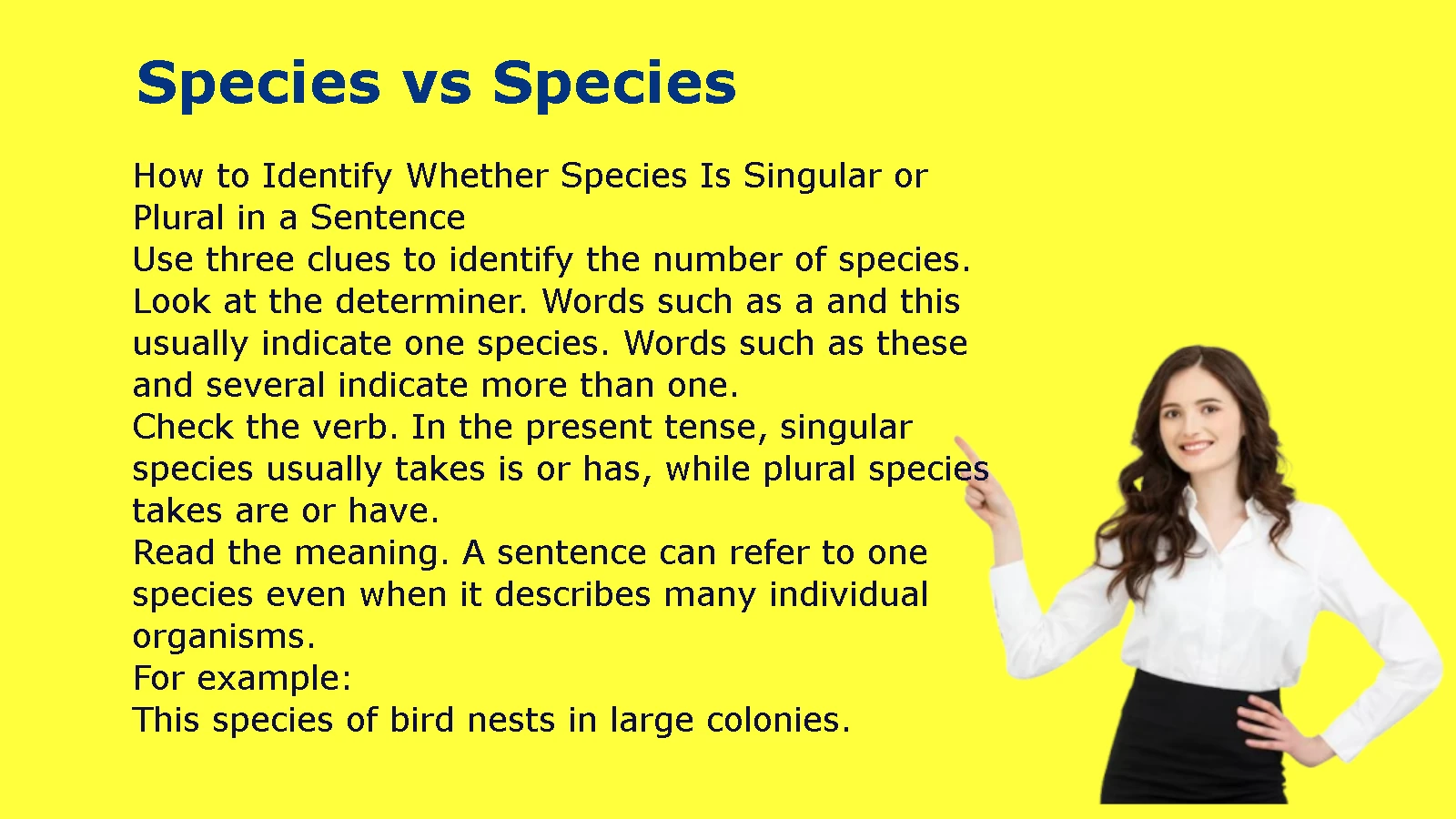
How to Identify Whether Species Is Singular or Plural in a Sentence
Use three clues to identify the number of species.
Look at the determiner. Words such as a and this usually indicate one species. Words such as these and several indicate more than one.
Check the verb. In the present tense, singular species usually takes is or has, while plural species takes are or have.
Read the meaning. A sentence can refer to one species even when it describes many individual organisms.
For example:
This species of bird nests in large colonies.
The sentence refers to one species, even though the bird may have thousands of individual members.
Compare it with:
These species of bird nest in different environments.
Here, the sentence refers to multiple species.
What Does Species Mean in Biology?
In biology, a species is a group of organisms classified together based on shared characteristics and their evolutionary relationships. Under the commonly taught biological species concept, members of a species can generally interbreed naturally and produce fertile offspring. However, scientists use different species concepts because this definition does not fit every organism.
The term is a fundamental part of biological classification. It helps scientists describe biodiversity, identify organisms, study evolution, and track changes in ecosystems.
The Scientific Meaning of Species
Biologists use species to classify living organisms into distinct groups. A species may include individuals that differ in size, color, age, or other features while still belonging to the same recognized group.
For example, domestic cats can have different coat colors, patterns, and body sizes. These differences do not automatically make them separate species.
Scientists consider several factors when classifying organisms:
- Physical characteristics: Body structures, shapes, colors, and other observable traits.
- Genetic evidence: DNA similarities and differences between populations.
- Reproductive relationships: Whether organisms can reproduce with one another under natural conditions.
- Evolutionary history: How populations developed and how closely they relate to other groups.
- Ecological characteristics: The habitats, resources, and environmental roles associated with organisms.
No single criterion works for every case. Scientists may classify organisms differently depending on the evidence available and the species concept they use.
For instance, the biological species concept works well for many sexually reproducing animals. It becomes less useful for bacteria, which commonly reproduce asexually, and for extinct organisms known only through fossils.
Species Examples in Animals, Plants, and Other Organisms
Examples make the biological meaning of species easier to understand.
| Common name | Scientific name | Group |
| Domestic cat | Felis catus | Mammal |
| Gray wolf | Canis lupus | Mammal |
| Monarch butterfly | Danaus plexippus | Insect |
| Giant sequoia | Sequoiadendron giganteum | Tree |
| Rice | Oryza sativa | Flowering plant |
| Baker’s yeast | Saccharomyces cerevisiae | Fungus |
Each scientific name identifies a recognized species. Scientific names are useful because common names vary between regions and languages.
For example, people may use different common names for the same organism. A scientific name provides a more consistent reference in research and education.
Important distinction: An individual organism is not the same thing as a species. One monarch butterfly is an individual. Danaus plexippus is the species to which that butterfly belongs.
A species can contain many individuals distributed across different habitats. Depending on the organism, those individuals may form separate populations that still belong to the same species.
Species vs. Genus, Population, and Variety
Biological classification uses several terms to describe different levels of organization. Although these terms relate to one another, they do not mean the same thing.
| Term | Meaning | Example |
| Species | A recognized biological group | Felis catus |
| Genus | A classification grouping one or more related species | Felis |
| Population | Members of a species living in a particular area | A local population of gray wolves |
| Variety | A term used for particular forms or subdivisions, with its meaning depending on context | A named botanical variety |
A genus is a broader taxonomic category than a species. For example, Felis is the genus that includes the domestic cat and several other cat species.
A population describes organisms living in a particular place. A single species may have many populations spread across different regions.
The word variety has a more flexible meaning. In everyday English, it often means a type or form. In botany, it can also refer to a formal taxonomic rank below the species level.
These distinctions matter in scientific writing. Replacing species with population or genus can change the meaning of a sentence.
Can Two Different Species Look Alike?
Yes. Two different species can look very similar, and members of the same species can look quite different.
Scientists sometimes encounter closely related organisms that share many visible features. In such cases, DNA analysis, reproductive evidence, behavior, and geographic distribution may help distinguish them.
For example, some closely related insect species look almost identical to the naked eye. Researchers may need genetic evidence or detailed examination of physical structures to identify them reliably.
The reverse can also happen. Members of one species may vary considerably in appearance because of age, sex, genetics, or environmental conditions.
Appearance alone does not always determine species identity. Biological classification often requires several kinds of evidence.
Species Examples in Singular and Plural Sentences
The easiest way to learn how to use species is to compare it in complete sentences. The noun remains unchanged, but its meaning and the agreement of the other words depend on whether the sentence refers to one group or several.
Examples of Species Used as a Singular Noun
Use species as a singular noun when you refer to one biological group.
Examples:
- This species is native to Australia.
- The species has adapted to a dry climate.
- A new species was identified during the survey.
- Each species occupies a particular ecological niche.
- One species of frog lives near the stream.
- That species requires clean water to survive.
- The species is known for its distinctive markings.
- Scientists believe this species is vulnerable to habitat loss.
In each sentence, species refers to one group, even when that group contains many individual organisms.
The article a is particularly useful when introducing a singular species for the first time.
For example:
Researchers discovered a species of beetle in the forest.
After introducing it, you could write:
The species appears to be active mainly at night.
The second sentence refers to the same single species.
Examples of Species Used as a Plural Noun
Use species as a plural noun when you refer to two or more distinct groups.
Examples:
- Several species live in the rainforest.
- These species are adapted to different environments.
- Many species depend on pollinating insects.
- Different species have different feeding habits.
- The researchers identified three species in the sample.
- Endangered species need suitable habitats to survive.
- Those species are found across several continents.
- The species were recorded during the field study.
Words such as several, many, and three make the plural meaning clear.
However, a plural noun does not always need a number. In the sentence below, the plural meaning comes from the broader context:
Scientists compared the species found in the two regions.
The sentence may refer to multiple species collected from those regions.
Species Subject-Verb Agreement: Is or Are?
Choosing between is and are is one of the most common challenges with this word.
The correct choice depends on whether species is singular or plural in the sentence.
| Sentence | Correct verb | Reason |
| This species ___ rare. | is | One species |
| These species ___ rare. | are | Multiple species |
| Each species ___ a unique role. | has | Each treats the noun as singular |
| Several species ___ at risk. | are | Several indicates multiple species |
| The species ___ adapted to cold weather. | is | One species is being discussed |
| The species ___ found in several countries. | are | Multiple species are being discussed |
Compare these two examples carefully:
- The species is declining in number.
- The species are declining in number.
Both sentences can be correct. In the first, species refers to one group. In the second, it refers to several groups.
When the noun appears without a clear determiner, readers must use the surrounding context to understand its number.
For example:
The species is protected by law.
This sentence describes one species.
The species are protected by different conservation programs.
This sentence can describe multiple species, with each group receiving protection under the relevant programs.
Common Mistakes When Using Species in Sentences
Writers often make mistakes because they assume every plural noun needs an -s or -es ending.
Avoid these errors:
| Incorrect or confusing | Correct or clearer | Explanation |
| Three specieses live here. | Three species live here. | The plural form is unchanged. |
| These species is rare. | These species are rare. | These indicates a plural subject. |
| This species are endangered. | This species is endangered. | This indicates one species. |
| Each species have a habitat. | Each species has a habitat. | Each takes a singular verb. |
| One species of birds are endangered. | One species of bird is endangered. | The sentence refers to one species. |
The final example is worth a closer look. The plural noun birds can sometimes appear in phrases describing a group of birds, but one species of bird is endangered is a clearer choice when the focus is a single species.
A practical rule is to identify the head noun of the sentence. In one species of bird, the head noun is species, not bird.
Species Plural: Is Species’ or Specieses Correct?
The plural of species is species. You do not add -es to make the noun plural. An apostrophe is used only when you need a possessive form, and the exact placement depends on the grammatical construction and the style convention you follow.
What Is the Plural of Species?
The singular and plural forms are identical.
- One species
- Two species
- Several species
- Hundreds of species
Here are some original examples:
One species of orchid grows in this valley.
Several species of orchid grow in this valley.
The reserve protects dozens of species.
The number of groups changes, but the spelling of the noun does not.
This pattern also appears in the word series:
- One television series
- Two television series
The surrounding words clarify the intended number.
Why Specieses Is Usually Incorrect
Specieses is generally not the standard plural of species. English has retained the same form for singular and plural use.
For example:
- Correct: The island supports many species of insects.
- Incorrect in standard usage: The island supports many specieses of insects.
Adding -es makes the word unnecessarily long and does not follow its established plural pattern.
If you want to make the number clear, use a determiner or a number instead:
- One species
- Two species
- Several species
- Numerous species
These expressions are natural and grammatically correct.
How Articles and Quantifiers Show Singular or Plural Meaning
Articles and quantifiers often make the intended number obvious.
| Expression | Number | Example |
| A species | Singular | A species has disappeared from the area. |
| One species | Singular | One species dominates the habitat. |
| Each species | Singular | Each species has different needs. |
| This species | Singular | This species is easy to recognize. |
| Two species | Plural | Two species share the same habitat. |
| Several species | Plural | Several species depend on the wetland. |
| Many species | Plural | Many species migrate seasonally. |
| These species | Plural | These species are closely related. |
The word species itself does not reveal the number. Instead, the sentence uses other words to show whether one or multiple groups are involved.
Species Pronunciation: How to Say Species Correctly
The word species is commonly pronounced SPEE-sheez in English. It has two syllables, with the stress on the first syllable. The pronunciation generally remains the same whether the word is singular or plural.
Species Pronunciation in American English
In American English, species is usually pronounced /ˈspiːʃiːz/.
Break it into two syllables:
- First syllable: SPEE
- Second syllable: sheez
The first syllable carries the stress. The opening sound is the same long ee vowel you hear in see.
Example:
Scientists identified a new species of butterfly.
When speaking, give the first syllable the strongest emphasis. Avoid adding an extra syllable or changing the final sound into an -is ending.
Species Pronunciation in British English
British English also commonly uses the pronunciation /ˈspiːʃiːz/. Regional accents may affect the exact quality of the vowels, but the main pronunciation pattern remains similar.
The important points are:
- The word has two syllables.
- The stress falls on the first syllable.
- The ending sounds like sheez.
- The pronunciation does not change between singular and plural uses.
Both American and British speakers can use the same basic pronunciation guide.
Species or Species: Does the Pronunciation Change in the Plural?
No. The pronunciation of species generally stays the same in singular and plural contexts.
| Use | Example | Pronunciation |
| Singular | This species is rare. | SPEE-sheez |
| Plural | These species are rare. | SPEE-sheez |
The sentence changes around the noun, but the word itself remains unchanged.
This is similar to the spelling pattern. You do not add a new ending to the word simply because you are referring to multiple species.
Common Species Pronunciation Mistakes
A few mistakes can make the word harder to recognize.
- Adding an extra syllable: Keep the word to two syllables.
- Stress on the second syllable: Place the main stress on the first syllable.
- Pronouncing the ending as a short is sound: The standard pronunciation ends with a voiced z sound.
- Changing the plural pronunciation: Do not invent a separate plural pronunciation.
A useful practice method is to say the word slowly, then use it in a complete sentence. This helps you maintain the correct stress when speaking naturally.
Species Singular Possessive and Plural Possessive
The possessive form of species shows ownership or association. The standard form species’ is commonly used for both singular and plural possessive meanings because the noun already ends in s. Context tells the reader whether one species or multiple species are involved.
What Is the Singular Possessive of Species?
The singular possessive shows that something belongs to or is associated with one species.
Examples:
- The species’ habitat is shrinking.
- The species’ scientific classification has changed.
- The species’ survival depends on suitable nesting sites.
- The species’ range covers several regions.
In these sentences, the noun refers to one species.
Because species already ends in s, many style guides and writers use an apostrophe after the final letter to form the possessive: species’.
Some style conventions permit or prefer species’s for a singular possessive. If you are writing for a school, publication, or scientific organization, follow its style guide consistently.
What Is the Plural Possessive of Species?
The plural possessive shows that something belongs to or is associated with multiple species.
Examples:
- The species’ habitats differ across the region.
- The species’ ranges overlap in the reserve.
- The species’ survival rates vary between environments.
- The species’ interactions influence the ecosystem.
The spelling is the same as the common singular possessive form. The context establishes whether one species or several species are involved.
Compare:
The species’ habitat is protected.
This usually refers to one species and its habitat.
The species’ habitats are protected.
This usually refers to multiple species and their respective habitats.
The noun after the possessive can help readers understand the intended meaning, but the surrounding sentence still matters.
Species vs. Species’: When Should You Use an Apostrophe?
Use species when you simply name the organism group. Use species’ when you need to show possession or association.
| Form | Function | Example |
| Species | Singular or plural noun | Several species live here. |
| Species’ | Possessive form | The species’ habitat is protected. |
| Species’s | Alternative singular possessive under some style conventions | The species’s habitat is protected. |
The form species’s is not universally preferred. Some style guides favor adding ‘s to singular nouns ending in s, while others use a final apostrophe for certain classical or already s-ending words.
For general writing, species’ is a widely accepted and practical choice. Keep your usage consistent throughout the document.
How to Make Species Possessive Without Confusing the Reader
Follow these steps when you need the possessive form.
Identify the owner. Decide whether the sentence refers to one species or several.
Choose the possessive convention. Use the style required by your school, employer, or publication. If no guide applies, species’ is a common option.
Check the noun that follows. A singular noun such as habitat may refer to one species, while a plural noun such as habitats may suggest several. Neither clue replaces the need to check the full sentence.
For example:
The species’ nesting behavior changes during the breeding season.
This sentence describes the nesting behavior of one species.
The species’ nesting behaviors differ across the study area.
This sentence can describe the behavior patterns of multiple species.
If a sentence remains ambiguous, rewrite it for clarity:
The nesting behavior of each species changes during the breeding season.
This version makes the relationship explicit without relying on an ambiguous possessive.
Species Synonyms and Related Words
Common synonyms for species include kind, type, sort, and category. These words can work in everyday contexts, but they are not always interchangeable with species in biology. Scientific writing often requires the more precise term because it identifies a particular taxonomic group.
Common Synonyms for Species
The best synonym depends on the context.
| Synonym | Typical meaning | Example |
| Kind | A general group or class | What kind of plant is this? |
| Type | A category distinguished by certain features | This type of material resists heat. |
| Sort | An informal way to describe a category | That sort of behavior is unusual. |
| Category | A group defined by shared criteria | The data fall into a separate category. |
| Variety | A particular form or variation | The garden contains a variety of roses. |
| Organism group | A descriptive phrase for related living things | The organism group was examined in the laboratory. |
In ordinary conversation, kind or type may communicate the general meaning of species.
For example:
What species of tree is growing beside the house?
You might casually ask:
What kind of tree is growing beside the house?
The second sentence sounds natural, but it is less precise. The word species may be necessary if the speaker wants a formal biological identification.
Species vs. Kind: Are They Interchangeable?
Not always. Kind is a broad everyday word, while species has a specific role in biological classification.
Compare these examples:
- What kind of music do you enjoy?
- What species of bird did you see?
- This kind of fabric dries quickly.
- This species of fish lives in freshwater.
You can use kind to describe almost any category of thing. In contrast, species generally refers to a biological classification.
In casual conversation, people sometimes use kind when they mean a biological species. However, the terms are not exact equivalents in scientific work.
Species vs. Variety in Biology
The word variety can refer to a general difference or a formal botanical classification. It does not automatically mean the same thing as species.
A species may contain considerable variation. Plants within the same species, for instance, can differ in color, size, or growth habits without being classified as separate species.
In botanical taxonomy, variety can describe a recognized subdivision below the species level.
The distinction is important:
- Species: A taxonomic group recognized as a species.
- Variety: A form or subdivision that may exist within a species, depending on the context.
- Variation: Differences between individuals or populations.
For example, two roses may differ in color but still belong to the same species. Their appearance alone does not establish that they represent separate species.
Why Scientific Writing Often Requires the Word Species
Scientific language aims to communicate precise meanings. Replacing a technical term with a loose synonym can make a statement less accurate.
Consider this sentence:
Several species of frog inhabit the wetland.
The sentence states that multiple distinct biological species live there.
Now compare:
Several kinds of frog inhabit the wetland.
The meaning is understandable, but kinds could refer to species, varieties, breeds in a loose sense, or other groupings.
Use species when you mean the biological classification. Choose kind or type when the classification is informal or when the precise taxonomic level does not matter.
Species vs. Other Commonly Confused Words
The word species is sometimes confused with related terms because all of them can describe categories or groups. However, each has a different meaning or grammatical role.
Species vs. Specie
Species is the word used for a biological group and can also refer to a type or category of something.
Specie, pronounced differently, is a financial term that refers to money in the form of coins rather than paper currency or other forms of payment. It also appears in some specialized historical and economic contexts.
Examples:
- The researchers identified a new species of moth.
- The payment was made in specie.
Do not use specie as a substitute for the ordinary plural of species.
Species vs. Genus
A species is a taxonomic group, while a genus is a broader classification that may contain one or more species.
For example, the domestic cat’s scientific name is Felis catus. Felis is the genus, and catus identifies the species within that scientific name.
The distinction matters when you describe relationships between organisms. Two organisms can belong to the same genus but represent different species.
Species vs. Breed
A breed is a group of domesticated animals selected for particular inherited traits. A species is a broader biological classification.
For example, a Labrador Retriever and a German Shepherd are different dog breeds, but both belong to the domestic dog species.
A breed does not automatically constitute a separate species.
This difference is useful when writing about agriculture, animal care, pet ownership, or genetics.
Species vs. Population
A population is a group of organisms of the same species living in a particular area or interacting within a particular region.
A single species may have many populations.
For example, gray wolves living in separate regions may belong to the same species while forming distinct populations. These populations may differ in size, genetic characteristics, or local behavior.
The distinction matters in ecology and conservation. A species can remain present overall while a particular local population declines or disappears.
Quick Guide to Using Species Correctly
You can use species correctly by checking the intended number, matching the verb, and adding an apostrophe only when you need a possessive form.
| Form | Meaning | Example |
| Singular species | One biological group | This species is rare. |
| Plural species | Two or more biological groups | These species are rare. |
| Singular possessive | Something associated with one species | The species’ range is shrinking. |
| Plural possessive | Something associated with multiple species | The species’ ranges overlap. |
| Incorrect standard plural | An unnecessary ending | Use species, not specieses. |
A Simple Three-Step Check for Species
Use this method when proofreading your work.
Step one: Identify the number.
Ask whether the sentence refers to one species or several. Look for words such as a, each, one, several, many, and these.
Step two: Check the verb.
Use a singular verb for a singular subject and a plural verb for a plural subject.
- This species is protected.
- These species are protected.
Step three: Check the possessive form.
If you are expressing ownership or association, choose a consistent possessive style.
- The species’ habitat is shrinking.
- The species’ habitats are shrinking.
You do not need to change species into specieses at any point.
A Practical Example: Editing a Biology Report
Imagine a student writes the following paragraph:
Three specieses of fish lives in the pond. This species are sensitive to pollution, and the species’s habitats is shrinking.
The paragraph contains several grammar problems. The plural form is incorrect, the verbs do not agree with their subjects, and the possessive construction needs attention.
A clearer revision would be:
Three species of fish live in the pond. These species are sensitive to pollution, and their habitats are shrinking.
If the student means one particular species in the second sentence, the wording could instead be:
Three species of fish live in the pond. One species is especially sensitive to pollution, and its habitat is shrinking.
The revised examples show why context matters. Correct spelling alone is not enough; the number of the noun must also match the meaning of the sentence.
Frequently Asked Questions About Species
Is species singular or plural?
Species can be singular or plural. Use it in the singular when referring to one biological group and in the plural when referring to two or more groups. The spelling stays the same in both cases.
What is the plural of species?
The plural of species is species. For example, one species refers to one group, while several species refers to multiple groups. In standard English, you generally should not write specieses.
How do you pronounce species?
The common English pronunciation is SPEE-sheez, with two syllables and stress on the first. The pronunciation generally stays the same whether species is singular or plural.
What is an example of a species?
The domestic cat (Felis catus) is one example of a species. A single cat is an individual organism, while Felis catus refers to the species as a whole.
What is the singular possessive of species?
A common singular possessive form is species’, as in the species’ habitat. Some style guides also accept or prefer species’s. Follow the relevant style guide and use the same convention consistently.
What is another word for species?
Common alternatives include kind, type, and sort. These words work in everyday conversation, but they may not express the precise biological meaning of species. Use the scientific term when taxonomic accuracy matters.
Conclusion: Use Species Correctly in Every Sentence
The main rule behind species vs species is simple: species has the same spelling in both singular and plural forms. You can write one species or many species without changing the noun.
Remember these practical points:
- Species singular: This species is endangered.
- Species plural: These species are endangered.
- Species pronunciation: SPEE-sheez.
- Species possessive: Species’ is a common form, although style conventions vary.
- Species synonyms: Kind and type may work in everyday contexts, but they are not always precise biological substitutes.
When you are unsure, check the surrounding words and the verb. This small step will help you avoid common errors in essays, reports, and everyday writing.