Mean vs Means can be confusing because both words can appear in similar sentences but serve different grammatical roles. Mean can function as a verb, adjective, or mathematical noun, while means can be a verb or a noun referring to a method, resource, or way of doing something. The correct choice depends on the subject, sentence structure, and intended meaning.
For example, you would write “I mean what I say” but “She means what she says.” However, you would also say “A bicycle is a means of transport” and “Buses are common means of transport.” These examples show why understanding subject-verb agreement, singular and plural nouns, means of communication, and mathematical mean helps you choose the right form.
This guide explains the difference between mean and means, when to use each word, how both forms work in different contexts, and how to avoid common grammar mistakes. You’ll also learn when to use mean vs. meant and how to recognize the correct expression in everyday English.
What Is the Difference Between Mean and Means?
Mean is the base form of a verb, an adjective meaning unkind, or a mathematical term for an average. Means is the third-person singular form of the verb mean and a noun referring to a method, resource, or way of achieving something. The correct form depends on how the word functions in a sentence.
Consider these examples:
- Mean: I mean what I say.
- Means: She means what she says.
- Mean as an adjective: That was a mean thing to say.
- Means as a noun: Email is a convenient means of communication.
- Mean in mathematics: The mean of 4, 6, and 8 is 6.
Although the words look similar, you cannot always replace one with the other.
Mean vs Means: Quick Comparison Table
| Feature | Mean | Means |
| Verb form | Base form of the verb | Third-person singular present tense |
| Common subjects | I, you, we, they | He, she, it, or a singular noun |
| Noun meaning | An average in mathematics | A method, resource, or way |
| Adjective meaning | Unkind or ungenerous | Not commonly used as an adjective |
| Example | They mean well. | He means well. |
| Mathematical example | Find the mean of these numbers. | This symbol means addition. |
The most important distinction concerns verb agreement. Use mean with plural subjects and with I or you. Use means with a third-person singular subject in the simple present tense.
The noun means follows a different rule. It can refer to one method or several methods, depending on the sentence.
When to Use Mean
Use mean when the sentence calls for the base form of the verb, an adjective, or the mathematical noun describing an average.
As a verb, mean can express an intention, definition, or significance.
Examples:
- I mean every word I say.
- What do you mean by that comment?
- These instructions mean we must arrive early.
- They mean well, even when their advice sounds blunt.
Use mean as an adjective when you want to describe someone or something as unkind, unfair, or ungenerous.
Examples:
- It was mean to exclude her from the conversation.
- He made a mean joke about his friend’s mistake.
- The shop owner was not mean with his time or attention.
In mathematics, the mean usually refers to the arithmetic average of a set of numbers.
For example, the mean of 3, 6, and 9 is 6 because their sum is 18 and 18 divided by 3 equals 6.
When to Use Means
Use means when a third-person singular subject performs the action of the verb mean in the simple present tense.
Examples:
- She means no harm.
- This message means a lot to me.
- The red light means you must stop.
- His silence means he needs more time.
You can also use means as a noun when discussing a method, resource, or way of achieving something.
Examples:
- A telephone is a means of communication.
- Walking is an inexpensive means of transport.
- Education can provide a means of improving your career prospects.
Notice the difference between these two sentences:
- Verb: This sign means the road is closed.
- Noun: This bridge is a means of crossing the river.
In the first sentence, means describes what the sign communicates. In the second, means refers to a method of crossing.
Is Means Singular or Plural?
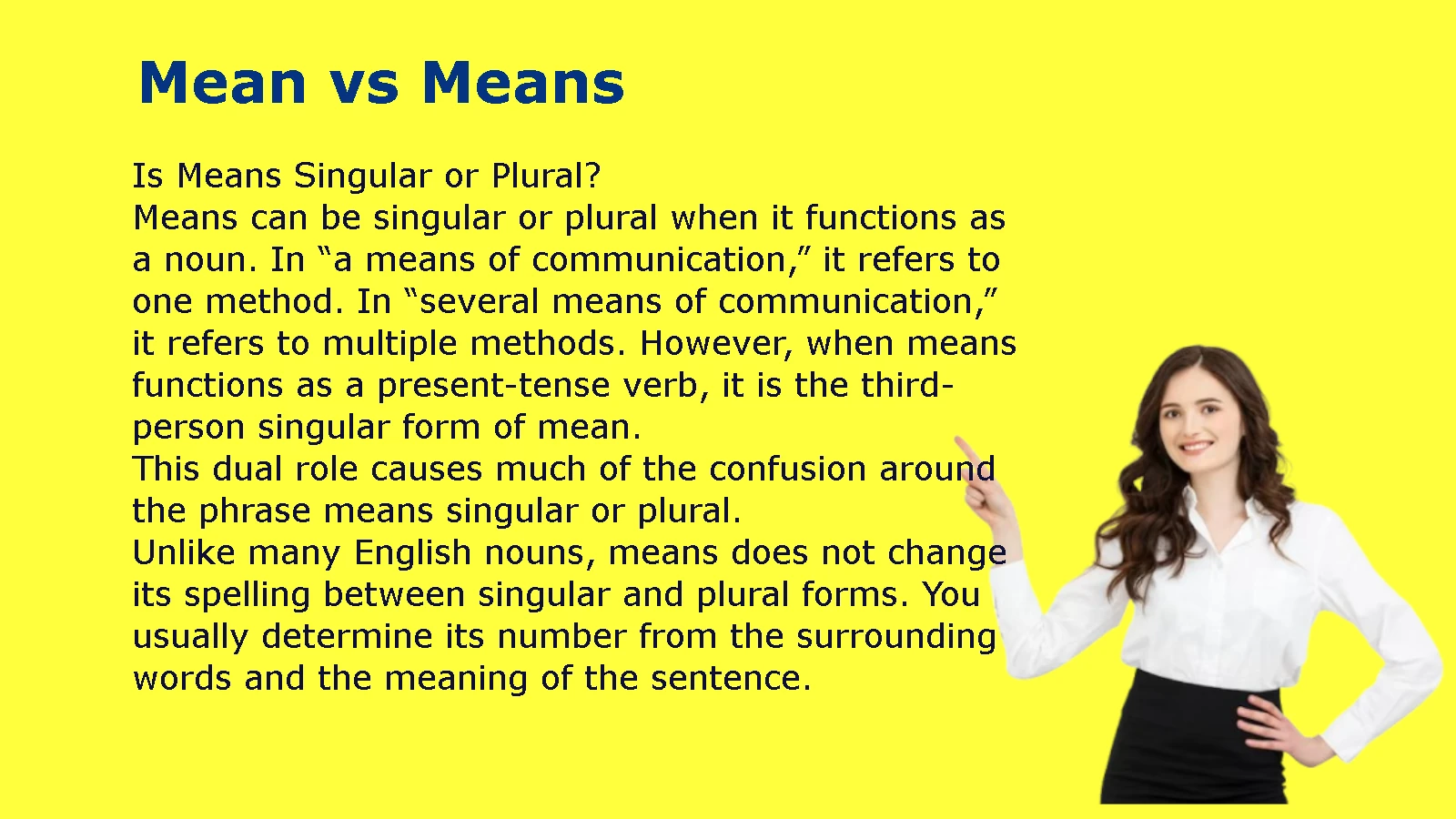
Means can be singular or plural when it functions as a noun. In “a means of communication,” it refers to one method. In “several means of communication,” it refers to multiple methods. However, when means functions as a present-tense verb, it is the third-person singular form of mean.
This dual role causes much of the confusion around the phrase means singular or plural.
Unlike many English nouns, means does not change its spelling between singular and plural forms. You usually determine its number from the surrounding words and the meaning of the sentence.
When Means Is a Singular Noun
The noun means can describe one method, process, or resource.
Examples:
- A bicycle is a means of transportation.
- Email is an effective means of communication.
- A scholarship can be a means of funding your education.
- This agreement provides a means of resolving disputes.
The article a provides a useful clue. In “a means of transportation,” the noun refers to one method.
You can also use demonstratives and other expressions to show that the noun is singular.
Examples:
- This means of payment is convenient.
- One means of contact is no longer available.
- An alternative means of access is needed.
Here, means remains unchanged, even though the sentence refers to one method.
When Means Is a Plural Noun
The noun means also refers to several methods, resources, or ways of achieving a result.
Examples:
- Several means of communication are available.
- Different means of transport serve different needs.
- The company explored alternative means of reducing costs.
- Digital payments provide convenient means of transferring money.
Words such as several, many, different, and various often indicate that means is plural.
Compare these sentences:
| Singular noun | Plural noun |
| A means of communication is available. | Several means of communication are available. |
| This means of payment is secure. | These means of payment are secure. |
| One means of transport is sufficient. | Multiple means of transport are available. |
The noun itself does not change. Instead, the surrounding words reveal whether the sentence refers to one method or several.
Why Means Is Not Always the Plural of Mean
The assumption that means is always the plural of mean is incorrect because the two forms can belong to different grammatical categories.
Consider these examples:
- Verb: She means what she says.
- Plural verb subject: They mean what they say.
- Singular noun: A means of communication is necessary.
- Plural noun: Several means of communication are necessary.
In the first two examples, the difference comes from subject-verb agreement. In the final two, means is a noun that keeps the same spelling in both numbers.
Remember this practical rule:
If the word describes what someone intends or what something signifies, check the subject. If it refers to a method or resource, check whether the sentence describes one method or several.
This distinction will help you avoid most mean-versus-means mistakes.
Should You Use Mean or Means in a Sentence?
Use mean with I, you, we, and they in the simple present tense. Use means with he, she, it, or another third-person singular subject. When means is a noun, its number depends on the context rather than this verb rule.
The easiest way to choose is to identify the subject before deciding which verb form belongs in the sentence.
Mean or Means With Different Subjects
English uses different verb forms depending on the subject.
| Subject | Correct form | Example |
| I | Mean | I mean no offense. |
| You | Mean | You mean a lot to us. |
| We | Mean | We mean what we say. |
| They | Mean | They mean well. |
| He | Means | He means no harm. |
| She | Means | She means every word. |
| It | Means | It means the deadline has changed. |
| The teacher | Means | The teacher means to help. |
| The students | Mean | The students mean to finish today. |
This rule applies to the simple present tense. It does not mean that every sentence containing a singular subject must use means.
For example, after the auxiliary verb does, use the base form mean:
- Correct: Does she mean that?
- Incorrect: Does she means that?
The auxiliary verb already carries the third-person singular marking. Adding -s to the main verb would duplicate that marking.
The same principle applies to negatives:
- Correct: He does not mean to upset you.
- Incorrect: He does not means to upset you.
Mean or Means as a Noun
When you use means as a noun, focus on its meaning rather than the subject-verb rule.
Examples:
- A means of communication is available.
- Several means of communication are available.
- This means of payment works well.
- These means of payment work well.
In these sentences, the verb agrees with the noun phrase as a whole. A single means takes a singular verb, while multiple means take a plural verb.
This distinction becomes particularly useful in formal writing, where the expression means of communication or means of transport often appears.
Common Mean vs Means Mistakes
Writers often make mistakes when they focus on the word immediately before the verb rather than identifying the actual subject.
Here are some common errors and their corrections.
| Incorrect sentence | Correct sentence | Explanation |
| He mean well. | He means well. | He takes means in the simple present. |
| They means different things. | They mean different things. | They takes mean. |
| Does she means that? | Does she mean that? | Use the base form after does. |
| A means of transport are available. | A means of transport is available. | One means takes a singular verb. |
| Several means of transport is available. | Several means of transport are available. | Several means takes a plural verb. |
| This signs means stop. | These signs mean stop. | The plural subject signs takes mean. |
A useful editing habit is to read the sentence without its extra details.
For example, in “The message from the manager means that we need to reschedule,” the subject is the message, not the manager. Because the message is singular, means is correct.
Mean or Means of Communication?
Means of communication is the standard expression for a method or methods used to share information. Use “a means of communication” when referring to one method and “means of communication” when referring to methods collectively. The correct verb depends on whether the sentence treats the expression as singular or plural.
Communication can happen through speech, writing, gestures, electronic devices, and many other channels. The word means describes how the information travels from one person or group to another.
Examples of Means of Communication
Here are examples showing how the expression works in everyday English.
- Email is a common means of communication in offices.
- Video calls offer a convenient means of communicating with remote colleagues.
- Letters were once an important means of long-distance communication.
- Phones and messaging apps are popular means of communication.
- Body language can be a powerful means of expressing emotion.
- Public announcements provide a means of sharing urgent information.
Each sentence uses means to describe a method or methods of communicating.
The expression can also appear in academic, professional, and technical writing.
For example:
“Online learning provides a means of delivering lessons to students who cannot attend a physical classroom.”
Here, a means refers to one broad method of delivering education, even though that method may include several tools.
Is Means of Communication Singular or Plural?
The phrase means of communication can refer to either one method or multiple methods.
Compare the following examples:
- Singular: A means of communication is required for the project.
- Plural: Several means of communication are available to the team.
- General use: Modern means of communication have changed how people work.
In the first sentence, a signals one method, so the verb is is. In the second, several signals multiple methods, so the verb is are.
The third sentence uses means as a plural noun because the sentence refers to multiple communication methods in general.
However, the expression can also describe communication as a broad category without specifying a number.
For instance, “Email is a means of communication” identifies email as one method within that category.
When writing, choose the article and verb that match the meaning you intend to express.
Mean or Means of Transport?
Means of transport is a standard expression for a method used to move people or goods from one place to another. It can refer to one method, such as a bicycle, or several methods, such as buses and trains. The words around means determine whether the noun phrase is singular or plural.
Transportation methods vary according to distance, cost, availability, and purpose. A bicycle may suit a short urban journey, while an airplane may be more practical for international travel.
Examples of Means of Transport
These sentences show how to use the expression correctly.
- A bicycle is an affordable means of transport.
- A train is a practical means of traveling between cities.
- Buses and trains are common means of public transport.
- Ships remain important means of transporting goods.
- Walking is a simple means of getting around a neighborhood.
- Airplanes provide a fast means of traveling long distances.
The choice between singular and plural depends on the intended meaning.
For example, “A bus is a means of transport” refers to one method. By contrast, “Buses, trains, and bicycles are means of transport” refers to multiple methods.
Means of Transport vs. Means of Transportation
Both means of transport and means of transportation are correct expressions.
| Expression | Meaning | Example |
| Means of transport | Methods used to move people or goods | Trains are common means of transport. |
| Means of transportation | Methods used to travel or carry goods | Trucks are essential means of transportation. |
Transport is especially common in British English, while transportation is widely used in American English. Both forms appear in international English, so neither expression is universally incorrect.
You can choose the expression that suits your audience and maintain consistency throughout your article or document.
For example, a British audience may be more familiar with “public transport,” while an American audience may more often use “public transportation.”
The grammar remains the same with either phrase:
- One means of transportation is available.
- Several means of transportation are available.
What Does Mean or Means Mean in Mathematics?
In mathematics, mean usually refers to an average calculated from a set of numbers. By contrast, means can function as a verb that explains what a mathematical symbol or expression represents. For example, “The mean is 6” describes an average, while “The symbol + means addition” explains a symbol’s function.
These two uses are related to the general idea of meaning, but they serve different purposes.
Mean as a Mathematical Average
The arithmetic mean is the sum of a set of values divided by the number of values in that set.
The formula is:
Arithmetic mean = Sum of all values ÷ Number of values
For example, consider the numbers 4, 6, and 8.
- Add the values: 4 + 6 + 8 = 18.
- Count the values: There are 3.
- Divide the total by the count: 18 ÷ 3 = 6.
Therefore, the arithmetic mean is 6.
You can use the same method with larger data sets.
Suppose a student scores 70, 80, 85, and 95 on four tests. The total is 330. Divide 330 by 4, and the mean score is 82.5.
The mean helps summarize a data set with one representative value. However, it can be affected by unusually high or low numbers.
For example, the mean of 10, 12, 13, and 65 is 25. The unusually high value of 65 pulls the average upward, even though three of the four values fall between 10 and 13.
This is why statisticians sometimes compare the mean with the median and mode.
| Mathematical term | Meaning | Example using 2, 3, 3, 4, 18 |
| Mean | Sum divided by the number of values | 6 |
| Median | Middle value after sorting | 3 |
| Mode | Most frequently occurring value | 3 |
The mean, median, and mode describe different aspects of a data set. Choosing the right measure depends on the data and the question being answered.
What Does This Symbol Mean?
In mathematical sentences, means often explains the interpretation of a symbol, number, or expression.
Examples:
- The symbol + means addition.
- The symbol = means that two expressions have equal values.
- The symbol ÷ means division.
- The expression (x > 5) means that (x) is greater than 5.
- A negative sign before a number means that the number is below zero on the number line.
In these examples, means is a verb. Its subject is singular, such as the symbol, the expression, or a negative sign.
When the subject is plural, use mean instead.
Examples:
- The symbols + and − mean addition and subtraction, respectively.
- These equations mean the same thing.
- The markings on the graph mean different values.
This difference is a straightforward example of subject-verb agreement.
Mean vs Means in Mathematical Sentences
Mathematical writing often uses both forms in the same explanation.
Consider these examples:
Example: The arithmetic mean
“The mean of these numbers is 10.”
Here, mean is a noun referring to an average.
Example: The meaning of a symbol
“This symbol means multiplication.”
Here, means is a verb explaining what the symbol represents.
Example: Multiple symbols
“These symbols mean different operations.”
Here, the plural subject symbols takes the verb mean.
Example: Multiple averages
“The means of the two data sets are different.”
Here, means is a plural noun referring to the averages calculated for two data sets. The verb are confirms that the noun is plural.
The context tells you whether mean refers to an average or means explains a symbol’s meaning.
Mean or Meant: What Is the Difference?
Mean is the base form of the verb and its present-tense form with subjects such as I, you, we, and they. Meant is the past tense and past participle of mean. Use meant to describe an earlier intention or meaning, and use mean after the auxiliary verb did.
Although mean, means, and meant share the same root, they perform different grammatical functions.
When to Use Mean
Use mean to describe an intention, definition, or significance in the present, or when the sentence requires the base form.
Examples:
- What do you mean?
- I mean what I say.
- These instructions mean we should leave early.
- What does this word mean?
- They mean no harm.
Notice the construction “What does this word mean?” The main verb remains mean because does already carries the third-person singular form.
When to Use Meant
Use meant when describing an intention or meaning in the past.
Examples:
- I meant to call you yesterday.
- She meant no offense.
- They meant to arrive before noon.
- His message meant more than he realized.
- What did you mean by that comment?
The last example illustrates an important rule. After did, use mean, not meant.
Correct: “What did you mean?”
Incorrect: “What did you meant?”
The auxiliary did marks the past tense, so the main verb stays in its base form.
Mean vs. Meant vs. Means
| Word | Grammatical role | Example |
| Mean | Base verb | I mean what I say. |
| Means | Third-person singular present verb | She means what she says. |
| Meant | Past tense or past participle | She meant what she said. |
| Mean | Mathematical noun | The mean is 12. |
| Means | Noun for a method or resource | A means of payment is available. |
A practical way to remember these forms is to ask two questions:
- When did it happen? Use mean or means for the present, depending on the subject, and meant for the past.
- What does the word describe? If it refers to a method or resource, means may be a noun rather than a verb.
More Examples of Mean and Means in Everyday English
Seeing the words in different contexts helps you recognize their grammatical roles more quickly.
Mean and Means in Questions
Questions often include auxiliary verbs, which can make the correct form less obvious.
Examples:
- What do you mean by that?
- What does this word mean?
- What do these instructions mean?
- Does the sign mean the road is closed?
- What did she mean when she said that?
Pay attention to the auxiliary verb.
Use mean after do, does, and did when they support the main verb:
- Do they mean it?
- Does he mean it?
- Did he mean it?
Avoid adding an extra ending to the main verb after these auxiliaries.
Mean and Means in Statements
Statements use the same subject-verb agreement rules.
Examples:
- I mean to finish this work today.
- The instructions mean we must use a different method.
- This result means we need to repeat the test.
- Those remarks mean different things to different people.
- She means well, even when she sounds impatient.
The word means can also refer to resources or methods.
For example, “The family has the means to pay for the repairs” refers to its financial resources. In this sense, means is a noun, not a verb.
Another example is “The ends do not always justify the means.” Here, the means refers to the methods used to achieve a goal.
Mean as an Adjective
The word mean has several meanings beyond the verb and mathematical noun.
As an adjective, it commonly describes behavior that is unkind, cruel, or ungenerous.
Examples:
- It was mean to criticize someone in public.
- He apologized for making a mean comment.
- The character in the story was mean to everyone.
In mathematics, mean can also describe an average or something calculated using an average.
For example, “The mean temperature for the week was 24°C” uses mean as part of a statistical expression.
Context is the key. In “She was mean to her brother,” the word describes behavior. In “The mean temperature was 24°C,” it refers to an average.
How to Choose Between Mean and Means
The easiest way to choose between mean and means is to identify the word’s grammatical role before checking the subject. This prevents you from confusing a verb form with a noun that refers to a method or resource.
A Simple Three-Step Grammar Check
Step 1: Identify the part of speech.
Ask whether the word expresses an intention, describes something, refers to an average, or names a method.
- “They mean well.” — Verb
- “That was mean.” — Adjective
- “Find the mean.” — Mathematical noun
- “A means of transport.” — Noun
Step 2: If it is a present-tense verb, check the subject.
Use mean with I, you, we, and they. Use means with he, she, it, and singular nouns.
- We mean business.
- He means business.
- These results mean a lot.
- This result means a lot.
Step 3: If it is a noun, check the context.
When means refers to a method or resource, look at the surrounding words to determine whether the sentence describes one method or multiple methods.
- A means of communication is necessary.
- Several means of communication are necessary.
This process works for ordinary conversations, academic writing, professional documents, and mathematical explanations.
Quick Practice: Mean or Means?
Choose the correct word for each sentence before checking the answers.
Fill in the blanks
- I _____ what I said.
- She _____ no harm.
- These numbers _____ something different.
- A bicycle is a useful _____ of transport.
- What does this symbol _____?
Answers and explanations
| Sentence | Answer | Why |
| I _____ what I said. | Mean | Use mean with I. |
| She _____ no harm. | Means | Use means with a third-person singular subject. |
| These numbers _____ something different. | Mean | Use mean with the plural subject numbers. |
| A bicycle is a useful _____ of transport. | Means | The noun means refers to a method. |
| What does this symbol _____? | Mean | Use the base verb after does. |
If you answered all five correctly, you understand the main distinction. If not, review the difference between means as a verb and means as a noun.
Frequently Asked Questions
Is means singular or plural?
Means can be singular or plural when used as a noun. “A means of communication” refers to one method, while “several means of communication” refers to multiple methods. As a present-tense verb, means is the third-person singular form of mean.
What is the difference between mean and means?
Mean is the base verb, an adjective meaning unkind, or a mathematical term for an average. Means is the third-person singular present-tense verb or a noun referring to a method or resource. The sentence determines which meaning applies.
Should I say mean or means of communication?
Use means of communication. For one method, write “A telephone is a means of communication.” For several methods, write “Telephones and emails are means of communication.” The noun means has the same spelling in both cases.
Is it mean or means of transport?
Means of transport is correct. You can write “A train is a means of transport” when referring to one method or “Trains and buses are means of transport” when referring to several. Both singular and plural uses are standard.
What does mean or means mean in math?
In mathematics, mean commonly refers to an average calculated by adding values and dividing by their number. Means can also be a verb explaining a symbol or expression, as in “The symbol + means addition.”
What is the difference between mean and meant?
Mean is the base form and present-tense form used with subjects such as I, you, we, and they. Meant is the past tense and past participle. Write “What did you mean?” because did takes the base form of the main verb.
Conclusion: Choose Mean or Means With Confidence
The difference between Mean vs Means becomes clear once you understand the word’s role in a sentence. Use mean with I, you, we, and they in the simple present tense. Use means with third-person singular subjects, such as he, she, and it. When means functions as a noun, it can describe either one method or several methods without changing its spelling.
Keep these distinctions in mind:
- Mean can be a verb, an adjective, or a mathematical noun.
- Means can be a third-person singular verb or a noun referring to a method or resource.
- Meant describes a past intention or meaning.
- Means of communication and means of transport are correct expressions.
- In mathematics, mean usually refers to an average, while means can explain what a symbol represents.
Before you finish your next sentence, identify the subject and determine how you’re using the word. That quick check will help you write more accurately and avoid common grammar mistakes.