Our vs. ours is a common grammar question in English. Both words show possession, but they work differently in a sentence. Use our before a noun, as in “our house,” and use ours when the noun doesn’t need to be repeated, as in “the house is ours.”
Understanding the difference between our and ours, ours vs. others, and the correct spelling of ours or ours’ can help you write more clearly. These words belong to the category of possessive forms, which express ownership, relationships, connections, or shared responsibilities. Once you understand their grammatical roles, choosing the correct word becomes much easier.
| Question | Answer |
| What is the difference between our and ours? | Our comes before a noun; ours stands alone. |
| Is it our house or ours house? | Our house is correct. |
| Is it ours or ours’? | Ours is the standard spelling. |
| Is ours a possessive pronoun? | Yes, ours is a possessive pronoun. |
| What is the difference between ours and others? | Ours expresses possession; others refers to additional people or things. |
Our vs. Ours: What’s the Difference?
Our is a possessive determiner that comes before a noun, while ours is a possessive pronoun that can stand alone. Use “our project” when naming the thing and “the project is ours” when referring back to it.
Our vs. Ours at a Glance
The easiest way to understand the distinction is to compare how each word appears in a sentence.
| Our | Ours |
| Our house is beautiful. | The beautiful house is ours. |
| Our teacher is helpful. | The helpful teacher is ours. |
| Our idea worked. | The successful idea was ours. |
| Our seats are near the stage. | The seats near the stage are ours. |
| Our team won. | The winning team was ours. |
Notice that our appears directly before a noun, such as house, teacher, idea, seats, or team.
In contrast, ours identifies something without placing that noun immediately after it.
Both words can refer to things shared by multiple people. They do not necessarily indicate equal ownership, legal ownership, or joint ownership. Their exact meaning depends on the surrounding context.
For example:
- Our company hired a new designer.
- The company that hired the new designer is ours.
The first sentence identifies a company associated with the speaker’s group. The second uses ours to identify the company.
Quick Rule to Remember
Use this simple test when deciding between our vs. ours:
- If a noun follows the possessive word, use our.
- If the possessive word stands independently, use ours.
Examples:
- Correct: Our plans changed.
- Correct: Those plans are ours.
- Incorrect: Ours plans changed.
- Incorrect: Those plans are our.
However, remember that the noun doesn’t always need to appear immediately after ours in every possible construction. The key is to understand whether the word functions as a determiner or a pronoun.
For example, “ours alone” is correct because alone doesn’t turn ours into a determiner.
What Does Our Mean?
Our is a possessive determiner that shows a relationship between the speaker’s group and a person, place, object, idea, or responsibility. It normally appears before a noun or a noun phrase. The word can express ownership, association, connection, or shared experience.
The word our is the first-person plural possessive form associated with we and us.
For example:
- Our garden needs water.
- Our children enjoy reading.
- Our appointment starts at noon.
- Our decision surprised everyone.
In each sentence, our helps identify the noun or noun phrase connected to the speaker and at least one other person.
When to Use Our
Use our when you want to identify a noun as belonging or relating to your group.
Before singular nouns
- Our neighbor owns a bakery.
- Our manager approved the request.
- Our plan needs revision.
plural nouns
- Our friends arrived early.
- Our documents are ready.
- Our customers appreciate honest communication.
Before longer noun phrases
- Our new marketing strategy needs testing.
- Our carefully prepared presentation impressed the audience.
- Our shared responsibility includes keeping the workspace clean.
The word our does not change based on whether the noun is singular or plural.
You can say:
- Our book
- Our books
- Our idea
- Our ideas
This consistency makes our relatively easy to use.
One important detail: our does not always mean something legally belongs to us.
For example, “our school” might refer to the school where a group studies or works. The speaker may not own the school.
Likewise, “our city” can express community identity rather than property ownership.
Examples of Our in Sentences
Here are natural examples showing how people use our in different contexts.
Everyday conversation
- Our bus is running late.
- Our kitchen needs a new light.
- Our favorite restaurant is closed today.
School and education
- Our assignment is due tomorrow.
- Our science teacher explained the experiment.
- Our group completed the presentation.
Business and professional writing
- Our company launched a new service.
- Our proposal outlines the project timeline.
- Our team identified three possible solutions.
Relationships and shared experiences
- Our friendship has lasted for years.
- Our family celebrates birthdays together.
- Our memories of that trip still make us smile.
These examples show that our can describe physical possessions, relationships, institutions, experiences, and abstract concepts.
What Does Ours Mean?
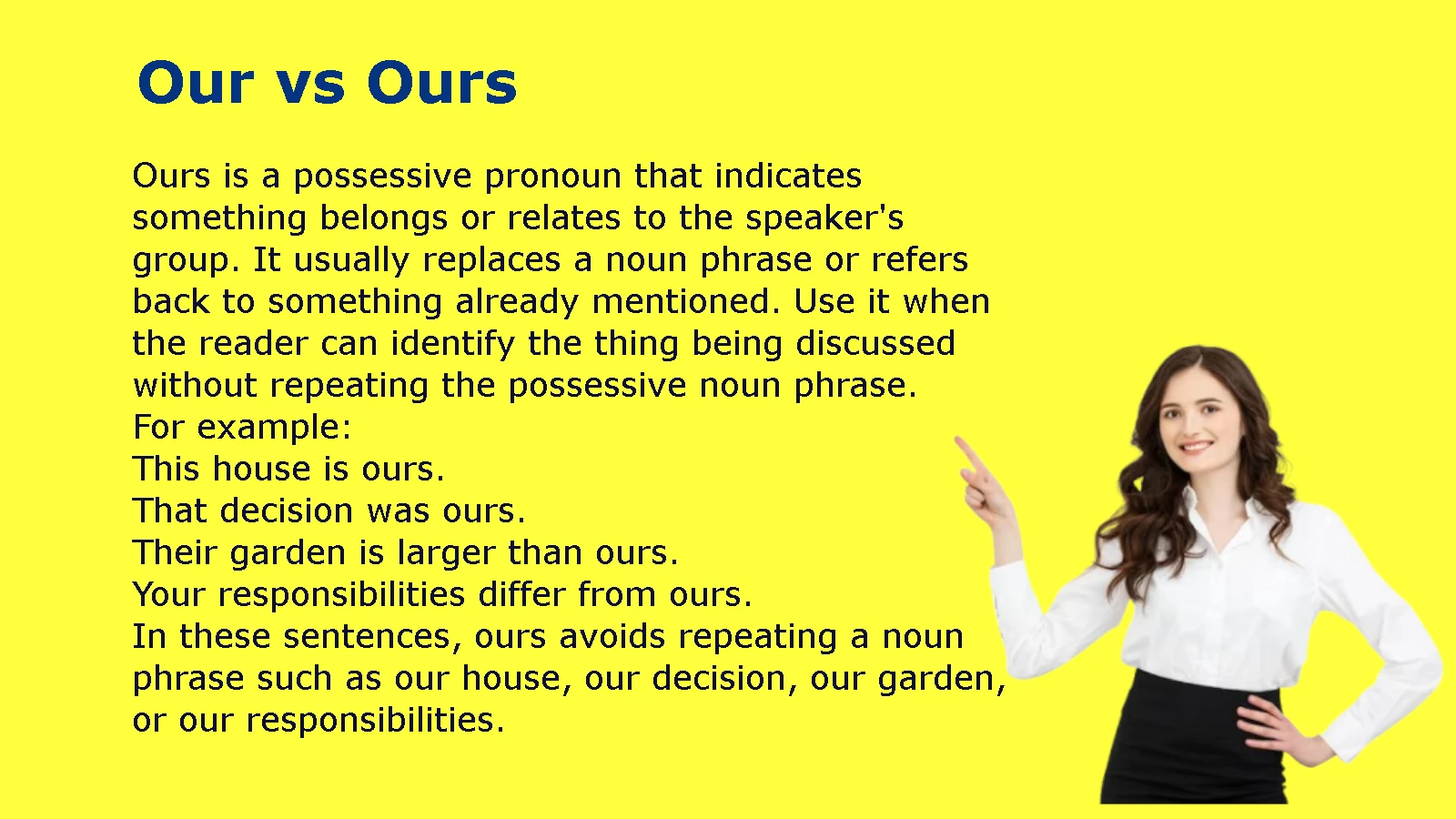
Ours is a possessive pronoun that indicates something belongs or relates to the speaker’s group. It usually replaces a noun phrase or refers back to something already mentioned. Use it when the reader can identify the thing being discussed without repeating the possessive noun phrase.
For example:
- This house is ours.
- That decision was ours.
- Their garden is larger than ours.
- Your responsibilities differ from ours.
In these sentences, ours avoids repeating a noun phrase such as our house, our decision, our garden, or our responsibilities.
This makes sentences smoother and more concise.
When to Use Ours
Use ours when the noun is understood from context.
When identifying ownership or association
- The blue bicycle is ours.
- The final choice was ours.
- This office space is ours.
When comparing two or more things
- Their presentation was shorter than ours.
- Your results were impressive, but ours were better.
- Her solution worked faster than ours.
avoiding unnecessary repetition
Instead of writing:
“Their classroom is clean, and our classroom is clean too.”
Write:
“Their classroom is clean, and ours is clean too.”
The second sentence avoids repeating classroom.
However, repetition is not always wrong. Writers sometimes repeat nouns to create emphasis or prevent confusion.
Examples of Ours in Sentences
The following examples demonstrate how ours works naturally.
Everyday examples
- Is this jacket yours or ours?
- The last two cookies are ours.
- That parking space is ours.
Academic examples
- Their research focuses on adults, while ours examines children.
- The first draft was theirs, but the revised version was ours.
- Our classmates presented first; the final presentation was ours.
Professional examples
- Their department handles sales, while ours manages customer support.
- The smaller office is theirs, and the larger one is ours.
- The final recommendation was ours.
A useful writing habit is to identify the noun that ours replaces. If readers cannot work out what ours refers to, rewrite the sentence for clarity.
Our vs. Ours Examples: How to Use Them Correctly
The best way to master our vs. ours is to study paired sentences. Each pair communicates a similar idea but uses a different grammatical structure.
| Using Our | Using Ours |
| Our car is parked outside. | The car parked outside is ours. |
| Our house needs repairs. | The house that needs repairs is ours. |
| Our idea received approval. | The approved idea was ours. |
| Our seats are comfortable. | The comfortable seats are ours. |
| Our project won the award. | The award-winning project was ours. |
Both columns contain correct sentences. The difference lies in sentence structure.
Our vs. Ours in Everyday Conversations
In everyday speech, people frequently use these words when discussing possessions, plans, and responsibilities.
Consider this conversation:
“Is that your umbrella?”
“No, it’s ours.”
Here, ours refers to an umbrella that belongs or relates to the speaker’s group. The speaker doesn’t need to repeat our umbrella.
Now consider:
“Where is our umbrella?”
The word our appears before the noun umbrella, so it functions as a possessive determiner.
More examples:
- Our dinner is ready.
- Dinner is ours to prepare tonight.
- Our tickets are in my bag.
- Those tickets are ours.
- Our turn comes next.
- The next turn is ours.
In casual conversations, these constructions often sound natural because the context makes the intended meaning clear.
Our vs. Ours in School and Workplace Writing
Correct possessive usage matters in professional and academic communication. Small grammar errors can distract readers from the message.
Compare these sentences:
Incorrect: Ours proposal explains the budget.
Correct: Our proposal explains the budget.
Why? The noun proposal follows the possessive determiner.
Now consider:
Incorrect: The proposal is our.
Correct: The proposal is ours.
Why? The sentence needs a possessive pronoun rather than a determiner.
Professional examples:
- Our department submitted the report.
- The department that submitted the report is ours.
- Our findings support the recommendation.
- The findings in the final section are ours.
Academic examples:
- Our experiment produced consistent results.
- The most useful findings were ours.
- Our research team reviewed the evidence.
- The research materials are ours.
Writers should also consider whether ours clearly identifies the correct group. In collaborative reports, a sentence such as “The conclusion is ours” may need clarification if several teams contributed.
Common Sentence Mistakes and Corrections
Use this table to recognize common errors.
| Incorrect | Correct | Explanation |
| Ours house is large. | Our house is large. | Use our before a noun. |
| This is our. | This is ours. | Use ours independently. |
| The decision is our’s. | The decision is ours. | No apostrophe is needed. |
| These books are our. | These books are ours. | The sentence needs a possessive pronoun. |
| Our’s was the best presentation. | Ours was the best presentation. | Ours is already possessive. |
| The responsibility is ours’. | The responsibility is ours. | The standard pronoun has no apostrophe. |
Some sentences may need more context before you can correct them accurately. For example, “This is our” could be part of an unfinished sentence, but it is generally incomplete if the writer intends to identify something using our alone.
Is It Ours or Ours’? Is Ours Ever Written With an Apostrophe?
Ours is the correct standard spelling of the possessive pronoun. You normally should not write ours’ or our’s when expressing possession. English possessive pronouns such as ours, yours, theirs, and hers do not require apostrophes.
This rule differs from the way writers form many possessive nouns.
For example:
- The student’s notebook
- The teacher’s desk
- The company’s policy
These nouns use apostrophes to show possession.
However:
- The notebook is ours.
- The desk is hers.
- The policy is theirs.
These pronouns already express possession.
Ours vs. Ours’ Spelling
The spelling ours’ is generally incorrect in standard English when you intend to use the possessive pronoun.
Correct:
- This responsibility is ours.
- The last seats are ours.
- That idea was ours.
Incorrect:
- This responsibility is ours’.
- The last seats are ours’.
- That idea was ours’.
The apostrophe doesn’t make the word more possessive. It simply introduces a spelling error in these contexts.
If you encounter ours’ in informal writing, examine the sentence before assuming the writer intended standard grammar. It could be a typo, an editing mistake, or part of unusual punctuation.
For everyday writing, use ours.
Ours vs. Our’s
The form our’s is also incorrect when used as the possessive pronoun.
A common reason for this mistake is confusion with words such as it’s.
Compare:
- It’s: A contraction of it is or it has.
- Its: The possessive determiner.
- Our: The possessive determiner.
- Ours: The possessive pronoun.
Examples:
- It’s raining outside.
- The dog wagged its tail.
- Our garden looks beautiful.
- The garden is ours.
Notice that its and ours follow different spelling patterns, even though both express possession.
A useful reminder is that possessive pronouns generally don’t use apostrophes.
Examples include:
| Correct | Incorrect |
| Yours | Your’s |
| Hers | Her’s |
| Theirs | Their’s |
| Ours | Our’s |
In standard English, these apostrophe forms are not the correct possessive pronouns.
Ours vs. Ours Pronunciation
The phrase ours vs. ours does not present a spelling difference because both sides contain the same word. However, pronunciation can vary among English speakers. Regional accents and speaking styles may affect how people pronounce ours, so a single sound guide cannot capture every speaker’s pronunciation.
How to Pronounce Ours
In common American English, ours is often pronounced with one syllable, approximately like “owrz.”
A simplified sound guide is:
- Start with the vowel sound in out.
- Move into an r sound.
- Finish with a voiced z sound.
A common American English IPA representation is /aʊrz/, although pronunciation varies by accent and phonetic analysis.
Some speakers may use a pronunciation that sounds closer to two syllables, particularly in certain accents or speaking styles.
Examples:
- The choice is ours.
- The blue bags are ours.
- The victory was ours.
In natural conversation, speakers may pronounce ours more quickly or reduce some sounds.
Our vs. Ours Pronunciation
Our and ours can sound similar, but the final sound in ours usually helps distinguish the words.
| Word | Common pronunciation guide | Main distinction |
| Our | “ow-er” or “ar,” depending on accent | No final /z/ |
| Ours | “owrz” | Usually ends with /z/ |
These are approximate guides, not strict representations of every English accent.
Examples:
- Our team is ready.
- The team is ours.
In both sentences, the words express a relationship to the speaker’s group. Their grammatical roles differ, and their pronunciation may also differ.
If you’re learning English, focus on listening to the entire sentence rather than trying to identify the word through one sound alone. Grammar and context often make the intended form clear.
Our vs. Others: What’s the Difference?
Our expresses a possessive relationship, while others refers to additional people or things. These words serve different grammatical purposes. Use our to identify something associated with your group and others to refer to people or things beyond the ones already mentioned.
For example:
- Our solution worked.
- Others tried a different solution.
The first sentence identifies a solution associated with the speaker’s group. The second refers to additional people.
Our vs. Others Examples
Here are examples that clarify the difference.
In everyday writing
- Our neighbors arrived early.
- Others arrived later.
professional communication
- Our team recommended a new process.
- Others supported the existing process.
In academic writing
- Our study examined younger participants.
- Others focused on older participants.
In comparisons
- Our approach is more practical than others.
- Our results differ from those of others.
The final example also shows an important grammar detail: others can appear after a preposition, such as of.
Ours vs. Others Examples
The comparison between ours and others works similarly.
Ours identifies something belonging or relating to the speaker’s group. Others identifies additional people or things.
Examples:
- This design is ours; the remaining designs belong to others.
- The final decision was ours, but others offered suggestions.
- Our results were consistent, while others were mixed.
- The responsibility is ours, not others’.
The last example needs a distinction. Others’ can be correct when it functions as the possessive form of others before an understood noun.
For example:
- Others’ opinions matter.
- Our opinions differ from others’ opinions.
- Our opinions differ from others’.
In the final sentence, opinions is omitted after others’ but understood from the context.
This differs from ours’, which is not the standard spelling of the pronoun ours.
Our vs. Others vs. Ours: Comparison Table
| Word | Grammatical function | Example |
| Our | Possessive determiner | Our results were promising. |
| Ours | Possessive pronoun | The promising results were ours. |
| Others | Pronoun | Others reported similar results. |
| Others’ | Possessive form of others | Others’ results were promising. |
Understanding these distinctions prevents confusion when comparing your work, ideas, or possessions with those of other people.
Common Our vs. Ours Grammar Mistakes
Many mistakes involving our vs. ours happen because writers focus on meaning but overlook sentence structure.
Both words express possession, so they can seem interchangeable. However, English grammar requires the correct form for each position.
Using Our Without a Noun
The word our generally needs a noun or noun phrase after it.
For example:
- Correct: Our project is complete.
- Incorrect: The project is our.
When our appears without a noun, the sentence may sound incomplete.
To correct the second sentence, write:
“The project is ours.”
However, a noun doesn’t always have to appear immediately after our.
For example:
“Our newly renovated office is ready.”
Here, the noun phrase contains several words, but our still functions as its possessive determiner.
Repeating the Noun After Ours
Writers sometimes repeat a noun unnecessarily after using ours.
For example:
Wordy: Their presentation was detailed, but our presentation was shorter.
More concise: Their presentation was detailed, but ours was shorter.
Both sentences are grammatically correct. The second version simply avoids repetition.
Still, repeating the noun can help when readers might misunderstand the reference.
For example:
“Their proposal was rejected, but ours was accepted.”
This works if the reader already knows which proposal ours identifies.
If multiple proposals exist, you could write:
“The proposal from our department was accepted.”
The goal is not to eliminate every repeated noun. It is to make the sentence clear and efficient.
Confusing Our, Ours, and Our Own
The phrase our own adds emphasis or highlights personal responsibility, independence, or possession.
Compare these examples:
- Our business needs a new website.
- The business is ours.
- We built the website on our own.
Each sentence has a different meaning.
Our business identifies a business associated with the speaker’s group.
The business is ours emphasizes the relationship between the group and the business.
On our own means independently or without help from others.
More examples:
- We developed our strategy.
- The strategy was ours.
- We developed the strategy on our own.
The phrase our own can also appear before a noun.
For example:
- We created our own training program.
- Our own research supported the recommendation.
Here, own adds emphasis, while our still functions as a possessive determiner.
How to Choose Between Our and Ours
Choosing between our and ours becomes easier when you follow a short editing process. Instead of memorizing dozens of examples, identify the grammatical role the sentence needs.
The Three-Step Grammar Test
Use this practical framework.
Step 1: Identify the thing you’re referring to.
Ask yourself what belongs or relates to the speaker’s group.
For example:
“The report belongs to our team.”
The thing being discussed is the report.
Step 2: Check the sentence structure.
Does the possessive word come before a noun?
If yes, use our.
- Our report
- Our manager
- Our responsibility
Does the sentence need a word that can stand alone?
Use ours.
- The report is ours.
- The manager is ours.
- The responsibility is ours.
Step 3: Read the sentence aloud.
Reading your sentence can help you notice awkward phrasing.
Compare:
- Ours office is near the entrance.
- Our office is near the entrance.
The second sentence follows standard grammar.
Now compare:
- The office is our.
- The office is ours.
The second sentence is correct when you want to express possession independently.
Practice: Our or Ours?
Test your understanding with these five sentences.
Fill each blank with our or ours.
- ______ teacher gave us a difficult assignment.
- That red bicycle is ______.
- We submitted ______ final report yesterday.
- Their classroom is larger than ______.
- The responsibility for this decision is ______.
Answers and explanations
- Our teacher gave us a difficult assignment.
Teacher is a noun that follows the possessive determiner. - That red bicycle is ours.
The possessive pronoun stands independently. - We submitted our final report yesterday.
Our comes before the noun phrase final report. - Their classroom is larger than ours.
Ours replaces the noun phrase our classroom. - The responsibility for this decision is ours.
The pronoun identifies the responsibility without repeating our responsibility.
If you answered all five correctly, you understand the basic distinction between the two possessive forms.
A Practical Editing Case Study
Imagine you’re reviewing a short team update before sending it to a client.
Original draft:
“Ours department finished the analysis. The final recommendation is our. Others departments will review ours report next week.”
The draft contains three errors involving possessive forms.
Edited version:
“Our department finished the analysis. The final recommendation is ours. Other departments will review our report next week.”
Here’s why the changes work:
- Ours department → Our department: The word department needs a possessive determiner.
- Recommendation is our → Recommendation is ours: The sentence needs an independent possessive pronoun.
- Ours report → Our report: The word report follows the possessive determiner.
One additional change improves the final sentence:
- Others departments → Other departments: Use other before the plural noun departments in this construction.
This example shows how a short proofreading routine can fix multiple grammar mistakes without changing the intended message.
Frequently Asked Questions
Is It Our or Ours?
Both words are correct, but they serve different purposes. Use our before a noun, as in “our house.” Use ours independently, as in “the house is ours.”
Is Ours Ever Spelled Ours’?
No. Ours is the standard spelling of the possessive pronoun. It does not require an apostrophe. Write “the decision is ours,” not “the decision is ours’.”
What Is the Difference Between Our and Ours in a Sentence?
Our is a possessive determiner, while ours is a possessive pronoun. For example, “Our car is new” uses our before a noun. “The car is ours” uses ours independently.
How Do You Pronounce Ours?
In common American English, ours is often pronounced approximately like “owrz,” usually as one syllable. Pronunciation can vary by regional accent and speaking style.
Is Ours a Possessive Pronoun?
Yes. Ours is a possessive pronoun that identifies something belonging or relating to the speaker’s group. For example, “That house is ours.”
What Is the Difference Between Ours and Others?
Ours expresses possession or association, while others refers to additional people or things. For example, “This design is ours, but others prefer a different style.”
Conclusion: Remember the Difference Between Our and Ours
The difference between our vs. ours comes down to grammatical function.
Use our before a noun or noun phrase:
- Our plan
- Our friends
- Our responsibilities
Use ours when the possessive form stands independently:
- The plan is ours.
- Those friends are ours.
- The responsibilities are ours.
Also remember that ours doesn’t need an apostrophe. Avoid our’s and ours’ when you intend to use the standard possessive pronoun.
When comparing ours vs. others, keep their meanings separate: ours expresses possession or association, while others refers to additional people or things.