Have you ever written “lyed” and wondered if it was the correct spelling of the past tense of lie? The confusion is understandable because Lyed or Lied looks like a simple spelling question, but the correct word depends on what you mean by lie and how you’re using it in a sentence.
Lied is the correct past tense and past participle of lie when you mean to tell something that is not true. Lyed is not a standard English word and is considered an incorrect spelling in this context.
Examples:
- She lied to me about where she was.
- He lied about his age.
The confusion often comes from the different meanings of lie. People may search for lyed or lied, is lyed a word, lied meaning, or past tense of lie because English has several verbs that look and sound similar. And here’s the tricky part: lie, lay, and lied follow different patterns depending on their meanings.
In this guide, you’ll learn the correct answer to Lyed or Lied, their meanings, pronunciation, and proper usage. You’ll also see clear examples of lied in a sentence, learn why lyed is incorrect, and understand the difference between lie, lay, and lied.
Is “Lyed” or “Lied” Correct?
Lied is correct. Lyed is not the standard spelling.
When lie means “to tell an untruth,” its past tense is lied.
Examples
- She lied about her age.
- He lied to his parents.
- They lied about the results.
- I knew he had lied to me.
- The witness admitted that he had lied.
- Why did you lie to me?
Notice the last example. After did, you use the base form lie, not lied.
The basic pattern is:
| Verb form | Correct form | Example |
| Base form | lie | Don’t lie to me. |
| Third person singular | lies | He lies about his age. |
| Past tense | lied | He lied to me. |
| Past participle | lied | He has lied before. |
| Present participle | lying | He is lying to me. |
The important spelling to remember is lied, not lyed.
Is “Lyed” a Word?
Lyed is not the standard past tense of lie.
If you mean “said something that wasn’t true,” standard English uses lied.
For example:
❌ She lyed about the money.
✅ She lied about the money.
The same applies in formal writing, emails, school assignments, articles, reports, and everyday messages.
Why Does “Lyed” Look Correct?
The mistake is easy to understand.
Many English verbs form their past tense by adding -ed:
- walk → walked
- call → called
- clean → cleaned
- jump → jumped
- open → opened
That can make lie → lyed look logical at first glance.
English, however, doesn’t always let you form a past tense by simply attaching letters to the spelling of the base word. The established past form of lie in the sense of “tell an untruth” is lied.
So the correct pattern is:
lie → lied
Not:
lie → lyed
There’s no standard spelling choice between lyed and lied. If the meaning is “told an untruth,” use lied.
What Does “Lied” Mean?
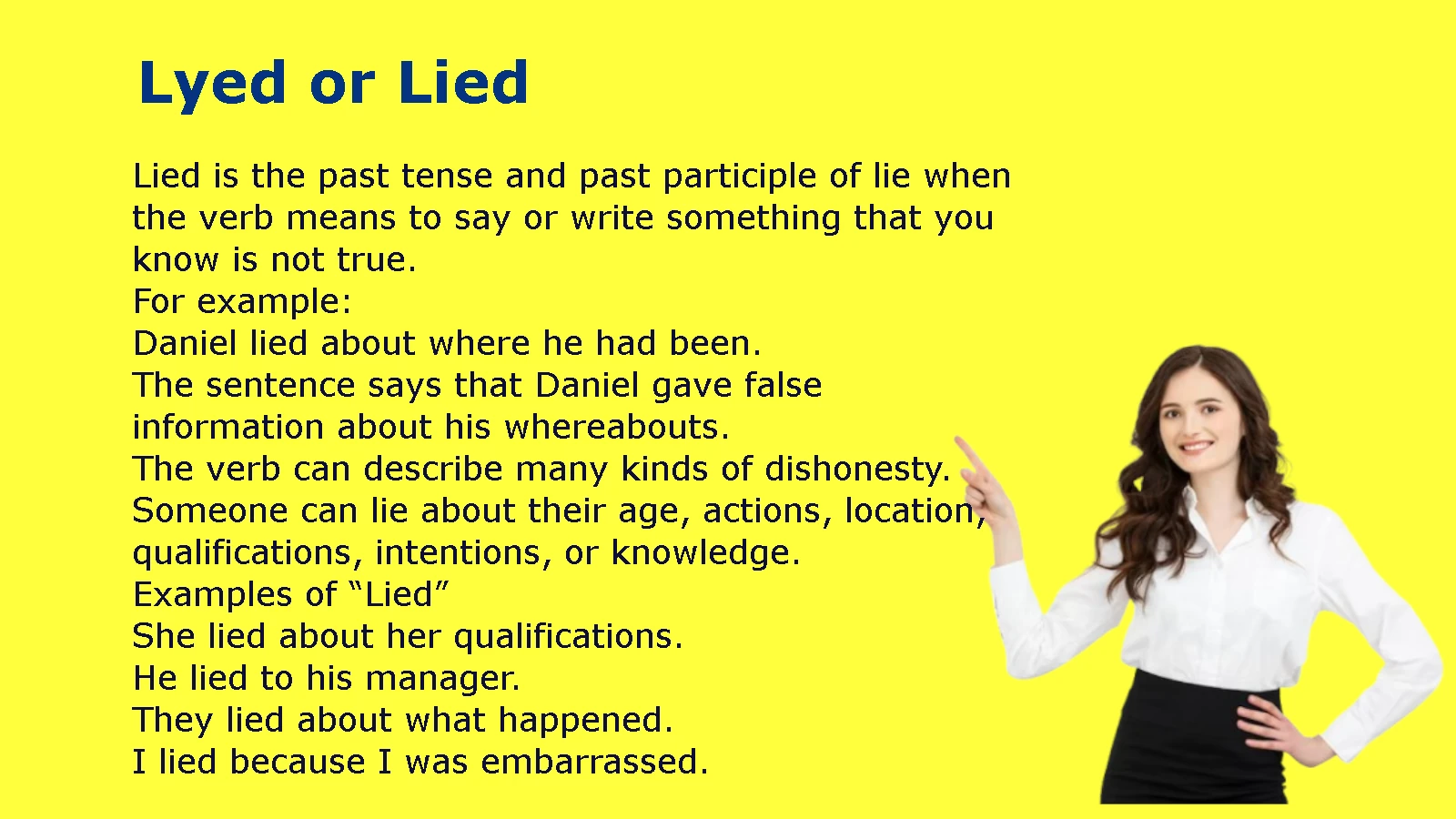
Lied is the past tense and past participle of lie when the verb means to say or write something that you know is not true.
For example:
Daniel lied about where he had been.
The sentence says that Daniel gave false information about his whereabouts.
The verb can describe many kinds of dishonesty. Someone can lie about their age, actions, location, qualifications, intentions, or knowledge.
Examples of “Lied”
- She lied about her qualifications.
- He lied to his manager.
- They lied about what happened.
- I lied because I was embarrassed.
- She admitted that she had lied.
- He has lied to me before.
- The company was accused of having lied about the product.
The meaning stays the same even when the surrounding grammar changes.
Lyed vs. Lied in a Sentence
Seeing the forms side by side makes the difference much easier to remember.
| Incorrect | Correct |
| He lyed to me. | He lied to me. |
| She lyed about her age. | She lied about her age. |
| They lyed about the incident. | They lied about the incident. |
| I knew he lyed. | I knew he lied. |
| She has lyed before. | She has lied before. |
| He had lyed to his parents. | He had lied to his parents. |
| Why did he lyed? | Why did he lie? |
The last example shows an important grammar rule.
Why Is “Did He Lie?” Correct?
When you use did, the auxiliary verb already carries the past tense.
So you write:
Did he lie?
Not:
❌ Did he lied?
Compare these sentences:
- He lied to me.
- Did he lie to you?
- Why did he lie?
- I know he lied.
The main verb changes depending on the structure of the sentence.
Lie, Lied, Lay, Lain, and Laid Explained
This is where the real confusion begins.
English uses lie for two different verbs, and lay is a separate verb as well.
Here are the three patterns you need to know:
| Meaning | Present | Past | Past participle |
| Tell an untruth | lie | lied | lied |
| Rest or recline | lie | lay | lain |
| Put or place something | lay | laid | laid |
This table is the key to the entire topic.
Pattern One: Lie → Lied → Lied
This means tell an untruth.
Pattern Two: Lie → Lay → Lain
This means rest, recline, or remain in a particular position.
Pattern Three: Lay → Laid → Laid
This means put or place something somewhere.
Once you separate these three patterns, lyed or lied becomes much easier.
Lie → Lied → Lied: When Someone Tells an Untruth
When lie means “to tell an untruth,” it behaves like a regular verb.
The forms are:
lie → lied → lied
Present Tense
I don’t lie to my friends.
Past Tense
I lied to my friend yesterday.
Present Perfect
I have lied before.
Past Perfect
I had lied about my whereabouts.
Present Progressive
I am lying to you.
The spelling changes in the -ing form:
lie → lying
Not lieing.
Quick Reference
| Tense or form | Example |
| Present | She lies to him. |
| Past | She lied to him. |
| Present perfect | She has lied to him. |
| Past perfect | She had lied to him. |
| Present progressive | She is lying to him. |
If the subject is being dishonest, lied is the past form you need.
When to Use “Lied”
Use lied when someone gave false information or deliberately said something untrue.
Lied to Someone
Use lied to when you identify the person who received the false statement.
Examples:
- He lied to his mother.
- She lied to her teacher.
- They lied to their manager.
- I think he lied to me.
- The witness lied to the investigators.
The basic structure is:
lie + to + person
Lied About Something
Use lied about when you identify the subject of the false statement.
Examples:
- He lied about his age.
- She lied about the money.
- They lied about the results.
- He lied about where he had been.
- She lied about her qualifications.
The structure is:
lie + about + subject
You can also use both:
He lied to his parents about where he had been.
Here, his parents are the people he lied to, while where he had been identifies what the lie concerned.
Lie → Lay → Lain: When Someone Rests
Now we move to the other lie.
This verb means to rest, recline, or be in a horizontal position.
Its forms are:
lie → lay → lain
This verb is irregular.
Present
I lie on the couch after work.
Past
I lay on the couch yesterday.
Past Participle
I have lain on the couch all afternoon.
Present Participle
I am lying on the couch.
The past tense lay is what causes so much confusion.
People often expect lied because it looks like the obvious past tense of lie. But lied belongs to the other verb.
The difference is only one letter, but the meaning changes completely.
Lied vs. Lay: What’s the Difference?
The easiest way to choose between lied and lay is to ask what the person is doing.
If the Person Is Telling an Untruth
Use lied.
She lied about the meeting.
If the Person Is Resting
Use lay for the past tense.
She lay on the sofa after dinner.
Consider these two sentences:
He lied on the couch.
This normally means he told an untruth while on the couch.
He lay on the couch.
This means he rested on the couch.
That one-letter difference can completely change the sentence.
When to Use “Lay”
Use lay in two important situations:
- As the past tense of lie, meaning “rest.”
- As the present tense of lay, meaning “put or place.”
The first use is what matters when you’re comparing lied and lay.
Lay as the Past of Lie
Yesterday, I lay in bed all morning.
She lay on the beach for hours.
The dog lay beside the fireplace.
He lay awake all night.
Here, nobody is putting an object somewhere. The person or animal is simply in a position.
Lay → Laid → Laid: When You Put Something Somewhere
The verb lay has another meaning: to put or place something in a particular position.
Its pattern is:
lay → laid → laid
For example:
Lay the book on the desk.
She laid the book on the desk.
She has laid the book on the desk.
This verb normally takes an object.
What Is the Object?
Look at:
She laid the keys on the table.
What did she lay?
The keys.
Now look at:
She lay on the sofa.
What did she lay?
There is no object. She is the one resting.
That’s a useful distinction.
The Object Test for Lay and Lie
When you’re unsure, ask:
Is someone putting something somewhere?
If yes, lay or laid is likely correct.
Examples:
- Lay the towel here.
- She laid the towel here.
- Lay the baby in the crib.
- He laid the papers on the desk.
If the subject is simply resting, use lie or its appropriate form:
- I lie on the bed.
- I lay on the bed yesterday.
- I am lying on the bed.
This object test won’t solve every unusual use of the verbs, but it works extremely well for ordinary sentences involving physical position.
Is “I Lied Down” Correct?
If you mean “I reclined” or “I rested,” the standard form is:
I lay down.
Not:
❌ I lied down.
Why?
Because the verb means recline, not tell an untruth.
Its pattern is:
lie → lay → lain
So:
- Present: I lie down.
- Past: I lay down.
- Past participle: I have lain down.
- Present participle: I am lying down.
Examples
I lie down after lunch.
I lay down for a short nap yesterday.
She lay down because she felt tired.
They were lying down when the phone rang.
The word lied doesn’t belong in these sentences because nobody is talking about dishonesty.
Is “I Lay Down” or “I Laid Down” Correct?
Both can be correct, but they don’t mean the same thing.
“I Lay Down”
Use this when you reclined.
I lay down for an hour.
Here, lay is the past tense of lie.
“I Laid Something Down”
Use laid when you placed something somewhere.
I laid my phone down.
Here, laid is the past tense of lay.
Compare:
| Sentence | Meaning |
| I lay down. | I reclined. |
| I laid the book down. | I placed the book down. |
| She lay on the bed. | She rested on the bed. |
| She laid the blanket on the bed. | She placed the blanket there. |
| He lay beside the window. | He rested there. |
| He laid the papers beside the window. | He placed the papers there. |
The presence of an object often gives you the answer.
Common Mistakes With Lyed, Lied, Lay, and Laid
These mistakes appear because several forms look and sound alike.
| ❌ Incorrect | ✅ Correct | Reason |
| He lyed to me. | He lied to me. | Lied means told an untruth. |
| She lyed about her age. | She lied about her age. | Lyed isn’t the standard form. |
| Did he lied to you? | Did he lie to you? | Use the base form after did. |
| She has lyed before. | She has lied before. | Lied is the past participle. |
| I lied on the couch. | I lay on the couch. | Lay is the past tense of lie meaning rest. |
| I laid on the couch. | I lay on the couch. | Laid belongs to lay, not the resting verb lie. |
| I lied down. | I lay down. | Lay is the past form for reclining. |
| I lay the book there yesterday. | I laid the book there yesterday. | Laid is the past tense of lay meaning place. |
Why Do People Write “Lyed”?
The mistake usually comes from treating lie like a regular verb without considering its established spelling.
A writer may think:
lie + ed = lyed
That seems reasonable if you’re working from the visible letters alone.
But English verb forms aren’t always predictable from spelling.
For this particular meaning:
lie → lied
The ie remains part of the spelling, producing lied.
This is similar to other spelling patterns where the final form isn’t created by simply adding letters exactly as they appear in the base word.
The important thing isn’t to invent a rule that covers every English verb. It’s simply to remember the established form:
lie → lied
“Lied” in Questions and Negative Sentences
The word lied doesn’t appear in every past tense sentence involving lie.
Auxiliary verbs can change the form you need.
Statement
He lied to me.
Question
Did he lie to me?
Negative
He did not lie to me.
Present Perfect
He has lied to me before.
Past Perfect
He had lied to me before I found out the truth.
The rule is simple:
After did, use the base form lie.
But after has, have, or had, use the past participle lied.
Compare These Forms
| Sentence | Why? |
| He lied to me. | Simple past |
| Did he lie to me? | Did carries the past tense |
| He didn’t lie to me. | Did carries the past tense |
| He has lied to me. | Present perfect |
| He had lied to me. | Past perfect |
| He is lying to me. | Present progressive |
This distinction is especially useful when proofreading
Lied
Means told an untruth.
He has lied about the incident.
Lain
Means rested or remained in a position.
He has lain on the sofa all afternoon.
The difference is semantic, not merely grammatical.
A Simple Three Verb Cheat Sheet
If you remember only one section from this article, remember this one.
Telling an Untruth
lie → lied → lied
Example:
He lied to me.
Resting or Reclining
lie → lay → lain
Example:
He lay on the couch.
Putting or Placing Something
lay → laid → laid
Example:
He laid the book on the couch.
That’s the whole puzzle in three lines.
Case Study: Three Nearly Identical Sentences
The words are closely related in spelling, but each verb describes a different action.
| Sentence | Verb | Meaning |
| Sarah lied to Mark. | lie | She told an untruth. |
| Sarah lay beside Mark. | lie | She rested there. |
| Sarah laid the blanket beside Mark. | lay | She placed something there. |
This is a useful mental model because it puts the three troublesome patterns into one small scene.
A Second Case Study: “On the Bed”
They may look almost identical, but they don’t mean the same thing.
He Lied on the Bed
The sentence uses lied in the “told an untruth” sense.
It suggests that he told a lie while on the bed.
He Lay on the Bed
The sentence uses lay as the past tense of lie.
It means he rested on the bed.
He Laid the Book on the Bed
The sentence uses laid as the past tense of lay.
It means he placed the book on the bed.
This is why replacing words mechanically can create new errors. Context determines the correct verb.
How to Remember Lyed or Lied
A simple memory trick can save you from the entire lyed vs. lied problem.
Remember: Lied = Dishonesty
If someone lied, they said something untrue.
He lied about his age.
Think:
lied = not telling the truth
Remember: Lay = Rested
If someone lay somewhere, they rested there.
He lay on the couch.
Think:
lay = rested
Remember: Laid = Placed
If someone laid something somewhere, they put it there.
He laid the keys on the table.
Think:
laid = placed
The Three Word Memory Rule
Lied = told a lie.
Lay = rested.
Laid = placed.
It isn’t a complete grammar lesson, but it’s a handy writing shortcut.
Frequently Asked Questions About Lyed or Lied
Is “lyed” correct?
No. If you mean that someone told an untruth, the correct past tense is lied.
He lied to me.
Is “lied” the past tense of “lie”?
Yes, when lie means “to tell an untruth.”
The pattern is:
lie → lied → lied
When lie means “rest or recline,” the pattern is:
lie → lay → lain
What is the past tense of lie?
There are two answers because there are two different verbs.
Lie meaning “tell an untruth”:
lied
Lie meaning “rest”:
lay
So both lied and lay can be past forms of lie, but they don’t have the same meaning.
Is “I lied down” correct?
Not if you mean that you reclined.
Use:
I lay down.
If you mean that you told an untruth, lied is correct:
I lied to him.
Is “I lay down” correct?
Yes, when you’re talking about the past action of reclining.
I lay down for a nap.
The present form is:
I lie down for a nap.
Is “I laid down” correct?
It can be correct when laid has an object.
I laid the book down.
For the act of reclining without an object, standard usage calls for:
I lay down.
What is the past participle of “lie”?
It depends on the meaning.
For tell an untruth:
lied
For rest or recline:
lain
Examples:
He has lied to me before.
He has lain on the couch all afternoon.
What is the difference between “lied” and “laid”?
Lied means told an untruth.
She lied to me.
Laid means put or placed something somewhere.
She laid the book on the table.
Is “lyed” ever the standard spelling?
No. In standard modern English, lied is the correct form when lie means “tell an untruth.”
Why isn’t the past tense “lyed”?
Because the established past form of the verb is lied. English doesn’t always create verb forms by simply adding -ed to the visible spelling of the base word.
The standard pattern is:
lie → lied
Is “He lied on the bed” correct?
It can be grammatically correct if the intended meaning is that he told an untruth while on the bed.
If you mean he rested on the bed, use:
He lay on the bed.
That distinction is important because changing lay to lied changes the meaning.
Is “She lay to me” correct?
No, not if you mean she told you something untrue.
Say:
She lied to me.
If you’re describing her resting position, lay can be correct:
She lay on the bed.
Lyed or Lied: Quick Answer
If you’re looking for the shortest possible answer:
Lied is correct. Lyed is not the standard form.
Use lied when lie means to tell an untruth:
He lied to me.
Use lay when lie means to rest, and you’re talking about the past:
He lay on the couch.
Use laid when lay means to put or place something:
He laid the book on the couch.
The three patterns are:
| Meaning | Verb forms | Example |
| Tell an untruth | lie → lied → lied | He lied to me. |
| Rest or recline | lie → lay → lain | He lay on the couch. |
| Put or place | lay → laid → laid | He laid the book down. |
Final Takeaway
The lyed or lied question has a straightforward answer: use lied when you’re talking about someone telling an untruth.
❌ She lyed about her age.
✅ She lied about her age.
But don’t confuse that verb with the other lie meaning “rest.”
Remember these three patterns:
lie → lied → lied = tell an untruth
lie → lay → lain = rest or recline
lay → laid → laid = put or place something
So when you’re stuck, don’t focus only on how the word looks. Focus on what the sentence means.
Is someone telling an untruth? Use lied.
Is someone resting? The past tense is lay.
Is someone placing something somewhere? Use laid for the past.
Once you separate those meanings, lyed has no place in the standard spelling. The correct word is simply lied.