Licence vs license is a common spelling question because both forms are correct, but their use depends on the type of English you write. In American English, license works as both a noun and a verb. In British English, licence is the noun, while license is the verb. This distinction affects everyday phrases such as driving license or licence, software license or licence, licence agreement, and licence plate.
The key is to identify your audience and the role the word plays in a sentence. A US driver usually has a driver’s license, while a UK driver usually has a driving licence. Likewise, American companies generally write software license, while British companies often use software licence. Once you understand the regional spelling rules, you can choose the correct form without guessing.
Licence vs License: What’s the Difference?
Licence and license have the same basic meaning: official permission to do something, or the document that proves you have that permission. The spelling difference mainly follows regional English conventions. American English uses license for both nouns and verbs, whereas British English uses licence for nouns and license for verbs.
| Feature | American English | British English |
| Noun | License | Licence |
| Verb | License | License |
| Driving document | Driver’s license | Driving licence |
| Software permission | Software license | Software licence |
| Business authorization | Business license | Business licence |
| Permission-granting action | License | License |
For example, an American writer might say, “I renewed my driver’s license.” A British writer would usually say, “I renewed my driving licence.”
Both sentences are correct. The difference comes from the spelling convention, not the meaning.
Licence vs License in American English
In American English, license is the standard spelling whether you use the word as a noun or a verb. You do not need to change the ending when the word’s grammatical role changes.
As a noun, license refers to official permission or the document that grants or records that permission.
Examples:
- I renewed my driver’s license last week.
- The restaurant needs a business license to operate.
- Her professional license allows her to work as a registered nurse.
- The company purchased a software license for its employees.
As a verb, license means to grant official permission or authorize an activity.
Examples:
- The state will license the new business after reviewing its application.
- The agency can license qualified drivers.
- The developer agreed to license the software to another company.
Notice that the spelling remains license in every example. This rule makes American English straightforward because you do not need to remember a separate noun spelling.
Licence vs License in British English
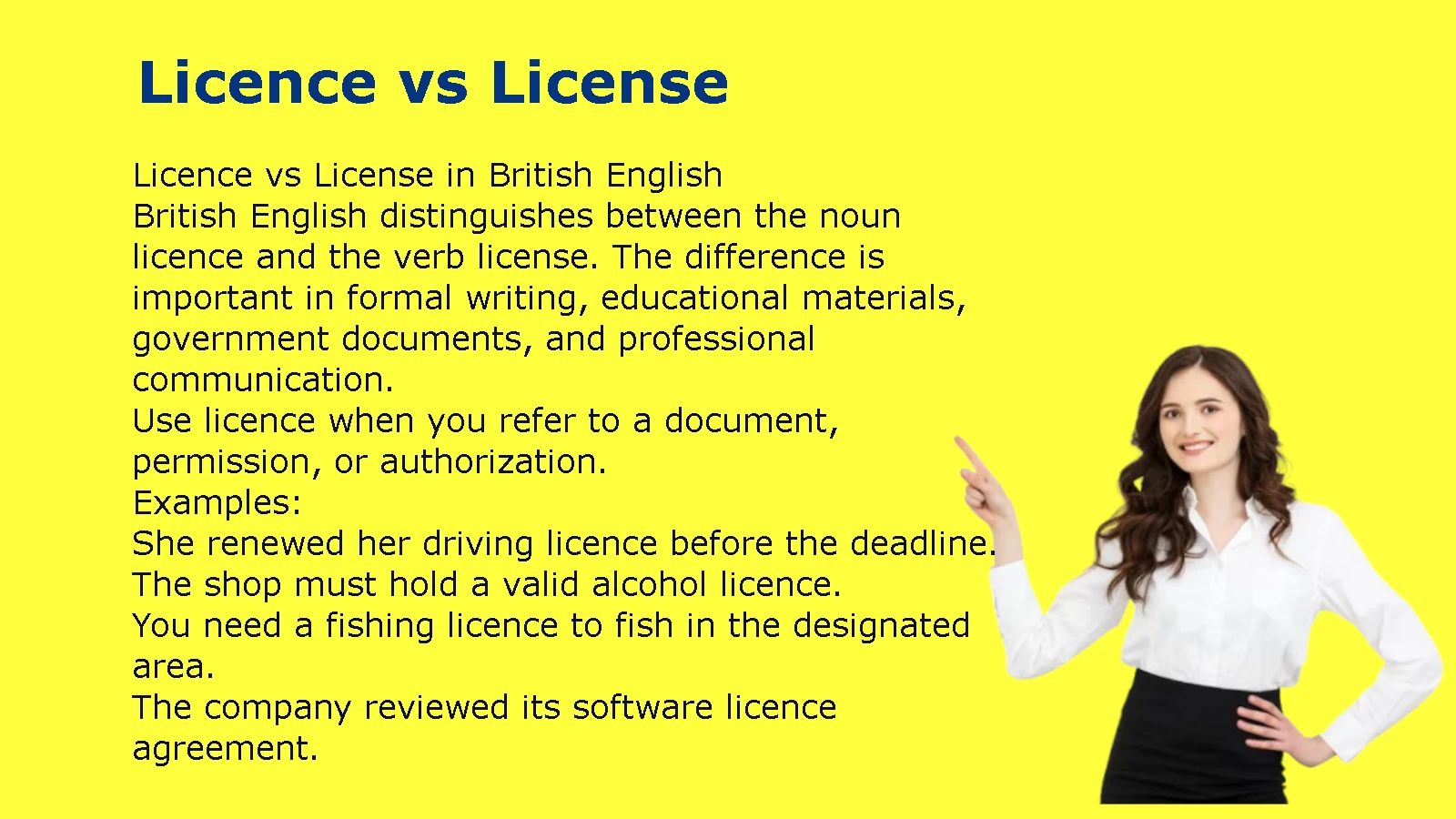
British English distinguishes between the noun licence and the verb license. The difference is important in formal writing, educational materials, government documents, and professional communication.
Use licence when you refer to a document, permission, or authorization.
Examples:
- She renewed her driving licence before the deadline.
- The shop must hold a valid alcohol licence.
- You need a fishing licence to fish in the designated area.
- The company reviewed its software licence agreement.
Use license when someone grants permission or authorizes an activity.
Examples:
- The authority will license the new business.
- The organization can license qualified professionals.
- The company plans to license its technology to overseas partners.
A simple way to check your spelling is to replace the word with permission or grant permission. If the word names the permission itself, British English generally uses licence. If it describes the act of granting permission, use license.
For example:
- The council issued a fishing licence. (Noun)
- The council will license the fishing operator. (Verb)
This distinction is one of the main reasons British and American writers sometimes correct each other’s spelling unnecessarily.
An Easy Trick to Remember Licence vs License
If you follow British English, remember this pattern:
- Licence is a noun, like advice.
- License is a verb, like advise.
The endings provide a useful reminder. British English uses -ce in the nouns licence and advice, but -se in the verbs license and advise.
Compare these examples:
| Noun | Verb |
| She gave me useful advice. | She will advise me tomorrow. |
| He renewed his licence. | The authority will license him. |
However, this trick applies to British spelling. In American English, license is both the noun and the verb, even though advice remains a noun and advise remains a verb.
If you write for an international audience, choose one spelling convention and apply it consistently.
Driving License or Licence: Which Is Correct?
Driving license or licence depends on the country and the official terminology used there. American English generally uses driver’s license, while British English generally uses driving licence. Both phrases refer to authorization to drive, but the preferred wording varies across jurisdictions.
Is It Driving License or Driving Licence?
Use the spelling that matches your audience.
In the United States, driver’s license is the standard expression. The phrase uses the possessive form driver’s because the document belongs to or identifies the driver.
Example: “You must carry a valid driver’s license when driving.”
In the United Kingdom, driving licence is the common expression. The noun licence follows the British spelling rule.
Example: “She applied for her first driving licence after passing the test.”
Other English-speaking countries may use different official terms. Canada, Australia, and other jurisdictions can have their own licensing terminology, so do not assume that every country follows the same pattern.
The safest approach is to use the wording found on the relevant government website or official document.
Driver’s License vs Drivers Licence
The apostrophe in driver’s license matters because it changes the grammatical meaning.
- Driver’s license: A license held by an individual driver. This is the standard American expression.
- Drivers’ licenses: Licenses belonging to multiple drivers, using a plural possessive.
- Drivers license: Often appears as an informal error or search variation when the writer intends the standard singular possessive phrase.
In British English, driving licence is usually the more natural general term.
Compare these sentences:
- My driver’s license expires in December.
- The company checked all its employees’ driving licences.
- The state issued new driver’s licenses to the applicants.
The first sentence refers to one person’s document. The second refers to documents held by multiple employees. The third uses the standard American plural form.
When writing an article about driving documents, include both the singular and plural forms where relevant. However, avoid using an incorrect spelling simply to repeat a keyword.
How to Spell Driving Licence on Official Documents
Official documents require more care than ordinary writing. A government agency may use a particular term, abbreviation, or document label, and you should preserve it when completing a form or describing the document.
Use these guidelines:
- Job applications: Follow the spelling used by the employer or the country where you are applying.
- Government forms: Copy the wording shown on the official form.
- Insurance documents: Use the terminology recognized by the insurer and relevant jurisdiction.
- International applications: Identify the issuing country and use its official document name.
- Legal statements: Preserve the original wording when quoting a document.
For example, if a form asks for your “Driving Licence Number,” enter the number from the relevant document. Do not change the label to “Driver’s License Number” simply because you prefer American spelling.
The spelling difference does not usually change the underlying meaning, but using the correct local term makes your writing clearer and more professional.
Software License or Licence?
Software license is the standard American spelling, while software licence is common in British English. In both cases, the term refers to permission to use software under specified conditions. The correct spelling depends on the English convention used in the document, website, or contract.
Is It Software License or Software Licence?
Both forms are correct in their respective regional conventions.
American English:
“The company purchased a software license for its accounting team.”
British English:
“The company purchased a software licence for its accounting team.”
The meaning remains the same. The spelling does not determine the software’s features, price, ownership, or legal restrictions.
Writers should also distinguish between a software license and the software itself. Buying or receiving a license does not necessarily mean that you own the underlying intellectual property. The license may grant limited rights to install, access, modify, or distribute the software.
For example, a company might purchase a subscription that permits 50 employees to use a business application. The agreement could restrict account sharing, copying, redistribution, or commercial resale.
The word license or licence identifies the permission arrangement. The actual rights depend on the agreement’s terms.
What Is a Software License?
A software license is a set of permissions and conditions that governs how someone may use a software product. It can define who may access the software, how many devices may run it, whether users can modify the code, and whether they can redistribute copies.
Common software licensing models include:
- Proprietary licenses: Limit how users may copy, modify, or redistribute the software.
- Open-source licenses: Permit certain uses of source code under stated conditions.
- Subscription licenses: Allow access while the subscription remains active.
- Per-user licenses: Limit access according to the number of authorized users.
- Per-device licenses: Tie permission to a specified number of computers or other devices.
- Perpetual licenses: Generally allow continued use of a particular version without a recurring subscription, subject to the contract’s terms.
These categories can overlap. For example, a proprietary product may use a subscription model, while an open-source project may impose conditions on redistribution or modified versions.
Consider a small business that purchases 20 user licenses for an accounting platform. If its agreement limits access to 20 named users, sharing one account among additional employees could violate the terms. The business should review the license rather than assume that purchasing the software grants unlimited access.
A software license also differs from a software subscription. A subscription describes a payment or access arrangement, while a license describes the permission to use the software. One product may involve both.
Software Licence Agreement vs Software License Agreement
A software license agreement in American English and a software licence agreement in British English refer to the same general type of document. The agreement sets out the conditions under which a user or organization may use the software.
A typical agreement may cover:
- Authorized users and devices.
- Installation and access limits.
- Subscription periods and renewal terms.
- Restrictions on copying or redistribution.
- Intellectual property rights.
- Support, maintenance, and updates.
- Termination and access after termination.
- Liability and dispute-resolution provisions.
Suppose a company buys software for its sales team. The agreement may permit installation on company devices but prohibit employees from distributing copies outside the organization. The license therefore defines the company’s permitted use.
Do not assume that every software license has the same terms. Read the actual agreement, especially when the software supports essential business operations or stores confidential information.
When writing about a specific agreement, preserve its official title. If the document is called a “Software License Agreement,” do not silently change its name to “Software Licence Agreement” in a quotation or formal reference.
Licence Agreement, Licence ID, and Licence Plate
The phrases licence agreement, licence ID, and licence plate can cause confusion because regional spelling rules interact with local terminology. American English generally uses license as a noun, while British English uses licence. Some expressions, such as number plate, also differ in wording rather than spelling.
Licence Agreement vs License Agreement
A licence agreement is the usual British spelling, while license agreement is the standard American spelling. Both describe an agreement that grants permission to use something under defined conditions.
Examples:
- The publisher signed a license agreement with the software developer. (American English)
- The publisher signed a licence agreement with the software developer. (British English)
License agreements appear in many fields, including software, publishing, trademarks, patents, media, and commercial partnerships.
For example, a company may license its brand name to another business. The agreement might specify where the brand can appear, how the licensee may use it, how long the permission lasts, and what fees apply.
The spelling itself does not determine the agreement’s legal effect. The wording, applicable law, and circumstances matter far more than whether the document uses license or licence.
Licence ID vs License ID
Licence ID and license ID can both be correct labels, depending on the issuing organization and its spelling convention. An ID may refer to a license number, a record identifier, or another reference used to locate an authorization.
You may encounter this term on:
- Driving or professional license records.
- Business licensing portals.
- Software administration dashboards.
- Permit applications.
- Membership or certification systems.
The term is not universal. Some organizations use license number, licence number, permit number, or another label instead.
If an online form asks for a licence ID, check the instructions to identify the exact number it requires. It may not be the same as a document’s serial number, application reference, or personal identification number.
For example, a professional registration portal might request a license number to verify a person’s authorization to practice. Entering an application reference instead could prevent the system from finding the correct record.
Practical rule: Copy the label used by the organization and enter the matching identifier from the official record.
Licence Plate vs License Plate
License plate is the standard American English term for the identification plate attached to a vehicle. In British English, number plate is the usual term.
Examples:
- The police officer checked the vehicle’s license plate. (American English)
- The mechanic recorded the vehicle’s number plate. (British English)
Although licence plate may appear in some British-style writing or regional contexts, it is not the usual term in the United Kingdom. Writers should generally prefer number plate when addressing a UK audience.
The phrase also illustrates why regional spelling comparisons sometimes involve more than changing c to s. American and British English can use different vocabulary for the same object.
Other examples include:
| American English | British English |
| License plate | Number plate |
| Driver’s license | Driving licence |
| Apartment | Flat |
| Truck | Lorry |
| Vacation | Holiday |
These differences do not mean that one variety is more correct than the other. They reflect established regional usage.
Common Licence and License Phrases by Region
The following table provides a practical reference for common expressions.
| Meaning | American English | British English |
| Permission or official document | Business license | Business licence |
| Authorization to drive | Driver’s license | Driving licence |
| Permission to use software | Software license | Software licence |
| Agreement granting permission | License agreement | Licence agreement |
| Identification document label | License ID (where used) | Licence ID (where used) |
| Vehicle identification plate | License plate | Number plate |
| Professional authorization | Professional license | Professional licence |
| Authorization for a regulated activity | Operating license | Operating licence |
These are general conventions, not universal labels. Government departments, regulators, and companies may use specific terminology that differs from the common form.
If you are writing for a particular industry or jurisdiction, check the terms used by the relevant organization.
How to Use License and Licence in a Sentence
To use license and licence correctly, identify both the regional spelling convention and the word’s grammatical role. American English uses license for nouns and verbs. British English uses licence for nouns and license for verbs.
License as a Noun in American English
In American English, license names permission, an authorization, or the document associated with that permission.
Examples:
- Maria renewed her driver’s license before starting her new job.
- The restaurant applied for a business license before opening.
- Our company purchased a software license for every employee who needs access.
- The contractor displayed a valid professional license.
- The city requires a special license for certain commercial activities.
In each sentence, the word identifies a document or permission. It does not describe the act of granting permission.
A useful test is to replace license with permit or authorization. If the sentence still makes sense, the word probably functions as a noun.
For example, “The restaurant needs a business permit” has the same basic grammatical structure as “The restaurant needs a business license.”
Licence as a Noun in British English
British English uses licence for the same noun meaning.
Examples:
- James renewed his driving licence online.
- The restaurant needs a valid operating licence.
- She received a professional licence after completing the required process.
- The company reviewed its software licence before renewing the subscription.
- The council granted the business a special licence.
The word refers to permission or a document in every example.
If you write a British English article about driving requirements, use driving licence consistently. Switching between driving licence and driver’s license without a reason may make the article feel inconsistent to readers.
However, if you are referring to the exact name of an American document, preserve the American spelling.
License as a Verb in American and British English
Both American and British English use license as a verb. The word describes the act of granting official permission or authorizing someone or something.
Examples:
- The state will license the new business after reviewing its application.
- The authority can license qualified professionals.
- The company plans to license its technology to an overseas partner.
- The agency may license additional operators next year.
- The publisher agreed to license the book’s translation rights.
British English keeps the -se ending even when the verb changes form.
Common forms include:
| Verb form | Example |
| License | The agency will license the business. |
| Licenses | The authority licenses qualified operators. |
| Licensed | The company licensed its technology last year. |
| Licensing | The firm is licensing its software to partners. |
These forms describe an action, not the document itself.
Compare the following British English sentences:
- The agency issued a licence. (Noun)
- The agency will license the operator. (Verb)
That small spelling difference can help readers recognize the word’s role immediately.
Common Mistakes When Using Licence and License
Even experienced writers sometimes mix regional spellings. Most errors happen when writers remember the basic rule but forget to apply it throughout a document.
Avoid these common mistakes:
- Using licence as a British English verb: Write “The authority will license the business,” not “The authority will licence the business.”
- Using license as a British English noun: In ordinary British prose, write “She renewed her driving licence.”
- Assuming every country uses British spelling: Local terminology may differ, even among countries that generally follow British conventions.
- Mixing spelling systems unnecessarily: Avoid switching between license and licence when the audience and style guide remain the same.
- Changing an official title: Preserve the spelling used in the name of a form, contract, or government document.
- Confusing the noun with the verb: Check whether the sentence refers to permission or to granting permission.
Consider this example:
Incorrect for standard British usage: “The council will issue a driving license and license the new operator.”
Better British English: “The council will issue a driving licence and license the new operator.”
Better American English: “The council will issue a driver’s license and license the new operator.”
The American version uses license twice. The British version changes the noun to licence but keeps the verb as license.
Licence vs License in Other English-Speaking Countries
English spelling varies by country, and the rules do not always divide neatly into British and American categories. A spelling that is common in one country may be less common in another, particularly in government terminology, legal documents, and specialist industries.
British English
British English generally uses licence as a noun and license as a verb.
Examples include:
- She applied for a driving licence.
- The company needs a business licence.
- The regulator will license the operator.
- The organization is licensing its technology to another firm.
The distinction is useful in everyday and formal writing. It also matches the noun–verb pattern seen in advice and advise.
When preparing British English content, maintain the same convention in headings, body text, tables, image captions, and metadata where appropriate.
American English
American English uses license for both grammatical roles.
Examples include:
- He renewed his driver’s license.
- The company applied for a business license.
- The agency will license the facility.
- The publisher is licensing its content to a streaming service.
American usage does not normally distinguish the noun spelling from the verb spelling. Writers should therefore avoid inserting licence into American prose unless it appears in an official title, a quotation, or a context that requires the original spelling.
Canadian, Australian, and Other English Varieties
Canadian and Australian English often share spelling conventions with British English, but their usage can vary by term, organization, and context. It is not safe to assume that every country outside the United States follows precisely the same rule.
For example, an Australian government department may use a particular phrase for a driver’s document, while a Canadian authority may use a different official label. The terminology on an official website should take priority over a general spelling rule.
When writing for these audiences:
- Check the relevant government’s preferred terminology.
- Review the organization’s spelling guide.
- Use the same convention throughout the page.
- Preserve official document names.
- Avoid treating regional differences as errors when both forms are accepted in their respective contexts.
The goal is not to force every English-speaking country into one category. It is to use the form that readers in the target location expect.
Advice vs Advise, Practise vs Practice, and Program vs Programme
Advice vs advise, practise vs practice, and program vs programme are related spelling comparisons that help explain wider differences between American and British English. Some pairs distinguish nouns from verbs, while others reflect regional spelling preferences or differences in meaning.
Advice vs Advise
Advice is a noun, while advise is a verb in both American and British English.
Use advice when referring to a recommendation, opinion, or guidance.
Examples:
- My teacher gave me useful advice before the exam.
- She asked for legal advice before signing the contract.
- His financial advice helped the business review its budget.
Use advise when describing the act of giving guidance.
Examples:
- I would advise you to read the agreement carefully.
- The lawyer will advise the client about the available options.
- Managers should advise employees when a policy changes.
This pair provides a useful memory aid for British licence and license. Both use -ce for the noun and -se for the verb.
However, do not assume that all words ending in these letters follow the same pattern. Check the particular word and the variety of English you are using.
Practise vs Practice
The distinction between practise and practice depends on regional spelling.
In British English, practice is a noun and practise is a verb.
Examples:
- The football team has training practice this afternoon.
- She needs more practice before the performance.
- He will practise the piano every evening.
- They practise their presentation before meeting the client.
In American English, practice is used as both a noun and a verb.
Examples:
- The team has basketball practice after school.
- She needs to practice her presentation.
- He practices the piano every day.
The difference resembles the British licence/license distinction, but it is not identical in every detail. British English uses practise for the verb, while both varieties use license as the verb spelling.
Program vs Programme
Program is the standard American spelling for most uses. British English commonly uses programme for organized activities, broadcasts, and events, but program is standard in computing.
Examples:
American English:
- The university launched a training program.
- She watched a television program about wildlife.
- The developer wrote a computer program.
British English:
- The university launched a training programme.
- She watched a television programme about wildlife.
- The developer wrote a computer program.
The computing exception matters because program is the established spelling in British technical usage. For example, a software developer in the UK would normally refer to a computer program rather than a computer programme.
This distinction shows why spelling comparisons require context. You cannot always choose a spelling simply by identifying the country.
Quick Comparison of Related British and American Spellings
| Word or meaning | American English | British English |
| Permission or document (noun) | License | Licence |
| Grant permission (verb) | License | License |
| Recommendation (noun) | Advice | Advice |
| Give a recommendation (verb) | Advise | Advise |
| Training or rehearsal (noun) | Practice | Practice |
| Train or rehearse (verb) | Practice | Practise |
| Computer instructions | Program | Program |
| Organized event or broadcast | Program | Programme |
These examples are useful when editing a page for regional consistency. They also provide opportunities to link to dedicated articles about each spelling pair.
For example, a detailed article on advice vs advise can cover pronunciation, sentence structure, and common errors without turning the licence vs license page into an unrelated grammar guide.
How to Choose the Correct Spelling
The best way to choose between licence and license is to identify your audience, determine whether you need a noun or a verb, and follow the relevant style guide. Official document names and legal terminology may require you to preserve a specific spelling.
Use American English for US Audiences
If your audience is primarily in the United States, use license as both a noun and a verb.
Examples:
- driver’s license
- business license
- software license
- license agreement
- license plate
- to license a business
Do not switch to licence merely because the word is a noun. That distinction belongs to British English, not standard American usage.
If you are preparing a US-focused article, check the spelling in your title, introduction, headings, tables, and meta description. Consistency makes the content easier to read and edit.
Use British English for UK Audiences
For a British audience, use licence as a noun and license as a verb.
Examples:
- driving licence
- business licence
- software licence
- licence agreement
- to license a company
- licensing a product
Remember that number plate is the usual British term for the vehicle identification plate. Changing license to licence does not automatically make an American phrase sound natural in British English.
For example, driving licence is usually more natural in the UK than driver’s licence, although local and official terminology can vary.
Follow the Required Style Guide or Official Document
Some writing tasks require a particular style regardless of the writer’s personal preference.
Follow these steps when deciding which spelling to use:
- Identify the audience: Determine whether the content targets US, UK, or another English-speaking audience.
- Check the style guide: Follow the publisher’s, employer’s, or organization’s spelling conventions.
- Review official terminology: Use the wording found on the relevant government or regulatory website.
- Check the grammatical role: Apply the noun–verb distinction if you are writing in British English.
- Edit for consistency: Search the finished document for both license and licence to catch accidental changes.
A practical example is a company publishing a software guide for both US and UK customers. The company could maintain separate regional versions, using software license in the US version and software licence in the UK version.
That approach keeps the wording familiar to each audience without changing the underlying technical information.
Frequently Asked Questions
Is Licence or License Correct?
Both spellings are correct, but the preferred form depends on the variety of English. American English uses license as both a noun and a verb. British English uses licence as a noun and license as a verb.
Is It Driving License or Driving Licence?
Driver’s license is the standard American expression, while driving licence is common in British English. Other countries may use different official terms, so check the wording used by the relevant licensing authority.
Is Software License or Software Licence Correct?
Both forms are correct. American English generally uses software license, while British English generally uses software licence. The spelling does not change the legal permissions granted by the software agreement.
Is Licence a Noun or a Verb?
In British English, licence is a noun and license is a verb. For example, “She renewed her licence” uses the noun, while “The agency will license the business” uses the verb. American English uses license for both.
How Do You Use License in a Sentence?
In American English, you can write, “I renewed my driver’s license.” You can also write, “The state will license the new business.” The first example uses a noun; the second uses a verb. In British English, the noun would usually be licence.
Is It License Plate or Licence Plate?
License plate is standard American English. In the United Kingdom, number plate is the usual term. Some regional contexts may use other forms, so follow local terminology when writing about vehicle registration.
Conclusion: Licence vs License Made Simple
The difference between licence vs license becomes easy once you identify the English variety and grammatical role.
In American English, license works as both a noun and a verb. In British English, licence is the noun and license is the verb. This rule explains why Americans write driver’s license and software license, while British writers commonly use driving licence and software licence.
Keep these practical rules in mind:
- Use license for nouns and verbs in American English.
- Use licence for nouns and license for verbs in British English.
- Prefer local expressions such as number plate when writing for UK readers.
- Follow official terminology on forms, contracts, and government documents.
- Keep regional spelling consistent throughout your content.