Busing vs Bussing can be confusing because both spellings appear in English, but their meanings depend on the context. Busing commonly refers to transporting people by bus, while bussing often describes clearing and resetting tables in a restaurant. In informal conversations, people may also use bussing when they mean the slang term bussin’, which describes something exceptionally good, especially food.
Understanding the difference between busing or bussing, bussing tables, bussing meaning in food slang, and busing in transportation helps you choose the right word. Although the spellings look similar, each term serves a different purpose. This guide explains their meanings, grammar, common uses, and sentence examples so you can use them confidently in everyday writing, restaurant job descriptions, and online conversations.
Busing vs Bussing: Which Spelling Is Correct?
Both busing and bussing are accepted spellings in English, but writers often use them differently. Busing is the standard spelling for transporting people by bus, while bussing is common when describing the restaurant task of clearing tables. However, restaurant usage varies, and some dictionaries, employers, and style guides use busing for table clearing as well.
The correct choice depends on what you want to communicate.
| Word | Meaning | Example |
| Busing | Transporting people by bus; also used for clearing restaurant tables | The school district is busing students to the museum. |
| Bussing | Clearing and resetting tables in a restaurant | Mia is bussing tables during the dinner rush. |
| Busser | A restaurant worker who clears and resets tables | The busser removed the dirty dishes. |
| Bussin’ | Informal slang meaning exceptionally good or delicious | These tacos are bussin’. |
The distinction becomes easier when you consider the surrounding sentence. If someone is discussing school transportation, busing is the usual choice. If a restaurant manager is describing a worker’s duties, bussing tables is a common expression.
Why Do Busing and Bussing Have Different Spellings?
The difference comes from English spelling conventions and the way writers form words ending in -ing. When adding this suffix, English sometimes doubles the final consonant, but not every word follows the same pattern.
Consider these examples:
- Run → running: The final consonant doubles.
- Sit → sitting: The final consonant doubles.
- Bake → baking: The silent e disappears.
- Bus → busing or bussing: Both forms appear in established usage, depending on the meaning and spelling convention.
The word bus creates confusion because writers use both busing and bussing for certain meanings. Standard American English generally favors busing for transportation. Restaurant writers often use bussing to describe clearing tables, although busing tables is also acceptable.
Do not assume that every word ending in a single consonant must double that consonant before -ing. English spelling depends on established usage as well as general rules.
Is Busing or Bussing More Common in American English?
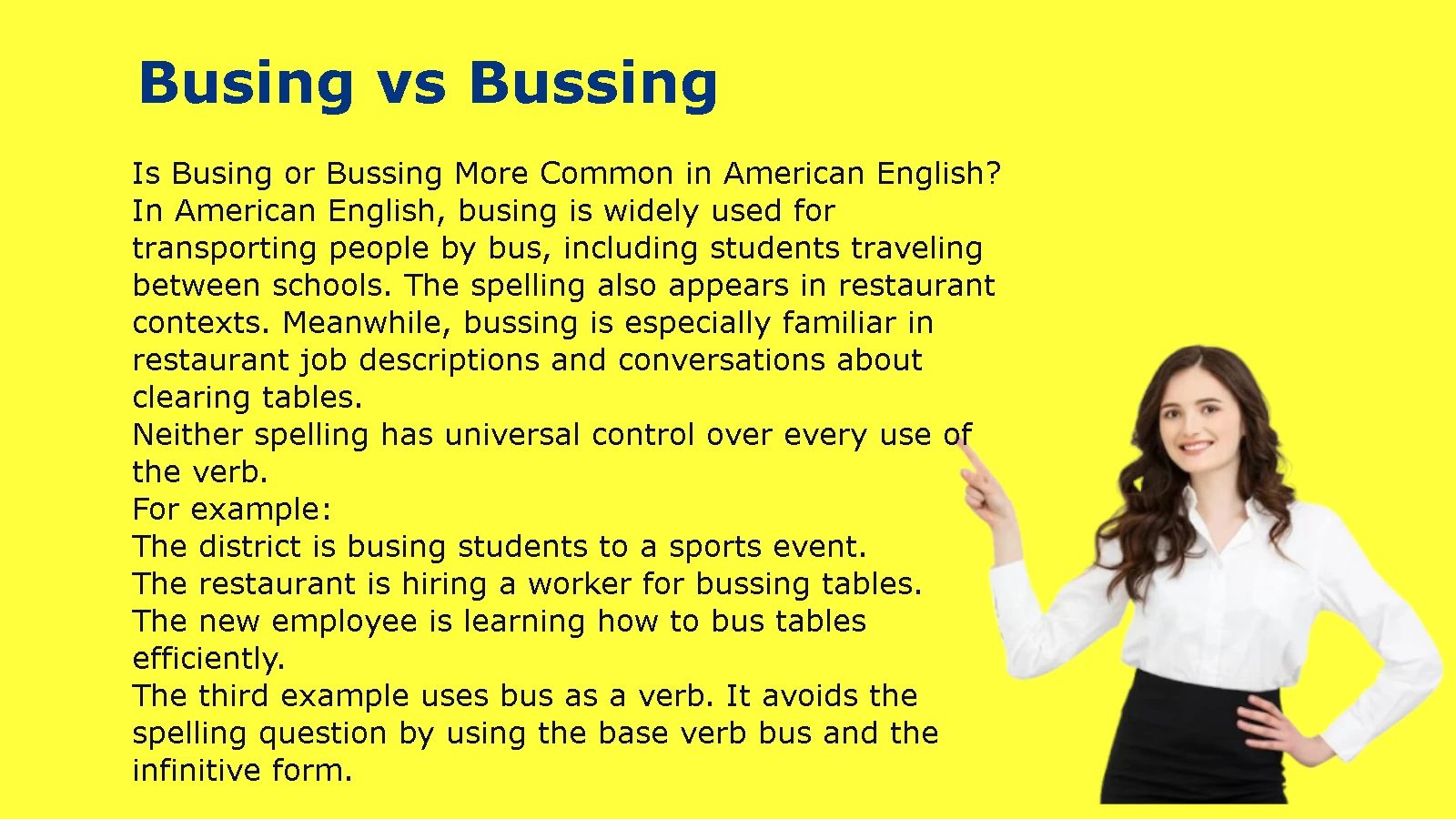
In American English, busing is widely used for transporting people by bus, including students traveling between schools. The spelling also appears in restaurant contexts. Meanwhile, bussing is especially familiar in restaurant job descriptions and conversations about clearing tables.
Neither spelling has universal control over every use of the verb.
For example:
- The district is busing students to a sports event.
- The restaurant is hiring a worker for bussing tables.
- The new employee is learning how to bus tables efficiently.
The third example uses bus as a verb. It avoids the spelling question by using the base verb bus and the infinitive form.
Practical tip: If you write for a restaurant, follow the terminology used by the employer or publication. If you discuss transportation, use busing unless a particular style guide specifies otherwise.
What Does Busing or Bussing Tables Mean?
Busing or bussing tables means removing used dishes, glasses, cutlery, and other items from dining tables and preparing those tables for the next customers. Restaurant workers who perform this task help maintain a clean dining area, improve table turnover, and support servers during busy shifts.
The task involves more than collecting plates. Depending on the restaurant, it may include wiping and sanitizing surfaces, replacing utensils, resetting place settings, and keeping the dining room organized.
What Does Bussing Tables Mean in a Restaurant?
In a restaurant, bussing tables refers to clearing and preparing tables after customers finish eating. The person doing the work usually removes dirty dishes and used napkins, cleans the table, and makes sure it is ready for another party.
A typical table-bussing routine may include the following steps:
- Clear used dishes: Collect plates, bowls, glasses, cups, and cutlery.
- Remove waste: Gather napkins, food scraps, and disposable items.
- Clean the surface: Remove crumbs, spills, and visible residue.
- Sanitize the table: Follow the restaurant’s food-safety procedures and required contact time for the sanitizing product.
- Reset the table: Replace menus, clean utensils, napkins, and other standard place settings.
- Check the surrounding area: Make sure the chairs, floor, and nearby surfaces look presentable.
The exact duties depend on the establishment. A casual restaurant may expect bussers to reset tables quickly, while a fine-dining restaurant may require more detailed preparation.
Example: After a family leaves a booth, a busser removes the plates and glasses, clears the napkins, cleans the tabletop, and resets the place settings before the next guests arrive.
This process helps the restaurant serve customers efficiently without sacrificing cleanliness.
What Is a Busser in a Restaurant?
A busser is a restaurant employee who clears used dishes, cleans tables, and helps prepare dining areas for incoming customers. Bussers commonly support servers, food runners, and other front-of-house employees.
Although their responsibilities vary, typical duties include:
- Clearing dishes from tables.
- Keeping dining areas clean and organized.
- Refilling water when the restaurant assigns that responsibility.
- Helping servers remove empty plates when appropriate.
- Restocking napkins, cutlery, and other dining supplies.
- Preparing tables for new guests.
- Helping maintain clean walkways and service stations.
A busser does not necessarily perform every task on this list. Restaurant managers divide responsibilities according to staffing, service style, and local procedures.
Busser vs. Server: What’s the Difference?
A server primarily takes customer orders, communicates with the kitchen, delivers food and drinks, and manages the dining experience. A busser primarily maintains the dining area by clearing and resetting tables.
| Responsibility | Busser | Server |
| Clears used dishes | Usually | Often helps when needed |
| Takes food orders | Not usually | Usually |
| Delivers food | Sometimes assists | Usually |
| Cleans and resets tables | Usually | May assist |
| Answers menu questions | Sometimes | Usually |
| Manages customer requests | Provides support | Usually leads |
Some restaurants combine these roles, particularly in smaller establishments. A job title alone does not determine every duty, so employees should check the actual job description.
Busing vs Bussing Tables: Which Should You Write?
Both busing tables and bussing tables appear in American English. The spelling bussing is common in restaurant contexts, but busing is also used for the same activity.
Choose a form that matches your workplace, audience, or publication style. Consistency matters more than switching between the two spellings without a reason.
For example:
- Restaurant job description: We are looking for a reliable employee to assist with bussing tables.
- Résumé: Responsible for clearing and resetting tables during busy service periods.
- Training instructions: Bus each table promptly after the guests leave.
- Workplace conversation: Can you help with busing the tables near the entrance?
Notice that the résumé example describes the responsibility without relying on either spelling. This approach can be useful when you want a professional, unambiguous description of your experience.
Example Sentences Using Bussing Tables
These examples show how the phrase works in everyday English:
- Mia is bussing tables while the servers handle customer orders.
- The restaurant needs another employee to bus tables during the lunch rush.
- After the customers leave, Jordan clears the plates and prepares the table for the next party.
- The manager asked the team to finish bussing the dining room before closing.
- His first restaurant job involved collecting dishes, wiping tables, and restocking supplies.
- The dining room became busy, so two servers helped the bussers clear the tables.
- Applicants should have experience with cleaning dining areas and resetting tables.
Use bussing tables when you want a familiar restaurant expression. Choose bus tables when you prefer a direct verb phrase that avoids the spelling variation.
What Does Bussing Mean in Food Slang?
In informal online language, bussing may be used to describe food that tastes exceptionally good. However, the more recognizable slang spelling is bussin’, a casual expression that means something is excellent, delicious, or especially satisfying. This slang meaning differs from bussing tables, which describes a restaurant task.
Context is the easiest way to distinguish the two meanings. If someone says, “I’m bussing tables,” they are probably talking about restaurant work. If someone says, “This pizza is bussin’,” they are praising the food.
What Does Bussin’ Mean When Talking About Food?
Bussin’ is an informal slang term that people often use to describe delicious food. Depending on the situation, it can also mean that something is exceptionally good or impressive.
For example, someone might use it to describe a spicy chicken sandwich, homemade cookies, a favorite restaurant meal, or a particularly good snack.
The term appears in social media captions, text messages, online comments, and casual conversations. It is not usually appropriate for formal business writing unless the writer is discussing slang itself.
Consider these examples:
- “This fried chicken is bussin’.”
- “Your homemade brownies are bussin’.”
- “That new burger place has some bussin’ food.”
- “The sauce on these noodles is bussin’.”
Each example communicates enthusiasm rather than a literal action involving tables.
The word also appears outside food conversations. A person might call a song, outfit, or performance bussin’ to express approval. However, food remains a familiar context for the expression.
Bussing vs. Bussin’: What’s the Difference?
The terms look similar, but they usually perform different roles in a sentence.
| Term | Meaning | Example |
| Bussing | Clearing or resetting restaurant tables | She is bussing tables after lunch. |
| Bussin’ | Slang for exceptionally good or delicious | This dessert is bussin’. |
| Busing | Commonly transporting people by bus; also used for table clearing | The school is busing students to the event. |
| Busser | A worker who clears and resets restaurant tables | Ask the busser to clear the empty plates. |
The apostrophe in bussin’ represents the omitted final g in the informal pronunciation and spelling of bussing. Writers do not always use the apostrophe consistently online, so you may encounter bussin, bussing, or other informal variations.
That variation does not make the terms interchangeable in every sentence.
For example, “I am bussing tables” describes work. “I am eating bussin’ tacos” praises the food. The surrounding words help readers understand the intended meaning.
Examples of Bussin’ in a Sentence
Here are several natural examples of the slang term:
- These homemade tacos are bussin’.
- The restaurant’s spicy wings were absolutely bussin’.
- My friend brought a chocolate cake, and every slice was bussin’.
- That food truck makes some bussin’ burgers.
- This sauce is so good that the whole meal is bussin’.
These sentences fit casual conversation and social media. For a formal restaurant review, you might instead write, “The spicy wings were flavorful, tender, and well-seasoned.”
Writing tip: Use bussin’ when you want to reproduce an informal voice. Use specific descriptive words such as flavorful, crispy, tender, or well-seasoned when you need a more professional tone.
What Does Bussing Mean in Gaming and Online Conversations?
The meaning of bussing in gaming depends on the game and the conversation. It is not a universal gaming term with one fixed definition. Some players use bussin’ as general slang to praise a game, weapon, play, or achievement, while other uses may refer to game-specific terminology or a typo.
The surrounding message provides the best clue.
Does Bussing Have a Special Meaning in Gaming?
There is no single meaning of bussing that applies across all video games. Gaming communities develop their own vocabulary, and the same word can mean different things in different settings.
For example, a player might write:
- “That new update is bussin’.”
- “Your final round was bussin’.”
- “This weapon is bussin’ after the latest patch.”
In these examples, the writer uses slang to express approval. The word does not identify a specific gameplay mechanic.
However, if someone uses bussing while discussing a particular game mode, character, item, or strategy, do not automatically assume that they mean food slang. Check the surrounding conversation and the game’s terminology.
How to Understand Bussing in a Gaming Chat
Use these steps to interpret the word correctly:
- Read the whole sentence. The words around bussing often reveal whether the person is praising something or describing an action.
- Identify the subject. If the subject is food, a weapon, a character, or a performance, slang may be the intended meaning.
- Check the game context. A term used in one game’s community may not have the same meaning elsewhere.
- Look for a specific explanation. If the word appears to refer to a mechanic or strategy, check the game’s glossary or a relevant community discussion.
For instance, “That build is bussin’” likely expresses approval in a casual chat. By contrast, a sentence that uses the word as part of a detailed gameplay instruction needs more context before you can define it accurately.
Avoid presenting a slang interpretation as an official gaming definition unless the particular game or community clearly establishes that meaning.
Busing vs Bussing in Other Contexts
Although restaurant work and slang account for many searches involving these spellings, busing also appears in transportation and historical discussions. The word buss has another, less common meaning related to kissing. Understanding these uses helps prevent confusion when you encounter the word outside a restaurant.
What Does Busing Mean in School Transportation?
Busing commonly means transporting people by bus. In education, it often describes a school district arranging bus transportation for students between their homes, schools, or other destinations.
Examples include:
- The school is busing students to the science museum.
- The district arranged busing for children who live far from campus.
- Parents received information about the new school busing schedule.
- The team is busing players to an away game.
In these sentences, busing has nothing to do with clearing tables or praising food.
The term also appears in discussions of school desegregation in the United States. In that historical and political context, busing refers to transporting students between neighborhoods or schools as part of efforts to address racial segregation. The practice has been debated in relation to school access, district boundaries, transportation, and educational opportunity.
When writing about this subject, explain the historical context instead of assuming readers will interpret the word as ordinary transportation.
Is Bussing Related to Kissing?
The English verb buss can mean to kiss, although this use is less common than kiss in modern everyday English. Its forms include bussed and bussing in contexts where the verb takes the usual -ed or -ing endings.
For example:
- The old film showed the couple bussing on the cheek.
- The characters exchanged a quick buss before leaving.
This meaning is distinct from bussing tables. The intended meaning depends on the sentence, and most modern readers are more familiar with kiss than with buss in this sense.
The word’s existence does not mean that every occurrence of bussing refers to kissing. Restaurant work remains a common context for the spelling.
What Does Busing Mean in a Political or Historical Context?
In U.S. history, school busing often refers to transporting students to schools outside their immediate neighborhoods, including programs associated with school desegregation.
The term became prominent in discussions about how school systems responded to legally enforced segregation and unequal access to education. Some districts used student transportation as part of desegregation plans, while communities debated the effects on students, families, schools, and neighborhoods.
This historical meaning is different from restaurant table clearing. If you encounter busing in a news report, history textbook, or political discussion about schools, look for references to students, districts, desegregation, or transportation.
For clarity, writers can use phrases such as school busing, student transportation, or busing for school desegregation instead of relying on the word alone.
Common Mistakes When Using Busing and Bussing
The most common mistakes occur when writers assume that the two spellings always have different meanings or treat restaurant language and internet slang as interchangeable.
A quick check of the sentence usually resolves the confusion.
Using Bussing When You Mean Food Slang
People sometimes write bussing when they intend the slang term bussin’. Readers may still understand the intended meaning, particularly in casual online conversations, but the apostrophe helps distinguish the slang form.
Compare these examples:
- Restaurant task: The employee is bussing tables.
- Food slang: The employee said the pizza was bussin’.
- Formal food description: The pizza was delicious and had a crisp crust.
If you are writing a social media post, bussin’ can convey an informal, enthusiastic tone. In a restaurant job description, bussing tables communicates a work responsibility.
Do not automatically correct every instance of bussing to bussin’. First determine what the writer wants to say.
Confusing a Busser With a Server
A busser and a server may work closely together, but their primary duties differ.
A busser usually clears used dishes and prepares tables for new customers. A server typically takes orders, communicates with the kitchen, brings food and drinks, and responds to customer requests.
Some restaurants ask servers to clear tables themselves. Others assign bussers to handle most of the cleanup. The distinction depends on the workplace, not just the job title.
For example, a résumé that says “Served customers and managed table assignments” describes different responsibilities from “Cleared dishes and reset tables between parties.”
When applying for a restaurant job, describe the actual duties you performed rather than relying on the title alone.
Treating One Spelling as Always Wrong
Another common mistake is insisting that busing or bussing must always be incorrect.
The standard spelling for transportation is generally busing. In restaurant writing, both busing tables and bussing tables appear in established use. A publication or employer may prefer one form, but that preference does not automatically make the other form an error in every context.
Use this simple approach:
- Choose busing for school or passenger transportation.
- Use bussing for restaurant table clearing if that matches your preferred style.
- Use bus tables when you want a straightforward verb phrase.
- Choose bussin’ for informal slang about something exceptionally good.
Consistency makes your writing easier to read and edit.
Quick Guide to Choosing the Right Word
If you need to choose between Busing vs Bussing quickly, identify the intended meaning before deciding on the spelling. The word’s context usually provides a clear answer.
| If you mean… | Use… | Example |
| Transporting students by bus | Busing | The district is busing students to school. |
| Clearing and resetting restaurant tables | Busing or bussing | The staff is bussing tables after dinner. |
| A restaurant worker who clears tables | Busser | The busser cleared the booth. |
| Delicious or exceptionally good food in slang | Bussin’ | These noodles are bussin’. |
| A historical student transportation policy | School busing | The class discussed school busing and desegregation. |
| The less common verb meaning to kiss | Buss | The character gave her a quick buss. |
This table covers the most common interpretations without treating every spelling as a separate word with an entirely unrelated meaning.
Which Spelling Should You Use in Formal Writing?
In formal writing, use the form that best matches the meaning and the style expected by your audience.
For transportation, busing is the usual American English spelling. For restaurant work, either busing tables or bussing tables may be appropriate, depending on the employer’s wording or the publication’s style guide.
For slang, avoid bussin’ in formal reports, résumés, and professional restaurant descriptions unless you are discussing the term itself.
Consider these examples:
Informal: The burgers at that place are bussin’.
Professional review: The restaurant serves flavorful burgers with crisp edges and well-seasoned patties.
Restaurant résumé: Cleared dishes, sanitized tables, and reset dining areas during high-volume service.
The professional examples communicate the intended meaning without depending on slang or spelling variations.
Frequently Asked Questions
Is It Busing or Bussing Tables?
Both busing tables and bussing tables are used in restaurant contexts. They describe removing used dishes, cleaning dining tables, and preparing them for the next customers. Bussing tables is a common spelling in restaurant writing, but the best choice for a specific workplace depends on its preferred terminology.
What Is Bussing in a Restaurant?
Bussing in a restaurant means clearing used dishes, collecting waste, cleaning tables, and preparing the dining area for new customers. A busser usually performs these duties and may also restock supplies or assist servers, depending on the restaurant’s procedures.
What Does Bussing Mean in Food Slang?
In food slang, people sometimes write bussing when they mean bussin’, an informal term for something exceptionally good or delicious. For example, “These tacos are bussin’” means the speaker thinks the tacos taste excellent. This slang meaning is different from bussing tables.
Is Busing or Bussing the Correct Spelling?
Both spellings appear in English, but their use depends on context. Busing is the standard form for transporting people by bus, while bussing is common in restaurant descriptions involving table clearing. Some writers also use busing for restaurant work, so consistency and context matter.
What Is a Busser?
A busser is a restaurant employee who clears used dishes, cleans tables, and prepares dining areas for new customers. Bussers often support servers by keeping the dining room organized and ensuring that tables are ready for the next guests.
What Does Bussing Mean in Gaming?
Bussing does not have one universal meaning across video games. In casual gaming conversations, players may use bussin’ as slang to praise a weapon, play, character, or update. A game-specific meaning requires context from the relevant game or community.
Conclusion: Busing vs Bussing Depends on Context
The difference between Busing vs Bussing becomes straightforward once you identify the intended meaning. Busing commonly refers to transporting people by bus, while bussing often describes clearing and resetting restaurant tables. In informal online conversations, bussin’ means something is exceptionally good, especially food.
Remember these simple distinctions:
- Use busing for school and passenger transportation.
- Use busing tables or bussing tables for restaurant cleanup, following your preferred style.
- Use busser for a restaurant worker who clears and resets tables.
- Use bussin’ when expressing informal praise for food or something impressive.
Before choosing a spelling, check the surrounding sentence and consider your audience. If you are writing a restaurant résumé, job description, school report, or social media caption, the right wording will make your meaning clear.













