Fliers vs Flyers is a common spelling question in English, especially when writing advertisements, discussing air travel, or choosing the correct plural form. Both fliers and flyers are correct, and both can refer to people or things that fly. However, flyer is a familiar choice for a printed advertisement, while frequent flyer is the widely recognized expression for someone who travels by air regularly.
Understanding the difference between flier vs. flyer, fliers or flyers plural, and flyer vs. brochure helps you choose the right word for your audience and purpose. The spellings can vary by context and personal or editorial preference, but neither form is universally wrong. British and American English both use flyer, and flier also appears in both varieties.
This guide explains the meaning of each word, shows how to use both plural forms, compares their use in advertising and aviation, and provides practical examples to help you write clearly and consistently.
What Is the Difference Between Fliers and Flyers?
Fliers and flyers are both correct plural forms of their respective singular nouns, flier and flyer. Their meanings overlap, and either spelling can describe people who fly or printed promotional materials. However, flyer is a common choice for advertisements, while frequent flyer is the familiar expression in airline travel.
The main difference involves spelling preference and context rather than a strict difference in meaning.
| Word | Singular | Plural | Common use |
| Flier | Flier | Fliers | People who fly, general references, and advertisements |
| Flyer | Flyer | Flyers | Promotional handouts, people who fly, and airline travel |
| Frequent flier | Frequent flier | Frequent fliers | People who travel by air regularly |
| Frequent flyer | Frequent flyer | Frequent flyers | Airline loyalty programs and regular air travelers |
For example, a business might print 1,000 flyers to promote a new store. An aviation writer might describe several fliers performing at an air show. Both sentences use accepted English.
The best spelling often depends on the expression, publication style, and audience. If you’re creating an advertisement, flyer is a practical default. If you’re following a style guide that prefers flier, use that spelling consistently.
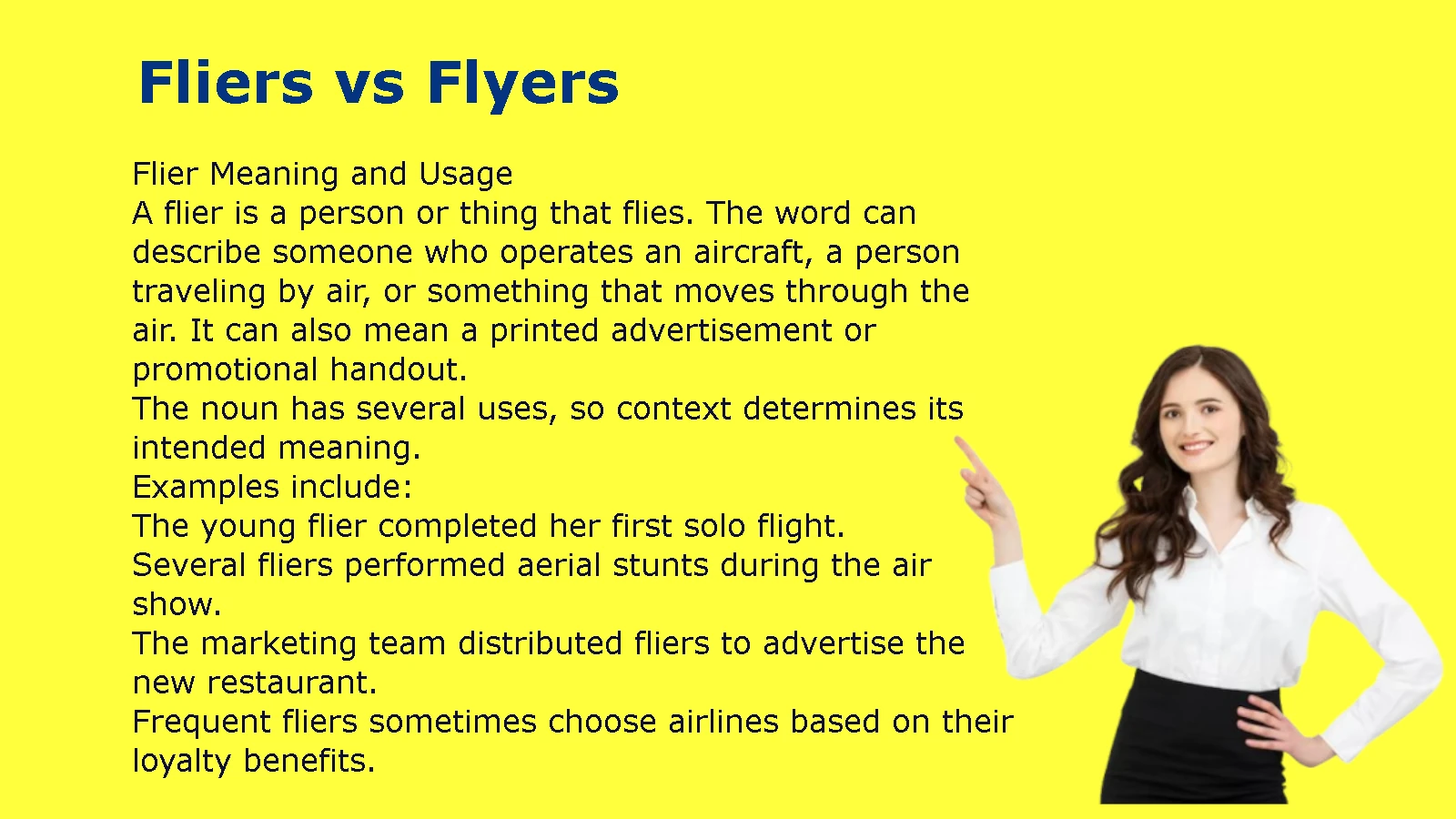
Flier Meaning and Usage
A flier is a person or thing that flies. The word can describe someone who operates an aircraft, a person traveling by air, or something that moves through the air. It can also mean a printed advertisement or promotional handout.
The noun has several uses, so context determines its intended meaning.
Examples include:
- The young flier completed her first solo flight.
- Several fliers performed aerial stunts during the air show.
- The marketing team distributed fliers to advertise the new restaurant.
- Frequent fliers sometimes choose airlines based on their loyalty benefits.
The spelling flier is especially useful when it matches an established expression or an organization’s preferred style. However, it isn’t limited to aviation. Writers also use it for promotional materials.
For instance, the sentence “We handed out fliers at the entrance” is grammatically correct. Replacing fliers with flyers would also work.
Flyer Meaning and Usage
A flyer can describe a person or thing that flies, but the word is particularly familiar in advertising and marketing. A flyer is usually a printed or digital promotional item that communicates information about an event, business, product, service, or special offer.
Businesses often use flyers because they present a message quickly and make important details easy to find.
Examples include:
- The bakery designed a flyer for its grand opening.
- Students received flyers announcing the college festival.
- Our neighborhood association distributed flyers about the cleanup event.
- The airline offers rewards to frequent flyers.
- The pilot is an experienced flyer who enjoys aerobatic competitions.
The word also appears in common expressions. For example, frequent flyer refers to someone who travels by air regularly, especially someone who participates in an airline’s loyalty program.
Although flyer is common in promotional writing, it isn’t restricted to advertisements. The correct interpretation depends on the surrounding words.
Flier vs. Flyer: Quick Comparison
The following table summarizes the main differences and similarities.
| Feature | Flier | Flyer |
| Is it a real English word? | Yes | Yes |
| Is the spelling correct? | Yes | Yes |
| Plural form | Fliers | Flyers |
| Can it mean a person who flies? | Yes | Yes |
| Can it mean an advertisement? | Yes | Yes |
| Common advertising choice | Accepted | Commonly preferred |
| Used in British English | Yes | Yes |
| Used in American English | Yes | Yes |
| Part of the expression “frequent flyer” | Yes, in the variant “frequent flier” | Yes, in the familiar expression “frequent flyer” |
The important point is that the two words don’t have completely separate meanings. In many sentences, you can replace one with the other without changing the message.
Quick tip: When you’re unsure, use flyer for a promotional handout and frequent flyer for airline travel. For other contexts, check the relevant style guide or choose the spelling that best fits your established writing style.
Is It Fliers or Flyers? Understanding the Plural Forms
The plural of flier is fliers, while the plural of flyer is flyers. Both follow standard English spelling patterns. Choose the plural that matches the singular form you use, and avoid switching spellings unnecessarily within the same document.
The difference is straightforward:
- One flier becomes two fliers.
- One flyer becomes two flyers.
Neither plural is inherently incorrect. The choice depends on which singular spelling you prefer or which form your organization uses.
What Is the Plural of Flier?
The plural of flier is fliers. You form it by keeping the existing spelling and adding s.
| Singular | Plural | Example |
| Flier | Fliers | The fliers boarded the aircraft. |
| Flier | Fliers | Volunteers distributed fliers throughout the neighborhood. |
| Flier | Fliers | Several experienced fliers attended the aviation event. |
Here are additional examples of fliers in natural sentences:
- The school sent fliers home with students to announce the fundraiser.
- Several fliers gathered near the hangar before the air show.
- Our team prepared colorful fliers to promote the weekend sale.
Notice that the word can refer to either people or promotional materials. The surrounding sentence tells the reader which meaning you intend.
If your headline reads “Free Fliers for the Community Festival,” readers will probably understand that you mean promotional handouts. However, “Experienced Fliers Perform at the Festival” clearly refers to people who fly.
What Is the Plural of Flyer?
The plural of flyer is flyers. Add s to the singular noun without changing its spelling.
| Singular | Plural | Example |
| Flyer | Flyers | The company printed 500 flyers. |
| Flyer | Flyers | Students collected flyers outside the library. |
| Flyer | Flyers | Frequent flyers can earn airline rewards. |
Use flyers when discussing advertisements, travel, or other situations where this spelling suits the context.
Examples:
- The restaurant distributed flyers announcing its new menu.
- Our marketing department designed flyers for three upcoming events.
- Frequent flyers often compare airline reward programs before booking flights.
A useful rule is to preserve the spelling throughout a piece of writing. If you begin with flyer and use it repeatedly for promotional materials, continue using flyers rather than switching to fliers without a reason.
Fliers or Flyers: Which Form Should You Use?
Both forms are correct, but flyers is a practical default for advertisements and promotional materials. Choose fliers when it matches your preferred spelling, an established expression, or a publication’s style guide.
Use these guidelines when deciding:
- For business advertising: Choose flyers for familiar terms such as event flyers, sales flyers, and promotional flyers.
- For aviation: Either fliers or flyers can describe people who fly.
- For airline loyalty programs: Prefer frequent flyer unless the organization uses another form.
- For academic or professional writing: Follow the relevant style guide.
- For consistent editing: Match the singular and plural forms throughout the text.
For example, a business could write, “We designed a flyer and printed 300 flyers.” The sentence is consistent and natural.
A less consistent version would use flyer in one paragraph and fliers in another to describe the same promotional item, without any reason for the change. That variation may not make the text grammatically incorrect, but it can distract readers and complicate editing.
Flier or Flyer for an Advertisement?
Both flier and flyer can mean a printed advertisement or promotional handout. However, flyer is a common choice in contemporary marketing. Businesses can use it for sales announcements, event promotions, restaurant offers, community notices, and other short promotional messages.
The word usually describes a compact piece of content designed to attract attention and communicate essential information.
Why Is Flyer Common in Advertising?
A flyer gives readers a quick overview of an offer, event, or service. Unlike a detailed report or catalog, it usually focuses on one primary message and a clear next step.
For example, a local bakery might create a flyer that includes:
- The bakery’s name and location
- A grand-opening announcement
- Opening dates and times
- Special discounts
- A website address or QR code
This format helps customers understand the offer without reading a lengthy document.
Businesses use flyers in several ways:
Retail promotions: Stores distribute flyers to announce discounts, seasonal sales, or new products.
Event marketing: Organizers create flyers for concerts, conferences, festivals, and charity events.
Local services: Plumbers, tutors, cleaning companies, and other service providers use flyers to introduce their services to nearby customers.
Community announcements: Schools, libraries, and neighborhood groups use flyers to share dates, schedules, and public notices.
Digital campaigns: Companies publish digital flyers on websites, email newsletters, and social media platforms.
Although flier is also correct, flyer is a familiar term in these marketing contexts. Choosing it can make the intended meaning immediately clear to readers.
Examples of Flyer and Flier in Marketing
The following examples show how both spellings work in promotional writing.
Examples using flyer:
- The bakery printed 500 flyers to promote its grand opening.
- Our company created a flyer advertising its new consulting service.
- Volunteers handed out flyers before the community concert.
- The gym designed a digital flyer to promote its introductory membership offer.
- The school posted flyers announcing the upcoming science fair.
Examples using flier:
- The restaurant distributed fliers to attract customers from nearby offices.
- Volunteers placed fliers on community noticeboards.
- Our team prepared promotional fliers for the charity event.
All these sentences are grammatically acceptable. The difference is a spelling preference, not a difference in the basic meaning of the promotional material.
A Practical Marketing Example
Imagine a small fitness studio preparing to launch a new membership plan. The owner wants to distribute promotional material to residents within a few miles of the studio.
The owner could create a flyer with the headline “Join Today and Save on Your First Month.” The design might include the studio’s address, class schedule, introductory price, and a QR code linking to the registration page.
In this case, flyer is a natural label for the promotional sheet. If the owner calls it a flier, readers will still understand the meaning. The marketing message and design matter more than the spelling variation.
For search visibility, the studio could also publish a digital version with a descriptive page title such as “Fitness Studio Membership Flyer.” This connects the promotional material to the service without forcing repeated keywords into the content.
Flyer vs. Brochure: What Is the Difference?
A flyer usually promotes one main message, offer, or event. A brochure provides more structured information about a business, product, service, destination, or organization. Flyers tend to be concise, while brochures often contain several sections or panels that explain a subject in greater detail.
The two formats serve different communication goals.
| Feature | Flyer | Brochure |
| Main purpose | Promote a specific offer or message | Explain a product, service, or organization |
| Typical length | Often one sheet | Often folded or multiple pages |
| Content | Short and direct | More detailed and organized |
| Design | Focuses on one central message | Uses sections or panels |
| Common uses | Sales, events, announcements | Travel, education, services, company profiles |
| Reader’s goal | Understand an offer quickly | Explore information and compare options |
| Typical call to action | Attend, buy, register, or visit | Learn more, compare, contact, or inquire |
For example, a hotel might distribute a flyer advertising a weekend discount. Its brochure might explain room types, amenities, dining options, conference facilities, and local attractions.
A real estate agency could also use both formats. A flyer might advertise an open house for one property, while a brochure could describe the agency’s services, team, and property portfolio.
Neither format is automatically better. Choose a flyer when you need to communicate one clear message quickly. Use a brochure when readers need enough information to understand a broader offering.
Flier or Flyer in British English
Both flier and flyer appear in British English. The spelling flyer is familiar for promotional handouts, but flier is also an accepted English spelling. Neither word is exclusively British or American, so writers should avoid treating this distinction as a strict regional spelling rule.
This differs from spelling pairs where regional conventions more clearly favor one form, such as colour in British English and color in American English.
Is Flyer the Preferred British Spelling?
British writers commonly use flyer for a printed promotional item. You may see phrases such as event flyer, advertising flyer, and promotional flyers in British publications and business materials.
However, flier also appears in British English. Its use does not automatically indicate an American writer or an incorrect spelling.
Consider these examples:
- The local council distributed flyers about the recycling program.
- The community center printed fliers announcing its new classes.
- The shop displayed a flyer promoting its seasonal sale.
- Volunteers handed out fliers at the entrance to the event.
All four sentences are understandable and grammatically correct.
For professional writing, the most useful approach is to follow the spelling preferred by your publication, employer, or client. If no style guide applies, flyer is a straightforward choice for promotional materials.
American English vs. British English Examples
The difference between flier and flyer is not a simple American-versus-British distinction. Both forms appear in both varieties, although writers and organizations may prefer one spelling.
| Context | American English example | British English example |
| Advertising | The store distributed flyers about the sale. | The shop distributed flyers about the sale. |
| Community event | Volunteers handed out fliers at the fair. | Volunteers handed out fliers at the village fair. |
| Air travel | Frequent flyers can earn reward points. | Frequent flyers can earn reward points. |
| Aviation | The fliers practiced their routines. | The fliers practiced their routines. |
The differences in these examples relate to the surrounding vocabulary and situation, not a mandatory spelling change.
If you’re writing for a British audience, consider other regional terms where relevant, but don’t assume that flyer needs to become flier. The same spelling can work in both varieties.
Frequent Flyer or Frequent Flier?
Both frequent flyer and frequent flier are accepted expressions for someone who travels by air regularly. However, frequent flyer is the familiar expression in airline loyalty programs, travel marketing, and everyday discussion of air travel.
Use frequent flyer as your default unless an airline, publication, or organization consistently uses frequent flier.
What Does Frequent Flyer Mean?
A frequent flyer is someone who travels by airplane often. The expression commonly refers to travelers who join airline loyalty programs to earn points, miles, or other benefits from eligible trips.
For example:
- Frequent flyers may qualify for certain airline rewards.
- My colleague is a frequent flyer who travels for business every month.
- The airline introduced new benefits for its frequent flyers.
- Frequent fliers sometimes compare loyalty programs before choosing an airline.
In travel marketing, frequent flyer program is a familiar term for a scheme that rewards eligible customers for their travel activity or other qualifying purchases.
The exact benefits depend on the program. They may include points or miles, tier-based perks, seat-related benefits, or access to selected services. Not every frequent flyer receives the same benefits, and the rules can differ among airlines.
Which Spelling Is More Common?
Frequent flyer is the practical choice for most general writing about airline travel. It is the familiar form in loyalty-program terminology and travel-related content.
Nevertheless, frequent flier is not inherently incorrect.
Use the following guidelines:
- Write frequent flyer program when discussing airline rewards in general.
- Use frequent flyers when referring to people who travel by air regularly.
- Preserve frequent flier if you’re quoting a source that uses that spelling.
- Follow the official wording when referring to a named program or publication.
- Avoid alternating between both forms in the same article unless the variation has a clear purpose.
For example, a travel website could write, “Frequent flyers can compare airline rewards before booking a trip.” This sentence uses a familiar expression and communicates the meaning clearly.
Flyers Meaning: Other Common Uses
The meaning of flyers depends on context. It can refer to printed promotional materials or to people and things that fly. The singular flyer appears in several established expressions, including frequent flyer and take a flyer. Understanding these uses helps prevent confusion when the word appears outside advertising.
What Does Flyer Mean in Different Contexts?
Here are the main meanings of flyer and flier.
Advertising: A flyer is a short promotional document that shares details about an offer, event, product, or service.
Example: The restaurant placed flyers near the entrance to advertise its lunch specials.
Aviation: A flyer or flier can refer to someone who flies, particularly a pilot or air traveler.
Example: The experienced flyer checked the aircraft before departure.
Air travel: A frequent flyer is someone who travels by air regularly.
Example: The frequent flyer used accumulated rewards toward a future trip.
Idiomatic usage: The expression take a flyer can mean taking a chance or making a speculative attempt, particularly in American English.
Example: The investor decided to take a flyer on a small company with an uncertain future.
These meanings are related to established uses of the words, but they aren’t interchangeable in every situation. For example, a person who takes a flyer on an investment isn’t necessarily buying a printed advertisement.
When the meaning seems unclear, look at the words around it. References to printing, events, and promotions usually indicate an advertisement. References to aircraft, airports, and airline rewards usually indicate travel or flying.
Flier, Flyer, and Pliers: Are They Related?
Pliers is a different word. It refers to a hand tool used to grip, bend, twist, or cut materials. Despite the similar spelling, it isn’t a variant of flier or flyer.
Compare the three terms:
| Word | Meaning | Example |
| Flier | A person or thing that flies; also an advertisement | The volunteers distributed fliers. |
| Flyer | A person or thing that flies; often an advertisement | The business printed flyers. |
| Pliers | A hand tool used to grip or manipulate objects | The mechanic used pliers to remove the clip. |
The word pliers generally refers to a tool, while fliers and flyers are plural forms of nouns associated with flying or promotional materials.
This distinction matters when typing, editing, or proofreading. An accidental change from flyers to pliers can completely alter a sentence.
For example:
- Correct: The volunteers distributed flyers outside the store.
- Incorrect for that meaning: The volunteers distributed pliers outside the store.
The second sentence would make sense only if the volunteers were actually handing out tools.
Fliers vs Flyers Examples in Everyday Writing
Examples are one of the easiest ways to understand the difference between fliers and flyers. Both forms can refer to advertisements or people who fly, so the surrounding context often matters more than the spelling itself.
Use the following sentences as models for your own writing.
Examples Using Fliers
- Several fliers circled above the beach during the air show.
- The school sent fliers home with students to announce the fundraiser.
- Some frequent fliers prefer direct flights for business travel.
- Volunteers distributed fliers about the neighborhood cleanup.
- The aviation club welcomed experienced fliers to its annual meeting.
- The restaurant prepared promotional fliers for its opening weekend.
- A group of fliers gathered near the hangar before the demonstration.
In these examples, fliers refers either to people who fly or to promotional materials. The sentence provides enough information to identify the meaning.
Examples Using Flyers
- The school sent flyers home with students before the science fair.
- Volunteers handed out flyers outside the community center.
- The bakery created flyers to advertise its grand opening.
- Frequent flyers can review the benefits offered by different airline programs.
- The travel agency displayed flyers promoting its latest holiday packages.
- The store printed flyers announcing its weekend discounts.
- Our marketing team designed digital flyers for social media.
These examples show why flyers is a versatile spelling. It works in advertising, business, education, and travel contexts.
Examples of Flier vs. Flyer in Sentences
The following pairs demonstrate how either spelling can work when the intended meaning stays the same.
Promotional materials
- The shop distributed fliers about its new products.
- The shop distributed flyers about its new products.
Air travel
- Frequent fliers may qualify for airline rewards.
- Frequent flyers may qualify for airline rewards.
Community events
- Volunteers prepared fliers for the charity concert.
- Volunteers prepared flyers for the charity concert.
Each pair communicates essentially the same idea. The main difference is spelling preference.
However, if you’re writing for a business, it’s sensible to choose one spelling and use it consistently. Consistency makes editing easier and gives the finished material a more professional appearance.
Common Mistakes to Avoid
Although both spellings are correct, writers sometimes misunderstand how to use them.
Mistake: Assuming flier is always incorrect.
Incorrect claim: “Flier is a misspelling of flyer.”
Correction: Both are accepted spellings. Choose according to context and style.
Mistake: Assuming flyer refers only to advertising.
Correction: Flyer can also refer to someone who flies, especially in expressions such as frequent flyer.
Mistake: Using the wrong plural.
Correction: The plural of flier is fliers. The plural of flyer is flyers. Match the plural to the singular spelling.
Mistake: Changing spelling without a reason.
Correction: If you use flyer throughout an advertising campaign, keep flyers in the plural unless you have a specific reason to change the form.
Mistake: Treating a flyer and a brochure as identical.
Correction: A flyer usually promotes a single message, while a brochure typically provides more detailed, organized information.
Mistake: Confusing flyers with pliers.
Correction: Flyers can refer to advertisements or people who fly. Pliers are tools used to grip, bend, or cut materials.
How to Choose Between Flier and Flyer
Choose between flier and flyer by considering your meaning, audience, and preferred style. Use flyer for promotional materials as a practical default, and use frequent flyer when discussing airline loyalty programs. In other contexts, both spellings may work, so consistency is more important than forcing a universal rule.
Use this quick decision guide.
| If you’re writing about… | Recommended choice | Reason |
| A printed advertisement | Flyer | A familiar term in marketing |
| Multiple promotional sheets | Flyers | The matching plural of flyer |
| Someone who flies | Flier or flyer | Both spellings are accepted |
| An airline loyalty program | Frequent flyer | Familiar industry expression |
| British English advertising | Flyer is a practical default | Common in British promotional writing |
| A publication with a house style | Follow its preferred form | Maintains editorial consistency |
| A tool used for gripping materials | Pliers | A separate word with a different meaning |
A Simple Editing Checklist
Before publishing, review your text using these steps:
- Check the meaning. Decide whether you’re referring to a person who flies, an advertisement, or something else.
- Choose the spelling. Select flier or flyer based on context and style.
- Match the plural. Use fliers with flier and flyers with flyer.
- Review common expressions. Use frequent flyer as the default for airline travel.
- Check regional expectations. Don’t assume the spelling must change between American and British English.
- Keep the document consistent. Use the same form throughout unless a quotation, proper name, or specific style requirement calls for another spelling.
For instance, a company writing a promotional campaign might choose flyer in its content guidelines. Its writers would then use flyer, flyers, and promotional flyer consistently across landing pages, printed materials, and email campaigns.
A travel blog might adopt frequent flyer as its standard expression. That choice creates consistency without incorrectly labeling frequent flier as a spelling error.
The goal isn’t to eliminate every variation. It’s to make a clear choice that suits the intended meaning and audience.
Frequently Asked Questions
Is It Fliers or Flyers?
Both fliers and flyers are correct plural forms. Fliers is the plural of flier, while flyers is the plural of flyer. Both can refer to people who fly or promotional materials, although flyers is a common choice for advertisements.
Is Flyer or Flier Correct for an Advertisement?
Both spellings can refer to an advertisement, but flyer is a familiar and practical choice for promotional materials. Businesses commonly use it for event announcements, sales, restaurant offers, and community promotions. Choose the form that matches your organization’s style and use it consistently.
What Is the Plural of Flier?
The plural of flier is fliers. For example, “The volunteers distributed fliers outside the library.” The plural of flyer is flyers, so the correct form depends on which singular spelling you use.
Is It Frequent Flyer or Frequent Flier?
Both frequent flyer and frequent flier are accepted expressions. However, frequent flyer is the familiar form in airline loyalty programs and general travel writing. Use that form by default unless a particular organization or publication prefers frequent flier.
Is Flier or Flyer Correct in British English?
Both flier and flyer appear in British English. Flyer is common for promotional handouts, but flier is also accepted. Neither spelling is exclusive to one side of the Atlantic, so follow your publication’s style guide when one applies.
What Is the Difference Between a Flyer and a Brochure?
A flyer usually communicates one main promotional message on a concise sheet. A brochure generally provides more detailed information in a structured format, such as folded panels or multiple pages. A store might use a flyer to advertise a sale and a brochure to explain its full range of products.
Conclusion: Fliers vs Flyers
The choice between Fliers vs Flyers is simpler than it may first appear. Both spellings are correct, and their meanings overlap. The plural of flier is fliers, while the plural of flyer is flyers. Either form can refer to people who fly or to promotional materials.
For everyday writing, remember these practical guidelines:
- Use flyer as a familiar choice for advertisements and promotional handouts.
- Use flyers as its plural form.
- Recognize flier and fliers as accepted alternatives.
- Prefer frequent flyer for general writing about airline travel and loyalty programs.
- Don’t assume British English requires a different spelling.
- Distinguish a flyer from a brochure by its purpose and level of detail.
- Keep your spelling consistent throughout each document.
If you’re preparing a business advertisement, designing a community announcement, or writing an article about air travel, choose the spelling that fits your context and audience.