Have you ever seen the words “synthesis” and “syntheses” and wondered why they look so similar but are used differently? While Synthesis vs Syntheses can be confusing at first, the difference is simple once you understand their meaning, number, and correct usage.
Synthesis is the singular form, meaning the combination of different ideas, elements, or parts into a whole. Syntheses is the plural form, referring to two or more such combinations. Both words are commonly used in academic writing, science, research, and everyday discussions about combining information or ideas.
Examples:
- The synthesis of the research findings revealed a clear pattern.
- Several syntheses of the available evidence were presented in the report.
The confusion is understandable. People often search for synthesis vs syntheses, synthesis plural, what is the plural of synthesis, or syntheses meaning because syntheses doesn’t look like the usual plural form of an English word. And here’s the kicker: although the spelling changes only slightly, the two words can completely change the meaning of a sentence.
In this guide, you’ll learn the complete difference between synthesis and syntheses, including their definitions, pronunciation, singular and plural forms, correct usage, and examples in sentences. You’ll also discover how to use each word in academic writing, science, and everyday English, along with a simple way to remember which form you need.
Synthesis vs. Syntheses at a Glance
The quickest way to understand synthesis vs. syntheses is to treat them like other singular and plural noun pairs.
| Word | Number | Pronunciation | Basic meaning | Example |
| Synthesis | Singular | /ˈsɪn.θə.sɪs/ | One combination, process, or resulting whole | The article offers a synthesis of several studies. |
| Syntheses | Plural | /ˈsɪn.θə.siːz/ | More than one synthesis | Researchers compared several syntheses of the evidence. |
Cambridge Dictionary lists syntheses as the plural of synthesis and gives the US pronunciations as /ˈsɪn.θə.sɪs/ and /ˈsɪn.θə.siːz/, respectively.
So the core rule is straightforward:
- One = synthesis
- More than one = syntheses
The word doesn’t change to synthesises in standard American English. The plural form is syntheses.
What Does Synthesis Mean?
Synthesis means bringing separate things together to create a whole. Those things might be ideas, findings, influences, substances, or other elements.
Cambridge defines the general sense as combining different ideas, influences, or things to make a whole that is different or new. In chemistry, however, the word has a more specialized meaning: producing a substance from simpler materials through a chemical reaction.
Think of synthesis as putting several puzzle pieces together. You don’t simply place the pieces side by side. You connect them to understand or create the larger picture.
For example:
- The essay provides a synthesis of three different theories.
- Her synthesis of the research revealed a common pattern.
- The album is a synthesis of jazz and electronic music.
- The laboratory developed a new synthesis of the compound.
The exact meaning depends on the field, but the central idea remains combination.
Synthesis Can Mean a Process or a Result
One reason the word sometimes feels confusing is that synthesis can describe both an act and what that act produces.
Consider this sentence:
The synthesis of the evidence changed the researchers’ conclusion.
Here, synthesis refers to the process of bringing evidence together and analyzing it as a whole.
Now consider:
The report presents a synthesis of recent research.
Here, synthesis refers more to the resulting integrated account.
Both uses are legitimate. The surrounding context tells you which sense the writer intends.
What Does Syntheses Mean?
Syntheses is simply the plural form of synthesis.
If one synthesis exists, you use synthesis. If several separate syntheses exist, you use syntheses.
Cambridge explicitly identifies syntheses as the plural form of synthesis.
For example:
- The researcher prepared one synthesis of the evidence.
- The researchers prepared several syntheses of the evidence.
The second sentence doesn’t describe one larger synthesis. It describes multiple distinct syntheses.
You might encounter this form when scholars compare different interpretations, researchers develop multiple chemical routes, or several groups independently integrate evidence.
Examples of Syntheses
Here are a few natural examples:
- The researchers compared several syntheses of the available evidence.
- These syntheses reached similar conclusions despite using different methods.
- The paper discusses competing syntheses of the historical record.
- Several chemical syntheses can produce the same target compound.
- The book examines different syntheses of philosophical ideas.
Notice how words such as several, these, different, multiple, and competing naturally signal the plural.
Synthesis vs. Syntheses: The Main Grammar Rule
The grammar rule behind synthesis vs. syntheses is no different from the basic distinction between any singular and plural noun.
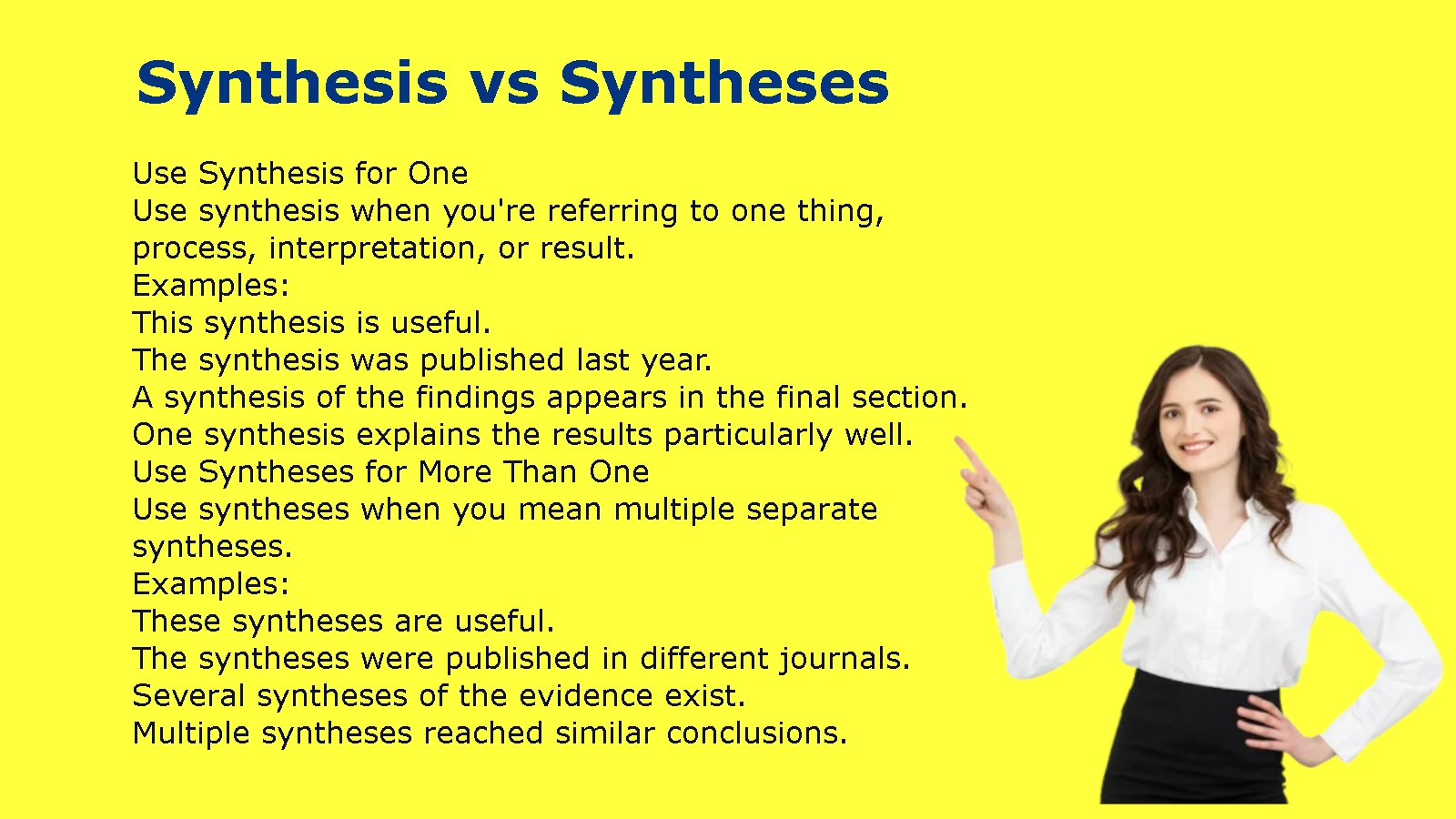
Use Synthesis for One
Use synthesis when you’re referring to one thing, process, interpretation, or result.
Examples:
- This synthesis is useful.
- The synthesis was published last year.
- A synthesis of the findings appears in the final section.
- One synthesis explains the results particularly well.
Notice the singular words surrounding synthesis:
- a synthesis
- one synthesis
- this synthesis
- the synthesis
- each synthesis
Use Syntheses for More Than One
Use syntheses when you mean multiple separate syntheses.
Examples:
- These syntheses are useful.
- The syntheses were published in different journals.
- Several syntheses of the evidence exist.
- Multiple syntheses reached similar conclusions.
Common plural markers include:
- several syntheses
- multiple syntheses
- these syntheses
- many syntheses
- different syntheses
- two syntheses
- three syntheses
The surrounding grammar gives you a useful clue. If the sentence contains several or multiple, you almost certainly need syntheses.
Synthesis vs. Syntheses Examples
Seeing the two forms side by side makes the difference much easier to remember.
| Singular | Plural |
| The synthesis was convincing. | The syntheses were convincing. |
| This synthesis combines several theories. | These syntheses combine several theories. |
| A synthesis appears in the report. | Several syntheses appear in the report. |
| One synthesis explains the findings. | Three syntheses explain the findings. |
| The chemical synthesis took two steps. | The chemical syntheses took different numbers of steps. |
| Her synthesis connects the sources. | Their syntheses connect different groups of sources. |
There’s another important detail here: the verb changes too.
Compare:
The synthesis is convincing.
with:
The syntheses are convincing.
Because synthesis is singular, it takes is. Because syntheses is plural, it takes are.
That pattern can help you catch mistakes while proofreading.
When to Use Synthesis
The singular form synthesis works whenever you’re talking about one unified combination or one distinct synthesis.
Synthesis of Ideas
You can use synthesis when different ideas come together to create a broader understanding.
For example:
Her synthesis of the two theories provides a fresh explanation.
The sentence refers to one integrated interpretation.
This use appears often in philosophy, history, literature, social science, and other fields where writers connect different viewpoints.
Synthesis in Academic Writing
Academic writers frequently use synthesis when they combine findings or ideas from multiple sources.
For example:
The literature review offers a synthesis of recent research on language development.
The writer isn’t merely listing what each researcher said. Instead, the sources come together to form a larger interpretation.
Oxford’s Department for Continuing Education describes synthesizing as combining ideas, perspectives, or findings from multiple sources and presenting them from a new vantage point.
That’s an important distinction.
Summary tells you what sources say. Synthesis shows you how those sources connect.
Synthesis in Chemistry
Chemistry gives synthesis a more specialized meaning.
Cambridge defines chemical synthesis as the production of a substance from simpler materials following a chemical reaction.
For example:
The synthesis of the compound required several reaction steps.
Here, synthesis refers to a particular chemical production process.
You might also see:
- protein synthesis
- organic synthesis
- chemical synthesis
- DNA synthesis
- drug synthesis
In these expressions, the word refers to a process of producing something through chemical or biological mechanisms.
Synthesis in Music and Art
The word can also describe the blending of artistic influences.
For example:
The band’s music is a synthesis of jazz, rock, and electronic sounds.
The phrase describes one resulting artistic style created from several influences.
Cambridge gives a similar general use by describing a musical work as a synthesis of different rhythms.
When to Use Syntheses
Use syntheses when you have more than one distinct synthesis.
The important word here is distinct.
If you combine ten sources into one integrated conclusion, you have one synthesis. If three researchers independently create three different integrated conclusions, you have three syntheses.
Multiple Research Syntheses
Academic research often produces more than one synthesis.
For example:
The review compares four syntheses of the available evidence.
Each synthesis represents a distinct integration or interpretation.
The plural becomes especially useful when researchers compare different approaches to the same body of evidence.
Multiple Chemical Syntheses
Chemists may develop different routes for producing the same compound.
For example:
The researchers tested two syntheses for the target molecule.
Here, syntheses refers to two separate chemical procedures.
A writer could also say:
Several syntheses have been proposed for the compound.
That means several distinct methods or production routes exist.
Multiple Interpretations
Historians, philosophers, and other scholars may develop different syntheses of a subject.
For example:
The book examines competing syntheses of modern political thought.
Each synthesis brings together evidence or ideas differently.
The plural therefore doesn’t mean that the word has suddenly gained a new meaning. It still refers to combining elements. The difference is that more than one combination exists.
Synthesis vs. Syntheses in Academic Writing
Academic writing is one of the places where this distinction matters most.
A strong academic synthesis doesn’t simply stack summaries on top of one another. It brings sources into conversation.
The Indiana University of Pennsylvania Center for Scholarly Communication explains that synthesis involves interpreting and analyzing multiple sources, comparing them, identifying connections, and creating a new whole.
Imagine researching whether remote learning affects student performance.
A weak paragraph might look like this:
- Researcher A found improved performance.
- Researcher B found no significant difference.
- Researcher C reported lower engagement.
- Researcher D found that results varied by course.
That’s mostly a source by source summary.
A synthesis would instead connect those findings:
Research suggests that remote learning doesn’t produce one consistent outcome. While some studies report improved academic performance, others find little difference or lower engagement. Taken together, these findings suggest that course design and student context may matter more than delivery format alone.
That’s synthesis because the writer has connected the evidence and drawn an interpretation.
A Simple Academic Synthesis Formula
When you’re writing a research paragraph, try this structure:
Source A + Source B + relationship between them + your interpretation
For example:
Source A finds X. Source B finds Y. Although the findings differ, both point toward Z.
That final connection is where the synthesis happens.
Synthesis Is Not the Same as Summary
This distinction deserves special attention because writers often use the two terms interchangeably.
They aren’t interchangeable.
| Summary | Synthesis |
| Reports what a source says | Connects ideas from multiple sources |
| Usually focuses on one source at a time | Usually brings several sources together |
| Describes existing information | Analyzes relationships among information |
| May not add interpretation | Often includes the writer’s interpretation |
| Answers “What does this source say?” | Answers “What do these sources collectively show?” |
Oxford notes that synthesizing commonly involves paraphrasing and summarizing, but synthesis goes further by bringing those pieces together and adding interpretation.
So don’t think of synthesis as simply “a fancy word for summary.”
It isn’t.
Synthesis vs. Syntheses in Chemistry
The same singular/plural rule applies in chemistry.
One Chemical Synthesis
Use synthesis for one chemical production process.
The synthesis produced the desired compound.
Or:
The team developed a new synthesis of the molecule.
The noun remains singular because the sentence discusses one process.
Several Chemical Syntheses
Use syntheses for multiple processes.
The researchers compared three chemical syntheses.
Each synthesis represents a separate route or procedure.
You could also write:
The study evaluates several syntheses of the same compound.
The compound may remain the same while the syntheses differ.
That’s a useful point. You don’t need different final products to justify the plural. Multiple distinct synthesis procedures can be syntheses even when they aim to produce the same substance.
How to Pronounce Synthesis and Syntheses
Spelling isn’t the only difference between the two words. Their endings also sound different.
Synthesis
Synthesis: /ˈsɪn.θə.sɪs/
A simple approximation is:
SIN-thuh-sis
The ending sounds like “sis.”
Syntheses
Syntheses: /ˈsɪn.θə.siːz/
A simple approximation is:
SIN-thuh-seez
The final sound resembles “sees.”
Cambridge gives these US pronunciations for both forms.
A useful memory trick is:
- synthesis → ends with a sis sound
- syntheses → ends with a seez sound
Don’t pronounce syntheses as though you simply added an ordinary -es ending to synthesis.
Common Mistakes With Synthesis and Syntheses
Because the plural looks unusual, mistakes are common.
Here are the ones worth watching for.
| Incorrect | Correct | Explanation |
| Several synthesis were compared. | Several syntheses were compared. | Several requires a plural noun. |
| A syntheses was published. | A synthesis was published. | A introduces a singular noun. |
| These synthesis are useful. | These syntheses are useful. | These indicates more than one. |
| One syntheses was selected. | One synthesis was selected. | One requires the singular form. |
| Two synthesis were developed. | Two syntheses were developed. | Two requires the plural. |
| The syntheses is convincing. | The synthesis is convincing. | One synthesis takes is. |
| The synthesis are convincing. | The syntheses are convincing. | Multiple syntheses take are. |
Mistake: Writing “Synthesises”
One particularly tempting mistake is synthesises.
For the noun plural in American English, the correct form is:
syntheses
Not:
synthesises
However, synthesizes is a different word. It’s the third person singular form of the verb synthesize in American English.
For example:
The researcher synthesizes the findings.
Here, synthesizes is a verb. It isn’t the plural of synthesis.
That distinction is worth remembering:
- synthesis = singular noun
- syntheses = plural noun
- synthesize = verb
- synthesizes = third person singular verb
Synthesis, Syntheses, and Related Word Forms
The word family can seem confusing because several forms look similar.
| Word | Part of speech | Meaning | Example |
| Synthesis | Noun | One act, process, or result of combining | The synthesis was effective. |
| Syntheses | Noun | More than one synthesis | The syntheses produced different results. |
| Synthesize | Verb | To combine or integrate | Researchers synthesize the evidence. |
| Synthesizes | Verb | Combines or integrates | The report synthesizes the findings. |
| Synthesized | Verb/adjective | Combined or produced through synthesis | The researchers synthesized the data. |
| Synthesizing | Verb form | Combining or integrating | She is synthesizing several sources. |
| Synthetic | Adjective | Made artificially or relating to synthesis | The laboratory produced a synthetic compound. |
The noun and verb forms perform different jobs.
Consider:
The synthesis of the evidence was clear.
Here, synthesis is a noun.
Now compare:
The researcher synthesizes the evidence.
Here, synthesizes is a verb.
The two sentences describe related actions, but their grammar differs.
A Real-World Academic Case Study
Consider a literature review about the effects of exercise on learning.
Suppose a researcher examines three studies:
- Study A reports improved memory.
- Study B finds stronger attention after exercise.
- Study C reports mixed results depending on exercise intensity.
The researcher could create one synthesis by connecting all three findings:
Exercise may support several aspects of cognitive performance, although its effects appear to depend on the specific outcome and intensity of activity.
That’s one integrated interpretation.
Now imagine another researcher compares three published reviews of the topic.
Each review combines evidence differently. The researcher might write:
The paper compares three syntheses of research on exercise and cognitive performance.
Now syntheses is correct because the paper discusses three separate integrated bodies of evidence.
The difference comes down to what the writer is counting.
What Is Being Counted?
Ask yourself:
Am I referring to one integrated whole or several distinct integrated wholes?
If it’s one, use synthesis.
If it’s several, use syntheses.
This question works across disciplines.
Another Case Study: Chemistry
Imagine a laboratory wants to produce a particular compound.
The researchers develop one route:
Starting materials → reaction 1 → intermediate → reaction 2 → target compound
That route is one synthesis.
Later, the team develops two alternative routes:
Route A → target compound
Route B → target compound
Now the project involves multiple syntheses.
The final product might be identical, but the processes differ.
Therefore:
The laboratory developed three syntheses of the compound.
The plural makes sense because the researchers have three distinct synthetic routes.
Synthesis vs. Syntheses in a Sentence
Sometimes the easiest way to choose the correct form is to examine the entire sentence.
Singular
The synthesis of these studies reveals an important trend.
Here, synthesis is the subject. The writer presents one integrated interpretation.
Plural
The syntheses of these studies reveal different trends.
Now the writer discusses multiple interpretations.
Notice the verb:
- The synthesis reveals
- The syntheses reveal
That change provides another grammatical clue.
Determiners Can Give You the Answer
Look at the word immediately before the noun.
| Determiner | Correct form |
| a | a synthesis |
| one | one synthesis |
| this | this synthesis |
| each | each synthesis |
| several | several syntheses |
| many | many syntheses |
| these | these syntheses |
| multiple | multiple syntheses |
| two | two syntheses |
| various | various syntheses |
This isn’t a perfect test for every sentence, but it’s an excellent proofreading shortcut.
How to Remember Synthesis vs. Syntheses
Here’s the easiest memory trick:
Synthesis = single. Syntheses = several.
The two words both begin with synthes-, so focus on the ending.
- synthesis → one
- syntheses → more than one
You can also remember the pair alongside other Greek-derived English nouns that form plurals differently from ordinary nouns.
For example:
- analysis → analyses
- thesis → theses
- synthesis → syntheses
- crisis → crises
- hypothesis → hypotheses
These forms come from Greek noun patterns that entered English through historical borrowing. The spelling may look unusual today, but the pattern becomes easier once you recognize it.
Synthesis vs. Syntheses Practice
Choose synthesis or syntheses in each sentence.
Practice Questions
- The article presents a detailed ______ of recent research.
- Several ______ of the evidence reached similar conclusions.
- This ______ combines findings from five studies.
- The researchers compared two different chemical ______.
- These ______ offer competing explanations.
- One ______ appears more convincing than the others.
- The report includes multiple ______ of the available data.
- Her ______ of the theories helped clarify the issue.
- The three ______ use different research methods.
- A new ______ of the compound was developed.
Answer Key
- synthesis
- syntheses
- synthesis
- syntheses
- syntheses
- synthesis
- syntheses
- synthesis
- syntheses
- synthesis
The trick isn’t memorizing ten separate answers. Look for the number.
If the sentence describes one, choose synthesis. If it describes more than one, choose syntheses.
Why Synthesis Matters in Academic Writing
The word carries more weight in academic writing than its simple dictionary definition might suggest.
A strong synthesis demonstrates that a writer can do more than collect information. It shows the ability to compare, connect, evaluate, and interpret.
For instance, imagine five sources all discuss the same topic.
A basic literature review might summarize each source separately:
- Source A says X.
- Source B says Y.
- Source C says Z.
- Source D agrees with A.
- Source E disagrees with B.
A synthesis asks a deeper question:
What does the relationship among these sources tell us?
That shift creates stronger academic writing.
The Indiana University of Pennsylvania writing resource similarly emphasizes that synthesis involves comparing and contrasting sources, identifying relationships, and adding interpretation rather than merely repeating source material.
A Strong Synthesis Usually Does Three Things
A useful synthesis often:
- Connects related ideas.
- Contrasts conflicting findings.
- Interprets what those relationships mean.
For example:
Although two studies report different outcomes, both suggest that the effect depends on the participants’ circumstances. This pattern indicates that context may explain more variation than the intervention itself.
That’s much more informative than simply listing the studies.
Synthesis in Different Fields
The word travels surprisingly well across disciplines.
| Field | Meaning of synthesis | Example |
| Academic writing | Combining sources and interpreting their relationships | A synthesis of recent scholarship |
| Chemistry | Producing a substance through chemical reactions | The synthesis of a compound |
| Biology | Production of biological substances | Protein synthesis |
| Music | Combining different musical influences | A synthesis of jazz and classical music |
| Philosophy | Combining or reconciling ideas | A synthesis of opposing views |
| History | Integrating evidence or interpretations | A synthesis of historical sources |
| Research | Combining findings into a broader understanding | A synthesis of clinical evidence |
The details change from field to field, but the central concept stays remarkably stable: bringing separate elements together into something more unified.
Frequently Asked Questions About Synthesis vs. Syntheses
Is synthesis singular or plural?
Synthesis is singular.
You can say:
The synthesis is convincing.
When you mean more than one, use syntheses.
Is syntheses singular or plural?
Syntheses is plural.
For example:
The syntheses are based on different methods.
The singular form is synthesis.
What is the plural of synthesis?
The plural of synthesis is syntheses. Cambridge Dictionary explicitly lists syntheses as the plural form.
What is the singular of syntheses?
The singular form of syntheses is synthesis.
So:
synthesis → syntheses
Is “syntheses” pronounced like “synthesis”?
No. The pronunciation changes at the end.
- synthesis: SIN-thuh-sis
- syntheses: SIN-thuh-seez
Cambridge lists /ˈsɪn.θə.sɪs/ for synthesis and /ˈsɪn.θə.siːz/ for syntheses.
Is synthesis only used in chemistry?
No.
Although synthesis has an important technical meaning in chemistry, English speakers also use it for combining ideas, influences, information, and other elements. Cambridge lists both the general combination sense and the specialized chemical sense.
Can synthesis refer to a process?
Yes.
In chemistry, synthesis can refer to the process of producing a substance through chemical reactions. In academic writing, it can describe the process of integrating information from multiple sources.
Can synthesis refer to a result?
Yes.
The word can also describe the resulting whole or integrated account.
For example:
The report provides a synthesis of current research.
The synthesis here is the integrated account presented by the report.
Is “synthesises” the plural of synthesis?
No.
The standard plural noun is syntheses.
However, synthesizes is a verb form in American English:
The author synthesizes the evidence.
That’s different from the noun syntheses.
What is the verb form of synthesis?
The verb is synthesize.
For example:
Researchers synthesize evidence from multiple studies.
The noun is:
Researchers produced a synthesis of the evidence.
What is the difference between synthesis and synthesizing?
Synthesis is a noun. Synthesizing is the -ing form of the verb synthesize.
Compare:
The synthesis of the sources was thorough.
and:
The writer is synthesizing the sources.
Both describe the same broad activity, but they perform different grammatical jobs.
Synthesis vs. Syntheses: Final Verdict
The difference between synthesis and syntheses isn’t complicated once you focus on number.
Synthesis is singular. Use it when you’re talking about one combination, interpretation, process, or resulting whole.
Syntheses is plural. Use it when you’re talking about two or more separate syntheses.
The essential rule is:
| If you mean… | Use… |
| One synthesis | synthesis |
| Two or more syntheses | syntheses |
For example:
The synthesis of the findings supports the conclusion.
But:
The researchers compared several syntheses of the findings.
The same distinction works in academic writing, chemistry, research, music, philosophy, and everyday formal English.
When you’re unsure, ask one simple question:
“Am I talking about one integrated whole or several?”
If the answer is one, choose synthesis. If the answer is several, choose syntheses.
Once that clicks, the spelling, grammar, pronunciation, and usage all fall into place.