Eminent and imminent are commonly confused because they look and sound similar, but they have completely different meanings. Eminent means famous, respected, or highly regarded, while imminent means something is about to happen very soon.
The confusion is understandable because people often search for eminent vs imminent, eminent meaning, imminent meaning, or wonder which word to use in a sentence. A simple way to remember the difference is that an eminent person is notable or respected, while an imminent event is about to occur.
| Question | Answer |
|---|---|
| What is the difference between eminent and imminent? | Eminent means famous or highly respected, while imminent means about to happen soon. |
| What does eminent mean? | Eminent means distinguished, famous, or respected in a particular field. |
| What does imminent mean? | Imminent means likely to happen very soon. |
| Is eminent a positive word? | Yes, eminent usually describes someone or something highly respected or distinguished. |
| Is imminent always negative? | No. Imminent simply means something is about to happen, although it’s often used for events that may be serious or concerning. |
Eminent vs Imminent: Quick Difference
| Word | Meaning | Usually Describes | Example |
| Eminent | Famous, respected, distinguished, or important | People, figures, experts, scholars, institutions, or notable things | She is an eminent historian. |
| Imminent | About to happen very soon | Events, situations, changes, arrivals, threats, or outcomes | A major storm is imminent. |
There is a useful question behind each word.
Eminent asks you to think about distinction. Who or what stands out because of reputation, importance, ability, or position?
Imminent asks you to think about time. What is close to happening?
For example:
The university invited an eminent physicist to speak about the imminent changes in the field.
The physicist is eminent because of professional distinction. The changes are imminent because they are expected soon.
Eminent vs Imminent in one sentence
An eminent person is distinguished, while an imminent event is about to happen.
That single rule handles most everyday uses.
What Does “Eminent” Mean?
Eminent is an adjective that describes someone or something that stands above others in importance, reputation, ability, or position.
Cambridge defines the word as “famous, respected, or important,” with an eminent historian as an example. Merriam Webster also defines it in terms of prominence and describes a second sense involving something that stands out and can readily be noticed.
In ordinary writing, the most useful sense is highly respected or distinguished.
Examples of eminent
Consider these sentences:
- She is an eminent medical researcher.
- The university honored an eminent historian.
- An eminent lawyer joined the legal team.
- The conference attracted several eminent scientists.
- He became an eminent figure in modern architecture.
- The museum displayed work by an eminent artist.
In each case, eminent tells you something about status or distinction. It doesn’t tell you when something will happen.
What makes someone eminent?
Being famous alone doesn’t necessarily make someone eminent.
A person can be widely known without being regarded as eminent in a particular field. Eminent usually carries a stronger sense of achievement, authority, standing, or distinction.
For example:
- A popular actor might be famous.
- A leading actor recognized for major contributions to the profession might be described as eminent.
- A respected professor with a long record of influential research may be an eminent scholar.
The word therefore often appears in formal writing, academic contexts, professional descriptions, biographies, and discussions of people who have achieved an important position.
Eminent can describe more than people
Although people are among its most common subjects, eminent isn’t restricted to individuals.
The word can also express prominence, importance, or something that stands out. Merriam Webster records senses connected with being prominent, noticeable, or projecting outward.
Still, in everyday modern writing, phrases such as eminent scholar, eminent scientist, and eminent physician are much more natural than forcing the word into situations where a simpler adjective would work better.
What Does “Imminent” Mean?
Imminent means that something is about to happen or is likely to happen very soon.
Cambridge defines it as something “coming or likely to happen very soon.” Merriam Webster similarly defines it as something “ready to take place” or “happening soon.”
The key idea is nearness in time.
For example:
- A storm is imminent.
- The patient’s arrival is imminent.
- The deadline is imminent.
- An announcement is imminent.
- The company’s closure appeared imminent.
In each sentence, something is close to occurring.
Does imminent always describe something bad?
No.
This is an important detail because imminent often appears with negative or threatening situations.
You frequently see phrases such as:
- imminent danger
- imminent disaster
- imminent death
- imminent threat
- imminent collapse
However, the word itself doesn’t mean “bad.”
You can also have:
- imminent arrival
- imminent announcement
- imminent launch
- imminent election
- imminent retirement
- imminent change
Cambridge provides examples involving an imminent arrival, election, interaction, and recovery, showing that the word isn’t limited to danger or disaster.
The negative association comes from common usage, not from the core definition.
Eminent vs Imminent: The Main Difference
The easiest way to separate the two words is to identify what kind of information the adjective provides.
Eminent tells you about distinction.
Imminent tells you about timing.
| If you mean… | Use |
| Famous or respected | Eminent |
| Distinguished | Eminent |
| Prominent | Eminent |
| Highly regarded | Eminent |
| About to happen | Imminent |
| Very close in time | Imminent |
| Expected soon | Imminent |
| Ready to take place | Imminent |
Here’s a simple test:
Is the word describing how notable something is or how soon something will happen?
If it’s about notability, choose eminent.
If it’s about time, choose imminent.
Eminent vs Imminent examples
Compare these sentences:
She consulted an eminent surgeon.
The surgeon is distinguished or highly respected.
Surgery was imminent.
The procedure was about to happen.
Now put both words together:
The eminent surgeon prepared for the patient’s imminent surgery.
The distinction is crystal clear. One word describes who the surgeon is in terms of professional standing. The other describes when the surgery will happen.
How to Use “Eminent” in a Sentence
The most common structure is:
eminent + noun
Examples include:
- an eminent professor
- an eminent scientist
- an eminent author
- an eminent physician
- an eminent historian
- an eminent judge
- an eminent scholar
- an eminent researcher
The noun usually refers to someone whose expertise, achievements, influence, or reputation sets them apart.
Examples of eminent in context
Academic context:
The university invited an eminent linguist to deliver the keynote lecture.
Medical context:
The patient sought advice from an eminent cardiologist.
Legal context:
An eminent constitutional scholar addressed the court.
Arts and culture:
The gallery hosted a retrospective honoring an eminent painter.
History:
The book examines the work of several eminent historians.
Notice the common thread: the person has distinction.
Eminent does not simply mean “good”
Calling someone eminent usually suggests more than competence.
Compare:
- She is a good doctor.
- She is an eminent doctor.
The first sentence says she performs well. The second suggests that she has achieved an unusually high level of distinction or recognition.
That difference matters in formal writing.
How to Use “Imminent” in a Sentence
Imminent commonly appears before nouns that represent events, developments, situations, or outcomes.
Common combinations include:
- imminent danger
- imminent arrival
- imminent departure
- imminent change
- imminent decision
- imminent deadline
- imminent threat
- imminent collapse
- imminent announcement
- imminent launch
Examples:
The dark clouds suggested that a storm was imminent.
The airline confirmed the plane’s imminent arrival.
The board met to discuss the company’s imminent merger.
Scientists warned that further changes were imminent.
The deadline was imminent, so the team worked late.
The word communicates urgency because the event is close.
Imminent does not mean “eventually”
This distinction is worth remembering.
If something is imminent, you expect it to happen very soon. The word carries a much stronger sense of immediacy than simply saying something will happen someday.
Compare:
The company will launch a new product next year.
This describes a future event.
The company’s product launch is imminent.
This suggests the launch is very close.
The exact amount of time can vary with context. Imminent doesn’t specify a fixed number of minutes, hours, or days. Instead, it emphasizes that the event is near enough to be expected soon.
Eminent vs Imminent Examples
The fastest way to master this pair is to see them side by side.
| Sentence | Correct Word | Explanation |
| She is an eminent scientist. | Eminent | She is distinguished in her field. |
| A major storm is imminent. | Imminent | The storm is about to happen. |
| The university honored an eminent historian. | Eminent | The historian has a distinguished reputation. |
| The professor’s retirement is imminent. | Imminent | The retirement is expected soon. |
| He became an eminent political figure. | Eminent | He became prominent and influential. |
| An announcement is imminent. | Imminent | The announcement is expected shortly. |
| The hospital consulted an eminent physician. | Eminent | The physician is highly respected. |
| The patient’s arrival is imminent. | Imminent | The arrival is about to occur. |
| She studied under an eminent philosopher. | Eminent | The philosopher was distinguished. |
| A major policy change appears imminent. | Imminent | The change appears likely to happen soon. |
A useful case study: “The eminent professor”
Consider this sentence:
The eminent professor warned that a major change was imminent.
The sentence contains both words because each performs a different job.
Eminent describes the professor. It tells readers that the professor has distinction, status, or expertise.
Imminent describes the change. It tells readers that the change is expected soon.
If you switch the words, the sentence breaks:
❌ The imminent professor warned that a major change was eminent.
That version doesn’t communicate the intended meanings.
The problem isn’t spelling alone. The words assign completely different types of information to the nouns they modify.
Common Phrases With “Eminent”
Some word combinations occur frequently enough to make useful learning patterns.
Eminent person
The award recognizes an eminent person who made lasting contributions to the field.
Eminent scholar
The university invited an eminent scholar to discuss the discovery.
Eminent scientist
The committee included several eminent scientists.
Eminent historian
An eminent historian wrote the introduction to the book.
Eminent physician
The hospital brought in an eminent physician for a second opinion.
Eminent figure
She became an eminent figure in the literary world.
The exact noun can change, but the underlying meaning remains stable: distinguished, prominent, respected, or important.
Common Phrases With “Imminent”
Imminent has its own set of natural combinations.
Imminent danger
The hikers were warned of imminent danger.
Imminent threat
Officials said there was no evidence of an imminent threat.
Imminent arrival
The train’s imminent arrival was announced over the speakers.
Imminent decision
Investors waited for the court’s imminent decision.
Imminent change
Employees prepared for imminent changes to the schedule.
Imminent deadline
With the imminent deadline, the team prioritized the final revisions.
Imminent disaster
Emergency crews prepared for an imminent disaster.
Merriam Webster lists impending and looming among close synonyms of imminent, while Cambridge also gives impending as a synonym.
Eminent vs Imminent Pronunciation
Pronunciation adds another layer to the confusion because the words sound very similar.
In US English, Cambridge gives these pronunciations:
- Eminent: /ˈem.ə.nənt/
- Imminent: /ˈɪm.ə.nənt/
The important difference occurs at the beginning.
Eminent begins with an “em” sound.
Imminent begins with an “im” sound.
That small vowel difference can disappear in fast conversation, especially when the words occur in longer sentences. Cambridge’s pronunciation entries confirm that the US forms differ in their first vowel sound.
For spelling, however, don’t rely only on pronunciation. Use the meaning as your guide.
How to Remember the Difference Between Eminent and Imminent
A good memory trick should connect the spelling to the meaning instead of asking you to memorize two isolated definitions.
Eminent = Exceptional
Think:
Eminent → Exceptional
Both begin with E.
If someone is eminent, that person stands out because of achievement, importance, expertise, or reputation.
Eminent = exceptional or distinguished.
Imminent = Immediate
Think:
Imminent → Immediate
Both begin with Im.
If something is imminent, it is close to happening.
Imminent = immediate or soon to happen.
The words aren’t exact synonyms. The connection simply gives you a useful memory hook.
The “Who vs. When” trick
An even better method is to ask two questions:
Who stands out? → Eminent
When is it happening? → Imminent
For example:
The eminent doctor said that surgery was imminent.
Ask:
- What does eminent tell you? Who the doctor is in terms of distinction.
- What does imminent tell you? When the surgery will happen.
This method works because it focuses on meaning rather than spelling.
Common Mistakes With Eminent and Imminent
These words often get confused because their spelling differs by only one letter.
Mistake: “An imminent professor”
❌ She is an imminent professor.
If the intended meaning is that the professor is distinguished or respected, use eminent.
✅ She is an eminent professor.
Mistake: “An eminent storm”
❌ An eminent storm is approaching.
If the storm is about to occur, use imminent.
✅ An imminent storm is approaching.
Mistake: “The announcement is eminent”
❌ The announcement is eminent.
If you mean the announcement is expected soon, use imminent.
✅ The announcement is imminent.
Mistake: “The eminent scientist”
This phrase is correct when the scientist is distinguished.
✅ The eminent scientist received a lifetime achievement award.
Here, the adjective says something about the scientist’s standing.
A quick correction table
| Incorrect | Correct | Meaning |
| An imminent scholar | An eminent scholar | Distinguished scholar |
| An eminent storm | An imminent storm | Storm expected soon |
| An eminent arrival | An imminent arrival | Arrival expected soon |
| An imminent historian | An eminent historian | Distinguished historian |
| An eminent deadline | An imminent deadline | Deadline approaching soon |
Eminent vs Imminent vs. Immanent
There is a third word that sometimes enters the conversation: immanent.
It isn’t the same as either eminent or imminent.
| Word | Meaning |
| Eminent | Distinguished, prominent, respected, or important |
| Imminent | About to happen very soon |
| Immanent | Existing or operating within something; a term especially associated with philosophy and theology |
Merriam Webster notes that immanent is pronounced the same as imminent, even though the meanings differ.
For most everyday writing, the important distinction remains Eminent vs Imminent. The third word matters mainly when reading philosophy, theology, academic writing, or other specialized material.
Why “immanent” causes confusion
All three words share a similar visual shape:
- eminent
- imminent
- immanent
The spellings are close enough to create mistakes, especially when someone remembers only the sound.
The solution is the same: check the meaning before choosing the spelling.
Eminent vs Imminent Synonyms
Knowing related words can reinforce the difference.
Synonyms for eminent
Depending on context, useful alternatives include:
- distinguished
- prominent
- renowned
- respected
- celebrated
- notable
- prestigious
- important
These aren’t interchangeable in every sentence.
For example:
an eminent scientist
could become:
a renowned scientist
But replacing it with important changes the tone and may weaken the idea of professional distinction.
Synonyms for imminent
Common alternatives include:
- impending
- looming
- approaching
- forthcoming
- upcoming
- near
- on the way
- expected soon
Again, context matters.
An imminent storm
could become:
an approaching storm
or:
an impending storm
But forthcoming often sounds more natural with events such as announcements, reports, or releases.
Merriam Webster’s thesaurus includes impending, looming, approaching, forthcoming, upcoming, nearing, and expected among words related to imminent.
Eminent vs Imminent in Real Sentences
Seeing the words in realistic contexts makes the distinction easier to apply.
Education
The university invited an eminent mathematician to deliver the annual lecture.
The mathematician has a distinguished reputation.
The final examination is imminent.
The examination is coming soon.
Medicine
An eminent surgeon reviewed the case.
The surgeon is highly respected.
The patient’s surgery was imminent.
The surgery was about to take place.
Business
The company hired an eminent economist as an adviser.
The economist is distinguished.
A major restructuring appeared imminent.
The restructuring seemed likely to happen soon.
Weather
The meteorologist consulted an eminent climate scientist.
The scientist is prominent in the field.
Severe weather was imminent.
The weather was expected very soon.
Politics
The panel included several eminent political scholars.
The scholars were distinguished.
An election announcement appeared imminent.
The announcement seemed likely to happen soon.
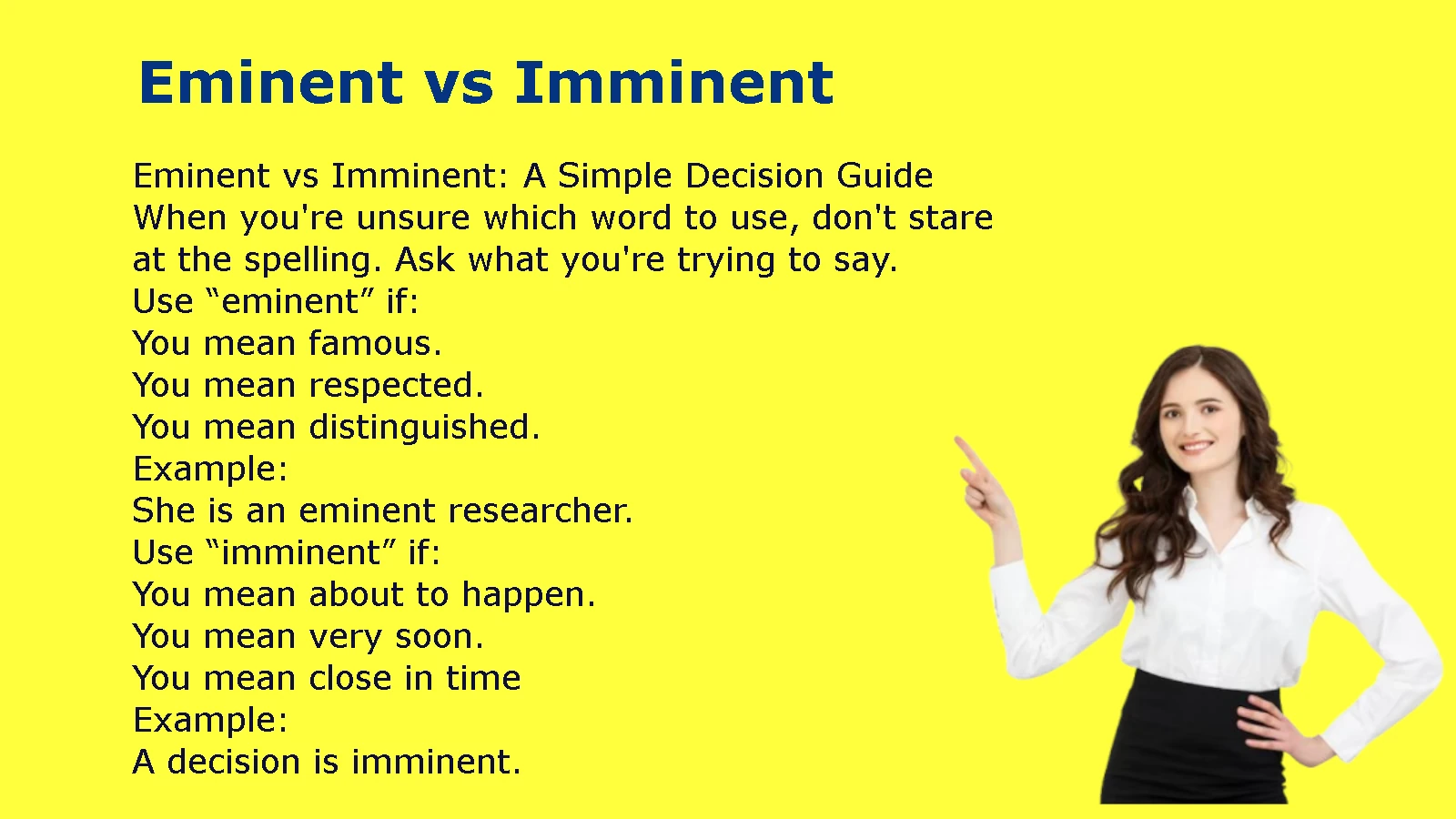
Eminent vs Imminent: A Simple Decision Guide
When you’re unsure which word to use, don’t stare at the spelling. Ask what you’re trying to say.
Use “eminent” if:
- You mean famous.
- You mean respected.
- You mean distinguished.
- You mean prominent.
- You mean important or influential.
- You’re describing someone’s professional or public standing.
Example:
She is an eminent researcher.
Use “imminent” if:
- You mean about to happen.
- You mean very soon.
- You mean close in time.
- You mean ready to take place.
- You’re describing an approaching event or situation.
Example:
A decision is imminent.
The fastest test
Replace the word mentally.
If “distinguished” fits, choose eminent.
If “about to happen” fits, choose imminent.
For example:
He is an ___ scholar.
Try distinguished:
He is a distinguished scholar.
That works. Therefore:
He is an eminent scholar.
Now try:
A storm is ___.
“About to happen” fits:
A storm is about to happen.
Therefore:
A storm is imminent.
This substitution test is quick, reliable, and useful when proofreading.
Is “Eminent” or “Imminent” Correct?
The correct word depends entirely on the meaning.
| Meaning you want | Correct word |
| Distinguished | Eminent |
| Famous and respected | Eminent |
| Prominent | Eminent |
| Highly regarded | Eminent |
| About to happen | Imminent |
| Very soon | Imminent |
| Approaching in time | Imminent |
| Ready to take place | Imminent |
Consider these examples:
The university honored an eminent professor.
The professor’s retirement is imminent.
Both sentences are correct because the adjectives describe different qualities.
Why Are Eminent and Imminent So Similar?
The similarity isn’t an accident.
Merriam Webster explains that both words ultimately connect to the Latin root minēre, associated with the idea of projecting or standing out. The Latin eminēre developed the idea of standing out, while imminēre developed the idea of projecting or overhanging.
That history helps explain why the spellings remain so close.
Merriam Webster also notes that eminent entered English in the 15th century, while imminent is recorded from the 16th century.
The modern meanings, however, are clearly separate.
You don’t need to memorize the Latin roots to use the words correctly. Still, the history explains why these two near twins ended up looking so alike.
Frequently Asked Questions About Eminent vs Imminent
What is the difference between eminent and imminent?
Eminent means distinguished, prominent, famous, respected, or important. Imminent means about to happen or likely to happen very soon.
Is an eminent person famous?
Usually, yes, but eminent suggests more than simple fame. It commonly describes someone who is distinguished, respected, influential, or important in a particular field.
Does imminent mean immediate?
They overlap, but they aren’t exact synonyms.
Imminent means something is about to happen or is expected very soon. Immediate can mean happening now, occurring without delay, or requiring action at once.
For example:
The storm is imminent.
This means the storm is coming very soon.
Take immediate action.
This means act without delay.
Can imminent describe a positive event?
Yes.
Although imminent frequently appears with negative situations such as danger or disaster, it can describe neutral or positive events too.
Examples include:
- imminent arrival
- imminent launch
- imminent announcement
- imminent recovery
Cambridge provides examples involving an imminent arrival and imminent recovery, among other contexts.
Can eminent describe a person?
Yes. In fact, describing a distinguished person is one of its most common uses.
Examples include:
- eminent scholar
- eminent scientist
- eminent physician
- eminent historian
- eminent author
Are eminent and imminent pronounced the same?
No.
In US English, Cambridge gives eminent as /ˈem.ə.nənt/ and imminent as /ˈɪm.ə.nənt/. The first vowel sound differs.
What is an easy way to remember Eminent vs Imminent?
Use this shortcut:
Eminent = exceptional or distinguished.
Imminent = immediate or soon to happen.
An even simpler memory trick is:
Eminent → Who stands out?
Imminent → What is about to happen?
Is “imminent danger” correct?
Yes. Imminent danger is a standard and common phrase. It means danger that is very close or about to occur. Merriam Webster and Cambridge both give examples of this usage.
Is “eminent danger” correct?
Not if you mean danger that is about to happen.
Use:
imminent danger
The word eminent describes distinction or prominence rather than approaching time.
Is “imminent scholar” correct?
Generally, no, if you mean a distinguished scholar.
Use:
eminent scholar
An eminent scholar is a scholar who is distinguished or highly respected.
Is “eminent” a synonym for “important”?
It can overlap with important, but the words aren’t identical.
Eminent often adds the idea of distinction, prominence, or high standing. It is especially useful when describing a person who has earned recognition in a field.
Final Thoughts on Eminent vs Imminent
The difference between eminent and imminent becomes simple once you stop focusing on their similar spelling.
Eminent is about distinction. It describes someone or something that stands out because of importance, reputation, achievement, or prominence.
Imminent is about time. It describes something that is about to happen or is expected very soon.
Remember the two key ideas:
Eminent = distinguished.
Imminent = about to happen.
So, an eminent scientist has an impressive reputation. An imminent discovery is one that is expected soon.
When you’re stuck, ask one question: Am I describing how notable something is, or how close it is to happening?
If the answer is notable, choose eminent.
If the answer is close in time, choose imminent.
That small distinction is enough to keep these two easily confused words on the right side of the sentence.