Swum vs swam can be confusing because both words come from the verb swim, but they are used in different grammatical situations. If you’ve wondered whether to say “I swam across the lake” or “I have swum across the lake,” the difference depends on the verb tense and helping verbs used in the sentence. The terms are closely connected to swim, swam, swum, past tense, past participle, and verb conjugation.
The main difference between swum vs swam is that swam is the simple past tense of swim, while swum is the past participle. You normally use swam by itself to describe a completed action in the past, as in “She swam yesterday.” By contrast, swum generally appears with a helping verb such as has, have, had, or be, as in “She has swum across the pool.”
In this guide, you’ll learn when to use “swam” and “swum,” how each form works in sentences, why “I have swam” is incorrect in standard English, and how the three forms of the verb “swim” differ: swim, swam, and swum. You’ll also see clear examples and comparisons to make the difference easy to remember.
By the end, you’ll know exactly when to use swam vs swum and how to use both forms naturally and correctly in everyday and formal writing.
Swum vs Swam: The Quick Answer
The difference between swam and swum is grammatical, not semantic. Both describe the act of moving through water, but they occur in different verb structures.
| Word | Grammatical form | Basic use | Example |
| swim | Base form | Present, infinitive, after auxiliaries such as did and modals | I swim every morning. |
| swam | Simple past | A completed action in the past | I swam yesterday. |
| swum | Past participle | Perfect constructions and other participial structures | I have swum there before. |
Cambridge Grammar gives the same three-form pattern: swim, swam, swum.
A useful shortcut is:
Past action by itself = swam
Have, has, or had + past participle = swum
Compare these sentences:
- I swam in the pool yesterday.
- She swam five laps this morning.
- We have swum in that lake before.
- He had swum for an hour before lunch.
The first two use swam because they describe completed past actions. The last two use swum because have and had require the past participle.
Swim, Swam, Swum: The Three Main Forms
Before comparing swam vs swum, it helps to understand all three forms of swim.
Swim: The Base Form
Swim is the base form of the verb.
It appears in several constructions:
- I swim every morning.
- They swim on Saturdays.
- I want to swim today.
- Did you swim yesterday?
- She can swim very well.
Notice something important in the last two examples. Even though the action may refer to the past, did takes the base form swim:
Did you swim yesterday?
Not:
Did you swam yesterday?
And not:
Did you swum yesterday?
This is one of the most useful rules to remember because auxiliary verbs can change which form you need.
Swam: The Simple Past Form
Swam is the simple past form of swim. Cambridge Dictionary explicitly identifies swam as the past simple of swim.
Use it when describing a completed event in the past:
- I swam yesterday.
- She swam across the pool.
- We swam in the ocean last summer.
- They swam before breakfast.
- He swam two miles yesterday morning.
Swum: The Past Participle
Swum is the past participle of swim. It is not simply an alternative spelling of swam.
It commonly follows have, has, or had:
- I have swum there before.
- She has swum in the ocean.
- They had swum for an hour.
- We have never swum in that lake.
That gives you the basic sequence:
swim → swam → swum
This pattern is similar to other irregular verbs such as sing → sang → sung and sink → sank → sunk. Cambridge Grammar specifically groups swim/swam/swum with these irregular verb patterns.
What Does Swam Mean?
Swam means that someone moved through water at a particular point or period in the past. Grammatically, it is the simple past tense of swim.
The word itself does not mean something different from swim. The difference is primarily the time and grammatical construction.
For example:
I swam in the lake yesterday.
The word swam tells us that the swimming happened in the past.
Another example:
Sarah swam five laps before school.
Again, the sentence presents the swimming as a completed past event.
Examples of Swam in a Sentence
Here are natural examples:
- I swam in the pool yesterday.
- She swam across the river.
- We swam at the beach last weekend.
- He swam five laps before breakfast.
- They swam together when they were children.
- My brother swam for two hours yesterday.
- The athlete swam the final length quickly.
- I swam in the ocean during our vacation.
- She swam every afternoon last summer.
- We swam until the sun went down.
The key feature is that swam can stand as the main past-tense verb without have, has, or had.
What Does Swum Mean?
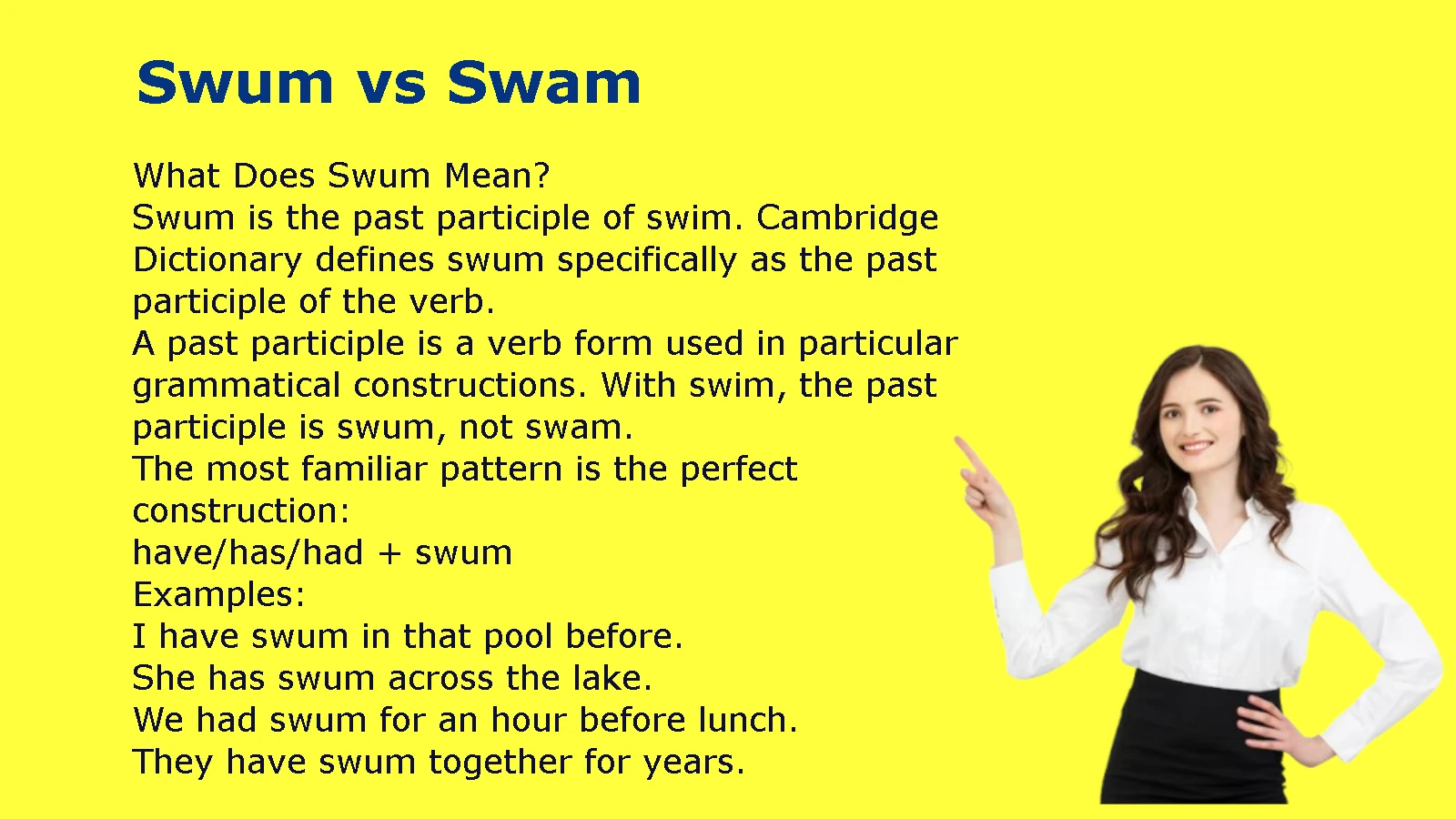
Swum is the past participle of swim. Cambridge Dictionary defines swum specifically as the past participle of the verb.
A past participle is a verb form used in particular grammatical constructions. With swim, the past participle is swum, not swam.
The most familiar pattern is the perfect construction:
have/has/had + swum
Examples:
- I have swum in that pool before.
- She has swum across the lake.
- We had swum for an hour before lunch.
- They have swum together for years.
The distinction becomes obvious when the two forms are placed next to each other:
I swam yesterday.
I have swum there before.
The first sentence uses the simple past. The second uses the present perfect.
Examples of Swum in a Sentence
- I have swum in the Atlantic Ocean.
- She has swum competitively since she was young.
- We have swum in that pool several times.
- He had swum across the lake before the storm arrived.
- They have never swum in open water.
- I haven’t swum since last summer.
- She had already swum five laps.
- Have you ever swum in the ocean?
- The athletes had swum several lengths before the break.
- He has swum farther than anyone else on the team.
Swum vs Swam in Sentences
Putting the two forms side by side makes the distinction easier to see.
| Swam | Swum |
| I swam yesterday. | I have swum before. |
| She swam across the pool. | She has swum across the pool many times. |
| We swam last weekend. | We have swum together before. |
| He swam in the lake. | He had swum in the lake before. |
| They swam for an hour. | They have swum for an hour every day this week. |
The important difference is not whether the action happened in water. Both forms describe swimming.
The difference is how the verb fits into the sentence.
Consider:
I swam in the pool yesterday.
This is a straightforward past-tense statement.
Now change the construction:
I have swum in the pool before.
Adding have means the past participle swum is required.
The same principle applies to has and had:
- She swam yesterday.
- She has swum today.
- She had swum before the race began.
When Should You Use Swam?
Use swam when you need the simple past tense of swim.
A common pattern is:
Subject + swam + complement
For example:
I swam yesterday.
Daniel swam across the pool.
We swam in the lake last weekend.
You will often see swam with expressions that identify a finished time in the past.
Common examples include:
- yesterday
- last night
- last week
- last month
- last summer
- two days ago
- three years ago
- when I was younger
- this morning, when the context places the action in a completed past period
Specific Past Time and Swam
A useful clue is a clearly completed past-time reference.
For example:
I swam in the ocean last summer.
She swam five miles yesterday.
We swam in that pool two days ago.
In each case, swam works naturally because the sentence presents the event as a completed past action.
This does not mean that every sentence about the past must use swam. The surrounding grammar still matters. The presence of have, has, or had, for example, changes the required form.
When Should You Use Swum?
Use swum when the grammar calls for the past participle.
The most common structure is:
have/has/had + swum
Have Swum
Use have swum with subjects such as I, you, we, and they in the present perfect.
Examples:
- I have swum there before.
- You have swum in this pool many times.
- We have swum together before.
- They have swum in open water.
Has Swum
Use has swum with third-person singular subjects such as he, she, and it.
Examples:
- She has swum across the lake.
- He has swum in several competitions.
- The swimmer has swum the required distance.
Had Swum
Use had swum in the past perfect.
Examples:
- She had swum for an hour before the race ended.
- They had swum across the lake before the weather changed.
- He had already swum five laps when I arrived.
The important point is that swum does not replace swam simply because the action happened in the past. The grammatical construction determines the form.
I Swam or I Swum?
The answer depends on what comes next.
If you are using the simple past, say:
I swam.
If you are using the present perfect, say:
I have swum.
Compare:
- I swam yesterday. ✓
- I have swum there before. ✓
- I swum yesterday. ✗
- I have swam there before. ✗
The mistake in I swum yesterday is not that swum is an invalid word. It is a real English word. The problem is that swum is the past participle, while the sentence needs the simple past swam.
Likewise, I have swam uses the wrong form after have.
A quick test is:
Can you remove the helping verb and still have the same grammatical structure?
If the sentence is simply:
I ___ yesterday.
The answer is swam.
If the sentence is:
I have ___ before.
The answer is swum.
I Haven’t Swum or I Haven’t Swam?
The correct form is:
I haven’t swum.
Not:
I haven’t swam.
Why? Because haven’t is a form of have, and have is followed by the past participle in this construction.
So:
- I haven’t swum in years.
- She hasn’t swum since last summer.
- We haven’t swum in that pool before.
- They haven’t swum in open water.
The same rule works with affirmative sentences:
I have swum there before.
And negative sentences:
I haven’t swum there before.
The change from have to haven’t does not change the required participle.
Is Swum a Word?
Yes. Swum is a standard English word and the past participle of swim. Cambridge Dictionary lists swum as the past participle of swim.
It appears naturally in constructions such as:
- have swum
- has swum
- had swum
- have never swum
- had already swum
For example:
She has swum in the sea many times.
There is no grammatical problem with swum itself. The problem occurs when it is used where the simple past swam is required.
Swum vs Swam Pronunciation
The two forms also sound different.
Cambridge gives the American pronunciations as /swæm/ for swam and /swʌm/ for swum.
In broad terms:
- swam uses the vowel sound associated with the word trap in many American accents.
- swum uses the vowel sound found in words such as cup in many American accents.
The consonant sound at the beginning is the same.
The important distinction is the vowel:
swam → /swæm/
swum → /swʌm/
Pronunciation can vary somewhat by accent, but the difference between these forms is clear in standard American English.
Why Pronunciation Can Help
If you hear someone say swam or swum, the different vowel can help you identify which form they are using.
That does not replace the grammar rule, though. When writing, the safest method is still to identify the verb construction:
- Simple past → swam
- Perfect construction → swum
Common Mistakes With Swam and Swum
Because swim is an irregular verb, its forms do not follow the regular -ed pattern. That makes the three forms easy to mix up.
Mistake: Using Swum as the Simple Past
Incorrect:
I swum yesterday.
Correct:
I swam yesterday.
The sentence needs the simple past, so swam is correct.
Mistake: Using Swam After Have
Incorrect:
I have swam in that lake.
Correct:
I have swum in that lake.
The structure have + past participle requires swum.
Mistake: Using Swam After Had
Incorrect:
She had swam before the race.
Correct:
She had swum before the race.
Again, had requires the past participle.
Mistake: Using Swam After Did
Incorrect:
Did you swam yesterday?
Correct:
Did you swim yesterday?
This is a different issue. After did, English uses the base form of the verb.
So the three forms can appear in three different structures:
- I swam yesterday.
- I have swum before.
- Did you swim yesterday?
Swam vs Swum Grammar Rule
If you want one rule to remember, use this:
Swam is the simple past. Swum is the past participle.
You can turn that into a three-part test.
Simple Past: Swam
Use swam when the verb itself carries the past tense:
I swam yesterday.
Perfect Construction: Swum
Use swum after have, has, or had:
I have swum before.
She has swum across the lake.
They had swum for an hour.
After Did: Swim
Use the base form swim after did:
Did you swim yesterday?
This produces a very useful three-way comparison:
| Structure | Correct Form | Example |
| Simple past | swam | I swam yesterday. |
| Have/has/had | swum | I have swum before. |
| Did | swim | Did you swim yesterday? |
Swam vs Swum vs Swim
The three forms are easier to remember when you see their roles together.
| Form | Role | Example |
| swim | Base form | I swim every morning. |
| swim | After did | Did you swim yesterday? |
| swim | After a modal | I can swim well. |
| swam | Simple past | I swam yesterday. |
| swum | Past participle | I have swum before. |
Cambridge’s grammar reference lists swim → swam → swum as the three basic forms of this irregular verb.
This distinction is particularly useful when writing questions.
Consider:
Did you swim?
The word did already marks the past tense. Therefore, the main verb returns to its base form swim.
Compare that with:
You swam.
There is no auxiliary did, so swam carries the past-tense marking.
And:
You have swum.
Here, have creates the perfect construction, so swum is required.
Swum vs Swam in Questions
Questions are a common source of mistakes because the auxiliary verb changes the form of swim.
Questions With Did
Use swim, not swam or swum:
- Did you swim yesterday?
- Did she swim in the lake?
- Did they swim this morning?
- When did he swim across the river?
The pattern is:
Did + subject + base verb
So:
Did + you + swim
Questions With Have or Has
Use swum:
- Have you swum in the ocean?
- Has she swum across the lake?
- Have they swum here before?
The pattern is:
Have/has + subject + past participle
So:
Have + you + swum
Questions With Had
Use swum:
- Had you swum there before?
- Had she swum that distance previously?
- Had they swum before the storm arrived?
The pattern is:
Had + subject + past participle
Understanding the auxiliary verb often gives you the answer immediately.
Swam vs Swum With Other Helping Verbs
Not every helping verb takes swum. The exact auxiliary matters.
| Construction | Correct Form | Example |
| Simple past | swam | She swam yesterday. |
| Present perfect | swum | She has swum today. |
| Past perfect | swum | She had swum before noon. |
| Question with did | swim | Did she swim yesterday? |
| Modal | swim | She can swim well. |
| Infinitive | swim | She wants to swim. |
This explains why it is risky to memorize a rule such as “past means swam.”
Past meaning does not automatically mean swam.
For example:
She had swum before noon.
The event happened in the past, but swum is still correct because the grammatical construction is past perfect.
Similarly:
She could swim when she was five.
The sentence refers to the past, but swim is required after the modal could.
The form depends on the construction, not merely on whether the event occurred in the past.
How to Remember Swam vs Swum
A simple memory trick is to focus on the word immediately before the verb.
Remember “Swam” for a Simple Past Statement
I swam yesterday.
There is no have, has, or had before the verb.
Remember “Swum” After Have, Has, or Had
I have swum before.
She has swum before.
They had swum before.
Remember “Swim” After Did
Did you swim yesterday?
This gives you an easy three-word formula:
Did → swim
Past statement → swam
Have/has/had → swum
You can apply that formula to most everyday sentences involving these three forms.
Swum vs Swam Practice Questions
Try these sentences before checking the answers.
- I ___ in the pool yesterday.
- She has ___ in that competition before.
- We ___ across the lake last summer.
- Have you ever ___ in the ocean?
- They had ___ for an hour before lunch.
- Did he ___ yesterday?
- I haven’t ___ in years.
- My brother ___ five laps this morning.
- Has Sarah ___ in open water before?
- We ___ at the beach last weekend.
Answers
- swam
- swum
- swam
- swum
- swum
- swim
- swum
- swam
- swum
- swam
Why the Answers Work
The first sentence is a simple past statement:
I swam in the pool yesterday.
The second uses has, so it needs the past participle:
She has swum in that competition before.
The sixth uses did, which requires the base form:
Did he swim yesterday?
The seventh contains haven’t, which is have not. Therefore:
I haven’t swum in years.
Once you identify the auxiliary verb, most of these questions become straightforward.
A Quick Swum vs Swam Reference Chart
Use this chart when you need a fast answer:
| If your sentence contains… | Use | Example |
| A completed past event | swam | I swam yesterday. |
| have | swum | I have swum before. |
| has | swum | She has swum before. |
| had | swum | They had swum before. |
| did | swim | Did you swim yesterday? |
| can | swim | I can swim well. |
| to + verb | swim | I want to swim. |
This table also shows why simply memorizing swam = past and swum = past participle is useful but incomplete. The base form swim remains necessary in several common constructions.
Frequently Asked Questions About Swum vs Swam
Is swum a word?
Yes. Swum is the standard past participle of swim.
Example:
I have swum in that pool before.
Is swam the past tense of swim?
Yes. Swam is the simple past form of swim.
Example:
I swam yesterday.
What is the past participle of swim?
The past participle is swum.
The three principal forms are:
swim → swam → swum
Is it “I swam” or “I swum”?
Use I swam when you are using the simple past:
I swam yesterday.
Use I have swum when you need the past participle:
I have swum there before.
Is it “I haven’t swam” or “I haven’t swum”?
Use I haven’t swum.
The construction is:
have + past participle
Therefore:
I haven’t swum in years.
Can I say “I swum yesterday”?
No, not in standard English.
The correct sentence is:
I swam yesterday.
Swum is the past participle, while the simple past form is swam.
Can I say “I have swam”?
No. In standard English, the correct construction is:
I have swum.
The verb following have in this perfect construction must be the past participle.
What is the difference between swim, swam, and swum?
Swim is the base form, swam is the simple past, and swum is the past participle.
Examples:
- I swim every morning.
- I swam yesterday.
- I have swum there before.
Is swam a past participle?
No. Swam is the simple past form.
Swum is the past participle.
Is “Did you swam?” correct?
No.
After did, use the base form:
Did you swim?
Not:
Did you swam?
Is “Have you swam?” correct?
No, not in standard English.
Use:
Have you swum?
The construction is have + past participle.
What is the easiest way to remember swam vs swum?
Remember:
Swim → swam → swum
Then apply the auxiliary test:
- Did → swim
- Simple past → swam
- Have/has/had → swum
Key Takeaway: Swum vs Swam
The difference between swum vs swam is simple once you understand their grammatical roles.
Swam is the simple past:
I swam yesterday.
Swum is the past participle:
I have swum before.
And swim is the base form:
Did you swim yesterday?
The complete pattern is:
swim → swam → swum
If you remember only one rule, make it this:
Use “swam” for the simple past, “swum” after have/has/had, and “swim” after did.
That rule handles the most common questions involving swum vs swam, including “I swam or I swum?”, “I haven’t swam or swum?”, and “Did you swim or swam?”
For authoritative reference, Cambridge Dictionary lists swam as the past simple and swum as the past participle of swim, while Cambridge Grammar includes swim → swam → swum among the basic forms of irregular verbs.
Final Examples to Remember
| Sentence | Correct? | Reason |
| I swam yesterday. | ✓ | Simple past |
| I have swum before. | ✓ | Have + past participle |
| She swam last weekend. | ✓ | Simple past |
| She has swum many times. | ✓ | Has + past participle |
| Did you swim yesterday? | ✓ | Did + base form |
| I haven’t swum in years. | ✓ | Have + past participle |
| I swum yesterday. | ✗ | Simple past requires swam |
| I have swam before. | ✗ | Have requires swum |
| Did you swam yesterday? | ✗ | Did requires swim |
Once these three forms are separated in your mind, swum vs swam stops being a confusing spelling choice and becomes a straightforward grammar rule.