A beaten vs beat comparison can be confusing because both words come from the verb “beat,” but they are used differently depending on the tense, sentence structure, and meaning. If you’ve come across “beaten” and “beat” and wondered which one is correct, the difference is closely connected to verb forms, past tense, past participles, grammar, and sentence construction.
The beaten vs beat distinction mainly depends on how the verb “beat” functions in a sentence. Beat is the simple present form and also the simple past form, while beaten is the past participle and is generally used with auxiliary verbs such as has, have, had, or been. Although both words can describe the act of defeating or striking someone or something, they cannot always be used interchangeably.
In this guide, you’ll learn the difference between “beaten” and “beat,” when to use each word, how they work in different tenses, and how to use them correctly in sentences. You’ll also see clear examples and a comparison table to make the grammar easy to understand.
By the end, you’ll know exactly when to use beat and beaten and how to avoid common mistakes when writing or speaking.
Beaten vs Beat: What’s the Difference?
Beat and beaten are two forms of the same irregular verb, but they do different grammatical jobs. The main distinction is simple:
Beat is the simple present and simple past form, while beaten is the past participle.
That means you can say:
- I beat him yesterday.
- I have beaten him before.
- They beat us in the final.
- We were beaten in the final.
You would not normally say “I beaten him yesterday” because beaten is not the simple past form.
Major dictionaries agree on the basic forms. Oxford lists the verb as beat – beat – beaten – beating, while Cambridge identifies beat as the past tense and beaten as the past participle.
The easiest way to remember the pattern is:
beat → beat → beaten
Understanding when each form belongs in a sentence is the key to using the verb correctly.
Quick Answer: Beaten vs Beat
| Verb form | Correct word | Example |
| Base form | beat | I can beat him. |
| Present tense | beat | I beat him regularly. |
| Simple past | beat | I beat him yesterday. |
| Past participle | beaten | I have beaten him before. |
| -ing form | beating | I am beating him at chess. |
So, if you’re asking “What is the past tense of beat?”, the answer is beat.
If you’re asking “What is the past participle of beat?”, the answer is beaten. Oxford specifically gives the verb forms as present beat, past simple beat, past participle beaten, and -ing form beating.
Beaten vs Beat: What Is the Difference?
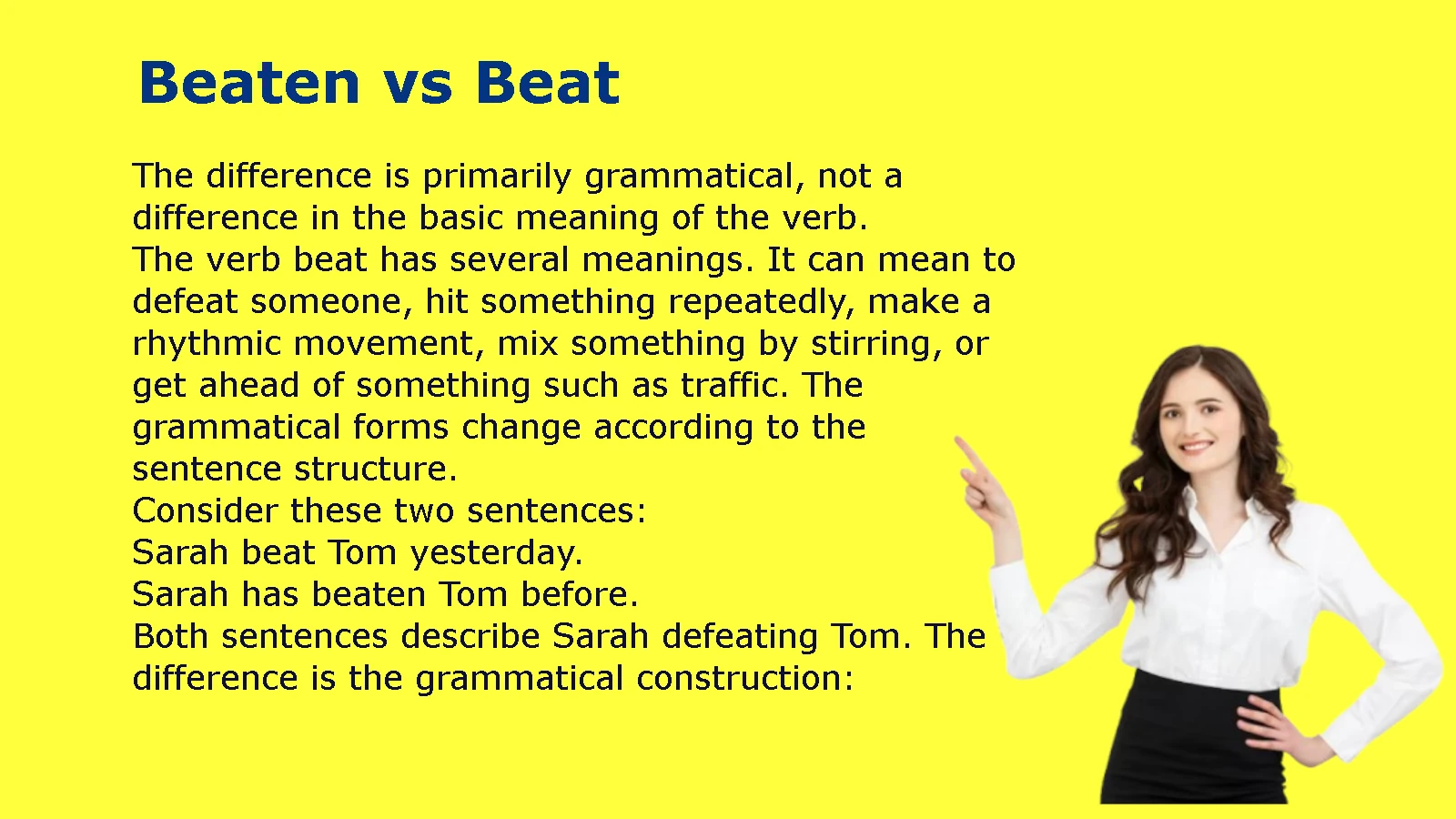
The difference is primarily grammatical, not a difference in the basic meaning of the verb.
The verb beat has several meanings. It can mean to defeat someone, hit something repeatedly, make a rhythmic movement, mix something by stirring, or get ahead of something such as traffic. The grammatical forms change according to the sentence structure.
Consider these two sentences:
Sarah beat Tom yesterday.
Sarah has beaten Tom before.
Both sentences describe Sarah defeating Tom. The difference is the grammatical construction:
- beat = simple past
- has beaten = present perfect, requiring the past participle
The same distinction appears with passive voice:
Tom was beaten by Sarah.
Here, beaten is required because the sentence uses the passive construction was + past participle.
The Basic Rule
Use beat when you are forming the simple present or simple past:
- I beat him.
- I beat him yesterday.
- They beat the other team.
- She beats me at chess.
Use beaten when you need the past participle:
- I have beaten him.
- She has beaten the record.
- They had beaten us before.
- We were beaten.
This is why learning the forms beat, beat, beaten is more useful than simply memorizing one definition.
Beat as the Present Tense
Beat can function as the base form of the verb and as the present-tense form for I, you, we, and they.
For example:
- I beat my brother at chess.
- You beat me every time.
- We beat our competitors regularly.
- They beat the traffic by leaving early.
With he, she, or it, the present-tense form becomes beats:
- She beats me at tennis.
- He beats his previous score.
- The champion regularly beats his rivals.
Cambridge gives examples of beat meaning to defeat someone in a competition, such as beating someone at tennis.
Examples of Beat in the Present Tense
- I beat my personal best whenever I train consistently.
- She beats everyone at chess.
- They beat their competitors on price.
- We beat the traffic by leaving early.
- He beats the deadline whenever possible.
Notice that beaten would not work in these basic present-tense sentences.
Incorrect:
I beaten everyone at chess.
Correct:
I beat everyone at chess.
Beat as the Past Tense
One unusual feature of beat is that its simple past form is exactly the same as its base form.
That gives us:
Present: beat
Past: beat
For example:
I beat him yesterday.
The word beat clearly refers to a completed past event, even though it looks identical to the base form.
Other examples include:
- She beat the record last year.
- Our team beat theirs on Saturday.
- He beat me in the final.
- They beat their biggest competitor.
- We beat the deadline.
Cambridge explicitly identifies beat as the past tense and beaten as the past participle.
Why “Beat” Can Be Past Without Changing Form
Many irregular verbs change their spelling in the past:
- go → went
- see → saw
- take → took
- write → wrote
Beat is different:
- beat → beat
The pronunciation also remains essentially the same for the verb forms shown in standard dictionaries, although the participle beaten has a different pronunciation. Oxford lists beat /biːt/ and beaten /ˈbiːtn/.
That unusual pattern is one reason learners sometimes assume beaten must be the past tense.
It isn’t.
Beaten as the Past Participle
Beaten is the past participle of beat.
A past participle normally appears with an auxiliary verb in perfect constructions or with forms of be in passive constructions.
Examples include:
- I have beaten him before.
- She has beaten the record.
- They had beaten us by halftime.
- We were beaten in the final.
- He had been beaten in the first round.
The important point is that beaten does not normally function as the simple past form.
Compare:
I beat him yesterday. ✓
I beaten him yesterday. ✗
But:
I have beaten him before. ✓
The auxiliary have signals a perfect construction, so the past participle beaten is used.
Beat, Beat, Beaten: The Three Main Forms
The easiest way to remember the verb is with its three principal forms:
| Form | Verb | Example |
| Base form | beat | I want to beat him. |
| Simple past | beat | I beat him yesterday. |
| Past participle | beaten | I have beaten him before. |
You can also add the -ing form:
| Form | Verb | Example |
| Present/base | beat | They beat their rivals. |
| Past | beat | They beat their rivals yesterday. |
| Past participle | beaten | They have beaten their rivals. |
| Present participle | beating | They are beating their rivals. |
Oxford confirms this complete pattern: beat, beat, beaten, beating.
Why Does Beat Have Two Different Past Forms?
The terminology can make this more confusing than it needs to be.
English grammar distinguishes between simple past and past participle. They are not always the same thing.
With regular verbs, the two forms are usually identical:
- walk → walked → walked
- play → played → played
- work → worked → worked
With beat, they are different:
- beat → beat → beaten
The second beat is the simple past, while beaten is the past participle.
That’s why these sentences work differently:
She beat the champion last night.
She has beaten the champion before.
The first sentence uses the simple past. The second uses the past participle.
When to Use Beat
Beat in the Present Tense
Use beat for the present tense with I, you, we, and they.
Examples:
- I beat my personal best regularly.
- They beat their rivals every season.
- We beat the traffic by leaving early.
- You beat me at chess every time.
For third-person singular subjects, use beats:
- He beats his previous score.
- She beats everyone at tennis.
- The machine beats the previous record.
Beat in the Simple Past
Use beat for a completed action in the past.
Examples:
- I beat him yesterday.
- She beat the record in 2025.
- The home team beat its rival 3–1.
- We beat them in the final.
- He beat me by two points.
The presence of a past-time expression often makes the construction obvious:
- yesterday
- last night
- last week
- two days ago
- in 2025
- earlier
- this morning, when referring to a completed event
For example:
They beat us last night.
Not:
They beaten us last night.
Beat After Modal Verbs
After modal verbs such as can, could, will, would, should, may, and might, use the base form beat, not beaten.
Examples:
- We can beat them.
- She might beat the record.
- They could beat the defending champions.
- You should beat your previous score.
- He will beat the deadline.
Incorrect:
We can beaten them.
Correct:
We can beat them.
The modal is followed by the base form of the verb.
Beat in Questions and Negatives
The same principle applies when using do, does, and did.
Questions
- Did you beat him?
- Did they beat the other team?
- Does she beat you at chess?
- Do you think we can beat them?
Negative sentences
- I didn’t beat him.
- They didn’t beat us.
- She doesn’t beat me often.
- We don’t beat our competitors on price.
After did, use beat, not beaten.
Incorrect:
Did you beaten him?
Correct:
Did you beat him?
Likewise:
I didn’t beaten him.
is incorrect.
The standard form is:
I didn’t beat him.
When to Use Beaten
Beaten With Have, Has, or Had
One of the most important uses of beaten occurs in perfect constructions.
Use:
have/has/had + beaten
Examples:
- I have beaten him before.
- She has beaten the record.
- They have beaten every team in the group.
- We had beaten them once before.
- He had beaten his previous score.
Cambridge lists beaten as the past participle in these kinds of constructions.
Present Perfect
Use has/have + beaten:
She has beaten the record twice.
They have beaten their rivals three times this season.
Past Perfect
Use had + beaten:
They had beaten us before the final.
She had already beaten the previous record.
The word beaten remains the past participle regardless of whether the auxiliary is has, have, or had.
Beaten in the Passive Voice
Beaten also appears frequently in passive sentences.
The basic pattern is:
be + beaten
Examples:
- The team was beaten.
- He was beaten by his opponent.
- They were beaten in the final.
- She was beaten by three points.
- The defending champions were beaten.
Oxford gives examples of beaten in passive constructions, including people or teams being defeated in competitions.
Compare the active and passive versions:
The champion beat his opponent.
The opponent was beaten by the champion.
The meaning is closely related, but the grammatical structure changes.
Beaten With Other Auxiliary Constructions
You may see beaten after combinations such as:
- has been beaten
- have been beaten
- had been beaten
- was beaten
- were beaten
- will have been beaten
Examples:
He has been beaten before.
They had been beaten by halftime.
The record will have been beaten by the end of the season.
The exact tense comes from the auxiliary verbs, while beaten functions as the past participle.
Beaten vs Beat Examples
Seeing the two forms side by side makes the difference much easier to recognize.
Examples With Beat
- I beat my brother at chess yesterday.
- She beat the record last year.
- Our team beat theirs 3–1.
- He beat me in the final round.
- They beat the deadline.
- We beat the traffic by leaving early.
- The champion beat his opponent.
- Did you beat your previous score?
Examples With Beaten
- I have beaten my brother at chess before.
- She has beaten the record twice.
- Our team has beaten theirs three times.
- He was beaten in the final round.
- They have beaten the deadline.
- We had beaten the traffic by leaving early.
- The champion was beaten by his opponent.
- She has beaten her previous score.
Beaten vs Beat in Different Grammatical Structures
| Grammatical structure | Correct form | Example |
| Simple present | beat | I beat him regularly. |
| Third-person present | beats | She beats him regularly. |
| Simple past | beat | I beat him yesterday. |
| Infinitive | beat | I want to beat him. |
| Modal + verb | beat | We can beat them. |
| Question with did | beat | Did you beat them? |
| Present perfect | beaten | I have beaten them. |
| Past perfect | beaten | I had beaten them before. |
| Passive present | beaten | They are beaten. |
| Passive past | beaten | They were beaten. |
| Perfect passive | beaten | They have been beaten. |
| Continuous | beating | They are beating us. |
This table captures the central rule: beat is used as the base/simple-past form, while beaten appears as the past participle.
Beaten vs Beat in Common Expressions
The correct form also depends on the grammatical structure surrounding common expressions.
Beat the Record vs Have Beaten the Record
Both can be correct:
She beat the record yesterday.
She has beaten the record three times.
The first uses the simple past. The second uses the present perfect.
Oxford specifically uses beat in expressions involving breaking or surpassing records.
Beat the Odds vs Have Beaten the Odds
You may encounter both:
They beat the odds and reached the final.
They have beaten the odds before.
Again, the difference comes from the tense and sentence structure, not from a different meaning of beat.
Beat Someone vs Get Beaten
These constructions reverse the grammatical perspective.
The boxer beat his opponent.
Here, boxer performs the action.
The opponent got beaten.
Here, opponent receives the action.
The phrase get beaten is a passive construction. In standard usage, beaten is the past participle.
Is “Beaten” the Past Tense of Beat?
No.
The simple past tense is beat.
The past participle is beaten.
So:
I beat him yesterday. ✓
I have beaten him before. ✓
But:
I beaten him yesterday. ✗
The confusion often comes from the fact that many English verbs use the same word for both past tense and past participle.
For example:
- worked → worked
- played → played
- walked → walked
But beat does not follow that pattern:
- beat → beat
- past participle → beaten
Oxford and Cambridge both identify this distinction directly.
Is “Beated” Correct?
In standard modern English, beated is not the standard past tense or past participle of beat.
The standard forms are:
beat → beat → beaten
So these are correct:
She beat the record.
She has beaten the record.
These are not standard:
She beated the record.
She has beated the record.
The error is understandable because many English verbs form their past tense by adding -ed. However, beat is an irregular verb, so its forms must be learned individually.
Beaten vs Beat: Common Mistakes
Mistake: Using “Beaten” as the Simple Past
Incorrect:
I beaten him yesterday.
Correct:
I beat him yesterday.
The time expression yesterday points to a completed past event, so the simple past beat is appropriate.
Mistake: Using “Beat” as the Past Participle
Incorrect in standard English:
I have beat him before.
Correct:
I have beaten him before.
The auxiliary have requires the past participle in this construction.
Mistake: Using “Beated”
Incorrect:
She beated the champion.
Correct:
She beat the champion.
Or:
She has beaten the champion.
Which form you choose depends on the sentence’s grammatical structure.
Mistake: Confusing Active and Passive Voice
Compare:
The team beat us.
and:
We were beaten by the team.
The first sentence is active. The second is passive.
This difference explains why beat appears in one sentence and beaten in the other.
Beaten vs Beat: Active and Passive Voice
Understanding active and passive voice is especially useful when deciding between these two forms.
Active Voice
In an active sentence, the subject performs the action:
The champion beat his opponent.
Structure:
subject + beat + object
Another example:
The home team beat the visitors.
Here, home team performs the action of defeating the visitors.
Passive Voice
In a passive sentence, the subject receives the action:
The opponent was beaten by the champion.
Structure:
subject + form of be + past participle
Since beaten is the past participle, it fits the construction.
Other examples include:
- The team was beaten in the final.
- The record was beaten by a younger athlete.
- They were beaten by three points.
- The defending champions have been beaten.
Cambridge and Oxford both provide passive examples using beaten, particularly in contexts involving competition and physical action.
“I Got Beaten” Meaning
“I got beaten” means that someone or something defeated you, or, depending on context, that you were physically hit.
The exact meaning comes from context.
Competition
I got beaten in the final.
This means another competitor defeated me.
Sports
We got beaten 2–1.
This means the other team won.
Physical action
He got beaten during the attack.
Here, beaten refers to repeated physical hitting.
Cambridge lists both defeat and hit repeatedly among the meanings of beat, showing why context matters when interpreting sentences with beaten.
The construction itself is passive:
got + beaten
Compare:
He beat me.
with:
I got beaten by him.
The first sentence emphasizes the person performing the action. The second emphasizes the person receiving it.
Beaten vs Beat in Sports and Competition
Sports provide some of the clearest examples of the distinction.
Consider these three sentences:
The Eagles beat the Tigers yesterday.
The Eagles have beaten the Tigers three times this season.
The Tigers were beaten by the Eagles yesterday.
All three describe a related result, but each uses a different grammatical construction.
| Sentence | Form | Why? |
| The Eagles beat the Tigers. | Past | Simple past |
| The Eagles have beaten the Tigers. | Past participle | Present perfect |
| The Tigers were beaten. | Past participle | Passive voice |
Cambridge’s examples similarly use beat for a team defeating another team and beaten for the team that loses in a passive construction.
Beaten vs Beat in Everyday English
The verb beat is much broader than sports.
It can describe defeating someone, surpassing a record, avoiding something, or physically hitting something. Cambridge and Oxford document several of these uses.
Games
I beat my friend at chess.
I have beaten him three times.
Records
She beat the school record.
She has beaten the record twice.
Deadlines
We beat the deadline.
We have beaten the deadline again.
Traffic
We left early to beat the traffic.
Oxford specifically identifies beat something as an informal way to avoid something such as traffic or heat.
Physical Action
The rain beat against the windows.
The rain had beaten against the windows all night.
Rhythm
He beat the drum.
The drummer has beaten the drum for several minutes.
The grammatical distinction remains the same even when the meaning of beat changes.
Beaten vs Beat: A Practical Case Study
Imagine that a tennis player defeats an opponent on Monday.
You could describe the event in several ways.
Simple Past
Maya beat Elena on Monday.
The event happened in the past, so beat is the simple past form.
Present Perfect
Maya has beaten Elena before.
The sentence connects a past event to the present without specifying a finished past time. The construction uses has + beaten.
Past Perfect
Suppose another event happened later:
Maya had beaten Elena before they met again in the championship.
The earlier event uses had + beaten.
Passive Voice
Now change the focus:
Elena was beaten by Maya on Monday.
The sentence uses was + beaten because it is passive.
The Lesson
All four sentences refer to the same basic verb, but the grammatical structure determines whether you use beat or beaten.
Beaten vs Beat: Quick Comparison Chart
| Question | Answer |
| What is the base form? | beat |
| What is the present form for I/you/we/they? | beat |
| What is the third-person singular present? | beats |
| What is the simple past? | beat |
| What is the past participle? | beaten |
| What is the -ing form? | beating |
| Is beaten the simple past? | No |
| Is beaten the past participle? | Yes |
| Is beated the standard past form? | No |
| Is “I beat him yesterday” correct? | Yes |
| Is “I have beaten him before” correct? | Yes |
| Is “I beaten him yesterday” correct? | No |
| Is “I have beat him before” standard? | No |
| Is “I got beaten” correct? | Yes |
Beaten vs Beat: How to Remember the Difference
If you regularly confuse these forms, remember one short pattern:
Beat → Beat → Beaten
Think of it as:
present → past → past participle
Use Beat
Use beat for:
- the base form
- simple present with I/you/we/they
- simple past
- infinitives
- modal constructions
- questions after did
Examples:
- I beat him.
- I beat him yesterday.
- I can beat him.
- I want to beat him.
- Did you beat him?
Use Beaten
Use beaten for:
- present perfect
- past perfect
- passive constructions
- perfect passive constructions
Examples:
- I have beaten him.
- I had beaten him.
- He was beaten.
- He has been beaten.
Beaten vs Beat Sentences
Here are contrasting examples that show exactly where each form belongs.
| Beat | Beaten |
| I beat him yesterday. | I have beaten him before. |
| She beat the record last year. | She has beaten the record twice. |
| They beat us in the final. | We were beaten in the final. |
| He beat me at chess. | He has beaten me several times. |
| We beat the deadline. | We have beaten the deadline. |
| The team beat its rival. | The rival was beaten by the team. |
| I beat the traffic. | We have beaten the traffic before. |
| She beat her previous score. | She has beaten her previous score. |
The pattern becomes much easier to recognize when you compare complete sentences instead of memorizing isolated words.
Beaten vs Beat Worksheet
Choose beat or beaten to complete each sentence.
Questions
- I ___ him at chess yesterday.
- She has ___ her previous record.
- They ___ their rivals last weekend.
- We were ___ in the final.
- He had ___ the champion once before.
- Did you ___ your personal best?
- The team has ___ every opponent this season.
- I can ___ you at tennis.
- She ___ me in the competition yesterday.
- They had been ___ before the championship began.
Answer Key
- beat
- beaten
- beat
- beaten
- beaten
- beat
- beaten
- beat
- beat
- beaten
The fastest way to check your answer is to look at the words immediately before the blank. Have, has, had, and forms of be often signal that you need the past participle beaten.
Frequently Asked Questions About Beaten vs Beat
Is the past tense of beat “beat” or “beaten”?
The simple past tense is beat.
I beat him yesterday.
Beaten is the past participle.
I have beaten him before.
Oxford lists the past simple as beat and the past participle as beaten.
Is beaten the past participle of beat?
Yes. Beaten is the standard past participle of beat.
The principal forms are:
beat – beat – beaten
Cambridge and Oxford both give this pattern.
Is “I beat him yesterday” correct?
Yes.
Beat is the simple past form, so this sentence is grammatically correct:
I beat him yesterday.
Is “I have beat him” grammatically correct?
In standard modern English, the usual form is:
I have beaten him.
The auxiliary have is followed by the past participle beaten.
Is “beated” a word?
Beated is not the standard past tense or past participle of beat.
Use:
- beat for the simple past
- beaten for the past participle
What are the three forms of beat?
The three principal forms are:
beat – beat – beaten
The -ing form is beating.
Why do we say “was beaten” but “beat” in the past tense?
Because these are different grammatical constructions.
Beat is the simple past:
The team beat us.
Beaten is the past participle used after was in the passive:
We were beaten by the team.
Is “I got beaten” correct?
Yes.
Got beaten is a passive construction and can mean that someone was defeated or physically hit, depending on context.
I got beaten in the final.
Here, it means I lost the final.
What is the past participle of beat in American English?
Beaten is the standard past participle in American English. Cambridge also notes beat as an alternative past participle in its American dictionary entry in certain usage descriptions, but beaten is the standard form learners should use in constructions such as has beaten and was beaten.
Final Rule: Beat vs Beaten
The difference between beaten vs beat becomes straightforward once you identify the grammatical form you need.
Remember:
beat → beat → beaten
Use beat for the base form and simple past:
- I can beat him.
- I beat him yesterday.
- Did you beat him?
Use beaten for the past participle:
- I have beaten him.
- She has beaten the record.
- They had beaten us.
- We were beaten.
The most common mistake is treating beaten as the simple past. If you’re describing a completed event with no auxiliary verb, use beat:
I beat him yesterday.
If you have have, has, had, was, were, been, or another structure requiring a past participle, beaten may be the correct form:
I have beaten him before.
Once you learn that single pattern—beat, beat, beaten—the difference becomes much easier to apply in writing and everyday English.