Have you ever written “taught” or “taut” and stopped to wonder which word is correct? While Taught or Taut may sound similar, these two words have completely different meanings, uses, and spellings.
Taught is the past tense and past participle of teach, meaning to give someone knowledge, skills, or information. Taut, on the other hand, means stretched tight, firm, or not loose. Although they sound alike, you cannot use them interchangeably.
Examples:
- She taught me how to play the piano.
- The rope was pulled taut across the room.
The confusion is understandable. People often search for taught vs taut, taught meaning, taut meaning, or how to use taught and taut in a sentence because both words have the same pronunciation but very different meanings. And here’s the kicker: one is connected to teaching, while the other describes something tight or stretched.
In this guide, you’ll learn the complete difference between Taught and Taut, including their meanings, definitions, pronunciation, correct usage, and examples in sentences. You’ll also discover how to remember the difference between taught vs taut and avoid this common spelling mistake.
Taught vs. Taut at a Glance
| Word | Meaning | Part of Speech | Example |
| Taught | Past tense and past participle of teach | Verb | She taught me Spanish. |
| Taut | Stretched tight, tense, or not slack | Adjective | The rope was taut. |
The quickest way to choose the correct spelling is to look at the meaning of the sentence.
If someone gave instruction, knowledge, or training, use taught.
If something is pulled tight or tense, use taut.
Why Are Taught and Taut Confused?
The main reason is pronunciation. In American English, both words are pronounced /tɔt/, so hearing either word by itself doesn’t tell you which spelling the speaker means. Major dictionaries list taught as the past tense and past participle of teach, while taut functions primarily as an adjective.
They are therefore a classic example of homophones: words that sound alike but have different spellings and meanings.
Think of them as two roads that share the same entrance but lead somewhere completely different.
What Does Taught Mean?
Taught is the simple past tense and past participle of the verb teach.
The verb teach means to give someone knowledge, instruction, training, or an understanding of how to do something. Cambridge gives examples that cover everything from teaching a subject to showing someone how to perform a skill.
The verb forms look like this:
| Verb Form | Example |
| teach | I teach English. |
| taught | I taught English yesterday. |
| taught | I have taught English for years. |
| teaching | I am teaching English now. |
Notice something important: taught doesn’t mean “tight.” It always connects to the verb teach when it functions as a verb.
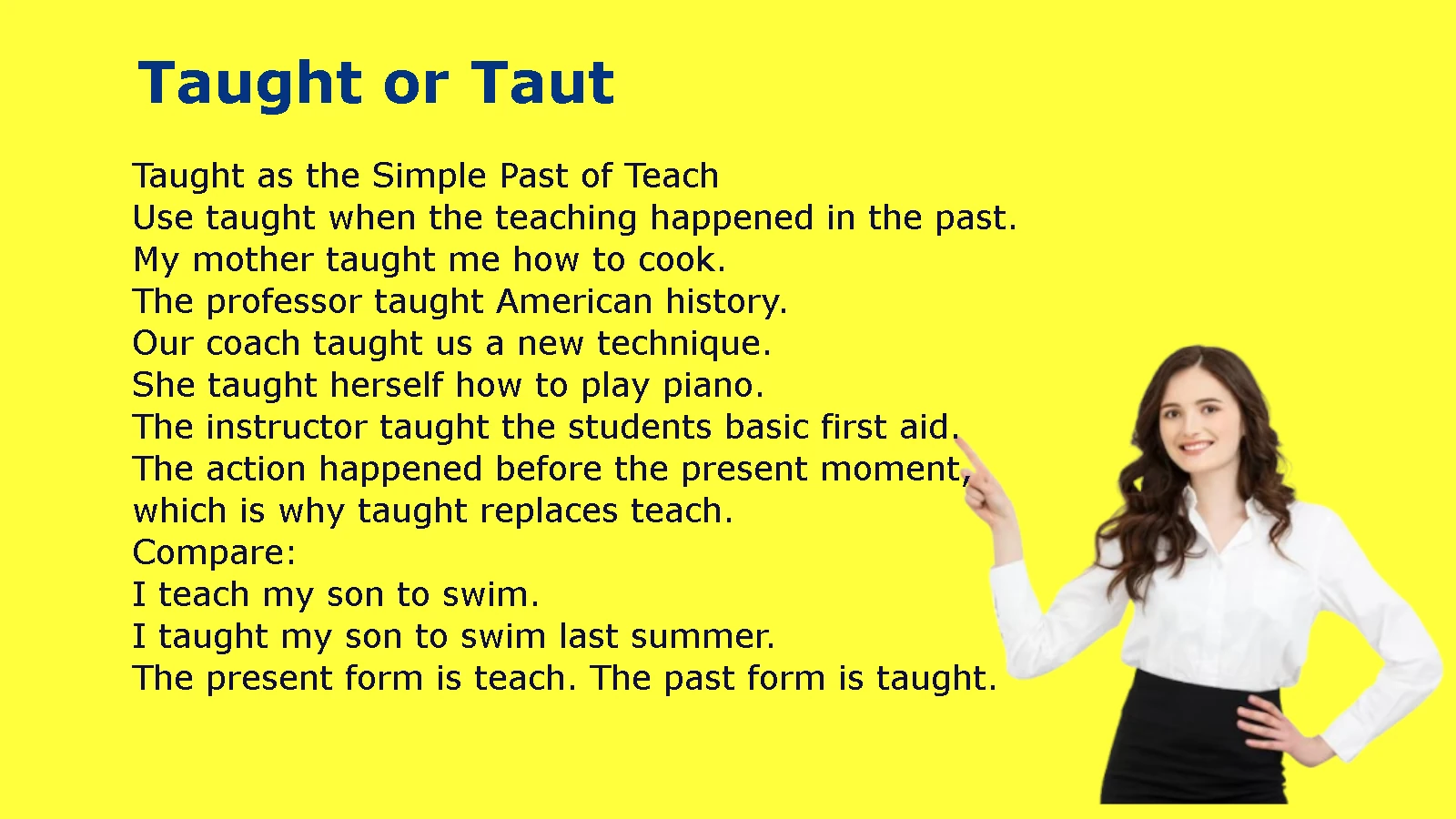
Taught as the Simple Past of Teach
Use taught when the teaching happened in the past.
- My mother taught me how to cook.
- The professor taught American history.
- Our coach taught us a new technique.
- She taught herself how to play piano.
- The instructor taught the students basic first aid.
The action happened before the present moment, which is why taught replaces teach.
Compare:
I teach my son to swim.
I taught my son to swim last summer.
The present form is teach. The past form is taught.
Taught as a Past Participle
Taught also works as the past participle of teach. That means you can use it with auxiliary verbs such as have, has, and had, as well as in passive constructions.
Examples include:
- I have taught English for ten years.
- She has taught hundreds of students.
- They had taught us the basic rules before the competition.
- He was taught how to repair the machine.
- We were taught to respect the rules.
The form doesn’t change.
Teach → taught → taught
That’s one reason English learners sometimes find the verb unusual. Many regular verbs add -ed in the past, such as walk → walked or learn → learned. Teach is irregular, so its past form is taught.
How Do You Use Taught in a Sentence?
The word taught commonly appears in several sentence patterns.
Taught Someone Something
This pattern identifies the person receiving the information or skill.
My grandfather taught me patience.
Other examples:
- She taught him mathematics.
- The instructor taught us the basic rules.
- Experience taught her an important lesson.
- The coach taught the players discipline.
Taught Someone How to Do Something
This structure focuses on a particular skill or action.
My brother taught me how to ride a bike.
More examples:
- She taught me how to bake bread.
- He taught the children how to swim.
- The mechanic taught us how to change a tire.
- My uncle taught me how to fish.
Taught Someone to Do Something
You can also use taught + object + to + verb.
- My parents taught me to be polite.
- The coach taught us to stay focused.
- Her father taught her to drive.
- The trainer taught the dog to sit.
Cambridge specifically lists structures such as teach something to someone and teach someone to do something, which explains why these patterns occur so often with taught.
What Does Taut Mean?
Taut is primarily an adjective. It describes something that is stretched tightly, pulled tight, tense, or not slack.
The most literal use describes a physical object.
Imagine a rope hanging loosely between two posts. Now pull both ends until the rope becomes straight and tight.
The rope is taut.
For example:
The rope was pulled taut between the two trees.
Other physical examples include:
- taut fishing line
- taut guitar strings
- taut cables
- taut fabric
- taut muscles
- taut skin
- taut wires
Oxford lists examples such as taut violin strings, a taut rope, and skin stretched taut across the face.
Taut Means More Than Just Physically Tight
The meaning of taut can extend beyond physical objects.
It can describe emotional tension, a person’s expression, a voice, or even writing. Cambridge and Oxford both recognize these broader uses.
For example:
- Her voice sounded taut with anger.
- His face became taut with worry.
- The atmosphere was taut with tension.
- The movie was a taut thriller.
- The writer used taut prose.
So, while tight remains the easiest synonym for the physical meaning, taut can carry a stronger sense of strain, tension, control, or restraint.
Taut Can Describe Physical Tightness
The most common use of taut involves something stretched tightly.
Consider a tent.
If the fabric hangs loosely, it isn’t taut. If you pull the fabric until it stretches smoothly across the frame, it becomes taut.
Examples:
- The tent ropes were taut.
- She pulled the cord taut.
- The sail remained taut in the wind.
- The guitar strings were taut.
- The cable became taut as the load moved.
Merriam Webster defines this sense as having “no give or slack” and gives a taut rope as an example.
Taut Can Describe Muscles and Skin
Taut can also describe a person’s body when the muscles are firm or tense.
For example:
Years of training left his muscles taut and strong.
Oxford includes a separate sense for a person or body with hard muscles and little excess fat.
You might also encounter:
- taut muscles
- taut skin
- a taut body
- taut features
Here’s where taut becomes more interesting.
The word doesn’t always describe an object. It can describe a person’s emotional or mental state.
If someone looks anxious, strained, or highly tense, their expression may be described as taut.
For example:
Her face was taut with anxiety.
Other examples include:
- His voice was taut with anger.
- She gave a taut smile.
- His expression remained taut and serious.
- The conversation became increasingly taut.
- The room felt taut with anticipation.
Collins and Oxford both recognize this sense of taut as showing worry, anxiety, strain, or tension.
This usage works because physical tension and emotional tension share the same basic idea: something is under strain.
A stretched rope is tense.
A nervous person can be tense, too.
Taut Can Describe Writing, Stories, and Films
One of the less obvious meanings of taut involves writing, speech, films, and storytelling.
When someone calls a story taut, they usually mean it is carefully controlled, concise, exciting, and free from unnecessary material. Cambridge describes taut writing or speech as controlled, clear, and short.
Oxford similarly uses taut thriller and taut prose for writing that contains no unnecessary parts.
For example:
The novel has a taut plot that never loses momentum.
Here, taut doesn’t mean the pages are physically stretched.
It means the writing is tight and controlled.
Every scene has a purpose. The plot moves forward. The author doesn’t bury the story under unnecessary details.
This figurative meaning makes taut especially useful in literary criticism and professional writing.
Examples of Taut Writing
- The journalist wrote a taut, focused article.
- The director created a taut psychological thriller.
- Her prose is taut and economical.
- The screenplay has a taut structure.
- The short story maintains a taut pace from beginning to end.
In this context, synonyms such as concise, controlled, tight, and economical often work well.
Taught or Taut: Which One Is Correct?
The answer depends entirely on what you’re trying to say.
Use Taught When You Mean:
- instructed
- educated
- trained
- showed someone how to do something
- gave someone knowledge
- helped someone learn a lesson
Examples:
My teacher taught me algebra.
Experience taught him to be careful.
She taught herself to play guitar.
Use Taut When You Mean:
- stretched tight
- pulled tight
- not slack
- tense
- strained
- physically firm
- tightly controlled in writing or storytelling
Examples:
The rope was taut.
His muscles were taut after the workout.
She spoke in a taut voice.
The film has a taut storyline.
The distinction is simple once you focus on meaning instead of sound.
Taught vs. Taut Examples Side by Side
The following examples show the difference clearly:
| Taught | Taut |
| My father taught me how to drive. | The rope was pulled taut. |
| She taught English at the school. | The cable remained taut. |
| Experience taught him patience. | His muscles were taut. |
| The coach taught us a new strategy. | The fishing line suddenly went taut. |
| My grandmother taught me how to cook. | The tent ropes were taut. |
| The instructor taught the class first aid. | Her face looked taut with worry. |
| He taught himself French. | The strings were stretched taut. |
| Life taught her an important lesson. | The movie had a taut plot. |
Look for the central idea.
Taught connects to learning.
Taut connects to tightness or tension.
The Easiest Way to Remember Taught vs. Taut
You don’t need a complicated mnemonic.
Use two simple substitutions:
Taught = taught by a teacher.
Taut = tight.
Use the “Teach” Test
When you’re unsure, replace the word with teach.
If the sentence is about instruction or learning, you probably need taught.
My mother taught me to cook.
The present version would be:
My mother teaches me to cook.
That makes the connection obvious.
Use the “Tight” Test
Now try replacing the word with tight.
Pull the rope taut.
You can say:
Pull the rope tight.
The meaning remains nearly the same.
Therefore, taut is correct.
This trick works particularly well because the two words have entirely different semantic families:
- taught → teach → teacher → learning
- taut → tight → tension → stretched
Common Mistakes With Taught and Taut
Because the words sound alike, spelling mistakes often appear when someone writes what they hear.
Mistake: “My Teacher Taut Me”
Incorrect:
My teacher taut me English.
Correct:
My teacher taught me English.
Why? The teacher gave instruction. The verb is teach, whose past tense is taught.
Mistake: “Pull the Rope Taught”
Incorrect:
Pull the rope taught.
Correct:
Pull the rope taut.
Why? The rope becomes tight, not educated.
Mistake: “She Taught Her Muscles”
Incorrect:
Her muscles were taught after exercise.
Correct:
Her muscles were taut after exercise.
Here, taut describes the physical condition of the muscles.
Mistake: Choosing by Sound Alone
This is the biggest trap.
When someone says:
“The rope was taut.”
you can’t determine the spelling simply by listening.
The same applies to:
“She taught me how to swim.”
The pronunciation doesn’t give the spelling away.
Context does the heavy lifting.
Are Taught and Taut Homophones?
Yes. Taught and taut are homophones because they have the same pronunciation in standard American English but different meanings and spellings.
Compare:
Taught
- connected to teach
- verb
- refers to instruction or learning
Taut
- connected to tightness or tension
- adjective
- describes something stretched, tense, or tightly controlled
Homophones can cause spelling errors because English spelling doesn’t always follow pronunciation perfectly.
Other familiar examples include:
- there / their / they’re
- to / too / two
- right / write
- flower / flour
- sea / see
With taught and taut, the safest strategy is always to identify the meaning first.
Taught vs. Taut Pronunciation
In American English, both words are commonly pronounced /tɔt/. Cambridge lists the American pronunciation for taught as /tɔt/ and the American pronunciation of taut as /tɑːt/ in its entries, with pronunciation notation varying somewhat by dictionary system.
For practical writing purposes, the important point is this:
The words sound alike enough that pronunciation cannot reliably distinguish their spellings.
That makes context especially important.
If you hear someone say:
“The line went taut.”
you need the surrounding meaning to know that they mean tight.
If you hear:
“She taught the class.”
the context tells you that the word relates to teaching.
Taught or Taut in Different Contexts
Different situations make the distinction even clearer.
In Education
Use taught.
The professor taught biology for twenty years.
The subject involves instruction, so taught is the natural choice.
In Skill Training
Use taught.
My uncle taught me how to fish.
Someone showed another person how to perform a skill.
With Ropes and Cables
Use taut.
The workers pulled the cable taut.
The cable has been stretched until it has little slack.
With Fishing Lines
Use taut.
The fishing line suddenly went taut.
The line became tight because something pulled against it.
With Muscles
Use taut.
Her muscles were taut after the race.
Here, the adjective describes physical firmness or tension.
With Emotions
Use taut.
His voice sounded taut with anger.
The word describes emotional strain rather than physical stretching.
With Stories and Films
Use taut.
The director created a taut thriller.
The story is tightly constructed and keeps unnecessary material to a minimum. Cambridge, Oxford, and Merriam Webster all recognize this broader figurative use.
A Closer Look at “Taught”
Although taught has one basic dictionary identity, its real-world use is broader because teach can describe many kinds of learning.
Formal Teaching
The instructor taught the students chemistry.
Practical Instruction
My father taught me how to change a tire.
Self Education
She taught herself to code.
Lessons From Experience
The mistake taught him to double-check his work.
That last use is especially important. A person doesn’t always need another human being to “teach” them.
A situation, mistake, experience, or consequence can teach someone something.
For example:
The failed experiment taught the students an important lesson about measurement.
The past tense remains taught because the sentence still describes learning.
A Closer Look at “Taut”
Taut has a surprisingly broad range of uses.
Physical Objects
The rope was taut.
Body and Muscles
His muscles looked taut and firm.
Skin
The fabric stretched taut across the frame.
Facial Expressions
Her face became taut with worry.
Voices
He answered in a taut voice.
Situations
The atmosphere remained taut throughout the meeting.
Writing
The novel is a taut psychological thriller.
Merriam Webster also records senses involving proper order or condition, particularly in nautical use, as well as efficient structure and detail.
So while taut often starts with the idea of something being physically tight, its meaning can stretch into emotional and literary territory.
Taut vs. Tight: Are They the Same?
Taut and tight overlap, but they aren’t perfect synonyms in every situation.
When something is stretched and has little slack, taut is often a precise choice.
The rope was taut.
You could also say:
The rope was tight.
However, tight has many additional meanings that taut doesn’t share.
For example:
- a tight schedule
- tight jeans
- tight security
- a tight budget
- a tight friendship
You generally wouldn’t replace all of these with taut.
That’s why it’s better to remember:
Taut is a specific kind of tightness or tension.
It often suggests something that has been drawn, stretched, strained, or held under tension.
Can Taut Describe a Person?
Yes, but the intended meaning depends on the context.
It can describe someone’s body as firm or muscular:
He had a lean, taut physique.
It can also describe someone’s appearance when they look tense:
Her face was taut with anxiety.
Oxford recognizes both physical and emotional uses.
However, taut isn’t simply a general synonym for “fit” or “healthy.” The context matters.
Can Taut Describe Writing?
Yes.
When a writer describes a story, screenplay, article, or piece of prose as taut, the word usually praises its tight construction and lack of unnecessary material.
For example:
The author delivers a taut mystery with no wasted scenes.
Here, taut suggests that the story moves efficiently. Each scene contributes something. The tension stays controlled.
Cambridge describes taut writing or speech as controlled, clear, and short, while Oxford applies the word to carefully written material with no unnecessary parts.
This is why you’ll often see phrases such as:
- taut prose
- taut thriller
- taut screenplay
- taut narrative
- taut plot
- taut dialogue
What Part of Speech Is Taught?
Taught is a verb form when it functions as the past tense or past participle of teach.
Examples:
She taught English.
She has taught English for years.
The first uses taught as the simple past.
The second uses taught as the past participle.
There are also fixed adjective-like compounds such as self-taught and well-taught, but the core word remains the past participle of teach. Oxford lists self-taught alongside taught.
What Part of Speech Is Taut?
Taut is primarily an adjective.
It describes a noun:
a taut rope
taut muscles
a taut expression
a taut thriller
Its related forms include:
- tautly — adverb
- tautness — noun
- tauter — comparative
- tautest — superlative
Merriam Webster lists tautly and tautness as derived forms.
Examples:
The writer constructed the scene tautly.
The rope’s tautness made it difficult to move.
Taught or Taut: A Simple Decision Chart
When you’re editing a sentence, use this quick guide:
| Ask yourself… | Choose |
| Did someone teach, train, or instruct someone? | Taught |
| Is this the past form of teach? | Taught |
| Did someone learn something? | Taught |
| Is something stretched tight? | Taut |
| Is something not slack? | Taut |
| Does someone look tense or strained? | Taut |
| Are muscles firm or tense? | Taut |
| Is a story tightly constructed? | Taut |
If the answer involves learning, choose taught.
If it involves tightness or tension, choose taut.
Taught or Taut: Quick Practice Test
Choose taught or taut in each sentence.
- My mother ___ me how to bake.
- Pull the rope ___ before tying it.
- The coach ___ us a new strategy.
- The fishing line went ___.
- Experience ___ him to be more patient.
- Her face looked ___ with worry.
- The professor ___ the students chemistry.
- The cable remained ___ under the load.
- He ___ himself how to play guitar.
- The movie had a ___ and suspenseful plot.
Answers
| # | Answer | Why? |
| 1 | taught | Someone received instruction. |
| 2 | taut | The rope needs to become tight. |
| 3 | taught | The coach provided instruction. |
| 4 | taut | The fishing line became tight. |
| 5 | taught | Experience provided a lesson. |
| 6 | taut | The face showed tension. |
| 7 | taught | The professor instructed students. |
| 8 | taut | The cable was under tension. |
| 9 | taught | He instructed himself. |
| 10 | taut | The plot was tightly constructed. |
If you got all ten right, you’ve got the distinction down.
Frequently Asked Questions About Taught and Taut
Is “taught” the past tense of “teach”?
Yes. Taught is both the simple past tense and past participle of teach.
Present: I teach.
Past: I taught.
Past participle: I have taught.
What does “taut” mean?
Taut means stretched tightly, pulled tight, tense, or not slack. It can also describe emotional tension and tightly controlled writing.
Are “taught” and “taut” homophones?
Yes. They are pronounced alike in standard English varieties, although dictionary pronunciation systems may represent American and British vowel sounds differently. Their meanings and spellings remain distinct.
Is “taut” a word?
Yes. Taut is a standard English adjective with a long history of use. Major dictionaries recognize meanings involving physical tightness, tension, physical firmness, and tightly constructed writing.
Is “taut” the same as “tight”?
Sometimes. Taut can mean tightly stretched or not slack, so tight works as a synonym in many physical contexts.
However, tight has many meanings that taut doesn’t share.
Can you say “taut muscles”?
Yes.
Taut muscles can describe muscles that are firm, tense, or strongly defined. Oxford and Merriam Webster both recognize physical uses involving muscles and bodily firmness.
Can you say “taut writing”?
Yes.
Taut writing describes writing that is controlled, concise, and free from unnecessary material.
Can “taught” describe a lesson from experience?
Yes.
A situation can teach someone something, so its past form can be taught.
The mistake taught her to slow down.
The experience taught him an important lesson.
Is “taut” a verb?
It can appear as a rare verb in specialized usage, but the ordinary word readers encounter is the adjective meaning tightly stretched or tense. Merriam Webster records a separate verb with specialized Scottish usage.
For everyday English, think of taut as an adjective.
Taught or Taut: The Final Answer
The difference between taught and taut comes down to two ideas:
Taught = teach.
Taut = tight.
Use taught when someone gave instruction, training, knowledge, or a lesson.
My father taught me how to drive.
Use taut when something is stretched tight, tense, firm, or tightly controlled.
The rope was pulled taut.
The words sound alike, which makes them easy to confuse. Their meanings, however, point in opposite directions. One concerns learning. The other concerns tension.
When in doubt, run the sentence through the two simple tests:
Can you connect the word to teach? Choose taught.
Can you replace it with tight? Choose taut.
Once that habit sticks, taught or taut stops being a spelling trap and becomes an easy context clue.