Metaphors are figures of speech that describe one thing by saying it is something else, helping readers or listeners understand an idea through comparison, imagery, or symbolism. If you’ve come across the word “metaphors” and wondered what it means, how metaphors are used, or why writers and speakers use them, the term is closely connected to figurative language, comparisons, imagery, symbolism, descriptions, and creative expression.
The metaphors meaning refers to expressions that directly describe one thing as another to create a particular image, idea, or feeling without using words such as “like” or “as.” However, not every metaphor has the same purpose. Some are used in everyday speech, while others appear in literature, poetry, storytelling, speeches, songs, and academic writing. Terms such as figurative language, analogy, symbolism, simile, comparison, and imagery are related but can have slightly different meanings and uses.
In this guide, you’ll learn what “metaphors” means, how metaphors are used in sentences, the different types of metaphors, and how metaphors differ from related expressions such as similes, analogies, and symbolism. You’ll also see clear examples to make the meaning easy to understand.
By the end, you’ll know exactly what metaphors means and how to recognize and use this common and powerful form of figurative language naturally and correctly.
Quick Answer: What Does “Metaphor” Mean?
A metaphor is a figure of speech that describes one thing in terms of another to highlight a shared quality, idea, or relationship. It creates a figurative comparison rather than a literal one.
For example:
“Time is a thief.”
Time is not literally a person who steals things. The metaphor suggests that time seems to take moments, opportunities, or parts of our lives away from us.
Metaphors appear everywhere in English. You find them in everyday conversations, literature, songs, speeches, journalism, advertising, business writing, and ordinary expressions such as “a wave of emotion,” “the heart of the city,” and “a mountain of work.”
The key idea is simple: a metaphor transfers an image or concept from one thing to another to communicate meaning more vividly.
What Is the Meaning of “Metaphor”?
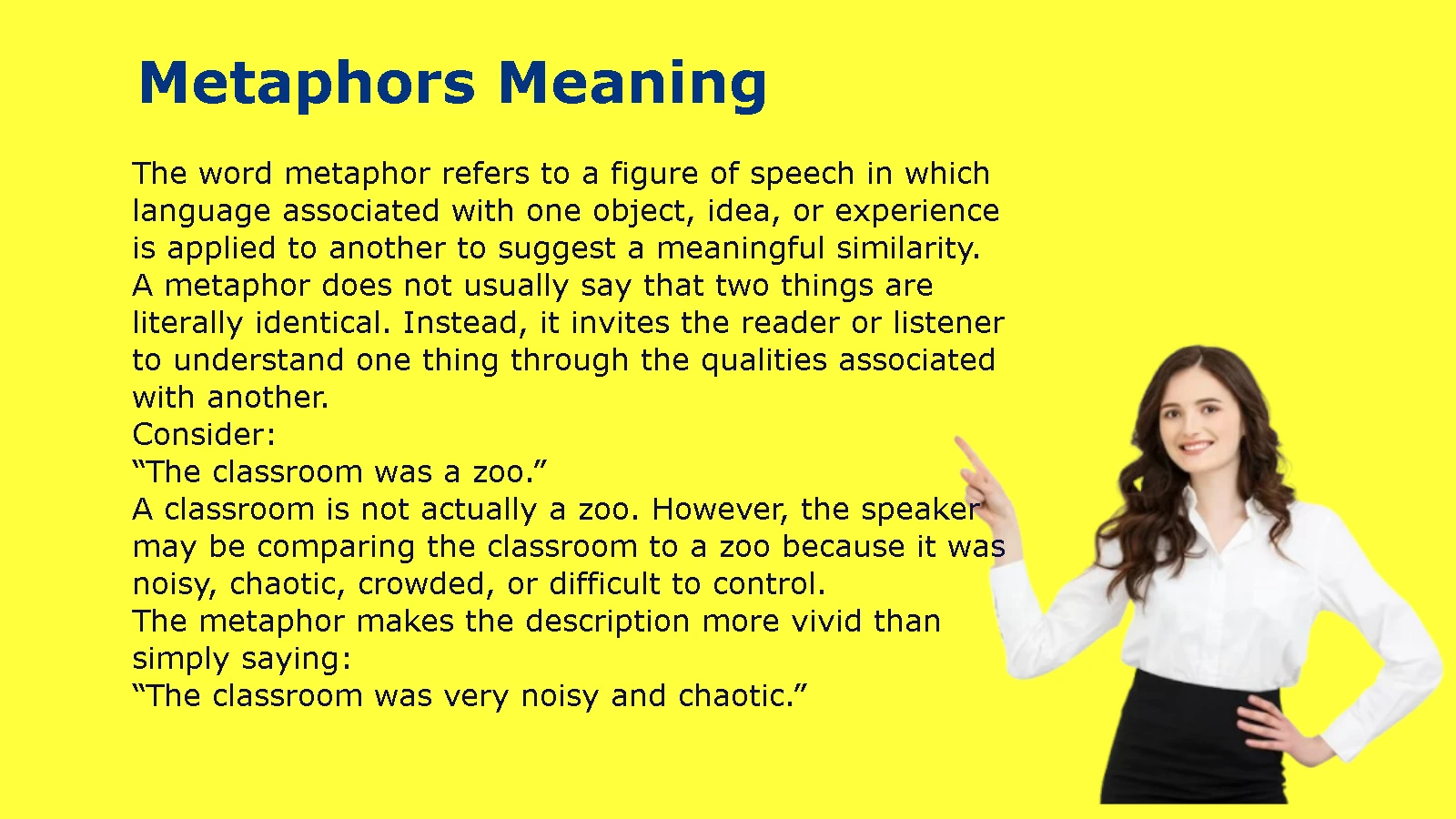
The word metaphor refers to a figure of speech in which language associated with one object, idea, or experience is applied to another to suggest a meaningful similarity.
A metaphor does not usually say that two things are literally identical. Instead, it invites the reader or listener to understand one thing through the qualities associated with another.
Consider:
“The classroom was a zoo.”
A classroom is not actually a zoo. However, the speaker may be comparing the classroom to a zoo because it was noisy, chaotic, crowded, or difficult to control.
The metaphor makes the description more vivid than simply saying:
“The classroom was very noisy and chaotic.”
That is one reason metaphors are so useful. They can compress an entire idea into a few memorable words.
Metaphor Definition
In simple terms:
A metaphor is a figurative comparison in which one thing is described as another to communicate a particular quality or idea.
The comparison can involve:
- physical appearance
- behavior
- emotion
- movement
- experience
- value
- relationships
- abstract ideas
- cause and effect
Merriam-Webster describes metaphor as a figure of speech that uses language literally associated with one kind of object or idea in place of another to suggest likeness or analogy.
Literal Meaning vs. Metaphorical Meaning
Understanding the difference between literal and figurative language is essential.
| Expression | Literal meaning | Metaphorical meaning |
| “He has a heart of stone.” | His heart is made of stone. | He seems emotionally cold or insensitive. |
| “She is drowning in work.” | She is physically underwater. | She has an overwhelming amount of work. |
| “The news was a bombshell.” | The news was an explosive device. | The news was extremely surprising or shocking. |
| “Their relationship is on thin ice.” | They are standing on fragile ice. | Their relationship is in a risky or unstable situation. |
The metaphorical interpretation depends on context.
How Metaphors Work
A metaphor works by connecting two things that are not literally the same but share a relevant quality or relationship.
For example:
“Knowledge is power.”
Knowledge and physical power are not identical. The metaphor connects them through the idea that knowledge can give a person influence, capability, or control.
A useful way to understand a metaphor is to ask three questions:
- What is being described?
- What image is being used to describe it?
- What quality connects the two?
In “Knowledge is power”:
- The subject is knowledge.
- The comparison is to power.
- The connection is that knowledge can increase a person’s ability to act, influence decisions, or accomplish goals.
This underlying connection is what gives a metaphor its meaning.
The Two Sides of a Metaphor
Some linguistic discussions distinguish between the thing being described and the image used to describe it.
For example:
“Her voice was music.”
The voice is what the speaker is describing. Music supplies the image or comparison.
The intended connection might involve qualities such as:
- beauty
- harmony
- pleasantness
- emotional effect
Not every metaphor has one single fixed interpretation. Context can change which quality matters most.
Metaphor Examples With Meanings
The easiest way to understand metaphors is to see them in context.
| Metaphor | Meaning |
| “Time is a thief.” | Time seems to take moments and opportunities away. |
| “Life is a journey.” | Life involves stages, changes, decisions, and destinations. |
| “She has a heart of stone.” | She appears emotionally cold or unfeeling. |
| “He is a walking encyclopedia.” | He has an unusually large amount of knowledge. |
| “The classroom was a zoo.” | The classroom was chaotic or extremely noisy. |
| “The world is your oyster.” | You have many opportunities available to you. |
| “Her words cut deep.” | Her words caused strong emotional pain. |
| “He is buried in paperwork.” | He has an overwhelming amount of paperwork. |
| “Their marriage is on the rocks.” | Their marriage is experiencing serious difficulties. |
| “The city never sleeps.” | The city remains active at almost all hours. |
| “My mind is a blank page.” | I cannot think of anything or have no ideas at the moment. |
| “She is the backbone of the team.” | She provides essential support and strength. |
| “He has a mountain of problems.” | He has many serious problems. |
| “That idea is a seed.” | The idea could develop into something larger. |
| “The news opened a floodgate of criticism.” | The news led to a large and sudden amount of criticism. |
More Metaphor Examples
Here are additional examples organized by meaning.
For emotions:
- “Fear gripped him.”
- “Anger boiled inside her.”
- “His sadness was a heavy cloud.”
- “She carried the weight of guilt.”
For relationships:
- “Their friendship is a bridge between two families.”
- “Their relationship has hit a wall.”
- “She was the anchor in his life.”
work:
- “The project is gaining momentum.”
- “We have a mountain of tasks.”
- “The company is at a crossroads.”
For success and failure:
- “She climbed the ladder of success.”
- “His career took off.”
- “The plan hit a brick wall.”
- “The business is on shaky ground.”
These expressions demonstrate why metaphor is common in everyday English rather than being limited to poetry.
Common Types of Metaphors
Metaphors can be classified in several ways. The terminology varies somewhat among textbooks and linguistic traditions, so the categories should not be treated as one universal list.
Several types are especially useful for understanding English.
Direct Metaphor
A direct metaphor makes the comparison explicitly by identifying one thing with another.
Examples include:
“Her eyes were stars.”
“He is a machine.”
“The city is a jungle.”
The speaker does not mean that the person literally becomes a machine or that the city literally becomes a jungle. The comparison emphasizes particular qualities.
For example, calling someone “a machine” could suggest that the person works tirelessly, performs efficiently, or shows little emotion. The surrounding context determines the intended meaning.
Implied Metaphor
An implied metaphor does not directly state the comparison. Instead, the metaphor is suggested through the language used.
Consider:
“The lawyer attacked the argument.”
The lawyer is not physically attacking anything. The verb “attacked” evokes the language of physical conflict to describe forceful criticism.
Another example is:
“The company is struggling to survive.”
The language of survival can frame a business as though it were a living organism facing danger.
Implied metaphors can be especially subtle because readers may understand the image without consciously noticing that a metaphor is being used.
Extended Metaphor
An extended metaphor develops a comparison over multiple sentences, paragraphs, or even an entire work.
Instead of making one comparison and immediately moving on, the writer continues using related imagery.
For example, a writer might describe a person’s career as a journey:
She started with no clear destination. After several wrong turns, she found a better road. The difficult years became steep climbs, but eventually she reached a place she had once considered impossible.
The writer has extended the metaphor of a journey through words such as destination, turns, road, climbs, and reached.
Extended metaphors can create structure and unity in a piece of writing.
Dead Metaphor
A dead metaphor is a figurative expression whose original image has become so familiar that speakers may no longer notice it as a metaphor.
For example:
“The foot of the mountain.”
A mountain does not literally have a human foot. Yet English speakers commonly use foot to refer to the bottom of something.
Other familiar expressions include:
- the leg of a table
- the head of a department
- the face of a clock
- the arm of a chair
These expressions are so conventional that their metaphorical origins often fade into the background.
Mixed Metaphor
A mixed metaphor combines different metaphorical images in a way that produces an awkward, contradictory, or illogical expression.
For example:
“We need to get the ball rolling and nip this problem in the bud before it gets out of hand.”
Each expression can work independently. The problem is that the sentence combines several unrelated images.
Mixed metaphors are not always accidental, and writers can sometimes use them deliberately for humor. In formal writing, however, inconsistent imagery can make an argument harder to follow.
Merriam-Webster similarly describes a mixed metaphor as a combination of different metaphorical images or ideas that can produce an illogical effect.
Metaphor vs. Simile
Metaphor and simile both create comparisons, but they express those comparisons differently.
A metaphor generally presents one thing in terms of another:
“Her smile is sunshine.”
A simile usually makes the comparison explicit with words such as like or as:
“Her smile is like sunshine.”
| Metaphor | Simile |
| “He is a lion.” | “He is like a lion.” |
| “Her voice is music.” | “Her voice is like music.” |
| “The office was a zoo.” | “The office was like a zoo.” |
| “His words were knives.” | “His words were like knives.” |
The difference is not simply that one is figurative and the other is not. Both can be figurative. The important distinction is how the comparison is constructed.
A metaphor often feels more direct or compressed because it identifies the subject with the comparison.
Metaphor vs. Analogy
A metaphor and an analogy are related, but they are not identical.
A metaphor may communicate an idea in a few words:
“The brain is a computer.”
An analogy generally explains a relationship by showing how two things correspond in particular ways.
For example:
“Learning a new language is like building a house. You need a foundation before you can construct more complex parts.”
The analogy explains the relationship between language learning and construction.
An analogy can therefore be much more developed than a single metaphor.
Merriam-Webster describes analogy as a way of explaining or describing one thing through another that shares certain points or qualities.
The Practical Difference
Think of the distinction this way:
- Metaphor: creates a figurative identification or comparison.
- Analogy: uses a correspondence between two things to explain an idea.
- Simile: explicitly compares two things, commonly with “like” or “as.”
The categories can overlap in real communication, which is why context matters.
Metaphor vs. Personification
Personification gives human characteristics, actions, or emotions to something nonhuman.
For example:
“The wind whispered through the trees.”
Wind cannot literally whisper in the human sense. The sentence gives it a human action.
A metaphor has a broader function:
“The city is a sleeping giant.”
Here, the city is compared to a giant, while sleeping also gives the city a human-like state.
The two devices can therefore appear together.
| Metaphor | Personification |
| “The city is a jungle.” | “The city never sleeps.” |
| “Her anger was a fire.” | “The wind screamed.” |
| “His mind is a battlefield.” | “The old house groaned.” |
The main distinction is that personification specifically involves human qualities, while metaphor does not necessarily do so.
Metaphor vs. Hyperbole
Hyperbole is deliberate exaggeration used for emphasis.
For example:
“I have told you a million times.”
The speaker almost certainly does not mean that the statement was literally repeated one million times.
A metaphor works differently:
“Her voice was thunder.”
This is not primarily about exaggerating a numerical amount. It compares her voice with thunder to communicate qualities such as loudness, force, or intensity.
A sentence can contain both devices, but they serve different purposes.
How to Identify a Metaphor in a Sentence
When you encounter a potentially figurative sentence, use a simple process.
Ask Whether the Statement Is Literal
Consider:
“He has a mountain of homework.”
Does he literally possess a mountain made of homework?
No. The phrase suggests that he has a very large amount of homework.
Look for an Implied Comparison
Ask:
What is this thing being compared to?
In “a mountain of homework,” the amount of homework is compared with a mountain.
Find the Shared Quality
Next ask:
Why was that comparison chosen?
A mountain can suggest:
- size
- difficulty
- overwhelming scale
- something that takes effort to climb
The intended meaning becomes clearer once you identify the shared quality.
Check the Context
Context is crucial.
For example:
“The meeting was a battlefield.”
The writer may mean that the meeting involved arguments and competing positions.
However, a literal battlefield could also be discussed in a historical article. The surrounding sentences determine whether battlefield is being used literally or metaphorically.
Make Sure It Is Actually a Metaphor
Not every unusual expression is automatically a metaphor.
Ask whether the language creates a meaningful comparison. If it does not, another figure of speech or simply an idiomatic expression may be involved.
How to Use Metaphors in Writing
Good metaphors do more than decorate a sentence. They help readers understand, visualize, remember, or feel an idea.
Metaphors in Creative Writing
Authors use metaphors to make abstract ideas concrete.
Compare:
“He was extremely nervous.”
with:
“Nerves were a swarm of bees inside his chest.”
The second sentence gives the reader an image. The metaphor can suggest agitation, movement, discomfort, and lack of control.
Strong creative metaphors often work because they give an abstract emotion a physical shape.
Metaphors in Everyday Speech
Many metaphors have become ordinary parts of English.
Examples include:
- break the ice
- hit the nail on the head
- on the same page
- a window of opportunity
- a wave of support
- the heart of the matter
- a bright future
- a dead end
People often use these expressions without thinking of themselves as speaking figuratively.
Metaphors in Professional Writing
Metaphors can make professional communication easier to understand when they clarify a complicated idea.
For example:
“The company needs a stronger foundation before expanding.”
The metaphor of a foundation helps readers understand that the company may need stable systems, finances, staffing, or processes before taking on additional growth.
However, professional writing should not use figurative language merely to sound sophisticated. If a literal sentence is clearer, use the literal sentence.
How to Create an Effective Metaphor
Start with the idea you want to communicate.
Then ask:
What familiar thing has a similar quality?
Suppose you want to explain that a new business has enormous potential but is still undeveloped.
You might compare it to:
“A seed waiting to grow.”
That metaphor communicates potential, development, and time.
A useful metaphor should have a clear connection to the idea it describes.
Common Metaphor Mistakes
Confusing Metaphors With Similes
A sentence containing “like” is not automatically a simile, and the absence of “like” does not automatically make something a metaphor.
Look at the actual grammatical comparison.
Treating Every Figurative Expression as a Metaphor
Figurative language includes many devices, including:
- metaphors
- similes
- personification
- hyperbole
- idioms
- symbolism
- metonymy
- irony
These concepts overlap in some contexts, but they are not interchangeable.
Mixing Metaphors
Too many unrelated images can distract the reader.
For example:
“We need to steer the project onto the right track before the ball gets rolling.”
The sentence moves between transportation and sports imagery.
A cleaner sentence would keep one image:
“We need to steer the project back onto the right track.”
Using Clichéd Metaphors Too Often
Expressions such as “a needle in a haystack” and “the tip of the iceberg” are familiar because they are widely used.
That does not make them wrong. However, creative writing can become predictable when every paragraph relies on familiar clichés.
Making the Comparison Too Difficult
A metaphor fails when readers cannot reasonably determine what the comparison means.
The goal is not to make a metaphor mysterious. The goal is to make an idea clearer, stronger, or more memorable.
Metaphor Meaning in Literature
Metaphors are particularly important in literature because they allow writers to communicate several layers of meaning at once.
A simple metaphor can describe:
- a character’s emotional state
- a relationship
- a conflict
- a theme
- an abstract idea
- a change in circumstances
- a character’s view of the world
Consider:
“His life was a ship without a compass.”
The metaphor suggests more than simply saying that the character was confused.
A ship without a compass can imply:
- lack of direction
- uncertainty
- vulnerability
- dependence on external forces
- difficulty reaching a destination
The metaphor therefore gives the reader a framework for understanding the character.
Case Study: “Life Is a Journey”
“Life is a journey” is one of the most recognizable conceptual metaphors in English.
Once the journey framework is established, many related expressions become possible:
- starting a new chapter
- reaching a crossroads
- taking the wrong path
- moving forward
- looking back
- losing direction
- reaching a destination
These expressions allow writers and speakers to discuss abstract experiences through the familiar structure of travel.
That is one reason extended metaphors can be powerful: one central comparison can organize many related ideas.
Metaphor Meaning in Everyday Language
Metaphors are not restricted to novels and poetry.
English speakers regularly use metaphorical expressions when discussing ordinary subjects.
Emotions
- “Anger exploded.”
- “Fear took hold of him.”
- “She was drowning in sadness.”
- “He carried his grief with him.”
Time
- “Time is slipping away.”
- “We are running out of time.”
- “The years flew by.”
- “That period is behind us.”
Work
- “We are facing an uphill battle.”
- “The project is gaining momentum.”
- “We hit a roadblock.”
- “The company is at a crossroads.”
Relationships
- “They built a strong foundation.”
- “Their relationship fell apart.”
- “He is the anchor of the family.”
- “They have reached a breaking point.”
These expressions show that metaphor is deeply integrated into ordinary English.
What Does “Metaphorically” Mean?
Metaphorically means using language in a figurative rather than literal sense.
For example:
“I was drowning in paperwork.”
Metaphorically, this means:
I had an overwhelming amount of paperwork.
The speaker is not claiming to be physically underwater.
Compare:
- Literally: “The boat was sinking.”
- Metaphorically: “I was sinking under the pressure.”
The word metaphorically can signal that the speaker does not intend the statement to be interpreted literally.
Metaphorically vs. Literally
| Word | Meaning | Example |
| Literally | In the actual or exact sense | “The glass literally broke.” |
| Metaphorically | In a figurative or comparative sense | “The news metaphorically shattered his world.” |
In everyday speech, people sometimes use literally for emphasis even when they do not mean the strict literal sense. That usage can create confusion, so precise writing should distinguish literal and figurative meanings carefully.
Metaphor in a Sentence
Here are natural examples of the word metaphor itself:
“The writer uses a metaphor to describe grief as a heavy weight.”
“Calling the office a zoo is a metaphor for its chaotic atmosphere.”
“The novel uses an extended metaphor of a journey to represent personal growth.”
“The teacher explained the difference between a metaphor and a simile.”
“Her description of time as a thief is a familiar metaphor.”
The word metaphor is normally used as a noun.
Related forms include:
- metaphorical — adjective
- metaphorically — adverb
Examples:
“The poem contains several metaphorical descriptions.”
“He was metaphorically drowning in responsibilities.”
Metaphor Synonyms and Related Terms
There is no single perfect synonym for metaphor in every context.
Several words are related but have different meanings.
| Term | Meaning | Same as metaphor? |
| Figure of speech | Broad category for nonliteral or rhetorical expressions | No |
| Figurative language | Language that goes beyond strict literal meaning | No |
| Simile | Explicit comparison, often using “like” or “as” | No |
| Analogy | Comparison used to explain a relationship or idea | No |
| Symbolism | Use of something to represent a broader meaning | No |
| Imagery | Language that creates sensory or mental pictures | No |
| Idiom | Established expression whose meaning may not be predictable from its individual words | No |
| Comparison | General act of identifying similarities or differences | Broader term |
Calling all of these synonyms would be misleading.
They belong to the same general area of language and rhetoric, but their functions differ.
Metaphor and Figurative Language
A metaphor is one type of figurative language.
Figurative language allows speakers and writers to communicate meanings beyond the strict literal interpretation of words.
For example:
“The news hit him like a truck.”
This is figurative language, but it is constructed as a simile because it uses “like.”
Compare:
“The news was a truck hitting him.”
That creates a different metaphorical structure.
The broader category of figurative language includes many techniques, so it is useful to identify the specific device when accuracy matters.
Metaphor and Symbolism
Metaphor and symbolism can overlap, but they perform different functions.
A metaphor creates a comparison:
“Her heart was a locked door.”
The comparison suggests emotional guardedness or difficulty connecting with others.
A symbol, by contrast, can represent a broader idea within a particular work or context.
For example, a road in a story might symbolize:
- choice
- freedom
- change
- uncertainty
- life’s direction
A single object can therefore function symbolically while a particular description of that object can also be metaphorical.
Why Do Writers Use Metaphors?
Metaphors have several practical purposes.
They Make Abstract Ideas Concrete
Concepts such as grief, time, success, freedom, fear, and responsibility can be difficult to visualize.
A metaphor gives them an image.
They Make Writing More Memorable
Compare:
“The company is experiencing many problems.”
with:
“The company is walking through a minefield.”
The second sentence creates a stronger mental image and suggests that mistakes could have serious consequences.
They Communicate Complex Ideas Efficiently
A well-chosen metaphor can communicate several related qualities in a short phrase.
They Influence How Readers Understand an Idea
Metaphors do not merely add decoration. The comparison chosen by a writer can guide interpretation.
Calling a negotiation “a battle” emphasizes competition and conflict.
Calling the same negotiation “a bridge-building exercise” emphasizes cooperation and connection.
The underlying event may be the same, but the metaphor changes the frame through which the reader sees it.
How to Tell Whether a Metaphor Is Effective
A useful metaphor should earn its place in the sentence.
Ask these questions:
- Does it clarify the idea?
- Is the comparison understandable?
- Does it fit the context?
- Does it create a useful image?
- Does it avoid unnecessary complexity?
- Does it introduce unintended meanings?
- Does it remain consistent with surrounding imagery?
A metaphor does not need to be unusual to be effective. Sometimes a familiar metaphor communicates an idea more quickly than an original one.
The important issue is whether the comparison helps the reader understand something.
Frequently Asked Questions About Metaphors
What is a metaphor in simple words?
A metaphor is a way of describing one thing as another to show a meaningful similarity. For example, “Time is a thief” compares time with a thief to suggest that time takes moments away from us.
What is an example of a metaphor?
“The classroom was a zoo” is a metaphor. It does not mean that the classroom literally contained animals. It suggests that the classroom was noisy, chaotic, or difficult to control.
What are five examples of metaphors?
Five common examples are:
- “Time is a thief.”
- “Life is a journey.”
- “She has a heart of stone.”
- “He is a walking encyclopedia.”
- “The city is a jungle.”
The intended meaning of each depends on the qualities associated with the comparison.
What is the difference between a metaphor and a simile?
A metaphor presents a direct figurative comparison, while a simile explicitly compares two things, commonly using “like” or “as.”
For example:
- Metaphor: “Her voice is music.”
- Simile: “Her voice is like music.”
What are the main types of metaphor?
Common categories include direct metaphors, implied metaphors, extended metaphors, dead metaphors, and mixed metaphors. Different linguistic and literary sources may use somewhat different classification systems.
What does metaphorically mean?
Metaphorically means in a figurative rather than literal sense.
For example, “I am drowning in work” metaphorically means that you have an overwhelming amount of work.
Is a metaphor always a comparison?
A metaphor involves a comparison or transfer of meaning, but it does not always look like an obvious comparison. An implied metaphor may communicate the comparison through a verb, adjective, or other expression rather than directly saying that one thing is another.
Can a metaphor be one word?
Yes. A single word can be used metaphorically.
For example:
“The lawyer attacked the argument.”
The word “attacked” is metaphorical because the lawyer is not physically attacking the argument. The word transfers the idea of physical conflict to argumentative criticism.
What is an extended metaphor?
An extended metaphor is a comparison developed across multiple sentences, paragraphs, or a larger work. The writer continues using related language from the same comparison.
What is a mixed metaphor?
A mixed metaphor combines different metaphorical images, sometimes creating an awkward or contradictory expression. Mixed metaphors can occur accidentally, although writers may also use them intentionally for humor or stylistic effect.
Key Facts to Remember About Metaphors
- A metaphor is a figure of speech based on a figurative comparison or transfer of meaning.
- Metaphors can describe both concrete and abstract ideas.
- They appear in everyday speech, literature, journalism, advertising, business, and academic communication.
- A metaphor does not normally use “like” or “as” to create the comparison; those words are commonly associated with similes.
- Implied metaphors may hide the comparison within an action or description.
- Extended metaphors develop one comparison over a longer passage.
- Dead metaphors have become so conventional that their original imagery may no longer feel noticeable.
- Mixed metaphors combine incompatible or unrelated images.
- A metaphor is not the same thing as an analogy, simile, personification, hyperbole, symbolism, or idiom.
- Context determines the intended meaning of many metaphors.
- The best metaphors do more than make writing colorful: they help readers understand an idea.
Conclusion: Metaphors Meaning
The simplest explanation of metaphors meaning is that a metaphor describes one thing through another to communicate a shared quality, relationship, or idea.
When someone says “Time is a thief,” the statement is not literal. It creates a comparison between time and a thief to express the feeling that time takes moments away. When someone says “She has a heart of stone,” the metaphor uses the qualities associated with stone to describe emotional coldness or lack of compassion.
Metaphors can be direct or implied, brief or extended, familiar or highly creative. They can make abstract ideas easier to visualize and give ordinary language greater precision and emotional force.
Understanding metaphors also means knowing what they are not. A simile makes an explicit comparison, an analogy explains a relationship, personification gives human qualities to nonhuman things, and hyperbole relies on deliberate exaggeration.
Once you learn to identify the subject, comparison, and shared quality, most common metaphors become much easier to understand. That skill is useful not only for interpreting literature but also for understanding everyday English, professional communication, journalism, and conversation.