Dyeing and dying are two different words that look and sound similar but have completely different meanings. If you’ve come across “dyeing vs dying” and wondered which spelling is correct, the difference is easy to understand once you look at how each word is used. Dyeing is related to changing the color of something, while dying refers to the process of approaching or experiencing death.
The dyeing vs dying difference comes down to meaning, spelling, and context. Dyeing is the present participle of dye, as in She is dyeing her hair blonde. Dying is the present participle of die, as in The plant is dying because it lacks water. Although the words differ by only one letter, using the wrong form can completely change the meaning of a sentence.
In this guide, you’ll learn the difference between dyeing and dying, what each word means, how to use them in sentences, and why “dyeing” has an extra “e.” You’ll also see clear examples, common mistakes, and simple ways to remember which spelling to use.
By the end, you’ll know exactly when to use dyeing and when to use dying, so you can choose the correct word confidently in your writing.
Quick Answer: Dyeing vs Dying
The easiest way to remember the difference is to look at the base verb.
| Word | Base verb | Meaning | Example |
| Dyeing | dye | Changing the color of something | She is dyeing her hair. |
| Dying | die | Approaching death or coming to an end | The plant is dying. |
| Dieing | die | Generally not the standard everyday form | ❌ The plant is dieing. |
Dyeing = adding or changing color.
Dying = approaching death or ending.
Cambridge Dictionary lists dyeing as the present participle of dye and dying as the present participle of die.
So if you are talking about hair color, fabric, clothing, yarn, or another material being colored, use dyeing.
If you are talking about a person, animal, plant, battery, machine, tradition, or other thing coming to an end, use dying when that meaning is appropriate.
What Does Dyeing Mean?
Dyeing is the present participle of the verb dye. It means changing the color of something by applying a dye or coloring substance.
Cambridge defines dye as changing the color of something using a special liquid and specifically gives dyeing as its present participle.
The word commonly appears in contexts involving:
- Hair
- Clothing
- Fabric
- Yarn
- Textiles
- Craft materials
- Natural fibers
- Other materials that can be colored
Dyeing Hair
One of the most common uses is dyeing hair.
For example:
- She is dyeing her hair brown.
- I am dyeing my hair this weekend.
- He started dyeing his hair after noticing gray strands.
- The stylist is dyeing her hair blonde.
In all of these sentences, the action involves changing hair color.
The spelling dyeing makes sense once you identify the base verb:
dye → dyeing
The meaning has nothing to do with death.
Dyeing Clothes
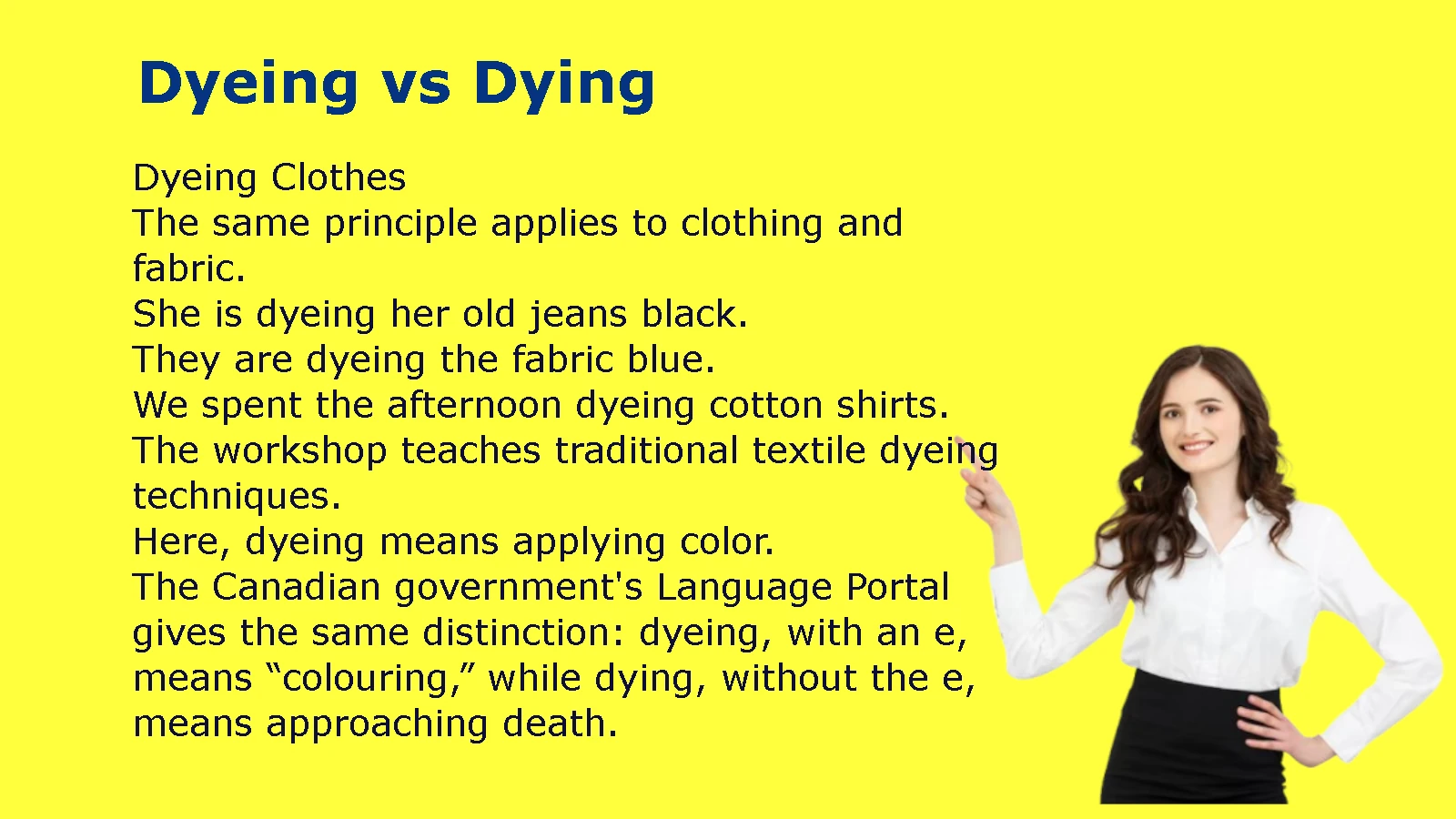
The same principle applies to clothing and fabric.
- She is dyeing her old jeans black.
- They are dyeing the fabric blue.
- We spent the afternoon dyeing cotton shirts.
- The workshop teaches traditional textile dyeing techniques.
Here, dyeing means applying color.
The Canadian government’s Language Portal gives the same distinction: dyeing, with an e, means “colouring,” while dying, without the e, means approaching death.
What Does Dying Mean?
Dying is the present participle of die.
The basic meaning is the process of stopping being alive or approaching death. Cambridge lists dying as the present participle of die.
Examples include:
- The injured animal is dying.
- The patient was dying.
- The flowers are dying.
- The old tree is dying.
- The fish were dying because of the lack of oxygen.
The word can also have broader or figurative meanings.
For example, English uses dying to describe something that is gradually disappearing, becoming weaker, or reaching its end:
- The tradition is dying.
- The industry is dying.
- The fire is dying down.
- The sound was dying away.
Cambridge also records expressions such as dying moments, dying seconds, and dying minutes for the final part of an event.
Dying Does Not Always Refer Directly to a Person
A common misconception is that dying can only describe a person or animal.
English uses the word more broadly.
For example:
The flowers are dying.
The flowers are living organisms, so the literal meaning applies.
But:
The fire is dying down.
Here, dying is figurative. The fire is becoming weaker rather than literally experiencing death.
Similarly:
The old tradition is dying.
This means the tradition is gradually disappearing or becoming much less common.
Dyeing vs Dying: What Is the Difference?
The core distinction is simple:
Dyeing comes from dye.
Dying comes from die.
The meanings are unrelated.
| Feature | Dyeing | Dying |
| Base verb | dye | die |
| Meaning | Changing color | Approaching death or ending |
| Common context | Hair, fabric, clothing | People, animals, plants, things ending |
| Example | She is dyeing her hair. | The plant is dying. |
| Pronunciation | Same as dying | Same as dyeing |
| Spelling | Contains e | Does not contain e |
This is why replacing one with the other can dramatically change the meaning of a sentence.
Compare:
- She is dyeing her hair. → She is changing its color.
- She is dying. → She is approaching death.
The difference is only one letter, but the meaning is completely different.
Why Is It Dyeing and Not Dieing?
This is one of the most important spelling questions surrounding dyeing vs dying.
The answer begins with the two different base verbs:
dye + ing = dyeing
die + ing = dying
The forms are not created from the same root.
The verb dye keeps its spelling when the -ing ending is added:
dye → dyeing
The verb die, however, changes its ie to y before -ing:
die → dying
This is a recognized English spelling pattern. The same type of change appears in words such as:
- lie → lying
- tie → tying
- die → dying
That is why the standard spelling is dying, not dieing, when you mean the ordinary present participle of die.
The Canadian Language Portal directly distinguishes dyeing from dying, while Cambridge dictionaries list dying as the present participle of die.
The Two Patterns Side by Side
Think of them as separate word families:
Color family
dye → dyeing → dyed
Death family
die → dying → died
This is much easier to remember than trying to memorize the spelling of dyeing and dying as isolated words.
Dyeing vs Dying Pronunciation
Dyeing and dying are homophones in standard English. That means they have the same pronunciation even though they have different spellings and meanings.
Both are pronounced with the same basic sound represented by /daɪ.ɪŋ/ in dictionary pronunciation.
The spelling therefore cannot be determined from hearing the word alone.
For example, if someone says:
“She is dyeing her hair.”
you cannot identify the spelling merely from the sound. You need the context to know that the speaker means changing hair color.
Likewise:
“The plant is dying.”
The surrounding meaning tells you that the correct spelling is dying.
This is an important example of why English contains many words that require context to distinguish them.
Dyeing Hair vs Dying Hair
The phrase dyeing hair is one of the most common places where this spelling difference matters.
Dyeing Hair Is Correct When You Mean Coloring Hair
Use dyeing when someone is changing the color of their hair.
Examples:
- I am dyeing my hair black.
- She is dyeing her hair red.
- He is dyeing his hair for the first time.
- The stylist is dyeing her hair blonde.
- They were dyeing their hair at home.
Cambridge specifically gives dyeing as the present participle of dye and provides hair-color examples for the verb.
Dying Hair Has a Different Meaning
The expression dying hair is grammatically possible if dying genuinely means approaching death and hair is being used in a context that supports that interpretation, but it does not mean coloring hair.
For the ordinary hair-coloring action, write:
I am dyeing my hair.
Do not write:
I am dying my hair.
The second sentence changes the intended word from dye to die.
A Simple Test for Hair
Ask yourself:
Am I changing the color?
If the answer is yes, use:
dyeing
If you mean approaching death, use:
dying
That one question resolves most hair-related spelling mistakes.
Dyeing Clothes vs Dying Clothes
The same distinction applies to clothing.
If you are changing the color of a shirt, dress, pair of jeans, or other garment, use dyeing.
Correct:
- She is dyeing her jeans black.
- We are dyeing the shirts blue.
- He enjoys dyeing old clothes.
- They are dyeing the fabric a darker shade.
Incorrect for the intended coloring meaning:
- She is dying her jeans black. ❌
- We are dying the shirts blue. ❌
The problem is not grammar. The problem is the word choice.
The verb die does not mean “change color.” The verb dye does.
Why Context Matters
Consider:
The clothes are dying.
That sentence does not communicate the ordinary idea of coloring clothes. It sounds like the clothes are being described as if they were living things.
Now compare:
The clothes are dyeing.
This is also awkward in many contexts because dye is normally transitive: someone dyes something.
A more natural sentence would be:
She is dyeing the clothes.
or:
The clothes are being dyed.
This illustrates another useful point: choosing the right spelling is only part of writing a natural sentence. Grammar and meaning still need to fit the context.
Die or Dye: What Is the Difference?
Understanding die and dye makes dyeing vs dying much easier.
| Word | Part of speech | Meaning | Example |
| Die | Verb | To stop being alive | The plant may die without water. |
| Dye | Verb | To change the color of something | They dye the fabric red. |
| Dye | Noun | A substance used to change color | The dye produced a deep blue. |
Cambridge defines die as stopping being alive and dye as changing the color of something using a coloring substance.
The spelling distinction becomes obvious when the words are placed side by side:
die → dying
dye → dyeing
If the action involves color, think dye.
If the action involves death, think die.
Dyeing vs Dying vs Dieing at a Glance
The third spelling deserves attention because many people wonder whether dieing is correct.
| Spelling | Standard everyday use? | Meaning |
| dyeing | Yes | Coloring something |
| dying | Yes | Approaching death or coming to an end |
| dieing | Generally no | Usually treated as a misspelling in ordinary writing |
For standard English, the practical rule is:
Use dyeing for color.
Use dying for death or decline.
Avoid dieing in ordinary writing.
LanguageTool notes that dieing is not listed as the standard present participle of die in major dictionaries and recommends dying for the ordinary meaning.
Can Dieing Ever Appear?
There is a narrow complication involving the noun die.
In manufacturing, a die is a tool used to cut, shape, form, or otherwise work with material. Some historical or specialized sources have used dieing in connection with such technical processes.
However, this is not the spelling ordinary writers need when discussing someone or something approaching death.
For everyday English:
The patient is dying.
not:
The patient is dieing.
Likewise:
The tree is dying.
not:
The tree is dieing.
Treating dieing as the normal present participle of die will lead to a spelling error in standard contemporary writing.
Common Mistakes With Dyeing and Dying
Writing Dieing Instead of Dying
This is probably the most straightforward spelling mistake.
Incorrect:
The flowers are dieing.
Correct:
The flowers are dying.
The base verb is die, and its standard present participle is dying.
Writing Dying Instead of Dyeing
This mistake usually appears when someone is talking about hair or clothing.
Incorrect:
She is dying her hair purple.
Correct:
She is dyeing her hair purple.
The intended base verb is dye, not die.
Confusing Die and Dye
Sometimes the easiest way to fix the mistake is to go back to the root word.
Ask:
Is the action about death?
Use die → dying.
Is the action about color?
Use dye → dyeing.
Assuming the Extra E Is Optional
The e in dyeing is not an optional spelling variation.
Compare:
- dyeing hair = changing hair color
- dying = approaching death
Removing the e changes the word.
How to Remember Dyeing vs Dying
A simple memory rule works well:
Dyeing = dye + ing = color
Dying = die + ing = death
You can also remember the two base verbs:
DYE has an E for extra color.
That is not a grammatical rule, but it can serve as a practical memory aid.
For the other word, remember:
die → dying
not:
die → dieing
The related forms lie → lying and tie → tying can also help you remember the ie → y spelling pattern.
Dyeing vs Dying Examples in Sentences
Examples With Dyeing
Here are natural examples involving color:
- She is dyeing her hair for the wedding.
- I spent Saturday dyeing an old jacket.
- They are dyeing the fabric green.
- The artist is dyeing the yarn with natural colors.
- He learned the basics of textile dyeing.
- We are dyeing Easter eggs this afternoon.
- The stylist finished dyeing my hair.
- She enjoys dyeing clothes different colors.
In every example, the action involves changing color.
Examples With Dying
These examples involve death, decline, or an ending:
- The plant is dying because it has not received enough water.
- The injured bird was dying.
- The flowers are dying in the heat.
- The old tree is dying.
- The fire is dying down.
- The tradition is slowly dying out.
- The battery is dying.
- The sound was dying away.
The meaning can therefore be literal or figurative.
A Useful Side-by-Side Exercise
Look at these pairs:
| Color meaning | Death/end meaning |
| She is dyeing her hair. | The plant is dying. |
| They are dyeing the fabric. | The flowers are dying. |
| He is dyeing his shirt. | The battery is dying. |
| We are dyeing the yarn. | The fire is dying down. |
| She enjoys dyeing clothes. | The tradition is dying out. |
The context makes the correct spelling clear.
Dyeing vs Dying in Different Contexts
Hair and Beauty
Use dyeing when someone changes hair color.
She is dyeing her hair blonde.
This is one of the most common uses of the word.
Clothing and Textiles
Use dyeing for changing the color of fabric, clothing, yarn, and related materials.
The workers are dyeing the fabric.
Plants and Nature
Use dying when a plant or other living organism is approaching death.
The flowers are dying.
People and Animals
Use dying for someone or something approaching death.
The animal is dying.
Objects and Figurative Uses
English can also use dying for things that are weakening or coming to an end.
Examples include:
- a dying industry
- a dying tradition
- a dying fire
- dying light
- dying sound
- dying moments
Cambridge specifically records figurative uses involving things becoming less common or important, as well as expressions referring to the final moments of an event.
Is Dyeing Correct?
Yes.
Dyeing is the correct word when you mean changing the color of something.
Examples:
- She is dyeing her hair.
- He is dyeing his clothes.
- They are dyeing the fabric.
- The company specializes in textile dyeing.
The word is not a misspelling of dying. It is a separate word derived from dye. Cambridge explicitly lists dyeing as the present participle of dye.
Is Dying Correct?
Yes.
Dying is the standard present participle of die.
Examples:
- The man is dying.
- The animal is dying.
- The plant is dying.
- The flowers are dying.
The word also appears in figurative expressions:
- The business is dying.
- The tradition is dying.
- The fire is dying down.
- The industry is dying.
Cambridge identifies dying as the present participle of die.
Is Dieing Correct?
For ordinary English, dieing is generally not the spelling you want.
If you mean that someone or something is approaching death, use:
dying
If you mean changing color, use:
dyeing
The spelling dieing can occur in rare or specialized technical contexts associated with a manufacturing die, but this is not the normal form of die + -ing used in everyday English.
For school assignments, professional writing, articles, emails, and ordinary conversation, the practical choices are straightforward:
- Dyeing for coloring
- Dying for death or decline
A Real-World Spelling Case Study: Hair Color
Consider a person writing this sentence:
I am dying my hair tomorrow.
The writer probably means that they plan to change their hair color.
The problem becomes clear when we identify the base verb. The intended verb is dye, not die.
Therefore:
I am dyeing my hair tomorrow.
is the correct sentence.
Now consider:
My houseplant is dying.
Here, the intended verb is die. The plant is losing life, so:
dying
is correct.
The two sentences differ by only one letter, but identifying the base verb immediately resolves the spelling.
A Second Case Study: Clothing
Suppose someone writes:
She is dying her wedding dress blue.
If the intended meaning is that she is changing the color of the dress, the correct sentence is:
She is dyeing her wedding dress blue.
The word dyeing signals the use of dye or a coloring process.
By contrast, if someone says:
The flowers in the garden are dying.
there is no coloring action. The flowers are losing their life.
The distinction is therefore based on meaning, not pronunciation.
Facts to Remember About Dyeing vs Dying
Keep these facts in mind:
- Dyeing is the present participle of dye.
- Dying is the present participle of die.
- Dyeing relates to changing color.
- Dying normally relates to death, decline, disappearance, or an ending.
- Dyeing and dying are pronounced the same in standard English.
- Dieing is generally not the standard everyday spelling for the present participle of die.
- The standard form is die → dying.
- Hair and clothing are common contexts for dyeing.
- People, animals, plants, batteries, fires, traditions, and industries can all be described with dying, depending on context.
- There is no ordinary American-versus-British spelling difference between dyeing and dying. Both varieties use these forms for the same meanings.
Frequently Asked Questions About Dyeing vs Dying
Is it dyeing or dying hair?
Use dyeing when you mean changing the color of someone’s hair.
Correct: She is dyeing her hair.
Dying refers to approaching death, so it does not express the normal hair-coloring meaning.
Is it dyeing or dying clothes?
Use dyeing when you mean changing the color of clothes.
Correct: They are dyeing their clothes black.
Why is it dying and not dieing?
The standard present participle of die is dying. The spelling changes from ie to y before -ing.
Thus:
die → dying
not:
die → dieing
Is dyeing a correct word?
Yes. Dyeing is the present participle of dye and means changing the color of something. Cambridge dictionaries explicitly list dyeing as the present participle of dye.
Are dyeing and dying pronounced the same?
Yes. They are homophones in standard English. Both have the basic pronunciation /ˈdaɪ.ɪŋ/.
What is the difference between die and dye?
Die means to stop being alive.
Dye means to change the color of something.
Their -ing forms are therefore:
die → dying
dye → dyeing
Can dieing ever be correct?
Rare technical uses related to a manufacturing die can be found, but dieing is not the standard everyday form of die meaning to approach death. In ordinary writing, use dying for that meaning.
Is dying correct in both American and British English?
Yes. Dying is the standard spelling in both major varieties of English when it is the present participle of die. The spelling does not change between American and British English for this word.
How can I remember dyeing vs dying?
Remember the base verbs:
dye → dyeing = color
die → dying = death
If you are talking about changing someone’s hair color or coloring fabric, the word needs the e: dyeing.
If you mean approaching death or coming to an end, use dying.
Dyeing vs Dying: Final Rule
The difference between dyeing vs dying is simple once you connect each word to its base verb.
Dyeing comes from dye and means changing the color of something.
She is dyeing her hair.
Dying comes from die and means approaching death or, in broader contexts, gradually ending or disappearing.
The flowers are dying.
The spelling dieing is generally not the standard form you should use for the ordinary verb die. If your sentence is about death, write dying. If it is about color, write dyeing.
The quickest test is to ask yourself what action you mean:
Color → dyeing
Death or ending → dying
Once you identify the base verb, the spelling becomes much easier to choose correctly.