Century or Centuary is a common spelling question that comes up when writing about periods of 100 years, historical eras, or specific dates in time. If you’ve wondered whether “century” or “centuary” is the correct spelling, the answer is straightforward: century is the correct spelling, while centuary is a misspelling. The word is commonly used when discussing history, time periods, years, decades, historical events, and long spans of time.
The century meaning refers to a period of 100 years. For example, the years from 1901 through 2000 make up the 20th century. The spelling “centuary” is incorrect and should not be used in standard English. Although the misspelling may occur because of the way century sounds when pronounced, it does not appear as the standard spelling of the word.
In this guide, you’ll learn whether “century” or “centuary” is correct, what century means, why “centuary” is a common misspelling, how to pronounce and spell “century” correctly, and how to use the word in sentences. You’ll also see clear examples to help you remember the correct spelling.
By the end, you’ll know exactly why century is correct and how to use this word naturally and correctly in your writing.
Century or Centuary: Quick Answer
If you only need the answer, use century.
| Spelling | Correct? | Meaning | Example |
| Century | ✅ Yes | A period of 100 years | The building is more than a century old. |
| Centuary | ❌ No | Not the standard English spelling | Do not use centuary in formal writing. |
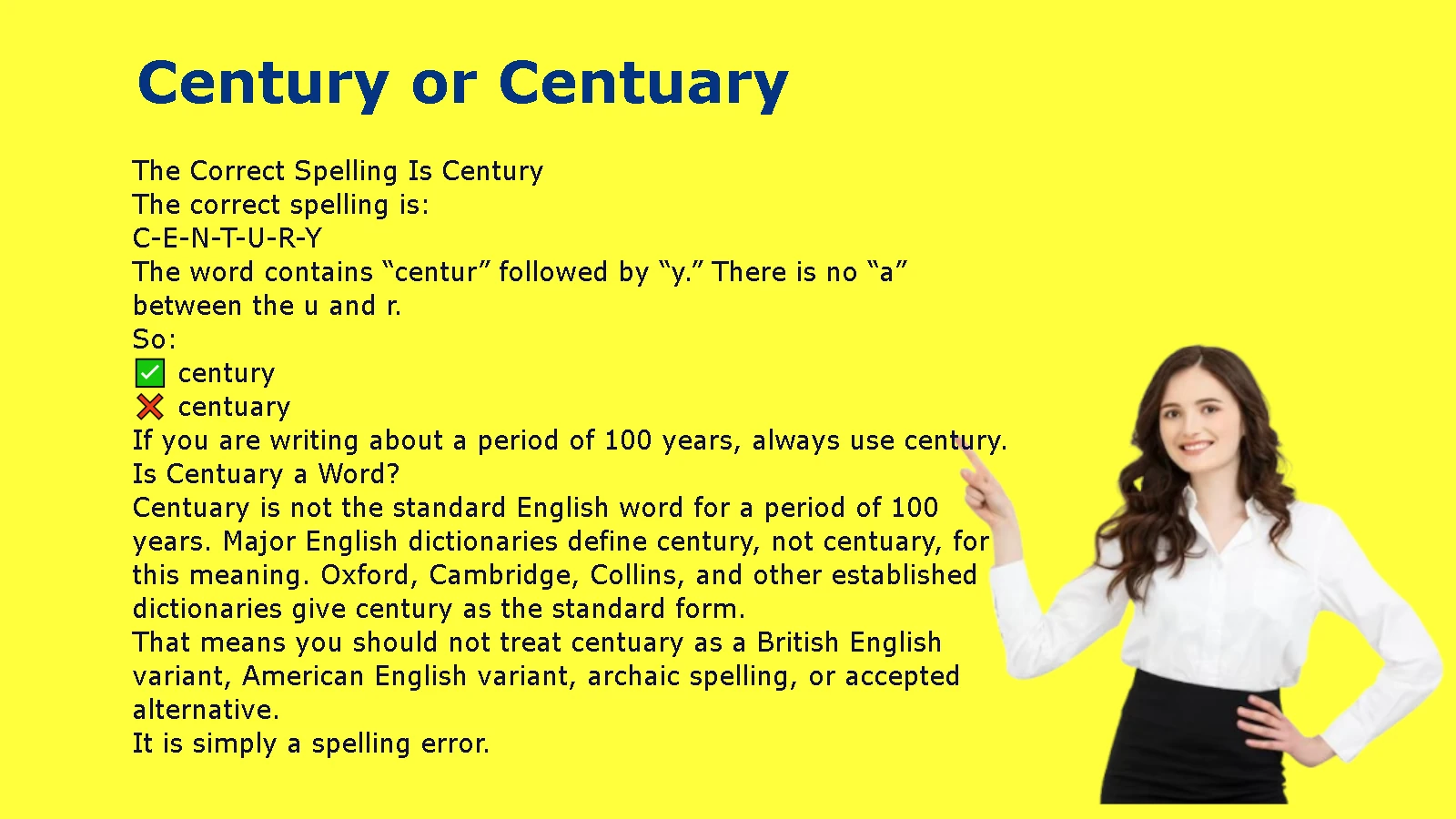
The Correct Spelling Is Century
The correct spelling is:
C-E-N-T-U-R-Y
The word contains “centur” followed by “y.” There is no “a” between the u and r.
So:
- ✅ century
- ❌ centuary
If you are writing about a period of 100 years, always use century.
Is Centuary a Word?
Centuary is not the standard English word for a period of 100 years. Major English dictionaries define century, not centuary, for this meaning. Oxford, Cambridge, Collins, and other established dictionaries give century as the standard form.
That means you should not treat centuary as a British English variant, American English variant, archaic spelling, or accepted alternative.
It is simply a spelling error.
What Does Century Mean?
The most common meaning of century is a period of 100 years.
For example:
- 100 years = one century
- 200 years = two centuries
- 300 years = three centuries
You can use century for an arbitrary period of 100 years or for a numbered historical/calendar period.
For example:
The company has existed for a century.
Here, a century means any period of 100 years.
You can also say:
The museum focuses on art from the 19th century.
Here, 19th century refers to a specific numbered historical period.
Oxford defines century as a period of 100 years and also records its specialized cricket meaning.
Century Definition
A simple definition is:
Century: a period of 100 years.
The plural is centuries.
Examples include:
- The castle is several centuries old.
- The tradition has continued for a century.
- The 20th century brought enormous technological change.
- The artifact dates from the 17th century.
The word can therefore describe both an exact 100-year duration and a conventional historical period.
Century as a General Period of 100 Years
A century does not always have to correspond to a numbered calendar century.
For example:
The company operated for a century before closing.
This simply means that it operated for 100 years.
Likewise:
The town changed dramatically over the past century.
This refers broadly to the previous 100 years.
The important idea is that a century consists of 100 consecutive years.
Why Is Centuary Incorrect?
The spelling centuary is incorrect because the standard English word is century.
The difference is only one letter, but that letter changes the spelling from the accepted form to a misspelling:
century → correct
centuary → incorrect
There is no need to add an a before the final ry.
Why Do People Spell Century as Centuary?
One likely reason is that century is not spelled exactly as it sounds.
Depending on accent and speaking speed, the middle of the word can be difficult to distinguish. English learners may therefore insert an a because they expect the sound to correspond more directly to the letters.
Compare:
century
with:
centuary
The second version may look plausible at first glance, but it is not the standard spelling.
Another reason is that English contains many words ending in -ary, such as:
- dictionary
- vocabulary
- necessary
- ordinary
- imaginary
This can make centuary look familiar even though the correct ending is -ury.
The safest approach is simply to memorize the standard spelling:
century = c-e-n-t-u-r-y
Century Does Not Have an “A” Before the R
A common visual mistake is to turn:
century
into:
centuary
The extra a is unnecessary.
If you frequently make this error, focus on the middle of the word:
cent-ur-y
rather than:
cent-u-ar-y
That small distinction can make the correct spelling easier to remember.
Century Meaning and Examples
The word century appears in everyday writing, historical discussions, academic texts, news articles, and sports reporting.
Here are some natural examples.
Examples of Century in a Sentence
The building has stood in the city for more than a century.
This means the building has existed for more than 100 years.
The 20th century saw enormous advances in medicine and technology.
Here, 20th century refers to a specific historical period.
The family has lived in the region for centuries.
The plural centuries means many periods of 100 years.
The museum contains paintings from the 18th century.
This identifies the historical period in which the paintings were created.
The company celebrated its centenary after a century of operation.
Here, centenary refers to the 100th anniversary, while century refers to the 100-year period.
Century in Everyday Time Expressions
You will often see century in expressions such as:
- a century ago
- for a century
- over the past century
- for centuries
- the next century
- the previous century
- the 20th century
- the 21st century
- the turn of the century
For example:
The railway has connected the two cities for nearly a century.
Or:
Several centuries of history are preserved in the old city.
These are ordinary, standard uses of the word.
Century vs. Centuary: Common Spelling Mistakes
Because centuary differs from century by only one letter, the mistake can easily appear in informal writing.
Here are some common errors and their corrections:
| Incorrect | Correct |
| centuary | century |
| Centuary | Century |
| 21st centuary | 21st century |
| a centuary ago | a century ago |
| one centuary | one century |
| several centurys | several centuries |
| two centuarys | two centuries |
Notice that there are actually two different spelling issues here.
The first is:
centuary → century
The second is the plural:
centurys → centuries
Learning both forms will prevent several common mistakes.
What Is the Plural of Century?
The plural of century is centuries.
It is not centurys.
Century → Centuries
The spelling changes when the word becomes plural:
century → centuries
This follows a common English spelling pattern for nouns ending in a consonant followed by y.
Examples include:
- city → cities
- country → countries
- story → stories
- century → centuries
So you should write:
The tradition has survived for centuries.
Not:
The tradition has survived for centurys.
Examples of Centuries in a Sentence
The ruins have survived for centuries.
Artists from several centuries are represented in the collection.
The two civilizations interacted over several centuries.
The tradition has been passed down through centuries of change.
The plural centuries means more than one century, or more generally, more than one period of 100 years.
The 20th Century and 21st Century
One of the most common sources of confusion involving the word century is the numbering of centuries.
It may seem logical to assume that the 20th century was the years 1900–1999 and the 21st century was 2000–2099.
Strictly speaking, that is not how numbered centuries work.
When Did the 20th Century Begin?
The 20th century began in 1901 and ended in 2000.
The reason is that the first century began with year 1, not year 0.
The sequence works like this:
| Century | Years |
| 1st century | 1–100 |
| 2nd century | 101–200 |
| 3rd century | 201–300 |
| 18th century | 1701–1800 |
| 19th century | 1801–1900 |
| 20th century | 1901–2000 |
| 21st century | 2001–2100 |
Collins gives the same strict chronological calculation, identifying AD 1801–1900 as the 19th century.
Why Did the 21st Century Begin in 2001?
The 21st century began on January 1, 2001, and will end on December 31, 2100.
This sometimes surprises people because the year 2000 was widely celebrated as the beginning of the new millennium and associated with the beginning of the 21st century.
However, under the conventional numbering system, there was no year zero in the sequence used to number these centuries.
The first century covered years 1 through 100. Therefore:
- 1st century = 1–100
- 2nd century = 101–200
- …
- 20th century = 1901–2000
- 21st century = 2001–2100
So if you are writing a history article or academic paper, 2001 is the correct beginning of the 21st century.
How to Use Century Correctly
The word century is a noun, and it commonly appears in several grammatical constructions.
Using “A Century”
Use a century when referring to a period of 100 years.
Examples:
The church has stood here for a century.
The tradition has survived for a century.
The company has been operating for almost a century.
You can also use numerical expressions:
The agreement lasted for one century.
Although a century and one century can have essentially the same meaning, a century is usually more natural in ordinary conversation.
Using “Centuries”
Use centuries when referring to multiple periods of 100 years.
Examples:
Humans have developed new technologies over centuries.
The ruins have remained hidden for centuries.
The tradition has changed considerably over the centuries.
The phrase over the centuries is especially common when describing gradual historical change.
Using “The 20th Century”
Use a numbered century when referring to a conventional historical period.
Examples:
The automobile transformed society during the 20th century.
Many influential artists worked during the 20th century.
The city experienced rapid growth during the 19th century.
When century follows an ordinal number such as 20th or 21st, it is normally written in lowercase unless it begins a sentence or appears in a title where capitalization is required by style.
Century in Different Contexts
Although the main meaning of century concerns time, the word has other established uses.
Century in History
The most familiar historical use is to describe a period of 100 years.
Historians frequently organize events according to centuries:
- 16th century
- 17th century
- 18th century
- 19th century
- 20th century
- 21st century
This makes it easier to discuss broad historical developments without listing individual years.
For example:
The Industrial Revolution transformed Britain during the 18th and 19th centuries.
The word is particularly useful when discussing long-term changes in politics, science, culture, economics, architecture, and technology.
Century in Cricket
Century also has a specific meaning in cricket.
A batter scores a century after making 100 runs in a single innings. Oxford and Cambridge both list this as an established sporting meaning of the word.
For example:
The batter scored a century in the second innings.
A century is an important milestone in cricket because reaching 100 runs represents a significant individual scoring achievement.
You may also encounter related expressions such as:
- half-century — 50 runs
- century — 100 runs
- double century — 200 runs
- triple century — 300 runs
The historical connection is interesting: the sporting meaning reflects the broader sense of century as a group or score of 100.
Century as a Group of One Hundred
The word can also refer more generally to a group or quantity of 100.
This meaning is less common in everyday modern English than the time-related meaning, but dictionaries record it.
For example, historical uses of century include groups of people or other things numbering 100.
The underlying idea remains the same:
century → hundred
Century Etymology and Word Origin
The origin of century helps explain why the word is associated with 100.
The English word comes through French from the Latin centuria, meaning a group or division of one hundred. Latin centuria is related to centum, meaning “hundred.”
This history is also connected with ancient Rome.
A centuria was a division associated with a hundred, particularly a military unit. Although the actual number of soldiers in a Roman military centuria was not always exactly 100 throughout Roman history, the term itself was based on the idea of a hundred.
Over time, the English word developed additional meanings.
Its modern sense of a period of 100 years became established in English centuries ago. Etymological sources date this specific time-period sense to the 17th century.
Century and the Latin Root for Hundred
The Latin root cent- appears in many English words associated with 100.
Consider:
- century — 100 years
- centennial — relating to 100 years or a 100th anniversary
- centenary — a 100th anniversary
- percent — per hundred
- cent — historically related to one hundredth
Recognizing cent- as a clue connected with 100 can make the meaning of century easier to remember.
Century vs. Centenary vs. Centennial
The words century, centenary, and centennial are closely related, but they are not identical.
| Word | Basic meaning | Example |
| Century | A period of 100 years | The building is a century old. |
| Centenary | A 100th anniversary | The school celebrated its centenary. |
| Centennial | Relating to a 100th anniversary or 100 years | The city held a centennial celebration. |
Century
A century is the period itself.
The organization has existed for a century.
The emphasis is on the 100-year period.
Centenary
A centenary is the 100th anniversary of an event or institution.
The university celebrated its centenary.
Here, the focus is on reaching the 100-year anniversary.
Centennial
Centennial is closely related to centenary and is particularly common in American English.
For example:
The town held a centennial celebration.
The word is associated with the 100th anniversary or a 100-year milestone. Dictionary sources trace centenary and centennial to roots associated with one hundred.
A useful way to remember the distinction is:
Century = 100 years
Centenary/centennial = 100-year anniversary or celebration
How to Remember the Correct Spelling of Century
If you often type centuary, use a simple spelling association.
Remember: Century Has No “A”
The easiest rule is:
Century has no “a” after the “u.”
Write:
C-E-N-T-U-R-Y
Not:
C-E-N-T-U-A-R-Y
You can also connect the word with its meaning:
cent- → hundred → century → 100 years
This gives you both the spelling and meaning at the same time.
Break the Word Into Parts
Instead of trying to remember the entire word as one unit, think:
cent + ury
That makes it easier to avoid inserting the extra a.
The correct form is:
cent-ury
not:
cent-u-ary
When proofreading, look specifically for the sequence “tuary.” If you see centuary, remove the a.
Century or Centuary: Practical Examples
The following examples show how the correct word works in different sentences.
| Incorrect Sentence | Correct Sentence |
| The building is a centuary old. | The building is a century old. |
| The tradition lasted for a centuary. | The tradition lasted for a century. |
| The museum displays 20th centuary artifacts. | The museum displays 20th-century artifacts. |
| The castle has survived for several centurys. | The castle has survived for several centuries. |
| He scored a centuary in the match. | He scored a century in the match. |
These examples reveal why correcting the spelling matters. The incorrect form can appear in otherwise perfectly understandable writing, but it is still not standard English.
A Quick Spelling Check for Century
Before publishing or submitting your writing, check these forms:
- century ✅
- centuries ✅
- 21st century ✅
- 20th-century literature ✅
- centuary ❌
- centurys ❌
- 21st centuary ❌
- several centurys ❌
Century as a Noun
Century is primarily a noun.
Examples:
A century has passed.
The century changed the way people lived.
The building is centuries old.
It can also appear in compound modifiers:
21st-century technology
19th-century architecture
In expressions such as 21st-century technology, 21st-century functions adjectivally to describe the noun that follows it.
Common Questions About Century or Centuary
Is Century or Centuary Correct?
Century is correct.
Centuary is a misspelling and should not be used as the standard spelling of the word.
How Do You Spell Century?
The correct spelling is:
C-E-N-T-U-R-Y
The word is century, not centuary.
Is Centuary a Word?
Centuary is not the standard English spelling for a period of 100 years. If you mean a period of 100 years, use century.
What Does Century Mean?
A century is a period of 100 years.
The word can also have specialized meanings, including a score of 100 runs by a batter in cricket.
What Is the Plural of Century?
The plural of century is centuries.
For example:
The tradition has existed for centuries.
Do not write centurys.
Is a Century Always 100 Years?
Yes. In its ordinary time-related sense, a century is a period of 100 years.
However, the starting point can vary when the word is used generally.
For example, 1850 to 1950 is a period of 100 years, so it can be described as a century-long period.
Numbered historical centuries have conventional boundaries based on the chronological numbering system.
When Did the 21st Century Begin?
The 21st century began on January 1, 2001, and ends on December 31, 2100.
What Is a Century in Cricket?
In cricket, a century is a score of 100 or more runs by one batter in a single innings.
For example:
The opening batter scored a century.
What Is the Difference Between Century and Centenary?
A century is a period of 100 years.
A centenary is the 100th anniversary of an event.
For example:
The organization has existed for a century.
versus:
The organization celebrated its centenary.
What Is the Difference Between Century and Centennial?
A century refers to a 100-year period.
Centennial generally describes something associated with a 100th anniversary or a 100-year milestone.
For example:
The bridge is a century old.
The city held a centennial celebration.
Century or Centuary: Final Verdict
When choosing between century or centuary, there is only one standard spelling you should use:
Century is Correct
Centuary is incorrect.
The word century means a period of 100 years. Its plural is centuries, and its meaning extends into several established contexts, including history and cricket.
The essential forms to remember are:
| Form | Correct Usage |
| century | Singular |
| centuries | Plural |
| 20th century | Historical period |
| 21st century | Current numbered century |
| centenary | 100th anniversary |
| centennial | Related to a 100th anniversary or 100 years |
| centuary | ❌ Incorrect |
| centurys | ❌ Incorrect |
The spelling becomes much easier once you connect the word with its underlying meaning:
Century = 100 years.
So, if you’re writing a sentence such as “The tradition has existed for more than a century,” century is the form you want.
And if you see “centuary,” correct it to “century.”