Dried out means having lost most or all of its moisture, usually because of heat, air, lack of water, or prolonged exposure. If you’ve come across the phrase “dried out” and wondered what it means, how it is used, or why something is described as dried out, the expression is closely connected to dryness, dehydration, moisture loss, water, heat, and changes in texture or condition.
The dried out meaning refers to something that has become very dry because its moisture has been removed or has evaporated. The phrase can describe food, plants, skin, soil, objects, or other materials, and it can also be used figuratively in some contexts. Terms such as dried, dry, dehydrated, parched, desiccated, withered, and moistureless are related, but they can have slightly different meanings and uses.
In this guide, you’ll learn what “dried out” means, how the phrase is used in sentences, what causes something to become dried out, and how “dried out” differs from related expressions such as “dry,” “dehydrated,” and “desiccated.” You’ll also see clear examples to make the meaning easy to understand.
By the end, you’ll know exactly what dried out means and how to use this common phrase naturally and correctly.
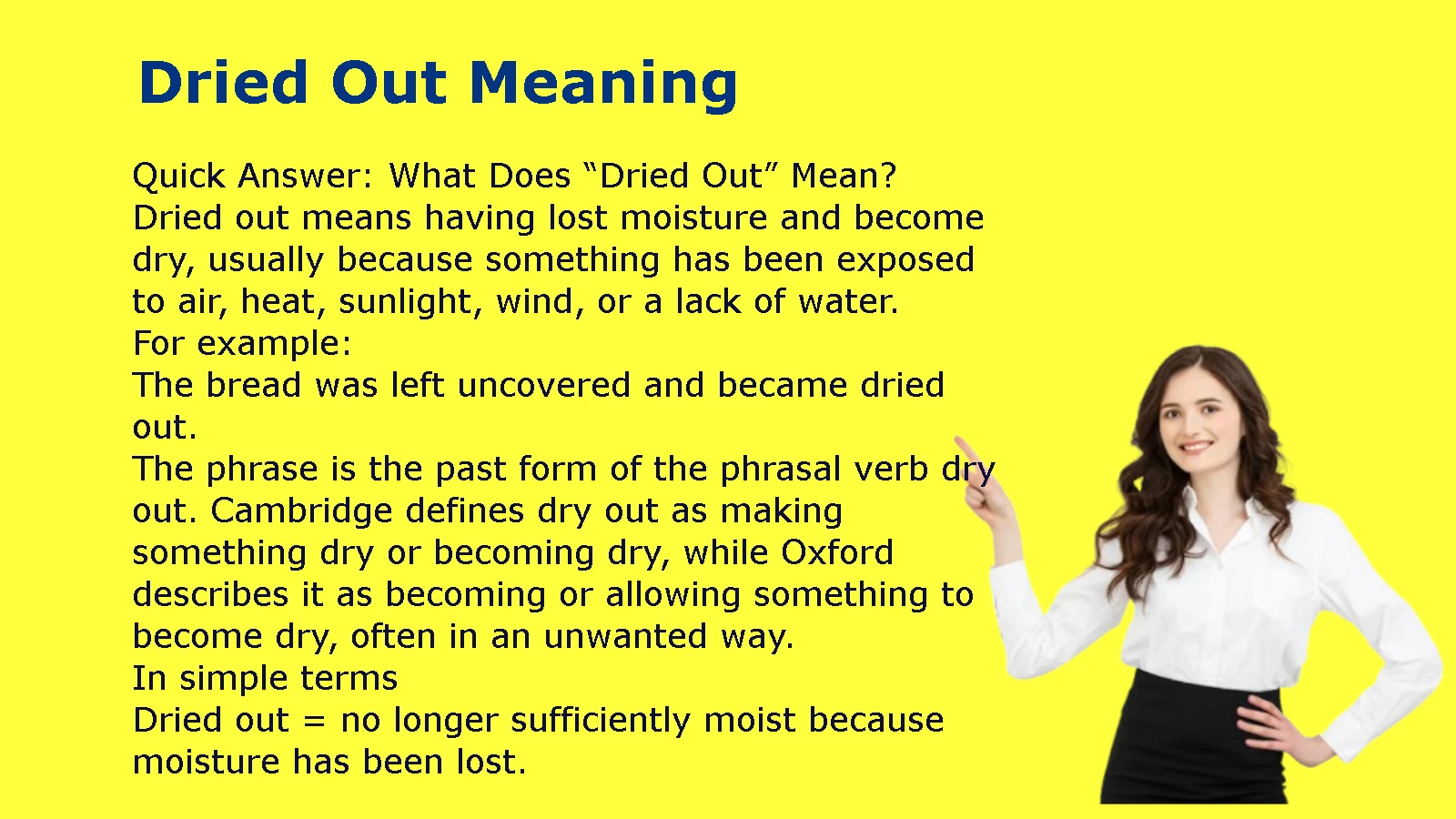
Quick Answer: What Does “Dried Out” Mean?
Dried out means having lost moisture and become dry, usually because something has been exposed to air, heat, sunlight, wind, or a lack of water.
For example:
The bread was left uncovered and became dried out.
The phrase is the past form of the phrasal verb dry out. Cambridge defines dry out as making something dry or becoming dry, while Oxford describes it as becoming or allowing something to become dry, often in an unwanted way.
In simple terms
Dried out = no longer sufficiently moist because moisture has been lost.
The exact meaning depends on the thing being described:
- Dried-out food has lost moisture and may become hard or unpleasant to eat.
- Dried-out soil has lost water and may become hard or dusty.
- Dried-out skin has lost moisture and may feel rough or tight.
- Dried-out paint has lost its liquid moisture and hardened.
- A dried-out plant has lost too much water and may wilt or die.
There is also an informal use connected with alcohol treatment. In that context, dry out means to stop drinking alcohol, usually after excessive or prolonged drinking.
What Does “Dried Out” Mean?
Dried out is the past tense or past participle form of dry out.
The basic verb dry means to become dry or make something dry. Oxford lists dried as the past simple and past participle form of dry.
Adding out creates the phrasal verb dry out. This often emphasizes the process of losing moisture, sometimes to an undesirable degree.
Compare these sentences:
- The towel dried quickly.
- The bread dried out after being left uncovered.
- The soil dried out during the hot weather.
- The paint dried overnight.
- The paint dried out inside the open container.
The second form can suggest that something became too dry or lost more moisture than intended.
Cambridge gives the basic meaning as “to make something dry, or to become dry.”
Literal meaning of dried out
The most common meaning is physical.
Something dried out has lost water or another form of moisture.
For example:
The riverbank had dried out after several weeks without rain.
The old leather had dried out and become stiff.
The cake was completely dried out after being left in the oven too long.
The phrase does not necessarily mean that an object contains absolutely no moisture. In ordinary use, it often means that the object has lost enough moisture to noticeably change its condition.
Why “out” matters
The word out gives the expression a stronger sense of moisture being removed or disappearing.
Consider:
- The towel is dry.
- The towel has dried out.
The first sentence simply describes the towel’s current condition. The second highlights a process in which moisture has been lost.
This distinction becomes especially useful when describing something that was previously moist:
The soil was damp yesterday, but it has dried out today.
Dried Out Meaning in English
In standard English, dried out is a normal and established expression. It is not simply a casual spelling variation or internet slang.
Dictionary definitions consistently connect dry out with becoming dry or causing something to become dry. Cambridge specifically gives the example of food drying out when it is not properly covered.
Oxford likewise describes dry out as becoming or allowing something to become dry, often in an unwanted way. Its examples include soil, skin, and wood.
This makes the expression especially common when talking about things that should retain moisture.
Examples of the ordinary meaning
- The bread has dried out.
- The grass has dried out in the heat.
- My skin gets dried out in winter.
- The paint has dried out inside the can.
- The soil became dried out after the drought.
- The meat was dried out because it was cooked too long.
- The wooden board had dried out in the sun.
In each case, the central idea is loss of moisture.
Dried Out Meaning in Different Contexts
The phrase appears in many everyday contexts. The basic meaning stays the same, but the practical result of losing moisture changes depending on the noun.
Dried Out Food Meaning
When food dries out, it loses moisture and can become hard, tough, chewy, crumbly, or less pleasant to eat.
This commonly happens with:
- Bread
- Cake
- Meat
- Cheese
- Cooked rice
- Pasta
- Fruit
- Pastries
- Leftovers
For example:
The chicken was safe to eat, but it had dried out in the refrigerator.
Cover the cake so it does not dry out.
The bread became dried out after several days.
Food can dry out because of exposure to air, prolonged heating, improper storage, or other conditions that allow moisture to escape.
Cambridge specifically uses uncovered food as an example of something that can dry out.
Dried Out Skin Meaning
Dried out skin means skin that has lost moisture and feels excessively dry.
For example:
The cold wind left my hands dried out.
This soap makes my skin feel dried out.
The expression is especially common when discussing environmental conditions. Cold weather, dry air, wind, and frequent washing can all be associated with dry-feeling skin.
Oxford gives skin as one of its examples of something that can dry out.
Dried Out Hair Meaning
Hair can also be described as dried out when it feels unusually dry, rough, or lacking moisture.
For example:
The heat left her hair feeling dried out.
Here, the phrase does not mean that the hair is literally devoid of all water. It describes its condition as noticeably dry.
Dried Out Soil Meaning
When soil dries out, it loses water and becomes increasingly dry.
For example:
The plants struggled because the soil had dried out.
Water the garden before the soil completely dries out.
This is one of the examples specifically used by Oxford to illustrate dry out.
Soil that has dried out may become hard, dusty, cracked, or difficult to work with, depending on its composition and environmental conditions.
Dried Out Plants Meaning
A plant can dry out when it loses too much water.
For example:
The flowers had dried out because nobody watered them.
The leaves started to curl after the plant dried out.
The phrase describes the plant’s loss of moisture. It does not automatically mean the plant has died.
A plant can be dried out without being completely dead, so the surrounding sentence matters.
Dried Out Paint Meaning
Paint can also dry out.
For example:
The paint in the open container had dried out.
In this context, the liquid portion of the paint has evaporated or otherwise been lost, leaving the remaining material hardened.
Notice the difference:
The paint dried on the wall.
This simply describes the paint becoming dry.
The paint dried out in the container.
This emphasizes unwanted loss of moisture that changed the paint’s condition.
Dried Out Wood Meaning
Wood can become dried out when it loses moisture.
For example:
The old wooden door had become dried out and brittle.
The wood was left outside until it had dried out.
The phrase is useful because it emphasizes the transition from a moister state to a drier one.
Dried Out as a Figurative Expression
The literal meaning is much more common, but dried out can sometimes be used figuratively.
In figurative writing, the expression can suggest that something has become depleted, lifeless, or lacking its former vitality.
For example:
After years of repeating the same idea, the campaign felt dried out.
His creativity seemed dried out after months of exhausting work.
These uses rely on the physical idea of something losing moisture and becoming less flexible or alive.
However, context matters. Not every figurative use is a fixed dictionary definition. Writers may create figurative expressions based on the ordinary meaning of dry out.
That is why it is better to interpret a figurative example from its sentence and surrounding context rather than assuming that dried out always has a special slang meaning.
Dried Out vs. Dry
Dried out and dry are closely related, but they do not always communicate exactly the same idea.
Dry is a broad adjective that describes something that is not wet or contains little or no moisture. Cambridge defines dry as describing something without water or another liquid in or around it.
Dried out focuses more strongly on the loss of moisture or the process that caused something to become dry.
| Expression | Main idea | Example |
| Dry | Not wet or moist | The towel is dry. |
| Dried out | Has lost moisture and become dry | The towel has dried out in the sun. |
| Drying | Currently becoming dry | The towel is drying. |
Compare:
The soil is dry.
This tells us about its condition.
The soil has dried out.
This emphasizes that the soil lost moisture and became dry.
Oxford lists dry as meaning not wet, damp, or sticky and without water or moisture.
Dried Out vs. Dry Up vs. Dry Off
These three expressions are easy to confuse because all involve dryness.
They are not interchangeable in every situation.
| Expression | Meaning | Example |
| dry out | Become or make something dry, often through loss of moisture | The soil has dried out. |
| dry up | Become completely dry; also describes a supply disappearing | The river dried up. |
| dry off | Remove moisture from a person or surface | Dry off with a towel. |
Dried out vs. dry up
Dry out normally focuses on something becoming dry through moisture loss.
The bread dried out.
Dry up can mean becoming completely dry, especially when discussing rivers, lakes, or other sources of water.
The river dried up during the drought.
Oxford also uses dry up for supplies that gradually disappear:
Funding for the project dried up.
It can also describe someone suddenly stopping speaking because they do not know what to say next.
So:
The soil dried out does not necessarily mean the same thing as the lake dried up.
Dried out vs. dry off
Dry off usually means to remove water or moisture from a surface, body, or object.
For example:
Dry off after your shower.
I dried off the wet table.
The focus is on removing moisture from something, often deliberately.
By contrast:
The table dried out.
This emphasizes that the table itself lost moisture and became dry.
Cambridge distinguishes dry out from dry off in its phrasal-verb listings.
Dried Out Synonyms
There is no single synonym that works perfectly in every sentence. The best alternative depends on what has dried and why.
Common synonyms and related words
- Dry — the broadest and simplest alternative
- Dehydrated — lacking water or having had water removed
- Desiccated — extremely dry; often more formal
- Parched — extremely dry, especially soil, land, or a person needing water
- Withered — shriveled or weakened, usually referring to plants
- Arid — extremely dry, usually describing land or climate
- Moistureless — lacking moisture, but relatively uncommon in everyday speech
- Depleted — useful in some figurative contexts, but not a direct synonym for physical dryness
Example comparisons
The fruit was dried out.
The fruit was dehydrated.
Both can work, but dehydrated can suggest a deliberate process of removing water, while dried out often describes an unwanted result.
Similarly:
The soil was dried out.
The soil was parched.
Both indicate dryness, but parched creates a stronger impression of extreme dryness.
Dried Out Antonyms
The opposite of dried out depends on the context.
Common opposites include:
- Moist
- Damp
- Wet
- Hydrated
- Fresh
- Moisturized
For example:
The soil was dried out after weeks without rain.
The soil was moist after the storm.
For food:
The cake was dried out.
The cake was moist.
The exact opposite is therefore not always simply wet. A cake, for example, can be moist without being wet.
Dried Out Meaning in Slang
Dried out is not primarily a slang expression. Its ordinary meaning is the standard meaning: to lose moisture and become dry.
However, the phrasal verb dry out has an established informal meaning related to alcohol use. Cambridge describes someone who dries out in this sense as stopping being dependent on alcohol, while Oxford labels this meaning informal.
For example:
He went to a clinic to dry out.
In this context, dry out does not mean that someone’s skin, clothes, food, or soil became dry. It refers to stopping alcohol use, generally in the context of treatment.
This meaning should not be confused with the ordinary physical meaning.
Two meanings of “dry out”
| Meaning | Example |
| Lose moisture | The leaves have dried out. |
| Informally stop drinking alcohol | He went away to dry out. |
The second meaning is context-dependent and should not be inserted into ordinary sentences about objects.
Dried Out Person Meaning
The phrase dried out person does not have one universal figurative definition.
If someone says:
He looked dried out after working outside all day.
The speaker may be describing a person who appears physically dehydrated or extremely dry.
In another context, someone might use dried out figuratively to describe a person who seems exhausted, depleted, or lacking energy. That interpretation comes from the surrounding context rather than from a single standard definition of dried-out person.
There is also the separate informal expression dry out, which can refer to alcohol treatment.
Therefore, context is especially important when the subject is a person.
Dried Out vs. Dried
The words dried and dried out are related, but the addition of out can change the emphasis.
Dried simply means that something has been made dry or has become dry.
The flowers were dried for decoration.
Here, drying may be intentional.
Dried out often suggests that something has lost moisture to an undesirable or excessive degree.
The flowers were left in the sun and became dried out.
The difference is subtle but useful.
Compare these examples
We dried the herbs before storing them.
This describes an intentional process.
The herbs dried out because they were stored incorrectly.
This suggests unwanted moisture loss.
That distinction is one reason dried out is especially common when describing food, skin, soil, wood, and other things that are expected to retain some moisture.
Dried Out in Sentences
Here are natural examples across several contexts:
Food
The bread became dried out after being left on the counter overnight.
The chicken was dried out because it was cooked too long.
Keep the cookies in an airtight container so they do not dry out.
Skin and hair
The cold weather left my hands dried out.
Her hair felt dried out after spending the afternoon in the sun.
Plants and soil
The soil had dried out before the next rainfall.
The flowers quickly became dried out without water.
Materials
The leather had become dried out and stiff.
The paint had dried out inside the uncovered container.
Figurative use
After years of repeating the same routine, his ideas felt dried out.
The discussion had become dried out and repetitive.
The final examples are figurative rather than literal. Their interpretation depends on context.
Common Mistakes With “Dried Out”
Confusing dried out with dry off
These expressions describe different actions.
Dry off means to remove moisture:
Dry out means to become dry or cause something to become dry:
The towel dried out in the sun.
Confusing dried out with dry up
A lake can dry up, while food can dry out.
The lake dried up during the drought.
The bread dried out after being left uncovered.
Although there can be overlap in some contexts, the expressions have different typical uses. Oxford specifically associates dry up with rivers and lakes becoming completely dry and with supplies gradually disappearing.
Assuming dried out always means completely dry
In everyday language, dried out often means that something has lost a significant amount of moisture. It does not necessarily mean that absolutely every trace of moisture has disappeared.
Treating dried out as a single word
The standard spelling is:
dried out
It consists of the past form dried plus the particle out.
Writing it as one word is incorrect in standard English.
Is “Dried Out” One Word or Two?
Dried out is written as two words.
The base expression is the phrasal verb dry out.
Its forms include:
| Form | Example |
| dry out | The soil may dry out. |
| dries out | The soil dries out quickly. |
| dried out | The soil has dried out. |
| drying out | The soil is drying out. |
Oxford identifies dry out as a phrasal verb, while its verb entry gives dried as the past simple and past participle of dry.
Therefore:
Correct: The bread has dried out.
Incorrect: The bread has driedout.
Is “Dried Out” Grammatically Correct?
Yes. Dried out is grammatically correct standard English.
It can appear in several sentence structures.
Intransitive use
The subject itself becomes dry:
The soil dried out.
The paint dried out.
The leaves dried out.
Transitive use
Someone or something causes another object to become dry:
The heat dried out the soil.
The wind dried out my skin.
Oxford and Cambridge both recognize dry out as both an intransitive and transitive phrasal verb.
Passive use
You can also use dried out in a passive construction:
The soil was dried out by the intense heat.
The herbs were dried out before being stored.
The passive construction focuses on the thing affected rather than the person or force causing the drying.
Case Study: “The Cake Dried Out”
Consider this short example:
Maya baked a cake in the afternoon. She left it uncovered overnight. By morning, the cake had dried out.
Why is dried out appropriate here?
The cake was originally moist. Exposure to air allowed it to lose moisture. The result was a cake that was noticeably drier than before.
Now compare:
Maya dried the cake.
That sentence sounds unnatural if the intended meaning is that the cake accidentally lost moisture. The verb dried can describe a deliberate drying process, but dried out better communicates the unwanted change in condition.
This illustrates an important usage principle:
“Dried out” often emphasizes an unwanted or excessive loss of moisture.
Oxford explicitly notes that dry out often describes becoming dry in a way that is not wanted.
Case Study: “The River Dried Up”
Now consider a different example:
The region experienced months of severe drought, and the small river eventually dried up.
Why not dried out?
Both expressions relate to dryness, but dry up is especially established for rivers, lakes, and other bodies or sources of water becoming completely dry.
Oxford gives rivers and lakes as a central example of dry up.
This gives us a useful rule:
- Food, soil, skin, wood, paint: often dry out
- Rivers, lakes, water sources: often dry up
- A wet person or surface: often dry off
These are patterns, not absolute rules, but they help you choose the natural expression.
How to Choose the Right Expression
When deciding whether to use dry, dried out, dry up, or dry off, ask what you are trying to describe.
If you are describing a condition
Use dry.
The towel is dry.
If something has lost moisture
Use dried out.
The bread has dried out.
If a water source has become completely dry
Use dried up.
The stream dried up.
If someone or something is having moisture removed
Use dry off.
Dry off before you put your clothes on.
This simple distinction handles many common usage questions.
Image Suggestions and Alt Text
A meaning article about dried out can benefit from simple visual examples rather than decorative stock images.
Suggested image
Image: A piece of fresh bread beside a hard, dried-out piece of bread.
Alt text: fresh bread compared with dried out bread
Suggested image
Image: Dry cracked soil beside moist soil.
Alt text: dried out soil compared with moist soil
Suggested image
Image: A simple comparison chart showing dry, dried out, dry up, and dry off.
Alt text: dried out meaning compared with dry dry up and dry off
These visuals directly support the meaning and usage of the target phrase.
Internal Link Opportunities
If this article is published on a word-meaning or grammar website, relevant internal links could point to existing pages about:
- Dry meaning
- Dry up meaning
- Dry off meaning
- Dried meaning
- Dehydrated meaning
- Desiccated meaning
Use descriptive anchor text that tells readers what the linked page covers. Avoid adding links simply to increase the number of internal links.
Frequently Asked Questions About Dried Out
What does dried out mean in English?
Dried out means that something has lost moisture and become dry. It commonly describes food, soil, plants, skin, hair, paint, wood, and other materials.
What does dried out mean in slang?
Dried out is not primarily slang. However, dry out has an established informal meaning related to stopping alcohol use, usually in the context of treatment for alcohol dependence.
What is another word for dried out?
Depending on context, possible alternatives include dry, dehydrated, desiccated, parched, and withered. These words are not interchangeable in every situation.
What does dried out mean when describing a person?
The meaning depends on context. It can describe someone who appears physically very dry or dehydrated, or it may be used figuratively to suggest exhaustion or a lack of vitality. It can also be confused with the separate informal expression dry out, which can refer to stopping alcohol use.
What is the difference between dried and dried out?
Dried can simply describe something that has been made dry, whether intentionally or naturally. Dried out more strongly emphasizes the loss of moisture and often suggests that the result is undesirable.
The herbs were dried for storage.
The herbs were dried out because they were left in the sun.
What is the difference between dried out and dry?
Dry describes a condition. Dried out emphasizes the process or result of losing moisture.
The towel is dry.
The towel has dried out.
What is the difference between dried out and dry up?
Dried out generally describes something losing moisture and becoming dry. Dry up is commonly used for rivers, lakes, and supplies that gradually disappear. Oxford gives both the water-source and supply meanings for dry up.
What is the difference between dried out and dry off?
Dry out means to become dry or make something dry. Dry off generally means to remove moisture from a person or surface.
The soil dried out.
Dry off with a towel.
Is dried out one word or two?
It is two words: dried out.
The base phrasal verb is dry out.
What does dry up mean?
Dry up can mean to become completely dry, especially when referring to a river or lake. It can also mean that a supply gradually disappears or that someone suddenly stops talking because they do not know what to say.
Conclusion
The main dried out meaning is straightforward: something has lost moisture and become dry.
The expression is commonly used for food, soil, plants, skin, hair, paint, wood, and other materials. It often emphasizes that moisture has been lost, sometimes in an undesirable way. Cambridge and Oxford both recognize dry out as a standard phrasal verb with this meaning.
The phrase also has an informal alcohol-related meaning when used as dry out, so context matters. That meaning should not be confused with ordinary statements about something becoming physically dry.
The easiest distinctions to remember are:
- Dry = not wet or moist.
- Dried out = has lost moisture and become dry.
- Dry up = become completely dry or gradually disappear.
- Dry off = remove moisture from something or someone.
Once you understand these differences, dried out becomes easy to use naturally and correctly in both everyday and formal English.