Futureproofed means designed, planned, or adapted to remain useful, effective, or successful despite future changes, challenges, or developments. If you’ve come across the word “futureproofed” and wondered what it means, how it is used, or what makes something future-proof, the term is closely connected to long-term planning, adaptability, technology, innovation, changing needs, and preparation for the future.
The futureproofed meaning refers to something that has been made or planned in a way that helps it continue working well as circumstances change. The word is often used for technology, businesses, skills, systems, products, buildings, careers, and strategies that are designed to cope with future developments. Related terms such as future-proof, adaptable, resilient, forward-looking, sustainable, and prepared for the future can have similar meanings but are not always interchangeable.
In this guide, you’ll learn what “futureproofed” means, how the word is used in sentences, what it means in different contexts, and how “futureproofed” differs from related expressions such as “future-proof,” “adaptable,” and “forward-looking.” You’ll also see clear examples to make the meaning easy to understand.
By the end, you’ll know exactly what futureproofed means and how to use this useful word naturally and correctly.
Quick Answer: What Does “Futureproofed” Mean?
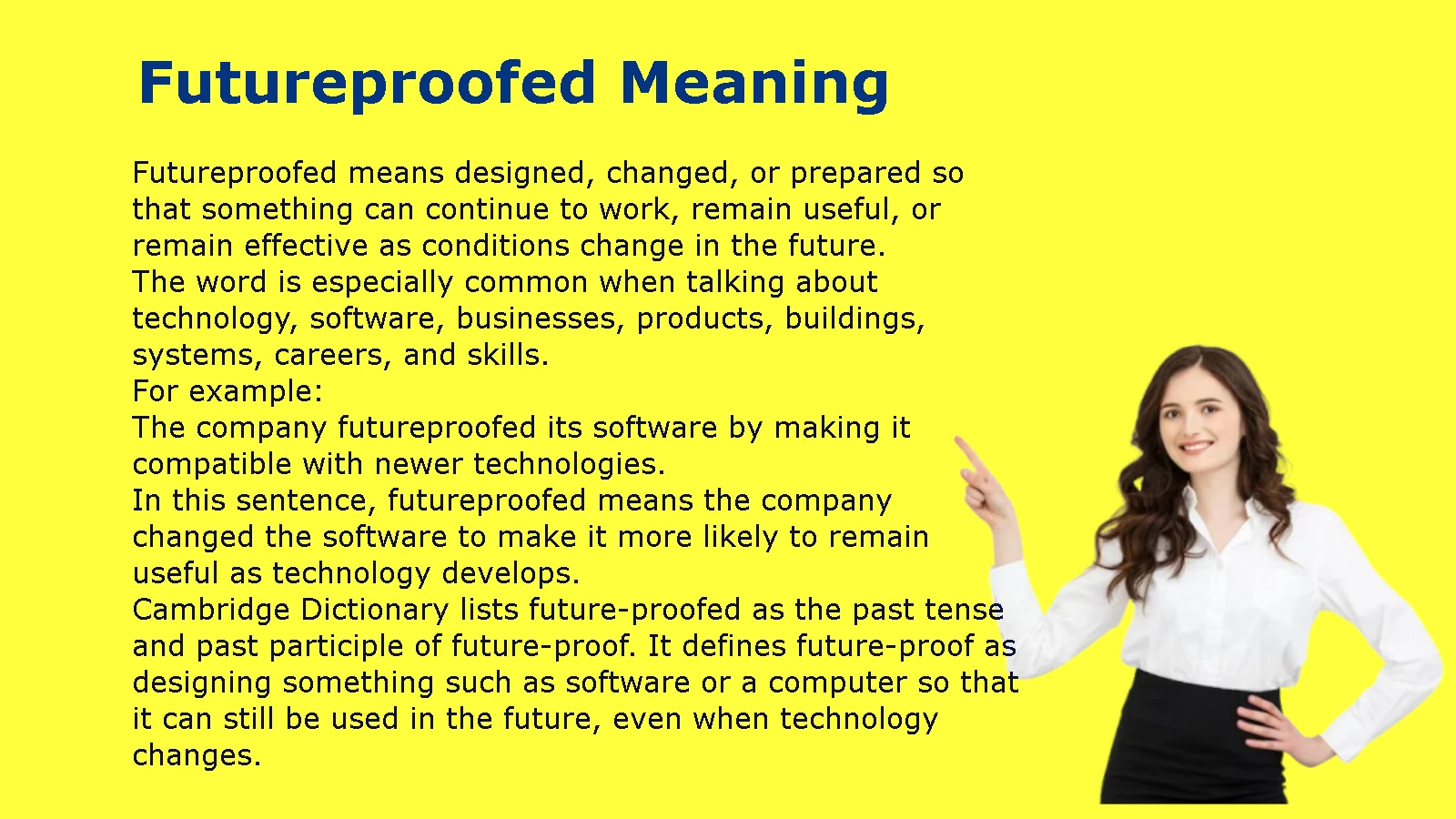
Futureproofed means designed, changed, or prepared so that something can continue to work, remain useful, or remain effective as conditions change in the future.
The word is especially common when talking about technology, software, businesses, products, buildings, systems, careers, and skills.
For example:
The company futureproofed its software by making it compatible with newer technologies.
In this sentence, futureproofed means the company changed the software to make it more likely to remain useful as technology develops.
Cambridge Dictionary lists future-proofed as the past tense and past participle of future-proof. It defines future-proof as designing something such as software or a computer so that it can still be used in the future, even when technology changes.
The term does not mean that something can never become outdated. It usually means that someone has taken steps to reduce the risk of future obsolescence or make adaptation easier.
What Does “Futureproofed” Mean?
Futureproofed is the past tense and past participle form of the verb future-proof.
In simple terms, if you futureproof something, you prepare it for changes that may happen later. If you have futureproofed something, those preparations have already been made.
Simple definition of futureproofed
Futureproofed means prepared or designed to remain useful, effective, adaptable, or functional despite likely changes in the future.
The exact meaning depends on what is being discussed.
For example:
- A futureproofed computer system is designed to accommodate technological changes.
- A futureproofed business has prepared for changing market conditions.
- A futureproofed career involves skills that can remain useful as the job market changes.
- A futureproofed building may include infrastructure that can accommodate future needs.
- A futureproofed product is designed with future updates, upgrades, or changing requirements in mind.
Oxford defines future-proof as something designed to continue working or remain effective after changes that may happen in the future.
What does futureproofed imply?
The word generally suggests three things:
- Something may change in the future.
- Someone has anticipated those changes.
- Steps have been taken to reduce their impact.
That is why futureproofed often appears in discussions about planning and adaptation.
Is “Futureproofed” a Word?
Yes, futureproofed is used as an English word form, although spelling conventions vary.
Major dictionaries recognize the underlying term future-proof. Cambridge lists future-proofed as the past tense and past participle of future-proof.
Collins also records future-proof and futureproof as forms of the verb, with future-proofed given as the past tense.
The most important point is that futureproofed, future-proofed, and future proofed are not equally standard in every context.
Futureproofed vs. future-proofed
Future-proofed is the clearest dictionary-supported form when you are using the established verb future-proof.
For example:
The network has been future-proofed for upcoming technology changes.
You will also encounter futureproofed, particularly because futureproof appears as an accepted alternative form in some dictionaries and real-world usage.
However, if your goal is conventional edited English, future-proofed is a safe and widely recognizable choice.
What about “future proofed”?
The open two-word form is much less suitable when you are treating the expression as a single verb.
Compare:
- The system was future-proofed. ✓
- The system was futureproofed. ✓ Used in some sources
- The system was future proofed. Less standard as a single verb
The hyphen helps readers immediately understand that future-proof functions as one compound verb.
Futureproofed Meaning in Simple Terms
Think of futureproofed as meaning made ready for what may come next.
Imagine buying a computer today. You could choose a system with enough capacity, upgrade options, current connections, and software compatibility to make future upgrades easier.
You have not guaranteed that the computer will work forever. Instead, you have reduced the chances that it will become unsuitable quickly.
That is the basic idea behind futureproofing.
A simple example
The company futureproofed its website by using a flexible content management system.
This does not mean the website will remain perfect forever.
It means the company designed the website in a way that should make it easier to accommodate future changes.
Another example
The school futureproofed its classrooms by installing infrastructure that can support newer digital equipment.
Again, the emphasis is on preparation and adaptability, not a guarantee about the future.
How to Use “Futureproofed” in a Sentence
The verb usually appears with an object.
Common patterns include:
Subject + futureproofed + object
The company futureproofed its operations.
Subject + has/have + futureproofed + object
The organization has futureproofed its technology infrastructure.
Object + was/were + futureproofed
The building was future-proofed during the renovation.
The word can also appear in passive constructions because the focus is often on the thing that received the preparation.
Futureproofed examples in everyday English
- We futureproofed the design so it can accommodate later changes.
- The renovation futureproofed the house for changing family needs.
- The manufacturer futureproofed the product with upgradeable components.
- They futureproofed the system before launching it.
- The new layout has futureproofed the workspace for expansion.
Futureproofed examples in business
Business uses the term when organizations prepare for changes in markets, technology, regulations, customer expectations, or operating conditions.
- The company futureproofed its business model before entering new markets.
- The retailer futureproofed its operations by expanding its digital sales channels.
- Management futureproofed the organization against changes in customer behavior.
- The firm futureproofed its supply chain by developing alternative suppliers.
- The new strategy was designed to futureproof the business against changing demand.
Futureproofed examples in technology
Technology is one of the most common contexts for this word.
- The developer futureproofed the software for new operating systems.
- The company futureproofed its network by allowing room for expansion.
- The IT team futureproofed the infrastructure before the upgrade.
- The device was designed to be future-proofed for newer standards.
- The organization has futureproofed its data architecture for increased demand.
Cambridge specifically connects future-proof with designing software and computers so they can continue to be used as technology changes.
Futureproofed examples for careers and skills
The expression can also describe professional preparation.
- She futureproofed her career by developing new technical skills.
- The training program was designed to futureproof employees’ skills.
- He futureproofed his career by learning how to work with emerging technologies.
- The company invested in training to futureproof its workforce.
Here, futureproofed does not mean a person has guaranteed permanent employment. It means the person or organization has taken steps to remain adaptable as work requirements change.
Futureproofed examples for products and systems
- The manufacturer futureproofed the device with upgradeable hardware.
- The software architecture was futureproofed for expansion.
- The new system was designed to be future-proofed against rapid technological changes.
- Engineers futureproofed the platform so additional features could be added later.
Futureproofed vs. Future-Proof vs. Future-Proofing
These three forms are closely related, but they have different grammatical roles.
| Form | Main function | Example |
| future-proof | Verb or adjective | We need to future-proof the system. |
| future-proofed | Past tense/past participle | We future-proofed the system. |
| future-proofing | Present participle/gerund | Future-proofing the system will take time. |
Future-proof
Future-proof can function as a verb.
The company wants to future-proof its technology.
It can also function as an adjective.
The company wants a future-proof technology platform.
Cambridge recognizes both the verb and adjective forms.
Oxford similarly defines future-proof as an adjective describing something designed to continue working or remain effective after future changes.
Future-proofed
Future-proofed refers to something that has already undergone the process.
The company future-proofed its technology.
Or:
The technology has been future-proofed.
Future-proofing
Future-proofing the network required additional planning.
Cambridge lists future-proofing as the present participle of future-proof.
The easiest way to remember the difference
Think about time:
- Future-proof = what you plan to do or what something is designed to be.
- Future-proofed = what you already did.
- Future-proofing = the process of doing it.
For example:
We will future-proof the system.
We future-proofed the system.
Future-proofing the system took six months.
What Does “Futureproofed” Mean in Different Contexts?
The core meaning remains the same, but the specific type of preparation changes according to the subject.
Futureproofed Technology
Technology changes quickly, so futureproofing often involves compatibility, scalability, flexibility, upgradeability, and interoperability.
A futureproofed system may be built so that new components can be added without replacing the entire system.
For example, software might use an architecture that allows developers to add new features later. A network might have capacity for additional devices. A hardware platform might support newer components.
The important idea is adaptability.
No technology can realistically guarantee immunity from every future development. Even a system designed carefully today may eventually become obsolete.
Futureproofed Businesses
A business can be futureproofed by preparing for changes rather than relying entirely on current conditions.
Possible areas include:
- technology
- customer behavior
- supply chains
- regulations
- competition
- workforce skills
- operating costs
- distribution channels
For example, a retailer that depends entirely on physical stores may expand its online capabilities to give customers another way to purchase products.
That does not guarantee future success. It simply gives the business more flexibility if customer behavior changes.
Futureproofed Careers
When people talk about a futureproofed career, they generally mean a career supported by adaptable and transferable skills.
Examples include:
- learning new software
- improving communication skills
- developing analytical abilities
- learning how to use emerging technologies
- gaining experience across multiple tasks
- keeping professional knowledge current
The expression should not be interpreted as a promise of permanent job security.
Futureproofed Products
A product can be futureproofed when its design anticipates likely changes in customer needs or technology.
Examples include:
- modular components
- upgradeable software
- expandable storage
- standardized connections
- replaceable components
- compatibility with newer systems
A product does not have to contain every possible future feature to be called future-proof. The key idea is that it has been designed with future change in mind.
Futureproofed Skills
Skills can be described as futureproofed when they are expected to remain useful across changing circumstances.
For example, a person might combine technical knowledge with:
- problem-solving
- communication
- critical thinking
- adaptability
- collaboration
- learning ability
Calling a skill “futureproofed” is still somewhat figurative because no skill can guarantee relevance indefinitely.
Is “Futureproofed” Hyphenated?
Future-proofed is the clearest conventional form when the verb is based on future-proof.
The underlying term is commonly written with a hyphen in major dictionaries.
Cambridge uses future-proof, future-proofed, and future-proofing in its entries.
Collins, however, records futureproof as an alternative spelling of future-proof.
This means you may encounter both forms in real English:
- future-proofed
- futureproofed
For edited content, consistency matters. If you choose the hyphenated form, use it consistently throughout a document.
Why the hyphen is useful
The hyphen makes the compound easier to parse.
Compare:
The company future-proofed its platform.
The reader can immediately identify future-proof as a single compound verb.
The same applies to:
a future-proof platform
Here, future-proof clearly acts as a compound adjective.
Is “Futureproofed” Grammatically Correct?
Yes, futureproofed is grammatically understandable and used as a past-tense or past-participle form of futureproof/future-proof.
However, future-proofed is the dictionary form you are likely to see in sources such as Cambridge.
As a past-tense verb
The engineers future-proofed the network.
The action happened in the past.
As a past participle
The network has been future-proofed.
Here, future-proofed works with has been in a passive construction.
As an adjective
Past participles can also function adjectivally.
We purchased a future-proofed system.
In this sentence, the expression describes the system rather than simply reporting an action.
Common grammatical patterns
| Pattern | Example |
| Past tense | They future-proofed the system. |
| Present perfect | They have future-proofed the system. |
| Passive | The system was future-proofed. |
| Adjectival | It is a future-proofed system. |
| Infinitive | They want to future-proof the system. |
| Gerund | Future-proofing the system was expensive. |
Futureproofed Synonyms and Similar Phrases
There is no single synonym that perfectly replaces futureproofed in every sentence.
Depending on the context, useful alternatives include:
- prepared for the future
- designed for future needs
- adapted for future changes
- built to accommodate change
- flexible
- adaptable
- resilient
- upgradeable
- forward-looking
- built to last
Futureproofed vs. adaptable
Adaptable describes something capable of adjusting to new circumstances.
The adaptable system can accommodate new requirements.
Futureproofed puts more emphasis on the deliberate preparation for future changes.
Futureproofed vs. sustainable
Sustainable usually concerns the ability to continue over time, often with environmental, economic, or resource considerations.
Futureproofed is broader. It focuses on remaining useful or effective despite anticipated changes.
A sustainable product is not automatically futureproofed, and a futureproofed product is not necessarily sustainable.
Futureproofed vs. resilient
Resilient generally means capable of withstanding or recovering from problems, disruption, or stress.
Futureproofed emphasizes planning and design intended to handle future change.
The concepts can overlap, but they are not identical.
Futureproofed vs. long-lasting
Long-lasting mainly means something continues for a long time.
A product could last physically for 20 years but still become technologically obsolete.
That is why long-lasting and futureproofed should not be treated as exact synonyms.
Futureproofed vs. Similar Concepts
These distinctions become especially useful in professional writing.
| Term | Main idea | Example |
| Futureproofed | Prepared for anticipated future changes | The system was future-proofed for expansion. |
| Adaptable | Able to adjust to change | The software is adaptable. |
| Resilient | Able to withstand or recover from disruption | The network is resilient. |
| Sustainable | Able to continue without exhausting relevant resources | The project uses sustainable materials. |
| Long-lasting | Remains usable for a long period | The equipment is long-lasting. |
| Upgrade-ready | Designed to accept future improvements | The computer is upgrade-ready. |
Using the more precise term can make professional writing clearer.
For example, if you simply mean that a product physically lasts a long time, long-lasting may be more accurate than futureproofed.
Common Mistakes With “Futureproofed”
Confusing futureproofed with future-proofing
These forms describe different grammatical situations.
The company is future-proofing its network.
This describes an ongoing process.
The company future-proofed its network.
This describes a completed action.
Assuming futureproofed means permanently protected
This is the biggest conceptual mistake.
Futureproofed does not mean guaranteed to remain useful forever.
Technology, markets, regulations, customer expectations, and other conditions can change in ways that are difficult to predict.
A futureproofed system is better understood as prepared for anticipated change, not immune to every possible change.
Using it when you only mean durable
Durability and futureproofing are different.
A durable product may survive years of physical use.
A futureproofed product is designed to remain relevant or adaptable as conditions change.
Sometimes a product can be both.
Treating future-proof as a guarantee
The word proof can make the expression sound absolute.
In ordinary modern usage, however, future-proof is generally used as a practical design concept rather than a literal guarantee.
Collins defines the verb in terms of designing or changing something so that it continues to be useful or successful if circumstances change.
Can Anything Really Be Completely Futureproofed?
Not in the absolute sense.
The future contains variables that cannot always be predicted. A technology may change unexpectedly. A regulation may change. A customer’s needs may shift. A new competitor may introduce an entirely different approach.
For that reason, futureproofing is better understood as risk reduction and adaptability than as a guarantee.
What effective futureproofing usually involves
A practical approach may include:
- anticipating plausible changes
- avoiding unnecessary dependence on one technology
- allowing room for upgrades
- using flexible systems
- maintaining compatibility
- monitoring emerging trends
- developing transferable skills
- reviewing plans regularly
The concept has applications far beyond software. Research and professional literature have discussed futureproofing in areas including infrastructure, electronics, industrial design, buildings, and climate-related planning.
Futureproofed in Formal and Professional Writing
Future-proofed can work well in business and technical writing, particularly when discussing design, technology, strategy, or planning.
For example:
The upgraded architecture has been future-proofed to support additional capacity.
That is concise and understandable.
However, sometimes a more precise phrase is better.
Instead of:
We future-proofed the organization.
You could write:
We redesigned the organization to adapt more easily to changing market conditions.
The second version tells readers what was actually done.
That matters because futureproofed can become vague when writers use it as a broad business buzzword without explaining the underlying action.
Better professional writing
Instead of:
Our platform is completely future-proofed.
Consider:
Our platform uses a modular architecture that allows new components to be added without replacing the core system.
The second sentence provides evidence for the claim.
Case Study: What Futureproofing Looks Like in Practice
Consider a fictional software company that is building a customer-management platform.
The company expects its customer base to grow and knows that customers may eventually request integrations with other services.
A short-term approach might build the system specifically around today’s requirements.
A futureproofing approach could instead:
- use modular components
- separate major system functions
- document APIs
- allow additional integrations
- design the database for growth
- monitor changing security requirements
- make upgrades easier
After those measures are implemented, the company could say:
The platform has been future-proofed for expansion.
Notice what the sentence does not claim.
It does not say the software will work forever. It says the developers have designed it to better accommodate future needs.
That distinction captures the practical meaning of futureproofed.
Futureproofed Meaning: Key Facts to Remember
Here are the most important points:
- Futureproofed means prepared or designed for future change.
- It is the past-tense or past-participle form of future-proof/futureproof.
- Future-proofed is a widely recognized dictionary form.
- Futureproofed is also encountered because futureproof is recorded as an alternative form by Collins.
- Future-proofing refers to the process of preparing for future changes.
- Future-proof can function as both a verb and an adjective.
- The term is common in technology, business, infrastructure, products, careers, and skills.
- Futureproofing does not guarantee that something will never become outdated.
- Adaptable, resilient, sustainable, and long-lasting overlap with the concept but have different meanings.
- In professional writing, it is often better to explain how something was futureproofed rather than making an unsupported claim.
FAQs About Futureproofed Meaning
What does futureproofed mean?
Futureproofed means designed, changed, or prepared to remain useful or effective as future conditions change. It commonly describes technology, businesses, products, systems, buildings, and professional skills.
Is futureproofed one word or two?
Future-proofed is the established hyphenated form based on the dictionary entry future-proof. Futureproofed is also used because futureproof is recognized as an alternative form by Collins.
Is it futureproofed or future-proofed?
Both forms appear in English usage, but future-proofed is the clearly established dictionary form in sources such as Cambridge.
What is another word for futureproofed?
Depending on the context, alternatives include prepared for the future, adaptable, flexible, upgradeable, resilient, designed for future needs, and built to accommodate change.
None is an exact replacement in every sentence.
What does futureproofed mean in business?
In business, futureproofed means that a company, strategy, process, or operation has been designed or changed to better handle future changes in markets, technology, customer needs, regulations, or competition.
What does futureproofed mean in technology?
In technology, it usually means designing software, hardware, networks, or systems so they can continue to work or be adapted as technology changes.
Cambridge specifically defines future-proof in relation to software and computers remaining usable as technology changes.
What does futureproofed mean in a job or career?
A futureproofed career is one supported by adaptable skills and knowledge that can remain useful as work requirements change. It does not mean guaranteed employment.
Is futureproofed the same as future-proof?
They are closely related, but their grammatical roles differ.
Future-proof can be a verb or adjective:
We need to future-proof the system.
Future-proofed is the past-tense or past-participle form:
We future-proofed the system.
What is the difference between futureproofing and futureproofed?
Futureproofing refers to the process:
Futureproofing the network took several months.
Futureproofed refers to the completed action or resulting state:
The network has been future-proofed.
Can something really be completely futureproofed?
Not in an absolute sense. Futureproofing reduces the risk of becoming unsuitable or outdated and makes adaptation easier, but it cannot guarantee protection against every possible future development.
Conclusion: Futureproofed Meaning Explained
The futureproofed meaning is straightforward: something has been prepared, modified, or designed to remain useful or effective as the future changes.
The term is especially useful when discussing technology, business strategy, products, infrastructure, systems, careers, and skills. Future-proofed is the established hyphenated form, while futureproofed also appears in modern English usage.
The most important distinction is between the related forms:
- Future-proof = prepare something for future changes or describe something designed for those changes.
- Future-proofed = already prepared or designed in that way.
- Future-proofing = the process of preparing for future changes.
Above all, remember that futureproofed does not mean guaranteed to last forever. It means someone has taken deliberate steps to make something more adaptable and less vulnerable to becoming outdated.
If you’re writing about technology, business, products, or careers, use futureproofed when you want to emphasize preparation for change. When precision matters, explain the actual measures behind that preparation rather than relying on the word alone.