Have you ever wondered whether Vertex vs Vertices refers to two different mathematical terms or simply different forms of the same word? The difference is easy to understand once you know whether you are talking about one point or more than one point.
Vertex is the singular form, while vertices is the plural form. In geometry, a vertex is a point where two or more lines, edges, or sides meet. When a shape has multiple such points, they are called vertices.
Examples:
- A triangle has three vertices.
- Each corner of a square is a vertex.
- A cube has eight vertices.
The confusion is understandable. People often search for vertex vs vertices, vertex meaning, vertices meaning, or what is the plural of vertex because the spelling changes from vertex to vertices instead of simply adding an s. And here’s the kicker: vertex and vertices describe the same type of point, but they differ in number.
In this guide, you’ll learn the complete difference between vertex vs vertices, including their definitions, pronunciation, plural form, correct usage, and examples in sentences. You’ll also discover how these terms are used in geometry, graphs, polygons, and three dimensional shapes, along with simple examples to help you remember the difference.
Vertex vs. Vertices at a Glance
Here is the quickest way to remember the difference:
| Word | Number | Meaning | Example |
| vertex | Singular | One point, corner, or meeting point | A triangle has a vertex at each corner. |
| vertices | Plural | Two or more points, corners, or meeting points | A triangle has three vertices. |
| vertexes | Plural | Alternative plural of vertex | The shape has four vertexes. |
In mathematical writing, vertices is generally the form you’ll encounter most often. Cambridge lists both vertices and vertexes, while Oxford also gives both forms.
So if you’re writing a math assignment, textbook explanation, academic paper, or technical document, vertices is the safest and most familiar plural choice.
The Simple Rule
Remember this:
One = vertex. More than one = vertices.
For example:
- One vertex is marked in red.
- Two vertices are connected by an edge.
- A triangle has three vertices.
- A cube has eight vertices.
- The graph contains 20 vertices.
That single rule solves most vertex vs. vertices questions.
What Does Vertex Mean?
A vertex is a point where lines, sides, rays, or edges meet. In everyday geometry, you can think of a vertex as a corner.
For example, look at a simple triangle. It has three corners. Each corner is a vertex.
Mathematical definitions become slightly more specific depending on the object. Cambridge defines a vertex in geometry as the point where two lines meet to form an angle or the point opposite the base of a shape.
Merriam Webster gives the word a broader mathematical meaning, describing a vertex as a point associated with an angle, polygon, polyhedron, graph, or network where lines or curves meet or terminate.
Vertex in Geometry
Geometry provides the most familiar use of vertex.
When two rays meet to create an angle, their meeting point is the vertex of the angle. Likewise, the corners of a polygon are its vertices.
Consider a square:
- It has four corners.
- Each corner is a vertex.
- Therefore, the square has four vertices.
The same idea applies to many two dimensional shapes.
A pentagon has five vertices. A hexagon has six. An octagon has eight.
The word also applies to three dimensional objects. A cube has eight vertices, while each place where several edges meet represents a vertex.
Vertex in an Angle
An angle has one vertex.
Suppose an angle uses points A, B, and C, with B sitting at the meeting point of the two rays. In that case, B is the vertex.
You might write:
Point B is the vertex of angle ABC.
If a diagram contains several separate angles, each angle can have its own vertex.
That’s why the plural becomes useful:
The diagram contains four vertices.
The important point is that the vertex isn’t the entire angle. It is the specific point where the two rays meet.
Vertex in a Polygon
A polygon consists of straight line segments connected to form a closed shape. The points where those segments meet are its vertices.
For example:
| Polygon | Number of vertices |
| Triangle | 3 |
| Quadrilateral | 4 |
| Pentagon | 5 |
| Hexagon | 6 |
| Heptagon | 7 |
| Octagon | 8 |
| Nonagon | 9 |
| Decagon | 10 |
For a simple polygon, the number of sides and vertices is the same.
So a hexagon has six sides and six vertices. A decagon has ten sides and ten vertices.
Vertex in Three Dimensional Shapes
The idea extends into three dimensions, although the terminology can feel slightly different at first.
A vertex of a polyhedron is a point where edges meet. Think of the corners of a box. Each corner represents a vertex.
Some familiar examples include:
| Solid | Number of vertices |
| Tetrahedron | 4 |
| Cube | 8 |
| Octahedron | 6 |
| Dodecahedron | 20 |
| Icosahedron | 12 |
A cube, for instance, has 8 vertices, 12 edges, and 6 faces.
This distinction helps prevent a common mistake: a vertex isn’t the same thing as an edge or a face. A vertex is a point, an edge is a line segment connecting vertices, and a face is a flat surface bounded by edges.
What Does Vertices Mean?
Vertices is the plural form of vertex.
It refers to two or more vertices. Cambridge explicitly defines vertices as the plural of vertex.
For example:
- One corner is a vertex.
- Two corners are vertices.
- Three corners are vertices.
- All the corners of a polygon are its vertices.
You don’t need to learn a separate definition for vertices. It represents the same type of point as vertex. The only difference is that it refers to multiple points.
Examples of Vertices
Consider these examples:
A triangle has three vertices.
Here, vertices refers to all three corners.
The square has four vertices.
Again, the word refers to multiple corners.
The cube has eight vertices.
The word describes the eight points where the cube’s edges meet.
Label the vertices A, B, C, and D.
Because the sentence refers to four points, the plural form vertices is required.
Cambridge’s examples also use vertices in mathematical contexts involving polyhedra and graphs.
Vertex vs. Vertices: The Main Difference
The central difference is singular versus plural.
Use vertex for one.
Use vertices for more than one.
| Singular | Plural |
| one vertex | two vertices |
| a vertex | several vertices |
| this vertex | these vertices |
| the vertex | the vertices |
| each vertex | all vertices |
Notice how the surrounding grammar changes too.
For example:
The vertex is located at point A.
But:
The vertices are located at points A, B, and C.
The noun changes from vertex to vertices, and the verb changes from is to are.
Compare These Sentences
Correct:
A triangle has three vertices.
Incorrect:
A triangle has three vertex.
Why? The number three tells you that you’re talking about multiple points.
Another example:
Correct:
Point A is a vertex of the polygon.
Incorrect:
Point A is a vertices of the polygon.
The sentence describes one point, so vertex is correct.
This might seem obvious once you see the examples, but these mistakes can slip into technical writing because vertices looks unfamiliar compared with ordinary plurals.
Why Is the Plural of Vertex “Vertices”?
The unusual plural comes from the word’s history.
Vertex entered English through Middle English from Latin. Oxford traces the word to Latin terms associated with a whirlpool, the crown of the head, and a summit.
English has retained the traditional vertices form alongside the more regular vertexes.
This isn’t unusual in English. The language contains many nouns with traditional plurals that don’t follow the simple “add s” pattern.
For example:
- analysis → analyses
- crisis → crises
- thesis → theses
- phenomenon → phenomena
- criterion → criteria
- vertex → vertices
The important thing is not to assume that every word ending in x must form its plural by adding es.
In the case of vertex, both vertices and vertexes are recognized. Merriam Webster lists vertices as the plural and vertexes as another plural form.
Vertexes vs. Vertices
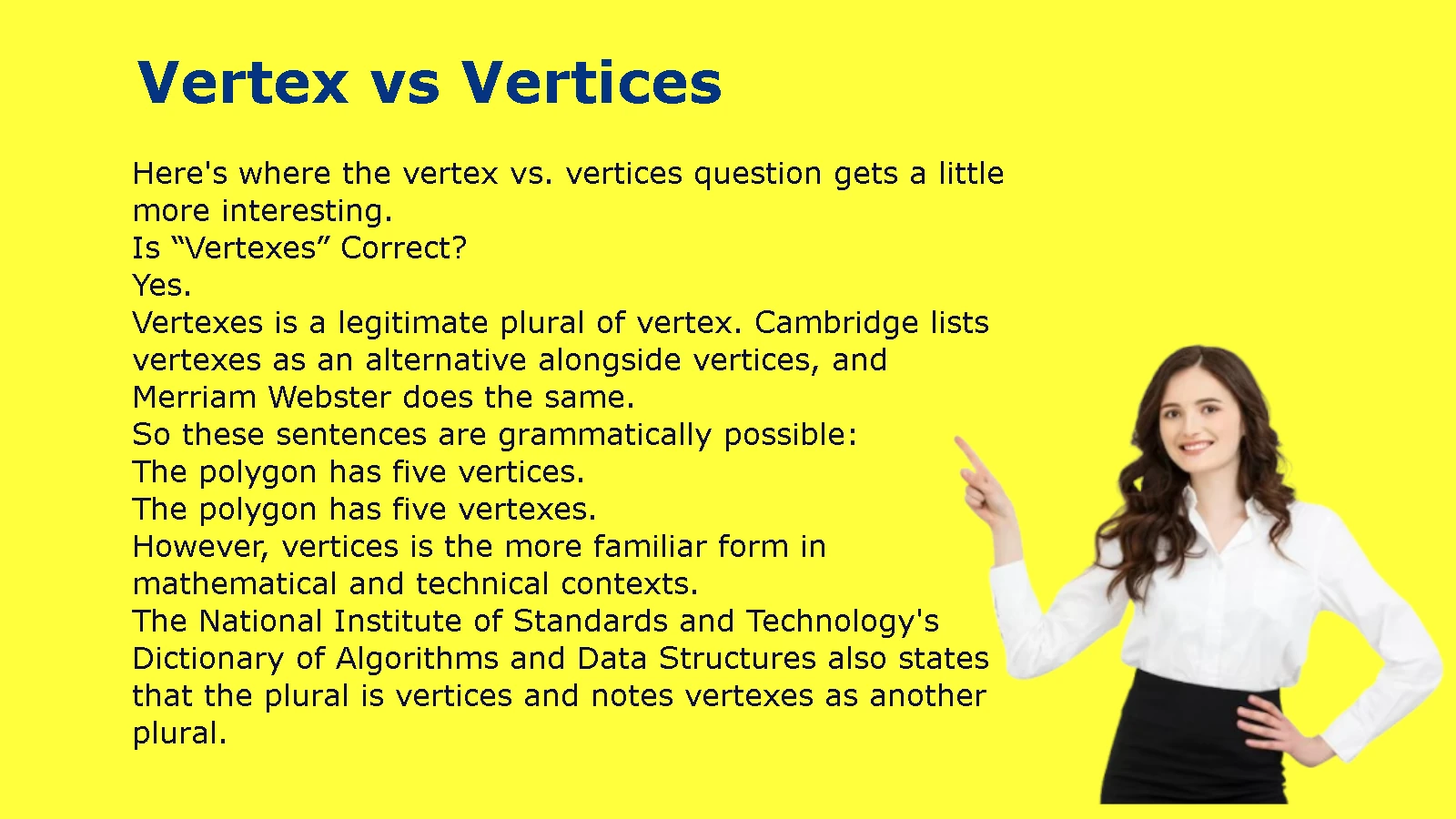
Here’s where the vertex vs. vertices question gets a little more interesting.
Is “Vertexes” Correct?
Yes.
Vertexes is a legitimate plural of vertex. Cambridge lists vertexes as an alternative alongside vertices, and Merriam Webster does the same.
So these sentences are grammatically possible:
The polygon has five vertices.
The polygon has five vertexes.
However, vertices is the more familiar form in mathematical and technical contexts.
The National Institute of Standards and Technology’s Dictionary of Algorithms and Data Structures also states that the plural is vertices and notes vertexes as another plural.
Which Form Should You Use?
If you’re choosing between the two, use vertices in most mathematics and technical writing.
| Form | Correct? | Recommended for mathematics? |
| vertex | Yes, singular | Yes |
| vertices | Yes, plural | Yes |
| vertexes | Yes, plural | Acceptable, but less standard in mathematical contexts |
There’s no need to treat vertexes as an error. It is an accepted English plural. Still, vertices will usually sound more natural to readers familiar with geometry, graph theory, and mathematics.
How to Pronounce Vertex and Vertices
Pronunciation creates another small difference between the two forms.
Cambridge gives the US pronunciation of vertex as approximately VUR-teks and vertices as approximately VUR-tuh-seez.
Vertex Pronunciation
Vertex: /ˈvɝː.t̬eks/
A simple approximation is:
VUR-teks
The second part sounds like teks, similar to the ending of text without the final t sound.
Vertices Pronunciation
Vertices: /ˈvɝː.t̬e.siːz/
A simple approximation is:
VUR-tuh-seez
The ending changes significantly. You don’t pronounce vertices as “vertex-es.”
That’s an important distinction because someone who has only seen the written form might naturally try to pronounce it like a regular plural.
Vertex vs. Vertices in Geometry
Geometry is where you’ll encounter these words most often.
The basic concept stays consistent: a vertex identifies one point, while vertices identifies multiple points.
Triangles
A triangle has three vertices.
If you label the triangle A, B, and C, then:
- A is a vertex.
- B is a vertex.
- C is a vertex.
- A, B, and C together are the vertices.
You could say:
Vertex A is opposite side BC.
Or:
The triangle has three vertices: A, B, and C.
Both sentences use the correct form because the first refers to one point while the second refers to three.
Quadrilaterals
A quadrilateral has four vertices.
Squares, rectangles, parallelograms, rhombuses, and trapezoids all have four vertices because each has four corners.
For example:
The rectangle has four vertices labeled A, B, C, and D.
If you’re talking about only one corner:
Vertex A is the upper left corner.
The number of points you’re discussing determines the form.
Three Dimensional Shapes
Three dimensional shapes make the concept even more useful.
A cube has:
- 8 vertices
- 12 edges
- 6 faces
A tetrahedron has:
- 4 vertices
- 6 edges
- 4 triangular faces
A dodecahedron has:
- 20 vertices
- 30 edges
- 12 pentagonal faces
These aren’t just vocabulary facts. They show why precise mathematical language matters. Saying “the cube has eight vertex” immediately creates a grammatical problem because eight requires the plural vertices.
Vertex vs. Vertices in Angles
An angle has a vertex at the point where its two rays meet.
For example, in ∠ABC, point B is the vertex.
You could write:
B is the vertex of ∠ABC.
If a diagram contains several angles, you might write:
The vertices of the angles are marked with dots.
The distinction becomes particularly important when describing diagrams. A student might refer to an entire corner, an angle, and its vertex as though they were interchangeable. They aren’t.
An angle describes the geometric figure formed by two rays. The vertex is the point where those rays share an endpoint.
That small distinction makes mathematical explanations much clearer.
Vertex vs. Vertices in Graph Theory
The word vertex has an important meaning outside traditional geometry.
In graph theory, a vertex is a fundamental point or node in a graph. The connections between vertices are called edges. NIST defines a vertex in graph theory as an item in a graph and notes that it is sometimes called a node.
So a graph might contain:
- 1 vertex
- 5 vertices
- 100 vertices
- 1 million vertices
The singular and plural rule remains exactly the same.
A Simple Graph Example
Imagine a transportation network.
Each city represents a vertex.
Each direct route connecting two cities represents an edge.
If a network contains New York, Boston, Philadelphia, and Washington as four points, then the graph has four vertices.
The actual objects don’t have to be cities. Vertices can represent people, websites, computers, intersections, tasks, or other entities depending on the graph.
This is why graph theory uses the terms vertex and vertices so frequently.
Vertex and Edge Are Not the Same
One of the easiest mistakes is confusing a vertex with an edge.
Think of a road map.
- A vertex is a location or point.
- An edge is a connection between two locations.
In a geometric polygon:
- A vertex is a corner.
- An edge is a side.
In graph theory:
- A vertex is a node.
- An edge is a connection.
The exact application changes, but the basic relationship remains useful.
Vertex vs. Vertices in a Sentence
Seeing the words in context makes the rule much easier to remember.
Examples With “Vertex”
- The vertex of the angle is labeled A.
- Point B is a vertex of the triangle.
- The parabola has a vertex at its highest point.
- The cone has a single vertex at its tip.
- Each vertex connects to neighboring points in the graph.
- The square has a vertex at each corner.
Examples With “Vertices”
- A triangle has three vertices.
- A square has four vertices.
- The cube has eight vertices.
- The polygon’s vertices are labeled A through F.
- The graph contains 25 vertices.
- The algorithm examines all vertices in the network.
The pattern is consistent. One point gets vertex. Multiple points get vertices.
Common Mistakes With Vertex and Vertices
Even though the rule is simple, several errors appear repeatedly.
Using “Vertex” After a Plural Number
Incorrect:
The pentagon has five vertex.
Correct:
The pentagon has five vertices.
A plural number such as five requires the plural noun.
Using “Vertices” for One Point
Incorrect:
Point A is a vertices of the triangle.
Correct:
Point A is a vertex of the triangle.
You’re describing one point, so use the singular.
Assuming “Vertexes” Is Wrong
Incorrect assumption:
Vertexes isn’t a real English word.
More accurate:
Vertexes is an accepted plural of vertex.
Major dictionaries recognize it. However, vertices remains the more conventional choice in mathematics.
Using the Wrong Verb
Incorrect:
The three vertices is connected.
Correct:
The three vertices are connected.
Because vertices is plural, it takes plural verbs in standard English.
Compare:
The vertex is connected to two edges.
The vertices are connected to several edges.
Inventing “Vertice” as the Singular
A common misconception treats vertice as the singular form of vertices.
The standard singular is vertex.
Use:
one vertex
not:
one vertice
The plural vertices does not produce a singular vertice in standard English.
Vertex vs. Vertices Grammar Rules
The grammar becomes easy if you focus on quantity.
Use “Vertex” for One
Use vertex after words such as:
- one
- a
- an
- each
- every
- this
- that
Examples:
Each vertex has a label.
One vertex is hidden.
This vertex connects to three edges.
Use “Vertices” for Multiple Points
Use vertices after words such as:
- two
- three
- several
- many
- these
- those
- all
Examples:
Three vertices form the triangle.
Several vertices are connected.
All vertices have coordinates.
Singular and Plural Agreement
| Singular | Plural |
| The vertex is visible. | The vertices are visible. |
| The vertex has two edges. | The vertices have several edges. |
| This vertex connects to B. | These vertices connect to B. |
| Each vertex represents a point. | All vertices represent points. |
The noun isn’t the only thing that changes. The verb and demonstrative words often change too.
Vertex vs. Vertices Examples by Context
The following table brings the most common uses together:
| Context | Singular | Plural |
| Triangle | one vertex | three vertices |
| Square | one vertex | four vertices |
| Pentagon | one vertex | five vertices |
| Cube | one vertex | eight vertices |
| Tetrahedron | one vertex | four vertices |
| Angle | one vertex | multiple vertices |
| Polygon | one vertex | several vertices |
| Graph | one vertex | many vertices |
| Network | one vertex | many vertices |
This pattern works across geometry and graph theory because the underlying grammatical distinction doesn’t change.
Vertex vs. Vertices vs. Vertexes
These three forms can look confusing when placed together, but their roles are clear.
| Word | Meaning | Number |
| vertex | A single point or corner | Singular |
| vertices | Multiple points or corners | Plural |
| vertexes | Multiple points or corners | Plural alternative |
The most important distinction is between vertex and the two plural forms.
You can think of the relationship like this:
vertex → vertices
or, less commonly:
vertex → vertexes
Oxford, Cambridge, and Merriam Webster all recognize the plural forms.
For mathematical writing, however, vertices is usually the better choice because it aligns with the terminology readers expect.
A Quick Case Study: Describing a Cube
Consider a student writing about a cube.
The student wants to say that a cube has eight corners.
A vague sentence might say:
A cube has eight corners.
That sentence is perfectly understandable. However, mathematical writing can be more precise:
A cube has eight vertices.
Now suppose the student wants to identify one particular corner:
Vertex A is connected to three edges.
The student then discusses the entire set:
The eight vertices are labeled A through H.
Notice how the noun changes based entirely on the number being discussed.
This small example captures the entire vertex vs. vertices rule.
A Quick Case Study: Describing a Graph
Now consider a graph containing six nodes.
In graph theory, each node is a vertex.
Because the graph has six nodes, you can say:
The graph contains six vertices.
If you focus on node C, you say:
Vertex C has three neighboring vertices.
This sentence uses both forms correctly.
Vertex C refers to one specific point.
Vertices refers to multiple connected points.
NIST similarly uses vertex for an individual graph item and vertices for the plural.
How to Remember Vertex vs. Vertices
A simple memory trick can save you from second guessing the spelling.
Think:
One corner = one vertex.
Many corners = many vertices.
You can also connect the words to familiar shape names.
Triangle:
- 1 corner → a vertex
- 3 corners → vertices
Square:
- 1 corner → a vertex
- 4 corners → vertices
Cube:
- 1 corner → a vertex
- 8 corners → vertices
The mathematical idea stays the same. Only the number changes.
Important Facts About Vertex and Vertices
Here are the facts worth remembering:
- Vertex is singular.
- Vertices is plural.
- Vertexes is also an accepted plural.
- Vertices is especially common in mathematics.
- A vertex can represent a corner or meeting point in geometry.
- A vertex can represent a node in graph theory.
- The plural of vertex is not vertice.
- A triangle has 3 vertices.
- A square has 4 vertices.
- A cube has 8 vertices.
- A tetrahedron has 4 vertices.
- In graph theory, vertices connect through edges.
- The US pronunciation of vertex is roughly VUR-teks.
- The US pronunciation of vertices is roughly VUR-tuh-seez.
Frequently Asked Questions About Vertex vs. Vertices
Is vertex singular or plural?
Vertex is singular. It refers to one point, corner, or meeting point.
Example:
Point A is a vertex of the triangle.
Is vertices singular or plural?
Vertices is plural. It refers to two or more vertices.
Example:
A triangle has three vertices.
Cambridge explicitly identifies vertices as the plural of vertex.
What is the plural of vertex?
The standard plural is vertices. Vertexes is also an accepted plural form.
Is vertexes grammatically correct?
Yes. Vertexes is grammatically acceptable.
However, vertices is generally the more familiar choice in mathematics and technical writing.
What is the plural of vertex in math?
Vertices is the standard plural used in mathematics.
For example:
A pentagon has five vertices.
Is “vertice” the singular of vertices?
No. The standard singular form is vertex.
The correct pair is:
vertex → vertices
Not:
vertice → vertices
How many vertices does a triangle have?
A triangle has three vertices.
Each vertex occurs where two sides meet.
How many vertices does a square have?
A square has four vertices, one at each corner.
How many vertices does a cube have?
A cube has eight vertices.
It also has 12 edges and 6 faces.
What is the difference between a vertex and an edge?
A vertex is a point where sides or edges meet. An edge is a line segment or connection between vertices.
In a cube, for example, the corners are vertices while the line segments connecting those corners are edges.
What is a vertex in graph theory?
In graph theory, a vertex is a fundamental point or node in a graph. Multiple points are called vertices. NIST uses vertex as an individual graph item and identifies vertices as its plural.
How do you pronounce vertices?
In US English, vertices is pronounced approximately VUR-tuh-seez. Cambridge gives the pronunciation as /ˈvɝː.t̬e.siːz/.
Which is better: vertices or vertexes?
Both are correct plurals. Vertices is generally the better choice for mathematical, academic, and technical writing because it is the conventional form readers expect.
Vertex vs. Vertices: Final Answer
The difference between vertex vs. vertices is simple:
- Vertex = one.
- Vertices = more than one.
- Vertexes = an accepted alternative plural.
In geometry, a vertex is usually a corner or point where lines, sides, or edges meet. In graph theory, it can represent a node in a network. When you’re referring to multiple points, use vertices.
The easiest example is a triangle:
A triangle has three vertices, and each corner is a vertex.
Once that distinction sticks, the choice becomes automatic. If you’re talking about one point, choose vertex. If you’re talking about several points, choose vertices.
Quick Reference
| If you mean… | Use… |
| One point | vertex |
| Two or more points | vertices |
| An alternative plural | vertexes |
| One corner of a triangle | vertex |
| All three corners of a triangle | vertices |
| One node in a graph | vertex |
| Multiple nodes in a graph | vertices |
The safest rule to carry forward is short enough to remember in seconds:
One vertex. Two or more vertices.