Have you ever come across the words basis and bases and wondered which one is correct? While Basis vs Bases may look like a simple comparison, these words have different meanings, pronunciations, and uses depending on the context.
Basis is a singular noun that means the foundation, reason, or underlying principle of something. Bases is the plural form of basis, meaning more than one foundation, reason, or underlying principle. However, bases can also have other meanings, such as the plural of base or a verb form of base.
Examples:
- Trust is the basis of their relationship.
- The report was prepared on the basis of reliable evidence.
- The researchers examined several bases for their conclusion.
The confusion is understandable. People often search for basis vs bases, basis meaning, bases meaning, is bases plural of basis, or how to use basis and bases in a sentence because the two words are closely related but aren’t always interchangeable. And here’s the kicker: basis and bases don’t even have the same pronunciation.
In this guide, you’ll learn the complete difference between Basis vs Bases, including their definitions, pronunciations, plural forms, correct usage, and examples in sentences. You’ll also discover when to use basis, when to use bases, and how to avoid common mistakes when using these words.
Basis vs Bases: Quick Answer
The simplest way to remember the difference is this:
Basis = one foundation, reason, principle, or method.
Bases = more than one basis.
But there is another possibility:
Base = one physical support, starting point, military installation, or similar thing.
Bases = more than one base.
The spelling bases works as the plural of both words.
| Word | Grammatical form | Meaning | Pronunciation |
| basis | Singular noun | Foundation, reason, principle, method, or underlying fact | BAY-sis |
| bases | Plural of basis | More than one foundation, reason, principle, or method | BAY-seez |
| base | Singular noun | Bottom, support, starting point, military installation, etc. | BAYS |
| bases | Plural of base | More than one base | BAY-siz |
Cambridge lists bases as the plural of both basis and base, with different pronunciations. Oxford makes the same distinction.
So when you see bases, don’t automatically assume it means multiple physical bases. The surrounding sentence tells you which word it represents.
What Does Basis Mean?
Basis is a singular noun that usually refers to the foundation, reason, principle, fact, or method on which something depends or develops.
Cambridge defines basis in terms of important facts or ideas from which something develops. It also uses the word for a method or way of doing something.
Consider this sentence:
“Evidence provides the basis for the decision.”
Here, basis doesn’t mean a physical object. It means the reason or foundation supporting the decision.
You can think of it as the ground underneath an idea. A building needs solid ground to stand. In much the same way, an argument, decision, theory, or plan can have a basis that supports it.
Basis Meaning: Foundation or Underlying Support
One of the most common meanings of basis is something that supports or gives structure to another thing.
For example:
- “Trust is the basis of a healthy friendship.”
- “The agreement provides a basis for future cooperation.”
- “Research formed the basis of the proposal.”
- “The facts give us a solid basis for action.”
In each example, basis identifies what something rests on intellectually or practically.
Basis Meaning: Reason or Justification
Basis can also mean a reason for believing, doing, or deciding something.
For example:
- “There is no basis for that accusation.”
- “The lawyer challenged the basis of the claim.”
- “The decision was made on the basis of the available evidence.”
- “The complaint has a reasonable basis.”
Here, the word points to the justification behind an action or conclusion.
Basis Meaning: Method or Arrangement
Another important use appears in expressions such as on a daily basis, on a temporary basis, and on a voluntary basis.
In this sense, basis refers to how something is organized or how it happens. Oxford specifically lists this usage for arrangements and frequency.
Examples include:
- “The report is reviewed on a monthly basis.”
- “She works on a part time basis.”
- “The employees are hired on a temporary basis.”
- “The committee meets on a regular basis.”
This is one reason basis appears so often in professional and academic writing.
What Does Bases Mean?
Bases has two possible sources:
- It can be the plural of basis.
- It can be the plural of base.
That’s the key to understanding basis vs bases.
Bases as the Plural of Basis
When bases means more than one foundation, reason, principle, or method, it is the plural of basis.
The spelling changes like this:
basis → bases
For example:
“The researchers examined several bases for their conclusion.”
The researchers aren’t examining physical objects. They’re examining several reasons or foundations for the conclusion.
Other examples include:
- “The proposal rests on several bases.”
- “The researchers identified different bases for comparison.”
- “The court considered several possible bases for the claim.”
- “The theories have different philosophical bases.”
- “The decision had several legal bases.”
Oxford identifies bases as the plural form of basis and gives it the pronunciation /ˈbeɪsiːz/.
Bases as the Plural of Base
Bases can also be the plural of base.
This meaning is completely different from the grammatical plural of basis.
A base can mean the bottom or supporting part of something. It can also refer to a military installation, a starting point, or a position in baseball.
For example:
- “The statue rests on a marble base.”
- “The statue rests on several marble bases.”
- “The soldiers returned to their military bases.”
- “The runners advanced around the bases.”
In these sentences, bases means multiple physical or conceptual bases, not multiple basis items.
Cambridge explicitly identifies bases as the plural of base as well as the plural of basis.
Basis vs Bases: The Main Difference
The biggest difference isn’t simply singular versus plural. The real issue is which word bases comes from.
| Form | What it means | Example |
| basis | One reason or foundation | “This fact is the basis of the argument.” |
| bases | Several reasons or foundations | “These facts are the bases of the argument.” |
| base | One physical or conceptual base | “The lamp has a heavy base.” |
| bases | Several physical or conceptual bases | “The lamps have heavy bases.” |
Notice how the last two examples use the same spelling as the plural of basis.
That’s where context matters.
A Simple Context Test
When you encounter bases, ask:
Does it mean several foundations, reasons, or principles?
If yes, it’s the plural of basis.
Does it mean several physical supports, military installations, starting points, or sports positions?
If yes, it’s the plural of base.
This simple test solves most cases.
How to Pronounce Basis
Basis is pronounced:
BAY-sis
Its US pronunciation is /ˈbeɪ.sɪs/. Cambridge gives the same basic pronunciation in its US dictionary entry.
Break it into two parts:
- ba → “bay”
- sis → “sis”
So:
basis = BAY-sis
Example:
“The evidence provides the basis for the decision.”
Don’t pronounce basis like BAY-sis with a long “ee” sound in the second syllable. The second syllable has the short i sound.
How to Pronounce Bases
This is where things get interesting.
The word bases has two pronunciations, depending on whether it is the plural of basis or base.
Bases as the Plural of Basis
When bases means multiple basis items, pronounce it:
BAY-seez
IPA:
/ˈbeɪ.siːz/
Example:
“The researchers examined several bases for the theory.”
Cambridge and Oxford both identify this pronunciation for bases as the plural of basis.
Bases as the Plural of Base
When bases means multiple base items, pronounce it:
BAY-siz
IPA:
/ˈbeɪ.sɪz/
Example:
“The military operates several bases in the region.”
Cambridge distinguishes this pronunciation from the plural of basis.
Pronunciation Comparison
| Word | Meaning | Pronunciation |
| basis | One foundation or reason | BAY-sis |
| bases | Plural of basis | BAY-seez |
| base | One physical or conceptual base | BAYS |
| bases | Plural of base | BAY-siz |
This is one of the rare situations in English where the exact same spelling has two different pronunciations because it represents two different words.
Why Is the Plural of Basis Bases?
The standard plural of basis is bases, not basises.
This pattern appears in several English words that entered the language through Greek and Latin.
Compare:
| Singular | Plural |
| basis | bases |
| analysis | analyses |
| crisis | crises |
| thesis | theses |
| hypothesis | hypotheses |
The spelling changes rather than simply adding -s.
For example:
analysis → analyses
not:
analysises
Likewise:
basis → bases
not:
basises
Dictionary.com notes this pattern among several words ending in -is, including hypothesis/hypotheses and crisis/crises.
The important point is practical rather than historical: English speakers use bases as the accepted plural of basis.
Is “Basises” Correct?
No. Basises is not the standard plural of basis.
Use:
basis → bases
not:
basis → basises
For example:
❌ “The researchers identified three basises for the conclusion.”
✅ “The researchers identified three bases for the conclusion.”
The second sentence is correct.
The same principle appears with other words that have irregular or classical plural forms.
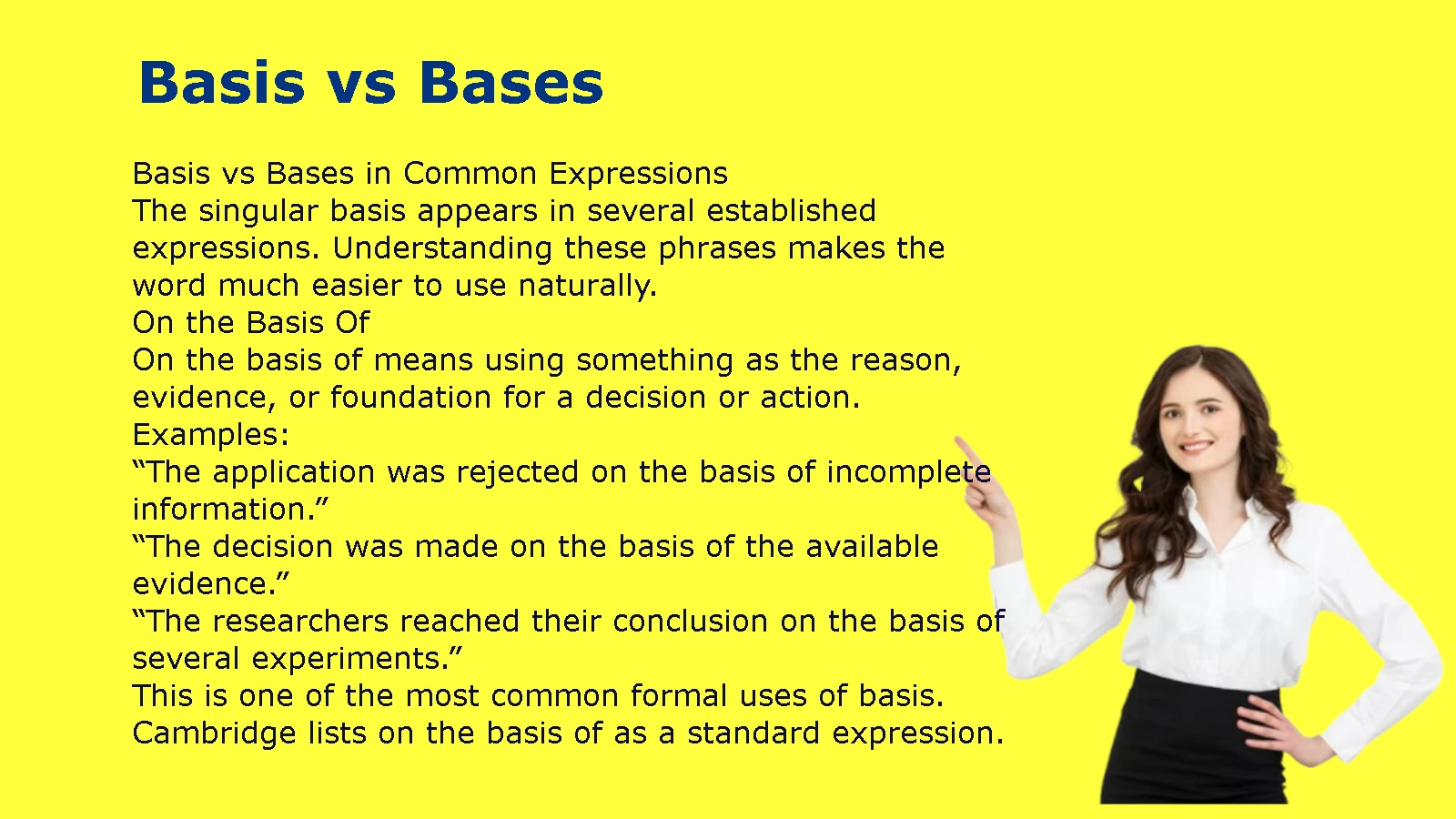
Basis vs Bases in Common Expressions
The singular basis appears in several established expressions. Understanding these phrases makes the word much easier to use naturally.
On the Basis Of
On the basis of means using something as the reason, evidence, or foundation for a decision or action.
Examples:
- “The application was rejected on the basis of incomplete information.”
- “The decision was made on the basis of the available evidence.”
- “The researchers reached their conclusion on the basis of several experiments.”
This is one of the most common formal uses of basis. Cambridge lists on the basis of as a standard expression.
Basis for
The expression basis for identifies the foundation or reason for something.
Examples:
- “The report provides a basis for further research.”
- “There is no basis for the allegation.”
- “The evidence forms the basis for the recommendation.”
On a Regular Basis
On a regular basis means regularly.
Example:
“The system is checked on a regular basis.”
You can also say:
- on a daily basis
- on a weekly basis
- on a monthly basis
- on an annual basis
- on a temporary basis
- on a permanent basis
Oxford lists these as common patterns with basis.
On a Case by Case Basis
On a case by case basis means that each situation will be considered separately.
Example:
“Refund requests are reviewed on a case by case basis.”
This expression is common in business, customer service, legal contexts, and administrative writing.
Basis vs Bases in Academic Writing
Academic writing frequently uses basis because researchers need to explain what supports an argument, theory, method, or conclusion.
Consider:
“The study provides a scientific basis for further investigation.”
Here, basis identifies the evidence or foundation supporting future research.
When multiple foundations are involved, bases can appear:
“The researchers considered economic and environmental bases for their recommendations.”
The distinction remains straightforward:
- one foundation → basis
- multiple foundations → bases
Merriam Webster also lists a specialized mathematical meaning of basis: a set of linearly independent vectors that can represent vectors in a vector space through linear combinations.
That technical use has the same plural:
basis → bases
For example:
“The mathematician selected a basis for the vector space.”
and:
“Different bases can be used to represent the same vector space.”
Basis vs Bases in Business Writing
Business English uses basis heavily, particularly when describing schedules, employment arrangements, payment systems, decisions, and procedures.
Common examples include:
- “Employees are paid on a weekly basis.”
- “The service is offered on a monthly basis.”
- “The position is available on a temporary basis.”
- “The figures are calculated on an annual basis.”
- “Applications are reviewed on a case by case basis.”
Cambridge’s Business English entry includes patterns such as daily, monthly, regular, full time, permanent, temporary, and case by case basis.
A Useful Style Point
Although on a regular basis is grammatically correct, regularly is often shorter and more direct.
Compare:
“The equipment is inspected on a regular basis.”
with:
“The equipment is inspected regularly.”
Both are correct. The second is more concise.
That doesn’t make basis wrong. It simply means you should choose the expression that best fits the tone and purpose of the sentence.
Basis vs Bases in Legal Writing
Legal writing often uses basis to identify the grounds for a claim, decision, argument, or action.
Examples include:
- “The claim has no legal basis.”
- “The court considered the basis for the appeal.”
- “The decision was made on the basis of the evidence.”
- “The complaint provides a sufficient basis for further investigation.”
When several grounds exist, bases can be correct:
“The appeal raised several legal bases for challenging the decision.”
Here, bases means multiple legal grounds or foundations.
The distinction depends on quantity. One ground is a basis. Several grounds are bases.
Basis vs Bases in Science
Scientific writing also uses basis to describe the underlying evidence, principle, or mechanism behind an explanation.
For example:
“The theory has a strong scientific basis.”
If multiple foundations are being discussed:
“The theory has biological and chemical bases.”
However, scientific writing should use the plural only when the context genuinely involves multiple foundations. Don’t change basis to bases simply because the sentence sounds more technical.
Bases in Different Contexts
Because bases has two sources, context is especially important.
Bases as Reasons or Foundations
“The committee considered several bases for the recommendation.”
Here, bases means reasons or grounds.
Pronunciation:
BAY-seez
Bases as Military Installations
“The country maintains several military bases.”
Here, bases means military installations.
Pronunciation:
BAY-siz
Bases in Baseball
“The runner advanced around the bases.”
Here, bases refers to the positions in baseball.
Pronunciation:
BAY-siz
Bases as Physical Supports
“The sculptures stand on wide stone bases.”
Here, bases means physical supports.
Pronunciation:
BAY-siz
The spelling remains unchanged in all four cases. The meaning comes from context.
Basis vs Base vs Bases
Adding base to the comparison makes the distinction much clearer.
| Word | Number | Common meaning | Example |
| basis | Singular | Reason, principle, foundation, method | “Evidence is the basis of the argument.” |
| bases | Plural of basis | Multiple reasons or foundations | “The arguments have different bases.” |
| base | Singular | Bottom, support, starting point, military installation | “The statue has a stone base.” |
| bases | Plural of base | Multiple physical or conceptual bases | “The statues have stone bases.” |
Oxford describes base as the lowest or supporting part of something. It also recognizes base as a synonym for basis when referring to an idea, fact, or situation from which something develops.
That overlap explains why the words sometimes feel interchangeable.
Still, they aren’t identical in every context.
Basis vs Base
Compare:
“The evidence forms the basis of the argument.”
and:
“The evidence forms the base of the argument.”
Both can be grammatical in appropriate contexts. However, basis is especially natural when referring to the underlying reason or principle of an argument.
By contrast:
“The lamp has a heavy base.”
You wouldn’t normally replace base with basis here.
❌ “The lamp has a heavy basis.”
That changes the meaning and sounds incorrect.
Common Mistakes With Basis and Bases
Using “Basises” Instead of “Bases”
This is the most obvious mistake.
❌ “There are several basises for the decision.”
✅ “There are several bases for the decision.”
The plural of basis is bases.
Using Basis After a Plural Determiner
A sentence such as:
“There are several basis for the decision.”
is incorrect because several requires a plural count noun.
Correct:
“There are several bases for the decision.”
Assuming Bases Always Means Base
This mistake can cause confusion when reading academic or legal writing.
Consider:
“The researchers examined several bases for their conclusion.”
Here, bases doesn’t refer to physical objects. It means several foundations or reasons.
Giving Bases Only One Pronunciation
The spelling doesn’t tell you everything.
Bases can be:
- BAY-seez when it is the plural of basis
- BAY-siz when it is the plural of base
Cambridge and Oxford both document this distinction.
Confusing Basis With Base
A basis commonly refers to an underlying reason, principle, or method.
A base can refer to a physical support, military installation, sports position, or starting point.
For example:
“The evidence is the basis for the decision.”
But:
“The statue rests on a stone base.”
The words are related. They aren’t interchangeable in every situation.
Basis vs Bases Examples in Sentences
Seeing the words in context makes the difference easier to remember.
- “Trust is the basis of their partnership.”
- “The report provides a solid basis for discussion.”
- “There is no basis for the accusation.”
- “The decision was made on the basis of the evidence.”
- “The theory has a strong scientific basis.”
- “Employees are paid on a weekly basis.”
- “The committee meets on a regular basis.”
- “The agreement provides a basis for future negotiations.”
- “The proposal has a sound economic basis.”
- “The findings form the basis for further research.”
- “The researchers identified several bases for their conclusion.”
- “The arguments have different philosophical bases.”
- “The proposal rests on several legal bases.”
- “The study examines the economic bases of the policy.”
- “The theories share some common bases.”
- “The court considered multiple bases for the appeal.”
- “Several theoretical bases support the model.”
- “The researchers compared the cultural bases of the two systems.”
- “The country operates several military bases.”
- “The runners moved around the bases.”
- “The sculptures have wide stone bases.”
- “The lamps have heavy metal bases.”
- “The company has offices at several regional bases.”
- “The workers inspected the equipment at both bases.”
The context makes the meaning clear even though the spelling stays the same.
A Practical Case Study: Choosing Basis or Bases
Imagine that a company is deciding whether to launch a new product.
The manager says:
“Customer research provides the basis for the decision.”
That’s correct because the research represents one overall foundation for the decision.
Later, the manager identifies three separate reasons:
- customer demand
- production costs
- market growth
The manager could say:
“The decision rests on three bases: customer demand, production costs, and market growth.”
Here, bases is the plural of basis because the word refers to multiple foundations or reasons.
Now imagine a different meeting:
“The company operates from three regional bases.”
This time, bases means physical locations or operating centers. It is the plural of base.
The spelling didn’t change. The meaning did.
How to Choose Basis or Bases
When you’re unsure, use this quick process.
Use Basis When You Mean One Foundation
Choose basis when you’re talking about one:
- reason
- principle
- foundation
- fact supporting something
- method
- arrangement
- underlying condition
Example:
“This evidence provides a strong basis for the claim.”
Use Bases When You Mean Multiple Foundations
Choose bases when you’re talking about several:
- reasons
- principles
- foundations
- grounds
- underlying ideas
Example:
“The researchers identified several bases for the theory.”
Use Base When You Mean One Physical or Conceptual Base
Choose base for one:
- bottom part
- support
- military installation
- baseball position
- starting point
- main ingredient
- mathematical foundation in certain contexts
Example:
“The vase has a broad base.”
Use Bases When You Mean Multiple Bases
Example:
“The statues have broad bases.”
Or:
“The soldiers returned to their bases.”
A Quick Memory Trick for Basis vs Bases
Here’s the easiest rule to keep in mind:
One basis → several bases.
Don’t add -s directly to the entire spelling. Instead, remember the established plural:
BASIS → BASES
If you’re talking about one reason:
basis
If you’re talking about several reasons:
bases
If you’re talking about one physical support:
base
If you’re talking about several physical supports:
bases
The spelling bases is shared by both plural forms.
Basis vs Bases: Important Facts
Here are the most useful facts to remember:
- Basis is singular.
- Bases is the standard plural of basis.
- Basises is not the standard plural of basis.
- Base is a separate word.
- Bases is also the plural of base.
- Bases has two pronunciations.
- BAY-seez means the plural of basis.
- BAY-siz means the plural of base.
- Context determines which meaning bases has.
- Basis commonly refers to a reason, foundation, principle, or method.
- Base commonly refers to a bottom, support, starting point, military installation, or similar thing.
- Both basis and base can sometimes describe the foundation of an idea.
Basis vs Bases: Comparison Chart
| Question | Basis | Bases |
| Is it singular? | Yes | No |
| Is it plural? | No | Yes |
| Can it mean a foundation? | Yes | Yes, if plural of basis |
| Can it mean a physical support? | Not usually | Yes, if plural of base |
| Can it mean multiple reasons? | No | Yes |
| Pronunciation | BAY-sis | BAY-seez or BAY-siz |
| Is “basises” correct? | No | No |
| Plural of basis | — | bases |
| Plural of base | — | bases |
Frequently Asked Questions About Basis vs Bases
Is bases the plural of basis?
Yes. Bases is the standard plural of basis.
For example:
“The argument has one basis.”
becomes:
“The arguments have several bases.”
Oxford and Cambridge both list bases as the plural of basis.
What is the plural of basis?
The plural of basis is bases.
Basis → bases
Not:
Basis → basises
Is basises a word?
Basises is not the standard plural form of basis.
Use bases instead.
❌ “Several basises”
✅ “Several bases”
How do you pronounce basis?
Basis is pronounced BAY-sis, represented in IPA as /ˈbeɪ.sɪs/.
How do you pronounce bases?
It depends on the meaning.
When bases is the plural of basis, pronounce it:
BAY-seez — /ˈbeɪ.siːz/
When bases is the plural of base, pronounce it:
BAY-siz — /ˈbeɪ.sɪz/
Cambridge explicitly distinguishes the two pronunciations.
Is bases singular or plural?
Bases is plural.
It can be the plural of either:
- basis
- base
The meaning comes from context.
What is the difference between basis and base?
Basis usually refers to a reason, principle, foundation, or method.
Base can refer to a physical support, bottom part, starting point, military installation, or an underlying idea.
For example:
“Evidence forms the basis of the argument.”
But:
“The lamp has a heavy base.”
What is the plural of base?
The plural of base is also bases.
However, this bases is pronounced BAY-siz, unlike bases as the plural of basis, which is pronounced BAY-seez.
Are basis and base synonyms?
They can be synonyms in some contexts, particularly when referring to an idea, fact, or situation that supports something.
Oxford lists basis, foundation, and base as related words for ideas or facts that support something.
However, they aren’t interchangeable in every sentence.
You can say:
“The evidence forms the basis of the argument.”
But you can’t normally replace basis with base when the sentence has a completely different established expression or meaning.
Final Verdict: Basis or Bases?
The difference between basis vs bases becomes easy once the plural form is clear.
Basis is singular. It refers to one foundation, reason, principle, fact, or method.
Bases is plural. Most importantly, it can be the plural of either basis or base.
Remember these four forms:
| If you mean… | Correct word |
| One reason or foundation | basis |
| Several reasons or foundations | bases |
| One physical support or starting point | base |
| Several physical supports or starting points | bases |
The pronunciation gives you another useful clue:
- basis = BAY-sis
- bases from basis = BAY-seez
- base = BAYS
- bases from base = BAY-siz
So, if you ever wonder whether bases is the plural of basis, the answer is yes. Just remember that bases also serves as the plural of base. The spelling is identical, but the meaning and pronunciation can change.
That small distinction is what makes basis vs bases confusing at first. Once you connect the word to its meaning, however, the rule is straightforward.