Quick Answer: Hugging or Huging?
Hugging is the correct spelling. Huging is a misspelling.
The correct sequence of letters is:
H-U-G-G-I-N-G
The spelling mistake usually happens because hug ends in a single g, so it may seem natural to simply add -ing and write huging. However, when the verb hug takes the -ing ending, the final consonant is doubled, giving us hugging.
However, huging is not an alternative spelling of hugging. Standard English uses hugging.
The word hugging is the present participle or gerund form of hug. It means holding someone or something closely with the arms and can describe an expression of affection, comfort, warmth, greeting, or support. The verb hug can also be used for holding something tightly or staying very close to something.
| Spelling | Status | Meaning |
| hugging | Correct | Holding someone or something closely with the arms |
| huging | Incorrect | Misspelling of hugging |
So, if you’re deciding between hugging vs huging, use hugging. Remember: hug + ing = hugging, with the final g doubled.
Why Is “Hugging” Spelled With Two Gs?
The reason hugging has two gs is the English final-consonant doubling rule.
When a short, one-syllable verb ends in a consonant-vowel-consonant pattern, the final consonant is doubled before a suffix beginning with a vowel, such as -ing or -ed. Cambridge’s grammar guidance gives examples such as hop → hopping, sit → sitting, and slim → slimming.
The word hug fits the pattern:
- h = consonant
- u = vowel
- g = consonant
So:
hug → hugging
The final g is doubled before -ing.
The Spelling Pattern
You can visualize it this way:
C + V + C
h + u + g
Add -ing:
h u g + g + ing
Result:
hugging
This isn’t a special rule created just for hug. It’s part of a much broader spelling pattern.
More Examples of the Same Rule
| Base verb | Correct -ing form | Incorrect form |
| hug | hugging | huging |
| run | running | runing |
| sit | sitting | siting |
| stop | stopping | stoping |
| plan | planning | planing |
| swim | swimming | swiming |
| rub | rubbing | rubing |
| drop | dropping | droping |
The important point is that the spelling changes when -ing is attached. You don’t simply take the base word and add the letters ing in every case.
What Does “Hugging” Mean?
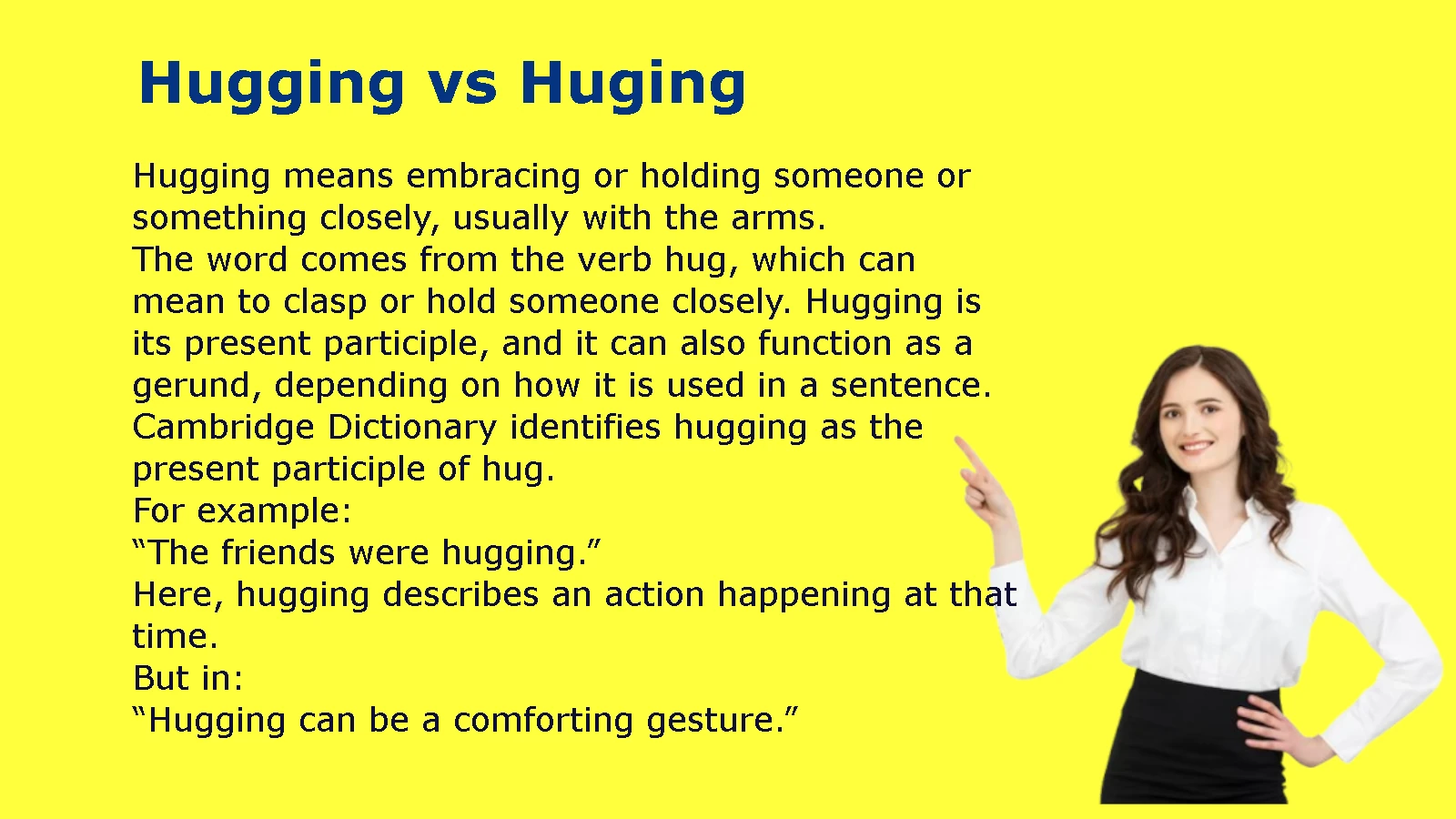
Hugging means embracing or holding someone or something closely, usually with the arms.
The word comes from the verb hug, which can mean to clasp or hold someone closely. Hugging is its present participle, and it can also function as a gerund, depending on how it is used in a sentence. Cambridge Dictionary identifies hugging as the present participle of hug.
For example:
“The friends were hugging.”
Here, hugging describes an action happening at that time.
But in:
“Hugging can be a comforting gesture.”
the word functions as a noun-like gerund.
Common Uses of “Hugging”
The word can describe different situations involving physical closeness, including:
- greeting someone
- saying goodbye
- showing affection
- comforting someone
- celebrating
- expressing support
- holding someone closely
The exact meaning depends on the sentence and context.
Examples
- “The children were hugging their parents.”
- “She was hugging her friend goodbye.”
- “The teammates were hugging after the match.”
- “He thanked her for hugging him when he was upset.”
The spelling remains hugging in each example.
Is “Huging” a Word?
Huging is not the standard spelling of the -ing form of hug.
If you mean the action of embracing someone, the correct form is hugging.
The incorrect spelling is easy to understand because someone might apply a simple “add -ing” strategy:
hug + ing = huging
But English spelling requires the final consonant to be doubled in this case:
hug + ing = hugging
Dictionaries list hugging, not huging, as the standard form. The American Heritage Dictionary, for example, gives the verb forms as hugged and hugging.
Why Do People Write “Huging”?
A spelling mistake doesn’t necessarily mean that someone doesn’t understand the word.
Huging can occur because the writer hears the word as one continuous sound and doesn’t realize that the spelling requires a doubled consonant. It’s also a predictable mistake when someone knows the general pattern of adding -ing but hasn’t learned when consonants are doubled.
Compare:
- play → playing
- read → reading
- work → working
In these words, you simply add -ing.
But:
- run → running
- sit → sitting
- hug → hugging
require consonant doubling.
Hugging vs Hug: What Is the Difference?
Hug and hugging are related forms of the same verb, but they don’t perform exactly the same grammatical role.
Hug is the base form.
Hugging is the -ing form.
Consider these examples:
| Form | Example | Function |
| hug | “I want to hug her.” | Base verb |
| hugs | “She hugs her children.” | Third-person singular present |
| hugged | “They hugged yesterday.” | Past tense |
| hugging | “They are hugging.” | Present participle |
| hugging | “Hugging can be comforting.” | Gerund |
This distinction is useful because hugging isn’t simply another spelling of hug. It is a different grammatical form.
How to Use “Hugging” in a Sentence
Hugging as an Action
The most common use of hugging is as part of a continuous verb construction.
For example:
- “They are hugging.”
- “She is hugging her sister.”
- “We were hugging when the photograph was taken.”
- “The two friends started hugging.”
In these examples, hugging describes an action that is happening or was happening around a particular time.
The helping verb determines the tense:
- is hugging → present continuous
- was hugging → past continuous
- are hugging → present continuous
- were hugging → past continuous
Hugging as a Gerund
Hugging can also act as a noun.
For example:
“Hugging can be a way to show affection.”
Here, hugging is the subject of the sentence.
Other examples include:
- “She enjoys hugging her family.”
- “They talked about hugging their friends goodbye.”
- “He wasn’t comfortable with hugging strangers.”
This is one reason hugging can appear in places where you might otherwise expect a noun.
Hugging in Everyday Conversation
The word is common in ordinary speech and writing.
For example:
“They were hugging after seeing each other again.”
The sentence simply describes an action. There’s no special slang meaning attached to hugging in this basic use.
Similarly:
“Everyone was hugging and congratulating the winner.”
Here, hugging appears alongside another activity to describe what people were doing.
Cambridge’s dictionary examples include ordinary uses of hugging as well as figurative uses, confirming that the word functions naturally in several grammatical contexts.
Common Misspellings of “Hugging”
The most important misspelling for this comparison is huging.
Other accidental forms can occur when someone types too many or too few letters, but they aren’t standard alternatives to hugging.
| Spelling | Status |
| hugging | ✅ Correct |
| huging | ❌ Incorrect |
| hugged | ✅ Correct past form |
| hug | ✅ Correct base form |
| hugs | ✅ Correct third-person singular form |
The key distinction is between hugging and huging.
If you’re proofreading an article, essay, message, school assignment, or other formal writing, change huging to hugging.
Examples of “Hugging” vs “Huging”
Seeing the two spellings side by side makes the difference easy to remember.
Correct Examples
- “The children were hugging their parents.”
- “They started hugging when they met.”
- “She is hugging her little brother.”
- “The friends were hugging after the ceremony.”
- “He gave everyone a hug before hugging his family goodbye.”
Incorrect Examples
These sentences contain the spelling error:
- “The children were huging their parents.” ❌
- “They started huging when they met.” ❌
- “She is huging her little brother.” ❌
- “The friends were huging after the ceremony.” ❌
In every case, replace huging with hugging.
A Simple Before-and-After Test
If you’re unsure, start with the base verb:
hug
Then add -ing according to the spelling rule:
hug + ing
Because hug has one syllable and ends in a single consonant after a single vowel, double the final consonant:
hug + g + ing
Therefore:
hugging
The Double-G Rule in “Hugging”
The spelling of hugging becomes easier once you understand the general rule rather than memorizing the word individually.
A useful version of the rule is:
For many one-syllable verbs ending in one vowel followed by one consonant, double the final consonant before adding -ing.
This produces forms such as:
- hop → hopping
- run → running
- sit → sitting
- stop → stopping
- swim → swimming
- hug → hugging
Cambridge explains that the final consonant is often doubled when a suffix beginning with a vowel is added, including -ing. It also notes that the vowel before the final consonant is short in these examples.
Why Does the Double G Matter?
The doubled consonant isn’t just decorative.
English spelling uses consonant doubling as part of a larger system for representing pronunciation. In hug, the u represents the short vowel sound /ʌ/. The spelling hugging maintains that relationship when -ing is added.
You can therefore think of the double g as part of the spelling pattern that tells the reader how the word is formed.
The practical rule is simpler than the theory:
hug → hugging
Compare “Hugging” With “Hoping”
This comparison is especially useful because it shows that not every verb receives a doubled consonant.
hug → hugging
But:
hope → hoping
Why?
Hope ends in a silent e, which is removed before -ing:
hope + ing → hoping
You don’t write hopeing.
The two words therefore follow different spelling patterns.
When You Do Not Double the Final Consonant
Understanding when not to double the consonant helps prevent overgeneralization.
Two Vowels Before the Final Consonant
When a word has two written vowels before the final consonant, the consonant generally isn’t doubled.
For example:
- rain → raining
- look → looking
- clean → cleaning
You don’t write rainning or lookking.
Cambridge specifically notes that final consonants aren’t doubled when there are two written vowels before them.
Two Consonants at the End
You also don’t normally double the final consonant when the word already ends in two consonants.
Examples include:
- help → helping
- lift → lifting
- start → starting
The existing consonant cluster changes the spelling pattern.
Words Ending in W, X, or Y
English doesn’t normally double a final w, x, or y in these forms.
Examples:
- snow → snowing
- fix → fixing
- play → playing
You don’t write snowwing, fixxing, or playying.
Longer Words
With words containing more than one syllable, stress becomes important.
For example:
- begin → beginning
- prefer → preferring
- admit → admitting
The final syllable is stressed in these words, so the consonant doubles.
But:
- visit → visiting
- open → opening
- listen → listening
do not double the final consonant because the final syllable isn’t stressed.
Cambridge’s spelling guidance specifically distinguishes stressed final syllables from unstressed ones.
Hugging vs Hugging: Understanding the Double-G Pattern
A common question behind hugging vs huging is really this:
Why does the spelling change when I add -ing?
The answer is that English suffixation sometimes changes the spelling of the base word.
The transformation is:
hug → hugging
not:
hug → huging
The final g is doubled because hug is a one-syllable verb with the relevant consonant-vowel-consonant pattern.
A Useful Comparison Table
| Base word | Pattern | -ing form |
| hug | CVC | hugging |
| run | CVC | running |
| sit | CVC | sitting |
| stop | CVC | stopping |
| rain | CVVC | raining |
| help | CVCC | helping |
| play | ends in y | playing |
| hope | silent e | hoping |
This table shows why you shouldn’t apply the rule mechanically to every English verb.
Is “Hugging” Spelled Differently in British English?
No. Hugging is the standard spelling in both American and British English.
Some English words have spelling differences between the two varieties. For example, British English often uses travelling, while American English commonly uses traveling. Cambridge notes this kind of variation in its discussion of consonant doubling.
But hugging does not have a comparable standard US/UK spelling split.
| Variety | Standard spelling |
| American English | hugging |
| British English | hugging |
So you don’t need to choose between hugging and another regional spelling.
How to Remember the Correct Spelling
The easiest method is to remember the base word and the spelling pattern:
HUG + ING = HUGGING
A quick mental check is:
Short vowel + one final consonant → double the consonant before -ing.
For hug:
- one syllable: yes
- one vowel before the final consonant: yes
- one final consonant: yes
Therefore:
g → gg
hug → hugging
A Simple Memory List
Keep these together:
- hug → hugging
- run → running
- sit → sitting
- stop → stopping
- swim → swimming
Then compare them with forms that don’t double:
- hope → hoping
- rain → raining
- help → helping
- play → playing
- fix → fixing
The contrast makes the pattern much easier to remember.
Why “Huging” Looks Plausible
Huging looks plausible because English has many verbs where you simply add -ing:
- work → working
- talk → talking
- read → reading
- play → playing
Someone who applies that pattern to hug might naturally write:
hug + ing = huging
The problem is that English has another spelling rule for words like hug.
This is why huging is a particularly understandable spelling mistake. The writer isn’t changing the pronunciation or meaning of the word; they’re simply missing the required doubled consonant.
Hugging in Dictionaries
The standard spelling is supported by established dictionaries.
Cambridge Dictionary defines hugging as the present participle of hug.
The American Heritage Dictionary gives hugged and hugging among the verb forms of hug.
This matters because it confirms that hugging isn’t merely a preferred style. It is the established standard spelling of the word’s -ing form.
What the Dictionary Forms Show
The main forms are:
| Grammatical form | Word |
| Base verb | hug |
| Third-person singular | hugs |
| Past tense | hugged |
| Present participle | hugging |
| Gerund | hugging |
Notice that both the past form and the -ing form double the g:
hug → hugged → hugging
That consistency provides another useful way to remember the spelling.
A Closer Look at “Hugged” and “Hugging”
The same doubling principle appears when forming the past tense:
hug + ed → hugged
and:
hug + ing → hugging
So if you already know that hugged has two gs, you can use that as a memory aid for hugging.
| Base | Past tense | -ing form |
| hug | hugged | hugging |
| stop | stopped | stopping |
| plan | planned | planning |
| rub | rubbed | rubbing |
This is another reason to avoid memorizing hugging as an isolated spelling. Learning the underlying pattern makes several related forms easier.
Common Questions About Hugging vs Huging
Is “hugging” or “huging” correct?
Hugging is correct. Huging is a misspelling.
Why does “hugging” have two Gs?
Because hug is a one-syllable verb ending in a single vowel followed by a single consonant. The final consonant is doubled before -ing.
Is “huging” ever correct?
Not as the standard English -ing form of hug. The standard spelling is hugging.
What is the -ing form of “hug”?
The -ing form is hugging.
What is the past tense of “hug”?
The past tense is hugged.
Is “hugging” a verb or a noun?
It can function in different ways. It is the present participle of hug, and it can also function as a gerund when the -ing form acts as a noun. Cambridge identifies hugging as the present participle of hug.
Is “hugging” spelled differently in American and British English?
No. Hugging is the standard spelling in both varieties.
What is the easiest way to remember “hugging”?
Remember:
hug + ing → hugging
The final g is doubled.
Final Answer: Hugging or Huging?
The correct spelling is hugging.
Huging is a common misspelling and should not be used when you mean the -ing form of hug.
The reason for the double g is the standard consonant-doubling pattern used with many short verbs. Since hug is a one-syllable verb with a single vowel followed by a single final consonant, the g is doubled before -ing:
hug → hugging
The same pattern appears in:
- run → running
- sit → sitting
- stop → stopping
- swim → swimming
So, whenever you’re deciding between hugging vs huging, choose hugging.
If you’re writing a sentence such as “They were ___ after the reunion,” the correct answer is:
They were hugging after the reunion.
Key Facts to Remember
- Hugging is the correct spelling.
- Huging is a misspelling.
- Hugging is the present participle of hug.
- The g is doubled before -ing.
- The same spelling principle appears in words such as running, sitting, and stopping.
- Hugging is spelled the same way in American and British English.
- The base verb is hug, while its past form is hugged and its -ing form is hugging**.