Device vs. devise is a common English word pair that can be confusing because the two words look and sound very similar, but they have completely different meanings and grammatical uses. Device is usually a noun referring to a tool, piece of equipment, or method, while devise is primarily a verb meaning to create, plan, or invent something.
The device vs. devise difference mainly comes down to part of speech and meaning. A device can be an electronic gadget, an instrument, or even a method used to achieve a particular purpose. Devise, on the other hand, means to carefully develop or come up with a plan, solution, system, or idea. Related terms include gadget, tool, equipment, invent, create, formulate, plan, and develop, but they are not always interchangeable.
In this guide, you’ll learn the difference between device and devise, what each word means, how to use them in sentences, and how their noun and verb forms affect their usage. You’ll also see clear examples, comparisons, and practical tips to help you remember which word to use.
By the end, you’ll know exactly when to use device and when to use devise, so you can avoid this common spelling and vocabulary mistake in both everyday and professional English.
Device vs Devise: Quick Answer
The simplest distinction is:
| Word | Part of Speech | Basic Meaning | Example |
| Device | Noun | An object, tool, piece of equipment, or method | “This device measures temperature.” |
| Devise | Verb | To invent, develop, or plan something | “They devised a new system.” |
Think of the difference this way:
A device is something you have or use. To devise is something you do.
A smartphone is a device. Creating a new smartphone feature requires engineers to devise a solution.
Likewise, a safety mechanism can be a device, while the engineers who created it may have devised the mechanism.
That distinction works in everyday conversation, business writing, academic writing, technology, literature, and many other contexts.
What Does “Device” Mean?
Device is a noun that generally refers to an object, machine, tool, or piece of equipment designed for a particular purpose.
Cambridge defines device as an object or machine invented for a particular purpose. The word can also describe a method used to produce a particular effect, especially in writing, rhetoric, marketing, or communication.
That means device doesn’t always refer to a physical object.
For example:
- A smartphone is a device.
- A medical monitor is a device.
- A smoke detector is a device.
- A rhetorical technique can be a device.
- A literary technique can be a device.
- A marketing method can be a device.
Device as a Noun
The most familiar use of device describes a physical object or piece of equipment.
Consider these examples:
“Please turn off all electronic devices before takeoff.”
Here, devices means phones, tablets, laptops, smartwatches, and similar electronic equipment.
Another example is:
“The engineer designed a safety device for the machine.”
In this sentence, device refers to a physical mechanism designed to perform a specific function.
The word often appears with modifiers that tell you what kind of device you’re discussing:
- electronic device
- mobile device
- medical device
- safety device
- communication device
- measuring device
- mechanical device
- recording device
- storage device
- tracking device
Cambridge specifically includes objects such as phones and computers among examples of devices used to connect to the internet.
Device Can Also Mean a Method
Here’s where the word gets slightly more interesting.
Device can also mean a method or technique used to achieve a particular effect. Cambridge lists this as a separate sense of the noun.
For example:
“The writer used irony as a literary device.”
The word doesn’t mean that irony is a physical object. Instead, it means irony is a technique the writer uses to create a particular effect.
You might encounter:
- literary device
- rhetorical device
- narrative device
- dramatic device
- poetic device
- persuasive device
- marketing device
For instance:
“Repetition is a common rhetorical device.”
Here, repetition is a technique rather than a machine.
This broader meaning explains why calling device merely “a gadget” isn’t quite enough. A gadget is usually physical. A device can be physical or conceptual, depending on the context.
Device Pronunciation
In standard English, device is pronounced:
/dɪˈvaɪs/
The final sound is /s/, like the sound at the end of ice.
The word has two syllables, with the stress on the second syllable.
The important point for distinguishing Device vs Devise is the final consonant:
- device → /s/
- devise → /z/
That difference may seem tiny on paper, but you can hear it clearly when the words are spoken carefully.
Device Synonyms
Depending on the context, possible synonyms for device include:
- gadget
- appliance
- instrument
- mechanism
- tool
- machine
- equipment
- apparatus
- contraption
- method
- technique
- strategy
However, these words aren’t interchangeable in every sentence.
For example, you can call a smartphone a device, gadget, or piece of equipment, but calling it a literary technique would obviously make no sense.
Likewise, a metaphor can be a literary device, but it isn’t a gadget or machine.
Context determines the best synonym.
What Does “Devise” Mean?
Devise is primarily a verb. It means to invent, develop, create, or carefully plan something, often by using intelligence, imagination, or careful thought.
Cambridge defines devise as inventing a plan, system, or object, generally through intelligence or imagination.
For example:
“The team devised a new strategy to reduce costs.”
The team didn’t necessarily build a physical object. They developed a plan.
Another example:
“Scientists devised a new method for testing the material.”
Again, devised means they developed or came up with the method.
Devise as a Verb
Because devise is a verb, it describes an action.
Common patterns include:
- devise a plan
- devise a strategy
- devise a system
- devise a method
- devise a solution
- devise a procedure
- devise a scheme
- devise a way
- devise a technique
- devise an approach
Here are a few examples:
“The manager devised a strategy to improve customer retention.”
“The engineers devised a way to make the machine more efficient.”
“The teacher devised a creative exercise for her students.”
“The researchers devised a new testing method.”
In each sentence, someone creates or develops an idea, plan, method, or system.
Devise Pronunciation
Devise is pronounced:
/dɪˈvaɪz/
The final sound is /z/.
Notice how only the final consonant differs from device:
- device → /dɪˈvaɪs/
- devise → /dɪˈvaɪz/
Both words share the same basic vowel pattern and stress placement, which explains why writers sometimes confuse them.
Devise Synonyms
Depending on the sentence, useful synonyms for devise include:
- invent
- create
- develop
- formulate
- design
- plan
- conceive
- engineer
- construct
- work out
- come up with
- develop a strategy
For example:
Devise a plan → develop a plan
Devise a solution → create a solution
These substitutions can help you understand what devise means without relying on the spelling alone.
Device vs Devise: Key Differences
The biggest difference between Device vs Devise is grammatical.
Device names something.
Devise describes an action.
Here’s a closer comparison:
| Attribute | Device | Devise |
| Part of speech | Noun | Verb |
| Main idea | An object, tool, method, or technique | To invent, develop, or plan |
| Pronunciation | /dɪˈvaɪs/ | /dɪˈvaɪz/ |
| Final sound | /s/ | /z/ |
| Common phrase | electronic device | devise a strategy |
| Can refer to an object? | Yes | Yes, as something created |
| Can refer to a plan? | Sometimes, as a method | Yes |
| Common forms | device, devices | devise, devises, devised, devising |
| Example | “This device saves energy.” | “They devised a solution.” |
The grammar test is especially useful.
If you’re talking about what something is, you probably need device.
If you’re talking about what someone did to create or develop something, you probably need devise.
Device vs Devise in One Sentence
You can even use both words in the same sentence:
“The engineers devised a new safety system and built a device to monitor it.”
That’s an excellent example because the two words perform completely different jobs.
Devised describes the creative process.
Device names the resulting object.
Device vs Devise Examples
Seeing the words in realistic sentences makes the difference easier to remember.
Examples With Device
- “My laptop is my most frequently used electronic device.”
- “The technician repaired the damaged device.”
- “This medical device monitors heart activity.”
- “The company developed a compact security device.”
- “The author used symbolism as a literary device.”
- “The safety device prevents the machine from overheating.”
- “A smartphone is a versatile communication device.”
- “The scientist tested the device under extreme conditions.”
Notice that device functions as a noun in every example.
Examples With Devise
- “The team devised a plan to increase sales.”
- “The engineers devised a safer operating procedure.”
- “We need to devise a solution before Friday.”
- “The teacher devised a new activity for the class.”
- “Researchers devised a method for detecting the problem.”
- “The company is devising a strategy for entering the market.”
- “She devised an ingenious way to organize the files.”
- “The committee must devise a workable system.”
Here, devise always functions as a verb.
Paired Examples
The following pairs show the distinction particularly clearly:
| With Device | With Devise |
| “The device measures air quality.” | “Scientists devised a way to measure air quality.” |
| “The device is easy to operate.” | “Engineers devised a simpler operating system.” |
| “The safety device stopped the machine.” | “The engineers devised a new safety procedure.” |
| “She bought a recording device.” | “She devised a system for organizing recordings.” |
| “The literary device creates suspense.” | “The author devised a clever plot.” |
A useful pattern emerges: device is often the finished thing or technique, while devise focuses on the act of creating or developing it.
Device vs Devise in Different Contexts
The distinction becomes even easier when you see how the words behave in different fields.
Device in Technology
Technology is probably the context in which you’re most likely to encounter device.
A phone, tablet, computer, smartwatch, router, camera, sensor, or gaming console can all be called devices.
Examples include:
- mobile device
- smart device
- electronic device
- wireless device
- connected device
- computing device
- medical device
“Make sure your device has enough storage before installing the software.”
Here, device clearly refers to a physical piece of technology.
Devise in Business
Business writing frequently uses devise when discussing plans and strategies.
For example:
“The marketing department devised a new campaign to reach younger customers.”
Or:
“The company needs to devise a long-term strategy for reducing operating costs.”
In these sentences, devise emphasizes deliberate planning.
It often suggests that someone has thought carefully about a problem and developed a response.
Device in Literature
In literature, device often refers to a technique that produces a particular effect.
A writer might use:
- metaphor
- irony
- foreshadowing
- symbolism
- repetition
- flashback
- personification
- imagery
as literary devices.
For example:
“Foreshadowing is an effective literary device because it can create suspense.”
In this sense, device doesn’t mean a physical object. It means a technique.
Devise in Writing
A writer can also devise something.
For example:
“The novelist devised an intricate plot with several unexpected twists.”
The novelist didn’t use devise to name the plot. Instead, devised describes the process of creating it.
That’s the core difference again:
The plot is what the writer devised.
Devising the plot is the action.
“Devise” in Legal Terms
The word devise has an important specialized meaning in law.
In legal contexts, particularly when discussing wills and estates, devise can refer to leaving property to someone through a will. Cambridge’s Business English Dictionary lists this legal sense and also recognizes devise as a noun referring to property given to someone through a will or the portion of a will that makes that gift.
For example:
“The will devised the property to his daughter.”
In this sentence, devised doesn’t simply mean “invented.”
It describes the transfer of property through a will.
The legal noun also appears in phrases such as:
“The will contained several specific devises.”
This meaning can surprise readers because it differs from the everyday meaning of devise.
Why the Legal Meaning Matters
If you’re reading a legal document, estate-planning material, or older legal writing, don’t automatically interpret devise as “invent.”
The surrounding context matters.
Compare:
“The engineers devised a new system.”
Here, devised means developed or invented.
But:
“The testator devised the property to his daughter.”
Here, devised refers to leaving property through a will.
The spelling stays the same, but the context changes the meaning.
Common Mistakes With Device and Devise
Because the words look almost identical, spelling mistakes are common.
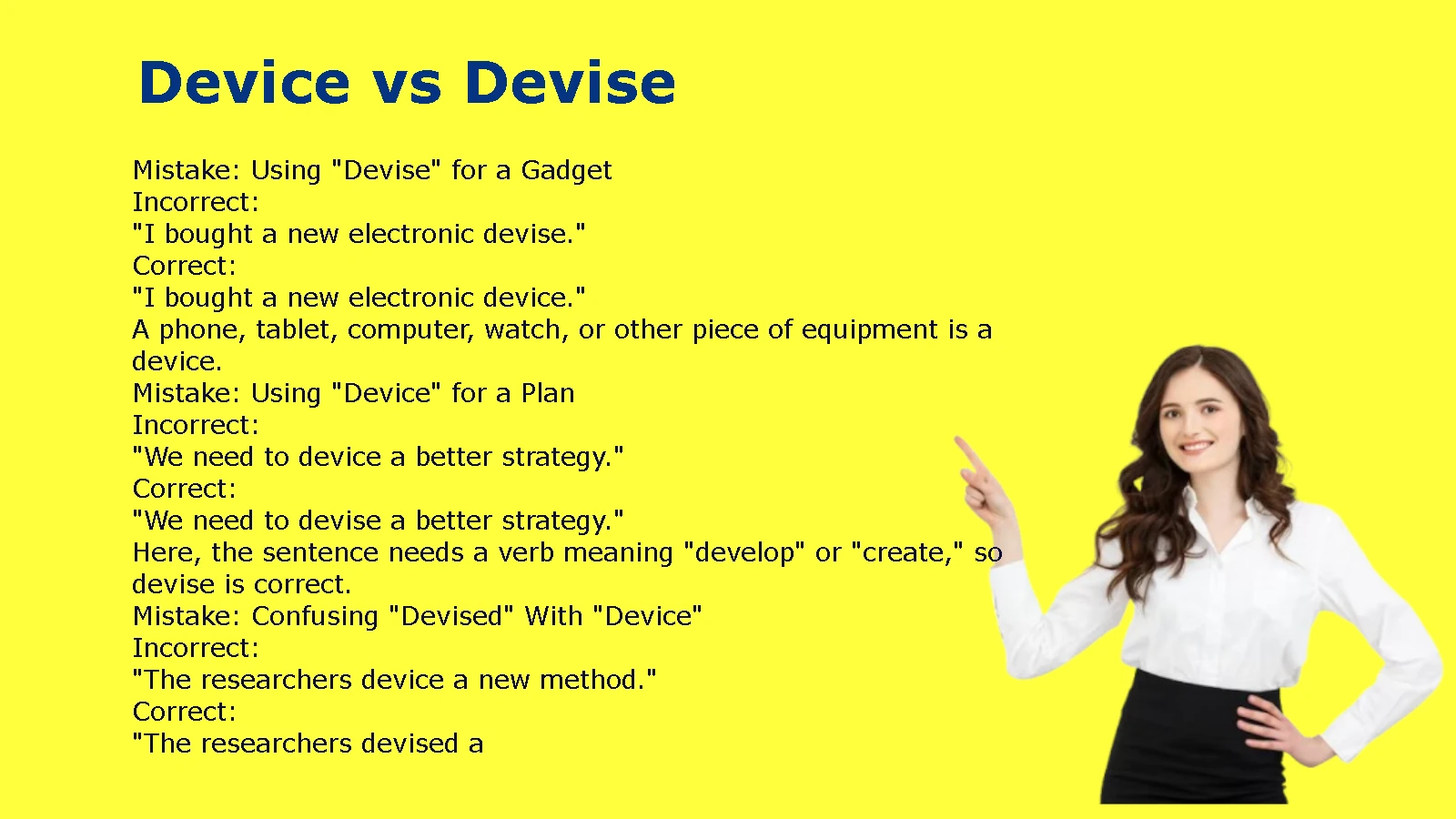
Mistake: Using “Devise” for a Gadget
Incorrect:
“I bought a new electronic devise.”
Correct:
“I bought a new electronic device.”
A phone, tablet, computer, watch, or other piece of equipment is a device.
Mistake: Using “Device” for a Plan
Incorrect:
“We need to device a better strategy.”
Correct:
“We need to devise a better strategy.”
Here, the sentence needs a verb meaning “develop” or “create,” so devise is correct.
Mistake: Confusing “Devised” With “Device”
Incorrect:
“The researchers device a new method.”
Correct:
“The researchers devised a new method.”
The past tense of devise is devised.
Mistake: Assuming “Device” Always Means Technology
Not every device is electronic.
A device can be a mechanical tool, safety mechanism, medical instrument, or even a literary technique.
For example:
“The author used repetition as a literary device.”
There’s no machine involved.
How to Remember Device vs Devise
When two words differ by only one letter, a small memory trick can save you from repeated mistakes.
The C = Concrete Trick
DeviCe contains a C.
Think:
C = Concrete thing
A device can be a physical object you can hold, use, operate, or inspect.
For example:
- cell phone
- camera
- computer
- calculator
- medical instrument
This isn’t a universal spelling rule. It’s simply a memory aid.
The S = Strategy Trick
DeviSe contains an S.
Think:
S = Strategy
You can devise a strategy, devise a solution, or devise a system.
Again, this is a mnemonic rather than a grammatical rule.
The Sound Trick
The pronunciation difference offers another useful shortcut:
device → ends with /s/
devise → ends with /z/
You can associate the stronger, voiced z sound with the active process of devising something.
If you’re unsure while writing, don’t rely solely on sound. Check the grammar of the sentence.
A Simple Test for Device vs Devise
Ask yourself one question:
Am I naming a thing, or am I describing the act of creating something?
If you’re describing the act of inventing, planning, or developing it, choose devise.
If You Mean a Thing
Use device:
“The device stopped working.”
If You Mean an Action
Use devise:
“The engineers devised a solution.”
If You Mean a Plan
Use devise:
“They devised a plan to solve the problem.”
If You Mean a Technique
Use device:
“The writer used irony as a literary device.”
This quick test catches most everyday mistakes.
Device vs Devise: Word Forms
Understanding the different forms also helps prevent errors.
Forms of Device
Because device is a noun, its basic plural form is:
- device
- devices
Example:
“The office has several electronic devices.”
You don’t normally conjugate device as a verb in modern standard English.
Forms of Devise
Because devise is a verb, it can change according to tense and grammatical structure:
- devise
- devises
- devised
- devising
Examples:
“She devises creative solutions.”
“They devised a new system.”
“The team is devising a strategy.”
“We need to devise a better approach.”
This difference gives you another reliable clue.
If you need a verb that means create or plan, devise is the word you’re looking for.
A Closer Look at the Relationship Between the Words
Although device and devise aren’t interchangeable, their meanings have a conceptual connection.
A person might devise something and eventually create a device.
Imagine an engineer trying to solve a practical problem.
First, the engineer thinks through the problem and devises a solution. Next, the engineer builds a physical device based on that solution.
For example:
“The engineers devised a new mechanism and built a device that could detect leaks.”
The first word describes the creative process.
The second names the resulting object.
This relationship provides a useful way to remember the difference without memorizing two isolated dictionary definitions.
Mini Case Study: How the Words Work Together
Imagine a company wants to reduce energy consumption in an office building.
The engineering team studies the building and devises a system that automatically adjusts lighting based on occupancy.
The company then installs a sensor device that detects movement.
The distinction looks like this:
| Stage | Correct Word | Why |
| Engineers develop the idea | Devise | They create a solution |
| Engineers plan the system | Devise | They formulate a method |
| Engineers build the sensor | Device | It’s a physical object |
| Workers install the sensor | Device | The sensor is the equipment |
| The company describes the sensor | Device | It names the object |
This is a practical example of why grammar matters. The two words can appear in the same discussion without meaning the same thing.
Device vs Devise in Professional Writing
Choosing the correct word becomes especially important in business, academic, technical, and professional writing.
A spelling error such as “device a strategy” can make an otherwise polished document look careless.
Compare these sentences:
“Our team will device a new customer-retention strategy.”
and:
“Our team will devise a new customer-retention strategy.”
The second sentence is correct because devise functions as the verb.
Now consider:
“The company developed a new monitoring device.”
Here, device is correct because the sentence names the equipment.
Professional Examples
Business:
“The leadership team devised a three-year growth strategy.”
Engineering:
“The engineers devised a more efficient cooling system.”
Technology:
“The new device uses less power than its predecessor.”
Education:
“The instructor devised an interactive lesson.”
Literature:
“Foreshadowing is a powerful literary device.”
Science:
“Researchers devised a new method for measuring the compound.”
These examples demonstrate that the distinction applies across many professional fields.
Device vs Devise: Frequently Asked Questions
Is “device” a noun or a verb?
Device is primarily a noun in modern standard English. It can refer to a physical object, machine, tool, method, or technique.
For example:
“The device stopped working.”
Is “devise” a noun or a verb?
Devise is primarily a verb meaning to invent, develop, or plan something.
For example:
“The team devised a new strategy.”
In legal terminology, devise can also function as a noun when referring to property given through a will.
Do device and devise sound the same?
No.
Device ends with an /s/ sound, while devise ends with a /z/ sound. Cambridge lists the US pronunciations as /dɪˈvaɪs/ and /dɪˈvaɪz/, respectively.
Is a phone a device?
Yes.
A smartphone is an electronic or mobile device.
Can device mean a method?
Yes.
In contexts such as literature, rhetoric, and marketing, device can mean a method or technique used to achieve a particular effect.
What does “devise a plan” mean?
Devise a plan means to create, develop, or formulate a plan, usually through deliberate thought.
For example:
“The team devised a plan to launch the product.”
What is the past tense of devise?
The past tense is devised.
Example:
“The researchers devised a new testing procedure.”
Can you use device and devise in the same sentence?
Absolutely.
For example:
“The engineers devised a new system and built a device to control it.”
The first word describes the act of creating. The second names the resulting object.
Practice Quiz: Device or Devise?
Test yourself by choosing device or devise for each sentence.
Fill in the Blank
1. The engineers need to ______ a more efficient cooling system.
2. Please turn off your electronic ______ before the presentation begins.
3. The company ______ a strategy to attract new customers.
4. The safety ______ prevents the machine from overheating.
5. The author used irony as a literary ______.
6. Scientists are trying to ______ a faster testing method.
7. This medical ______ monitors the patient’s vital signs.
8. The committee must ______ a solution before the deadline.
9. The inventor created a small electronic ______.
10. The teacher ______ an engaging exercise for the class.
Answers
| Question | Answer | Reason |
| 1 | devise | The engineers need to create a solution |
| 2 | device | A phone or tablet is a physical object |
| 3 | devised | The company created a strategy |
| 4 | device | The safety mechanism is an object |
| 5 | device | Irony is a literary technique |
| 6 | devise | Scientists want to develop a method |
| 7 | device | The monitor is a piece of equipment |
| 8 | devise | The committee needs to formulate a solution |
| 9 | device | The invention is a physical object |
| 10 | devised | The teacher created the exercise |
If you got most of these right, you’ve already mastered the central distinction.
Device vs Devise: Common Word Combinations
Collocations can make the difference easier to recognize because certain words naturally appear with device or devise.
Common Combinations With Device
- electronic device
- mobile device
- medical device
- safety device
- mechanical device
- security device
- communication device
- recording device
- storage device
- literary device
- rhetorical device
- measuring device
Common Combinations With Devise
- devise a plan
- devise a strategy
- devise a solution
- devise a system
- devise a method
- devise a technique
- devise an approach
- devise a procedure
- devise a way
- devise a scheme
When you become familiar with these combinations, choosing the correct spelling becomes much more automatic.
Why People Confuse Device and Devise
The confusion isn’t surprising.
Both words:
- begin with devi-
- contain the same long /aɪ/ sound
- have two syllables
- receive stress on the second syllable
- differ by only one letter in spelling
- have related historical associations with creating or arranging things
The final sound is also easy to overlook in rapid speech.
Writing creates an additional problem because c and s can both represent different sounds in English. That’s why visual memory alone isn’t always enough.
The best approach combines meaning, grammar, spelling, and pronunciation.
The Fastest Way to Remember Device vs Devise
If you only remember one rule, make it this:
Device = thing or technique. Devise = create or plan.
Then add the sound distinction:
Device ends in /s/. Devise ends in /z/.
And finally use the grammar test:
Can you put “a” or “the” before it?
If yes, device may be the noun you need.
Does it describe someone creating or planning something?
If yes, devise is likely correct.
For example:
- a device ✓
- the device ✓
- to devise ✓
- to device ✗ in standard modern usage
- a devise → possible in specialized legal usage, but not the ordinary everyday word for an object
Final Takeaway: Device vs Devise
The difference between Device vs Devise is simple once you separate the words by their grammatical jobs.
Device is a noun. It usually refers to an object, machine, tool, piece of equipment, method, or technique.
“The phone is an electronic device.”
Devise is a verb. It means to invent, develop, formulate, or carefully plan something.
“The engineers devised a new solution.”
Their pronunciations differ as well:
- device → /dɪˈvaɪs/ → final /s/ sound
- devise → /dɪˈvaɪz/ → final /z/ sound
The most useful memory trick is:
Device = the thing.
Devise = the act of creating or planning the thing.
There’s also a specialized legal meaning of devise, where the word relates to property transferred through a will.
Once you connect device with an object or technique and devise with an action, the spelling becomes much easier to remember. When in doubt, look at the role the word plays in the sentence. If you’re naming something, choose device. If you’re describing the process of creating or planning something, choose devise.