Submitted vs submited is a common spelling confusion, especially when you’re writing quickly or trying to form the past tense of the verb submit. If you’ve wondered whether “submitted” or “submited” is the correct spelling, the answer is straightforward: submitted is the correct spelling, while submited is a misspelling.
The submitted vs submited difference comes down to how English spelling rules work when adding -ed to a verb ending in a consonant followed by a stressed vowel and consonant. The verb submit becomes submitted by doubling the final t before adding -ed. Although submited may look like a natural spelling, it is not standard English.
In this guide, you’ll learn whether “submitted” or “submited” is correct, why the final “t” is doubled, how to use “submitted” in sentences, and how the spelling changes when you add endings such as -ed and -ing. You’ll also see clear examples to help you remember the correct form.
By the end, you’ll know exactly why submitted is correct, why submited is incorrect, and how to use the word naturally and confidently in your writing.
Submitted vs Submited: Quick Answer
Here’s the answer at a glance:
| Spelling | Correct? | Use |
| Submitted | ✅ Yes | Standard English spelling |
| Submited | ❌ No | Misspelling |
Submitted is the past tense and past participle of submit.
For example:
- I submitted my application yesterday.
- She submitted the assignment before class.
- They have submitted the final proposal.
- The documents were submitted for review.
The incorrect form submited drops one of the two t’s. It isn’t an accepted alternative spelling.
The Simple Rule
When you change submit to its past-tense form, don’t simply attach -ed:
submit + ed = submitted
The final t doubles:
submit → submitted
That same pattern appears in words such as admit → admitted, commit → committed, and permit → permitted.
What Does Submitted Mean?
Submitted means that someone gave, sent, presented, or formally offered something for consideration, review, approval, or a decision.
It’s the past form of submit, which can have several related meanings depending on context.
For example, if you hand your completed application to a university, you submitted an application. If an employee sends a report to a manager for review, the employee submitted a report. If a researcher sends a paper to a journal, the researcher submitted a manuscript.
Cambridge defines submit as giving or offering something so that another person or group can make a decision about it. It also uses the word for formally sending documents, plans, proposals, and requests to an authority. Cambridge Dictionary
Common Meanings of Submitted
The word commonly appears in these situations:
- Applications: She submitted her application online.
- Assignments: He submitted his homework late.
- Reports: The team submitted its report.
- Proposals: The company submitted a proposal.
- Research: The authors submitted their paper to a journal.
- Requests: We submitted a request for approval.
- Documents: The required documents were submitted yesterday.
- Evidence: The lawyer submitted the evidence to the court.
In each case, submitted tells you that something was formally given or presented to someone else.
Why Is Submitted Spelled With Two Ts?
The spelling submitted follows a final-consonant doubling pattern in English.
The base verb is:
submit
It ends with a single t. When the past-tense ending -ed is added, the final consonant is doubled:
submit → submitted
The same thing happens when you form the present participle:
submit → submitting
This isn’t an arbitrary spelling choice. English uses consonant doubling in certain word formations to preserve the pronunciation and structure of the base word. The exact doubling rules depend on factors such as syllable count, the final letters, the preceding vowel, stress, and the suffix being added. Our Languages
The Spelling Pattern Behind Submitted
Consider these related words:
| Base Word | Past Tense |
| admit | admitted |
| commit | committed |
| omit | omitted |
| permit | permitted |
| submit | submitted |
| transmit | transmitted |
Notice the pattern.
Each word ends in -mit or a similar final consonant structure. When the appropriate vowel-starting suffix is added, the final consonant doubles.
So:
submit + ed → submitted
Not:
submit + ed → submited
The second version treats the suffix as though the final t should remain single. Standard spelling doesn’t work that way here.
Why Doesn’t “Submited” Look Right?
Once you become familiar with English spelling patterns, submited starts to look unusual because related forms consistently preserve the doubled consonant:
- submitted
- submitting
- submission
- submitter
The doubled t isn’t something added only in one isolated form. It belongs to the standard spelling pattern of the verb when certain endings are attached.
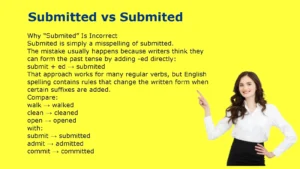
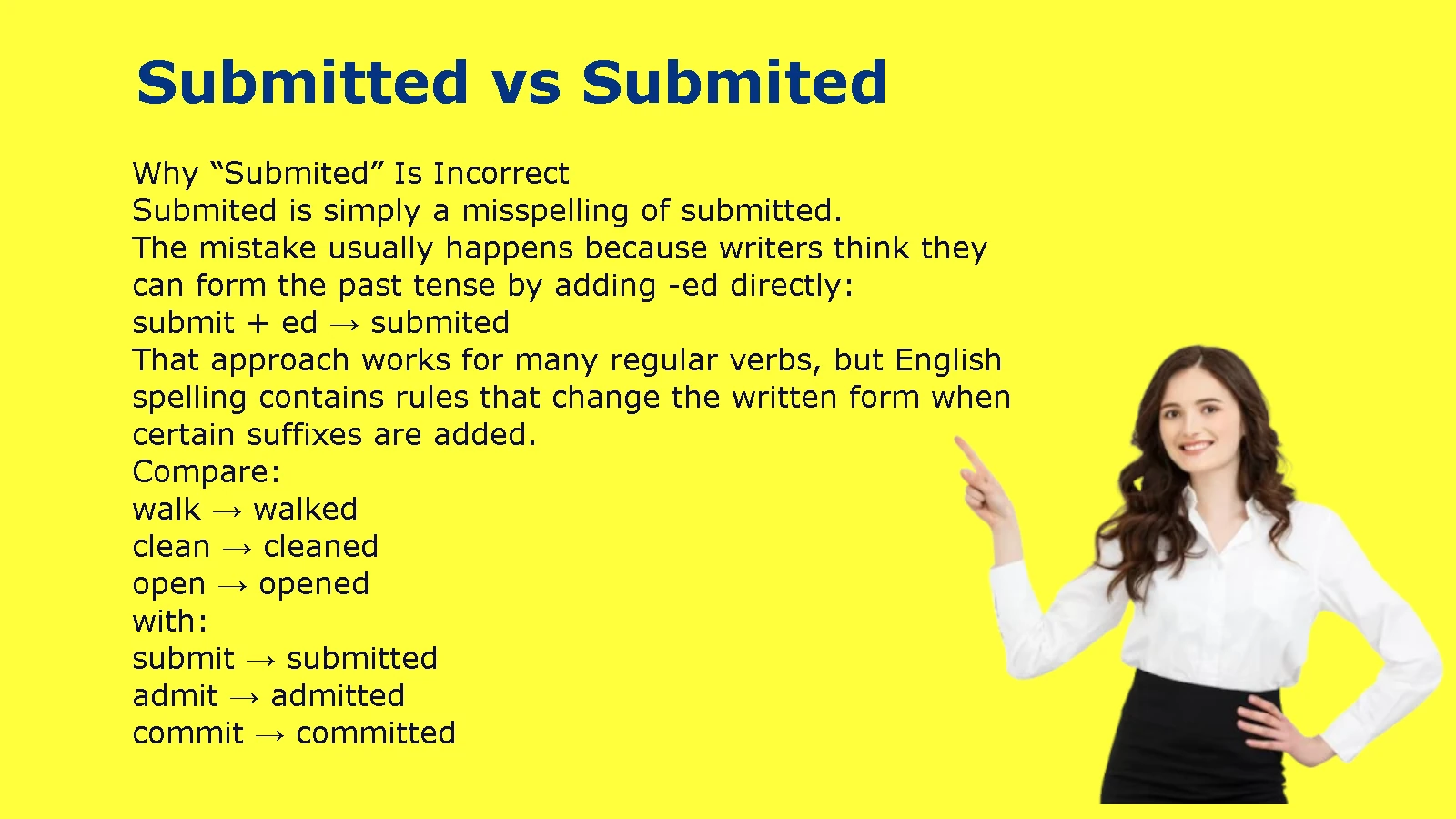
Why “Submited” Is Incorrect
Submited is simply a misspelling of submitted.
The mistake usually happens because writers think they can form the past tense by adding -ed directly:
submit + ed → submited
That approach works for many regular verbs, but English spelling contains rules that change the written form when certain suffixes are added.
Compare:
- walk → walked
- clean → cleaned
- open → opened
with:
- submit → submitted
- admit → admitted
- commit → committed
The important point isn’t that every verb doubles its final consonant. They don’t. The doubling depends on the spelling and pronunciation pattern of the particular word.
For submit, the standard form is firmly established as submitted. Major dictionaries list submitted as the past form of submit. Cambridge Dictionary
Submitted vs Submited: What Is the Difference?
There is no difference in meaning because submited isn’t a standard alternative form.
The comparison is straightforward:
| Word | Meaning | Standard English? |
| submitted | Past tense/past participle of submit | ✅ Yes |
| submited | Intended as the past tense of submit | ❌ No |
If you see submited in an email, form, essay, website, or document, the writer almost certainly intended submitted.
Correct Examples
- I submitted my application on Monday.
- She submitted the form online.
- We submitted the proposal for review.
- The student submitted the assignment early.
- They have submitted all the required documents.
Incorrect Examples
- I submited my application on Monday.
- She submited the form online.
- We submited the proposal for review.
- The student submited the assignment early.
- They have submited all the required documents.
The fix is simple every time: replace submited with submitted.
Submitted in a Sentence
Because submitted appears frequently in academic, professional, legal, and everyday writing, understanding its natural usage matters as much as memorizing the spelling.
Everyday Examples of Submitted
Here are some ordinary examples:
- I submitted the form this morning.
- She submitted her application before the deadline.
- We submitted the request online.
- He submitted the documents yesterday.
- They submitted their names for consideration.
The word often appears when someone sends something through an official process.
Academic Examples of Submitted
Academic writing uses submitted particularly often:
- The student submitted the assignment before class.
- Maria submitted her thesis for review.
- The researchers submitted their findings to the journal.
- He submitted the final paper on Friday.
- The students submitted their projects electronically.
In these sentences, the word emphasizes formal delivery rather than merely sending something casually.
For example, you might send a friend a document. You’d more likely submit a document to a professor when the document forms part of an academic requirement.
Professional Examples of Submitted
The same distinction appears at work:
- The department submitted its annual report.
- She submitted a leave request.
- We submitted the proposal to the client.
- The contractor submitted a revised bid.
- The employee submitted the required paperwork.
Business English commonly uses submit for documents that enter a formal review, approval, or decision-making process. Cambridge Dictionary
Scientific Examples of Submitted
Scientific and research writing also relies heavily on this verb:
- The researchers submitted the manuscript for peer review.
- The authors submitted a revised paper.
- The laboratory submitted its findings to the committee.
- The team submitted the results for further analysis.
This usage isn’t merely stylistic. Submitted signals that the material has been formally presented to another party for evaluation or consideration.
Submitted as the Past Tense and Past Participle of Submit
One reason submitted appears in so many sentence structures is that it serves two closely related grammatical roles.
It functions as both the simple past and the past participle of submit. Cambridge explicitly identifies submitted as both the past simple and past participle. Cambridge Dictionary
Submitted as the Past Tense
Use submitted as the simple past when an action happened in the past.
Examples:
- I submitted the application yesterday.
- She submitted her assignment last night.
- They submitted the report on Friday.
- We submitted the proposal before the meeting.
The verb describes a completed past action.
Submitted as a Past Participle
The same form appears after helping verbs such as has, have, and had.
Examples:
- She has submitted the application.
- They have submitted the documents.
- He had submitted the report before the meeting.
- We have submitted our final proposal.
The spelling remains submitted in every case.
Submitted in Passive Constructions
You can also use submitted in passive sentences.
Examples include:
- The application was submitted yesterday.
- The documents were submitted for review.
- The report has been submitted.
- The proposal had been submitted before the deadline.
In these sentences, the thing that someone submitted becomes the grammatical subject.
For example:
Active: The researcher submitted the paper.
Passive: The paper was submitted by the researcher.
Both sentences describe the same basic event, although the active version focuses more directly on who performed the action.
American vs British English: Is Submitted Spelled Differently?
No. Submitted is spelled the same way in American and British English.
There is no American submitted versus British submited distinction.
| Variety | Correct Spelling |
| American English | submitted |
| British English | submitted |
| Incorrect form | submited |
The same double t appears in both varieties.
This makes the spelling especially easy to settle: you don’t need to check which English variety you’re using. Submitted is the standard choice.
Cambridge’s American English entry gives submit with the same spelling and identifies submitted as its past form. Cambridge Dictionary
Common Words Related to Submitted
Learning the whole word family can make the spelling easier to remember.
| Word | Form | Example |
| submit | Base verb | Please submit the form. |
| submits | Third-person singular | She submits reports monthly. |
| submitted | Past tense/past participle | She submitted the report. |
| submitting | Present participle/gerund | He is submitting the form. |
| submission | Noun | Your submission was accepted. |
| submitter | Noun | The submitter received a confirmation. |
Submit
Submit is the base form.
Please submit your application by Friday.
Submits
Submits is the third-person singular present form.
The department submits its report every quarter.
Submitted
Submitted serves as both the simple past and past participle.
She submitted the form yesterday.
She has submitted the form.
Submitting
Submitting is the -ing form.
He is submitting his application now.
Notice that the t doubles here too:
submit → submitting
Submission
Submission is a noun.
Your submission must include three references.
This word doesn’t simply add -ed or -ing to the base form. It follows a different derivational pattern.
Submitter
A submitter is a person or entity that submits something.
The submitter must provide a valid email address.
Submitted vs Submited: Common Spelling Mistakes
The most obvious mistake is submited, but it’s not the only spelling error associated with submit.
Submited
❌ Submited
✅ Submitted
The missing t is the key error.
Submiting vs Submitting
Another common mistake is:
❌ submiting
✅ submitting
The same doubling pattern applies when adding -ing.
submit → submitting
Submit vs Submitted
These forms aren’t interchangeable.
| Word | Function | Example |
| submit | Base/present form | Please submit the form. |
| submitted | Past/past participle | I submitted the form. |
You wouldn’t normally write:
Yesterday, I submit the report.
Instead:
Yesterday, I submitted the report.
Likewise, after will, use the base form:
I will submit the report tomorrow.
Not:
I will submitted the report tomorrow.
How to Remember the Spelling of Submitted
The easiest memory trick is to connect submitted with other familiar -mitted words.
Think:
admit → admitted
commit → committed
permit → permitted
submit → submitted
Once you recognize the pattern, the spelling becomes much easier to retrieve.
A Simple Memory Formula
Remember:
Submit has one T. Submitted has two Ts.
That’s short enough to remember when you’re writing quickly.
Another useful approach is to picture the transformation:
SUBMIT → SUBMITTED
The extra T appears right before -ed.
Why This Trick Works
The spelling rule isn’t unique to submit. English regularly doubles certain final consonants when suffixes beginning with vowels are added. The exact conditions vary by word, but consonant doubling is a well-established spelling pattern. Our Languages
You don’t need to memorize every technical condition to spell submitted correctly. For this particular word, remembering the established form is enough.
Submitted vs Similar Words
Sometimes spelling questions overlap with vocabulary questions. A writer may know that submitted is correct but still wonder whether another word would fit better.
Submitted vs Sent
Sent has a broader meaning.
I sent the email to Sarah.
Submitted suggests that you formally gave something to someone for consideration, processing, review, approval, or a decision.
I submitted my application to the university.
You can send many things. You submit things when they enter a more formal process.
Submitted vs Filed
Filed often suggests placing or officially recording a document in a particular system or record.
The attorney filed the motion.
Submitted emphasizes presenting something to another person or organization.
The attorney submitted the documents for review.
The two words can overlap in certain contexts, but they aren’t always interchangeable.
Submitted vs Presented
Presented can mean showing or putting something before someone.
She presented her findings to the committee.
Submitted usually carries a stronger sense of formal delivery for review, approval, or consideration.
She submitted her findings to the committee.
The exact choice depends on what happened and what you want to emphasize.
When to Use Submitted
Knowing the spelling is only half the battle. The word also appears in several useful grammatical patterns.
Submitted + Object
The most common structure is:
submitted + something
Examples:
- submitted an application
- submitted a report
- submitted a form
- submitted a proposal
- submitted an assignment
- submitted a request
- submitted a manuscript
- submitted evidence
For example:
The company submitted a proposal for the project.
Submitted By + Person or Organization
Use submitted by when you want to identify who performed the action.
Examples:
- The application was submitted by Maria.
- The report was submitted by the finance department.
- The paper was submitted by three researchers.
- The complaint was submitted by the customer.
This structure is especially common in formal documents and records.
Submitted To + Recipient or Authority
Use submitted to when identifying the person, organization, institution, or authority that received the material.
Examples:
- The proposal was submitted to the committee.
- The application was submitted to the university.
- The report was submitted to management.
- The documents were submitted to the court.
Submitted For + Purpose
You can also use submitted for to explain why something was presented.
Examples:
- The paper was submitted for review.
- The application was submitted for approval.
- The proposal was submitted for consideration.
- The manuscript was submitted for publication.
These patterns are particularly useful in professional and academic writing.
Submitted in Common Phrases
Certain combinations occur frequently enough to remember as useful phrases.
| Phrase | Example |
| submitted an application | She submitted an application for the position. |
| submitted a report | The team submitted a report on Monday. |
| submitted a proposal | They submitted a proposal to the board. |
| submitted a request | We submitted a request for additional information. |
| submitted an assignment | He submitted the assignment before class. |
| submitted for review | The manuscript was submitted for review. |
| submitted for approval | The plan was submitted for approval. |
| submitted to the committee | The proposal was submitted to the committee. |
| submitted by the applicant | The form was submitted by the applicant. |
| has been submitted | The final version has been submitted. |
These combinations show why submitted is so common in formal writing. The word naturally fits situations involving applications, documents, proposals, research, and official requests.
A Simple Case Study: Correcting “Submited”
Imagine a student writing an email to a professor:
I have submited my final assignment through the online portal.
The meaning is perfectly clear. However, the spelling is wrong.
The correction is:
I have submitted my final assignment through the online portal.
Only one letter changes, but that one letter matters in formal writing.
Now consider a job application:
I submited my application yesterday.
The corrected version is:
I submitted my application yesterday.
The same correction applies whether you’re writing an email, academic paper, resume, business report, or online form.
What This Case Shows
The error doesn’t usually come from misunderstanding the meaning of the word. It comes from forgetting the consonant-doubling pattern.
That makes submited a classic spelling mistake: the writer knows the word but produces the wrong written form.
Why People Commonly Write Submited
The mistake makes sense when you look at how the word sounds.
When you pronounce submitted, the two t’s don’t sound like two separate, strongly emphasized consonants. English pronunciation doesn’t always map neatly onto spelling.
That can make it tempting to write:
submited
instead of:
submitted
Another reason is that many regular past-tense verbs simply take -ed without changing their spelling:
- work → worked
- call → called
- clean → cleaned
- open → opened
A writer may apply that simpler pattern automatically to submit.
However, spelling rules don’t always work by simply attaching letters. English contains many cases where adding a suffix changes the written form.
For submit, the standard result is:
submit + -ed → submitted
Is Submitted the Correct Spelling?
Yes. Submitted is the correct spelling.
It’s the standard past tense and past participle of submit.
Correct: submitted
Incorrect: submited
Dictionaries list submitted as the past form of submit, and standard English uses this spelling in academic, professional, everyday, and formal contexts. Cambridge Dictionary
If you’re proofreading an important document, choose submitted every time.
Is Submited a Word?
Submited is not the standard spelling of the past tense of submit.
In practical writing, treat it as a misspelling.
You might encounter it in user-generated content, informal posts, drafts, or documents containing spelling errors. Its appearance doesn’t make it a valid alternative form.
The standard form is:
submitted
So if spell-check flags submited, it isn’t asking you to choose between two legitimate variants. You should correct it to submitted.
What Is the Past Tense of Submit?
The past tense of submit is submitted.
Present: I submit the report every Friday.
Past: I submitted the report yesterday.
The spelling includes two t’s.
Past Tense Examples
- She submitted her application yesterday.
- We submitted the paperwork last week.
- He submitted the assignment before the deadline.
- They submitted a formal request.
- The researchers submitted their paper.
What Is the Past Participle of Submit?
The past participle is also submitted.
It commonly appears with helping verbs such as has, have, and had.
Examples:
- I have submitted the form.
- She has submitted the application.
- They have submitted the report.
- He had submitted the documents before noon.
It also appears in passive constructions:
- The application was submitted yesterday.
- The documents have been submitted for review.
- The proposal had been submitted before the meeting.
So there’s no spelling difference between the past tense and past participle:
submitted = past tense
submitted = past participle
Is Submitting Spelled With Two Ts?
Yes.
The correct spelling is:
submitting
Not:
submiting
The same consonant-doubling pattern appears when -ing is added:
submit → submitting
Compare:
- admit → admitting
- commit → committing
- omit → omitting
- submit → submitting
This gives you another useful memory aid. If you remember submitted with two t’s, you’re already halfway toward remembering submitting correctly.
Is Submitted Spelled Differently in British English?
No.
Both American and British English use:
submitted
There is no British spelling submited.
| English Variety | Correct Form |
| American English | submitted |
| British English | submitted |
| Canadian English | submitted |
| Incorrect form | submited |
Some English words genuinely differ between American and British spelling, such as color/colour or organize/organise in relevant style systems.
Submitted isn’t one of those words.
Submitted vs Submited: A Quick Comparison
| Question | Answer |
| Which spelling is correct? | Submitted |
| Is submited correct? | No |
| What is the base verb? | Submit |
| What is the past tense? | Submitted |
| What is the past participle? | Submitted |
| Does the final T double? | Yes |
| Is submitting spelled with two Ts? | Yes |
| Does British English use submited? | No |
| Does American English use submited? | No |
| What does submitted mean? | Gave or presented something for consideration, processing, review, approval, or a decision |
Frequently Asked Questions About Submitted vs Submited
Is submitted the correct spelling?
Yes. Submitted is the correct standard spelling.
Is submited correct?
No. Submited is a misspelling of submitted.
Why does submitted have two Ts?
The final t in submit doubles when the appropriate suffix -ed is added. The resulting spelling is submitted.
What is the past tense of submit?
The past tense is submitted.
I submitted the application yesterday.
What is the past participle of submit?
The past participle is also submitted.
I have submitted the application.
Is submitting spelled with two Ts?
Yes. The correct spelling is submitting.
She is submitting the form now.
Is submitted a British or American spelling?
It’s both. Submitted is standard in American and British English.
Can submitted and submited be used interchangeably?
No. Submited is not a standard alternative spelling. Use submitted.
What does submitted mean?
It generally means that someone gave, presented, or formally sent something to another person or organization for consideration, review, approval, processing, or a decision. Cambridge Dictionary
What is the difference between submitted and sent?
Sent has a broader meaning. Submitted usually suggests a more formal process in which something is presented to someone for consideration, review, approval, or a decision.
I sent my friend a photo.
I submitted my application to the university.
How do you remember the spelling of submitted?
Remember:
submit → submitted
The single t in submit becomes two t’s before -ed.
Final Verdict: Submitted Is Correct
When choosing between submitted and submited, there isn’t much room for debate:
Submitted ✅
Submited ❌
The correct word is submitted, with two t’s.
It’s the past tense and past participle of submit, a verb commonly used when you formally give an application, report, assignment, proposal, request, manuscript, or other material to someone for consideration or processing. Cambridge Dictionary
The easiest spelling pattern to remember is:
submit → submitted → submitting
So the next time you’re tempted to write submited, stop for a second and look for that extra t.
Submitted is the spelling you want.