A chain is the correct and standard spelling for a linked series of metal rings, objects connected together, or something that connects or binds things. If you’ve come across the spelling “chane” and wondered whether it is a correct alternative, the confusion is usually related to spelling, pronunciation, or typing mistakes. The term chain is commonly connected to links, jewelry, necklaces, connections, sequences, restraints, and things joined together.
The chain or chane question asks which spelling is correct and whether “chane” is a valid English word. In standard English, chain is the correct spelling for the word used to describe a series of connected links or something that connects people or things. Chane is generally considered a misspelling of chain, although it may appear in names, specialized contexts, or as a typo. Related terms such as link, necklace, connection, sequence, and series can have similar meanings depending on the context.
In this guide, you’ll learn whether “chain” or “chane” is correct, what chain means, why “chane” is often considered a misspelling, how to use chain in sentences, and how to remember the correct spelling. You’ll also see clear examples to make the difference between chain and chane easy to understand.
By the end, you’ll know exactly whether to use chain or chane and how to spell and use this common English word naturally and correctly.
Chain or Chane: Quick Answer
| Word | Standard English spelling? | Meaning | Example |
| chain | Yes | Connected links, a series of connected things, a business group, and more | She locked her bicycle with a chain. |
| chane | No, not as the standard spelling of chain | Not the standard English form of this word | Use chain, not chane. |
So, if you’re asking “Is it chain or chane?”, the answer is simple:
Chain is correct. Chane is incorrect when you mean the ordinary English word “chain.”
There is no standard British-English spelling in which chane replaces chain. Likewise, chane is not an American-English alternative.
The standard spelling is C-H-A-I-N.
What Does Chain Mean?
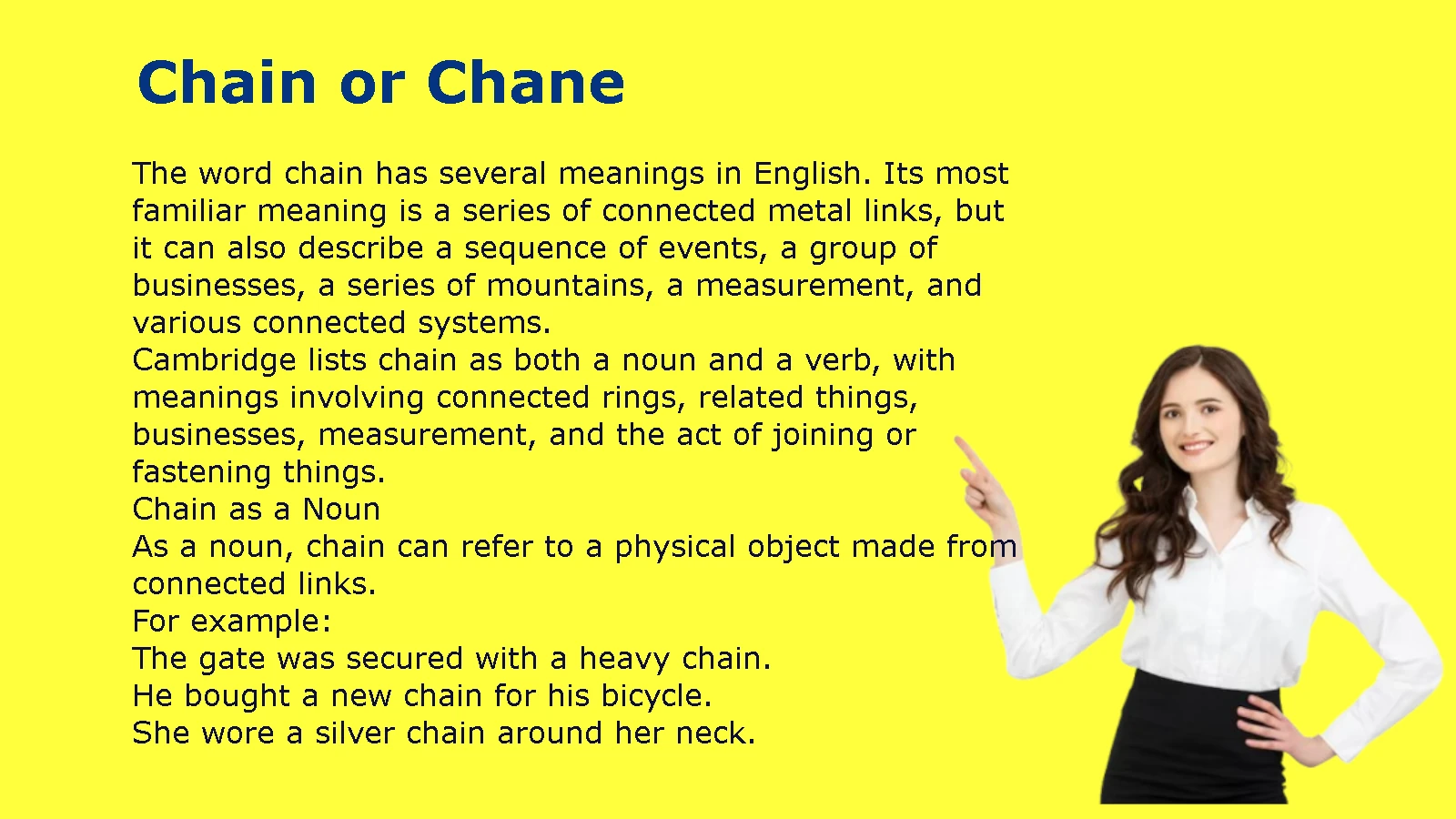
The word chain has several meanings in English. Its most familiar meaning is a series of connected metal links, but it can also describe a sequence of events, a group of businesses, a series of mountains, a measurement, and various connected systems.
Cambridge lists chain as both a noun and a verb, with meanings involving connected rings, related things, businesses, measurement, and the act of joining or fastening things.
Chain as a Noun
As a noun, chain can refer to a physical object made from connected links.
For example:
- The gate was secured with a heavy chain.
- He bought a new chain for his bicycle.
- She wore a silver chain around her neck.
A chain does not have to be made of metal in every context. The central idea is connection: separate links or elements are joined together to form a longer whole.
The word also has several figurative meanings.
A chain of events, for example, is a series of events in which one event leads to another.
The first mistake started a chain of events that eventually caused the project to fail.
A chain of command is an organizational structure in which authority passes through different levels.
The complaint was sent through the company’s chain of command.
A food chain describes relationships between organisms based on who eats whom.
A supply chain describes the connected stages involved in producing and delivering goods or services.
The common idea behind all these expressions is connection or sequence.
Chain as a Verb
Chain can also be a verb.
As a verb, it can mean to fasten, restrain, or connect something with a chain.
For example:
He chained his bicycle to the railing.
It can also mean to connect things together into a sequence.
The program allows users to chain several operations together.
Cambridge records both the physical sense of fastening something with a chain and the broader sense of joining or connecting things.
The main verb forms are:
| Verb form | Example |
| chain | They chain the equipment together. |
| chains | He chains his bicycle outside. |
| chained | The bicycle was chained to a post. |
| chaining | The system is chaining several processes together. |
This means that chain is not only the name of an object. It is also an action.
Chain or Chane: Which One Is Correct?
If you’re writing in standard English, use chain.
Chane is not an alternative spelling of chain in ordinary English. You should therefore write:
- chain of events, not chane of events
- chain reaction, not chane reaction
- chain store, not chane store
- chain of command, not chane of command
- supply chain, not supply chane
- chain link, not chane link
This distinction applies regardless of whether you’re writing American or British English.
Correct and Incorrect Examples
| Incorrect | Correct |
| chane | chain |
| chane reaction | chain reaction |
| chane of events | chain of events |
| chane store | chain store |
| chane of command | chain of command |
| supply chane | supply chain |
| chane link | chain link |
| bicycle chane | bicycle chain |
The easiest correction is simply to remember the spelling:
C-H-A-I-N = chain
Why Is “Chane” a Common Spelling Mistake?
One reason people may write chane is pronunciation.
The word chain is pronounced /tʃeɪn/ in both British and American English. Cambridge breaks this pronunciation into the /tʃ/ sound as in cheese, the /eɪ/ sound as in day, and the final /n/ sound.
In simple terms, chain sounds roughly like:
“chayn”
That pronunciation does not tell you immediately that the word uses ai rather than ane.
English contains several ways to represent similar vowel sounds. Compare:
- rain
- train
- main
- brain
- day
- say
- great
- eight
Because English spelling is influenced by its history and by words borrowed from different languages, pronunciation alone cannot always determine spelling.
That’s why chane can look plausible even though it isn’t the standard spelling of this English word.
How Do You Spell Chain?
The correct spelling is:
C-H-A-I-N
A Simple Way to Remember “Chain”
One useful memory trick is to connect chain with other familiar words containing ai:
- rain
- train
- brain
- main
- plain
- gain
- pain
For example:
A chain can connect to a train.
The point isn’t that ai always represents the same sound in English. It doesn’t. The trick simply gives you a group of familiar words that can help you remember the spelling of chain.
Another practical method is to remember the common phrase chain reaction.
If you have seen that expression many times, you can use it as a spelling anchor:
chain reaction → chain
How Do You Pronounce Chain?
Chain is pronounced:
/tʃeɪn/
It rhymes with words such as:
- train
- rain
- brain
- main
- pain
Cambridge gives the same /tʃeɪn/ pronunciation for both UK and US English.
The word has one syllable.
You can break the pronunciation into three basic sounds:
- /tʃ/ — the “ch” sound
- /eɪ/ — the long-A sound
- /n/ — the final “n” sound
So:
chain → /tʃeɪn/
The pronunciation is the same whether you’re using the word as a noun or a verb.
Is “Chane” a Word?
This question needs a little qualification.
If by chane you mean the ordinary English word referring to connected links, a sequence, or the related verb, then no: chane is not the standard English spelling of chain.
However, it would be inaccurate to claim that the letter sequence chane can never occur in any language or context.
For example, Wiktionary records chane in specific non-English contexts, including an obsolete Classical Nahuatl spelling and a Tagalog form.
That does not make chane an acceptable spelling of the ordinary English word chain.
The useful distinction is:
“Chane” may occur in particular names or languages, but it is not the standard English spelling of “chain.”
Therefore, when you’re writing an English sentence such as “She wore a gold chain,” the correct spelling is chain.
Chain in Everyday English
The word chain appears in everyday English far beyond descriptions of jewelry or hardware.
Understanding its different uses can help you recognize why the spelling remains chain in many apparently unrelated expressions.
Chain as Connected Metal Links
This is probably the most familiar use.
Examples include:
- bicycle chains
- jewelry chains
- door chains
- anchor chains
- chain-link fencing
- chains used for securing equipment
Examples:
The old chain had started to rust.
She wore a thin gold chain.
The bicycle chain came off while he was riding.
In each case, chain refers to a physical structure made from connected links.
Chain as a Series of Events
A chain of events is a sequence in which events are connected.
For example:
A power failure triggered a chain of events that delayed the entire operation.
The first event can lead to a second event, which leads to a third, and so on.
This figurative meaning comes naturally from the physical idea of linked chain segments. Just as one link is connected to the next, one event can be connected to another.
Chain as a Group of Businesses
A chain can also refer to a group of similar businesses operated by the same company or organization.
Examples include:
- restaurant chain
- hotel chain
- supermarket chain
- bookstore chain
- retail chain
- fast-food chain
For example:
The restaurant chain has locations in several countries.
Cambridge defines this business use as a group of shops, restaurants, hotels, or other businesses owned by the same company.
This meaning is especially common in business and consumer writing.
Chain as a Group of Mountains
A mountain chain is a connected or related series of mountains.
For example:
The Rockies form a major mountain chain in North America.
The term works because the mountains can be understood as a connected geographical sequence.
Chain as a Measurement
Chain also has a historical surveying meaning.
One chain equals 66 feet, or 22 yards. That is also 4 rods.
This unit is associated particularly with surveying and land measurement. Cambridge identifies the chain as a length measurement of 66 feet and notes its use in British measurement contexts.
A few useful conversions are:
| Measurement | Equivalent |
| 1 chain | 66 feet |
| 1 chain | 22 yards |
| 1 chain | 4 rods |
| 10 chains | 660 feet |
| 80 chains | 1 mile |
The measurement is less common in ordinary modern conversation, but it remains relevant in historical surveying and some descriptions of land and distance.
Chain or Chane in Common Expressions
One of the easiest ways to reinforce the correct spelling is to learn common expressions containing chain.
Chain Reaction
A chain reaction is a series of events in which one event causes or contributes to the next.
The initial failure caused a chain reaction throughout the system.
The expression is used in everyday writing as well as technical contexts.
Chain of Events
A chain of events is a connected sequence of events.
The accident resulted from a complicated chain of events.
Chain of Command
A chain of command is the hierarchy through which authority and responsibility are organized.
The employee followed the company’s chain of command.
Supply Chain
A supply chain is the network and sequence involved in producing, moving, and supplying goods.
For example, a product may involve:
raw materials → manufacturing → transportation → distribution → retailer → customer
Each stage is connected to others, which explains the use of the word chain.
Food Chain
A food chain describes the transfer of energy and nutrients through feeding relationships among organisms.
A simple example might be:
grass → grasshopper → frog → snake
This is another figurative use of the basic idea of connected links.
Chain Link
A chain link is one individual link in a chain. The expression is also familiar from chain-link fencing, which is made from interwoven wire links.
Chain or Chane in Different Parts of Speech
The word chain can function in more than one grammatical role.
| Part of speech | Meaning | Example |
| Noun | Connected links | The chain is rusty. |
| Noun | A sequence | It began a chain of events. |
| Noun | A group of businesses | She works for a hotel chain. |
| Noun | A measurement | The survey covered two chains. |
| Verb | To fasten with a chain | He chained the bicycle to the post. |
| Verb | To connect things | The processes can be chained together. |
This is important because someone searching “chain or chane” may encounter the word in a sentence where it doesn’t obviously refer to a metal object.
For instance:
The company has expanded its chain of stores.
Here, chain is a noun.
But:
He chained the gate shut.
Here, chained is the past tense of the verb chain.
The spelling remains based on chain.
Chain: Singular and Plural Forms
The singular form is:
chain
The plural form is:
chains
Examples:
- The chain is broken.
- The chains were too heavy.
- Several chains were attached to the structure.
The plural is formed normally by adding -s.
Verb Forms of Chain
The principal forms are:
- chain
- chains
- chained
- chaining
Examples:
They chain the equipment together.
She chains her bicycle to the rack.
He chained the gate.
The software is chaining several operations together.
There is no form chane involved in these conjugations.
Chain or Chane: Common Mistakes
Writing “Chane” Instead of “Chain”
This is the most direct spelling error.
❌ He bought a new chane for his bicycle.
✅ He bought a new chain for his bicycle.
Writing “Chane Reaction”
The correct expression is chain reaction.
❌ The decision caused a chane reaction.
✅ The decision caused a chain reaction.
Writing “Chane of Events”
The established expression is chain of events.
❌ A chane of events changed the outcome.
✅ A chain of events changed the outcome.
Assuming “Chane” Is British English
It isn’t.
British English and American English both use chain.
The pronunciation is also the same in standard UK and US English: /tʃeɪn/.
So there is no American-versus-British spelling issue here.
Confusing Pronunciation With Spelling
Hearing “chayn” doesn’t mean you should automatically spell the word chane.
English has many cases where pronunciation and spelling cannot be mapped perfectly letter by letter.
The safest approach is to remember the established written form:
chain
Chain or Chane: Practical Examples
Here are several examples showing how the correct spelling works in different contexts.
Physical Object
The lock was attached to a thick chain.
Jewelry
She wore a simple silver chain.
Bicycle
The bicycle chain needs to be replaced.
Sequence
One error started a chain of problems.
Business
The company owns a growing restaurant chain.
Authority
The issue was passed up the chain of command.
Biology
The organisms occupy different positions in the food chain.
Business Operations
The company is reviewing its supply chain.
Verb
They chained the equipment together.
These examples demonstrate why chain is a useful vocabulary word rather than merely a spelling item.
A Closer Look at the Meaning Behind “Chain”
The different meanings of chain may seem unrelated at first, but they share a central idea: things connected in a sequence or structure.
Consider a physical chain.
Each link connects to another:
link → link → link → link
Now consider a chain of events:
event → event → event → event
A business chain works differently, but the concept of multiple related units remains:
location → location → location → location
A supply chain follows the same broad concept:
supplier → manufacturer → distributor → retailer → customer
The word therefore has developed a broad range of meanings while retaining the underlying idea of connection.
This is why expressions such as chain reaction, chain of command, and supply chain are so natural in English.
Case Study: Choosing Chain in Real Writing
Imagine you’re proofreading this sentence:
The company’s supply chane was disrupted after severe weather affected transportation.
At first glance, the sentence seems understandable. The reader knows what chane probably means.
But the spelling is still incorrect.
The corrected version is:
The company’s supply chain was disrupted after severe weather affected transportation.
Now consider another example:
The first delay created a chane of events that affected the entire project.
The correction is:
The first delay created a chain of events that affected the entire project.
This illustrates an important point about spelling mistakes: context can make an incorrect word understandable, but understandable does not mean correct.
For formal writing, academic work, business communication, websites, reports, and professional documents, use the established spelling chain.
Is Chain the Same in American and British English?
Yes, the spelling chain is used in both American and British English.
There is no spelling distinction such as:
- American: chain
- British: chane
That distinction does not exist.
Both varieties use:
chain
Both also use the same standard pronunciation /tʃeɪn/.
There can be differences in vocabulary and pronunciation between American and British English, but chain is not one of the words with different standard spellings.
Why “Chain” Is the Better Choice in Formal Writing
If you’re writing an essay, report, email, article, assignment, or professional document, chain is the only standard choice for the intended English word.
Using chane may cause readers to see the word as a spelling error.
For example:
❌ The company experienced problems throughout its supply chane.
✅ The company experienced problems throughout its supply chain.
The second version is appropriate for professional writing.
The same applies to common expressions:
- chain reaction
- chain of command
- chain of events
- supply chain
- food chain
- chain store
- chain link
Learning these expressions also helps reinforce the spelling because you encounter chain repeatedly in different contexts.
Chain or Chane: Quick Reference
| Question | Answer |
| Is chain correct? | Yes. |
| Is chane the standard English spelling of chain? | No. |
| How do you spell it? | C-H-A-I-N |
| How is chain pronounced? | /tʃeɪn/ |
| Does chain work as a noun? | Yes. |
| Does chain work as a verb? | Yes. |
| What is the plural? | chains |
| What is the past tense? | chained |
| What is the present participle? | chaining |
| Is chane a British spelling? | No. |
| Is chane an American spelling? | No. |
| Can “chane” appear in other languages? | Yes, in specific contexts, but that doesn’t make it the standard English spelling of chain. |
Frequently Asked Questions About Chain or Chane
Is it chain or chane?
It is chain. When you mean the English word for connected links, a connected series, a business group, or the related verb, chain is the correct spelling.
Is chane a word?
Chane can occur in specific non-English linguistic contexts, but it is not the standard English spelling of chain. Wiktionary records particular uses in Classical Nahuatl and Tagalog.
How do you spell chain?
The correct spelling is C-H-A-I-N: chain.
How do you pronounce chain?
Chain is pronounced /tʃeɪn/ in standard British and American English. It rhymes with train and rain.
Is chain a noun or a verb?
Chain is both a noun and a verb.
As a noun, it can mean connected metal links, a series of related things, or a group of businesses.
As a verb, it can mean to fasten something with a chain or connect things together.
What is the plural of chain?
The plural is chains.
Example:
The workers replaced the old chains.
What is the past tense of chain?
The past tense is chained.
Example:
He chained the bicycle to the railing.
What is the present participle of chain?
The present participle is chaining.
Example:
The system is chaining several operations together.
Is “chane” an alternative British spelling of “chain”?
No. British English uses chain, just like American English.
Why do people spell chain as chane?
The most likely reason is pronunciation. Chain sounds like “chayn,” so someone who is unfamiliar with its written form may choose chane. However, pronunciation alone does not establish the standard spelling.
What words rhyme with chain?
Common rhymes include:
- train
- rain
- brain
- main
- pain
- gain
- plain
These words can also help you remember the ai spelling.
What are some common phrases with chain?
Common expressions include:
- chain reaction
- chain of events
- chain of command
- supply chain
- food chain
- chain store
- chain link
- value chain
- chain of custody
Final Verdict: Chain or Chane?
When you’re deciding between chain or chane, choose chain.
Chain is the standard English spelling. It can be a noun referring to connected links, a sequence, a group of businesses, or other connected structures. It can also be a verb meaning to fasten or connect something with a chain.
Chane is not the standard English spelling of this word. Although the spelling chane occurs in certain non-English contexts, that does not make it an alternative spelling of the ordinary English word chain.
The essential distinction is simple:
Chain = correct standard English spelling
Chane = incorrect when intended as the ordinary English word “chain”
If you’re writing about a bicycle, necklace, business group, sequence of events, supply system, or connected objects, use chain.
Remember the spelling:
C-H-A-I-N → chain
And if you see chane in an ordinary English sentence where chain is intended, it should generally be corrected to chain.