Quick Answer: Marveled or Marvelled?
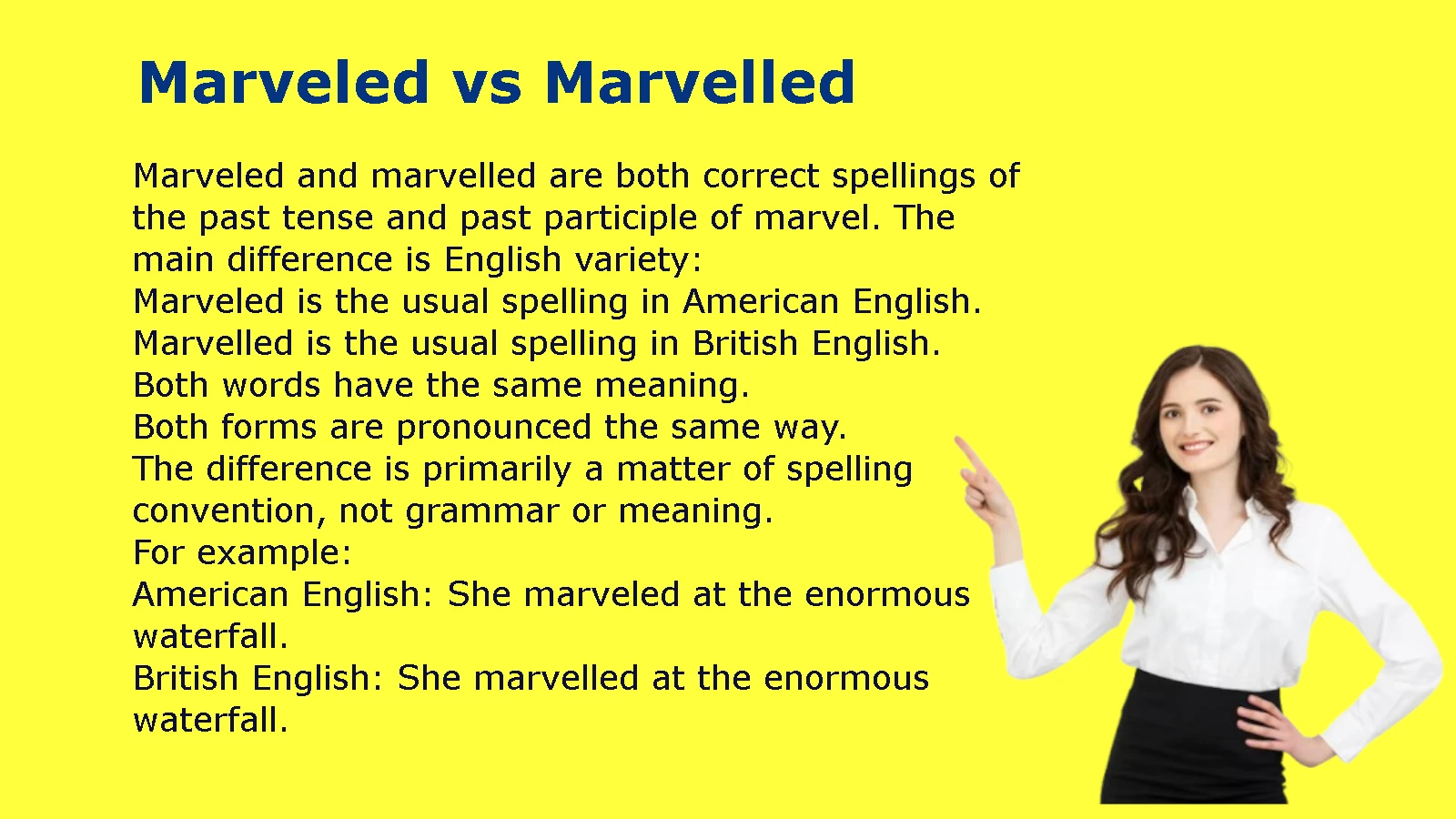
Marveled and marvelled are both correct spellings. The difference is mainly regional: marveled is the standard spelling in American English, while marvelled is commonly used in British English and other varieties of English.
The main difference is the number of l’s:
M-A-R-V-E-L-E-D → marveled
M-A-R-V-E-L-L-E-D → marvelled
Unlike a typical spelling mistake, marvelled is not an incorrect version of marveled. Both forms are accepted in standard English, but the preferred spelling depends on the variety of English you’re using.
The verb marvel means to feel or express great surprise, admiration, or wonder about something. Marveled and marvelled are the past-tense and past-participle forms of marvel.
| Spelling | Usage | Meaning |
| marveled | Standard American English | Felt or expressed great surprise, admiration, or wonder |
| marvelled | Standard British English and other varieties | Felt or expressed great surprise, admiration, or wonder |
So, if you’re deciding between marveled vs marvelled, use marveled in American English and marvelled in British English. Both spellings are correct, so choose the form that matches the English variety you’re writing in.
What Does Marvel Mean?
Marvel is a verb meaning to feel or express great surprise, wonder, or admiration about something.
It is commonly followed by at:
- marvel at something
- marvel at someone’s ability
- marvel at the beauty of something
- marvel at how something works
For example:
We stopped to marvel at the view.
Cambridge defines marvel as showing or experiencing great surprise or admiration. Oxford likewise explains that to marvel is to be very surprised or impressed by something.
The word can also function as a noun. As a noun, a marvel is a person or thing that causes wonder or admiration.
For example:
The new bridge is an engineering marvel.
Oxford gives examples such as the marvels of nature and the marvels of technology.
Marvel as a Verb
As a verb, marvel describes a person’s reaction:
She marveled at the artist’s skill.
The person is experiencing wonder or admiration.
Marvel as a Noun
As a noun, marvel describes something remarkable:
The telescope is a technological marvel.
Here, marvel means something wonderful, impressive, or astonishing.
Marveled vs Marvelled: What Is the Difference?
The difference between marveled and marvelled is mainly geographical.
| Spelling | Main variety | Meaning | Pronunciation |
| marveled | American English | Felt or expressed wonder or admiration | Same |
| marvelled | British English | Felt or expressed wonder or admiration | Same |
Neither spelling has a different definition.
If an American writer says:
The children marveled at the stars.
A British writer can write:
The children marvelled at the stars.
The meaning remains exactly the same.
Cambridge explicitly identifies the pattern as -ll- or US usually -l-, while Oxford lists marvelled and marveled as the corresponding British and US forms.
The Main Difference at a Glance
Think of the distinction this way:
American English → marveled
British English → marvelled
The extra l in marvelled does not add another syllable or change the pronunciation. It reflects a different spelling convention.
Marveled: American English Spelling
Marveled is the standard form used in American English.
If you’re writing an article, essay, email, report, or other content in standard US English, marveled is generally the form you should choose.
Examples include:
- The tourists marveled at the ancient architecture.
- She marveled at how quickly the project was completed.
- We marveled at the precision of the machine.
- He marveled at the beauty of the night sky.
- The children marveled at the magician’s performance.
Oxford’s American English dictionary gives marveled as the past simple and identifies marveling as the corresponding -ing form.
Why American English Uses Marveled
American English has a spelling pattern in which certain verbs ending in an unstressed -el generally do not double the final l before suffixes such as -ed and -ing.
That produces forms such as:
- marvel → marveled
- marvel → marveling
- travel → traveled
- travel → traveling
- cancel → canceled
- cancel → canceling
- label → labeled
- label → labeling
These forms are characteristic of standard American spelling.
Marvelled: British English Spelling
Marvelled is the standard British English spelling.
British English commonly doubles the final l in words of this type before adding -ed or -ing.
Examples include:
- She marvelled at the view.
- They marvelled at his patience.
- We marvelled at the ancient structure.
- He marvelled at the speed of the train.
- The audience marvelled at her performance.
Cambridge lists marvelled as the British past tense and past participle of marvel.
Oxford also gives marvelled as the standard form and specifically identifies marveled as the US English alternative.
Why British English Uses Marvelled
The spelling reflects a broader British English convention involving verbs ending in -l.
Consequently, British English commonly uses:
- marvel → marvelled
- marvel → marvelling
- travel → travelled
- travel → travelling
- cancel → cancelled
- cancel → cancelling
- label → labelled
- label → labelling
The important point is that this is a spelling difference, not a difference in the underlying verb.
Why Is It Marveled in American English but Marvelled in British English?
The distinction becomes easier to understand when you look at the spelling patterns surrounding the final l.
In many British English forms, the final l is doubled before suffixes such as -ed and -ing:
marvel → marvel + led → marvelled
American English generally uses a single l:
marvel → marvel + ed → marveled
The same contrast appears in several familiar words.
| American English | British English |
| marveled | marvelled |
| marveling | marvelling |
| traveled | travelled |
| traveling | travelling |
| canceled | cancelled |
| canceling | cancelling |
| labeled | labelled |
| labeling | labelling |
| modeled | modelled |
| modeling | modelling |
This is why someone accustomed to American spelling may initially think marvelled contains an unnecessary letter. To a British English reader, however, the double l is completely normal.
The reverse can happen too. A British English reader may expect marvelled and notice marveled as an American spelling.
Marveled vs Marvelled in a Sentence
Both forms work in exactly the same grammatical situations.
Examples With Marveled
She marveled at the beauty of the coastline.
The students marveled at the complexity of the experiment.
He marveled at how easily the machine solved the problem.
We marveled at the size of the ancient monument.
The visitors marveled at the artist’s attention to detail.
Examples With Marvelled
She marvelled at the beauty of the coastline.
The students marvelled at the complexity of the experiment.
He marvelled at how easily the machine solved the problem.
We marvelled at the size of the ancient monument.
The visitors marvelled at the artist’s attention to detail.
Notice that nothing else changes. The object, sentence structure, meaning, and pronunciation remain the same.
Only the spelling of the verb changes.
How to Use Marveled and Marvelled Correctly
The verb marvel is often used with at.
The most common structure is:
subject + marvel/marveled/marvelled + at + object
For example:
The tourists marveled at the architecture.
Or in British English:
The tourists marvelled at the architecture.
You can also use marvel with a clause introduced by that.
For example:
She marveled that anyone could have completed the task so quickly.
Oxford lists both constructions: marvel at something and marvel that…
Correct
I marveled at her determination.
Correct in British English
I marvelled at her determination.
Also Correct
I marveled that he managed to finish on time.
Incorrect Pattern to Avoid
I marveled to her determination.
The normal preposition is at, not to, when you’re expressing admiration or surprise about something.
Marveled vs Marvelled in American and British English
The following table makes the distinction easier to remember.
| Form | American English | British English |
| marvel | ✓ | ✓ |
| marveled | ✓ | Usually no |
| marvelled | — | ✓ |
| marveling | ✓ | — |
| marvelling | — | ✓ |
| marvelous | ✓ | — |
| marvellous | — | ✓ |
Cambridge lists marvelled as the British form and marveled as the US form. Its entry for marvelous similarly gives marvelous for US English and marvellous for UK English.
This means the spelling pattern extends beyond the past tense.
If you’re consistently writing British English, you will often see:
marvel → marvelled → marvelling → marvellous
In American English, the corresponding forms are:
marvel → marveled → marveling → marvelous
Marveled vs Marvelled: Related Forms
Understanding the related forms can prevent spelling inconsistencies.
Marveled and Marvelled
These are the past tense and past participle forms of marvel.
American English:
She marveled at the result.
British English:
She marvelled at the result.
Cambridge confirms that marvelled is both the past simple and past participle of marvel.
Marveling and Marvelling
These are the present participle and -ing forms.
American English:
He is marveling at the transformation.
British English:
He is marvelling at the transformation.
Oxford identifies marveling as the US English form and marvelling as the standard form in its main entry.
Marvelous and Marvellous
The adjective follows a similar regional pattern.
American English:
It was a marvelous experience.
British English:
It was a marvellous experience.
Cambridge lists marvelous as US English and marvellous as the UK form.
Oxford likewise gives marvellous with marvelous as the US English equivalent.
Is Marveled or Marvelled Correct?
Both are correct.
The correct choice depends on the variety of English you’re using.
Use marveled when following standard American English conventions.
Use marvelled when following standard British English conventions.
Neither spelling should automatically be called a misspelling.
For example, this is correct in American English:
The researchers marveled at the unexpected result.
This is correct in British English:
The researchers marvelled at the unexpected result.
The dictionaries support both forms. Oxford specifically labels marveled as the US English form, while Cambridge describes the spelling pattern as -ll- or US usually -l-.
Which Spelling Should You Use?
Your choice should depend on your audience and the style of English you’re following.
For American English
Use marveled.
The audience marveled at the performance.
This is the natural choice for most US-focused writing.
For British English
Use marvelled.
The audience marvelled at the performance.
This follows standard British spelling conventions.
For Academic or Professional Writing
Follow the spelling system required by your institution, employer, publisher, or style guide.
The most important principle is consistency.
If your document otherwise uses American forms such as:
- traveled
- canceled
- labeled
- modeled
then marveled fits naturally.
If your document uses:
- travelled
- cancelled
- labelled
- modelled
then marvelled is the appropriate match.
For International Websites
Pick a consistent English variety rather than switching between conventions from sentence to sentence.
For example, a website using American English might write:
The travelers marveled at the scenery and labeled the photographs.
A British English website might write:
The travellers marvelled at the scenery and labelled the photographs.
Consistency makes the writing look deliberate and polished.
Marveled vs Marvelled: Common Mistakes
The spelling difference is simple, but several mistakes appear regularly.
Assuming Marvelled Is Always Wrong
Some American English readers may see marvelled and assume it is misspelled.
That isn’t correct.
Marvelled is a standard British English spelling. Cambridge and Oxford both recognize it.
Assuming Marveled Is Always Wrong
The opposite assumption is equally inaccurate.
Marveled is the standard American English form.
Oxford’s American English entry gives marveled as the past simple and past participle.
Mixing Spelling Systems
A common editing problem is using American and British spellings in the same document without a reason.
For example:
The traveler marvelled at the view and canceled the trip.
This combination isn’t necessarily impossible, but it creates an inconsistent spelling style if the text is intended to follow one variety of English.
A consistently American version would be:
The traveler marveled at the view and canceled the trip.
A consistently British version would be:
The traveller marvelled at the view and cancelled the trip.
Thinking the Double L Changes Pronunciation
It doesn’t.
Marveled and marvelled have the same basic pronunciation.
The extra l is a spelling distinction rather than a pronunciation distinction.
Marveled vs Marvelled: A Practical Style Guide
If you’re editing a document and aren’t sure which spelling to use, check the other words in the same document.
| If your document uses… | Choose… |
| traveled | marveled |
| cancelled | marvelled |
| labeled | marveled |
| labelled | marvelled |
| modeling | marveling |
| modelling | marvelling |
| marvelous | marveled |
| marvellous | marvelled |
This isn’t a rule that every writer must follow mechanically. Instead, it is a useful way to identify the spelling convention already being used in your text.
Case Study: Choosing the Right Spelling in Two Versions of the Same Paragraph
Consider this paragraph in American English:
The travelers marveled at the enormous cathedral. They had never seen anything quite like it. Their guide explained how the structure had been built, and the visitors marveled at the precision of the original design.
Now convert it to British English:
The travellers marvelled at the enormous cathedral. They had never seen anything quite like it. Their guide explained how the structure had been built, and the visitors marvelled at the precision of the original design.
The meaning doesn’t change.
The spelling changes because the English variety changes.
This is the central point to remember when deciding between marveled and marvelled.
A Note on Canadian English
English spelling isn’t always divided neatly into only American and British categories.
Canadian English can use conventions associated with both systems, depending on the word and context.
Oxford’s American English entry, for example, notes marvelled as the form usually used in Canadian English alongside American marveled.
That means Canadian usage deserves some caution if you’re preparing content specifically for a Canadian audience.
For general writing, follow the style guide or editorial standard required by the publication rather than assuming that every Canadian spelling must match either American or British English perfectly.
The History Behind Marvel
The spelling difference becomes even more interesting when you look at the history of the word.
Marvel has a long history in English. Oxford traces the noun to Middle English, from Old French merveille, ultimately connected with Latin mirabilis, meaning “wonderful,” from mirari, “to wonder.”
Collins gives a similar origin, tracing the word through Middle English and Old French back to Latin roots associated with wonder and admiration.
So the word’s basic idea has remained closely connected to wonder, surprise, and admiration for centuries.
Today, that meaning appears in ordinary sentences:
We marveled at the stars.
It also appears in expressions describing remarkable things:
The telescope was a technological marvel.
Marveled Meaning and Marvelled Meaning
Both forms mean essentially the same thing:
to experience or express great surprise, wonder, or admiration.
Examples:
She marveled at his courage.
She marvelled at his courage.
The spelling changes, but the meaning does not.
Collins defines marvel in terms of expressing great surprise, wonder, or admiration and provides both marveled and marvelled among its forms.
Synonyms for Marveled and Marvelled
Depending on context, possible alternatives include:
- admired
- wondered
- was amazed
- was astonished
- was impressed
- was awed
- gazed in wonder
- was fascinated
These aren’t perfect substitutes in every sentence.
For example:
She marveled at the architecture.
could become:
She was amazed by the architecture.
But marveled often combines wonder and admiration, which gives it a slightly different shade of meaning from simple surprise.
Marveled vs Marvelled: What About Pronunciation?
There is no meaningful pronunciation distinction between marveled and marvelled caused by the extra l.
The two spellings represent the same past-tense verb.
Oxford gives the past form with the same pronunciation for the US and standard form.
This means you don’t need to pronounce the British form as though it contains an additional syllable.
The distinction is visible on the page rather than something listeners normally hear.
Is Marvelled British Spelling?
Yes.
Marvelled is the standard British English spelling of the past tense and past participle of marvel.
For example:
She marvelled at the beauty of the landscape.
Cambridge lists marvelled as the past simple and past participle of marvel, while Oxford identifies marveled as the US English alternative.
Is Marveled American Spelling?
Yes.
Marveled is the standard American English spelling.
For example:
She marveled at the beauty of the landscape.
Oxford’s American English dictionary specifically gives marveled as the past form.
Is Marveled a Word?
Yes.
Marveled is a standard English word and is the past tense and past participle of marvel in American English.
The scientists marveled at the discovery.
It is not an informal abbreviation or an alternative spelling created by modern internet usage.
Is Marvelled a Word?
Yes.
Marvelled is also a standard English word.
It is the usual British English spelling of the past tense and past participle of marvel.
The scientists marvelled at the discovery.
Cambridge and Oxford both recognize the form.
Marveled or Marvelled: Which One Should You Remember?
The easiest way to remember the difference is:
American English: marveled
British English: marvelled
You can also remember the related forms:
US: marveled, marveling, marvelous
UK: marvelled, marvelling, marvellous
The pattern is similar to other spelling pairs such as:
traveled / travelled
canceled / cancelled
labeled / labelled
modeled / modelled
Once you recognize the broader spelling pattern, marveled vs marvelled becomes much easier to remember.
Quick Comparison: Marveled vs Marvelled
| Question | Marveled | Marvelled |
| Is it a word? | Yes | Yes |
| Is it correct? | Yes | Yes |
| Main variety | American English | British English |
| Part of speech | Verb | Verb |
| Base form | marvel | marvel |
| Tense | Past | Past |
| Past participle | Yes | Yes |
| Meaning | Wondered or admired | Wondered or admired |
| Pronunciation | Same | Same |
| Extra letter | One l | Two l’s |
| Related -ing form | marveling | marvelling |
| Related adjective | marvelous | marvellous |
FAQs About Marveled vs Marvelled
Is marveled or marvelled correct?
Both are correct. Marveled is the standard American English spelling, while marvelled is the standard British English spelling.
Is marveled American or British?
Marveled is primarily the standard American English spelling.
Is marvelled British spelling?
Yes. Marvelled is the standard British English spelling.
Why does British English spell it marvelled?
British English commonly doubles the final l in verbs of this type before adding -ed and -ing, producing marvelled and marvelling.
Is marveling or marvelling correct?
Both are correct, depending on the English variety. Marveling is the usual American spelling, while marvelling is the usual British spelling. Oxford lists these corresponding forms.
What is the past tense of marvel?
The past tense is marveled in American English and marvelled in British English.
Do marveled and marvelled have the same meaning?
Yes. Both mean that someone experienced or expressed wonder, surprise, or admiration.
Do marveled and marvelled sound the same?
Yes. The extra l in marvelled represents a spelling difference rather than a different pronunciation.
Can I use marvelled in American English?
You may encounter marvelled in American contexts, particularly in quotations, names, or material following another spelling convention. However, marveled is the usual American English form.
Can I use marveled in British English?
Readers will generally understand it, but marvelled is the conventional British spelling.
Is marvelous American or British?
Marvelous is the standard American spelling, while marvellous is the standard British spelling.
Is marveled a past participle?
Yes. Marveled is both the past simple and past participle in American English.
For example:
She marveled at the view.
She has marveled at the view many times.
The British equivalents are:
She marvelled at the view.
She has marvelled at the view many times.
What is the difference between marveled and marvelled?
There is no difference in meaning. Marveled follows American English spelling, while marvelled follows British English spelling.
Final Verdict: Marveled or Marvelled?
Marveled and marvelled are both correct.
The choice depends on the variety of English you’re using.
Use marveled in standard American English:
The visitors marveled at the spectacular view.
Use marvelled in standard British English:
The visitors marvelled at the spectacular view.
The two forms have the same meaning, grammatical function, and pronunciation. The extra l in marvelled is simply part of the British spelling convention.
The simplest rule is:
Marveled = American English
Marvelled = British English
Once you remember that distinction, you’ll know which spelling to choose whenever you encounter marveled vs marvelled.