Clung vs clanged can be confusing because both words describe past actions, but they have completely different meanings and uses. Clung is the past tense and past participle of cling, meaning to hold tightly, stay close to something, or remain attached. Clanged, on the other hand, is the past tense of clang, meaning to make or cause a loud, sharp metallic sound. If you’ve come across “clung” and “clanged” and wondered which word is correct, the difference becomes clear when you look at their meanings, pronunciation, and sentence usage.
The clung vs clanged distinction mainly depends on whether you are describing holding, attachment, or staying close or a loud metallic noise. Words such as cling, clung, cling to, clang, clanged, metallic sound, and ringing noise are related to these two verbs but have different grammatical roles and meanings.
In this guide, you’ll learn what “clung” means, what “clanged” means, when to use each word, and how “clung” differs from “clanged” in sentences. You’ll also see clear examples, pronunciation details, verb forms, and common mistakes to help you understand the difference.
By the end, you’ll know exactly when to use clung and when to use clanged, so you can choose the correct word naturally and confidently.
Quick Answer: Clung vs Clanged
Clung is the past tense and past participle of cling.
cling → clung → clung
It describes holding something tightly, sticking to something, or remaining close to someone or something. Cambridge Dictionary gives examples involving people holding onto one another, clothes sticking to the body, and objects remaining attached to surfaces.
Clanged is the past tense and past participle of clang.
clang → clanged → clanged
It describes making or causing a loud, deep ringing sound, especially a sound associated with metal.
So:
- The child clung to her mother. ✓
- The child clanged to her mother. ✗
- The iron door clanged shut. ✓
- The iron door clung shut. ✗
A useful memory trick is:
Clung = held on.
Clanged = made a loud metallic sound.
What Does Clung Mean?
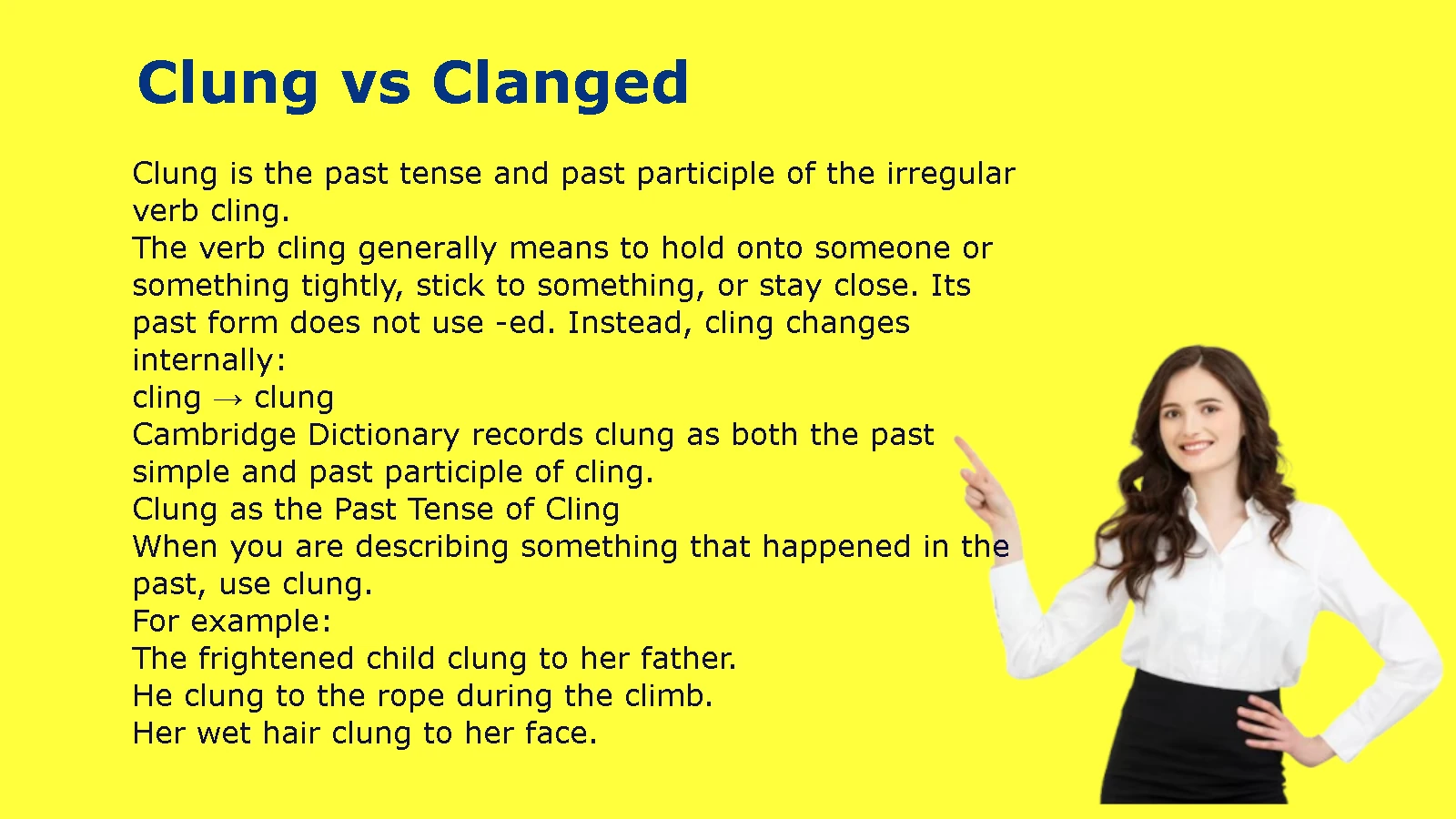
Clung is the past tense and past participle of the irregular verb cling.
The verb cling generally means to hold onto someone or something tightly, stick to something, or stay close. Its past form does not use -ed. Instead, cling changes internally:
cling → clung
Cambridge Dictionary records clung as both the past simple and past participle of cling.
Clung as the Past Tense of Cling
When you are describing something that happened in the past, use clung.
For example:
- The frightened child clung to her father.
- He clung to the rope during the climb.
- Her wet hair clung to her face.
- The fabric clung to his skin.
- The leaves clung to the branches after the storm.
In each example, the word expresses attachment, gripping, or staying close.
The attachment does not always have to be physical. English also uses cling figuratively. Someone can cling to hope, cling to an idea, or cling to the past. In those cases, the person is not physically holding an object. Instead, they are refusing to give up an idea, belief, feeling, or expectation.
Clung Can Describe Physical Attachment
A person can cling to an object:
She clung to the handrail as she walked down the slippery steps.
An object can also cling to another surface:
The wet shirt clung to his back.
This second use is especially important because cling does not always involve a conscious action. Clothing, hair, dust, mud, leaves, and other things can cling to surfaces.
Cambridge Dictionary specifically gives examples of wet clothes clinging to a person and hair clinging to a face.
Clung Can Also Mean Remaining Close
Cling can describe staying physically close to someone or something.
For example:
The frightened child clung to her mother.
The idea is not merely being nearby. It suggests close attachment or dependence.
The verb can also describe something following or remaining close to another thing:
The narrow road clung to the coastline.
Here, the road obviously cannot physically grab the coastline. The expression means that it stayed very close to it. Cambridge Dictionary recognizes this use of cling to mean staying close or near.
Clung Can Have a Figurative Meaning
English often uses cling metaphorically.
Consider these examples:
- She clung to hope.
- He clung to the belief that everything would work out.
- They clung to the past.
- The company clung to its old methods.
- He clung to the idea that he could fix the problem.
In these sentences, clung does not describe a physical grip. It describes maintaining an emotional, mental, or figurative attachment.
Cling, Clung, Clung: Verb Forms
One of the most common questions connected with this topic is whether the correct forms are cling, clung, clung.
Yes.
| Verb Form | Word | Example |
| Base form | cling | I cling to the railing. |
| Third-person singular | clings | She clings to the rope. |
| Past tense | clung | She clung to the rope. |
| Past participle | clung | She has clung to the rope. |
| Present participle | clinging | She is clinging to the rope. |
The important point is that clung serves as both the past tense and past participle.
For example:
She clung to the railing yesterday.
Here, clung is the simple past.
She has clung to that belief for years.
Here, clung is the past participle used with has.
There is no standard form clinged for the ordinary past tense of cling. The correct form is clung. Cambridge identifies clung as the past simple and past participle of cling.
What Does Clanged Mean?
Clanged is the past tense and past participle of clang.
Unlike cling, clang is a regular verb. Its past form is created by adding -ed:
clang → clanged
The verb clang refers to producing a loud, deep, ringing sound, particularly one resembling the sound of metal being struck. It can be used both when the object itself produces the sound and when someone or something causes another object to make that sound.
For example:
The old gate clanged shut.
The gate produced a loud metallic sound as it closed.
Another example is:
The bells clanged in the distance.
Here, the bells produced the characteristic ringing sound.
Clanged as the Past Tense of Clang
Use clanged when describing a metallic or similarly resonant sound that occurred in the past.
Examples include:
- The metal door clanged shut.
- The tools clanged against the floor.
- The old pipes clanged during the night.
- The bell clanged loudly.
- The bucket clanged against the railing.
The important idea is sound, not attachment.
Clanged Can Be Transitive or Intransitive
Clang can be used without a direct object:
The gates clanged shut.
It can also be used with an object:
He clanged the metal gate shut.
In the first sentence, the gates make the sound. In the second, someone causes the gate to make that sound.
Cambridge provides both kinds of usage, including a sentence in which someone clanged a metal gate shut.
Clang, Clanged, Clanged: Verb Forms
The forms of clang are much more regular than those of cling.
| Verb Form | Word | Example |
| Base form | clang | The gates clang when they close. |
| Third-person singular | clang | The gate clangs shut. |
| Past tense | clanged | The gate clanged shut. |
| Past participle | clanged | The gate has clanged shut. |
| Present participle | clanging | The gate is clanging in the wind. |
The key contrast is therefore:
cling → clung
but
clang → clanged
That difference is grammatical as well as semantic.
Clung vs Clanged: Key Differences
The easiest way to understand clung vs clanged is to compare what each word communicates.
| Feature | Clung | Clanged |
| Base verb | cling | clang |
| Pronunciation | /klʌŋ/ | /klæŋd/ |
| Meaning | held tightly, stuck, or remained close | made or caused a loud ringing sound |
| Verb type | irregular | regular |
| Past form | clung | clanged |
| Past participle | clung | clanged |
| Common objects | hands, clothes, hair, vines, surfaces | gates, bells, pipes, tools, metal objects |
| Main idea | attachment | sound |
| Example | She clung to the rope. | The gate clanged shut. |
The distinction can be reduced to two questions:
Is something holding on or sticking? Use clung.
Is something making a loud metallic sound? Use clanged.
Clung Refers to Holding or Sticking
If the sentence describes a grip, attachment, or close connection, clung is likely the correct choice.
The climber clung to the rock.
The wet fabric clung to her body.
The child clung to his father’s hand.
Each sentence describes some form of attachment.
Clanged Refers to Sound
If the sentence describes a loud ringing or metallic noise, use clanged.
The gate clanged shut.
The pan clanged against the floor.
The pipes clanged behind the wall.
These examples have nothing to do with gripping or sticking. Their defining feature is sound.
Clung vs Clanged Examples
Side-by-side examples make the difference especially clear.
| Clung | Clanged |
| The baby clung to her mother. | The gate clanged shut. |
| He clung to the rope. | The chain clanged against the railing. |
| Wet clothes clung to his body. | The metal bucket clanged on the floor. |
| The vines clung to the wall. | The old pipes clanged during the night. |
| She clung to hope. | The church bells clanged in the distance. |
| The mud clung to his boots. | The tools clanged against the steel surface. |
| They clung together in fear. | The doors clanged behind them. |
| The leaves clung to the branches. | The iron plates clanged together. |
Notice how changing the verb can completely alter the meaning.
The child clung to the gate.
This means the child held onto the gate.
The gate clanged shut.
This means the gate made a loud sound as it closed.
Both sentences could describe the same scene, but clung describes the child’s action while clanged describes the gate’s sound.
Why Do People Confuse Clung and Clanged?
The confusion is understandable because the words share several visual and phonetic features.
Both begin with cl- and contain the consonant sound represented by ng. Their base forms, cling and clang, are also closely shaped words.
However, they belong to different verbs.
Cling and Clang Are Different Verbs
Cling means to hold tightly, stick, or stay close.
Clang means to make a loud ringing sound.
Their past forms follow different patterns:
cling → clung
clang → clanged
The similarity in spelling should not be mistaken for a grammatical relationship.
Clung Is Not the Past Tense of Clang
This is one of the most important points.
Incorrect:
The gate clung shut.
If the intended meaning is that the gate made a loud metallic sound, the correct sentence is:
The gate clanged shut.
Clung cannot be used as the past tense of clang.
Clanged Is Not a Form of Cling
The reverse mistake is also incorrect.
Incorrect:
She clanged to the rope.
Correct:
She clung to the rope.
The first sentence would suggest that she somehow produced a metallic ringing sound in relation to the rope, which is not the intended meaning.
The second sentence clearly means that she held onto the rope.
Cling vs Clang: Understanding the Base Verbs
Looking at the present-tense verbs makes the difference easier to remember.
Cling Meaning
Cling means to hold tightly, stick to something, or remain close.
Examples:
- Hold tightly: Cling to the railing.
- Stick: Mud clings to the tires.
- Stay close: The child clings to her parent.
- Remain attached figuratively: He clings to an old belief.
The verb is commonly followed by to:
She clung to the rope.
He clung to hope.
Cambridge Dictionary specifically lists cling to something and cling (on) to something among the verb’s uses.
Clang Meaning
Clang refers to making a loud, deep ringing sound, particularly one associated with metal.
Examples:
- The gate clanged shut.
- The bell clanged loudly.
- The tools clanged against the floor.
- The pipes clanged behind the wall.
Unlike cling, clang is fundamentally connected with sound.
This distinction is useful when choosing between the two words:
Cling = attachment
Clang = sound
Is Clung a Word?
Yes. Clung is a standard English word.
It is the past simple and past participle of cling. Major dictionaries recognize it as the standard form.
For example:
She clung to the railing.
They had clung together during the storm.
The word is not informal slang or an unusual spelling. It is the normal past form of the irregular verb cling.
One reason learners sometimes question it is that many English verbs form their past tense with -ed. Cling does not follow that pattern.
Compare:
- walk → walked
- jump → jumped
- open → opened
with:
- cling → clung
- sing → sang
- ring → rang
- begin → began
The exact patterns vary among irregular verbs, so cling simply has to be learned as cling → clung → clung.
Is Clanged a Word?
Yes. Clanged is also a standard English word.
It is the past tense and past participle of clang. Cambridge Dictionary explicitly identifies clanged as both forms.
Examples include:
The iron door clanged shut.
The bell had clanged several times.
Unlike cling, the verb clang forms its past tense regularly by adding -ed.
clang + ed = clanged
The spelling can look slightly unusual because the base word already ends in g, but clanged is the correct form.
Common Mistakes With Clung and Clanged
Mistake: Using Clanged for Holding
Incorrect:
The frightened child clanged to her mother.
Correct:
The frightened child clung to her mother.
The action is holding tightly, so the verb must be cling, whose past form is clung.
Mistake: Using Clung for a Metallic Sound
Incorrect:
The metal gate clung shut.
Correct:
The metal gate clanged shut.
The gate is making a loud sound, so clanged is required.
Mistake: Writing Clinged
Incorrect:
She clinged to the rope.
Correct:
She clung to the rope.
Clinged is not the standard past form of cling. The irregular form is clung.
Mistake: Treating Clung and Clanged as Variations of One Verb
They are not.
| Wrong Assumption | Correct Understanding |
| cling → clanged | cling → clung |
| clang → clung | clang → clanged |
| cling and clang are forms of the same verb | They are different verbs |
| clung means made a metallic sound | clung means held, stuck, or remained close |
| clanged means held tightly | clanged means made a ringing sound |
Clung vs Clanged in Different Contexts
The surrounding nouns and actions usually reveal which word you need.
Physical Attachment
Use clung when a person or object is attached to another object.
The wet towel clung to the railing.
The child clung to her father’s arm.
The vines clung to the brick wall.
A useful test is to replace clung with held tightly or stuck to.
If the sentence still makes sense, clung is probably appropriate.
For example:
The mud clung to his boots.
Replace it:
The mud stuck to his boots.
The meaning remains essentially intact.
Metallic Sounds
Use clanged when something makes a loud ringing or metallic noise.
The gate clanged shut.
You can think of it as a sound word. The sentence is describing what the ears perceive.
Other related sound verbs include:
- clanked
- clattered
- banged
- rattled
- rang
They are not exact synonyms, though. Clang has a distinctive association with a loud, deep, ringing sound, especially one produced by metal.
Figurative Uses of Clung
The figurative uses of clung are common in ordinary English.
She clung to hope.
He clung to the belief that he was right.
They clung to the past.
The team clung to its narrow lead.
In the final example, the team is not physically holding its lead. The expression means that it managed to keep the lead despite pressure.
These figurative uses are another reason clung cannot be replaced with clanged.
Clung vs Clanged: Simple Memory Trick
If you need to choose quickly, remember:
Clung = cling = hold or stick.
Clanged = clang = make a loud sound.
Think about a rope and a metal gate.
Rope:
She clung to the rope.
Metal gate:
The gate clanged shut.
The first word answers the question “What did she do?”
The second answers “What sound did the gate make?”
This simple distinction works in most everyday sentences.
Clung vs Clanged: Ten Clear Example Sentences
Here are ten examples showing how the two words work in real sentences.
Examples With Clung
The baby clung to her mother.
The baby held her mother tightly.
He clung to the railing during the storm.
He held onto the railing for support.
Her wet hair clung to her face.
Her hair remained stuck closely against her face.
The mud clung to his shoes.
The mud remained attached to the shoes.
She clung to the hope that they would return.
She continued to hold onto that hope mentally or emotionally.
Examples With Clanged
The old gate clanged shut.
The gate made a loud metallic sound when it closed.
The tools clanged against the floor.
The tools produced a sharp ringing noise when they hit the floor.
The pipes clanged throughout the night.
The pipes repeatedly made loud metallic sounds.
The bell clanged in the distance.
The bell produced a loud ringing sound.
The metal bucket clanged against the stairs.
The bucket made a loud metallic noise as it struck the stairs.
Clung vs Clanged in a Short Story
Consider this short example:
During the storm, Maya clung to the railing as the old building shook. A few seconds later, the metal door clanged shut behind her.
Both words appear naturally in the same situation.
Clung describes Maya’s action. She held the railing tightly.
Clanged describes the door’s sound. The metal door made a loud ringing noise.
This illustrates why the two words should not be treated as interchangeable. They can appear next to each other because they describe different parts of the same event.
Related Verb Forms: Cling and Clang
The complete comparison is useful for anyone trying to learn the forms of both verbs.
| Verb | Base Form | Past Tense | Past Participle | -ing Form |
| Cling | cling | clung | clung | clinging |
| Clang | clang | clanged | clanged | clanging |
This table also answers several common grammar questions.
Past Tense of Cling
The past tense of cling is clung.
Present: She clings to the rope.
Past: She clung to the rope.
Present perfect: She has clung to the rope.
Past Tense of Clang
The past tense of clang is clanged.
Present: The gate clangs when it closes.
Past: The gate clanged when it closed.
Present perfect: The gate has clanged several times.
The two verbs therefore differ not only in meaning but also in how their past forms are created.
Clung vs Clanged vs Clang vs Cling
Seeing all four words together can remove any remaining confusion.
| Word | Grammatical Role | Meaning |
| cling | base verb | hold, stick, or stay close |
| clung | past/past participle | held, stuck, or stayed close |
| clang | base verb | make a loud ringing sound |
| clanged | past/past participle | made a loud ringing sound |
Compare these sentences:
I cling to the rope.
I clung to the rope.
The gate clangs when it moves.
The gate clanged when it moved.
Once you identify the base verb, choosing the past form becomes much easier.
Clung vs Clanged: A Quick Decision Guide
When proofreading a sentence, use this checklist.
Choose clung if:
- Someone is holding onto something.
- Something is stuck to a surface.
- Someone remains very close to another person.
- Someone continues to hold an idea, belief, hope, or memory.
- You could replace the word with held tightly or stuck to.
Choose clanged if:
- Something makes a loud ringing sound.
- A metal object produces a resonant noise.
- A gate, bell, pipe, tool, chain, or similar object makes such a sound.
- You could describe the event in terms of a loud metallic noise.
A Simple Substitution Test
Try replacing the word.
She clung to the railing.
Could you say:
She held tightly to the railing.
Yes. Clung works.
Now:
The gate clanged shut.
Could you say:
The gate made a loud metallic sound as it shut.
Yes. Clanged works.
If the sentence involves gripping or sticking, think cling.
If it involves ringing or metallic noise, think clang.
Frequently Asked Questions About Clung vs Clanged
Is clung the past tense of cling?
Yes. Clung is both the past tense and past participle of cling.
The basic pattern is:
cling → clung → clung
For example:
She clung to the railing.
She has clung to the railing.
Cambridge Dictionary confirms that clung is the past simple and past participle of cling.
What is the past tense of cling?
The past tense of cling is clung.
The form is irregular, so clinged is not the standard past-tense form.
Correct: She clung to the rope.
Incorrect: She clinged to the rope.
Is clung a word?
Yes. Clung is a standard English word and the past tense and past participle of cling.
What is the past tense of clang?
The past tense of clang is clanged.
clang → clanged
For example:
The iron door clanged shut.
Is clanged a word?
Yes. Clanged is the standard past tense and past participle of clang. It describes making or causing a loud ringing sound, particularly a metallic one.
What is the difference between cling and clang?
Cling means to hold tightly, stick to something, or remain close.
Clang means to make a loud, deep ringing sound.
For example:
The child clung to the railing.
The metal railing clanged when it was struck.
What is the difference between clung and clanged?
Clung comes from cling and describes holding, sticking, or remaining attached.
Clanged comes from clang and describes producing a loud ringing or metallic sound.
She clung to the rope.
The chain clanged against the floor.
Is clang related to cling?
The words are similar in spelling and pronunciation, but they are different English verbs with different meanings and grammatical forms.
The important forms are:
cling → clung
clang → clanged
Do not use the similarity between the words as a reason to treat clung and clanged as interchangeable.
What does clanged mean?
Clanged means that something made or caused a loud, deep ringing sound, especially a sound associated with metal.
For example:
The steel gate clanged shut.
The word can also be used transitively:
He clanged the gate shut.
Cambridge Dictionary gives clanged as the past simple and past participle of clang.
What does clung mean?
Clung means held tightly, stuck to something, or remained close. It is the past tense and past participle of cling.
For example:
The wet fabric clung to her skin.
The frightened child clung to his father.
The word can also have figurative meanings:
He clung to hope.
These uses all retain the basic idea of attachment.
Final Difference Between Clung and Clanged
The distinction between clung vs clanged is straightforward once you identify the base verb.
Clung comes from cling:
cling → clung → clung
It means held tightly, stuck, or remained close.
Clanged comes from clang:
clang → clanged → clanged
It means made or caused a loud ringing or metallic sound.
| If you mean… | Use |
| held tightly | clung |
| stuck to something | clung |
| stayed close | clung |
| held onto an idea or hope | clung |
| made a loud metallic sound | clanged |
| produced a ringing noise | clanged |
| caused a metal object to make a loud sound | clanged |
The fastest way to remember the difference is:
Clung = cling = hold on.
Clanged = clang = make a loud metallic sound.
So if someone holds onto a rope, they clung to it. If a metal gate makes a loud ringing noise, it clanged.
Once you remember cling → clung and clang → clanged, the confusion between these two words disappears.