Sung vs sang can be confusing because both forms come from the verb sing, but they are used differently in English sentences. If you’ve wondered whether to say “I sang a song” or “I have sung a song,” the difference is closely connected to verb tenses, past tense, past participles, perfect tenses, and sentence structure.
The sung vs sang difference is simple once you know their grammatical roles. Sang is the simple past tense of sing, while sung is the past participle and normally appears with an auxiliary verb such as have, has, had, or be. For example, “She sang beautifully yesterday” uses the simple past, while “She has sung at many concerts” uses the past participle.
In this guide, you’ll learn the difference between “sung” and “sang,” when to use each form, how they work in different tenses, and how to avoid common mistakes. You’ll also see clear examples of sang vs sung in everyday sentences, along with related forms such as sing, singing, and sung.
By the end, you’ll know exactly when to use sang and sung and how to use both forms naturally and correctly in English.
Sung vs Sang: What Is the Difference?
The main difference between sang and sung is their grammatical function.
Sang is the simple past form of sing. You use it when the singing happened at a definite point or period in the past.
Sung is the past participle. It normally appears with an auxiliary verb in perfect constructions and passive voice.
Consider these sentences:
- She sang at the wedding.
- She has sung at many weddings.
- She had sung before the guests arrived.
- The song was sung by the choir.
The first sentence uses sang because sang itself carries the past tense.
The other sentences use sung because another verb carries the tense. In has sung, for example, has is the auxiliary and sung is the participle.
Cambridge’s grammar reference explains that English verbs have different forms serving different grammatical functions, while its dictionary specifically gives sing as sang, sung.
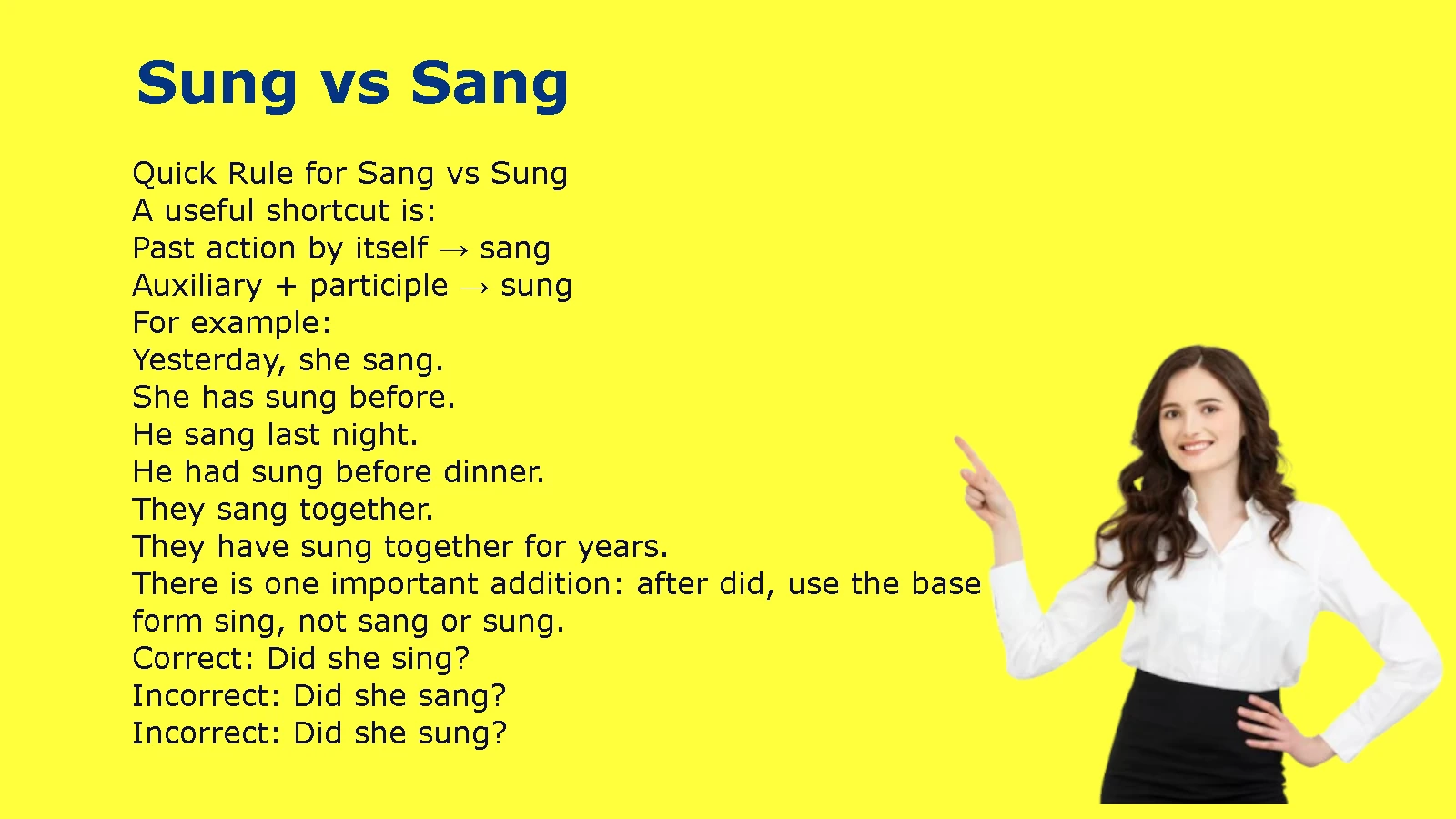
Quick Rule for Sang vs Sung
A useful shortcut is:
Past action by itself → sang
Auxiliary + participle → sung
For example:
- Yesterday, she sang.
- She has sung before.
- He sang last night.
- He had sung before dinner.
- They sang together.
- They have sung together for years.
There is one important addition: after did, use the base form sing, not sang or sung.
- Correct: Did she sing?
- Incorrect: Did she sang?
- Incorrect: Did she sung?
That rule exists because did already marks the sentence as past tense.
Sang Meaning and Usage
Sang is the simple past form of sing. It refers to an action that happened in the past.
Cambridge Dictionary defines sing as making musical sounds with the voice, usually with a tune and words, and identifies sang as its past form.
When to Use Sang
Use sang when you are talking about a completed past event.
Examples include:
- Maria sang at the school concert.
- We sang around the campfire.
- He sang his favorite song yesterday.
- The children sang beautifully at the ceremony.
- I sang in the choir when I was younger.
- They sang together during the celebration.
Notice that no auxiliary verb comes before sang.
The basic structure is:
Subject + sang + object/complement
For example:
Sarah sang a beautiful song.
Here, sang directly expresses the past action.
Sang With Specific Past-Time Expressions
Sang commonly appears with expressions that identify a finished period or point in the past.
Examples:
- She sang yesterday.
- He sang last night.
- We sang at the party last weekend.
- They sang during the ceremony on Saturday.
- I sang when I was in college.
This contrasts with the present perfect, where has/have + sung is used to connect a past action with the present.
The British Council explains that the present perfect uses have/has + past participle, while the past simple is used for completed past events.
Sung Meaning and Usage
Sung is the past participle of sing.
Unlike sang, it generally does not function as the ordinary simple past form. Instead, it works with auxiliary verbs in constructions such as the present perfect, past perfect, and passive voice.
Examples:
- I have sung this song before.
- She has sung professionally for years.
- He had sung before the audience arrived.
- The anthem was sung by the choir.
- Several songs were sung during the ceremony.
When to Use Sung
Use sung after auxiliary verbs when the grammar requires the past participle.
Common combinations include:
- has sung
- have sung
- had sung
- was sung
- were sung
- been sung
The exact meaning depends on the construction.
For example:
She has sung this song before.
This is present perfect. The experience happened at some point before now.
Now compare:
She sang this song yesterday.
This is simple past. The action belongs to a finished past time.
The British Council describes the present perfect as have/has + past participle and explains that it can describe experiences up to the present or past actions with a present connection.
Sung vs Sang Grammar Rules
Understanding the grammar behind these forms is more useful than memorizing isolated sentences.
Simple Past: Sang
Use sang for a completed past action.
Structure:
Subject + sang + object
Examples:
She sang the national anthem.
David sang at the concert.
We sang three songs.
The verb itself carries the past tense.
Present Perfect: Has or Have Sung
Use has/have + sung for the present perfect.
Structure:
Subject + has/have + sung
Examples:
She has sung that song before.
We have sung together many times.
I have sung in front of large audiences.
The British Council confirms that the present perfect is formed with the present tense of have plus the past participle.
This construction often describes experience or a past event that remains relevant to the present.
Past Perfect: Had Sung
Use had + sung for the past perfect.
Structure:
Subject + had + sung
Examples:
She had sung before the guests arrived.
They had sung three songs before the show ended.
He had sung in several competitions before becoming a professional.
The important point is that the singing happened before another past event.
Compare:
She sang before dinner.
This simply reports a past event.
She had sung before dinner began.
This emphasizes that her singing happened before another past event.
Passive Voice: Was or Were Sung
Sung can also appear in passive constructions.
Examples:
The song was sung by the choir.
The songs were sung by the students.
The anthem was sung at the beginning of the ceremony.
In these sentences, the subject receives the action rather than performing it.
Compare:
Active:
The choir sang the anthem.
Passive:
The anthem was sung by the choir.
The change from sang to sung happens because the passive construction requires the past participle.
Sang vs Sung Examples
The easiest way to see the difference is to compare sentences that use the same basic idea.
| Sentence | Correct Form | Reason |
| She ___ at the wedding yesterday. | sang | Simple past |
| She has ___ at several weddings. | sung | Present perfect |
| He ___ beautifully last night. | sang | Simple past |
| He had ___ before we arrived. | sung | Past perfect |
| We ___ three songs at the event. | sang | Simple past |
| We have ___ those songs before. | sung | Present perfect |
| The choir ___ the anthem. | sang | Simple past |
| The anthem was ___ by the choir. | sung | Passive |
| They ___ together yesterday. | sang | Simple past |
| They have ___ together for years. | sung | Present perfect |
The pattern becomes clear: sang works as the simple past, whereas sung normally needs an auxiliary verb.
Sang or Sung: Which One Should You Use?
When you are unsure whether to use sang or sung, look at the sentence rather than the meaning of the word alone.
Use Sang When the Sentence Is Simple Past
Ask yourself:
Did the singing happen in the past, with no auxiliary requiring a participle?
If yes, use sang.
She sang at the festival.
He sang yesterday.
We sang together last night.
Use Sung After Has, Have, or Had
If the sentence contains has, have, or had, you will normally need sung.
She has sung this song before.
They have sung together many times.
He had sung before the audience arrived.
Do not write:
She has sang this song before.
The correct form is:
She has sung this song before.
Use Sung in Passive Constructions
If the sentence uses was or were as part of a passive construction, sung is generally the required form.
The song was sung beautifully.
The songs were sung by the children.
Use Sing After Did
This is where another common mistake appears.
Because did already marks the past tense, the main verb returns to its base form.
Correct:
Did she sing at the concert?
Incorrect:
Did she sang at the concert?
Incorrect:
Did she sung at the concert?
The same principle applies to negative sentences:
She did not sing.
Not:
She did not sang.
Not:
She did not sung.
Common Mistakes With Sang and Sung
You Sang vs You Sung
Both forms can occur with you, but they serve different grammatical functions.
Simple past:
You sang beautifully yesterday.
Present perfect:
You have sung beautifully many times.
The subject you does not determine whether the verb is sang or sung. The grammatical construction does.
He Sang vs He Sung
A common error is using sung as though it were the simple past.
Incorrect:
He sung at the concert last night.
Correct:
He sang at the concert last night.
But sung is correct when an auxiliary is present:
He has sung at the concert before.
The distinction is not about whether the subject is he. It is about the verb form required by the sentence.
Have Sang vs Have Sung
This is one of the most common errors.
Incorrect:
I have sang this song before.
Correct:
I have sung this song before.
The reason is simple: have requires the past participle in the present perfect.
The pattern is:
have + sung
not:
have + sang
The same applies to has and had:
- has sung
- have sung
- had sung
Did You Sing vs Did You Sang
The correct question is:
Did you sing?
Not:
Did you sang?
And not:
Did you sung?
The auxiliary did carries the past tense, so the main verb remains in its base form.
Compare:
You sang yesterday.
with:
Did you sing yesterday?
The first sentence has no past auxiliary. The second one uses did.
Sung vs Sang in Different Tenses
The three forms of sing appear differently depending on the tense or construction.
| Tense or construction | Correct form | Example |
| Simple present | sing/sings | She sings every Sunday. |
| Simple past | sang | She sang yesterday. |
| Present perfect | has/have sung | She has sung before. |
| Past perfect | had sung | She had sung before lunch. |
| Future | will sing | She will sing tomorrow. |
| Modal construction | can sing | She can sing well. |
| Passive past | was/were sung | The songs were sung by the choir. |
| Infinitive | to sing | She wants to sing. |
| Gerund/present participle | singing | She enjoys singing. |
This table also shows why you should not treat sang and sung as interchangeable versions of the same past form.
They occupy different grammatical positions.
“Sang” and “Sung” in Questions
Questions make the difference particularly easy to see.
Simple Past Questions
Use did + sing:
Did she sing at the event?
Did they sing together?
The main verb is sing, not sang, because did already expresses the past.
Present Perfect Questions
Use has/have + sung:
Has she sung this song before?
Have they sung together?
Have you ever sung in public?
The present perfect uses have/has + past participle, which is why sung is required.
Past Perfect Questions
Use had + sung:
Had she sung before the ceremony?
Had they sung the anthem before?
The same rule applies: had is followed by the past participle sung.
Sang vs Sung in Everyday Sentences
Here are natural examples showing how the forms work in ordinary situations.
Music and Performances
The singer sang three songs at the concert.
The singer has sung at this venue several times.
The final song was sung by the entire band.
Singing With Friends
We sang along with the radio during the road trip.
We have sung that song together many times.
School and Choirs
The students sang at the school assembly.
The students had sung several songs before the principal spoke.
The final piece was sung by the senior choir.
Ceremonies and Events
Everyone sang the national anthem.
Everyone has sung the anthem at previous ceremonies.
The anthem was sung before the ceremony began.
Talking About Past Experience
I sang in a school play when I was twelve.
I have sung in several school performances.
The first sentence identifies a particular period in the past. The second focuses on experience up to the present.
Sang vs Sung: An Easy Memory Trick
The easiest way to remember the three forms is:
Sing → sang → sung
Then divide the forms by function.
Sing is the base form.
I like to sing.
Sang is the simple past.
I sang yesterday.
Sung is the past participle.
I have sung before.
A compact memory rule is:
Sang stands alone for simple past. Sung usually needs a helping verb.
That is not a substitute for understanding every possible construction, but it works well for the most common situations.
Sung vs Sang vs Sing
Because learners often confuse all three forms, it helps to compare them directly.
| Verb form | What it is | Example |
| sing | Base form | I want to sing. |
| sang | Simple past | I sang yesterday. |
| sung | Past participle | I have sung before. |
Consider these three sentences together:
I sing in a choir.
I sang in a choir last year.
Each sentence uses a different form because the grammatical construction changes.
Sing in the Present and After Auxiliaries
The base form sing appears in several situations.
Examples:
- I sing every day.
- They sing together.
- She wants to sing.
- We can sing another song.
- Did he sing last night?
- They will sing tomorrow.
Notice that auxiliary verbs such as did, can, and will are followed by the base form.
Sang for Simple Past
Use sang when no auxiliary is carrying the past tense.
She sang yesterday.
They sang at the wedding.
Sung for the Past Participle
Use sung with the constructions that require a past participle.
She has sung before.
They had sung three songs.
The song was sung by the choir.
A Practical Way to Decide Between Sang and Sung
When proofreading your sentence, follow these steps.
Check for an Auxiliary Verb
Look immediately before the verb.
If you see has, have, or had, use sung:
She has sung.
If you see was or were in a passive construction, use sung:
The song was sung.
If you see did, use sing:
Did she sing?
Check Whether You Are Simply Reporting a Past Event
If the sentence simply tells the reader that someone sang in the past, use sang.
He sang at the party.
She sang last Friday.
We sang after dinner.
Check the Time Expression
A finished past-time expression often points toward the simple past.
Examples:
- yesterday
- last night
- last week
- two days ago
- in 2020
- when I was a child
For example:
She sang at the festival last year.
The present perfect normally does not combine with a finished past-time expression such as yesterday or last year. The British Council specifically notes this distinction in its present-perfect guidance.
Compare:
She sang there last year.
with:
She has sung there before.
The first identifies a finished time. The second describes past experience without specifying a finished past time.
Case Study: Why “She Has Sang” Is Incorrect
Consider this sentence:
She has sang at three concerts.
At first glance, the sentence may sound understandable. However, sang is the simple past form, while the construction has + ___ requires the past participle.
The correct sentence is:
She has sung at three concerts.
Now change the sentence:
She sang at three concerts last year.
Here, sang is correct because the sentence uses the simple past and identifies a completed past period.
The contrast can be summarized like this:
| Incorrect or correct | Sentence | Explanation |
| ❌ | She has sang at three concerts. | Has requires the past participle. |
| ✅ | She has sung at three concerts. | Present perfect. |
| ✅ | She sang at three concerts last year. | Simple past. |
| ❌ | She did sang at three concerts. | Did requires the base form. |
| ✅ | She did sing at three concerts. | Past question/negative construction. |
This single comparison resolves several common sang vs sung mistakes at once.
Another Case Study: “He Sang” vs “He Has Sung”
These two sentences can describe related events but use different grammar.
He sang at the festival.
This is a straightforward statement about a past event.
He has sung at the festival.
This uses the present perfect and presents the event as part of his experience up to now.
The difference is therefore not simply “past versus not past.” Both sentences refer to an event that happened before the present. The grammatical choice depends on how the speaker connects that past event to the present.
The British Council notes that present perfect constructions can describe experiences up to the present and past actions that remain relevant now.
Common Questions About Sung vs Sang
Is “sang” the past tense of “sing”?
Yes. Sang is the simple past form of sing.
She sang yesterday.
Cambridge Dictionary lists sang as the past form of sing.
Is “sung” the past tense of “sing”?
Not exactly. Sung is the past participle, while sang is the simple past.
She sang yesterday.
She has sung before.
Is it “I sang” or “I sung”?
Use I sang when you mean simple past:
I sang at the party last night.
Use I have sung when you need the past participle:
I have sung at several parties.
Is it “I have sang” or “I have sung”?
The correct form is:
I have sung.
Have + past participle requires sung, not sang.
Is it “you sang” or “you sung”?
Both can be correct, depending on the sentence.
You sang beautifully yesterday.
You have sung beautifully before.
The subject you does not determine the choice. The grammatical construction does.
Is it “he sang” or “he sung”?
For simple past:
He sang at the concert.
For present perfect:
He has sung at the concert before.
So neither form is universally correct or incorrect. The surrounding grammar determines the answer.
Is “Did you sang?” grammatically correct?
No.
The standard form is:
Did you sing?
After did, use the base form sing.
Can “sung” be used without an auxiliary verb?
In standard modern English, sung generally functions as a past participle and therefore appears with an auxiliary in ordinary finite constructions.
For example:
She has sung.
The song was sung beautifully.
Using sung as though it were the simple past is not standard in sentences such as:
❌ She sung yesterday.
The standard form is:
✅ She sang yesterday.
What is the past participle of “sing”?
The past participle is sung.
The three principal forms are:
sing → sang → sung
Cambridge Dictionary explicitly gives sang as the past tense and sung as the past participle.
What are the three forms of “sing”?
The three commonly taught forms are:
sing — sang — sung
Examples:
- I sing every day.
- I sang yesterday.
- I have sung before.
Sung vs Sang: Final Comparison
Here is the entire rule in one table:
| If you mean… | Use | Example |
| Present/base form | sing | I sing every day. |
| Completed past action | sang | I sang yesterday. |
| Present perfect | sung | I have sung before. |
| Past perfect | sung | I had sung before dinner. |
| Passive construction | sung | The song was sung by the choir. |
| Question with did | sing | Did you sing? |
| Negative with did | sing | She did not sing. |
| Future with will | sing | They will sing tomorrow. |
| Modal construction | sing | She can sing beautifully. |
Final Rule to Remember
The easiest way to remember sung vs sang is to learn the complete verb sequence:
Sing → sang → sung
Then remember what each form does.
Sing is the base form:
I want to sing.
Sang is the simple past:
I sang yesterday.
Sung is the past participle:
I have sung before.
The most common mistakes happen when sang is incorrectly used after has, have, or had, or when sung is incorrectly used as the simple past.
So keep these three patterns handy:
- I sang yesterday.
- I have sung before.
- Did I sing yesterday?
Once you recognize the auxiliary verb and the tense, choosing between sang and sung becomes much easier.