Traveler and traveller are both correct spellings, but their usage depends on the type of English. Traveler is the preferred spelling in American English, while traveller is standard in British English and other varieties. When comparing Traveler vs Traveller, the correct choice depends on your audience and writing style.
Many people aren’t sure if they should write traveler or traveller, especially in emails, blogs, academic writing, or professional documents. Here’s the good news: the difference isn’t about right or wrong—it’s about regional spelling and knowing when each version is appropriate.
In this guide, you’ll learn the difference between Traveler vs Traveller, discover the correct spelling for American English and British English, and understand when to use traveler or traveller in different contexts. You’ll also find the meaning of traveler and traveller, pronunciation, real sentence examples, and simple tips to remember the correct usage.
By the end, you’ll know exactly which spelling fits your audience and how to avoid one of the most common English spelling confusions.
Traveler vs Traveller: What’s the Difference?
At first glance, traveler and traveller appear to be different words. In reality, they have exactly the same meaning.
Both refer to:
- A person who travels from one place to another
- Someone traveling for business or leisure
- A tourist, explorer, commuter, or passenger depending on the context
The only distinction is regional spelling.
| Feature | Traveler | Traveller |
| Meaning | A person who travels | A person who travels |
| Pronunciation | Same | Same |
| Correct spelling | Yes | Yes |
| Primary usage | American English | British English |
| Changes meaning? | No | No |
For example:
American English
- She is an experienced traveler who has visited more than 40 countries.
- Every traveler should carry travel insurance.
British English
- She is an experienced traveller who has visited more than 40 countries.
- Every traveller should keep copies of important documents.
Notice that only the spelling changes. The pronunciation, grammar, and meaning remain identical.
Quick Comparison: Traveler vs Traveller
Sometimes, seeing the differences side by side makes everything clearer.
| Category | Traveler | Traveller |
| English variety | American English | British English |
| Dictionary status | Correct | Correct |
| Pronunciation | /ˈtrævələr/ | /ˈtrævələ/ (accent varies) |
| Used in the United States | Yes | Rarely |
| Used in the United Kingdom | Rarely | Yes |
| Used in Australia | No | Yes |
| Used in New Zealand | No | Yes |
| Used in Ireland | Rarely | Yes |
| Meaning | Person who travels | Person who travels |
The table highlights an important point: the spelling depends on your audience, not on correctness.
Traveler Meaning
The word traveler is the standard American English spelling for someone who journeys from one location to another.
Dictionary Definition
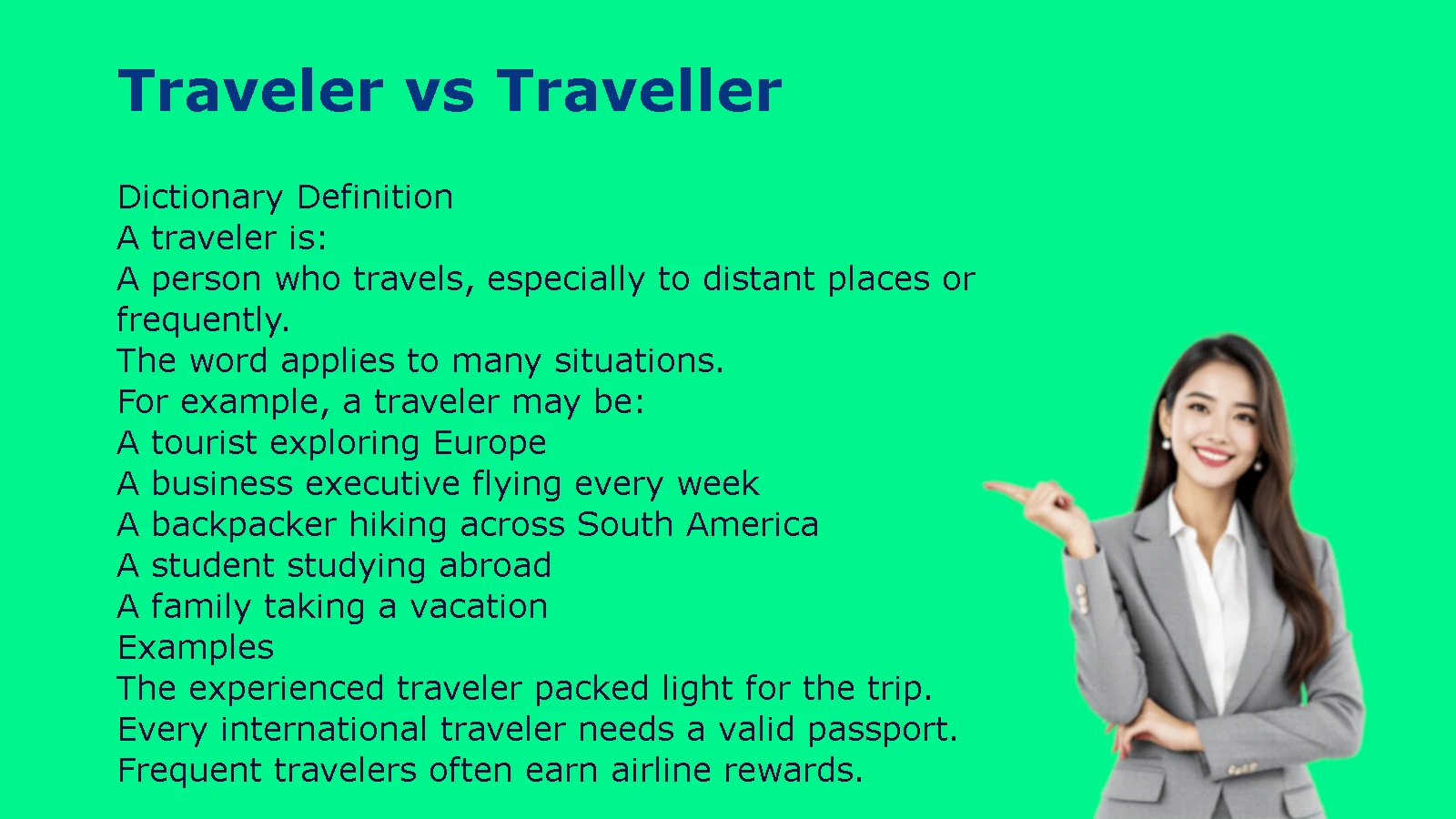
A traveler is:
A person who travels, especially to distant places or frequently.
The word applies to many situations.
For example, a traveler may be:
- A tourist exploring Europe
- A business executive flying every week
- A backpacker hiking across South America
- A student studying abroad
- A family taking a vacation
Examples
- The experienced traveler packed light for the trip.
- Every international traveler needs a valid passport.
- Frequent travelers often earn airline rewards.
Common American Usage
You’ll commonly see traveler in:
- U.S. newspapers
- American travel blogs
- Government travel websites
- Airline publications
- School textbooks
- Business documents
If your audience lives primarily in the United States, traveler is almost always the preferred spelling.
Traveller Meaning
Traveller is the standard British English spelling of the same word.
Although the spelling contains two l letters, the pronunciation remains essentially the same.
Dictionary Definition
A traveller is:
Someone who travels from place to place, either regularly or occasionally.
British English uses traveller in nearly every formal and informal setting.
Examples
- Every traveller should check visa requirements before departure.
- The railway offers discounts for frequent travellers.
- Experienced travellers usually pack only the essentials.
Common British Usage
You’ll frequently encounter traveller in:
- UK newspapers
- British government publications
- Tourism websites
- University writing
- Travel agencies
- Hotel booking platforms
If your readers are primarily from the United Kingdom, Australia, or New Zealand, traveller is the expected spelling.
Why Do Americans Spell It “Traveler”?
The difference between traveler and traveller didn’t happen by accident. It reflects a broader pattern in American English spelling.
During the early 1800s, American lexicographer Noah Webster promoted spelling reforms that simplified many English words. His goal wasn’t to change meanings. Instead, he wanted American spelling to be more consistent and easier to learn.
Many of the spellings Americans use today come directly from Webster’s dictionaries.
For example:
| British English | American English |
| traveller | traveler |
| travelled | traveled |
| travelling | traveling |
| cancelled | canceled |
| labelled | labeled |
| modelling | modeling |
Notice the pattern.
American English often uses one consonant where British English keeps two.
This approach appears in thousands of everyday words.
Why the Simplification Happened
Several factors influenced American spelling.
- Education became more standardized.
- Dictionaries favored simpler forms.
- Printing costs encouraged shorter spellings.
- American English gradually developed its own identity.
Over time, simplified spellings became standard throughout the United States.
Today, you’ll find traveler in virtually every major American dictionary and style guide.
The Grammar Rule Behind Traveler vs Traveller
Many people assume the spelling difference is random.
It isn’t.
The distinction comes from different spelling rules used in American and British English.
Understanding Consonant Doubling
When adding suffixes like:
- -ed
- -er
- -ing
English sometimes doubles the final consonant.
Examples include:
- stop → stopped
- plan → planning
- admit → admitted
However, words ending in l often follow different rules depending on the variety of English.
American English Rule
American English usually doubles the final l only when the last syllable receives the primary stress.
Examples:
- compel → compelled
- excel → excelling
But for words like travel, where the stress falls on the first syllable (TRAV-el), American English usually keeps a single l.
That creates:
- traveler
- traveled
- traveling
British English Rule
British English generally doubles the final l before adding many suffixes, even when the stress isn’t on the final syllable.
As a result, British English prefers:
- traveller
- travelled
- travelling
This pattern appears in many familiar words.
| Base Word | American English | British English |
| travel | traveled | travelled |
| travel | traveler | traveller |
| travel | traveling | travelling |
| cancel | canceled | cancelled |
| label | labeled | labelled |
| model | modeling | modelling |
Understanding this rule makes many British and American spelling differences much easier to remember.
Case Study: One Word, Two Markets
Imagine an international travel company launching two websites.
The U.S. site targets customers in New York, Chicago, and Los Angeles.
Its homepage reads:
Every traveler deserves a smooth journey.
Meanwhile, the UK site targets London, Manchester, and Edinburgh.
It says:
Every traveller deserves a smooth journey.
Both sites communicate the same message.
Neither spelling is wrong.
Instead, each version matches the expectations of its audience. Visitors see the spelling they’re accustomed to, which makes the content feel more natural and trustworthy.
That’s why many global companies localize spelling based on the region they’re serving.
Key Points to Remember
- Traveler is the preferred American English spelling.
- Traveller is the preferred British English spelling.
- Both words share the same pronunciation and meaning.
- The difference comes from regional spelling conventions, not grammar mistakes.
- Consistency matters more than choosing one spelling over the other.
Why Do the British Spell It “Traveller”?
British English follows a spelling convention that often doubles the final “l” before adding suffixes such as -er, -ed, and -ing. That’s why you’ll commonly see traveller, travelled, and travelling throughout the United Kingdom and many Commonwealth countries.
This convention has existed for centuries and remains the accepted standard in modern British English. Unlike American English, which adopted several spelling simplifications during the 19th century, British English largely preserved traditional spellings.
For native British speakers, traveller looks completely natural. In fact, traveler may appear unfamiliar or even incorrect in formal British writing, even though dictionaries recognize it as the American variant.
The British Consonant-Doubling Pattern
British English doubles the final l in many words before adding a suffix, especially when the base word ends with -l.
Here are a few common examples:
| Base Word | British English | American English |
| Travel | Travelled | Traveled |
| Travel | Travelling | Traveling |
| Travel | Traveller | Traveler |
| Cancel | Cancelled | Canceled |
| Label | Labelled | Labeled |
| Model | Modelling | Modeling |
| Fuel | Fuelled | Fueled |
| Signal | Signalling | Signaling |
Notice the pattern. British English consistently keeps the double l, while American English often removes one.
This isn’t unique to traveller. It’s part of a much broader spelling system.
Why the Two Spellings Continue to Exist
English isn’t governed by a single worldwide authority. Instead, different countries follow their own accepted standards.
As English spread across continents, regional variations naturally developed. American English evolved separately from British English, creating differences in spelling, punctuation, vocabulary, and even pronunciation.
Today, both spellings are officially recognized.
- American dictionaries prefer traveler.
- British dictionaries prefer traveller.
- International readers understand both.
That’s why you’ll often encounter both versions online, especially on multinational websites.
Quote: “Correct English depends on context. The right spelling is the one that matches your audience.”
Which Countries Use Each Spelling?
Choosing between traveler and traveller becomes much easier when you know your audience.
The following table shows which spelling is generally preferred in English-speaking countries.
| Country | Preferred Spelling |
| United States | Traveler |
| United Kingdom | Traveller |
| Canada | Traveller (most publications) |
| Australia | Traveller |
| New Zealand | Traveller |
| Ireland | Traveller |
| South Africa | Traveller |
| India | Traveller (British convention) |
United States
American schools, publishers, newspapers, and businesses almost always use traveler.
Examples include:
- Travel guides
- Airline websites
- Newspapers
- Government publications
United Kingdom
British publications consistently use traveller.
You’ll see it on:
- Tourism websites
- University publications
- Newspapers
- Government travel advice
Canada
Canadian English blends American and British influences. However, most Canadian dictionaries and style guides still favor traveller.
That said, you’ll occasionally encounter traveler, particularly in marketing aimed at American audiences.
Australia and New Zealand
Both countries follow British spelling conventions.
Standard forms include:
- traveller
- travelled
- travelling
Traveler vs Traveller in Major Dictionaries
Leading dictionaries agree on one important point:
Both spellings are correct.
The preferred form simply depends on the variety of English.
| Dictionary | Preferred Entry |
| Merriam-Webster | Traveler |
| American Heritage Dictionary | Traveler |
| Oxford English Dictionary | Traveller (Traveler listed as US variant) |
| Cambridge Dictionary | Traveller (Traveler noted as US spelling) |
| Collins Dictionary | Traveller |
Although the preferred spelling changes, every dictionary defines the word in essentially the same way.
Traveler vs Traveller in Popular Style Guides
Professional writers often follow established style guides instead of relying solely on dictionaries.
Here’s what major guides recommend.
AP Style
Associated Press Style follows American English.
Use:
- traveler
- traveled
- traveling
This style appears in thousands of American newspapers and news websites.
Chicago Manual of Style
The Chicago Manual of Style also follows American spelling.
Editors using Chicago should write:
- traveler
- traveled
- traveling
Oxford Style
Oxford publications generally use British English.
That means:
- traveller
- travelled
- travelling
Cambridge Style
Cambridge follows British spelling throughout its educational materials.
Students writing for British universities should normally use traveller unless instructed otherwise.
Why Consistency Matters More Than the Spelling
Imagine reading an article that says:
- traveler
- traveller
- traveled
- travelled
all within the same page.
It feels inconsistent and distracting.
Professional writing sticks to one regional standard from beginning to end.
If you’re writing for Americans, use American spelling throughout.
If you’re writing for British readers, keep everything in British English.
Consistency builds trust and improves readability.
Examples Using “Traveler”
These examples reflect standard American English.
Everyday Conversation
- Every traveler should arrive at the airport early.
- The experienced traveler packed only one suitcase.
- She’s an adventurous traveler who enjoys mountain hiking.
Business Writing
- Our company offers insurance for every international traveler.
- Frequent travelers can earn loyalty rewards.
Education
- The textbook follows American spelling, so it uses traveler throughout.
Tourism
- Every traveler should check local customs before visiting another country.
Examples Using “Traveller”
These examples follow British English.
Everyday Conversation
- Every traveller should keep emergency contacts handy.
- The seasoned traveller recommended visiting during spring.
Business Writing
- Business travellers often benefit from flexible flight bookings.
- Our insurance protects every international traveller.
Education
- British universities teach students to write traveller.
Tourism
- Every traveller should confirm passport validity before departure.
Common Mistakes to Avoid
Many people make the same spelling mistakes repeatedly. Fortunately, they’re easy to avoid.
Mixing Both Spellings
❌ The traveler packed carefully because every traveller needs preparation.
✅ The traveler packed carefully because every traveler needs preparation.
or
✅ The traveller packed carefully because every traveller needs preparation.
Choose one version and stay consistent.
Assuming One Spelling Is Wrong
Neither spelling is incorrect.
The correct choice depends on your audience.
Ignoring Regional Expectations
A British publisher expects British spelling.
An American publisher expects American spelling.
Using the appropriate version makes your writing look more professional.
Changing Only One Related Word
This mistake appears often.
For example:
❌ traveler, travelled, travelling
The spellings don’t match.
Instead, use either:
American English
- traveler
- traveled
- traveling
or
British English
- traveller
- travelled
- travelling
Traveler vs Traveller in SEO and Content Writing
For SEO, spelling matters more than many writers realize.
Search engines understand that traveler and traveller are regional variants. However, your audience still influences which version performs better.
When to Use “Traveler”
Choose traveler if your audience is mainly in:
- United States
- American businesses
- U.S. educational institutions
- American travel websites
When to Use “Traveller”
Choose traveller for readers in:
- United Kingdom
- Australia
- New Zealand
- Ireland
- South Africa
- Most British-English markets
Should You Include Both Keywords?
Yes—but naturally.
For example, an article titled Traveler vs Traveller can explain both spellings while maintaining consistent spelling throughout the body based on the target audience.
This approach helps readers searching either keyword without making the content feel repetitive.
SEO Best Practices
- Match your spelling to your target country.
- Keep the same spelling in headings and body text.
- Use the alternate spelling naturally where comparisons are necessary.
- Don’t keyword stuff.
- Write for readers first and search engines second.
Traveler vs Traveller in Brand Names
Companies usually follow the spelling conventions of the country where they operate.
For example:
An American travel agency will probably use Traveler.
A British travel magazine will almost certainly use Traveller.
However, some international brands intentionally keep one spelling worldwide to maintain brand consistency. Once a spelling becomes part of a trademark or company name, it usually stays the same regardless of regional conventions.
Case Study: Localizing a Travel Website
A travel booking company launches separate websites for the United States and the United Kingdom.
US Homepage
Helping every traveler book unforgettable vacations.
UK Homepage
Helping every traveller discover unforgettable holidays.
The services are identical. Only the regional spelling changes.
This simple localization improves the user experience because visitors immediately recognize language that feels familiar. It also supports regional SEO by aligning with the search terms people are more likely to use.
Common Word Forms
Once you understand the difference between traveler and traveller, it’s easier to recognize other related words. The same regional spelling pattern applies to plurals, possessives, and verb forms.
The table below shows the most common variations.
| American English | British English | Meaning |
| traveler | traveller | A person who travels |
| travelers | travellers | More than one person who travels |
| traveled | travelled | Past tense of travel |
| traveling | travelling | Present participle of travel |
| traveler’s | traveller’s | Possessive singular |
| travelers’ | travellers’ | Possessive plural |
If you’re writing in American English, keep every related word in the American form. Likewise, if you’re writing in British English, use the British forms consistently.
Examples in American English
- The traveler checked in early.
- Experienced travelers often pack light.
- She traveled across Europe last summer.
- They’re traveling to Japan next month.
- The traveler’s passport expired.
- The travelers’ luggage arrived safely.
Examples in British English
- The traveller checked in early.
- Experienced travellers often carry adapters.
- She travelled across Europe last summer.
- They’re travelling to Japan next month.
- The traveller’s passport expired.
- The travellers’ luggage arrived safely.
Synonyms of Traveler
Sometimes, traveler or traveller isn’t the best choice. Depending on the situation, another word may communicate your meaning more precisely.
Here’s a list of common synonyms and when to use them.
| Word | Best Used For |
| Tourist | Someone visiting places for leisure |
| Explorer | Someone discovering unfamiliar places |
| Voyager | Long-distance journeys, especially by sea or space |
| Globetrotter | Someone who travels extensively around the world |
| Backpacker | Budget traveler carrying a backpack |
| Wayfarer | Literary or historical contexts |
| Pilgrim | Religious journeys |
| Passenger | Someone riding in a vehicle |
| Nomad | Someone without a permanent home who moves frequently |
| Commuter | Someone traveling regularly between home and work |
Choosing the Right Synonym
Although these words relate to travel, they aren’t always interchangeable.
For example:
- A tourist usually travels for recreation.
- An explorer searches for new places or knowledge.
- A backpacker often travels independently on a limited budget.
- A commuter travels regularly but doesn’t necessarily visit new destinations.
Using the most accurate word makes your writing clearer and more engaging.
Traveler vs Traveller: Side-by-Side Comparison
If you only remember one table from this guide, make it this one.
| Feature | Traveler | Traveller |
| Correct spelling | Yes | Yes |
| Meaning | Person who travels | Person who travels |
| Pronunciation | Same | Same |
| American English | Preferred | Rare |
| British English | Rare | Preferred |
| Australian English | Rare | Preferred |
| Canadian English | Less common | More common |
| New Zealand English | Rare | Preferred |
| Grammar | Correct | Correct |
| Formal writing | Correct in US | Correct in UK |
| Dictionaries | Recognized | Recognized |
The comparison makes one thing clear:
The difference is regional—not grammatical.
How to Remember the Difference
Many people worry they’ll forget which spelling belongs to which variety of English. Fortunately, there’s an easy memory trick.
Simple Memory Tip
Think of it this way:
- America likes shorter spellings.
- Britain often keeps traditional spellings.
That explains why American English uses:
- traveler
- traveled
- traveling
While British English uses:
- traveller
- travelled
- travelling
Another helpful trick is to remember other familiar spelling differences.
| American English | British English |
| Color | Colour |
| Favorite | Favourite |
| Honor | Honour |
| Center | Centre |
| Traveler | Traveller |
The patterns become easier to recognize once you’ve seen several examples.
When Should You Use “Traveler”?
Choose traveler if you’re writing for readers in the United States or following American English style guides.
Common situations include:
- American universities
- U.S. businesses
- American newspapers
- Government publications
- Marketing aimed at U.S. consumers
- Most U.S.-based blogs and websites
If your audience expects American English, traveler is the correct choice.
When Should You Use “Traveller”?
Choose traveller when writing for readers who use British English.
This includes:
- The United Kingdom
- Australia
- New Zealand
- Ireland
- Many international organizations using British English
- Publishers following UK editorial standards
Using the expected spelling creates a smoother reading experience and demonstrates attention to detail.
Frequently Asked Questions
Is traveler or traveller correct?
Both spellings are correct.
Traveler is the standard American English spelling, while traveller is the standard British English spelling.
Why is traveler spelled with one “l” in the United States?
American English adopted several spelling simplifications during the 19th century. As a result, many words ending in -l use a single l before suffixes when the final syllable isn’t stressed.
Why does British English use traveller?
British English follows a traditional spelling convention that usually doubles the final l before adding suffixes such as -er, -ed, and -ing.
Is traveller wrong in American English?
Not exactly.
Americans will understand the spelling, but it isn’t the preferred form in U.S. publications or style guides.
Is traveler wrong in British English?
No.
British readers recognize traveler as the American spelling. However, formal British writing almost always uses traveller.
Which spelling should students use?
Use the spelling required by your school, university, teacher, or publication.
If no preference exists:
- Use traveler for American English.
- Use traveller for British English.
Above all, stay consistent.
Do traveler and traveller sound different?
No.
The pronunciation is essentially the same. The only difference is the written spelling.
Which spelling is more common worldwide?
Globally, traveller appears in many countries that follow British English conventions, including the UK, Australia, New Zealand, Ireland, and several Commonwealth nations.
However, traveler dominates in the United States, which has one of the world’s largest English-speaking populations and produces a significant share of online content.
As a result, both spellings are widely used across the internet.
Does Google understand both spellings?
Yes.
Modern search engines recognize traveler and traveller as regional spelling variants.
Even so, using the spelling your audience naturally searches for can improve relevance and user satisfaction.
Key Takeaways
If you’re still deciding which spelling to use, remember these essential points.
- Traveler and traveller have exactly the same meaning.
- Traveler is the preferred spelling in American English.
- Traveller is the preferred spelling in British English and most Commonwealth countries.
- The pronunciation does not change.
- The spelling difference reflects regional language conventions, not a difference in grammar or definition.
- Match your spelling to your audience and use it consistently throughout your writing.
- Keep related forms consistent as well:
- American English: traveler, traveled, traveling
- British English: traveller, travelled, travelling
Whether you’re writing a school assignment, publishing a travel blog, editing a business document, or optimizing content for search engines, choosing the appropriate regional spelling helps your work appear polished, credible, and reader-friendly.
In the end, traveler vs traveller isn’t a question of right versus wrong. It’s a question of writing for the people who will read your work. When you match your language to your audience, your message becomes clearer, more natural, and more effective.