Bore vs borne can be confusing because both words are forms of the verb bear, but they have different meanings and uses. If you’ve come across “bore” and “borne” and wondered which one is correct, the difference becomes clearer when you look at verb forms, carrying, enduring, giving birth, producing, and past actions.
The bore vs borne distinction mainly depends on how the verb bear is being used. Bore is the simple past tense of bear, while borne is the past participle, usually used with auxiliary verbs such as have, has, or had. For example, “She bore the responsibility” is correct for a past action, while “She has borne the responsibility” uses the past participle. These words are related to terms such as bear, bearing, endured, carried, supported, and gave birth, but they cannot always be used interchangeably.
In this guide, you’ll learn the difference between bore and borne, what each word means, how to use them in sentences, and why “borne” appears after helping verbs such as “has” and “had.” You’ll also see clear examples and a simple comparison table to help you choose the right word.
By the end, you’ll know exactly when to use bore and borne and how to use both forms naturally and correctly.
Quick Answer: Bore vs Borne
The simplest way to remember the difference is:
- Bore = the simple past of bear.
- Borne = the past participle of bear for most meanings.
- Born = the special past participle used when talking about birth.
- Bear = the present or base form.
| Word | Form | Main use | Example |
| Bear | Base form | Present or infinitive | They must bear the cost. |
| Bore | Simple past | Completed past action | They bore the cost. |
| Borne | Past participle | Perfect and passive constructions | They have borne the cost. |
| Born | Birth-related participle | Talking about birth | She was born in June. |
Oxford lists bore as the past simple and borne as the past participle of bear.
So if you’re choosing between bore vs borne, first ask yourself whether you need a simple past verb or a past participle.
What Does Bore Mean?
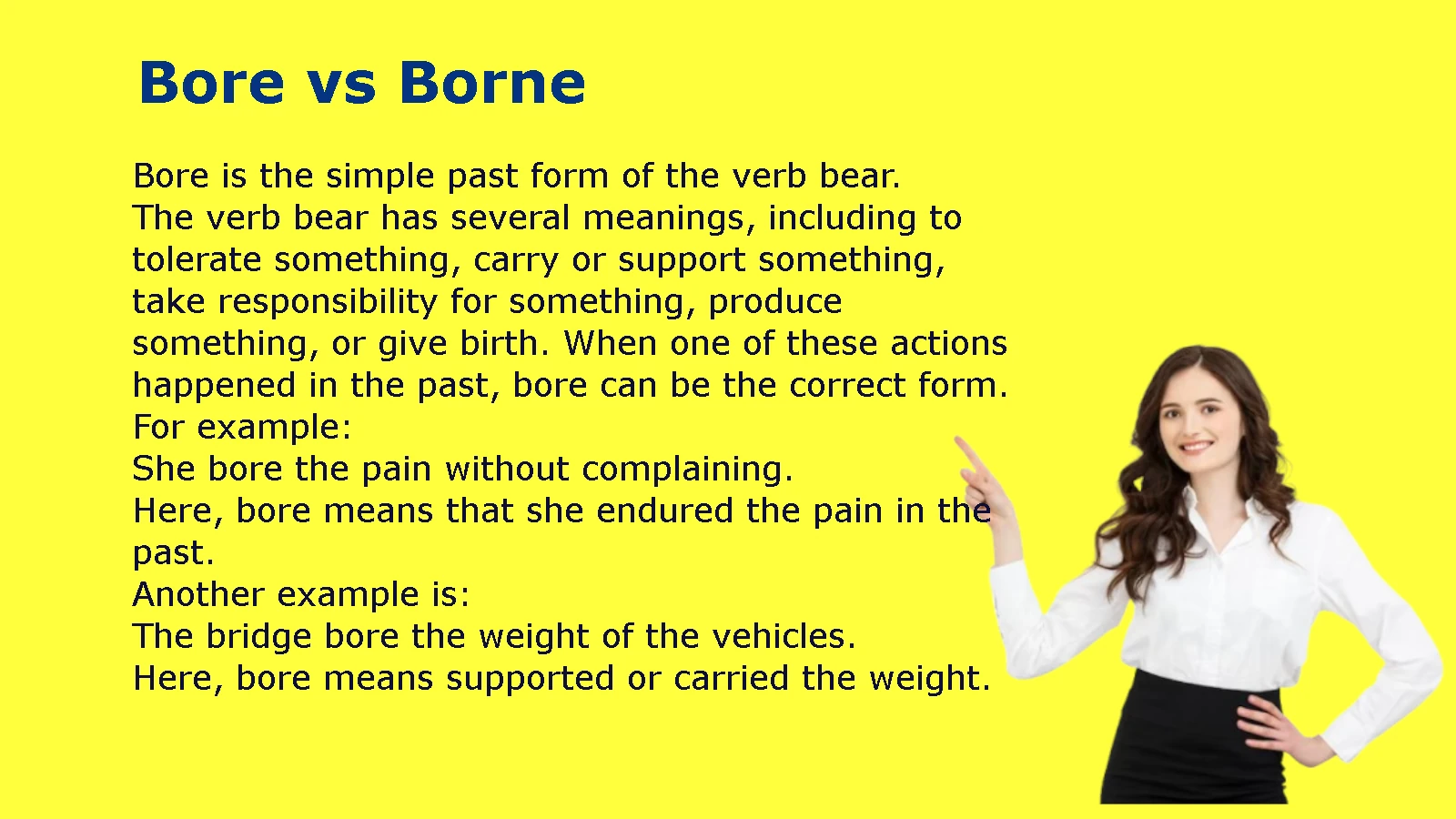
Bore is the simple past form of the verb bear.
The verb bear has several meanings, including to tolerate something, carry or support something, take responsibility for something, produce something, or give birth. When one of these actions happened in the past, bore can be the correct form.
For example:
She bore the pain without complaining.
Here, bore means that she endured the pain in the past.
Another example is:
The bridge bore the weight of the vehicles.
Here, bore means supported or carried the weight.
You can also use bore when bear means produce:
The tree bore fruit for the first time.
And in a more formal use involving childbirth:
She bore three children.
Cambridge notes that bear can be used for giving birth, with the simple past bore, although ordinary modern English more commonly uses had when simply stating that someone had children.
Bore as the Past Tense of Bear
The basic pattern is:
bear → bore
Examples:
- I bear the responsibility now.
- I bore the responsibility alone.
- They bear the cost.
- They bore the cost last year.
- The structure bears the weight.
- The structure bore the weight during the storm.
The important point is that bore does not normally need an auxiliary verb such as has, have, or had.
You can say:
She bore the burden.
But you would say:
She has borne the burden.
Not:
She has bore the burden.
That is one of the most common errors in this word family.
What Does Borne Mean?
Borne is the past participle of bear for most meanings.
Past participles commonly appear after auxiliary verbs such as has, have, and had, and they also appear in passive constructions.
For example:
She has borne the responsibility for years.
Here, borne follows has, so the sentence uses the past participle.
Another example:
The cost was borne by the company.
The passive construction was borne by is also correct.
Oxford gives examples of borne for responsibilities, burdens, grudges, weight, and other meanings associated with bear.
Borne With Have, Has, and Had
A useful test is to look for have, has, or had.
| Auxiliary | Correct form | Example |
| Have | borne | They have borne the cost. |
| Has | borne | She has borne the responsibility. |
| Had | borne | He had borne the burden alone. |
The pattern is:
have/has/had + borne
Not:
have/has/had + bore
For example:
The residents have borne the inconvenience for months.
Not:
The residents have bore the inconvenience for months.
Borne in Passive Constructions
Borne is also common in passive sentences.
Consider:
The expenses were borne by the organization.
The organization carried or paid the expenses.
Another example:
The weight was borne by the supporting beams.
Here, borne means supported or carried.
This construction appears frequently in formal, academic, business, legal, and technical writing.
Bore vs Borne: Key Difference
The central distinction is grammatical rather than simply a difference in meaning.
Bore is the simple past.
Borne is generally the past participle.
Compare:
The company bore the expense.
The company has borne the expense.
The first sentence describes a completed past action using the simple past.
The second uses the present perfect, so it requires the past participle.
The same pattern appears with bear meaning tolerate:
She bore the criticism patiently.
She has borne the criticism patiently.
The meaning is closely related, but the grammatical construction determines which form you need.
Bore vs Borne Comparison Table
| Feature | Bore | Borne |
| Base verb | Bear | Bear |
| Grammatical role | Simple past | Past participle |
| Common pattern | Subject + bore | Has/have/had + borne |
| Passive use | Generally not used this way | Common |
| Example | She bore the burden. | She has borne the burden. |
| Meaning | Carried, endured, supported, produced, etc. in the past | Has/have/had carried, endured, supported, produced, etc. |
A quick grammar test can therefore solve many cases:
If you can naturally put has, have, or had before the blank, you probably need borne, not bore.
Bore vs Borne vs Born
The third word, born, causes much of the confusion.
Although born and borne are related forms of bear, modern English gives them different jobs.
Born is normally used to refer to the fact of birth:
She was born in California.
Their son was born in March.
The puppies were born yesterday.
Cambridge specifically explains that born is used with be to indicate that a child has entered the world or to state when or where someone started life.
Borne, meanwhile, covers the other major meanings of bear, including carrying, enduring, supporting, and producing.
| Form | Example | Meaning |
| Bear | I cannot bear the noise. | Tolerate |
| Bore | She bore the pain bravely. | Tolerated in the past |
| Borne | She has borne the pain bravely. | Has tolerated |
| Born | She was born in Chicago. | Entered the world |
Bear, Bore, Born, or Borne?
The full pattern looks like this:
bear → bore → borne/born
The unusual part is that the past participle has two forms with different uses.
- Bear: present/base form
- Bore: simple past
- Borne: past participle for most meanings
- Born: birth-related form
This is why saying that born is simply another spelling of borne would be misleading. The two forms have developed distinct grammatical uses in modern English. The MLA Style Center likewise distinguishes born for birth from borne in broader uses of bear.
When to Use Bore
Use bore when you need the simple past of bear.
Enduring Something
She bore the pain with remarkable patience.
He bore the criticism without responding.
They bore the uncertainty for several months.
Here, bear means tolerate or endure.
Carrying or Supporting Something
The workers bore the heavy equipment up the stairs.
The old bridge bore the weight surprisingly well.
In these examples, bore describes a completed action in the past.
Taking Responsibility
She bore responsibility for the project’s failure.
The manufacturer bore the cost of the repairs.
Oxford identifies bear as a verb that can mean taking responsibility for something, and gives bore as its simple past form.
Producing Fruit
The apple tree bore fruit that summer.
This meaning is somewhat more formal or literary than everyday alternatives, but it remains standard English.
Oxford specifically lists bear for producing flowers or fruit.
Giving Birth
Bore can also describe giving birth, particularly in formal or historical writing:
The queen bore three children.
She bore a son in 1842.
Cambridge notes that this use exists but is relatively formal, while ordinary modern English often uses had when simply stating that someone had children.
When to Use Borne
Use borne when bear is functioning as a past participle and the meaning isn’t specifically the passive fact of being born.
With Has, Have, or Had
These constructions are straightforward:
She has borne the responsibility for years.
They have borne the expense themselves.
He had borne the burden before help arrived.
The structure is:
has/have/had + borne
With Was, Were, Is, or Are in Passive Constructions
Examples include:
The cost was borne by the employer.
The weight was borne by the steel frame.
The consequences were borne by the entire community.
The phrase borne by is particularly common when explaining who carries a cost, responsibility, burden, or consequence.
Borne Out
Borne out is another established expression.
It means confirmed or shown to be true.
For example:
The results bore out her original theory.
And in a perfect construction:
The results have borne out her original theory.
Notice the difference:
bore out = simple past
borne out = past participle
That distinction follows the same grammatical rule.
When to Use Born Instead of Borne
Use born when you are talking about birth.
The most common structure is:
was/were + born
Examples:
I was born in 2001.
She was born in Boston.
The twins were born prematurely.
The horse was born in Kentucky.
Cambridge specifically warns that English uses was/were born when stating when or where someone started life.
Why You Usually Don’t Say “Borne” Here
A sentence such as:
She was borne in 1990.
does not mean the same thing as:
She was born in 1990.
The second sentence states the year of her birth.
Borne is used for other meanings of bear, not as the ordinary form in the passive construction be born.
However, there is an important nuance: borne can appear in contexts related to reproduction when bear means give birth, especially in active or descriptive constructions.
For example:
The dog has borne three litters.
That means the dog has given birth to three litters.
The MLA Style Center also notes that borne can occur in active uses referring to giving birth, while born is used in passive constructions to state the fact of birth.
Bore vs Borne Examples in Sentences
Seeing the forms side by side makes the distinction much easier.
Examples With Bore
- The workers bore the burden of the additional costs.
- She bore the criticism without complaint.
- The bridge bore the weight of the trucks.
- The tree bore fruit that year.
- The document bore his signature.
- She bore two children during the following decade.
Borne
- The company has borne the expense.
- She has borne the responsibility for years.
- The cost was borne by the manufacturer.
- The weight was borne by the foundation.
- His resentment was borne out of years of conflict.
- The evidence has borne out the original claim.
Examples With Born
- She was born in 1997.
- Their daughter was born in Texas.
- The puppies were born in the spring.
- He was born into a farming family.
- The idea was born from a conversation between the two researchers.
That last example illustrates an extended use of born in the sense of something being created or originating from something. The MLA notes that born can also function adjectivally in expressions such as Scottish-born and can describe something that originates from an experience or circumstance.
Bore vs Borne in Different Contexts
The meaning of bear changes depending on context, but the grammatical distinction between bore and borne remains useful.
Carrying or Supporting Something
When bear means carry or support, use bore for simple past and borne for the past participle.
The bridge bore the weight safely.
The bridge has borne the weight safely.
The second sentence requires the participle because it uses has.
Oxford lists carrying and supporting weight among the established meanings of bear.
Experiencing or Enduring Something
With emotional or physical difficulty:
She bore the pain silently.
She has borne the pain silently.
The meaning remains essentially the same, but the tense and construction change.
Taking Responsibility for Something
This usage appears frequently in formal writing:
The contractor bore the responsibility for the mistake.
The contractor has borne responsibility for the mistake.
You will also see:
The contractor bore the cost.
and:
The cost was borne by the contractor.
Producing Fruit or Results
When a plant produces fruit:
The tree bore fruit last year.
For a perfect construction:
The tree has borne fruit every summer.
The verb bear also appears in the established expression bear fruit, which can be literal or figurative. Oxford defines bear fruit as having a successful result.
Borne by, Borne Out, and Other Common Expressions
Some expressions make borne particularly common in English.
Borne By
Borne by means carried, supported, paid for, or endured by someone or something.
Examples:
The additional costs were borne by the company.
The weight is borne by the foundation.
The consequences were borne by local residents.
Borne Out
Borne out means confirmed by evidence or later events.
For example:
The research findings bore out the original prediction.
Later evidence borne out the theory.
The second example would need a grammatical structure such as:
Later evidence has borne out the theory.
The distinction is worth remembering:
- bore out → simple past
- has borne out → present perfect
Borne in Mind
The expression bear in mind means to remember or consider something.
For example:
Please bear in mind that prices can change.
In a passive or participial construction, you may encounter:
This limitation should be borne in mind when interpreting the results.
Oxford lists bear/keep in mind as an established expression meaning to remember or consider something.
Bore vs Borne Pronunciation
Bore and borne are not generally pronounced the same.
Oxford gives the following forms for the verb bear:
- bore: /bɔːr/ in British English and /bɔːr/ in the cited American entry
- borne: /bɔːn/ in British English and /bɔːrn/ in the cited American entry
In many English accents, borne and born are pronounced alike or nearly alike, while bore ends with an r sound in rhotic accents such as General American English.
For practical purposes:
- bore rhymes with words such as more in many varieties of English.
- borne is pronounced like born in many standard varieties.
The spelling distinction is therefore also reflected in pronunciation, although accents differ.
Bore vs Borne: Common Mistakes
These words cause predictable errors, particularly because bear is an irregular verb.
Using Bore After Has, Have, or Had
Incorrect:
She has bore the responsibility for years.
Correct:
She has borne the responsibility for years.
After has, you need the past participle.
Using Borne as the Simple Past
Incorrect:
She borne the responsibility last year.
Correct:
She bore the responsibility last year.
Without an auxiliary verb, the simple past form is bore.
Confusing Born and Borne
Incorrect:
She was borne in 2002.
Correct:
She was born in 2002.
When the sentence states the fact of someone’s birth, born is the standard form.
Assuming Born and Borne Are Always Interchangeable
They aren’t.
Compare:
She was born in Canada.
with:
The cost was borne by the company.
The first refers to birth. The second means the company carried or paid the cost.
Confusing Bore With the Other Word “Bore”
There is another English word bore unrelated to the past tense of bear.
For example:
The lecture bored me.
Here, bore is a different verb meaning to make someone feel uninterested or tired.
It has its own forms:
bore → bored → boring
That is different from:
bear → bore → borne/born
This distinction is particularly useful because the same spelling bore can represent two different verbs.
Bore vs Borne vs Bourne
Bourne is another word that can look confusingly similar.
It should not be treated as another form of bear.
Borne is the past participle of bear.
Bourne is a separate English word, traditionally referring to a destination or boundary and, in some uses, a small stream. It can also appear in proper names.
So:
- bore → past form of bear
- borne → past participle of bear
- born → birth-related form
- bourne → separate word
If you’re writing about carrying, enduring, supporting, or responsibility, bourne is not the spelling you want.
How to Remember the Difference Between Bore and Borne
A simple three-part rule covers most situations:
Bore = simple past. Borne = past participle. Born = birth.
Then apply it to actual sentences.
Simple past:
She bore the burden.
Present perfect:
She has borne the burden.
Birth:
She was born in 2000.
This gives you a reliable decision process.
A Simple Grammar Test
When you’re unsure, ask these questions:
Did the action happen in the past with no auxiliary?
Use bore.
He bore the responsibility.
Does the sentence contain has, have, or had?
Use borne for the relevant non-birth meaning.
He has borne the responsibility.
Does the sentence describe someone’s birth?
Use born.
He was born in 2000.
Is the sentence passive and does it mean something was carried, supported, endured, or paid for?
Use borne.
The cost was borne by the employer.
This method is more useful than trying to memorize isolated sentences.
Bore vs Borne in Formal and Everyday Writing
Both forms are standard English, but borne often appears in formal constructions because expressions involving responsibility, costs, burdens, evidence, and support are common in professional writing.
For example:
The additional expense was borne by the contractor.
That sentence would be perfectly natural in a business or legal document.
In everyday conversation, however, speakers often choose simpler wording:
The contractor paid the extra cost.
Likewise, instead of:
She bore the responsibility for the mistake.
a speaker might say:
She took responsibility for the mistake.
The important point is that bore and borne aren’t informal or formal versions of the same word. They are different grammatical forms.
A Practical Case Study: Choosing Between Bore, Borne, and Born
Consider this short paragraph:
Maria was born in 1985. After taking over the family business, she bore much of the responsibility herself. Over the next decade, she borne the company’s financial difficulties.
The third sentence is wrong.
Why?
The phrase over the next decade suggests a continuing period, and the intended construction uses the perfect form:
Maria was born in 1985. After taking over the family business, she bore much of the responsibility herself. Over the next decade, she had borne the company’s financial difficulties.
Or, more naturally:
Over the next decade, she bore the company’s financial difficulties.
If the sentence uses had, however, borne is required:
By 1995, she had borne the company’s financial difficulties for a decade.
This example shows why context alone isn’t enough. You must also look at the verb construction.
Quick Comparison: Bear, Bore, Born, and Borne
| Word | Grammatical form | Main use | Example |
| Bear | Base/present form | Carry, endure, support, produce, etc. | We must bear the cost. |
| Bore | Simple past | Completed past action | We bore the cost. |
| Borne | Past participle | Perfect or passive constructions | We have borne the cost. |
| Born | Birth-related participle | Fact of birth | She was born in May. |
The key relationship is:
bear → bore → borne
with born serving the specialized birth-related use.
Facts to Remember About Bore vs Borne
Keep these points handy:
- Bore is the simple past of bear.
- Borne is the past participle of bear for most meanings.
- Born is used for the fact of birth.
- Bore can mean carried, endured, supported, produced, or gave birth in a past-time context.
- Borne commonly follows has, have, or had.
- Borne by is common in passive constructions involving costs, weight, responsibility, and consequences.
- Borne out means confirmed or supported by evidence.
- Born appears most commonly in was/were born.
- Bore and borne are different grammatical forms, not interchangeable spellings.
- Bore can also be an entirely different verb meaning to make someone uninterested.
Frequently Asked Questions About Bore vs Borne
Is bore the past tense of bear?
Yes. Bore is the simple past form of bear.
She bore the responsibility alone.
Oxford lists bore as the past simple form of bear.
Is borne the past tense of bear?
No. Borne is generally the past participle, not the simple past.
The basic forms are:
bear → bore → borne
For example:
She bore the burden.
She has borne the burden.
What is the difference between bore and borne?
Bore is the simple past, while borne is the past participle.
Use bore for a completed past action:
He bore the responsibility.
Use borne after auxiliary verbs or in passive constructions:
He has borne the responsibility.
The responsibility was borne by him.
Is it born or borne?
It depends on the meaning.
Use born when referring to birth:
She was born in 1995.
Use borne for most other meanings of bear:
She has borne the burden for years.
Cambridge makes this same distinction between born for birth and borne for the broader uses of bear.
Is it bore the burden or borne the burden?
Both can be correct, depending on the sentence.
She bore the burden alone.
Here, bore is the simple past.
She has borne the burden alone.
Here, borne is the past participle.
Is it bore fruit or borne fruit?
Both can be correct in different grammatical constructions.
The tree bore fruit last year.
The tree has borne fruit for many years.
Use bore for simple past and borne for a perfect construction.
Is it borne by or born by?
For the meaning carried, supported, paid for, or endured by, use borne by.
The cost was borne by the company.
Use born when referring to birth:
She was born by…
That second construction would usually be unnatural because English normally says was born to a mother or was born in a place, rather than using born by to identify the person responsible for the birth.
Are bore and borne pronounced the same?
No. In many accents, bore ends with an r sound, while borne does not. Oxford gives distinct pronunciations for the two forms.
What is the difference between born and borne?
Born is primarily used for the fact of birth:
He was born in 1990.
Borne is used for most other meanings of bear:
He has borne the responsibility for years.
The distinction is grammatical and semantic rather than simply a spelling preference.
What are the forms of bear?
The main forms are:
bear → bore → borne
The additional form born is used specifically in the modern birth-related construction.
Is “borne out” the same as “bore out”?
No. They are different grammatical forms.
The evidence bore out the claim.
The evidence has borne out the claim.
Bore out is simple past, while borne out is the past participle used after an auxiliary such as has.
Conclusion: Bore vs Borne Made Simple
The difference between bore vs borne comes down primarily to verb form.
Bore is the simple past of bear:
She bore the responsibility.
Borne is the past participle for most meanings:
She has borne the responsibility.
Born is the special form used when talking about birth:
She was born in 2000.
So the easiest rule to remember is:
Bear → bore → borne, but born for birth.
Once you identify whether the sentence needs a simple past, a past participle, or the special birth-related form, choosing between bore, borne, and born becomes much more straightforward.
For authoritative reference, Oxford’s verb entry confirms the forms and major meanings of bear, while Cambridge’s grammar guidance provides the practical distinction between born and borne.