Bled vs bleed can be confusing because both words come from the same verb, but they are used differently in English sentences. Bled is the past tense and past participle of bleed, while bleed is the base form of the verb. If you’ve come across “bled” and “bleed” and wondered which one is correct, the difference is mainly connected to verb tense, past actions, present actions, injuries, blood loss, and figurative uses.
The bled vs bleed distinction refers to the difference between “bled,” which describes something that already happened, and “bleed,” which is used for the base form of the verb, including present-tense and infinitive constructions. For example, you can say “The cut bled yesterday” when describing a past event, but “The cut may bleed again” when referring to a possible action. Related forms include bleeds, bleeding, and bled, each serving a different grammatical purpose.
In this guide, you’ll learn the difference between bled and bleed, when to use each word, how their verb forms work, and how to use them correctly in sentences. You’ll also see clear examples, common mistakes, and simple explanations to help you understand the difference between bled and bleed.
By the end, you’ll know exactly when to use “bled” and when to use “bleed” and how to choose the correct form naturally and correctly in everyday English.
Quick Answer: Bled vs Bleed
Bled and bleed are forms of the same irregular verb, but they are used differently.
- Bleed is the base form of the verb and is used for present-time statements, infinitives, and after modal verbs.
- Bled is both the simple past tense and past participle of bleed.
- Bleeding is the present participle and is used in continuous forms.
| Form | Grammatical function | Example |
| bleed | Base form/present form | I bleed easily. |
| bleeds | Third-person singular present | His nose bleeds often. |
| bled | Simple past | His nose bled yesterday. |
| bled | Past participle | His nose has bled before. |
| bleeding | Present participle | His nose is bleeding. |
The easiest rule to remember is:
Bleed = base or present form. Bled = past and past participle.
For example, say “I bleed easily” when describing a general tendency, but “I bled yesterday” when describing something that already happened.
Both Cambridge and Oxford list bled as the simple past and past participle of bleed.
What Does Bleed Mean?
Bleed is a verb that most commonly means to lose blood, especially from a wound or injury.
For example:
- My finger started to bleed.
- The cut may bleed again.
- Some people bleed more easily than others.
- The wound continues to bleed.
Oxford defines bleed as losing blood, particularly from a wound or injury. The verb also has several other established meanings involving color, liquids, mechanical systems, money, and resources.
Bleed as a Base Verb
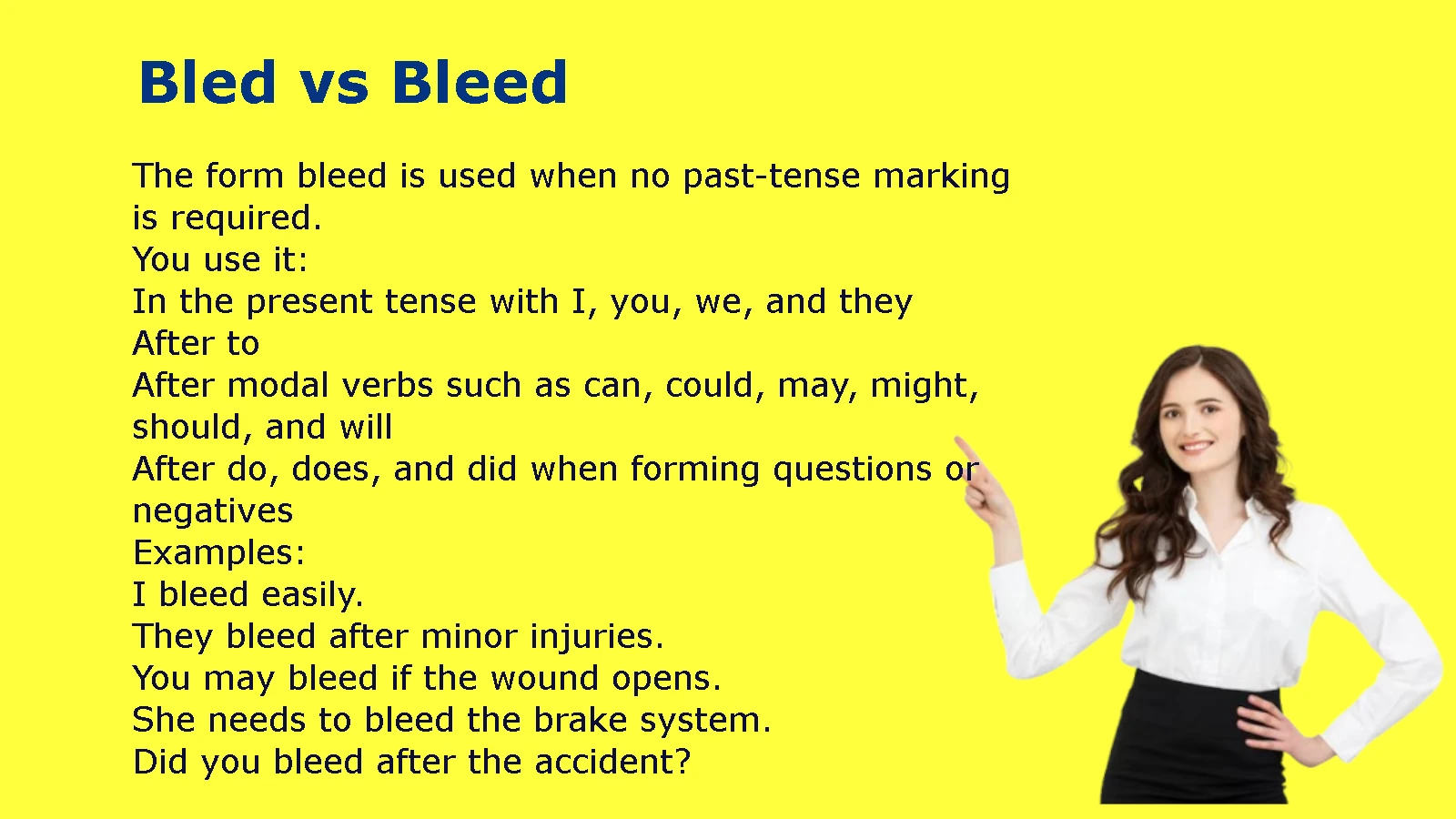
The form bleed is used when no past-tense marking is required.
You use it:
- In the present tense with I, you, we, and they
- After to
- After modal verbs such as can, could, may, might, should, and will
- After do, does, and did when forming questions or negatives
Examples:
- I bleed easily.
- They bleed after minor injuries.
- You may bleed if the wound opens.
- She needs to bleed the brake system.
- Did you bleed after the accident?
Notice the last example carefully. Even though did refers to the past, the verb following did stays in its base form:
Did + bleed, not did + bled.
What Does Bled Mean?
Bled is the simple past tense and past participle of bleed.
Cambridge’s dictionary entry for bled explicitly identifies it as both the simple past and past participle of bleed.
The word can describe the same basic actions as bleed, but the grammatical structure determines when you use it.
Bled as the Simple Past
Use bled when you are describing an action that happened in the past.
Examples:
- I bled after cutting my finger.
- She bled for several minutes.
- His nose bled during the game.
- The wound bled heavily after the fall.
In each sentence, the bleeding happened at a completed point or period in the past.
Compare:
- Present: The wound bleeds easily.
- Past: The wound bled yesterday.
Bled as a Past Participle
Bled also functions as a past participle.
It commonly appears with:
- has
- have
- had
- Forms of be in passive constructions
Examples:
- The wound has bled before.
- The cut had bled through the bandage.
- The patient had bled significantly before treatment began.
- The brake lines were bled by the mechanic.
The important point is that bled does not change form between the simple past and past participle.
That gives you this pattern:
bleed → bled → bled
Bled vs Bleed: The Main Grammar Difference
The clearest way to understand bled vs bleed is to look at the complete verb forms.
| Verb form | Example | Function |
| bleed | I bleed easily. | Base/present |
| bleeds | The cut bleeds easily. | Third-person singular present |
| bled | The cut bled yesterday. | Simple past |
| bled | The cut has bled before. | Past participle |
| bleeding | The cut is bleeding. | Present participle |
This is an irregular verb pattern. You cannot create the past tense by simply adding -ed.
So:
- bleed → bled ✅
- bleed → bleeded ❌
Oxford gives the complete pattern as bleed, bled, bled, bleeding.
When to Use Bleed
There are several common situations in which bleed is the correct form.
Use Bleed for Present-Time Statements
When you are talking about something that happens generally or is happening according to a present-tense statement, use bleed or bleeds, depending on the subject.
Examples:
- I bleed easily.
- We bleed less when the wound is properly treated.
- Some cuts bleed more than others.
- His nose bleeds every winter.
Remember the subject agreement:
- I bleed
- You bleed
- We bleed
- They bleed
- He bleeds
- She bleeds
- It bleeds
The third-person singular form is bleeds, not bleed.
Use Bleed After Modal Verbs
A modal verb takes the base form of the verb.
Therefore:
- may bleed ✅
- can bleed ✅
- might bleed ✅
- could bleed ✅
- should bleed ✅
- will bleed ✅
Do not write:
- may bled ❌
- can bled ❌
- might bled ❌
- will bled ❌
Examples:
The wound may bleed again.
A small cut can bleed more than you expect.
The fabric might bleed when washed.
The same principle applies to the nonmedical meanings of bleed.
- The colors may bleed.
- The company could bleed money.
- The paint might bleed into the surrounding area.
When to Use Bled
Use bled when the grammar requires either the simple past or past participle.
Use Bled for a Completed Past Action
If the action happened in the past, bled is normally the form you need.
Examples:
- He bled after cutting his hand.
- The child bled from a small cut.
- The wound bled throughout the night.
- The ink bled into the paper.
Time expressions can make this especially obvious:
- yesterday
- last night
- earlier
- two hours ago
- during the accident
- after the fall
- before the doctor arrived
For example:
Correct: The wound bled yesterday.
Incorrect: The wound bleed yesterday.
Use Bled After Have, Has, or Had
Because bled is also the past participle, it follows have, has, and had in perfect constructions.
Examples:
- I have bled before.
- She has bled from the same wound before.
- They had bled for several minutes before help arrived.
Compare these carefully:
| Sentence | Correct? | Why |
| I have bled before. | ✅ | Have + past participle |
| I have bleed before. | ❌ | Wrong verb form |
| She has bled before. | ✅ | Has + past participle |
| She has bleed before. | ❌ | Wrong verb form |
| They had bled heavily. | ✅ | Had + past participle |
| They had bleed heavily. | ❌ | Wrong verb form |
Bleed Past Tense: Why Is It Bled?
The past tense of bleed is bled.
This is not a regular -ed formation. English has many irregular verbs whose past forms do not follow the ordinary pattern.
For example:
| Base | Past | Past participle |
| bleed | bled | bled |
| feed | fed | fed |
| lead | led | led |
| meet | met | met |
| keep | kept | kept |
The important thing is not to create a form such as bleeded.
Bleeded is not the standard past tense or past participle of bleed.
The correct forms are:
bleed → bled → bled
Bled vs Bleed Examples in Sentences
Seeing the two forms in context makes the difference much easier to remember.
Examples With Bleed
- Small cuts can bleed heavily.
- I tend to bleed when I shave.
- The wound may bleed again.
- Some fabrics bleed when washed.
- The colors can bleed into each other.
- The company continues to bleed money.
- You should not expect the ink to bleed on this paper.
With Bled
- The cut bled for several minutes.
- He bled after falling off his bicycle.
- The wound bled through the bandage.
- The red dye bled into the white fabric.
- The company bled money during the difficult period.
- The colors bled during the first wash.
Examples With Both Bleed and Bled
Putting the two forms into the same context highlights the difference:
The wound can bleed easily, and it bled again yesterday.
Some dyes bleed when washed, and this particular dye bled badly.
The business continues to bleed money, but it bled even more last year.
The meaning stays related. The time and grammatical structure change.
Bled vs Bleed in Different Contexts
One reason this comparison can seem confusing is that bleed has more than one established meaning.
Bleed in Medical and Physical Contexts
The most familiar meaning is to lose blood.
Examples:
- The cut is starting to bleed.
- His nose bleeds frequently.
- The wound bled after the fall.
The past form remains bled regardless of the specific injury.
Bleed for Color, Ink, or Dye
Bleed can also describe color spreading beyond its intended area.
Cambridge gives this meaning for colors, ink, and paint that spread into another area.
Examples:
- The red ink may bleed through the paper.
- The colors bleed into each other.
- The dye bled into the white fabric.
- The paint has bled beyond the original edge.
Here, bleed does not necessarily involve blood at all.
Bleed in Printing
In printing, bleed is also used as a technical term for an image or color extending beyond the final trimmed edge of a printed piece.
The underlying idea is related to the general sense of something extending beyond its intended boundary.
You may encounter expressions such as:
- the image bleeds off the page
- a full-bleed image
- bleed area
This is different from the medical meaning, but the verb form still follows the same grammatical pattern:
- The image bleeds to the edge.
- The image bled beyond the trim line.
Bleed in Mechanical Systems
Bleed can also mean removing air or liquid from a closed system so that the system works properly. Cambridge specifically lists this use for systems such as radiators and brakes.
For example:
- The mechanic needs to bleed the brakes.
- The brakes were bled yesterday.
- The technician is bleeding the system.
Here again, the forms follow the same pattern:
bleed → bled → bleeding
Bleed in Business and Finance
The verb can be used figuratively for losing money, jobs, resources, or other valuable things.
For example:
- The company is bleeding money.
- The business bled cash for years.
- The organization has bled resources since the project began.
Cambridge’s Business English entry recognizes bleed for losing a lot of money or causing someone or something to lose money.
Bled vs Bleed vs Bleeding
A common source of confusion is treating bled, bleed, and bleeding as interchangeable.
They are not.
| Form | Use | Example |
| bleed | Base/present form | The wound may bleed. |
| bled | Past/past participle | The wound bled yesterday. |
| bleeding | -ing form | The wound is bleeding. |
Bleed
Use bleed after a modal, after to, or for an appropriate present-tense subject.
The wound may bleed.
Bled
Use bled for a completed past event or after has, have, or had.
The wound bled yesterday.
The wound has bled before.
Bleeding
Use bleeding in continuous forms or when the -ing form functions as a noun or modifier.
The wound is bleeding.
Oxford lists bleeding as the -ing form of bleed.
Common Mistakes With Bled and Bleed
Mistake: “She Bleed Yesterday”
❌ She bleed yesterday.
The word yesterday identifies a completed past action, so the past form is required.
✅ She bled yesterday.
Mistake: “The Wound May Bled”
❌ The wound may bled.
After may, use the base form.
✅ The wound may bleed.
Mistake: “Did You Bled?”
❌ Did you bled after the injury?
When did is used to form a past question, the following verb returns to its base form.
✅ Did you bleed after the injury?
This is a particularly useful rule because learners sometimes use the past form twice: did + bled. English does not work that way.
Mistake: “I Have Bleed”
❌ I have bleed before.
After have, the perfect construction requires the past participle.
✅ I have bled before.
Mistake: “Bleeded”
❌ The wound bleeded for ten minutes.
✅ The wound bled for ten minutes.
The standard forms are bleed, bled, bled. Cambridge and Oxford both confirm this verb pattern.
Bled vs Bleed in Questions and Negative Sentences
Questions and negative sentences create some of the most common mistakes.
Questions With Did
Use did + bleed:
- Did you bleed?
- Did the wound bleed?
- Did his nose bleed?
Not:
- Did you bled? ❌
- Did the wound bled? ❌
Why?
Because did already carries the past tense. The main verb therefore remains in its base form.
did + bleed
Negative Sentences With Did Not
The same rule applies to negative sentences:
- I did not bleed.
- She did not bleed.
- The wound did not bleed.
Not:
- I did not bled. ❌
- She did not bled. ❌
Questions With Have or Has
Use bled after have or has:
- Have you bled before?
- Has the wound bled recently?
Not:
- Have you bleed before? ❌
- Has the wound bleed recently? ❌
This gives you a useful contrast:
| Structure | Correct form |
| Did + … | bleed |
| Does + … | bleed |
| Do + … | bleed |
| May + … | bleed |
| Can + … | bleed |
| Have + … | bled |
| Has + … | bled |
| Had + … | bled |
Bled vs Bleed Pronunciation
The two words are spelled similarly, but they do not have the same vowel sound.
- bleed — /bliːd/
- bled — /bled/
Cambridge lists bleed with /bliːd/ and bled with /bled/, while Oxford likewise gives /bliːd/ for bleed and /bled/ for the past form.
The main difference is the vowel.
Bleed
The vowel in bleed is the long ee sound heard in words such as:
- need
- feed
- green
- sleep
Bled
The vowel in bled is the short vowel sound heard in words such as:
- bed
- red
- head
- said
This makes the pronunciation distinction important when speaking.
Bleed sounds like a word with the vowel of need, whereas bled uses the vowel of bed.
Is Bled a Word?
Yes. Bled is a standard English word.
It is not a spelling mistake, abbreviation, or informal version of bleed. It is the established simple past and past participle of the verb bleed. Cambridge’s dictionary has a dedicated entry identifying bled in exactly those grammatical roles.
Examples:
- He bled after the accident.
- She has bled before.
- The dye bled into the fabric.
- The brakes were bled by the mechanic.
Is Bleed an Irregular Verb?
Yes. Bleed is an irregular verb because its past forms do not follow the regular -ed pattern.
A regular verb might follow a pattern such as:
walk → walked → walked
But bleed follows:
bleed → bled → bled
Other irregular verbs have similar patterns:
- feed → fed → fed
- lead → led → led
- meet → met → met
- keep → kept → kept
Learning the three principal forms together is often easier than trying to construct the past form each time.
A Simple Way to Remember Bled vs Bleed
Use this short rule:
Bleed is the base form. Bled is the past form.
Then apply the grammar around it.
If You Mean Now or Generally
Use bleed:
I bleed easily.
If You Mean the Past
Use bled:
I bled yesterday.
If You Use a Modal
Use bleed:
I might bleed.
If You Use Have, Has, or Had
Use bled:
I have bled before.
If You Use Is, Am, or Are for an Ongoing Action
Use bleeding:
I am bleeding.
This five-part pattern solves most bled vs bleed questions.
Bled vs Bleed: Quick Comparison Table
| Feature | Bleed | Bled |
| Base form | Yes | No |
| Present form | Yes | No |
| Third-person present | Bleeds | No |
| Simple past | No | Yes |
| Past participle | No | Yes |
| -ing form | No | No |
| Pronunciation | /bliːd/ | /bled/ |
| Example | The wound may bleed. | The wound bled yesterday. |
The core distinction is grammatical rather than semantic. Both forms come from the same verb, but bleed occupies the base/present position while bled occupies the past and past-participle positions.
How to Choose Between Bled and Bleed
When you are unsure, ask yourself a few simple questions.
Did the Action Happen in the Past?
If yes, use bled.
The cut bled last night.
Is There a Modal Verb Before It?
If you have can, could, may, might, should, or will, use bleed.
The cut may bleed.
Is There “Did” Before the Verb?
Use bleed.
Did the cut bleed?
Is There “Have,” “Has,” or “Had”?
Use bled.
The cut has bled before.
Is the Action Happening Right Now?
For a continuous action, use bleeding.
The cut is bleeding.
This approach is more reliable than trying to memorize individual sentences.
Common Expressions With Bleed
The verb bleed appears in several established expressions.
Bleed Someone Dry
Bleed someone dry means to take away most or all of someone’s money or resources.
Oxford lists bleed somebody dry as an established idiom.
Example:
The expensive repairs nearly bled him dry.
Bleed Money
Bleed money means to lose money continuously or heavily.
Examples:
The company is bleeding money.
The business bled money during the downturn.
Cambridge recognizes this figurative business use.
Bleed Into
Bleed into can describe something spreading gradually into another area.
For colors:
The blue paint bled into the white section.
It can also be used more figuratively when one area, subject, or experience gradually extends into another.
Bleed Through
Bleed through describes something becoming visible through another surface or spreading through it.
For example:
The ink bled through the thin paper.
The form changes according to tense:
- The ink bleeds through the paper.
- The ink bled through the paper.
- The ink has bled through the paper.
Related Forms of Bleed
Knowing the related forms makes the bled vs bleed distinction easier to understand.
| Form | Grammatical role | Example |
| bleed | Base form | The cut may bleed. |
| bleeds | Third-person singular present | The wound bleeds easily. |
| bled | Past | The wound bled yesterday. |
| bled | Past participle | The wound has bled before. |
| bleeding | Present participle | The wound is bleeding. |
Do not confuse bleed with blood simply because the words are closely related.
Blood is primarily a noun referring to the red fluid circulating through the body, although blood can also function as a verb in a separate sense. Oxford lists blooded as the past and past participle of that verb, which is different from bled.
A Practical Case Study: Choosing the Correct Form
Consider this short situation:
Maria cuts her finger while preparing dinner. The cut starts to bleed. She tells her friend that she bled earlier in the week as well. Later, she says the wound has bled twice today.
Three forms appear because the grammar changes.
First:
The cut starts to bleed.
Here, bleed follows a present-tense construction.
Second:
She bled earlier in the week.
The event happened in the past, so bled is the simple past.
Third:
The wound has bled twice today.
Here, bled is the past participle following has.
The underlying action is related in all three cases. What changes is the verb form required by the sentence structure.
Bled vs Bleed: Common Sentence Corrections
| Incorrect | Correct | Reason |
| I bleed yesterday. | I bled yesterday. | Past action |
| She may bled. | She may bleed. | Modal + base form |
| Did he bled? | Did he bleed? | Did + base form |
| I have bleed before. | I have bled before. | Have + past participle |
| He is bled now. | He is bleeding now. | Ongoing action |
| They bleeded yesterday. | They bled yesterday. | Irregular past form |
These corrections reveal a broader grammar principle: the word immediately before the main verb often determines which form you need.
Bled vs Bleed: Frequently Asked Questions
Is bled the past tense of bleed?
Yes. Bled is the simple past tense of bleed. It is also the past participle. The complete pattern is bleed → bled → bled.
What is the past tense of bleed?
The past tense of bleed is bled.
Example:
The wound bled for several minutes.
What is the past participle of bleed?
The past participle is also bled.
Example:
The wound has bled before.
Is “I bleed yesterday” correct?
No. Because yesterday refers to a completed past event, use bled:
I bled yesterday.
Is “Did you bled?” correct?
No. After did, use the base form:
Did you bleed?
The word did already carries the past-tense meaning.
Is “Have you bleed before?” correct?
No. After have, use the past participle:
Have you bled before?
Is “bleeded” the past tense of bleed?
No. The standard past tense is bled, not bleeded.
bleed → bled → bled
What is the difference between bleed, bled, and bleeding?
Bleed is the base form, bled is the simple past and past participle, and bleeding is the -ing form.
- The wound may bleed.
- The wound bled yesterday.
- The wound is bleeding now.
How do you pronounce bleed?
Bleed is pronounced /bliːd/. The vowel is the long ee sound, as in need.
How do you pronounce bled?
Bled is pronounced /bled/. Its vowel is the same general vowel sound heard in bed and red. Oxford gives /bled/ for the past form.
Is bled a past participle?
Yes. Bled functions as both the simple past and past participle of bleed.
For example:
- Simple past: The wound bled.
- Past participle: The wound has bled.
What is the difference between bled and bleeding?
Bled refers to a past action or serves as a past participle, while bleeding is the -ing form used in continuous constructions.
Compare:
The wound bled yesterday.
The wound is bleeding now.
Should I use bleed or bled after “did”?
Use bleed.
Did the wound bleed?
Never use did bled in standard English.
Should I use bleed or bled after “can”?
Use bleed.
The wound can bleed.
Modal verbs such as can, could, may, might, and will are followed by the base form.
Bled vs Bleed: Final Takeaway
The difference between bled vs bleed is straightforward once you understand the verb forms.
Bleed is the base form. Use it for present-tense statements, after modal verbs, after to, and after auxiliary do/does/did when the main verb is required in its base form.
Bled is both the simple past tense and past participle of bleed. Use it for completed past actions and after has, have, or had.
The complete pattern is:
bleed → bled → bled → bleeding
Keep these examples in mind:
- Present: I bleed easily.
- Past: I bled yesterday.
- Perfect: I have bled before.
- Continuous: I am bleeding now.
- Modal: I may bleed again.
- Question with did: Did you bleed?
Once you remember bleed = base form and bled = past/past participle, most common mistakes disappear.