Speeded vs sped can be confusing because both forms are associated with the verb speed, but they are not always used in the same way. If you’ve come across “speeded” or “sped” and wondered which one is correct, the choice depends on the meaning, sentence structure, and style of English being used. Both forms are recognized, but sped is generally the more common past tense and past participle when referring to moving quickly.
The speeded vs sped distinction mainly comes down to how the verb speed is formed in the past tense. Sped is the traditional irregular form, while speeded is also used, particularly in certain contexts where the verb means to make something move faster, increase the speed of something, or accelerate a process. Related forms include speed, speeds, speeding, sped, speeded, accelerated, and moved quickly, although they can have slightly different uses.
In this guide, you’ll learn whether “speeded” or “sped” is correct, what each word means, how to use both forms in sentences, and when “sped” is more natural than “speeded.” You’ll also see clear examples, a comparison table, and explanations of common usage patterns to help you choose the right form.
By the end, you’ll know exactly how speeded and sped differ and how to use each form naturally and correctly.
Quick Answer: Speeded vs Sped
Sped and speeded are both valid forms of the verb speed.
- Sped is the traditional irregular past tense and past participle.
- Speeded is the regular past tense and past participle.
- Sped is especially natural when describing something that moved quickly: The car sped away.
- Speeded commonly appears when describing something becoming faster or being made faster: The changes speeded up the process.
- Sped up and speeded up are both established constructions.
- You should not automatically mark speeded as wrong.
Cambridge lists the verb as “sped or speeded” and gives examples involving both forms. Oxford similarly gives speeded as the regular past form while noting that sped is also used in certain senses.
| Form | Status | Common use |
| sped | Correct | Moving or happening quickly |
| speeded | Correct | Making or becoming faster, including speeded up |
| sped up | Correct | Becoming or making something faster |
| speeded up | Correct | Becoming or making something faster |
What Is the Difference Between Speeded and Sped?
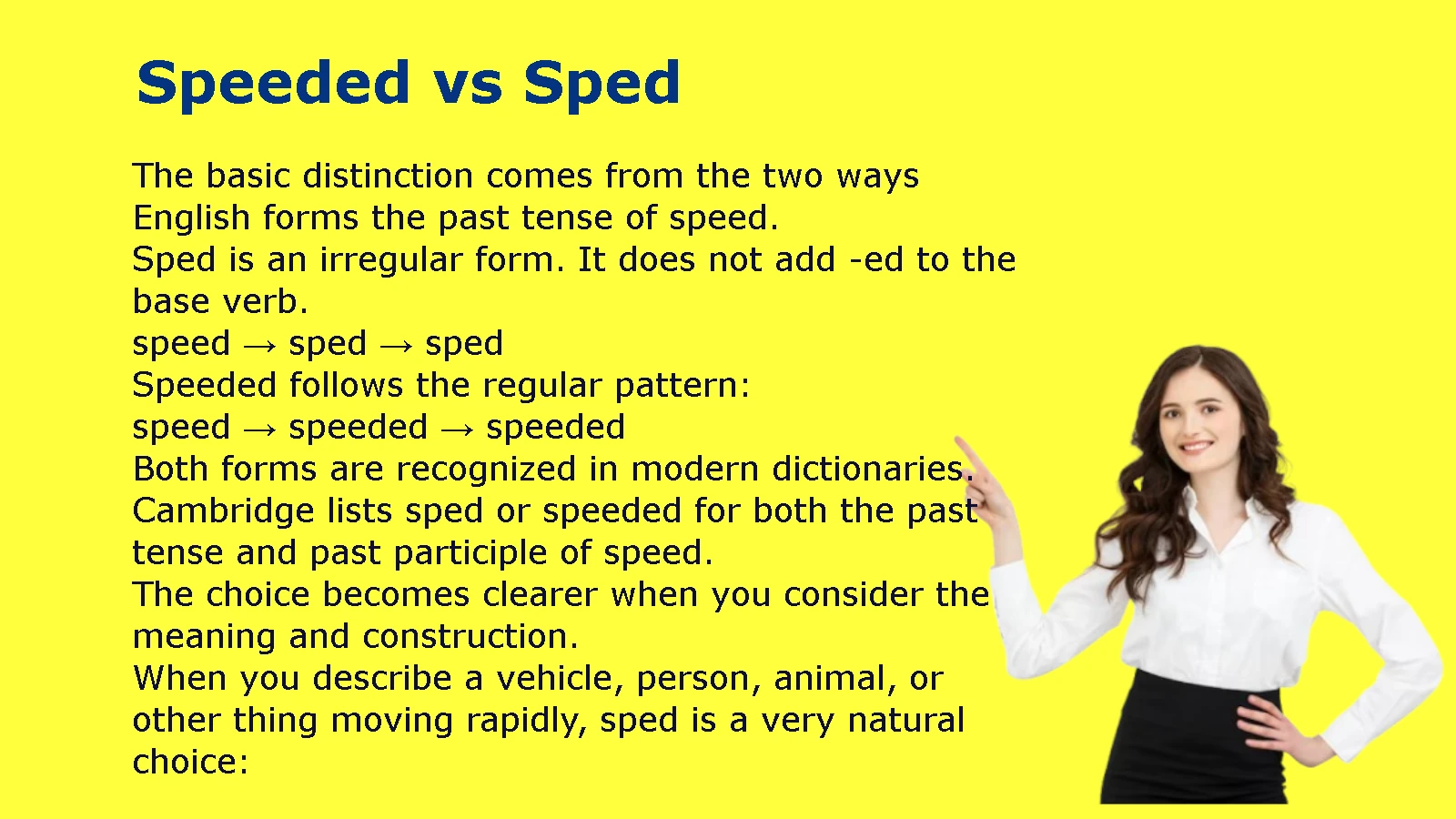
The basic distinction comes from the two ways English forms the past tense of speed.
Sped is an irregular form. It does not add -ed to the base verb.
speed → sped → sped
Speeded follows the regular pattern:
speed → speeded → speeded
Both forms are recognized in modern dictionaries. Cambridge lists sped or speeded for both the past tense and past participle of speed.
The choice becomes clearer when you consider the meaning and construction.
When you describe a vehicle, person, animal, or other thing moving rapidly, sped is a very natural choice:
The motorcycle sped down the road.
When you describe something causing a process to become faster, speeded can occur naturally:
The new software speeded the process.
However, the second sentence can also be expressed with sped up:
The new software sped up the process.
That is why a simple rule such as “always use sped” does not capture actual English usage.
Is “Sped” the Past Tense of Speed?
Yes. Sped is the past tense and past participle of speed.
Cambridge explicitly defines sped as the “past simple and past participle of speed.” Oxford gives the same basic grammatical information.
Sped as the Past Tense
Use sped when referring to an action that happened in the past.
- The car sped around the corner.
- The train sped through the tunnel.
- She sped home after receiving the message.
- The cyclist sped past the other riders.
- We sped down the highway before the storm arrived.
In these examples, sped describes rapid movement.
The construction is especially common with adverbs and prepositions such as away, down, along, past, off, and toward.
Sped as the Past Participle
Because sped also functions as a past participle, it can follow auxiliary verbs such as has, have, and had.
- The train has sped through several towns already.
- The car had sped away before anyone could identify it.
- She has sped through the assignment.
- The years have sped by.
Oxford lists sped as both the past tense and past participle of speed.
Is “Speeded” a Word?
Yes. Speeded is a real and grammatically recognized word.
It is not merely a typo for sped. Major dictionaries include it as a form of the verb speed. Cambridge gives sped or speeded as the past forms, while Oxford lists speeded as the regular past and past participle form and explains where sped is also used.
That distinction matters because writers sometimes assume that every verb must have only one accepted past form.
English does not always work that way.
Some verbs have competing forms because usage has developed along different grammatical paths. Speed is one example.
Examples of Speeded
- The new equipment speeded production.
- The treatment speeded his recovery.
- The changes speeded the process.
- The machine speeded the operation.
- The revised procedure speeded delivery.
Oxford includes a transitive sense of speed meaning to make something happen more quickly. It gives examples such as using speed to make recovery happen faster.
This meaning helps explain why speeded can appear naturally in sentences about processes, systems, and actions being made faster.
Speeded vs Sped Grammar
The grammar becomes easier when you look at the complete verb forms.
| Verb form | Form |
| Base form | speed |
| Third-person singular | speeds |
| Present participle | speeding |
| Past tense | sped / speeded |
| Past participle | sped / speeded |
Cambridge lists sped or speeded as the past tense and past participle, while Oxford gives speeded as the regular form and notes that sped is also used.
Present Tense
Use speed with I, you, we, and they:
- I speed through routine tasks.
- They speed along the highway.
Use speeds with third-person singular subjects:
- The car speeds down the road.
- The process speeds up after the update.
Present Participle
The -ing form is speeding:
- The car is speeding down the highway.
- Production is speeding up.
- Time seems to be speeding by.
The form speeding is also used as a noun in traffic contexts. For example, Cambridge defines speeding as driving faster than legally permitted.
Speeded vs Sped Examples
The easiest way to understand the distinction is to compare real sentence patterns.
Examples With Sped
Sped works naturally when something moves rapidly:
- The ambulance sped toward the hospital.
- The driver sped away from the intersection.
- The train sped through the countryside.
- The horse sped across the field.
- The cyclist sped past the finish line.
- We sped down the highway to avoid the traffic.
- The aircraft sped across the runway.
Cambridge uses similar constructions, including examples of trains, actresses, and people moving quickly.
Examples With Speeded
Speeded can be used when something causes an action or process to happen faster:
- The new system speeded production.
- The software speeded the calculation process.
- The changes speeded delivery.
- The treatment speeded recovery.
- The new procedure speeded the approval process.
In these sentences, the focus is not simply on an object moving rapidly. Instead, something is making another process faster.
Examples With Speeded Up
The phrase speeded up is especially useful:
- The update speeded up the computer.
- The new system speeded up production.
- The revised process speeded up delivery.
- The machine speeded up after maintenance.
- The tape speeded up toward the end.
Cambridge explicitly gives examples of speeded up, including “Can the job be speeded up in some way?” and an example involving a tape that became faster.
Speeded Up vs Sped Up
This is one of the most useful distinctions to understand.
Both speeded up and sped up are valid.
Sped up is particularly common in everyday English:
The car sped up when the light turned green.
Speeded up is also correct:
The new software speeded up the process.
Cambridge lists sped or speeded for the phrasal verb speed up. Its examples include both forms.
When to Use “Sped Up”
Use sped up naturally when something becomes faster or moves faster:
- The car sped up suddenly.
- The train sped up after leaving the station.
- The production line sped up during the afternoon.
- The economy sped up after the slowdown.
When to Use “Speeded Up”
Speeded up is also grammatical:
- The new equipment speeded up production.
- The software speeded up the process.
- The revised method speeded up the work.
- The technician speeded up the machine.
Cambridge Business English also provides examples of sped up and speed up in contexts involving production, delivery, and product development.
Speed vs Speeded vs Sped: Complete Verb Forms
A complete verb chart makes the pattern easier to remember.
| Tense/Form | Example |
| Present | I speed down the road. |
| Third-person present | She speeds down the road. |
| Present progressive | She is speeding down the road. |
| Past | She sped down the road. |
| Past alternative | She speeded the process. |
| Present perfect | She has sped through the work. |
| Past perfect | She had sped away. |
| Present perfect alternative | The changes have speeded the process. |
| Infinitive | to speed up |
| Gerund | speeding up |
One important point is that speeded does not replace sped in every sentence equally naturally. Oxford specifically distinguishes senses in which sped is used from its regular speeded form.
Common Sentences: Which Form Should You Use?
Consider these examples side by side.
| Sentence | Comment |
| The car sped down the road. | Natural for rapid movement |
| The car speeded down the road. | Grammatically possible, but less natural for many speakers |
| The car sped up. | Natural and common |
| The car speeded up. | Correct alternative |
| The software sped up the process. | Natural |
| The software speeded up the process. | Correct |
| The new system speeded production. | Correct |
| The new system sped production. | Possible in the sense of making something faster |
The key lesson is that meaning and construction matter more than a simple right/wrong rule.
For ordinary descriptions of rapid movement, sped is usually the straightforward choice.
For a construction meaning “made something faster,” both sped and speeded can occur, particularly with up.
Common Mistakes With Speeded and Sped
Assuming Speeded Is Always Wrong
This is the biggest mistake.
Because sped is so familiar, some writers assume speeded must be incorrect. Dictionaries do not support that conclusion. Cambridge explicitly lists both forms.
Assuming Sped Is the Only Correct Form
The opposite mistake is just as misleading.
Sped is unquestionably correct, but speeded is also an established form.
Confusing Sped With Speeding
These forms serve different grammatical roles:
- sped = past tense/past participle
- speeding = present participle/gerund
- speed = base form
- speeded = regular past/past participle form
For example:
The car sped away.
Not:
The car speeding away yesterday.
The second sentence would require a different grammatical construction, such as:
The car was speeding away.
Forgetting the “Up” Construction
Many questions about speeded vs sped are really questions about speeded up vs sped up.
Both are valid:
The process sped up.
The process speeded up.
Cambridge’s dictionary entry for speed up explicitly recognizes both forms.
Speeded vs Sped in Formal and Everyday English
Context can influence which form sounds most natural.
Everyday Conversation
Sped is a familiar choice when talking about rapid movement:
He sped home.
The car sped away.
The train sped past us.
This style is concise and natural.
Formal Writing
Formal writing can use either form when the grammar and meaning support it.
For example:
The revised procedure speeded the approval process.
Or:
The revised procedure sped up the approval process.
The second version is often easier for general readers because sped up is immediately familiar.
Academic and Professional Writing
In technical, business, or academic contexts, speeded can appear naturally when the subject causes a process to happen faster.
Examples include:
- The new algorithm speeded data processing.
- The revised workflow speeded up production.
- The automated system speeded the analysis.
- The updated procedure sped up delivery.
Oxford recognizes speed as a transitive verb meaning to make something happen more quickly, which supports this type of construction.
A Practical Guide to Choosing Speeded or Sped
When you’re unsure, ask what the sentence is actually describing.
If Something Moved Quickly
Choose sped in most ordinary sentences.
The car sped down the highway.
The runner sped toward the finish line.
If Something Became Faster
Either sped up or speeded up can work.
The machine sped up.
The machine speeded up.
If Something Made Another Process Faster
Both forms can occur, especially with up:
The update sped up the process.
The update speeded up the process.
The regular form speeded can also occur without up:
The update speeded the process.
If You Want the Most Familiar Everyday Form
For rapid movement, sped is usually the clearest choice.
For a process becoming faster, sped up is a very natural everyday construction.
That does not make speeded incorrect. It simply reflects ordinary usage patterns.
Speeded vs Sped: Examples in Different Contexts
Cars and Vehicles
The sports car sped down the highway.
The driver sped away when the light changed.
The vehicle sped up as the road became clear.
Trains and Aircraft
The train sped through the countryside.
The aircraft sped across the runway.
The train sped up after leaving the station.
Cambridge uses similar examples for speed, including a train moving rapidly and an actress speeding away in a waiting car.
Technology
The new processor sped up the application.
The updated software speeded up the calculations.
The optimization speeded the data-processing system.
Business and Production
Automation sped up production.
The new procedure speeded the approval process.
Better logistics speeded up deliveries.
These constructions show why speeded cannot simply be dismissed as an error.
People and Everyday Actions
She sped home after work.
He sped through the report.
They sped toward the station.
Here, sped is a natural way to describe rapid movement or action.
A Closer Look at the Meaning of “Speed”
The verb speed has several related uses.
It can describe moving quickly:
The car sped along the road.
It can describe causing someone or something to move quickly:
The ambulance sped the injured people away from the scene.
It can also mean making a process happen faster:
The changes sped the recovery process.
Cambridge defines the verb as meaning to move, go, or happen fast, or to cause something to do so.
This range of meanings explains why English can use both sped and speeded.
Case Study: Why “Speeded Up” Can Sound More Natural Than “Speeded”
Consider this sentence:
The company speeded the production process.
It is grammatical, but some readers may find the construction less familiar than:
The company sped up the production process.
The second sentence uses the common phrasal verb speed up.
Now compare:
The company sped the production process.
This can also be understood, but sped up clearly signals the intended meaning of making something faster.
That’s useful in practical writing. If your goal is maximum clarity for a broad audience, sped up is often an easy choice when the meaning is “made faster.”
Cambridge’s definition of speed up specifically covers both meanings: something happening or moving faster and someone or something causing it to happen or move faster.
Facts to Remember About Speeded vs Sped
Here are the key facts in one place:
- Sped is correct.
- Speeded is also correct.
- Sped is the past tense of speed.
- Sped is also a past participle.
- Speeded can function as both a past tense and past participle.
- Sped is particularly common when describing rapid movement.
- Speeded can be used when something makes a process faster.
- Sped up is correct.
- Speeded up is also correct.
- Dictionary sources recognize both forms.
- The most natural choice depends on the sentence, meaning, and context.
Speeded vs Sped: Quick Comparison
| Question | Answer |
| Is sped a word? | Yes |
| Is speeded a word? | Yes |
| Is sped the past tense of speed? | Yes |
| Is speeded a past form of speed? | Yes |
| Is sped up correct? | Yes |
| Is speeded up correct? | Yes |
| Is sped natural for rapid movement? | Yes |
| Is speeded always wrong? | No |
| Can speed be transitive? | Yes |
| Can speed mean “make faster”? | Yes |
FAQs About Speeded vs Sped
Is sped the past tense of speed?
Yes. Sped is the standard irregular past tense of speed. It is also used as the past participle. Cambridge and Oxford both identify sped as a past form of speed.
Is speeded grammatically correct?
Yes. Speeded is a recognized past tense and past participle of speed. It should not automatically be treated as an error.
Is speeded up correct English?
Yes. Speeded up is a correct form of the phrasal verb speed up. Cambridge explicitly lists sped or speeded for this construction.
Is sped up or speeded up correct?
Both are correct. The choice depends on the sentence and preferred usage. Cambridge recognizes both forms.
What is the past tense of speed?
The past tense can be sped or speeded. Sped is the irregular form, while speeded is the regular form.
What is the past participle of speed?
The past participle can be sped or speeded. For example:
The car has sped away.
The new system has speeded up production.
Both forms are recognized.
Can I say “the car speeded”?
The sentence is possible because speeded is a legitimate form of speed. However, “The car sped” is the more familiar choice for describing rapid movement.
Can I say “the process speeded up”?
Yes. “The process speeded up” is grammatically correct. “The process sped up” is also correct. Cambridge’s entry for speed up recognizes both forms.
Is sped more common than speeded?
Sped is particularly established in sentences describing rapid movement, such as “The train sped along the track.” However, speeded remains a recognized form and is used naturally in certain constructions, especially when discussing something being made faster.
What is the difference between speeded and sped?
Both are past forms of speed. Sped is the irregular form and is especially natural for rapid movement. Speeded is the regular form and can be used in contexts involving making something faster. Both also occur with speed up.
Final Takeaway: Speeded vs Sped
The answer to “speeded vs sped” is not simply that one is right and the other is wrong.
Sped is a standard past tense and past participle of speed, and it is especially natural when describing rapid movement:
The car sped down the road.
Speeded is also a legitimate form:
The new system speeded the process.
When you’re using the phrasal verb speed up, both forms are possible:
The process sped up.
The process speeded up.
For everyday writing, sped is often the simplest choice when something moved quickly. When you’re talking about making a process faster, sped up is a particularly natural construction, while speeded remains grammatically valid.
The safest approach is therefore to look at the meaning and sentence structure, rather than treating speeded as a spelling mistake. Major dictionary sources support both forms, with usage varying by sense and construction.