Omitted vs Ommited is a common spelling question that comes up when describing something that has been left out, excluded, or not included. If you’ve come across these two spellings and wondered “omitted or ommited?”, the confusion usually comes from the word’s double consonant pattern and the way its pronunciation sounds.
The correct spelling is omitted, with two t’s and one m. Ommited is a misspelling and is not the standard English spelling. The word omitted is the past tense and past participle of omit, meaning to leave something out, fail to include something, or intentionally exclude it. Related terms such as omit, omission, left out, excluded, skipped, and overlooked can have similar meanings but are used in different grammatical contexts.
In this guide, you’ll learn which spelling is correct, why “omitted” is spelled with one m and two t’s, what “omitted” means, how to use it in sentences, and how “omitted” differs from related words such as “omission” and “excluded.” You’ll also see clear examples to help you remember the correct spelling.
By the end, you’ll know exactly whether to use omitted or ommited and how to use omitted naturally and correctly in your writing.
Omitted vs Ommited: What Is the Difference?
There is no difference in meaning between omitted and ommited because ommited is not the standard spelling of the word.
When you want to say that something was left out, use omitted.
For example:
- The editor omitted the final paragraph.
- Her name was omitted from the list.
- Several important details were omitted from the report.
- The recipe omitted an important ingredient.
- The quotation was omitted from the final version.
Writing ommited in these sentences would be a spelling error.
Omitted Is the Correct Spelling
Omitted has six letters:
o-m-i-t-t-e-d
The spelling comes from the verb omit.
Cambridge identifies omitted as both the past simple and past participle form of omit.
The basic pattern is:
omit → omitted
For example:
The author omitted several details from the original draft.
Here, omitted tells us that the author left out several details.
Ommited Is Incorrect
Ommited is a misspelling of omitted.
The mistake is understandable because English has many words in which consonants are doubled when endings are added. A writer may incorrectly assume that the m in omit should be doubled before adding -ed.
That produces:
omit → ommited ✗
But the correct form is:
omit → omitted ✓
The spelling changes at the end of the word rather than by adding another m after the first letter.
What Does Omitted Mean?
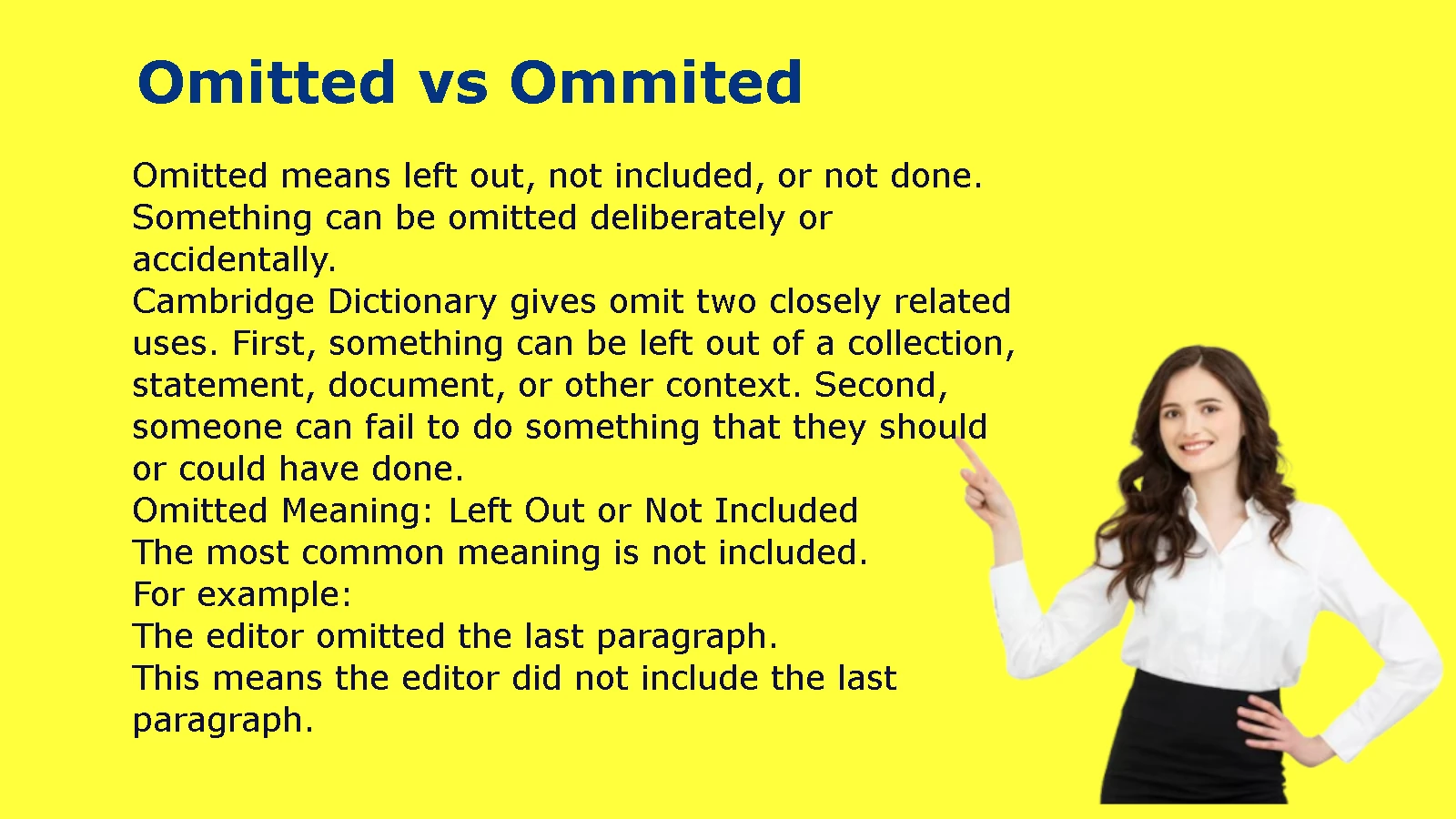
Omitted means left out, not included, or not done.
Something can be omitted deliberately or accidentally.
Cambridge Dictionary gives omit two closely related uses. First, something can be left out of a collection, statement, document, or other context. Second, someone can fail to do something that they should or could have done.
Omitted Meaning: Left Out or Not Included
The most common meaning is not included.
For example:
The editor omitted the last paragraph.
This means the editor did not include the last paragraph.
Another example:
Several names were omitted from the guest list.
The names were not included on the list.
The omission could be accidental or intentional. The word omitted itself does not always tell us why something was left out.
Compare:
- The editor accidentally omitted the reference.
- The editor deliberately omitted the reference.
Both sentences use omitted correctly. The surrounding words explain the reason.
Omitted Meaning: Failed to Do Something
Omit can also mean failing to perform an action.
For example:
She omitted to mention that the meeting had been canceled.
This construction is formal and is more characteristic of British English. Cambridge specifically records omit to do something as a formal construction.
In everyday American English, writers will often choose a more direct construction:
She failed to mention that the meeting had been canceled.
Why Is Omitted Spelled With Two M’s?
This is where much of the confusion comes from.
The correct spelling is omitted, which contains two consecutive m’s? No. It contains only one m.
Look carefully:
o m i t t e d
There is one m and two t’s.
That distinction is important.
The incorrect spelling is:
o m m i t e d
Here, the writer puts two m’s together and only one t.
So the easiest way to remember the spelling is:
OMIT + TED = OMITTED
The final consonant t is doubled.
Omit → Omitted
The word forms make the pattern clearer:
| Word form | Spelling |
| Base verb | omit |
| Third-person singular | omits |
| Past tense | omitted |
| Past participle | omitted |
| Present participle | omitting |
| Noun | omission |
The important forms to remember are:
omit → omitted → omitting
not:
omit → ommited → omm iting
Cambridge likewise lists omitting as the present participle and omitted as the past tense and past participle.
Omitted Examples in Sentences
Seeing the word in different contexts makes its meaning much easier to understand.
Omitted Information
The report omitted several important pieces of information.
The information was not included in the report.
Omitted Name
His name was accidentally omitted from the list.
The passive construction emphasizes the name rather than the person who left it out.
Omitted Details
The summary omitted several details from the original article.
The summary did not include those details, probably because it was shorter.
Omitted Paragraph
The editor omitted the final paragraph before publication.
The editor removed or left out the paragraph from the published version.
Omitted Ingredient
The recipe can be prepared with the ingredient omitted.
Here, omitted means the ingredient can be left out.
Omitted Step
The instructions omitted an important step in the installation process.
The instructions failed to include that step.
Omitted Data
The researchers omitted incomplete records from the analysis.
In this context, omitted means the records were not included in the analysis.
Omitted Reference
One of the references was omitted from the bibliography.
The reference should have appeared in the bibliography but did not.
Omitted From or Omitted In: Which Is Correct?
Both omitted from and omitted in can be grammatical, but they are used differently.
Omitted From
Omitted from is used when something or someone is left out of a larger group, list, document, collection, or other whole.
Examples:
Her name was omitted from the list.
The paragraph was omitted from the final report.
Several contributors were omitted from the credits.
The ingredient was omitted from the recipe.
Cambridge specifically gives examples of someone being omitted from a list and of something being omitted from a production or other context.
A useful pattern is:
someone/something + is/was + omitted from + larger whole
Omitted In
Omitted in can be used when the focus is on the particular document, version, discussion, process, or context in which something was not included.
For example:
The error was omitted in the revised version.
Several details were omitted in the final draft.
However, when you are specifically describing something being excluded from a list, document, or collection, omitted from is often the clearer choice.
Compare:
Her name was omitted from the list.
This clearly identifies the list as the place from which the name was excluded.
Omitted Synonyms and Related Words
Several words can replace omitted, but they are not identical in every context.
| Synonym | General meaning | Example |
| left out | Not included | The editor left out the final paragraph. |
| excluded | Deliberately kept out or not included | The data was excluded from the study. |
| skipped | Passed over or not dealt with | He skipped the final question. |
| removed | Taken away | The editor removed the paragraph. |
| deleted | Erased from a digital or written text | She deleted the sentence. |
| disregarded | Not considered | The warning was disregarded. |
| neglected | Failed to give proper attention | He neglected to mention the problem. |
Omitted vs Left Out
Left out is usually more conversational.
The editor left out the final paragraph.
Omitted sounds more formal.
The editor omitted the final paragraph.
The meaning is similar, but the tone differs.
Omitted vs Excluded
Excluded often emphasizes a decision not to include something.
The researchers excluded participants who did not meet the criteria.
Omitted can describe either intentional or accidental non-inclusion.
The researcher omitted one participant’s name from the list.
The context determines whether the omission was deliberate.
Omitted vs Deleted
Deleted suggests that something was actively removed from a file, document, database, or other existing material.
She deleted the sentence.
Omitted can simply mean that the material was not included in the first place.
The summary omitted the sentence.
That distinction can matter in technical, editorial, and professional writing.
Omitted vs Emitted
Both are different words with completely different meanings.
Omitted
It means left out or not included.
The editor omitted the final sentence.
Emitted
Emitted is the past tense and past participle of emit. It means released, produced, or sent out.
For example:
The device emitted a high-pitched sound.
The lamp emitted a soft glow.
The factory emitted large amounts of pollution.
The easiest way to remember the difference is:
- omit = leave out
- emit = send out
So:
The editor omitted the sentence.
means the sentence was left out.
But:
The machine emitted a sound.
means the machine produced or released the sound.
Omitted vs Emitted at a Glance
| Word | Meaning | Example |
| omitted | Left out | The editor omitted the paragraph. |
| emitted | Released or produced | The machine emitted smoke. |
This is a meaning difference, not merely a spelling difference.
Common Mistakes With Omitted
Writing Ommited Instead of Omitted
Incorrect:
The final paragraph was ommited.
Correct:
The final paragraph was omitted.
Remember:
omitted = o-m-i-t-t-e-d
Confusing Omitted With Emitted
Incorrect:
The editor emitted the final paragraph.
If you mean that the editor left the paragraph out, use:
The editor omitted the final paragraph.
Confusing Omitted From With Omitted In
When talking about exclusion from a list or collection, omitted from is often the natural construction.
Her name was omitted from the list.
Not:
Her name was omitted in the list.
The second sentence may be understandable in some contexts, but from clearly expresses the relationship between the omitted item and the larger group.
Using Deleted When Omitted Is More Accurate
Consider these two sentences:
The writer deleted the paragraph.
The writer omitted the paragraph.
The first suggests that the paragraph existed in the document and was actively removed. The second simply says that the paragraph was not included.
That difference can be useful when describing editing or publication processes.
Is Omitted Formal or Professional?
Yes. Omitted is a standard English word that works well in formal, academic, professional, technical, and everyday writing.
It is especially common when discussing documents, reports, lists, research, instructions, records, and information.
Omitted in Academic Writing
The authors omitted several variables from the final analysis.
For clarity, some technical details have been omitted.
The word is particularly useful when explaining why certain information does not appear in an academic text.
Omitted in Business Writing
The invoice number was accidentally omitted from the document.
Several items were omitted from the original proposal.
These sentences are concise and professional.
Omitted in Legal or Official Writing
Certain identifying details have been omitted from the published record.
This construction is common when information is intentionally withheld or not reproduced.
Omitted in Everyday English
The word is not restricted to formal writing.
I think you omitted one important detail.
You omitted my name from the invitation.
However, in casual conversation, left out may sound more natural:
I think you left out one important detail.
Omitted Grammar: Word Forms of Omit
Understanding the complete word family helps prevent spelling mistakes.
| Form | Function | Example |
| omit | Base verb | Please omit unnecessary details. |
| omits | Third-person singular present | The report omits several facts. |
| omitted | Past tense/past participle | The editor omitted the paragraph. |
| omitting | Present participle/gerund | She is omitting unnecessary details. |
| omission | Noun | The omission was accidental. |
Cambridge confirms that omitted is the past simple and past participle of omit, while omitting is its present participle.
Omit
Use omit when referring to the base verb.
Please omit the unnecessary section.
Omits
Use omits with a singular third-person subject in the present tense.
The summary omits several important details.
Omitted
Use omitted for the past tense or past participle.
The author omitted several examples.
Several examples were omitted from the article.
Omitting
Use omitting for the present participle or gerund.
By omitting the unnecessary details, the writer made the report shorter.
Omission
Omission is the noun form.
The omission of the final paragraph caused confusion.
Cambridge defines omission as the act of not including someone or something that should have been included, or the thing that was not included.
Omitted vs Omission
Although omitted and omission come from the same word family, they perform different grammatical jobs.
Omitted is generally a verb form or participial adjective.
The editor omitted the paragraph.
The paragraph was omitted.
Omission is a noun.
The omission of the paragraph was intentional.
A simple way to remember the distinction is:
- omit = the action
- omitted = the action in past/passive form
- omission = the act or result of leaving something out
Compare:
The editor omitted the reference.
The omission of the reference was noticed immediately.
The first sentence focuses on the action. The second focuses on the fact that something was left out.
Omitted vs Ommited: Examples at a Glance
The following examples show the most common spelling mistakes and their corrections.
| Incorrect | Correct |
| The name was ommited. | The name was omitted. |
| She ommited an important detail. | She omitted an important detail. |
| The paragraph was ommited from the article. | The paragraph was omitted from the article. |
| Several items were ommited from the list. | Several items were omitted from the list. |
| The report ommited key information. | The report omitted key information. |
| The reference was accidentally ommited. | The reference was accidentally omitted. |
The pattern is consistent: whenever you mean left out, use omitted.
How to Remember the Correct Spelling
The simplest memory trick is to start with the base word:
OMIT
Then add the correct ending:
OMIT + TED = OMITTED
Look at the final letters:
omit → omitted
The important point is that the consonant being doubled is t, not m.
A Quick Visual Trick
Break the correct word into parts:
OM + IT + TED
The end is:
TTED
not:
MTED
So:
OMITTED ✓
not:
OMMITED ✗
and certainly not:
OMMITTED ✗
A second useful memory connection is the related form omitting:
omit → omitted → omitting
Both omitted and omitting preserve the single m from omit and double the final t.
Case Study: Why the Spelling Error Is Easy to Make
Imagine a student writing this sentence:
The editor ommited three references from the article.
The student knows the word comes from omit, but may incorrectly apply a consonant-doubling pattern to the m:
omit → ommit…
The correct spelling does something different:
omit → omitted
The t is doubled before the -ed ending.
Correct:
The editor omitted three references from the article.
This small spelling distinction is important because spell-checking software may catch ommited, but writers should still know why the correct form looks the way it does. Understanding the word family makes the correct spelling easier to reproduce without relying entirely on automated correction.
When Should You Use Omitted?
Use omitted when something has been left out, whether the omission was intentional or accidental.
Common contexts include:
- Omitted information
- Omitted names
- Omitted details
- Omitted sections
- Omitted paragraphs
- Omitted references
- Omitted data
- Omitted ingredients
- Omitted steps
- Omitted words
- Omitted records
- Omitted charges
For example:
The editor omitted unnecessary repetition.
The applicant’s middle name was omitted from the form.
Several observations were omitted from the final dataset.
The instructions omitted an important safety step.
In each case, something that could have appeared or been done was left out.
Is Omitted Always Intentional?
No.
Omitted does not by itself tell you whether the omission was deliberate.
Consider:
The editor accidentally omitted the final paragraph.
The word accidentally tells us that the omission was unintended.
Now consider:
The editor deliberately omitted the final paragraph.
Here, deliberately tells us that the omission was intentional.
Without those modifiers:
The editor omitted the final paragraph.
We know only that the paragraph was not included.
This distinction matters because omission and intention are separate ideas.
Omitted in Passive Sentences
Omitted is especially common in passive constructions.
For example:
Her name was omitted from the report.
Several details were omitted from the summary.
The final section was omitted from the published edition.
The passive structure is useful when the thing that was left out is more important than the person responsible for leaving it out.
The general pattern is:
subject + was/were + omitted + from + context
For example:
Several names were omitted from the list.
This construction is natural and widely useful in formal writing. Cambridge provides be omitted from something as an established usage.
Omitted in Technical and Academic Contexts
The word is particularly useful when discussing information that has been intentionally excluded for reasons of space, relevance, methodology, or clarity.
For example:
To keep the discussion concise, several secondary examples were omitted.
A research paper might say:
Participants with incomplete records were omitted from the final analysis.
A technical document might say:
Optional parameters may be omitted from the command.
In these contexts, omitted does not necessarily imply an error. Something may be intentionally left out because it is unnecessary, irrelevant, repetitive, or outside the scope of the discussion.
Cambridge’s corpus examples include technical and academic uses such as information, parameters, proofs, scores, and observations being omitted.
Common Collocations With Omitted
A collocation is a combination of words that commonly appear together.
Knowing common combinations can help you use omitted naturally.
Some useful examples include:
- omitted from the list
- omitted from the report
- omitted from the article
- omitted from the final version
- accidentally omitted
- deliberately omitted
- intentionally omitted
- completely omitted
- partially omitted
- previously omitted
- information omitted
- details omitted
- names omitted
- references omitted
Examples:
Her name was accidentally omitted from the list.
Some details were deliberately omitted from the report.
The final paragraph was completely omitted from the published version.
These combinations are useful in academic, professional, editorial, and everyday writing.
Omitted vs Ommited: A Simple Rule
If you only remember one thing from this article, remember this:
The correct spelling is OMITTED, not OMMITED.
Think:
OMIT → OMITTED
The final t is doubled.
| Question | Answer |
| Is omitted correct? | Yes |
| Is ommited correct? | No |
| What does omitted mean? | Left out or not included |
| What is the base verb? | omit |
| What is the present participle? | omitting |
| What is the noun? | omission |
| What is the opposite idea? | Including or adding |
| Is omitted formal English? | Yes |
| Is omitted the past tense of omit? | Yes |
| Is omitted the past participle of omit? | Yes |
Frequently Asked Questions About Omitted vs Ommited
Is omitted or ommited correct?
Omitted is correct. Ommited is a misspelling.
The correct spelling is omitted.
Why is ommited incorrect?
The spelling ommited incorrectly places two m’s together and fails to double the final t.
The correct form is:
omit → omitted
Therefore:
omitted ✓
ommited ✗
What does omitted mean?
Omitted means left out, not included, or not done.
For example:
The editor omitted several unnecessary details.
This means the editor left those details out.
Is omitted a past tense?
Yes. Omitted is the past tense and past participle of omit.
For example:
She omitted the final paragraph.
As a past participle:
The final paragraph was omitted.
What is the noun form of omitted?
The related noun is omission.
The omission of the reference was accidental.
Omission refers to the act or result of leaving something out.
What is another word for omitted?
Depending on the context, alternatives include:
- left out
- excluded
- skipped
- removed
- deleted
- disregarded
They are not always exact substitutes, so choose the word that best describes what happened.
Is omitted formal English?
Yes. Omitted is standard English and is appropriate in formal, academic, professional, technical, and everyday writing.
Is it omitted from or omitted in?
Both constructions can occur, but omitted from is especially natural when something is left out of a list, document, group, collection, or other larger whole.
Her name was omitted from the list.
What is the difference between omitted and emitted?
Omitted means left out.
Emitted means released, produced, or sent out.
The editor omitted the paragraph.
The machine emitted a loud noise.
What is the difference between omitted and omission?
Omitted is a verb form or participial form.
The writer omitted the reference.
Omission is a noun.
The omission of the reference was noticed.
How do you spell omitted?
The correct spelling is:
O-M-I-T-T-E-D
A useful memory aid is:
omit + ted = omitted
Conclusion: Omitted vs Ommited
When choosing between omitted and ommited, the answer is straightforward: omitted is the correct spelling.
The word comes from the verb omit, which means to leave something out, fail to include something, or fail to do something. Its past tense and past participle are both omitted.
The spelling is:
omit → omitted
not:
omit → ommited
The most important spelling point is that omitted has one m and two t’s:
o-m-i-t-t-e-d
The related forms are also worth remembering:
- omit — base verb
- omits — present-tense form
- omitted — past tense and past participle
- omitting — present participle
- omission — noun
Use omitted when something has been left out, whether intentionally or accidentally. Use emitted when something has been released or produced. And when describing something that was left out of a list, report, document, or collection, omitted from is a particularly useful construction.
So if you are proofreading a sentence and see ommited, replace it with omitted.
Omitted ✓
Ommited ✗
That is the spelling to remember.