Targeting vs Targetting is a common spelling question, especially because many English words double their final consonant before adding a suffix. If you’ve come across “targeting” and “targetting” and wondered which spelling is correct, the answer is straightforward: targeting is the correct standard spelling, while targetting is generally considered a misspelling.
The difference between targeting vs targetting comes from how the verb target changes when the -ing suffix is added. The correct form is targeting, with only one t after the “e” is removed. You’ll commonly see it in contexts such as targeting customers, targeting an audience, targeting specific goals, digital advertising, marketing campaigns, and military strategy. The incorrect form targetting adds an unnecessary second “t.”
In this guide, you’ll learn whether “targeting” or “targetting” is correct, why the spelling is targeting, how to use it in sentences, and what spelling rule explains the difference. You’ll also see clear examples, common mistakes, and related forms such as target, targeted, targets, and targetable.
By the end, you’ll know exactly which spelling to use and why “targeting” is correct, so you can write the word naturally and confidently in formal, academic, professional, and everyday English.
Targeting vs Targetting at a Glance
The simplest answer is:
| Spelling | Status | Recommended use |
| targeting | Standard and widely used | Use this form |
| targetting | Variant recorded by some dictionaries | Use only when following a source or regional convention that specifically uses it |
| targeted | Standard past tense and past participle | Use this form |
| targetted | Variant recorded by some dictionaries | Generally avoid in standard US English |
Cambridge identifies targeting as the present participle of target.
Collins, meanwhile, records targeting or targetting as present-participle forms and targeted or targetted as past forms in its broader British-English entry.
That distinction matters because the question is not simply whether one spelling has ever appeared in English. A better question is which spelling is standard and appropriate for the type of English you are writing.
For American English, targeting is the clear practical choice.
The quick rule
If you’re writing an email, article, report, essay, website, resume, or business document for a general American-English audience, write:
The company is targeting new customers.
Not:
The company is targetting new customers.
Is Targeting or Targetting Correct?
Targeting Is the Standard Spelling
Targeting is formed from the verb target plus the suffix -ing.
The basic formation is:
target + ing = targeting
Cambridge lists targeting specifically as the present participle of target.
The word can function as part of a verb phrase:
The company is targeting younger customers.
It can also function as a noun:
Targeting the right audience requires research.
In addition, participles can sometimes work adjectivally:
The company developed a new targeting strategy.
The exact grammatical role depends on how the word is used in the sentence.
Targetting Is a Recorded Variant
Calling targetting simply “not a word” would be too absolute.
Collins records both targeting and targetting as present-participle forms of target.
That does not mean the two spellings are equally common or equally appropriate in every variety of English.
For readers using American English, targeting is the safer and more familiar spelling. It is also the form provided by Cambridge’s English Dictionary.
Therefore, if you’re deciding between the two forms for ordinary modern writing, the practical answer is:
Choose targeting.
Why Is Targeting Spelled With One T?
The confusion comes from a common English spelling pattern.
Some short verbs double their final consonant before -ing. For example:
- run → running
- sit → sitting
- stop → stopping
- plan → planning
Seeing these words can make targetting look logical.
But English spelling doesn’t use one universal “double the last letter” rule. Whether a consonant doubles depends on the spelling and pronunciation pattern of the base word.
The word target does not follow the same pattern as run, sit, or stop in standard spelling.
So:
- target → targeting
- not target → targetting
The safest approach is not to create the form from memory by analogy with another verb. Check the established spelling of the inflected form when there is uncertainty.
Target + -ing
The spelling can be viewed simply as:
| Base word | Suffix | Result |
| target | -ing | targeting |
The final t in target remains part of the word, but another t is not required in the standard spelling.
That gives us:
target + ing → targeting
rather than:
target + ting → targetting
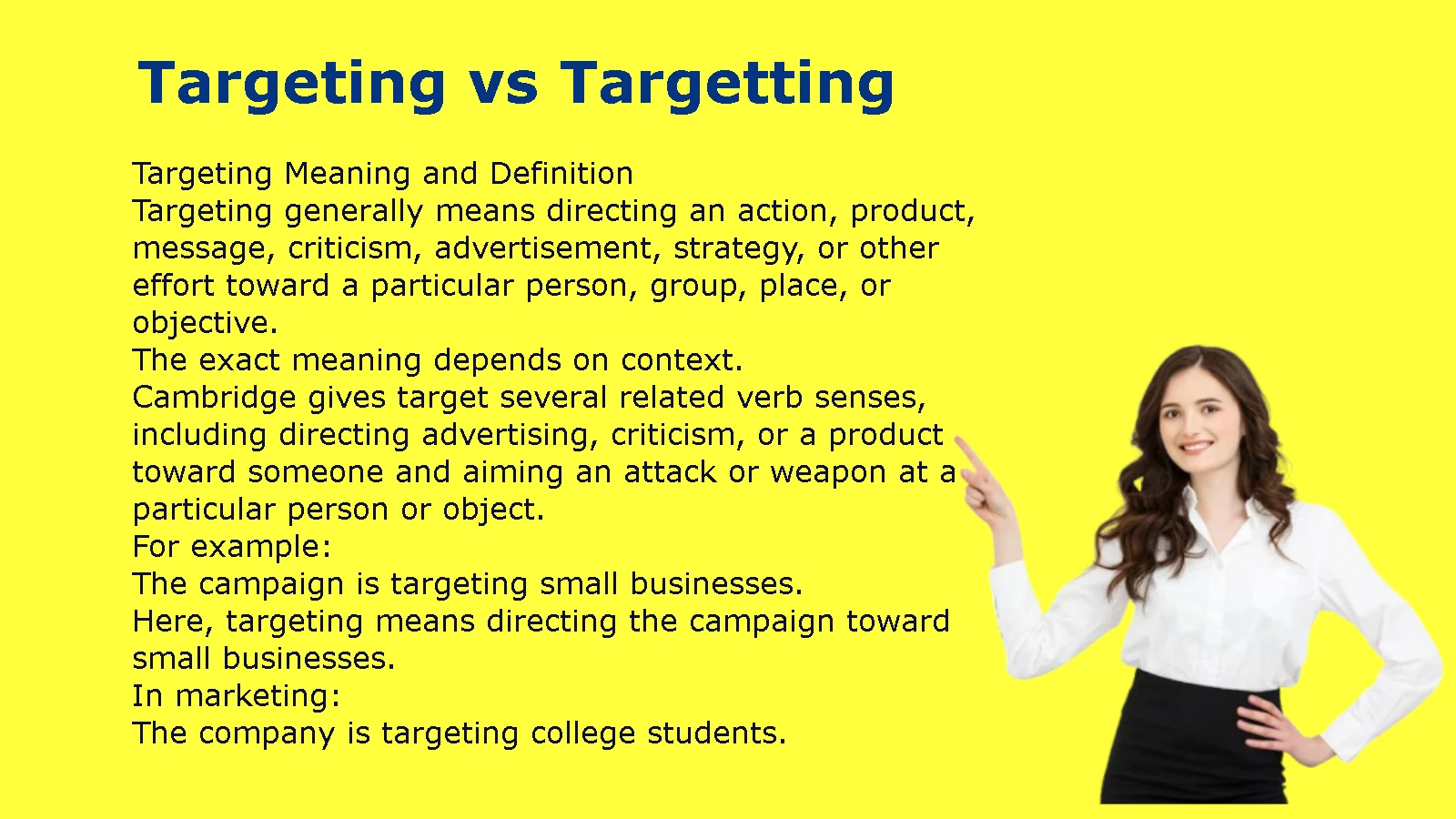
Targeting Meaning and Definition
Targeting generally means directing an action, product, message, criticism, advertisement, strategy, or other effort toward a particular person, group, place, or objective.
The exact meaning depends on context.
Cambridge gives target several related verb senses, including directing advertising, criticism, or a product toward someone and aiming an attack or weapon at a particular person or object.
For example:
The campaign is targeting small businesses.
Here, targeting means directing the campaign toward small businesses.
In marketing:
The company is targeting college students.
The company is focusing its marketing efforts on that particular group.
In a broader sense:
The program is targeting areas with high unemployment.
The program is being directed toward a particular set of locations.
The word does not necessarily imply something negative. Targeting can describe advertising, research, education, healthcare, policy, sports, technology, or many other activities.
Common meanings of targeting
Depending on the context, targeting can refer to:
- directing advertising toward a particular audience
- focusing a product on a particular market
- directing criticism toward someone or something
- aiming an attack at a particular target
- focusing a research project on a specific issue
- designing a treatment for a particular biological process
- pursuing a specific sales or performance objective
Collins similarly defines targeting in contexts involving attacks, appealing to a group, influencing people, and directing strategies toward a particular group.
Targeting Examples in Sentences
Understanding the word in context makes the spelling easier to remember.
Everyday Examples
The store is targeting customers who prefer affordable products.
The campaign is targeting local residents.
The teacher is targeting the areas where students need the most help.
The new service is targeting busy professionals.
The advertisement is targeting a younger audience.
Business and Marketing Examples
Marketing is one of the most common contexts for targeting.
The company is targeting customers in major cities.
The brand is targeting a specific age group.
The marketing team is targeting people who have already visited the website.
The campaign focuses on targeting customers with specific interests.
Cambridge uses targeting in examples involving advertising and particular groups, while its definition of target includes directing an action, advertisement, or product toward a person or group.
Academic and Professional Examples
The word also appears naturally in technical and academic contexts:
The study examines methods for targeting specific types of cells.
The program focuses on targeting areas with limited access to services.
Researchers are developing new approaches for targeting specific biological processes.
Cambridge’s corpus examples show targeting used in scientific and academic contexts, including research aimed at particular diseases, cells, and biological processes.
Military and Security Examples
In military contexts, targeting can refer to identifying or directing an attack toward a particular location, object, or person.
The report examined the process of targeting military installations.
The context is important because targeting can describe very different activities. A marketing team can target customers, while a military operation can target a physical location.
The spelling remains the same.
Targeting vs Targetted vs Targeted
Another common spelling problem involves the past-tense form.
The standard form is:
targeted
For example:
The campaign targeted young adults.
Not:
The campaign targetted young adults.
Cambridge lists targeted as the relevant form and defines it as something directed at a particular person or thing.
Collins also records targeted and targetted as variants in its broader entry.
For standard American English, however, targeted is the form to use.
Targeting vs Targeted
The two forms are not interchangeable because they serve different grammatical purposes.
| Form | Function | Example |
| target | Base verb | We target new customers. |
| targeting | Present participle/gerund | We are targeting new customers. |
| targeted | Past tense/past participle | We targeted new customers last year. |
| target | Noun | The customer is our target. |
Consider these examples:
The company is targeting younger customers.
The action is ongoing or being described as an activity.
The company targeted younger customers last year.
The action is presented as completed in the past.
The company created a targeted advertising campaign.
Here, targeted functions as an adjective describing the campaign.
Cambridge specifically recognizes targeted as an adjective meaning directed at a particular person or thing.
Targeting vs Targetting in American and British English
This is where the comparison becomes more interesting.
It would be misleading to claim that targetting never occurs in British English. Collins records it as a variant.
At the same time, targeting is unquestionably an established English form and is the form Cambridge presents as the present participle of target.
Therefore, the distinction is better expressed like this:
| Form | American English | British English |
| targeting | Standard | Standard and widely used |
| targetting | Uncommon; generally avoid | Recorded as a variant by Collins |
| targeted | Standard | Standard and widely used |
| targetted | Generally avoid | Recorded as a variant by Collins |
If your website follows US English, consistently use targeting and targeted.
If you’re reproducing or analyzing a British source that uses targetting, the spelling may reflect that source’s variant rather than being a random typographical error.
Does British English use targetting?
Targetting does appear in some British-English dictionary records, but targeting is also standard British usage.
This is an important distinction because English spelling isn’t always divided into a neat American-versus-British pair.
Some words have clear regional differences:
- color / colour
- center / centre
- organize / organise
The situation with targeting / targetting is less straightforward. The doubled-T spelling is recorded as a variant, rather than being the universally required British spelling. Collins explicitly gives both forms.
So don’t write:
British English always uses targetting.
That claim is too broad.
Instead, say:
Targetting is a variant recorded in some British-English dictionaries, while targeting is the standard form widely used in both American and British English.
Common Mistakes With Targeting
Several errors tend to appear around this word.
Writing Targetting Instead of Targeting
This is the central spelling confusion.
❌ targetting
✅ targeting
For general US-English writing, choose targeting.
Writing Targetted Instead of Targeted
The same doubling instinct appears in the past-tense form.
❌ targetted
✅ targeted
Although Collins records targetted as a variant, targeted is the standard form you should normally use in American English.
Confusing Targeting and Targeted
These forms have different grammatical roles.
The company is targeting new customers.
The company targeted new customers last year.
The first describes an ongoing action or activity. The second describes a completed past action.
Adding an Extra T Automatically
The biggest underlying problem is assuming that every word ending in a consonant must double that consonant before -ing.
English doesn’t work that way.
Compare:
- run → running
- sit → sitting
- stop → stopping
- target → targeting
The spelling of each word must be learned according to the applicable spelling pattern and established usage.
Targeting vs Targetting: Examples Side by Side
A comparison table can make the distinction easier to remember.
| Preferred form | Variant/less common form | Example |
| targeting | targetting | The company is targeting new customers. |
| targeting | targetting | The campaign is targeting young adults. |
| targeted | targetted | The company targeted a new market. |
| targeted | targetted | The advertisement was targeted at homeowners. |
For a US-English article, report, or website, use the preferred forms consistently:
targeting
targeted
The variants may appear in dictionaries or source material, but that doesn’t mean they are the best choices for your own writing.
How to Remember the Spelling of Targeting
A simple memory trick is to start with the base word:
TARGET + ING = TARGETING
Don’t insert another t.
You can also remember the pair together:
target → targeting → targeted
This gives you the three forms you are most likely to need.
| Base | -ing form | Past form |
| target | targeting | targeted |
Another useful technique is to associate the spelling with familiar phrases:
- targeted advertising
- targeted audience
- targeting customers
- targeting keywords
- targeting a market
- targeting specific users
Once you see targeting repeatedly in normal professional writing, the one-T form becomes easier to recognize.
Targeting vs Targetting in Professional Writing
For professional writing, consistency matters more than trying to reproduce every variant found in dictionaries.
If you’re writing a business proposal, academic paper, marketing report, resume, website, or email for a US audience, use:
targeting
For example:
Our marketing strategy focuses on targeting customers who have demonstrated an interest in outdoor products.
You could also simplify the sentence:
Our marketing strategy focuses on customers interested in outdoor products.
The second version is more concise, but if targeting is the appropriate term, its spelling should be targeting.
Targeting in formal writing
The word is completely appropriate in formal contexts when its meaning fits.
Examples include:
- targeting a specific audience
- targeting potential customers
- targeting specific keywords
- targeting particular outcomes
- targeting a disease pathway
- targeting high-priority areas
Cambridge’s examples demonstrate that the word is used across advertising, research, medicine, and other professional contexts.
A proofreading trick
When proofreading, search your document for:
targett
If you’re writing standard US English, this can quickly identify both:
- targetting
- targetted
Then replace them with:
- targeting
- targeted
This is especially useful in long documents because the extra t can be easy to miss during ordinary proofreading.
Targeting vs Targetting: Quick Grammar Guide
Here is the complete word family in a practical format:
| Word | Part of speech | Example |
| target | noun | The target is clearly defined. |
| target | verb | We target a specific audience. |
| targets | verb/noun plural | The campaign targets new customers. |
| targeting | present participle/gerund | We are targeting new customers. |
| targeted | past tense/past participle/adjective | The campaign targeted new customers. |
| targeting | noun in some contexts | Audience targeting can improve relevance. |
Cambridge identifies targeting as the present participle of target.
Collins defines target as both a noun and verb and records its related forms, including targeting, targetted, targeted, and the variant targetting.
Target as a noun
A target can be an object being aimed at:
The arrow hit the target.
It can also mean a desired result:
The company exceeded its sales target.
Cambridge gives both the physical-object sense and the intended-result sense of target.
Target as a verb
As a verb, target means to direct something toward a particular person, group, object, or goal.
The campaign targets small businesses.
The advertisement targets younger consumers.
The program targets areas with limited resources.
That verb produces the form targeting when used with -ing.
A Simple Case Study: Choosing the Correct Form
Imagine you’re writing a marketing report.
Your first draft contains:
Our company is targetting customers between 25 and 40.
The spelling looks plausible because words such as running and stopping double their final consonants.
However, for standard US English, change it to:
Our company is targeting customers between 25 and 40.
Now consider a past-tense sentence:
Last year, the company targetted customers between 25 and 40.
The same issue appears again.
The standard US-English version is:
Last year, the company targeted customers between 25 and 40.
Finally, consider an adjective:
We created a targetted advertising campaign.
The preferred form is:
We created a targeted advertising campaign.
Cambridge uses targeted advertising as an example of the adjective’s established use.
The pattern becomes easy:
target → targeting → targeted
Why Dictionaries May Show Both Targeting and Targetting
Readers sometimes become confused when a dictionary lists a spelling they were taught was “wrong.”
The key is that dictionaries document usage. They don’t necessarily declare that every listed variant is equally common, preferred, or appropriate in every variety of English.
Collins is a useful example. Its entry for target gives:
targeting or targetting
and:
targeted or targetted
Cambridge, on the other hand, presents targeting as the present participle and targeted as the past form.
These entries aren’t necessarily contradictory. They reflect different approaches to documenting English variation.
For a writer who wants a straightforward modern US-English choice, the practical solution remains:
Use targeting and targeted.
Is Targeting the Better Choice for SEO and Online Writing?
For an English-language website aimed at a broad or primarily American audience, targeting is the natural spelling to use.
That applies to phrases such as:
- targeting keywords
- targeting customers
- targeting an audience
- targeting specific users
- targeting search terms
- targeted advertising
- targeted content
- targeted marketing
Using the standard form also makes your writing look consistent across headings, body copy, image descriptions, metadata, and supporting content.
For example:
Targeting vs Targetting: Which Spelling Is Correct?
works naturally as a spelling-comparison headline.
A related heading could be:
Is Targeting or Targetting Correct?
And a supporting section could use:
Targeting vs Targetted vs Targeted
This covers the actual variants users may search for without treating every variant as equally preferred.
Targeting vs Targetting: What Should You Use?
If you need one answer for everyday writing, use targeting.
The evidence is straightforward:
- Cambridge lists targeting as the present participle of target.
- Cambridge uses targeted as the standard past form and adjective.
- Collins records targetting as a variant, particularly within its British-English documentation.
- The word target is used for both physical aims and intended goals, as well as for directing actions toward particular people or things.
So the practical spelling guide is:
target → targeting → targeted
rather than:
target → targetting → targetted
The latter forms do appear in dictionary documentation, but they are not the forms you generally want when writing standard American English.
Frequently Asked Questions
Is Targeting or Targetting Correct?
Targeting is the standard spelling you should normally use, especially in American English. Targetting is also recorded as a variant by Collins, so it is not accurate to claim that the spelling has never been used in English.
Why Is Targetting Wrong?
For standard American English, targetting is not the preferred spelling. The standard form is targeting. The extra t comes from applying a consonant-doubling pattern that does not produce the usual spelling of target + -ing.
Is Targeting the British Spelling?
Yes, targeting is used in British English as well. Collins also records targetting as a British-English variant. Therefore, it is too broad to say that British English exclusively uses targetting.
Is Targetted or Targeted Correct?
Targeted is the standard form used in general modern English, particularly in American English. Targetted is recorded as a variant by Collins, but targeted is the safer standard form for ordinary professional writing.
Why Doesn’t Target Double the T Before -ing?
The standard spelling is based on the established inflected form targeting, not on automatically doubling every final consonant. Some English verbs double their final consonant before -ing, but target is normally written targeting.
What Is the Meaning of Targeting?
Targeting means directing an action, product, advertisement, criticism, strategy, or other effort toward a particular person, group, place, or objective.
How Do You Use Targeting in a Sentence?
You can use targeting to describe an ongoing action or activity:
The company is targeting customers in several major cities.
It can also function as a noun:
Targeting the right audience requires careful research.
Is Targetting a Real Word?
Targetting is a recorded spelling variant. Collins includes it among the forms of target. However, targeting is the standard form presented by Cambridge and is the better choice for general US-English writing.
What Is the Difference Between Targeting and Targeted?
Targeting is the -ing form:
We are targeting new customers.
Targeted is the past-tense/past-participle form and can also work as an adjective:
We targeted new customers last year.
We created a targeted campaign.
Cambridge recognizes both forms in these grammatical roles.
Conclusion: Targeting vs Targetting
The spelling question targeting vs targetting has a straightforward practical answer, with one important linguistic qualification.
Targeting is the standard form you should use in American English and is widely used in British English as well. Targetting is a documented variant, particularly in some British-English dictionary material, so calling it completely nonexistent would oversimplify the evidence.
For most writers, the easiest word family to remember is:
- target
- targeting
- targeted
Examples include:
The company is targeting a new audience.
The campaign targeted younger customers.
The brand created a targeted advertising campaign.
If you’re writing for a US audience, choosing targeting and targeted will give you the standard spellings expected in professional, academic, and online writing.
Remember: target + ing = targeting.