Singeing and singing may look and sound similar, but they have completely different meanings and uses. If you’ve come across “singeing vs singing” and wondered which word is correct, the difference comes down to both spelling and meaning. Singeing refers to burning or scorching something slightly, while singing means producing musical sounds with your voice.
The singeing vs singing difference is especially important because the two words can be confused when written quickly or heard in conversation. Singeing is the present participle of singe, meaning to burn the surface of something lightly, while singing is the present participle of sing, meaning to produce music or sounds with the voice. Their different meanings make the correct spelling important in sentences.
In this guide, you’ll learn the difference between singeing and singing, what each word means, how to spell them correctly, and how to use both words in sentences. You’ll also see clear examples, definitions, and explanations of why singeing keeps the e while singing does not.
By the end, you’ll know exactly when to use singeing and when to use singing, so you can choose the correct word confidently in your writing.
Quick Answer: Singeing vs Singing
The simplest distinction is:
- Singeing = burning or scorching something slightly.
- Singing = producing musical sounds with your voice.
- Singeing comes from singe.
- Singing comes from sing.
- Singeing keeps the e from singe.
- Singing does not contain an e because its base verb is sing.
| Word | Base verb | Meaning | Example |
| Singeing | singe | Burning slightly on the surface | The flame was singeing the paper. |
| Singing | sing | Producing musical sounds with the voice | The children were singing a song. |
So, if you mean lightly burning, use singeing. If you mean making music with your voice, use singing.
What Does Singeing Mean?
Singeing is the present participle of the verb singe. To singe something means to burn it slightly, usually on the surface and without completely destroying it. Cambridge Dictionary specifically defines singe as burning slightly on the surface without producing flames.
The word can describe a small amount of heat damage to materials such as:
- Hair
- Fur
- Fabric
- Paper
- Grass
- Leaves
- Threads
- Other surfaces
For example:
The candle was singeing the edge of the curtain.
The sentence means that the heat or flame was slightly burning the curtain’s edge.
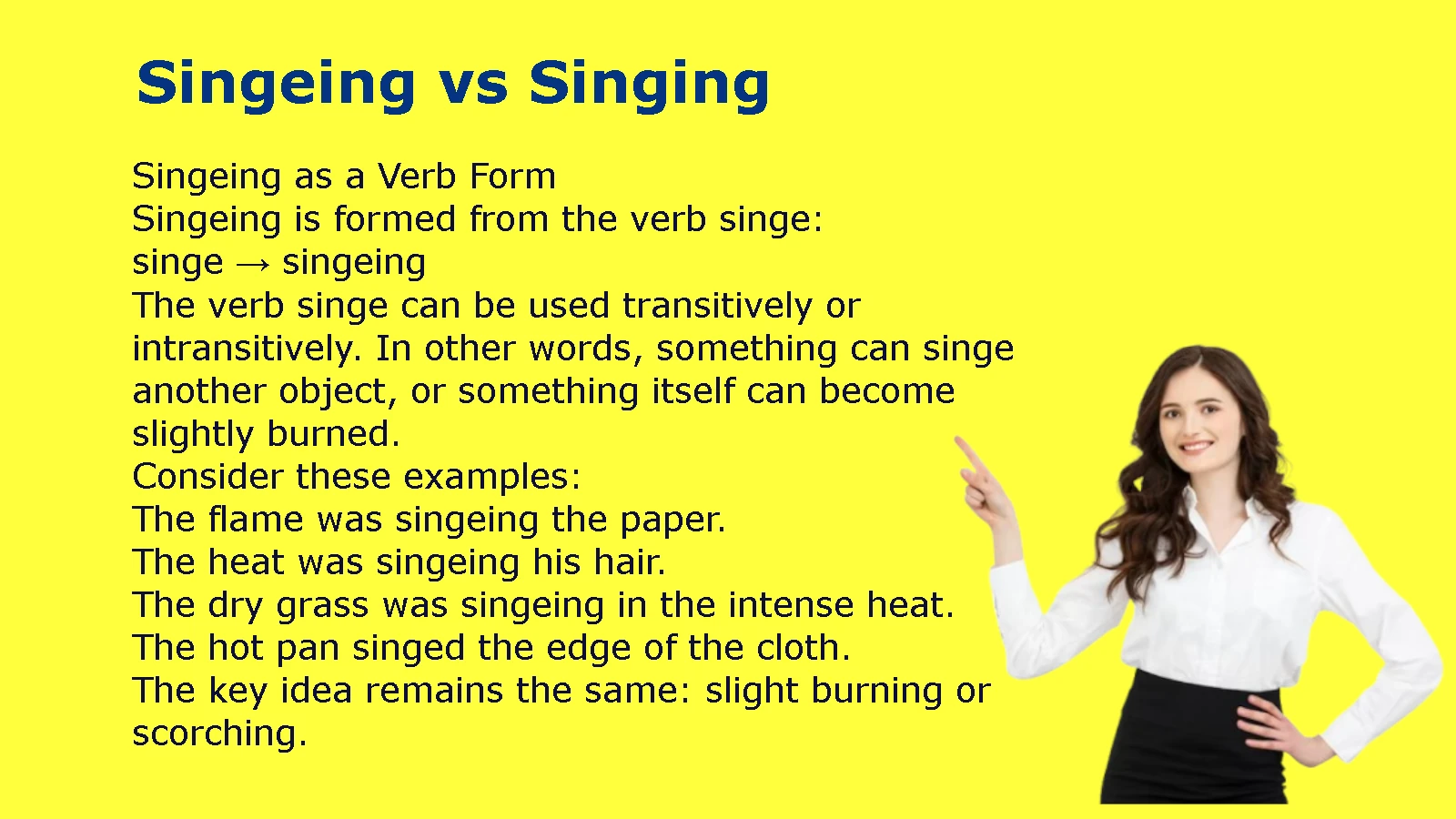
Singeing as a Verb Form
Singeing is formed from the verb singe:
singe → singeing
The verb singe can be used transitively or intransitively. In other words, something can singe another object, or something itself can become slightly burned.
Consider these examples:
- The flame was singeing the paper.
- The heat was singeing his hair.
- The dry grass was singeing in the intense heat.
- The hot pan singed the edge of the cloth.
The key idea remains the same: slight burning or scorching.
Singeing Hair
One particularly common use is singeing hair.
When hair is singed, heat burns the outer part of the hair. The expression does not mean that the hair is being completely burned away.
For example:
The candle flame came too close and started singeing her hair.
Here, singeing clearly describes the effect of heat on hair.
Another example is:
The barber accidentally singed a few hairs near the client’s ear.
The past tense singed describes an action that has already happened.
What Does Singing Mean?
Singing is the present participle of sing. It refers to producing musical sounds with the voice, often by following a melody and using words or lyrics. Cambridge Dictionary defines singing as the activity of making musical sounds with the voice, usually involving a tune with words.
Examples include:
- Singing a song
- Singing in a choir
- Singing on stage
- Singing along with music
- Singing softly
- Singing loudly
For example:
The students were singing in the classroom.
Here, singing has nothing to do with burning. It describes the production of musical sounds using the voice.
Singing as a Verb Form
The formation is straightforward:
sing → singing
Unlike singe, the verb sing does not end in a silent e. Therefore, its present participle is simply singing.
Examples include:
- She is singing a beautiful song.
- They were singing together.
- He enjoys singing in the shower.
- The audience started singing along.
Singing can also function as a noun in English. For example:
Singing is one of her favorite activities.
Cambridge Dictionary lists singing as a noun referring to the activity of making musical sounds with the voice.
Singeing vs Singing: Key Differences
The biggest difference is meaning, not merely spelling.
Singeing relates to heat and slight burning. Singing relates to music and the human voice.
| Feature | Singeing | Singing |
| Base verb | singe | sing |
| Basic meaning | Burn slightly | Produce musical sounds |
| Main subject area | Heat, fire, materials | Music, voice, performance |
| Spelling | singeing | singing |
| Pronunciation | /ˈsɪn.dʒɪŋ/ | /ˈsɪŋ.ɪŋ/ |
| Past tense of base verb | singed | sang |
| Past participle | singed | sung |
| Example | The flame was singeing the fabric. | She was singing a song. |
The pronunciation difference is also important. Cambridge gives singe as /sɪndʒ/ and singing as /ˈsɪŋ.ɪŋ/.
The Meaning Test
A useful way to distinguish the words is to ask what action is taking place.
If the action involves slight burning, choose singeing.
The heat was singeing the grass.
If the action involves using the voice musically, choose singing.
The children were singing in the choir.
This meaning-based test is often more reliable than trying to remember the spelling alone.
Why Is Singeing Spelled With an Extra E?
The spelling singeing often causes confusion because many readers expect the word to become singing when singe takes the -ing ending.
However, the two words are formed from different base verbs.
Singe + ing = singeing
Sing + ing = singing
The final e in singe is retained in singeing so that the word continues to represent the verb singe. Removing that letter would produce singing, which is already the present participle of the entirely different verb sing.
This distinction is particularly useful because singe and sing already have different pronunciations.
Why Singeing Cannot Simply Become Singing
Suppose you wrote:
The flame was singing his hair.
The sentence would normally be understood as saying that the flame was somehow producing a song. It would not communicate the intended meaning of slightly burning the hair.
The correct sentence is:
The flame was singeing his hair.
The extra e therefore helps preserve the identity of the base verb.
Singe, Singeing, Singed
The main forms of singe are:
| Form | Word | Example |
| Base form | singe | Flames can singe the grass. |
| Present participle | singeing | The heat is singeing the grass. |
| Past tense | singed | The fire singed the grass. |
| Past participle | singed | The grass was singed by the fire. |
By contrast, the forms of sing are irregular:
| Form | Word | Example |
| Base form | sing | They sing together. |
| Present participle | singing | They are singing together. |
| Past tense | sang | They sang together yesterday. |
| Past participle | sung | They have sung together before. |
This table makes the difference particularly clear: singeing belongs to singe, while singing belongs to sing.
Singeing and Singing Pronunciation
Pronunciation provides another useful clue.
Singe is pronounced /sɪndʒ/, while sing begins with the /sɪŋ/ sound. Cambridge Dictionary gives singe as /sɪndʒ/ and singing as /ˈsɪŋ.ɪŋ/.
The important difference is the sound at the end of the first part of each word.
- Singeing has the /dʒ/ sound associated with singe.
- Singing has the /ŋ/ sound associated with sing.
That distinction can help you identify the correct word when speaking.
How to Pronounce Singeing
The pronunciation of singeing is commonly represented as:
/ˈsɪn.dʒɪŋ/
The first part comes from singe, and the final part comes from the -ing ending.
How to Pronounce Singing
Singing is pronounced:
/ˈsɪŋ.ɪŋ/
The first syllable contains the /ŋ/ sound found in sing.
Because the words have similar written forms, listening carefully to this consonant difference can help distinguish them.
Singeing vs Singing Examples
Context makes the difference especially easy to understand.
Examples With Singeing
- The candle was singeing the edge of the paper.
- The heat was singeing the dry grass.
- She accidentally singed her hair near the stove.
- The flames were singeing the wooden fence.
- The hot iron was singeing the loose threads.
- The fire came close enough to singe the leaves.
- The fabric was slightly singed by the heat.
- The flame kept singeing the ends of the fibers.
Every example involves some form of slight burning or scorching.
Examples With Singing
- The children were singing a song.
- She enjoys singing in the choir.
- He was singing along with the radio.
- They spent the evening singing together.
- The performer was singing on stage.
- We heard someone singing upstairs.
- The audience joined in singing.
- She has been singing professionally for several years.
Every example involves singing with the voice.
Singeing Hair vs Singing
The phrase singeing hair is particularly useful when learning the distinction because it creates a common spelling trap.
Compare these sentences:
The flame was singeing his hair.
He was singing a song.
The first sentence describes heat damaging hair slightly. The second describes a musical activity.
Now compare the incorrect substitution:
The flame was singing his hair.
This changes the word from singe to sing. The result does not express the intended meaning.
The opposite mistake can be just as confusing:
She was singeing in the choir.
That sentence suggests that she was slightly burning something in the choir rather than using her voice to sing.
The correct version is:
She was singing in the choir.
A Simple Context Test
When you are uncertain, look at the words around the target word.
Words associated with singeing often involve:
- Fire
- Flame
- Heat
- Hair
- Fabric
- Grass
- Paper
- Burning
- Scorching
Words associated with singing often involve:
- Song
- Music
- Voice
- Choir
- Lyrics
- Melody
- Stage
- Concert
- Performance
The surrounding context usually makes the intended word obvious.
Is Singeing a Word?
Yes. Singeing is a standard English word and the present participle of singe. Cambridge Dictionary explicitly lists singeing as the present participle of singe.
The spelling can look unusual because English readers are familiar with singing, a much more common word. Seeing singeing may therefore create the impression that an extra e has been inserted accidentally.
It has not.
For example:
The heat is singeing the tips of the leaves.
Here, singeing is completely correct.
You can also use it in continuous verb constructions:
The fire was singeing the grass.
The hot surface is singeing the fabric.
The candle had been singeing the paper.
Is Singing a Word?
Yes. Singing is also a standard English word. It is the present participle of sing and can also function as a noun.
Cambridge Dictionary defines singing as the activity of making musical sounds with the voice, generally following a tune.
Examples include:
She loves singing.
They are singing together.
His singing impressed the audience.
In the final example, singing functions as a noun rather than simply appearing as part of a progressive verb construction.
Singe vs Sing: What Is the Difference?
Understanding the two base verbs makes singeing vs singing much easier.
Singe
Singe means to burn something slightly or scorch its surface.
Examples:
- The flame singed the paper.
- The heat singed his hair.
- The fire singed the grass.
Sing
Sing means to produce musical sounds with your voice.
Examples:
- She sings beautifully.
- They sang at the concert.
- He has sung that song many times.
The verbs also have different past forms.
| Verb | Present | Past | Past participle | Present participle |
| singe | singe | singed | singed | singeing |
| sing | sing | sang | sung | singing |
This is one of the most useful comparisons to remember.
Singeing vs Singed
Both come from the same verb, but they serve different grammatical functions.
Singeing is the present participle:
The fire is singeing the grass.
Singed is the past tense or past participle:
The fire singed the grass.
The grass was singed by the fire.
The distinction is similar to other English verb forms:
- burning → burned/burnt
- scorching → scorched
- singeing → singed
However, don’t confuse singed with sang or sung. Those forms belong to sing, not singe.
Common Mistakes With Singeing and Singing
The similarity between the two words creates several predictable errors.
Writing Singing When You Mean Singeing
Incorrect:
The candle was singing the paper.
Correct:
The candle was singeing the paper.
The intended action is slight burning, so singeing is required.
Writing Singeing When You Mean Singing
Incorrect:
The children were singeing in the music room.
Correct:
The children were singing in the music room.
The activity involves music and voices, so singing is correct.
Assuming Singeing Is a Typo
Some writers see singeing and automatically change it to singing.
That is a mistake.
Singeing is an established word, and its spelling reflects the base verb singe.
Confusing Singed With Sang
These are also different:
The fire singed the cloth.
She sang the song.
Singed comes from singe, while sang is the past tense of sing.
Singeing vs Singing in Sentences
Here is a side-by-side comparison that shows how context determines the correct spelling.
| Correct word | Sentence | Meaning |
| Singeing | The flame was singeing the paper. | Slightly burning |
| Singing | The children were singing a song. | Producing music with the voice |
| Singeing | The heat was singeing his hair. | Slightly burning |
| Singing | She was singing in the choir. | Using her voice musically |
| Singeing | The fire was singeing the dry grass. | Scorching |
| Singing | They were singing along with the radio. | Joining in with a song |
A Useful Case Study
Consider this sentence:
The performer was singeing on stage.
The word looks possible because singeing is spelled correctly. However, the context tells us that something is wrong. A performer on stage is probably singing, not lightly burning something.
Now change the context:
The candle flame was singeing the performer’s costume.
Here, singeing makes perfect sense because the sentence describes heat affecting fabric.
The spelling cannot be selected by appearance alone. Meaning and context determine the correct word.
How to Remember Singeing vs Singing
A simple memory trick is to connect each word with its base verb.
Think: Singeing → Singe → Scorch
If something is being slightly burned, think of singe.
Singe → singeing
The heat was singeing the fabric.
Think: Singing → Sing → Song
If someone is making music with their voice, think of sing.
Sing → singing
They were singing a song.
Another useful shortcut is to associate singeing with fire and singing with music.
| If the context involves… | Use |
| Fire | singeing |
| Heat | singeing |
| Burning hair | singeing |
| Scorching fabric | singeing |
| Music | singing |
| A song | singing |
| A choir | singing |
| A voice | singing |
Related Words and Forms
Knowing the related forms can prevent further confusion.
Forms of Singe
- singe — base form
- singes — third-person singular present
- singeing — present participle
- singed — past tense
- singed — past participle
Examples:
The flame may singe the paper.
The heat singes the fabric.
The flame is singeing the fabric.
The flame singed the fabric.
The fabric was singed.
Forms of Sing
- sing — base form
- sings — third-person singular present
- singing — present participle
- sang — past tense
- sung — past participle
Examples:
They sing every weekend.
She sings beautifully.
They are singing now.
She sang yesterday.
She has sung that song before.
The forms are different because the verbs themselves are different.
Singeing Synonyms
Depending on context, possible alternatives to singeing include:
- Scorching
- Burning slightly
- Charring slightly
- Burning
- Seared in some contexts
However, these words are not always exact substitutes.
Singe generally suggests limited or slight burning rather than complete destruction. Cambridge specifically describes it as burning slightly on the surface.
For example:
The candle singed the paper.
This does not necessarily mean the paper was consumed by fire. It suggests a relatively small amount of burning.
Singing Synonyms and Related Terms
Depending on context, words related to singing include:
- Vocalizing
- Chanting
- Performing
- Humming
- Crooning
- Warbling
- Yodeling
These are not interchangeable in every sentence.
For example, humming usually refers to making a musical sound with the lips closed, while singing generally involves producing a vocal melody, often with words.
Similarly, chanting can refer to repeated or rhythmic vocal sounds rather than conventional song performance.
When Should You Use Singeing?
Use singeing when the sentence describes the process of slightly burning or scorching something.
Typical contexts include:
- Singeing hair
- Singeing fabric
- Singeing threads
- Singeing grass
- Singeing paper
- Singeing leaves
- Singeing fur
For example:
The technician was singeing the loose fibers from the material.
The word is especially appropriate when the burning is limited rather than destructive.
When Should You Use Singing?
Use singing when the sentence describes making musical sounds with the voice.
Typical contexts include:
- Singing a song
- Singing in a choir
- Singing on stage
- Singing along
- Singing loudly
- Singing softly
- Singing professionally
For example:
The audience began singing along with the performer.
Cambridge’s examples include uses such as singing and dancing, singing career, and choral singing, demonstrating how broadly the word functions in musical contexts.
Frequently Asked Questions
Is singeing a correct spelling?
Yes. Singeing is the correct present participle of singe. It means burning or scorching something slightly.
Is singing spelled correctly?
Yes. Singing is the present participle of sing and refers to producing musical sounds with the voice.
What is the difference between singeing and singing?
Singeing means slightly burning or scorching something, while singing means producing musical sounds with the voice.
The flame was singeing the paper.
She was singing a song.
Why does singeing have an e?
Singeing comes from the base verb singe, so the final e is retained in the spelling. It must be distinguished from singing, which comes from the separate verb sing.
Is singeing the same as burning?
Not exactly. Singeing specifically suggests slight or surface burning. It does not necessarily mean that something has been completely burned. Cambridge defines singe as burning slightly on the surface.
How do you pronounce singeing?
Singeing is commonly pronounced /ˈsɪn.dʒɪŋ/. Its first part comes from singe, which Cambridge gives as /sɪndʒ/.
What is the past tense of singe?
The past tense of singe is singed.
The flame singed his hair.
What is the difference between singed and singing?
Singed comes from singe and means slightly burned.
Singing comes from sing and means producing musical sounds.
The fabric was singed.
The children were singing.
Can singeing refer to burning hair?
Yes. Singeing hair is a valid use because singe can describe slightly burning hair.
The candle was singeing her hair.
Why is singeing not spelled singing?
Because they come from different verbs.
Singe → singeing
Sing → singing
The two words may look similar, but their meanings, pronunciations, and grammatical roots are different.
Final Difference Between Singeing and Singing
The difference between singeing vs singing is simple once you connect each word to its base verb.
Singeing comes from singe and means burning or scorching something slightly. It is commonly used with things such as hair, fabric, paper, grass, and threads. Cambridge Dictionary confirms that singeing is the present participle of singe.
Singing comes from sing and means producing musical sounds with the voice. It can describe the act of singing itself or function as part of a progressive verb construction.
The quickest way to remember the distinction is:
Singeing = slight burning.
Singing = making music with your voice.
So, when you are talking about a flame singeing hair, keep the e. When you are talking about someone singing a song, leave it out.