Have you ever wondered whether buffalo or buffaloes is the correct plural form? You’re not alone. Both spellings are commonly seen in English, and the choice can be confusing because buffalo can function as both a singular noun and a plural noun in some varieties of English.
Buffalo can be both singular and plural, while buffaloes is also a correct plural form. Both buffalo and buffaloes can refer to more than one buffalo.
Buffalo and buffaloes can both be correct. Buffalo is the singular form and is also commonly used as a plural, particularly in American English. Buffaloes is the regular plural form and is also widely accepted. The correct choice depends on the variety of English you are using and the context of the sentence.
| Word | Correct? | Use |
| Buffalo | ✅ Correct | Singular noun and, in some contexts, plural noun |
| Buffaloes | ✅ Correct | Regular plural form of buffalo |
The confusion often comes from the fact that many English nouns form their plurals by adding -s or -es, while buffalo has more than one accepted plural form. You may therefore see phrases such as one buffalo, two buffalo, and two buffaloes in standard English.
The important point is that buffalo is not simply an incorrect plural of buffaloes. Both forms have established usage, although buffaloes makes the plural meaning more explicit.
In this guide, you’ll learn the complete difference between Buffalo vs Buffaloes, including their meaning, singular and plural forms, pronunciation, grammar, origin, and usage. You’ll also learn when to use buffalo, when to use buffaloes, whether buffalo can be plural, and how to use both forms correctly in clear English sentences.
Buffalo vs Buffaloes: What Is the Difference?
The simplest difference is grammatical:
- Buffalo can be singular or plural.
- Buffaloes is plural.
- Buffalo can also function as a verb.
- Buffaloes can refer to more than one animal, but it is not the standard present-tense verb form.
Consider these examples:
One buffalo was standing near the river.
Here, buffalo is singular.
Several buffalo were standing near the river.
Here, buffalo is plural.
Several buffaloes were standing near the river.
Here, buffaloes is also plural.
The important point is that buffalo does not always need an -es ending to become plural. Cambridge lists the plural as buffaloes or buffalo, while Oxford lists buffalo, buffaloes in its main learner dictionary.
Quick Comparison of Buffalo and Buffaloes
| Word | Number | Function | Example |
| buffalo | Singular | Noun | A buffalo crossed the field. |
| buffalo | Plural | Noun | Several buffalo crossed the field. |
| buffaloes | Plural | Noun | Several buffaloes crossed the field. |
| buffalo | Verb | Verb | The complicated question buffaloed him. |
This makes buffalo vs buffaloes different from a simple singular-versus-plural pair such as book/books. With buffalo, the singular and plural can have the same form.
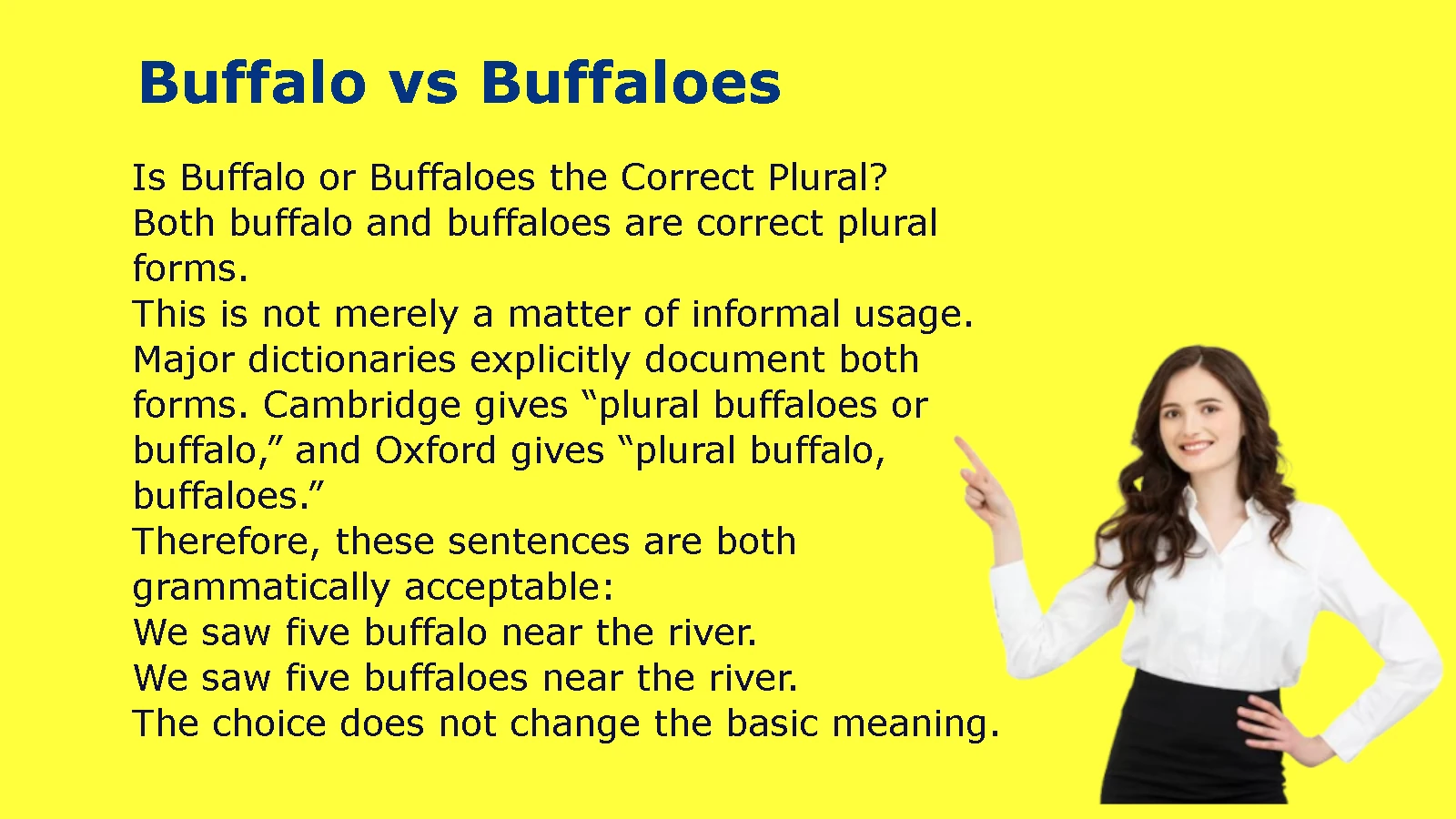
Is Buffalo or Buffaloes the Correct Plural?
Both buffalo and buffaloes are correct plural forms.
This is not merely a matter of informal usage. Major dictionaries explicitly document both forms. Cambridge gives “plural buffaloes or buffalo,” and Oxford gives “plural buffalo, buffaloes.”
Therefore, these sentences are both grammatically acceptable:
- We saw five buffalo near the river.
- We saw five buffaloes near the river.
The choice does not change the basic meaning.
Why Can Buffalo Have Two Plural Forms?
English contains many nouns whose plural does not necessarily require a visible ending.
For example:
- one sheep → two sheep
- one deer → two deer
- one fish → two fish
- one buffalo → two buffalo
At the same time, English also permits a regular plural ending for buffalo:
- one buffalo → two buffaloes
This means buffalo can behave like a zero-plural noun while buffaloes follows the regular plural pattern.
There is therefore no grammatical reason to treat buffaloes as an incorrect form.
When Should You Use Buffalo?
Use buffalo when the context already makes the plural meaning clear or when that form fits the style you are following.
Buffalo as a Singular Noun
When buffalo refers to one animal, it takes singular grammar.
For example:
- A buffalo is grazing near the lake.
- The buffalo was moving slowly.
- One buffalo crossed the road.
- That buffalo looks unusually large.
Notice the singular verbs:
A buffalo is, not a buffalo are.
The article a also makes the singular meaning clear.
Buffalo as a Plural Noun
Buffalo can also refer to multiple animals.
For example:
- Several buffalo were grazing.
- We watched a herd of buffalo.
- The buffalo were moving toward the water.
- Thousands of buffalo once lived across the Great Plains.
In these sentences, the surrounding words reveal that buffalo is plural.
The word several, for example, cannot normally modify a singular count noun. Therefore, several buffalo clearly means more than one animal.
Why Buffalo Can Sound Natural as a Plural
The plural form buffalo is especially natural after words that already show number.
Common examples include:
- many buffalo
- several buffalo
- hundreds of buffalo
- thousands of buffalo
- a herd of buffalo
- large numbers of buffalo
For example:
The researchers observed hundreds of buffalo from a safe distance.
There is no need to add -es because hundreds of already establishes that the noun is plural.
When Should You Use Buffaloes?
Use buffaloes when you want an unmistakable regular plural form.
Examples include:
- The buffaloes moved toward the river.
- Several buffaloes were grazing in the field.
- Farmers raise buffaloes for milk.
- The village depends on its buffaloes for agricultural work.
- The researchers studied wild buffaloes.
There is nothing grammatically wrong with these sentences.
In fact, Cambridge provides numerous corpus examples using buffaloes, including references to herds and livestock.
Buffaloes Can Make Plurality Obvious
One practical advantage of buffaloes is that the ending immediately signals plurality.
Compare:
The buffalo were grazing.
and:
The buffaloes were grazing.
Both are correct, but the second makes the plural form visually obvious.
This can be useful in educational writing, beginner-level material, or sentences where you want to avoid any momentary ambiguity.
Buffalo Plural in American and British English
The plural question is not as simple as saying that one form belongs exclusively to American English and the other belongs exclusively to British English.
Both buffalo and buffaloes are documented in major English dictionaries.
Cambridge’s entries for both British and American English give buffaloes or buffalo as plural forms.
Oxford’s main learner dictionary likewise lists:
buffalo, buffaloes
for the plural.
Oxford’s American English dictionary goes slightly further and records buffalo, buffaloes, or buffalos.
Buffalo vs Buffaloes by Variety
| Variety or source | Documented plural forms |
| Cambridge English | buffalo, buffaloes |
| Oxford Learner’s Dictionary | buffalo, buffaloes |
| Oxford American English | buffalo, buffaloes, buffalos |
| General English usage | buffalo and buffaloes are both established |
The safest conclusion is simple: do not label buffaloes as wrong simply because you have seen buffalo used as the plural.
Both forms have dictionary support.
Buffalo vs Buffaloes in a Sentence
The easiest way to understand the difference is to see the two forms in context.
Examples With Buffalo
Here are examples where buffalo functions as a singular or plural noun:
- A buffalo was standing beside the stream.
- The buffalo moved slowly across the field.
- Several buffalo were grazing on the grass.
- We saw a herd of buffalo during the tour.
- Many buffalo once lived in this region.
- The farmer owns three buffalo.
- The buffalo were gathered near the water.
- A large buffalo crossed the road.
In examples 1 and 8, buffalo is singular.
In examples 3, 5, 6, and 7, it is plural.
Examples With Buffaloes
Now compare sentences using buffaloes:
- Several buffaloes were grazing near the lake.
- The buffaloes crossed the road together.
- The farmers keep buffaloes for milk.
- The buffaloes moved into the shelter before the storm.
- Researchers examined several buffaloes.
- The buffaloes were part of a large herd.
- The villagers watched the buffaloes from a distance.
- Young buffaloes stayed close to the adults.
All of these use buffaloes as a straightforward plural noun.
Buffalo Is Also a Verb
The word buffalo has another grammatical role that is easy to overlook.
As a verb, buffalo means to confuse, bewilder, intimidate, or overwhelm someone.
For example:
The complicated instructions buffaloed the students.
Here, buffaloed does not refer to an animal. It means that the instructions confused or bewildered the students.
The verb can appear in several forms:
| Form | Example |
| buffalo | The question may buffalo him. |
| buffaloes | The confusing wording buffaloes new readers. |
| buffaloed | The difficult problem buffaloed the class. |
| buffaloing | The constant changes are buffaloing the team. |
This creates an important distinction:
Buffaloes can be a plural noun or a third-person singular verb, depending on context.
For example:
The buffaloes crossed the field.
Here, buffaloes is a plural noun.
The confusing instructions buffaloes the reader.
Here, buffaloes is a verb.
The spelling is identical, but the grammatical function is different.
Buffalo as a Verb in a Sentence
Here are some clear examples:
- The complicated puzzle buffaloed me.
- The unfamiliar legal language buffaloed the reader.
- The sudden change in instructions buffaloed the students.
- The technical explanation buffaloed the new employees.
- The unexpected question buffaloed the witness.
The verb is particularly useful when someone is confused or intimidated by something difficult.
Buffalo vs Buffaloes as Verbs
Do not assume that every occurrence of buffaloes refers to animals.
Compare:
The buffaloes are drinking water.
Here, buffaloes is a plural noun.
The complicated explanation buffaloes the audience.
Here, buffaloes is a verb.
The subject tells you which meaning applies.
What Does the Buffalo Buffalo Sentence Mean?
The famous sentence
Buffalo buffalo Buffalo buffalo buffalo buffalo Buffalo buffalo.
looks impossible at first glance.
However, it can be grammatical because buffalo has multiple meanings and grammatical functions.
The sentence relies on three uses:
- Buffalo as a proper noun referring to Buffalo, New York
- buffalo as a noun referring to the animal
- buffalo as a verb meaning to confuse or intimidate
Oxford separately recognizes Buffalo as the name of the city in New York, while its dictionary entry for buffalo includes both the animal and the North American bison sense.
The sentence is therefore not simply eight repetitions of one meaning.
The capitalization provides an important clue. The capitalized Buffalo can function as a proper noun, while lowercase buffalo can represent the animal or verb.
Buffalo Buffalo Buffalo Buffalo Buffalo Buffalo Buffalo Buffalo Meaning
The longer version is:
Buffalo buffalo Buffalo buffalo buffalo buffalo Buffalo buffalo.
A useful paraphrase is:
Buffalo bison that other Buffalo bison intimidate also intimidate Buffalo bison.
The exact interpretation depends on how the sentence is parsed, but the essential grammatical trick is the same: the repeated spelling represents different words or grammatical roles.
A simplified structural reading is:
[Buffalo buffalo] [Buffalo buffalo] [buffalo] [buffalo] [Buffalo buffalo]
The first phrase can be understood as referring to buffalo associated with Buffalo, while buffalo in the middle functions as a verb.
The sentence demonstrates an important fact about English:
Word repetition does not automatically make a sentence grammatically meaningless.
Grammar depends on function, context, syntax, and meaning—not simply on how many times a word appears.
Is Buffaloes Always Correct?
Buffaloes is correct when it is being used as the plural noun.
However, that does not mean it is required every time you refer to more than one buffalo.
These are both correct:
We saw five buffalo.
We saw five buffaloes.
Likewise:
The buffalo were grazing.
The buffaloes were grazing.
The choice is primarily a matter of usage and style.
A Simple Rule for Choosing
If you want the simplest practical rule, use this:
Use buffalo for one animal and for the plural when context makes the number clear; use buffaloes when you want an explicit plural ending.
For example:
- One buffalo → singular
- Two buffalo → plural
- Two buffaloes → plural
- Many buffalo → plural
- Many buffaloes → plural
You should never write one buffaloes.
Common Mistakes With Buffalo and Buffaloes
Using Buffaloes as the Singular
Incorrect:
One buffaloes was grazing.
Correct:
One buffalo was grazing.
Buffaloes is plural, so it cannot follow one.
Using a Singular Verb With Plural Buffalo
Incorrect:
Several buffalo is grazing.
Correct:
Several buffalo are grazing.
The noun buffalo may look singular because it has no ending, but the word several establishes that it is plural.
Assuming Buffalo Cannot Be Plural
Some writers incorrectly assume that every plural noun must have an ending.
That is not true.
Correct:
We saw six buffalo.
Also correct:
We saw six buffaloes.
The absence of -es does not make buffalo singular.
Assuming Buffaloes Is Incorrect
This is another common mistake.
Correct:
The buffaloes crossed the field.
Dictionary evidence clearly supports buffaloes as a plural form.
Confusing Buffalo With Bison
The everyday word buffalo is sometimes used for the North American animal that is scientifically a bison.
This is especially common in American English.
That does not mean all animals called buffalo are bison.
Buffalo vs Bison: Are They the Same Animal?
Strictly speaking, buffalo and bison are not interchangeable zoological terms.
True buffalo include animals such as:
- African buffalo
- water buffalo
Bison include:
- North American bison
- European bison
Oxford defines buffalo as a large animal of the cow family and separately notes its common use for a North American bison.
Oxford’s entry for bison identifies the North American animal as one type of bison and notes that it is also called buffalo.
So there is a difference between scientific terminology and common English usage.
Why Do Americans Say Buffalo for Bison?
The historical common name buffalo became widely established for the North American bison.
As a result, expressions such as:
- buffalo herd
- buffalo meat
- buffalo range
- buffalo grass
- buffalo hunting
can refer to the North American bison in American contexts.
For precise zoological writing, however, bison is the appropriate term for the North American species.
Buffalo vs Buffaloes vs Bison
| Term | Basic meaning | Plural |
| buffalo | A buffalo animal; also commonly used for North American bison | buffalo / buffaloes |
| buffaloes | Explicit plural of buffalo | — |
| bison | A member of the genus Bison | bison |
| water buffalo | Asian buffalo species | water buffalo / water buffaloes |
| African buffalo | African buffalo species | African buffalo / African buffaloes |
Oxford lists bison with the plural bison, while buffalo has the plural forms buffalo and buffaloes in its main learner dictionary.
Buffalo vs Buffaloes in Formal Writing
Both forms can appear in formal writing.
The better choice depends on the context and the style of the publication.
For scientific writing, it is often more important to identify the actual species than to debate buffalo versus buffaloes. If you mean the North American animal, for example, bison may be more precise.
For general educational writing, either plural form can work:
The buffalo migrate across the grasslands.
or:
The buffaloes migrate across the grasslands.
For a general audience, buffaloes can sometimes make the plural easier to recognize immediately.
For established expressions, however, changing buffalo to buffaloes may sound less natural.
Compare:
buffalo wings
with:
buffaloes wings
The second version is wrong because Buffalo wings is a fixed expression referring to chicken wings prepared in a particular style. Oxford lists Buffalo wings as a plural noun in North American English.
Case Study: Choosing Buffalo or Buffaloes
Consider this sentence:
The farmer owns several buffalo.
A reader immediately understands that the farmer owns more than one animal because several establishes plurality.
Now consider:
The farmer owns several buffaloes.
The meaning is identical, but the plural marker -es makes the number visible in the noun itself.
Neither sentence needs correction.
Now change the sentence:
The farmer owns one buffaloes.
This is incorrect because one requires a singular noun.
The correct version is:
The farmer owns one buffalo.
This example shows why context and grammatical number matter more than simply adding or removing -es.
Facts to Remember About Buffalo vs Buffaloes
Here are the key facts to keep in mind:
- Buffalo is a noun.
- Buffaloes is a valid plural noun.
- Buffalo can also be plural.
- Buffaloes is never the singular noun.
- One buffalo is correct.
- Two buffalo is correct.
- Two buffaloes is also correct.
- Buffalo can function as a verb.
- Buffaloed can mean confused or intimidated.
- Buffaloes can also be a third-person singular verb.
- Bison and buffalo are not technically identical zoological terms.
- American English commonly uses buffalo for the North American bison.
- Oxford records buffalos as another American English plural variant, although buffalo and buffaloes are the forms most relevant to this comparison.
- The famous Buffalo buffalo sentence works because the same spelling can represent different grammatical functions.
Buffalo vs Buffaloes: Quick Comparison
| Question | Answer |
| Is buffalo singular? | Yes. |
| Can buffalo be plural? | Yes. |
| Is buffaloes correct? | Yes. |
| Is buffaloes singular? | No. |
| What is the plural of buffalo? | Buffalo or buffaloes. |
| Can buffalo be a verb? | Yes. |
| What does the verb buffalo mean? | To confuse, bewilder, intimidate, or overwhelm. |
| Is buffalo the same as bison? | Not technically, although buffalo is commonly used for North American bison. |
| Is two buffalo correct? | Yes. |
| Is two buffaloes correct? | Yes. |
| Is one buffaloes correct? | No. |
| What is the plural of bison? | Bison is a standard plural form. |
Frequently Asked Questions About Buffalo vs Buffaloes
Is buffalo or buffaloes correct?
Both are correct plural forms. You can write two buffalo or two buffaloes. Major dictionaries recognize both forms.
What is the plural of buffalo?
The plural can be buffalo or buffaloes.
For example:
- one buffalo
- two buffalo
- two buffaloes
Both plural forms are grammatically accepted.
Can buffalo be plural?
Yes. Buffalo can function as both a singular and plural noun.
For example:
One buffalo was grazing.
Several buffalo were grazing.
The verb helps show whether buffalo is singular or plural.
Is buffaloes grammatically correct?
Yes. Buffaloes is a standard plural form of buffalo. Cambridge explicitly identifies buffaloes as the plural of buffalo.
What is the plural of buffalo in British English?
Buffalo and buffaloes are both documented in British English dictionaries. Cambridge’s British English entry gives buffaloes or buffalo.
What is the plural of buffalo in American English?
American English also uses buffalo and buffaloes. Oxford’s American English dictionary additionally records buffalos as a plural variant.
Is buffalo a singular or plural word?
It can be either, depending on context.
A buffalo was nearby.
Here, it is singular.
Several buffalo were nearby.
Here, it is plural.
What is the verb form of buffalo?
Buffalo can be used as a verb meaning to confuse, bewilder, intimidate, or overwhelm.
Its past tense is buffaloed.
Example:
The complicated explanation buffaloed me.
What does Buffalo buffalo buffalo mean?
The famous phrase uses different meanings and grammatical functions of Buffalo/buffalo. Buffalo can refer to Buffalo, New York, the animal, or the verb meaning to confuse or intimidate.
The phrase demonstrates how English syntax can produce a grammatical sentence using repeated words.
Why can buffalo be both singular and plural?
English allows some nouns to have identical singular and plural forms. Buffalo is one such noun. It can also take the regular plural ending -es, producing buffaloes.
Final Answer: Buffalo or Buffaloes?
When comparing buffalo vs buffaloes, there is no need to choose one as the only correct form.
Buffalo and buffaloes are both correct plural forms.
Use buffalo when you want the unmarked plural:
We saw five buffalo.
Use buffaloes when you prefer an explicit plural ending:
We saw five buffaloes.
For singular use, write:
We saw one buffalo.
Never write:
We saw one buffaloes.
The most important point is that buffalo can be both singular and plural, while buffaloes is specifically plural. Major dictionaries support this usage.
And if you encounter the famous Buffalo buffalo Buffalo buffalo buffalo buffalo Buffalo buffalo, remember that the strange-looking sentence is built on the unusual flexibility of the word buffalo. The same spelling can function as a proper noun, an animal noun, or a verb.
The simplest rule to remember
One buffalo. Two buffalo. Two buffaloes.
All three are correct.