“Regretted” vs. “regreted” is a common spelling question that comes up when writing about feeling sorry, remorseful, or disappointed about something you did or failed to do. If you’ve wondered whether regretted or regreted is the correct spelling, the answer depends on understanding how the verb regret forms its past tense and past participle.
The regretted vs. regreted distinction is straightforward: regretted is the correct spelling, while regreted is a misspelling. The verb regret ends in a consonant-vowel-consonant pattern, so the final t is doubled before adding -ed. This gives us regretted, not regreted. Related forms include regret, regrets, regretting, and regrettable.
In this guide, you’ll learn whether “regretted” or “regreted” is correct, why the final “t” is doubled, how to pronounce “regretted,” and how to use the word correctly in sentences. You’ll also see clear examples and related spelling rules to help you avoid this common mistake.
By the end, you’ll know exactly why regretted is the correct spelling and how to use it naturally and correctly in your writing.
Regretted vs Regreted: The Difference
The two forms aren’t alternative spellings with different meanings. Only one is standard English.
| Spelling | Correct? | Meaning |
| regretted | Yes | Past tense and past participle of regret |
| regreted | No | Misspelling of regretted |
The word regretted describes a feeling of being sorry about something that happened or something you did or failed to do.
For example:
- I regretted my decision.
- She regretted leaving so early.
- They regretted not asking for help.
In each sentence, the regret happened in the past.
The spelling regreted, on the other hand, doesn’t represent a separate grammatical form. If you see it in a sentence, the writer almost certainly intended regretted.
Why the Error Happens
The mistake is understandable because writers often treat the word as if they can simply attach -ed to the base form:
regret + ed = regreted
English spelling doesn’t always work that mechanically. In this case, the final t doubles before the suffix is added.
The correct formation is:
regret + t + ed = regretted
Once you know that pattern, the spelling becomes much easier to remember.
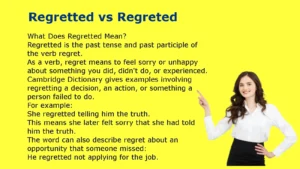
What Does Regretted Mean?
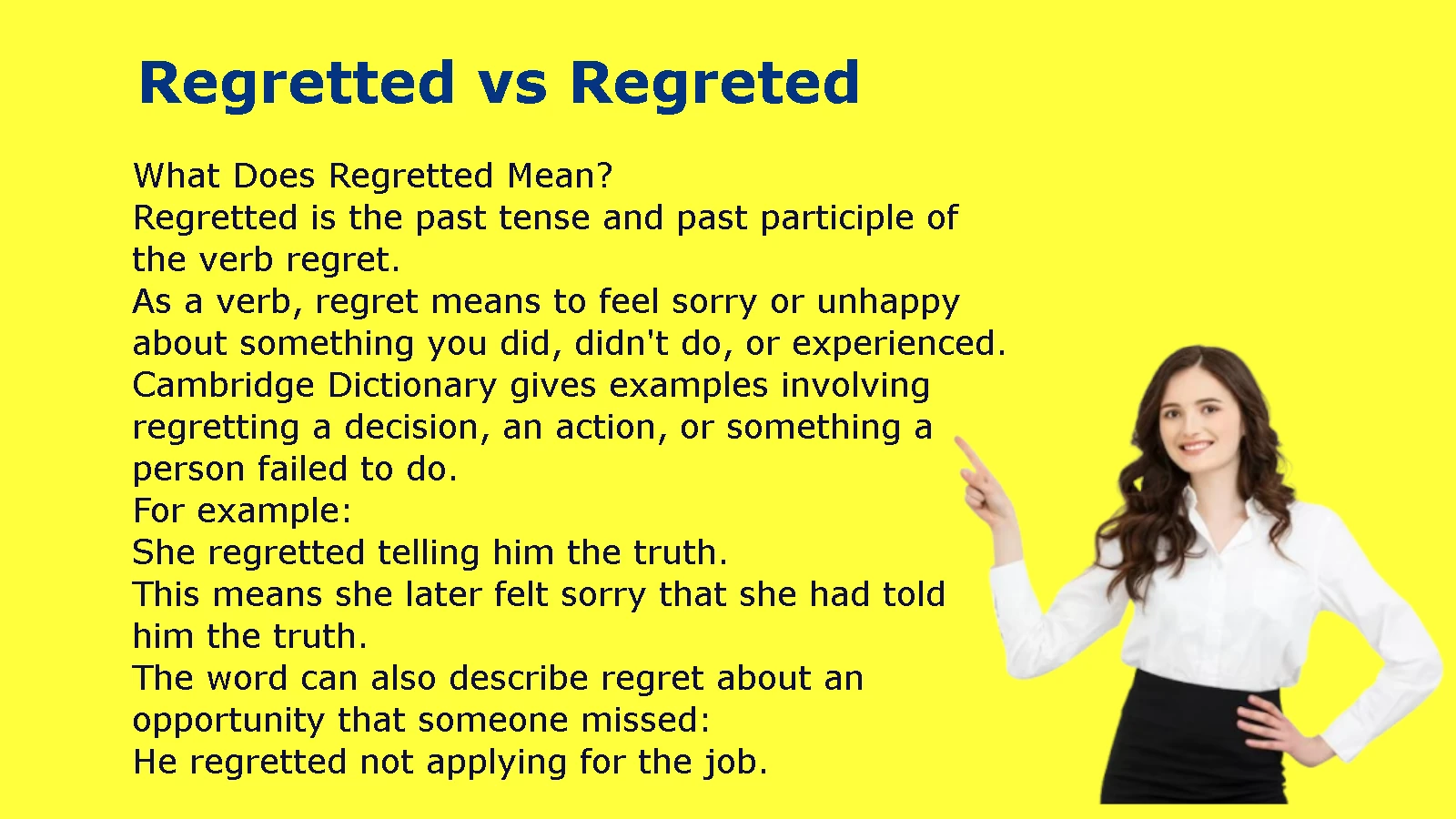
Regretted is the past tense and past participle of the verb regret.
As a verb, regret means to feel sorry or unhappy about something you did, didn’t do, or experienced. Cambridge Dictionary gives examples involving regretting a decision, an action, or something a person failed to do.
For example:
She regretted telling him the truth.
This means she later felt sorry that she had told him the truth.
The word can also describe regret about an opportunity that someone missed:
He regretted not applying for the job.
Regretted as the Past Tense
The simple past form tells you that the feeling of regret existed at a particular point in the past.
Consider:
- I regret my decision. — Present
- I regretted my decision. — Past
The first sentence describes how you feel now. The second places that feeling in the past.
More examples include:
- She regretted her choice.
- We regretted leaving so early.
- He regretted what he had said.
- They regretted missing the opportunity.
- I immediately regretted sending the message.
Regretted as the Past Participle
Regretted also functions as the past participle of regret.
You’ll see it after auxiliary verbs such as have, has, and had.
For example:
- I have regretted that decision for years.
- She has regretted leaving the company.
- They had regretted their choice before the consequences became clear.
Cambridge specifically identifies regretted as both the past tense and past participle of regret.
Why Is Regretted Spelled With Two Ts?
The double t isn’t random. It follows a common English spelling pattern involving a short stressed vowel and a final consonant.
The base word is:
regret
The word has two syllables:
re-GRET
The second syllable carries the main stress, and the vowel sound before the final t is short. When -ed is added, the final consonant doubles:
regret → regretted
The same basic pattern appears in words such as:
| Base word | Past tense |
| stop | stopped |
| plan | planned |
| admit | admitted |
| prefer | preferred |
| occur | occurred |
| regret | regretted |
The exact spelling rules surrounding consonant doubling can become more detailed when words have different stress patterns, syllable structures, or suffixes. However, for regret, the practical rule is simple: keep the double t when adding -ed or -ing.
That gives you:
- regret → regretted
- regret → regretting
Not:
- regret →
regreted - regret →
regreting
Why “Regreted” Is Incorrect
The spelling regreted leaves out one of the two required t’s.
Think of the word as having a small spelling bridge between the base word and the suffix:
regret + t + ed = regretted
If you write regreted, that extra t disappears:
regret + ed = regreted
That formation isn’t the standard English spelling.
This is especially easy to notice when you compare regretted with related forms such as regretting and regrettable. Standard dictionary entries consistently preserve the double t in these forms.
Regretted vs Regreted in a Sentence
The easiest way to see the difference is to put the two spellings side by side.
| Incorrect | Correct |
| I regreted my decision. | I regretted my decision. |
| She regreted leaving early. | She regretted leaving early. |
| He regreted what he said. | He regretted what he said. |
| They regreted missing the meeting. | They regretted missing the meeting. |
| We regreted not asking sooner. | We regretted not asking sooner. |
The correction doesn’t change the meaning. It simply restores the standard spelling.
Everyday Examples With Regretted
Here are some natural examples:
- I regretted spending all my money that weekend.
- She regretted turning down the invitation.
- He regretted speaking without thinking.
- We regretted taking the longer route.
- They regretted not checking the schedule first.
- I immediately regretted that decision.
Notice that regretted often appears with a noun, a pronoun, or an -ing form.
Professional Examples With Regretted
The word can also appear in workplace writing:
- The manager regretted the decision to cancel the meeting.
- The company later regretted rejecting the proposal.
- She regretted not raising the issue sooner.
- He regretted his response during the discussion.
In formal writing, however, don’t assume that regretted is always the best choice. Depending on the context, words such as acknowledged, apologized, or expressed regret may communicate the intended idea more precisely.
Regretted as the Past Tense of Regret
The simplest grammatical use of regretted is the simple past.
Use it when the action or feeling belongs to a completed point or period in the past.
Present vs Past
Compare these sentences:
I regret leaving the company.
This describes a present feeling.
I regretted leaving the company.
This places the feeling in the past.
The distinction matters because changing the tense can change the time relationship of the sentence.
More examples:
- She regrets her decision.
- She regretted her decision.
- He regrets saying those words.
- He regretted saying those words.
- I regret not going.
- I regretted not going.
Cambridge gives regretted as the past form and uses it to describe past decisions and actions.
Regretted as a Past Participle
The past participle regretted appears in several common grammatical constructions.
Present Perfect
Use has/have regretted when you connect a past feeling or experience with the present.
Examples:
- I have regretted that decision ever since.
- She has regretted leaving the team.
- They have never regretted their choice.
The construction is:
has/have + regretted
Past Perfect
Use had regretted when you need to place regret before another event in the past.
For example:
She had regretted her decision before the situation changed.
The construction is:
had + regretted
Another example:
He had already regretted sending the email when the reply arrived.
The past perfect establishes the earlier event clearly.
Passive Constructions
Although less common in everyday speech, regretted can appear in passive constructions.
For example:
The decision was deeply regretted by the committee.
Here, regretted follows was and functions as part of the passive construction.
A more natural alternative in many contexts would be:
The committee deeply regretted the decision.
The second version uses active voice and usually sounds more direct.
Regretted vs Regretting: Why the Spelling Changes
Regretted and regretting come from the same base verb, but they use different suffixes.
| Form | Example |
| regret | I regret the decision. |
| regretted | I regretted the decision. |
| regretting | I am regretting the decision. |
The important spelling point is that both -ed and -ing retain the doubled t.
So:
regret → regretted
and
regret → regretting
The form regreting is incorrect.
Cambridge lists regretting as the present participle of regret and regretted as its past tense and past participle.
Examples of Regretting
- She is regretting her decision.
- He started regretting the purchase immediately.
- I don’t want to spend years regretting what I didn’t do.
- They were regretting their choice by the end of the day.
The spelling stays consistent because the final t doubles before the suffix.
Regret, Regretted, Regretting, and Regretful
These words belong to the same word family, but they don’t perform the same grammatical job.
| Word | Part of speech | Meaning | Example |
| regret | Verb/noun | Feel sorry about something; a feeling of sorrow | I regret my decision. |
| regretted | Verb | Past tense/past participle | She regretted her choice. |
| regretting | Verb | Present participle/gerund | He is regretting his decision. |
| regretful | Adjective | Feeling or expressing regret | She felt regretful afterward. |
| regretfully | Adverb | In a regretful manner | He regretfully declined. |
| regrettable | Adjective | Deserving regret or unfortunate | It was a regrettable mistake. |
This distinction matters because you can’t simply swap these forms.
For example:
She regretted the decision.
Here, regretted is a verb.
But:
She was regretful about the decision.
Here, regretful is an adjective.
The meanings are related, but the grammar isn’t interchangeable.
Regretted vs Regretful
This is a particularly useful distinction when you’re writing carefully.
Regretted describes an action or state of feeling regret in the past:
He regretted his words.
Regretful describes someone or something as showing or expressing regret:
He sounded regretful.
You can remember the difference this way:
- regretted = what someone felt or did
- regretful = what someone was like or seemed
That small distinction can make a sentence much more precise.
American and British English: Is Regretted Spelled Differently?
No.
Regretted has the same spelling in American and British English.
| Variety | Correct spelling |
| American English | regretted |
| British English | regretted |
| Canadian English | regretted |
| Australian English | regretted |
There is no standard British form with one t and no American form with one t.
Cambridge’s American and British dictionary entries both identify regretted as the past tense and past participle of regret.
So if you’re writing for a US audience, regretted is correct. If you’re writing for a UK audience, regretted is still correct.
Common Spelling Mistakes With Regretted
The biggest mistake is obvious once you know the rule, but several related forms can cause confusion.
Regreted vs Regretted
This is the main spelling error.
Incorrect:
I regreted my decision.
Correct:
I regretted my decision.
Regreting vs Regretting
Dropping the second t is also incorrect.
Incorrect:
She is regreting what she said.
Correct:
She is regretting what she said.
Regret vs Regretted
Don’t use the past form when the sentence requires the base verb.
Correct:
I regret saying that.
Correct:
I regretted saying that.
The first sentence describes a present feeling. The second places the feeling in the past.
Regretful vs Regretted
These words aren’t interchangeable.
Correct:
He regretted the decision.
Correct:
He felt regretful about the decision.
The first uses a verb. The second uses an adjective.
How to Remember the Spelling of Regretted
A simple memory trick works well:
Regret has one T. Regretted has two.
Think of the final t as making room for the suffix by doubling:
regret → regretted
You can also remember the word family together:
regret → regretted → regretting → regrettable
Each of these forms keeps the double t once the relevant suffix is attached.
Another useful trick is to compare regret with stop:
stop → stopped
regret → regretted
You wouldn’t write stoped, so don’t write regreted.
A Quick Spelling Formula
When you need the past tense:
regret + doubled t + ed = regretted
When you need the present participle:
regret + doubled t + ing = regretting
That’s enough to prevent the most common spelling mistakes.
Regretted in Common Phrases
Certain constructions appear naturally with regretted.
Regretted the Decision
She regretted the decision almost immediately.
This is one of the most straightforward uses.
Regretted Saying
He regretted saying something he didn’t mean.
The verb regret commonly takes an -ing form when referring to an action someone wishes they hadn’t done. Cambridge provides examples using this construction.
Regretted Doing
I regretted spending so much money.
Regretted Not Doing
She regretted not taking the opportunity.
This construction is particularly useful because regret can concern an action you didn’t take.
Deeply Regretted
The company deeply regretted the error.
The adverb deeply emphasizes the strength of the feeling.
Immediately Regretted
He immediately regretted sending the message.
This phrase works especially well when someone recognizes a mistake almost as soon as they make it.
Is Regreted a Word?
No. Regreted is not the standard spelling of the past tense or past participle of regret.
If you intend to describe someone feeling sorry about something in the past, use regretted.
For example:
She regretted her decision.
Not:
She regreted her decision.
The standard dictionary form is regretted.
Is Regretted the Correct Spelling?
Yes. Regretted is the correct spelling.
It is the simple past and past participle of regret.
The spelling follows this pattern:
regret → regretted
The final t doubles before -ed.
What Is the Past Tense of Regret?
The past tense is:
regretted
Example:
I regretted my decision.
What Is the Past Participle of Regret?
The past participle is also:
regretted
Example:
I have regretted my decision for years.
So unlike some irregular verbs, regret uses the same form for its simple past and past participle.
| Form | Word |
| Base form | regret |
| Simple past | regretted |
| Past participle | regretted |
| Present participle | regretting |
Can Regretted and Regreted Be Used Interchangeably?
No.
They aren’t two accepted spellings of the same word.
Regretted is the standard form. Regreted is a spelling error.
This distinction matters in formal writing because spelling mistakes can make otherwise strong work look careless. A single missing letter won’t usually prevent someone from understanding your sentence, but it can still undermine confidence in an essay, report, résumé, email, or application.
When in doubt, return to the base form:
regret → regretted
The second t belongs there.
A Simple Case Study: Correcting a Common Spelling Error
Imagine you’re writing a sentence for a formal report:
The organization regreted its decision to cancel the program.
At first glance, the sentence looks fine. The meaning is clear. Yet the spelling is incorrect.
The correction is:
The organization regretted its decision to cancel the program.
Why?
Because regretted is the past tense of regret. The final t doubles before -ed.
Now compare three versions:
| Version | Correct? | Reason |
| The organization regreted its decision. | ❌ | Missing a t |
| The organization regretted its decision. | ✅ | Standard past-tense form |
| The organization regrets its decision. | ✅ | Present-tense form |
The third sentence isn’t a spelling correction of the second. It changes the tense and therefore changes the time reference.
That distinction is important. Good editing isn’t just about spotting letters. It’s about understanding how the word functions in the sentence.
Quick Spelling Test
Test yourself before moving on.
Choose the Correct Form
She ______ leaving the job.
- A. regreted
- B. regretted
Answer: B. regretted
He is ______ his decision.
- A. regreting
- B. regretting
Answer: B. regretting
I ______ not taking the opportunity.
- A. regret
- B. regretted
If you’re describing a past feeling:
Answer: B. regretted
I ______ making that choice.
If you’re describing a current feeling:
Answer: A. regret
The spelling exercise also reveals an important point: choosing between regret and regretted depends on the sentence’s tense. Choosing between regretted and regreting depends on the grammatical construction.
Regretted vs Regreted: Key Facts to Remember
If you only remember a few points, remember these:
- Regretted is the correct spelling.
- Regreted is incorrect.
- Regretted is the simple past of regret.
- Regretted is also the past participle.
- The final t doubles before -ed.
- Regretting also contains two t’s.
- American and British English use the same spelling.
- Regretful is an adjective, not another spelling of regretted.
- The base form is regret.
- The correct word family includes regret, regretted, regretting, regretful, regretfully, and regrettable.
- If you see regreted in standard English writing, replace it with regretted.
FAQs About Regretted vs Regreted
Is Regretted the Correct Spelling?
Yes. Regretted is the correct spelling. It is the simple past tense and past participle of regret.
Is Regreted a Word?
No. Regreted is a misspelling of regretted. Standard English uses two t’s.
Why Does Regretted Have Two Ts?
The final consonant doubles when the suffix -ed is added to regret. The resulting form is regretted, not regreted.
What Is the Past Tense of Regret?
The past tense is regretted.
I regretted my decision.
What Is the Past Participle of Regret?
The past participle is also regretted.
I have regretted that decision.
Is Regretting Spelled With Two Ts?
Yes. The correct spelling is regretting.
She is regretting her decision.
The form regreting is incorrect. Cambridge lists regretting as the present participle of regret.
Is Regretted the Same in American and British English?
Yes. Regretted is spelled the same way in both American and British English. There is no standard one-t variant based on dialect.
What Is the Difference Between Regret and Regretted?
Regret is the base or present form:
I regret my decision.
Regretted is the past form:
I regretted my decision.
The choice depends on when the feeling occurred.
What Is the Difference Between Regretted and Regretful?
Regretted is a verb form:
She regretted her decision.
Regretful is an adjective:
She felt regretful about her decision.
Can I Write Regreted Instead of Regretted?
No. In standard English, use regretted.
The correct spelling is:
regretted
The incorrect form is:
regreted
Is “I Regretted It” Correct?
Yes.
I regretted it.
This means you felt sorry about something that happened or something you did.
Is “I Regretted Doing It” Correct?
Yes. Regretted + an -ing form is a standard construction.
I regretted doing it.
It means you later felt sorry about the action.
Is “I Regretted to Do It” Correct?
Usually, no. When regret refers to feeling sorry about an action that already happened, English normally uses regret + -ing:
I regretted doing it.
However, regret + to + verb has a different formal use. It commonly introduces bad news or information that the speaker is sorry to communicate:
We regret to inform you that your application was unsuccessful.
Cambridge identifies this formal use separately from the meaning of regretting a past action.
Is “Regretted Not” Correct?
Yes.
You can use regretted + not + -ing when someone feels sorry about failing to do something:
She regretted not studying harder.
This construction is especially common when discussing missed opportunities or choices.
What Is the Correct Spelling: Regreted or Regretted?
The correct spelling is regretted.
A quick memory formula is:
regret + t + ed = regretted
Conclusion: Regretted Is the Correct Spelling
When choosing between regretted vs regreted, there isn’t a close contest. Regretted is the correct standard spelling, while regreted is a misspelling.
The reason for the double t becomes clear once you look at the word formation:
regret → regretted
The final t doubles before -ed. The same pattern appears in regretting.
Remember the word family:
regret → regretted → regretting
You can then distinguish the related forms without confusion:
- regret = base/present form
- regretted = past tense and past participle
- regretting = present participle
- regretful = adjective
- regretfully = adverb
- regrettable = adjective
Most importantly, don’t write regreted when you mean the past form of regret. Keep the second t.
Correct: I regretted my decision.
Incorrect: I regreted my decision.
Once you remember regret → regretted, this spelling is easy to get right.