Drove and driven are both forms of the verb “drive,” but they are used in different grammatical contexts. If you’ve come across “drove vs driven” and wondered which form is correct, the difference is mainly connected to verb tense, participles, helping verbs, and sentence structure.
The drove vs driven distinction is straightforward: drove is the simple past tense of “drive,” while driven is the past participle. You can say “I drove to work yesterday,” but with a helping verb such as “have,” “has,” or “had,” you need “driven,” as in “I have driven to work many times.” Neither form is interchangeable in every sentence.
In this guide, you’ll learn the difference between drove and driven, when to use each form, how they work in different tenses, and how to avoid common mistakes. You’ll also see clear examples comparing drove vs driven so you can recognize the correct form quickly.
By the end, you’ll know exactly when to use drove and driven and how to use both forms naturally and correctly in everyday and formal writing.
What Is the Difference Between Drove and Driven?
The main difference between drove and driven is grammatical rather than semantic. Both refer to an action related to drive, but they appear in different verb constructions.
Drove is used as the simple past form:
- I drove home.
- She drove to the airport.
- We drove across the country.
Driven is the past participle:
- I have driven home.
- She had driven to the airport.
- We have driven across the country.
The distinction becomes much easier when you look at the verb pattern around each word.
| Form | Typical construction | Example |
| drove | Subject + drove | She drove home. |
| have driven | have/has + driven | She has driven home. |
| had driven | had + driven | She had driven home. |
| will have driven | will have + driven | She will have driven 200 miles. |
| was driven | was/were + driven | The car was driven carefully. |
A common mistake is treating drove and driven as interchangeable because they both describe a past action. English does not work that way. The form depends on the grammatical structure of the sentence.
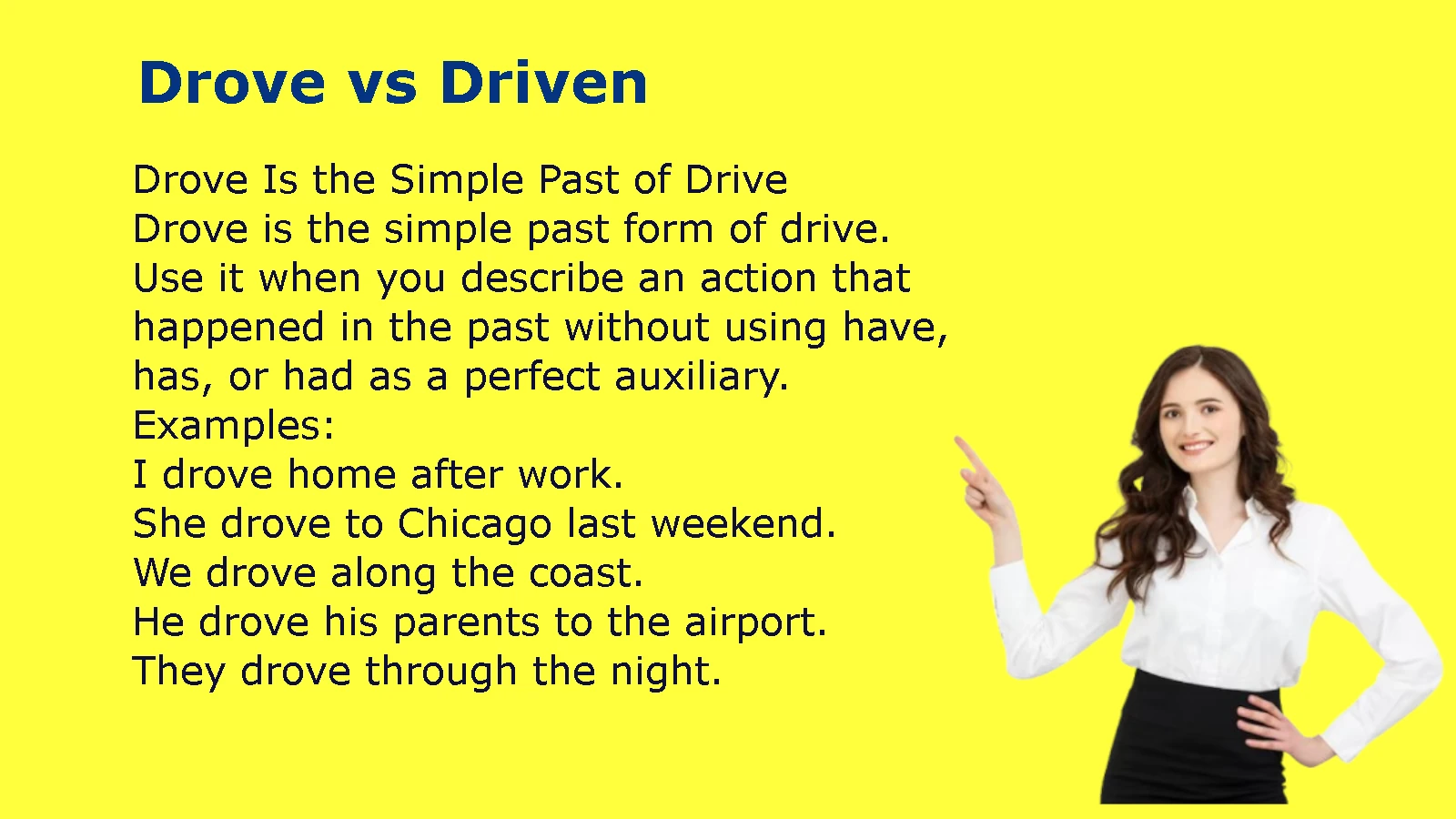
Drove Is the Simple Past of Drive
Drove is the simple past form of drive.
Use it when you describe an action that happened in the past without using have, has, or had as a perfect auxiliary.
Examples:
- I drove home after work.
- She drove to Chicago last weekend.
- We drove along the coast.
- He drove his parents to the airport.
- They drove through the night.
The Oxford Advanced Learner’s Dictionary gives drove as the past simple form and driven as the past participle.
A useful clue is the presence of a finished past-time expression:
- yesterday
- last night
- last week
- two hours ago
- in 2024
- earlier that morning
For instance:
Correct: I drove to work yesterday.
Incorrect: I driven to work yesterday.
The second sentence uses the wrong verb form for the simple past.
Driven Is the Past Participle of Drive
Driven is the past participle of drive. It is commonly used with auxiliary verbs to form perfect tenses.
Examples include:
- I have driven this route before.
- She has driven hundreds of miles today.
- We had driven for three hours before stopping.
- They will have driven 500 miles by noon.
Driven also appears in passive constructions:
- The car was driven by a professional.
- The vehicles were driven across the country.
Cambridge identifies driven as the past participle and gives examples in both perfect and passive constructions.
Drove vs Driven in a Sentence
The easiest way to understand drove vs driven is to compare complete sentences.
| Sentence | Correct? | Explanation |
| I drove home yesterday. | ✅ | Simple past |
| I have driven home before. | ✅ | Present perfect |
| I had driven home before the storm. | ✅ | Past perfect |
| I will have driven 300 miles by then. | ✅ | Future perfect |
| The car was driven by Maria. | ✅ | Passive construction |
| I have drove home before. | ❌ | Use driven after have |
| I had drove home before the storm. | ❌ | Use driven after had |
| I driven home yesterday. | ❌ | Simple past requires drove |
Notice that drove can stand as the main past-tense verb:
I drove home.
By contrast, driven normally needs another verb in these constructions:
I have driven home.
That auxiliary verb is what helps form the perfect tense.
When to Use Drove
Use drove when you are describing a completed action in the past using the simple past tense.
Drove for a Completed Past Action
Consider these examples:
- I drove to the store yesterday.
- Sarah drove home after dinner.
- We drove 40 miles to visit our relatives.
- He drove the truck last Saturday.
- They drove through Pennsylvania last summer.
Cambridge’s American Dictionary lists drove as the past tense and provides examples such as traveling a particular distance or driving through a location.
The important point is not that the action involved a car. Drive has several meanings, so drove can describe different kinds of past actions.
For example:
- The engine drove the wheels.
- He drove a nail into the wall.
- She drove the ball down the field.
Cambridge records drive with meanings involving vehicles, force, power, and sports, among others.
Drove in Questions and Negative Sentences
There is another rule that frequently causes confusion.
After did, use the base form drive, not drove.
Correct:
- Did you drive home?
- Did she drive to work?
- Did they drive all night?
Incorrect:
- Did you drove home?
- Did she drove to work?
- Did they drove all night?
The same rule applies after didn’t:
- I didn’t drive yesterday.
- She didn’t drive to the office.
- We didn’t drive very far.
Not:
- I didn’t drove yesterday.
- She didn’t drove to the office.
Why? The auxiliary did already carries the past tense. The main verb therefore returns to its base form.
Compare:
Statement: I drove home.
Question: Did I drive home?
Negative: I didn’t drive home.
This is one of the most useful rules to remember when choosing among drive, drove, and driven.
When to Use Driven
Use driven when the grammar requires the past participle of drive.
The most common patterns are have driven, has driven, and had driven.
Have Driven
Use have driven with the present perfect tense.
The structure is:
have + driven
Examples:
- I have driven this route before.
- We have driven through several states.
- They have driven for six hours.
- You have driven this car many times.
With a singular third-person subject, use has driven:
- She has driven to Boston.
- He has driven that truck before.
- My brother has driven across the country.
The present perfect connects a past action with the present in some way. It can describe experience, an action within an unfinished time period, or a past action whose result is relevant now.
For example:
I have driven that route before.
This tells the listener that the experience happened at some unspecified time before now.
Had Driven
Use had driven for the past perfect.
The structure is:
had + driven
Examples:
- I had driven for two hours before stopping.
- She had driven home when the storm began.
- We had driven 100 miles before realizing we were going the wrong way.
- They had already driven through the city when we called.
The past perfect is useful when you have two past events and want to show which one happened first.
Consider:
When I called Sarah, she had already driven home.
Both events occurred in the past. Sarah’s drive happened first, and the phone call happened later.
Using had driven makes that sequence clear.
Was or Were Driven
Driven can also appear in passive constructions.
Examples:
- The car was driven by my brother.
- The trucks were driven across the border.
- The vehicle was driven carefully.
- The race cars were driven by experienced professionals.
Here, driven is not being used as the simple past. It is the past participle in a passive structure.
The difference becomes obvious when you compare:
Active: Maria drove the car.
Passive: The car was driven by Maria.
In the active sentence, drove is the simple past. In the passive sentence, driven follows the auxiliary was.
Drove vs Driven in Different Verb Tenses
Looking at the full verb system makes the difference easier to remember.
| Tense or construction | Form | Example |
| Simple present | drive/drives | I drive every day. |
| Simple past | drove | I drove yesterday. |
| Present perfect | have/has driven | I have driven before. |
| Past perfect | had driven | I had driven for hours. |
| Future perfect | will have driven | I will have driven 500 miles by then. |
| Present continuous | am/is/are driving | I am driving now. |
| Past continuous | was/were driving | I was driving at noon. |
| Passive | was/were driven | The car was driven carefully. |
The three basic forms are therefore:
drive → drove → driven
Do not memorize these as interchangeable alternatives. Memorize them as different forms with different grammatical jobs.
Have You Drove or Have You Driven?
The correct phrase is “Have you driven?”, not “Have you drove?”
Correct
Have you driven this car before?
Incorrect
Have you drove this car before?
The reason is straightforward: have requires the past participle when forming the present perfect.
The pattern is:
have/has + past participle
Since the past participle of drive is driven, the correct construction is:
- have driven
- has driven
Examples:
- Have you driven in heavy traffic before?
- Have you driven across the country?
- Has she driven this route?
- Have they driven that far before?
A useful comparison is:
| Incorrect | Correct |
| Have you drove? | Have you driven? |
| Has she drove? | Has she driven? |
| Have they drove? | Have they driven? |
| I have drove. | I have driven. |
I Would Have Driven or I Would Have Drove?
The correct form is “would have driven.”
The structure is:
would + have + past participle
Because driven is the past participle, you say:
- I would have driven.
- She would have driven.
- They would have driven.
Not:
- I would have drove.
- She would have drove.
- They would have drove.
For example:
I would have driven you home if I had known you needed a ride.
Another example:
She would have driven to the meeting, but her car broke down.
The word would does not change the requirement that follows have. The structure still needs a past participle.
This same principle applies to many irregular verbs:
- would have gone, not would have went
- would have seen, not would have saw
- would have written, not would have wrote
- would have driven, not would have drove
Had Driven or Had Drove?
The correct form is had driven.
The past perfect always uses:
had + past participle
Therefore:
- ✅ I had driven home.
- ❌ I had drove home.
- ✅ She had driven for five hours.
- ❌ She had drove for five hours.
- ✅ They had driven through the night.
- ❌ They had drove through the night.
Here is the rule in action:
By the time we arrived, John had driven home.
The driving happened before another past event, the arrival.
Another example:
She had already driven 200 miles before taking a break.
The phrase had driven makes the earlier past action clear.
Drove vs Drived: Is Drived a Word?
For standard modern English, drived is not the correct past-tense or past-participle form of drive.
The standard forms are:
drive → drove → driven
Therefore, these are incorrect:
- I drived home.
- I have drived home.
- She had drived to work.
Use:
- I drove home.
- I have driven home.
- She had driven to work.
| Incorrect form | Standard form |
| drived | drove |
| have drived | have driven |
| had drived | had driven |
| was drived | was driven |
The mistake is understandable because many English verbs form their past tense with -ed. For example:
- walk → walked
- work → worked
- play → played
But drive is an irregular verb. Its past forms do not follow that pattern.
Common Mistakes With Drove and Driven
Understanding the rules is useful, but seeing the mistakes side by side makes them easier to avoid.
Using Drove After Have or Has
Incorrect:
I have drove to that city before.
Correct:
I have driven to that city before.
The word have signals the present perfect, so the past participle is required.
Using Drove After Had
Incorrect:
She had drove home before I called.
Correct:
She had driven home before I called.
The word had forms the past perfect with the past participle.
Using Drove After Did
This mistake works in the opposite direction.
Incorrect:
Did you drove to work?
Correct:
Did you drive to work?
Because did already expresses the past, the main verb uses its base form.
Using Driven as a Standalone Simple Past
Incorrect:
I driven to the store yesterday.
Correct:
I drove to the store yesterday.
You cannot normally replace the simple past drove with the past participle driven.
Confusing Drove With Driving
Driving is the present participle or -ing form, so it serves a different purpose.
Compare:
- I drove home yesterday.
- I am driving home now.
- I have driven home before.
Each form has a different grammatical role.
Drove vs Driven Examples
The following examples show how the forms work in everyday English.
Examples With Drove
- I drove to the supermarket yesterday.
- She drove home after dinner.
- We drove across the state last summer.
- He drove his daughter to school.
- They drove through the mountains.
- I drove 200 miles on Saturday.
- Sarah drove the rental car carefully.
- We drove until midnight.
- He drove past the house without stopping.
- The truck drove through the gate in the movie scene.
Examples With Driven
- I have driven this road before.
- She has driven hundreds of miles this week.
- We had driven for three hours before taking a break.
- He has never driven a truck.
- They had driven through the night.
- I would have driven if my car had been available.
- The vehicle was driven by an experienced driver.
- She will have driven 1,000 miles by the end of the trip.
- Have you driven in snow before?
- The cars were driven onto the track.
Compare the Forms Directly
| Drove | Driven |
| I drove yesterday. | I have driven before. |
| She drove home. | She has driven home. |
| We drove all night. | We had driven all night. |
| He drove the truck. | The truck was driven by him. |
| They drove 100 miles. | They had driven 100 miles. |
Drove vs Driven: An Easy Rule to Remember
If you only remember one rule, use this:
Drove = simple past. Driven = past participle.
You can make that rule even easier with three examples:
Simple past:
I drove home.
Present perfect:
I have driven home.
Past perfect:
I had driven home.
There is also an important fourth pattern:
Question with did:
Did you drive home?
So the basic sequence is:
drive → drove → driven
And the most useful sentence patterns are:
- I drive.
- I drove.
- I have driven.
- I had driven.
- I am driving.
- I was driving.
Once you identify the auxiliary verb, choosing the correct form becomes much easier.
Drove and Driven Pronunciation
The words drove and driven also have different pronunciations.
In American English, Cambridge gives drove as /droʊv/ and driven as /ˈdrɪvən/.
The difference is easy to hear once you compare them:
- drove has one syllable.
- driven has two syllables.
The first vowel is also different. Drove contains the long o sound associated with /oʊ/, while driven begins with the short /ɪ/ sound.
You should therefore avoid treating driven as simply a longer version of drove. They are distinct forms in both spelling and pronunciation.
Drove vs Driven in Formal and Everyday English
The grammatical distinction between drove and driven does not change according to formality.
You use drove and driven according to the sentence structure whether you are speaking casually, writing an email, preparing an academic paper, or communicating at work.
For example:
Casual:
I drove home late.
Professional:
I drove to the office after the meeting.
Formal:
The vehicle was driven to the facility after the inspection.
The register may change the vocabulary around the verb, but the underlying grammar remains the same.
A Simple Case Study: Choosing the Correct Form
Consider this short conversation:
Alex: “Have you ___ this route before?”
Jordan: “Yes, I ___ here last summer.”
Which forms belong in the blanks?
The first sentence is:
Have you driven this route before?
The second is:
Yes, I drove here last summer.
Why?
The first sentence uses have, so it requires the past participle driven.
The second sentence describes a completed action at a specific time in the past, last summer, so it uses the simple past drove.
Now change the conversation:
Alex: “Did you ___ here yesterday?”
The answer is:
Did you drive here yesterday?
Not:
Did you drove here yesterday?
The auxiliary did carries the past tense, so the main verb returns to drive.
This small comparison captures the central rule behind most drove vs driven questions.
A Quick Test for Drove, Driven, or Drive
When you are unsure which form to use, follow these steps.
Check for Have, Has, or Had
If you see have, has, or had, you will generally need the past participle:
- have driven
- has driven
- had driven
Check for Did
If you see did or didn’t, use the base form:
- did drive
- didn’t drive
Look for a Simple Past Statement
If there is no auxiliary verb and you are describing a completed past action, drove is usually the correct form:
She drove home yesterday.
Look for a Passive Construction
If you have was or were and the sentence is passive, driven can be the correct form:
The car was driven by a mechanic.
This quick process eliminates most common errors.
Drove vs Driven: Quick Reference
| If you mean… | Use | Example |
| Present action or general habit | drive | I drive every day. |
| Completed past action | drove | I drove yesterday. |
| Present perfect | have/has driven | I have driven before. |
| Past perfect | had driven | I had driven for hours. |
| Future perfect | will have driven | I will have driven 500 miles. |
| Passive construction | was/were driven | The car was driven carefully. |
| Question with did | drive | Did you drive there? |
| Negative with didn’t | drive | I didn’t drive there. |
| -ing construction | driving | I am driving now. |
Frequently Asked Questions About Drove vs Driven
Is drove the past tense of drive?
Yes. Drove is the simple past tense of drive.
Example:
I drove to work yesterday.
Both Cambridge and Oxford list drove as the past form of drive.
Is driven the past tense of drive?
No. Driven is the past participle of drive.
It is used in constructions such as:
I have driven there before.
The simple past is drove.
Is drove or driven correct after have?
Driven is correct.
Say:
I have driven there before.
Not:
I have drove there before.
Is it have drove or have driven?
The correct form is have driven.
The pattern is:
have + past participle
Therefore:
She has driven home.
Is it had drove or had driven?
The correct form is had driven.
The past perfect uses:
had + past participle
Example:
We had driven for four hours before stopping.
Is it did you drove or did you drive?
The correct form is Did you drive?
After did, use the base form drive.
Is drived a correct word?
Drived is not the standard modern English form of drive. The standard forms are drive, drove, driven.
What is the third form of drive?
If you are learning the traditional three-form pattern, the forms are:
drive → drove → driven
Here, driven is the third form, or past participle.
What is the difference between drove and driven?
Drove is the simple past, while driven is the past participle.
Compare:
I drove yesterday.
and:
I have driven before.
Can driven be used without have, has, or had?
Yes, but not normally as an ordinary standalone simple past verb. Driven can appear in passive constructions and other structures.
For example:
The car was driven by Maria.
Here, driven follows was in a passive construction.
Related Drive Grammar Questions
Once you understand drove vs driven, several related forms become much easier.
Drive vs Drove vs Driven
- Drive = base form
- Drove = simple past
- Driven = past participle
Drove vs Drived
Use drove, not drived, as the standard past form.
Have Driven Meaning
Have driven is the present perfect construction and can describe past driving experience or an action connected to the present.
Driven Meaning
Driven is the past participle of drive. It can appear in perfect constructions and passive sentences.
Driven vs Driving
Driven is the past participle, while driving is the -ing form.
Compare:
I have driven there before.
I am driving there now.
Drive Past Tense
The past tense of drive is drove.
Drive Past Participle
The past participle of drive is driven.
Drove Pronunciation
In American English, drove is pronounced /droʊv/.
Driven Pronunciation
In American English, driven is pronounced /ˈdrɪvən/.
Final Takeaway: Drove vs Driven
The difference between drove and driven becomes straightforward once you stop treating them as interchangeable forms.
Drove is the simple past:
I drove to work yesterday.
Driven is the past participle:
I have driven to work many times.
Drive is the base form:
I drive to work every day.
And after did, return to the base form:
Did you drive to work?
The complete pattern is:
drive → drove → driven
Remember the four most useful examples:
- I drive every day.
- I drove yesterday.
- I have driven before.
- Did you drive yesterday?
Once you recognize whether the sentence calls for a base form, simple past, or past participle, choosing between drove and driven becomes much easier.